Prevod
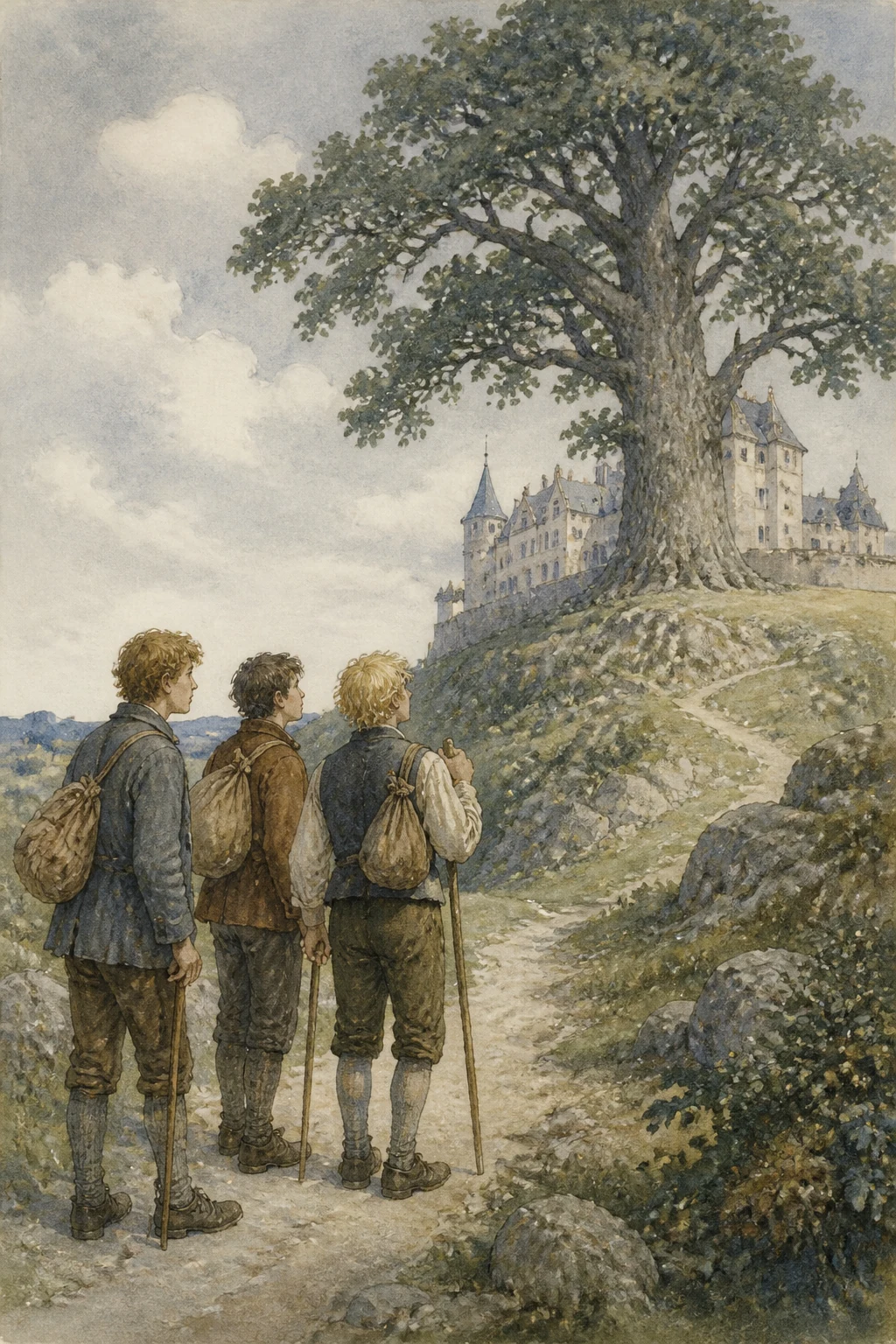
Once upon a time there were three brothers who had sunk deeper and deeper into poverty, until at last their need was so great that they went hungry and had not a morsel left to eat. Then they said, "Things cannot go on like this. We had better go out into the world and seek our fortune." So they set off and had already traveled a long way, over many a little blade of grass, but fortune had not yet crossed their path. One day they came to a great forest, and in the midst of it stood a mountain. As they drew nearer, they saw that the mountain was made entirely of silver. Then the eldest said, "Now I have found the fortune I wished for, and I ask for nothing greater." He took as much silver as he could carry, turned around, and went home. But the other two said, "We ask a little more of fortune than mere silver," and without touching it, they went on. After walking for another few days, they came to a mountain made entirely of gold. The second brother stopped and pondered, unable to make up his mind. "What shall I do?" he said. "Shall I take enough gold to last me all my life, or shall I go on?" At last he made his choice, filled his pockets with all they would hold, said farewell to his brother, and went home. But the third said, "Silver and gold do not tempt me. I will not give up on my fortune; perhaps something better is in store for me." He went on, and after three days he came to a forest even larger than the others, which seemed to have no end at all. Since he could find nothing to eat or drink, he was close to perishing. He climbed a tall tree to see whether he could spy the edge of the forest from up there, but as far as his eye could reach he saw nothing but treetops. So he began to climb down again, but hunger tormented him, and he thought, If only I could fill my belly just once more. When he reached the ground, he was astonished to see a table beneath the tree, richly laden with dishes of steaming food. "This time," he said, "my wish has been granted just when I needed it," and without asking who had brought the food or who had cooked it, he went up to the table and ate with relish until his hunger was satisfied. When he had finished, he thought, It would be a pity to let this fine little tablecloth go to ruin here in the forest. So he folded it neatly and put it away. Then he went on, and that evening, when hunger stirred again, he decided to put his little cloth to the test. He spread it out and said, "I wish you were covered with good food once more," and scarcely had the wish passed his lips when it held as many dishes of the finest food as there was room for. "Now I see," he said, "what kitchen cooks for me. You shall be dearer to me than the mountains of silver and gold," for he realized that it was a little tablecloth that laid itself. Yet the cloth was not enough to make him settle down at home; he preferred to keep wandering through the world and try his luck further. One evening, in a lonely forest, he met a charcoal burner covered in black dust, who was burning charcoal and had some potatoes by the fire for his supper. "Good evening, blackbird!" he said. "How do you fare here all alone?" "One day is much like another," replied the charcoal burner, "and potatoes every evening. Would you care for some? Will you be my guest?" "Thank you kindly," answered the traveler. "I would not take your supper from you; you were not expecting a guest. But if you will make do with my company, you shall be my guest instead." "Who is to serve your meal?" said the charcoal burner. "I can see you have nothing with you, and there is no one for hours around who could give you anything." "And yet you shall have a meal," he answered, "as good as any you have ever tasted." Then he took his little cloth from his knapsack, spread it on the ground, and said, "Little cloth, lay yourself!" At once there were dishes of boiled meat and roast meat, as hot as though they had just come from the kitchen. The charcoal burner opened his eyes wide, but he did not wait to be asked twice. He helped himself and crammed ever larger mouthfuls into his soot-blackened mouth. When they had finished eating, the charcoal burner grinned and said, "Listen, that little cloth of yours is just to my liking. It would be the very thing for me here in the forest, where no one cooks me anything good. I will offer you a trade. Hanging in that corner is a soldier's knapsack, old and shabby though it is, with marvelous powers inside it. Since I no longer need it, I will give it to you for the cloth." "First I must know what these marvelous powers are," he replied. "I will tell you," answered the charcoal burner. "Whenever you tap it with your hand, a corporal appears with six men, armed with muskets and swords, and whatever you command, they carry out." "Very well," he said. "If that is the bargain, let us make the exchange." He gave the charcoal burner the cloth, lifted the knapsack from its hook, slung it over his shoulder, and said farewell. When he had gone a little way, he decided to try out his knapsack's marvelous powers and tapped it. At once the seven warriors stood before him, and the corporal said, "What does my lord and master command?" "March at the double to the charcoal burner and demand my wishing-cloth back!" They wheeled left, and before long they brought him what he had asked for, having taken it from the charcoal burner without much ceremony. He dismissed them, went on his way, and hoped that fortune would smile still more brightly on him. At sunset he came to another charcoal burner, who was preparing his supper by the fire. "If you would like to eat with me," said the sooty fellow, "potatoes with salt, but without fat, then sit down beside me." "No," he answered, "this time you shall be my guest," and he spread out his cloth, which was at once covered with the finest dishes. They ate and drank together and were in good spirits. After the meal the charcoal burner said, "Up there on the shelf lies an old, worn little hat with strange powers. If someone puts it on and turns it around on his head, the field guns open fire as though twelve stood side by side, and shoot down everything before them, so that no one can withstand them. The little hat is no use to me, and I would gladly give it to you for your tablecloth." "That sounds well enough," he answered, took the little hat, put it on, and left his cloth behind. But scarcely had he gone a little way when he tapped his knapsack, and his soldiers had to fetch the cloth back for him. One thing leads to another, he thought, and I feel my good fortune has not yet run its course. Nor had his thoughts deceived him. After walking for another day, he came to a third charcoal burner, who, like the others, invited him to share some potatoes without any fat. Instead, he let the man eat from his wishing-cloth, and the charcoal burner enjoyed the food so much that at last he offered him a little horn in exchange, whose powers were stranger still than those of the hat. When someone blew it, all walls and fortifications came tumbling down, and in the end whole towns and villages too. He gave the charcoal burner the cloth for it, but afterward had his men demand it back, so that at last he had the knapsack, the little hat, and the little horn all together. "Now," he said, "I am a made man, and it is time to return home and see how my brothers are faring."
When he arrived home, his brothers had built themselves a fine house with their silver and gold and were living in luxury. He went in to see them, but because he wore a half-torn coat, with the shabby little hat on his head and the old knapsack on his back, they refused to acknowledge him as their brother. They mocked him and said, "You claim to be our brother, who scorned silver and gold and wanted a better fortune for himself. He would surely come riding up in all his splendor like a mighty king, not like a beggar," and they drove him out of the door. Then he flew into a rage and tapped his knapsack until a hundred and fifty men stood before him in rank and file. He ordered them to surround his brothers' house, and two of them were to take hazel switches and tan the hides of those two arrogant fellows until they knew who he was. A tremendous uproar arose, and people came running and tried to help the two brothers in their distress, but they could do nothing against the soldiers. At last word of it reached the king, who grew angry and sent out a captain with his company to drive the troublemaker from the town. But the man with the knapsack soon had a larger force assembled, and they beat back the captain and his men, who had to retreat with bloody noses. The king said, "This upstart can still be brought to heel," and the next day he sent a larger force against him, but it accomplished even less. The man summoned still more troops to oppose them, and to finish the business more quickly, he turned his little hat around on his head a few times. Then the heavy guns began to fire, and the king's men were beaten and put to flight. "Now I will make no peace," he said, "until the king gives me his daughter for my wife and lets me rule the whole kingdom in his name." He sent this message to the king, who said to his daughter, "Necessity is a hard nut to crack. What choice have I but to do as he asks? If I am to have peace and keep the crown upon my head, I must give you to him."
So the wedding was celebrated, but the princess was vexed that her husband was a common man who wore a shabby hat and carried an old knapsack over his shoulder. She would gladly have been rid of him, and day and night she pondered how to bring it about. Then she thought, Could his marvelous powers lie in the knapsack? She pretended affection and caressed him, and when his heart had softened, she said, "If only you would take off that wretched knapsack! It makes you look so ugly that I am ashamed of you." "My dear child," he answered, "this knapsack is my greatest treasure. As long as I have it, I fear no power in the world," and he revealed to her the marvelous powers it possessed. Then she flung her arms around his neck as though she meant to kiss him, but deftly slipped the knapsack from his shoulder and ran off with it. As soon as she was alone, she tapped it and ordered the soldiers to seize their former master and take him away from the royal palace. They obeyed, and the faithless woman sent still more men after him to drive him right out of the country. He would have been lost had he not had his little hat. But scarcely were his hands free when he turned it around a few times. At once the guns began to thunder and struck down everything before them, and the princess herself had to come and beg for mercy. Because she pleaded so movingly and promised to mend her ways, he let himself be persuaded and granted her peace. She treated him kindly and pretended to love him dearly, and after a time she managed to beguile him into confiding that even if someone gained possession of the knapsack, they could do nothing against him as long as the old little hat was still his. Once she knew the secret, she waited until he had fallen asleep, then took away his hat and had him thrown out into the street. But he still had the little horn, and in a great rage he blew into it with all his might. At once everything came crashing down—walls, fortifications, towns, and villages—and the king and the princess were crushed to death. Had he not lowered the little horn, but blown only a little longer, everything would have fallen in ruins, and not one stone would have been left upon another. Now no one opposed him any longer, and he made himself king over the whole realm.