Waltey
Mackinack
195 Mackinack
Myths and Legends of Our Own Land · Charles M. SkinnerO besedilu
Mackinack
- Vir
- Myths and Legends of Our Own Land
- Avtor
- Charles M. Skinner
- Jezik branja
- Slovenščina
- Jezik izvirnika
- English
- Čas branja
- 3 min branja
- Obseg
- 3 strani
- Naslov izvirnika
- 195 Mackinack
O izvirniku
Myths and Legends of Our Own Land
Obsežna zgodovinska zbirka ameriških legend, ki jih je Skinner zbral in avtorsko rekonstruiral. Bralni jezik je Slovenščina, izvirnik pa prihaja iz vira Myths and Legends of Our Own Land v jeziku English.
Besedilo
Mackinack
Mackinack ni bil le rojstni kraj Hiawathe: bil je tudi dom samega boga — Gitchija Manitouja ali Mitchija Manitouja — ki je tja postavil indijanska Adama in Evo, da bi varovala in obdelovala njegove vrtove. Ustvaril je tudi bobra, da bi imeli njegovi otroci kaj jesti, ti pa so se mu za dobroto zahvaljevali z daritvami. Bogate žrtvene daritve so jim po smrti zagotavljale vstop v srečna lovišča onkraj Skalnega gorovja. Tisti, ki teh daritev niso opravili, so morali brez zavetja tavati okoli Velikih jezer pod nadzorom nikoli spečih velikanov, desetkrat višjih od smrtnikov.
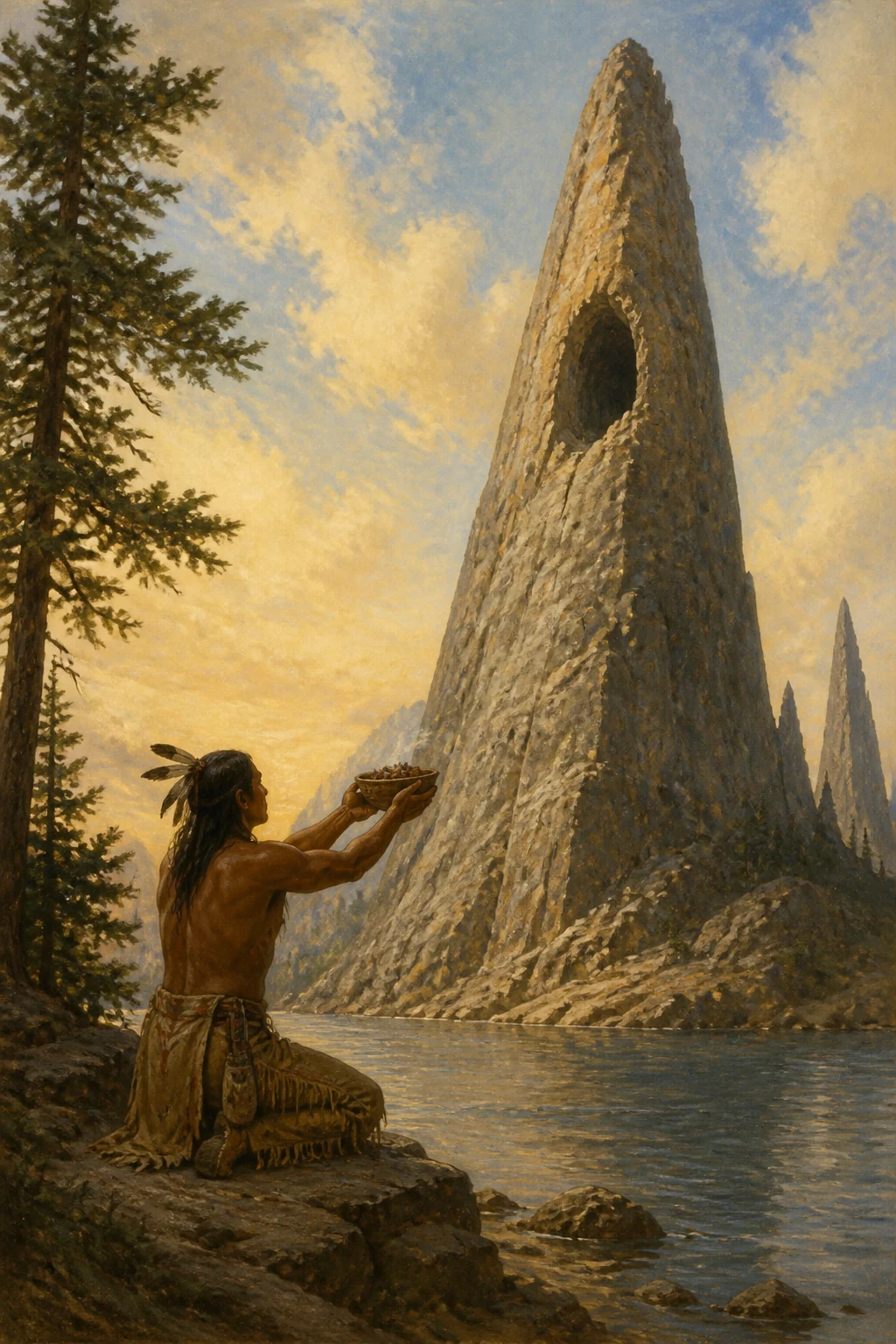
Ti velikani še vedno obstajajo, vendar v obliki stožčastih skal; ena od njih, imenovana Sugar-Loaf ali Manitoujev vigvam, je visoka devetdeset čevljev. Jamo v tem obelisku kažejo kot Manitoujevo bivališče, nekoč pa so verjeli, da ima tudi vsak drug skalni stolp v tej skupini svojega duha; od tod ime otoka — Michillimackinack (kraj velikih plešočih duhov). Arch Rock je kraj, ki ga je Manitou zgradil, da bi iz Dežele sončnega vzhoda laže dosegel svoj dom. Na severu je bilo veliko takšnih spomenikov božanstev. Najdemo jih povsod okoli jezer in v gozdnati divjini; najosupljivejši med njimi je veličasten bazaltni stolp na območju Black Hills v Wyomingu. Znan je kot Devil's Tower ali Mateov tipi, Indijanci pa ga imajo za vigvam živalskega bitja, ki se lahko po mili volji spremeni v človeka. Ta nenavadna skala se dviga osemsto čevljev nad reko Belle Fourche.
Globoko pod Mackinackom je bila veličastna in prelepa jamska dvorana, kjer so duhovi prirejali veseljačenja. Indijanec, ki je dobil dovoljenje, da zapusti svoje telo, si jo je ogledal v družbi enega od duhov, in ko se je znova odel v meso, je navdušeno pripovedoval o njeni lepoti. Ko sta Adam in Eva umrla, sta tudi sama postala duhova in še naprej bdela nad Manitoujevim domom.
Obstaja pa še druga različica tega izročila, po kateri je bilo prvotno ime otoka Moschenemacenung, kar pomeni »velika želva«. Francoski misijonarji in trgovci, ki jim je bila ta beseda nekoliko pretrd oreh za izgovarjavo, so jo omilili v Michillimackinack; ko pa so prišli Angleži, so jim trije zlogi zadoščali prav tako dobro kot sto, in tako je še danes Mackinack. Manitou je iz kaplje lastnega znoja ustvaril želvo in jo poslal na dno Huronskega jezera, od koder je prinesla polna usta blata; iz tega je nastal Mackinack. Za nagrado za svojo službo je smela želva tam za vselej spati na soncu.
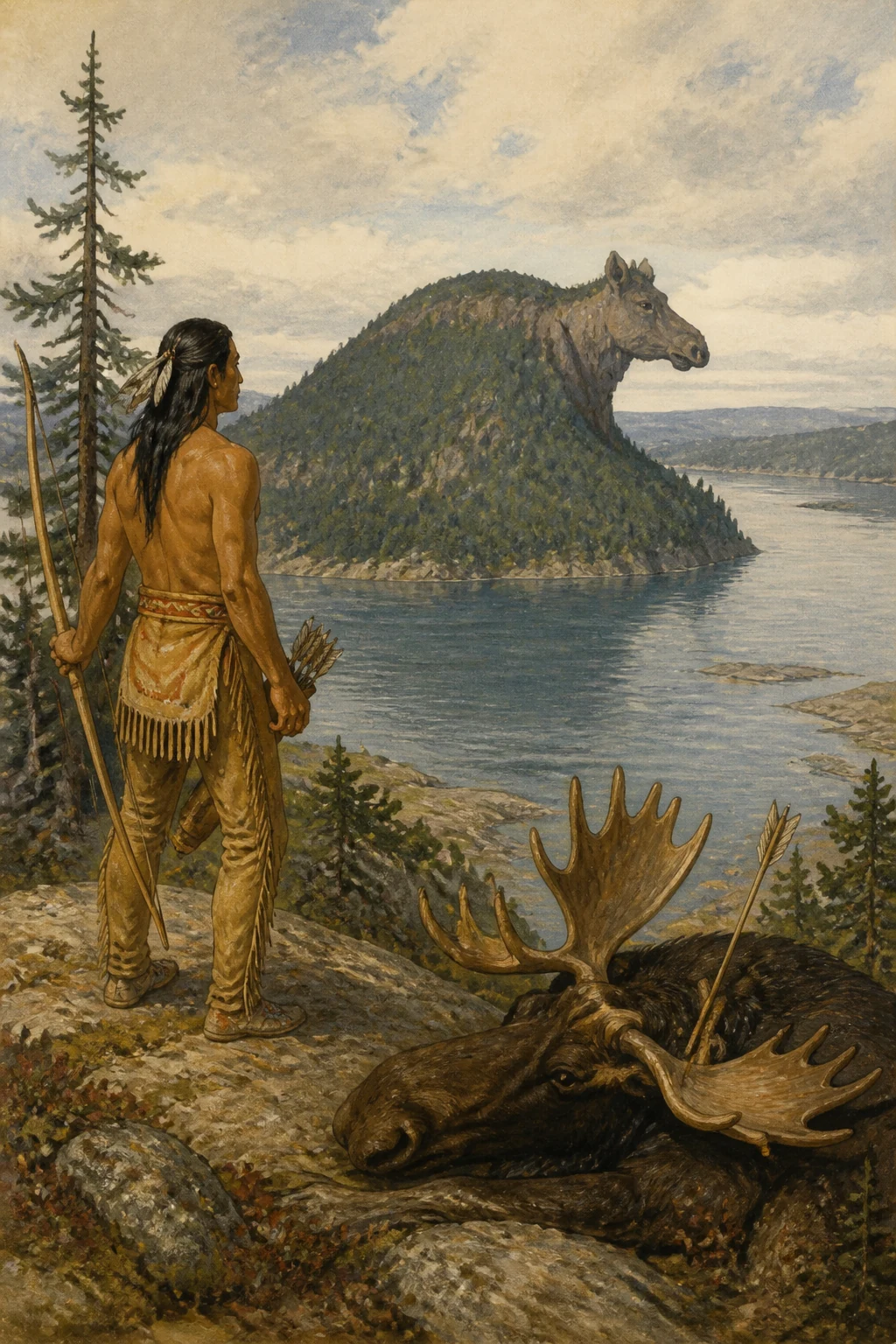
Še ena različica pravi, da je Veliki duh iz prvotnega oceana vzel zrno peska, ga položil na vodno gladino in skrbel zanj, dokler ni zraslo tako veliko, da je mlad volk, ki je nenehno tekel, umrl od starosti, še preden je dosegel njegove meje. Pesek je postal zemlja. Prerokba je ljudstvo Winnebago opozorila, da bo Manibozho (Michabo ali Hiawatha) ob koncu njihovega trinajstega rodu udaril s kugo. Deset rodov je že minilo. Vsi bodo pomrli razen enega čistega para, ki bo naselil na novo ustvarjeni svet. Manibozho ali Minnebojou velja za »kulturni mit«, toda Indijanci verujejo vanj. Pravijo, da spi na severni obali Gornjega jezera, pod »hribom s štirimi grbami«, znanim kot Speči velikan. Tam mu prinašajo daritve, in prav upanje, da bo kmalu vstal, je leta 1890 na Zahodu sprožilo mrzlico pričakovanja Mesije.
Izvirnik
195 Mackinack
Naslednje strani prikazujejo izvirno besedilo za primerjavo.
Not only was Mackinack the birthplace of Hiawatha: it was the home of God himself--Gitchi Manitou, or Mitchi Manitou--who placed there an Indian Adam and Eve to watch and cultivate his gardens. He also made the beaver, that his children might eat, and they acknowledged his goodness in oblations. Bounteous sacrifices insured entrance after death to the happy hunting-grounds beyond the Rocky Mountains. Those who had failed in these offerings were compelled to wander about the Great Lakes, shelterless, and watched by unsleeping giants who were ten times the stature of mortals.
These giants still exist, but in the form of conical rocks, one of which-called Sugar-Loaf, or Manitou's Wigwam--is ninety feet high. A cave in this obelisk is pointed out as Manitou's abiding-place, and it was believed that every other spire in the group had its wraith, whence has come the name of the island--Michillimackinack (place of great dancing spirits). Arch Rock is the place that Manitou built to reach his home from Sunrise Land the better. There were many such monuments of divinities in the north. They are met with all about the lakes and in the wooded wilderness, the most striking one being the magnificent spire of basalt in the Black Hills region of Wyoming. It is known as Devil's Tower, or Mateo's Tepee, and by the red men is held to be the wigwam of a were-animal that can become man at pleasure. This singular rock towers above the Belle Fourche River to a height of eight hundred feet.
Deep beneath Mackinack was a stately and beautiful cavern hall where spirits had their revels. An Indian who got leave to quit his body saw it in company with one of the spirits, and spread glowing reports of its beauties when he had clothed himself in flesh again. When Adam and Eve died they, too, became spirits and continued to watch the home of Manitou.
Now, there is another version of this tradition which gives the, original name of the island as Moschenemacenung, meaning “great turtle.” The French missionaries and traders, finding the word something too large a mouthful, softened it to Michillimackinack, and, when the English came, three syllables served them as well as a hundred, so Mackinack it is to this day. Manitou, having made a turtle from a drop of his own sweat, sent it to the bottom of Lake Huron, whence it brought a mouthful of mud, and from this Mackinack was created. As a reward for his service the turtle was allowed to sleep there in the sun forever.
Yet another version has it that the Great Spirit plucked a sand-grain from the primeval ocean, set it floating on those waters, and tended it until it grew so large that a young wolf, running constantly, died of old age before reaching its limits. The sand became the earth. Prophecy has warned the Winnebagoes that Manibozho (Michabo or Hiawatha) shall smite by pestilence at the end of their thirteenth generation. Ten are gone. All shall perish but one pure pair, who will people the recreated world. Manibozho, or Minnebojou, is called a “culture myth,” but the Indians have faith in him. They say that he lies asleep on the north shore of Lake Superior, beneath the “hill of four knobs,” known as the Sleeping Giant. There offerings are made to him, and it was a hope of his speedy rising that started the Messiah craze in the West in 1890.
Nadaljuj z branjem