Prevod
Long ago there was a land where the nights were always dark and the sky lay spread above it like a black cloth, for the moon never rose there, and not a single star shone in the darkness. When the world was created, the supply of light for the night had run out. Once, four young men set out from this land on their travels and came to another kingdom, where, in the evening, when the sun had vanished behind the mountains, a shining globe sat in an oak tree, casting a gentle light far and wide. By its light everything could be clearly seen and told apart, though it was not as bright as the sun. The travellers stopped and asked a farmer who was driving past in his wagon what sort of light it was. 'That is the moon,' he answered. 'Our mayor bought it for three thalers and fastened it to the oak tree. Every day he must pour in oil and keep it clean so that it always burns brightly. For this we pay him one thaler a week.'
When the farmer had driven away, one of them said, 'We could do with that lamp. We have an oak tree at home just as tall, and we could hang it there. What a joy it would be not to have to grope about in the dark at night!' 'Do you know what?' said the second. 'Let us fetch a wagon and horses and carry the moon away. They can buy themselves another one here.' 'I am a good climber,' said the third. 'I shall soon bring it down!' The fourth fetched a wagon and horses, and the third climbed the tree, bored a hole in the moon, passed a rope through it, and lowered it to the ground. Once the shining globe lay in the wagon, they covered it with a cloth so that no one would notice the theft. They brought it safely back to their own land and set it in a tall oak. Young and old rejoiced as the new lamp shed its light over all the fields and filled their parlours and chambers. The dwarfs came out of their rocky caves, and the little elves in their red coats danced in rings upon the meadows.
The four kept the moon supplied with oil, trimmed its wick, and received their thaler every week. But they grew into old men, and when one of them fell ill and knew his death was near, he decreed that a quarter of the moon, being his property, should be buried with him. When he died, the mayor climbed the tree and cut off a quarter with a pair of hedge shears, and it was laid in the coffin. The moon's light dwindled, though scarcely enough to be noticed. When the second man died, the second quarter was buried with him, and the light grew dimmer. It grew fainter still after the death of the third, who likewise took his share with him, and when the fourth was laid in his grave, the old darkness returned. When people went out in the evening without a lantern, they bumped their heads together.
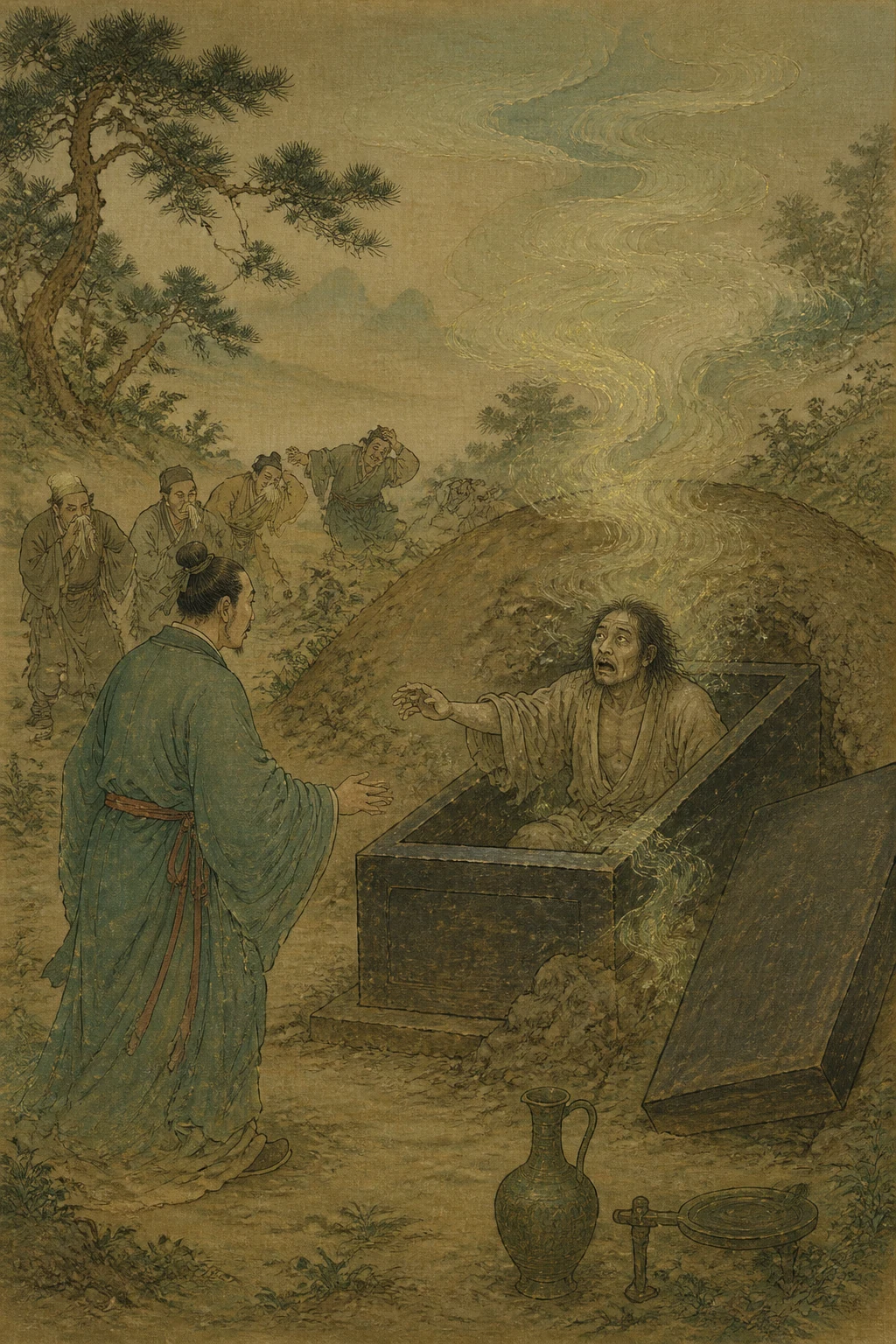
But when the pieces of the moon came together again in the underworld, the dead grew restless and awoke from their sleep in that place where darkness had always reigned. They were astonished to find that they could see again. The moonlight was enough for them, for their eyes had grown so weak that they could not have borne the brightness of the sun. They rose, grew merry, and took up their old ways of life. Some went off to play games and dance; others ran to the taverns, where they demanded wine, got drunk, caroused and quarrelled, and at last raised their cudgels and began beating one another. The uproar grew worse and worse, until it reached all the way to heaven.
Saint Peter, who guards the gate of heaven, thought that the underworld had risen in revolt, and summoned the heavenly hosts to drive back the Evil One should he and his companions attempt to storm the dwelling place of the blessed. But when they did not come, he mounted his horse and rode out through heaven's gate and down into the underworld. There he quieted the dead, told them to lie down in their graves again, and took the moon away with him and hung it high in the sky.