O besedilu
Lov na kalidonskega merjasca
- Vir
- Ovidove preobrazbe
- Avtor
- Ovid
- Jezik branja
- English
- Jezik izvirnika
- Latin
- Čas branja
- 10 min branja
- Obseg
- 8 strani
- Naslov izvirnika
- The Calydonian Boar Hunt
O izvirniku
Ovidove preobrazbe
Pesniški tok antičnih preobrazb, kjer bogovi, ljudje in narava stalno menjavajo obliko. Bralni jezik je English, izvirnik pa prihaja iz vira Ovidove preobrazbe v jeziku Latin.
Besedilo
Lov na kalidonskega merjasca
And now the land of Etna sheltered the weary Daedalus, and Cocalus, who had taken up arms for his suppliant, was praised for his kindness; now Athens had ceased to pay its mournful tribute, thanks to Theseus’ glorious deed. The temples were wreathed with garlands, and they invoked warlike Minerva with Jupiter and the other gods, honoring them with the blood of vowed sacrifices, gifts, and caskets of incense.
Wandering rumor had spread the name of Theseus through the cities of Argos, and the peoples who dwelt in wealthy Achaia implored his help in times of great peril. Calydon, though it had Meleager, also sought his aid with anxious, suppliant prayers. The reason for its plea was a boar, the servant and avenger of wrathful Diana. For Oeneus, they say, rejoicing in a year of plenty, had offered the firstfruits of his crops to Ceres, his wine to Lyaeus, and the oil of Pallas’ olive to golden-haired Minerva.
This zealous homage, begun by the farmers, reached all the gods above; only the altars of Latona’s daughter, they say, were passed over and left without incense. Anger touches even the gods. “We shall not endure this unpunished: though dishonored, we shall not be called unavenged,” she said, and, spurned, sent a boar to ravage Oeneus’ fields, a creature so huge that grassy Epirus breeds no greater bulls, while those of Sicily’s fields are smaller.
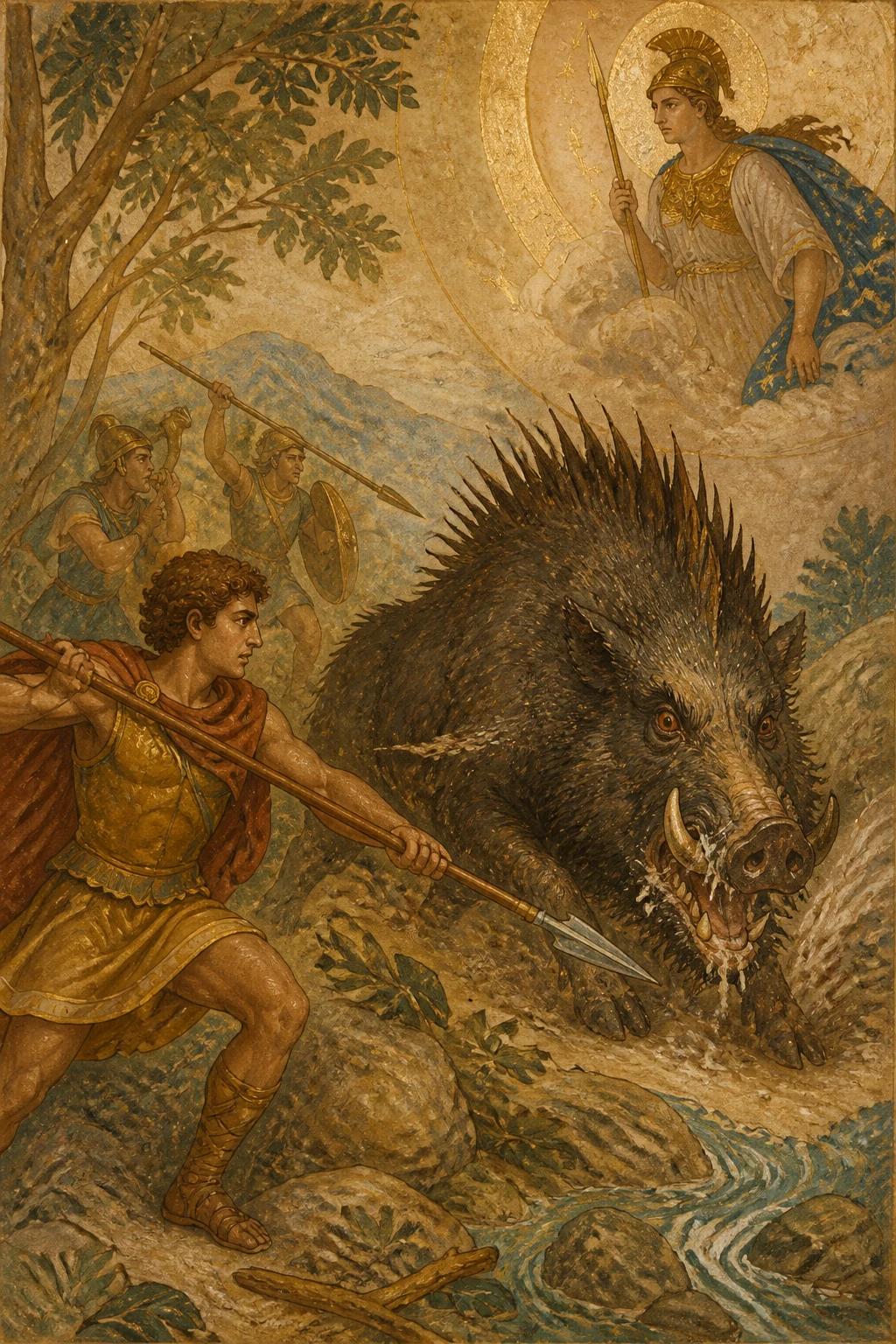
Its eyes flash with blood and fire; its shaggy neck bristles, and its hairs stand stiff as spear shafts, rising like a palisade, like tall shafts of spears. With a harsh hissing, seething foam pours down its broad shoulders; its tusks rival an Indian elephant’s. Lightning comes from its mouth; its breath sets leaves ablaze. Now it tramples the growing crops while still green, now it reaps the ripened hopes of farmers doomed to weep, destroying Ceres’ grain in the ear. In vain the threshing floor, in vain the granaries await the promised harvest.
Heavy clusters are strewn on the ground with the long vine shoots, and olives with the branches of the evergreen tree. It rages against the flocks as well: neither shepherd nor dog can protect them, nor fierce bulls defend the herds. The people scatter, believing themselves safe only within the city walls, until Meleager and with him a chosen band of young men gather, eager for glory: the twin sons of Tyndareus, one famed for boxing, the other for horsemanship; Jason, builder of the first ship; Theseus and Pirithous, happily united in friendship; the two sons of Thestius, and the sons of Aphareus, Lynceus and swift Idas; Caeneus, no longer a woman;
fierce Leucippus, and Acastus, renowned for his javelin; Hippothous and Dryas, and Phoenix, son of Amyntor; the matched sons of Actor, and Phyleus, sent from Elis. Nor were Telamon and the father of great Achilles absent, nor tireless Eurytion, with the son of Pheres and Iolaus of Hyantian Thebes; nor Echion, unbeaten in the race; nor Lelex of Naryx, Panopeus, Hyleus, fierce Hippasus, and Nestor, still in the first years of youth; nor those Hippocoon sent from ancient Amyclae; nor Penelope’s father-in-law, with Ancaeus of Parrhasia; nor the wise son of Ampycus, nor the son of Oecles, still safe from his wife; nor the Tegean girl, glory of Lycaeus’ woods.
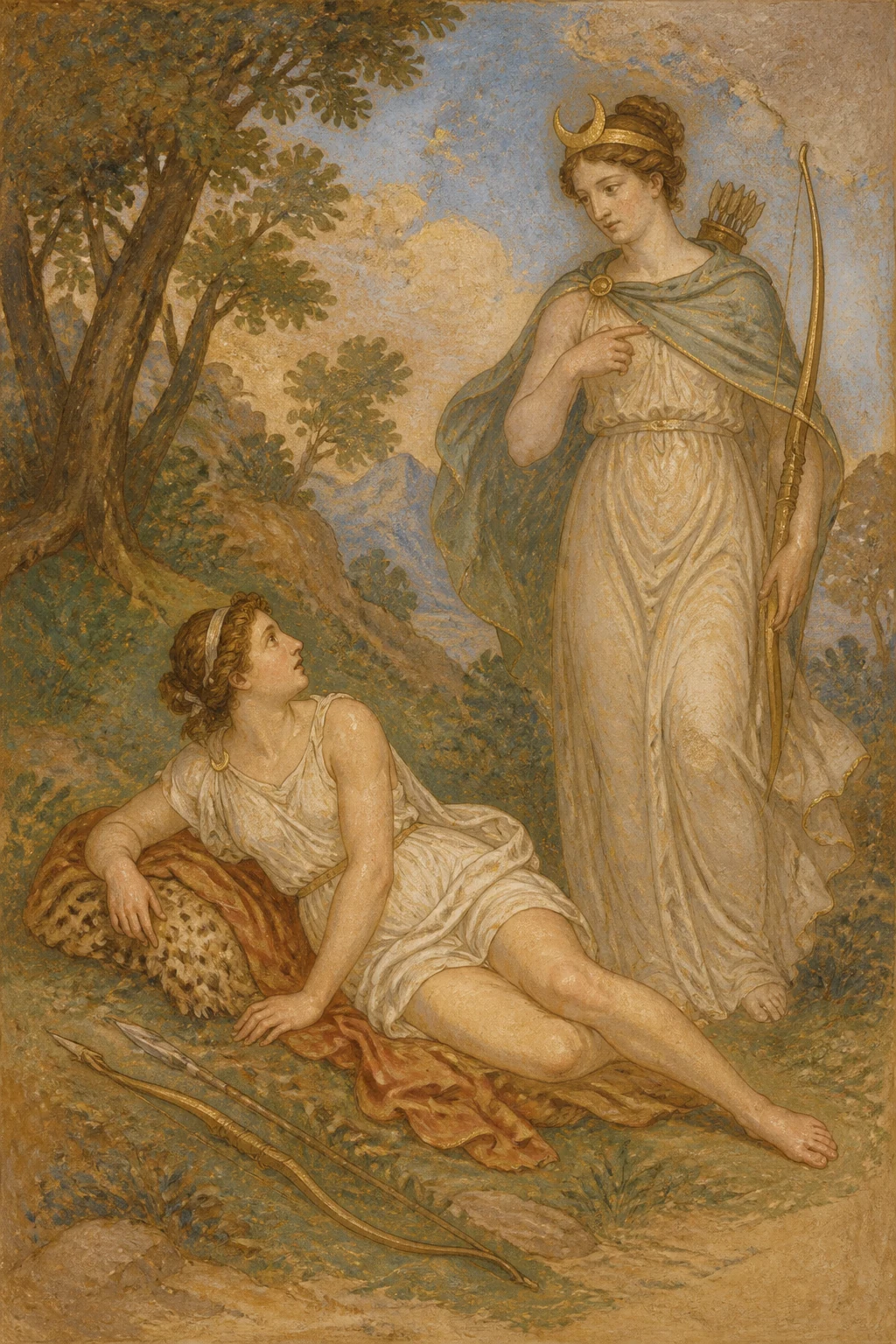
A polished clasp fastened her garment at the neck; her hair was simply dressed, gathered in a single knot. From her left shoulder hung an ivory quiver, rattling with arrows, and her left hand held a bow. Such was her dress; her face was one you might truly call maidenly in a boy, boyish in a maiden. The Calydonian hero saw her and desired her in the same instant, though the god opposed his love, and drank in secret flames. “Happy the man,” he said, “whom she deigns to take as husband.” Time and modesty allowed no more: the greater task of the great contest pressed.
A forest thick with trees, which no age had ever felled, rose from the plain and overlooked the sloping fields. When the men reached it, some stretched out nets, some unleashed the hounds, and others followed the deep-pressed tracks, eager to find their peril. There was a hollow valley where streams of rainwater were accustomed to descend; the bottom of its pool was filled with pliant willow, slender sedges, marsh rushes, osiers, and short reeds beneath the taller canes.
Roused from this place, the boar charged fiercely into the midst of its foes, like lightning struck from clashing clouds. The woodland fell before its rush, and the trees it thrust aside crashed loudly. The young men shouted and held their weapons leveled in strong right hands, the broad iron blades quivering. It charged and scattered the dogs, striking at each that stood against its fury, sweeping the barking pack aside.
The first spear, hurled by Echion’s arm, missed and lightly wounded the trunk of a maple. The next seemed certain to lodge in the back it aimed at, had its thrower not put too much force behind it: it flew too far. Jason of Pagasae had cast that spear. “Phoebus,” said the son of Ampycus, “if I have worshipped you and worship you still, let my spear strike surely where I aim!”
The god granted the prayer as far as he could: the boar was struck, but not wounded, for Diana had stripped the iron from the flying javelin; the wood arrived without its point. The beast’s anger flared, burning no less fiercely than lightning: flame flashed from its eyes and breathed from its chest. As a heavy stone flies, hurled by a taut-drawn cord, when aimed at walls or towers crowded with soldiers, so the deadly boar charged straight and sure at the young men, laying low Hippalmus and Pelagon, who guarded the right flank; their comrades dragged them away.
But Enaesimus, Hippocoon’s son, did not escape the fatal blows: as he trembled and prepared to turn and flee, a slash behind the knee severed his sinews. The Pylian too might have died before the days of Troy, but, planting his spear, he vaulted with all his strength into the branches of a nearby tree and from that safe perch looked down on the foe he had escaped.
Fiercely whetting its tusks on the oak’s trunk, the beast threatened destruction; then, trusting its newly sharpened weapons, it ripped great Eurytus’ son in the thigh with its curving tusk. But the twin brothers, not yet stars in heaven, both splendid to behold, both riding horses whiter than snow, brandished through the air the quivering points of their spears. They would have wounded it, had the bristling beast not entered the dark woods, where neither javelin nor horse could follow.
Telamon pursued, and, heedless in his eagerness, caught his foot on a tree root and fell headlong. While Peleus helped him rise, the Tegean girl set a swift arrow to the string and sent it from her bending bow. The shaft lodged beneath the beast’s ear, grazing its skin and staining its bristles with a little blood. Yet she was no happier at her successful shot than Meleager. He is said to have been the first to see the blood, the first to point it out to his companions, and to say, “You shall receive the honor your courage deserves.”
The men blushed with shame, urging one another on, rousing their spirits with shouts and hurling their weapons in confusion: the crowded volleys spoiled their aim and thwarted their blows. Then the axe-bearing Arcadian, raging toward his doom, cried, “Learn, young men, how far a man’s weapons surpass a woman’s, and make way for my achievement! Though Latona’s daughter herself protect it with her weapons, my right hand shall kill it, despite Diana’s will.”
Such were the boasts he uttered with swelling pride; then, lifting his double-edged axe in both hands, he rose to his full height upon his toes. The beast struck before he could act, driving both tusks high into his groin, the shortest road to death. Ancaeus fell, and his entrails spilled in bloody coils and streamed from his body; the earth was soaked with gore. Pirithous, Ixion’s son, advanced against the foe, brandishing his hunting spears in his strong right hand.
But the son of Aegeus cried, “Keep your distance, dearer to me than myself, half of my soul! The brave may fight from afar: rash courage was Ancaeus’ ruin.” He spoke and hurled a heavy cornel spear tipped with bronze. Well aimed, it would have fulfilled his wish, but a leafy branch broken from a tree blocked its path. The son of Aeson also hurled a javelin, which chance turned from the boar to the doom of an innocent hound: it pierced the dog’s flanks and pinned it through them to the earth.
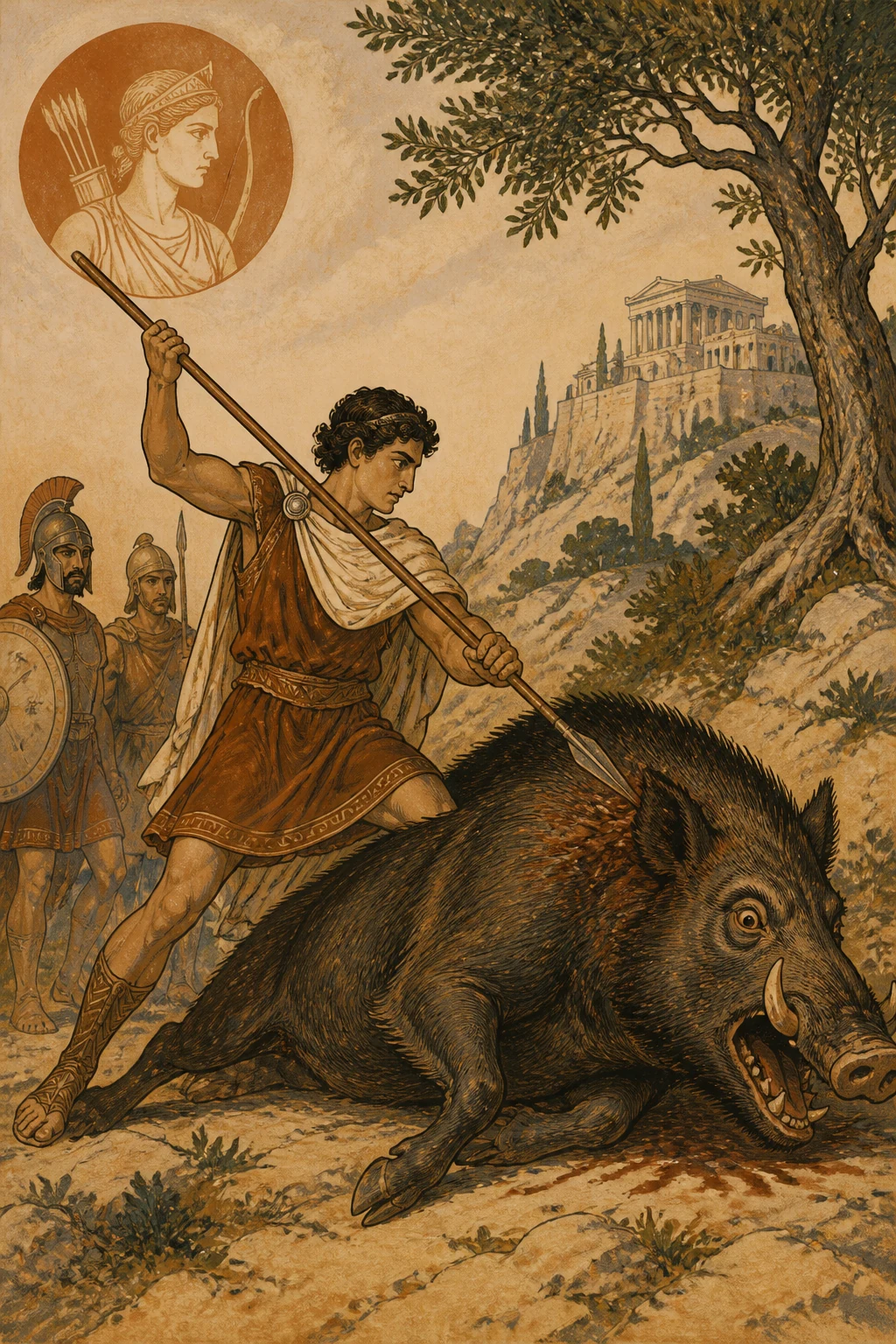
But Oeneus’ son had mixed fortune: of the two spears he threw, the first stuck in the ground, the second in the middle of the boar’s back. At once, as it raged and wheeled its body round, pouring out hissing foam mingled with fresh blood, the man who had wounded it came up, provoked its fury, and buried his gleaming hunting spear deep in its chest. His companions acclaimed their joy with shouts and eagerly clasped his victorious right hand in theirs.
They gazed in wonder at the monstrous beast, stretched over so much ground, and still thought it unsafe to touch; yet each dipped his weapon in its blood. The victor planted his foot upon the deadly head and said, “Take, maiden of Nonacris, the spoils that are mine to bestow, and let my glory be shared with you.” At once he gave her the hide, its back bristling with stiff hair, and the head with its mighty tusks.
She delighted in the gift and in the giver alike; the others envied her, and murmurs ran through the whole company. Among them the sons of Thestius stretched out their arms and shouted loudly, “Come, put them down, woman! Do not steal the honors that are ours. Do not let trust in your beauty deceive you, lest your lovesick champion be too far away to help.” They robbed her of the gift and him of the right to give it.
The son of Mars could not endure it. Gnashing his teeth in swelling anger, he cried, “Learn, you thieves of another’s honor, how far deeds differ from threats!” With impious steel he pierced Plexippus’ breast, which feared no such attack. Toxeus hesitated, uncertain what to do, longing to avenge his brother, yet fearing his brother’s fate. Meleager gave him little time to doubt, but warmed the weapon, still hot from the first murder, in the blood of the other brother.
Izvirnik
The Calydonian Boar Hunt
Naslednje strani prikazujejo izvirno besedilo za primerjavo.
Source ID: ovid_metamorphoses_story_055 Citation: Ovid, Metamorphoses 8.260-8.444 Original language: Latin Source: PerseusDL canonical-latinLit Source URL: https://github.com/PerseusDL/canonical-latinLit/blob/master/data/phi0959/phi006/phi0959.phi006.perseus-lat2.xml Segmentation certainty: medium 260: Iamque fatigatum tellus Aetnaea tenebat 261: Daedalon, et sumptis pro supplice Cocalus armis 262: mitis habebatur, iam lamentabile Athenae 263: pendere desierant Thesea laude tributum.
264: Templa coronantur, bellatricemque Minervam 265: cum Iove disque vocant aliis, quos sanguine voto 266: muneribusque datis et acerris turis honorant. 267: Sparserat Argolicas nomen vaga fama per urbes 268: Theseos, et populi, quos dives Achaia cepit, 269: huius opem magnis imploravere periclis. 270: Huius opem Calydon, quamvis Meleagron haberet, 271: sollicita supplex petiit prece. Causa petendi 272: sus erat, infestae famulus vindexque Dianae.
273: Oenea namque ferunt pleni successibus anni 274: primitias frugum Cereri, sua vina Lyaeo, 275: Palladios flavae latices libasse Minervae. 276: Coeptus ab agricolis superos pervenit ad omnes 277: ambitiosus honor; solas sine ture relictas 278: praeteritae cessasse ferunt Latoidos aras. 279: Tangit et ira deos. “At non impune feremus, 280: quaeque inhonoratae, non et dicemur inultae” 281: inquit, et Oeneos ultorem spreta per agros 282: misit aprum, quanto maiores herbida tauros 283: non habet Epiros, sed habent Sicula arva minores.
284: Sanguine et igne micant oculi, riget horrida cervix, 285: et sactae similes rigidis hastilibus horrent 286: stantque velut vallum, velut alta hastilia saetae 287: fervida cum rauco latos stridore per armos 288: spuma fluit, dentes aequantur dentibus Indis, 289: fulmen ab ore venit, frondes adflatibus ardent. 290: Is modo crescentes segetes proculcat in herba, 291: nunc matura metit fleturi vota coloni 292: et Cererem in spicis intercipit. Area frustra 293: et frustra exspectant promissas horrea messes.
294: Sternuntur gravidi longo cum palmite fetus 295: bacaque cum ramis semper frondentis olivae. 296: Saevit et in pecudes: non has pastorve canisve, 297: non armenta truces possunt defendere tauri. 298: Diffugiunt populi nec se nisi moenibus urbis 299: esse putant tutos, donec Meleagros et una 300: lecta manus iuvenum coiere cupidine laudis: 301: Tyndaridae gemini, spectatus caestibus alter, 302: alter equo, primaeque ratis molitor Iason, 303: et cum Pirithoo, felix concordia, Theseus; 304: et duo Thestiadae prolesque Aphareia, Lynceus 305: et velox Idas, et iam non femina Caeneus
306: Leucippusque ferox iaculoque insignis Acastus 307: Hippothousque Dryasque et cretus Amyntore Phoenix, 308: Actoridaeque pares et missus ab Elide Phyleus. 309: Nec Telamon aberat magnique creator Achillis 310: cumque Pheretiade et Hyanteo Iolao 311: impiger Eurytion, et cursu invictus Echion, 312: Naryciusque Lelex Panopeusque Hyleusque feroxque 313: Hippasus et primis etiamnum Nestor in annis, 314: et quos Hippocoon antiquis misit Amyclis, 315: Penelopaeque socer cum Parrhasio Ancaeo, 316: Ampycidesque sagax et adhuc a coniuge tutus 317: Oeclides, nemorisque decus Tegeaea Lycaei.
318: Rasilis huic summam mordebat fibula vestem, 319: crinis erat simplex, nodum conlectus in unum. 320: Ex umero pendens resonabat eburnea laevo 321: telorum custos, arcum quoque laeva tenebat. 322: Talis erat cultu; facies, quam dicere vere 323: virgineam in puero, puerilem in virgine possis. 324: Hanc pariter vidit, pariter Calydonius heros 325: optavit renuente deo flammasque latentes 326: hausit et “o felix, siquem dignabitur” inquit 327: “ista virum.” Nec plura sinit tempusque pudorque 328: dicere: maius opus magni certaminis urget.
329: Silva frequens trabibus, quam nulla ceciderat aetas, 330: incipit a plano devexaque prospicit arva. 331: Quo postquam venere viri, pars retia tendunt, 332: vincula pars adimunt canibus, pars pressa sequuntur 333: signa pedum cupiuntque suum reperire periclum. 334: Concava vallis erat, quo se demittere rivi 335: adsuerant pluvialis aquae: tenet ima lacunae 336: lenta salix ulvaeque leves iuncique palustres 337: viminaque et longa parvae sub harundine cannae.
338: Hinc aper excitus medios violentus in hostes 339: fertur, ut excussis elisi nubibus ignes. 340: Sternitur incursu nemus et propulsa fragorem 341: silva dat. Exclamant iuvenes praetentaque forti 342: tela tenent dextra lato vibrantia ferro. 343: Ille ruit spargitque canes, ut quisque furenti 344: obstat, et obliquo latrantes dissipat ictu. 345: Cuspis Echionio primum contorta lacerto 346: vana fuit truncoque dedit leve vulnus acerno.
347: Proxima, si nimiis mittentis viribus usa 348: non foret, in tergo visa est haesura petito: 349: longius it. Auctor teli Pagasaeus Iason. 350: “Phoebe,” ait Ampycides “si te coluique coloque, 351: da mihi quod petitur certo contingere telo!” 352: Qua potuit, precibus deus adnuit: ictus ab illo est, 353: sed sine vulnere, aper; ferrum Diana volanti 354: abstulerat iaculo: lignum sine acumine venit.
355: Ira feri mota est, nec fulmine lenius arsit: 356: emicat ex oculis, spirat quoque pectore flamma. 357: Utque volat moles adducto concita nervo, 358: cum petit aut muros aut plenas milite turres, 359: in iuvenes certo sic impete vulnificus sus 360: fertur et Hippalmon Pelagonaque, dextra tuentes 361: cornua, prosternit; socii rapuere iacentes. 362: At non letiferos effugit Enaesimus ictus, 363: Hippocoonte satus: trepidantem et terga parantem 364: vertere succiso liquerunt poplite nervi.
365: Forsitan et Pylius citra Troiana perisset 366: tempora: sed sumpto posita conamine ab hasta 367: arboris insiluit, quae stabat proxima, ramis 368: despexitque, loco tutus, quem fugerat hostem. 369: Dentibus ille ferox in querno stipite tritis 370: inminet exitio fidensque recentibus armis 371: Eurytidae magni rostro femur hausit adunco. 372: At gemini, nondum caelestia sidera, fratres, 373: ambo conspicui, nive candidioribus ambo 374: vectabantur equis, ambo vibrata per auras 375: hastarum tremulo quatiebant spicula motu.
376: Vulnera fecissent, nisi saetiger inter opacas 377: nec iaculis isset nec equo loca pervia silvas. 378: Persequitur Telamon studioque incautus eundi 379: pronus ab arborea cecidit radice retentus. 380: Dum levat hunc Peleus, celerem Tegeaea sagittam 381: imposuit nervo sinuatoque expulit arcu. 382: Fixa sub aure feri summum destrinxit harundo 383: corpus et exiguo rubefecit sanguine saetas.
384: Nec tamen illa sui successu laetior ictus, 385: quam Meleagros erat. Primus vidisse putatur 386: et primus sociis visum ostendisse cruorem 387: et “meritum” dixisse “feres virtutis honorem.” 388: Erubuere viri seque exhortantur et addunt 389: cum clamore animos iaciuntque sine ordine tela: 390: turba nocet iactis et, quos petit, impedit ictus. 391: Ecce furens contra sua fata bipennifer Arcas 392: “discite, femineis quid tela virilia praestent, 393: o iuvenes, operique meo concedite!” dixit.
394: “Ipsa suis licet hunc Latonia protegat armis, 395: invita tamen hunc perimet mea dextra Diana.” 396: Talia magniloquo tumidus memoraverat ore 397: ancipitemque manu tollens utraque securim 398: institerat digitis, primos suspensus in artus. 399: Occupat audentem, quaque est via proxima leto, 400: summa ferus geminos direxit ad inguina dentes. 401: Concidit Ancaeus glomerataque sanguine multo 402: viscera lapsa fluunt: madefacta est terra cruore.
403: Ibat in adversum proles Ixionis hostem 404: Pirithous valida quatiens venabula dextra. 405: Cui “procul” Aegides “o me mihi carior” inquit 406: “pars animae consiste meae! licet eminus esse 407: fortibus: Ancaeo nocuit temeraria virtus.” 408: Dixit et aerata torsit grave cuspide cornum. 409: Quo bene librato votique potente futuro, 410: obstitit abscisa frondosus ab arbore ramus.
411: Misit et Aesonides iaculum: quod casus ab illo 412: vertit in inmeriti fatum latrantis et inter 413: ilia coniectum tellure per ilia fixum est. 414: At manus Oenidae variat, missisque duabus 415: hasta prior terra, medio stetit altera tergo. 416: Nec mora, dum saevit, dum corpora versat in orbem 417: stridentemque novo spumam cum sanguine fundit, 418: vulneris auctor adest hostemque inritat ad iram 419: splendidaque adversos venabula condit in armos.
420: Gaudia testantur socii clamore secundo 421: victricemque petunt dextrae coniungere dextram 422: inmanemque ferum multa tellure iacentem 423: mirantes spectant, neque adhuc contingere tutum 424: esse putant; sed tela tamen sua quisque cruentat. 425: Ipse pede imposito caput exitiabile pressit 426: atque ita “sume mei spolium, Nonacria, iuris,” 427: dixit “et in partem veniat mea gloria tecum.”
428: Protinus exuvias rigidis horrentia saetis 429: terga dat et magnis insignia dentibus ora. 430: Illi laetitiae est cum munere muneris auctor: 431: invidere alii, totoque erat agmine murmur. 432: E quibus ingenti tendentes bracchia voce 433: “pone age nec titulos intercipe, femina, nostros,” 434: Thestiadae clamant “nec te fiducia formae 435: decipiat, ne sit longe tibi captus amore 436: auctor” et huic adimunt munus, ius muneris illi.
437: Non tulit et tumida frendens Mavortius ira 438: “discite, raptores alieni” dixit “honoris, 439: facta minis quantum distent,” hausitque nefando 440: pectora Plexippi nil tale timentia ferro. 441: Toxea, quid faciat, dubium pariterque volentem 442: ulcisci fratrem fraternaque fata timentem 443: haud patitur dubitare diu calidumque priori 444: caede recalfecit consorti sanguine telum.
Nadaljuj z branjem