O besedilu
Kalisto in Arkad
- Vir
- Ovidove preobrazbe
- Avtor
- Ovid
- Jezik branja
- English
- Jezik izvirnika
- Latin
- Čas branja
- 7 min branja
- Obseg
- 6 strani
- Naslov izvirnika
- Callisto and Arcas
O izvirniku
Ovidove preobrazbe
Pesniški tok antičnih preobrazb, kjer bogovi, ljudje in narava stalno menjavajo obliko. Bralni jezik je English, izvirnik pa prihaja iz vira Ovidove preobrazbe v jeziku Latin.
Besedilo
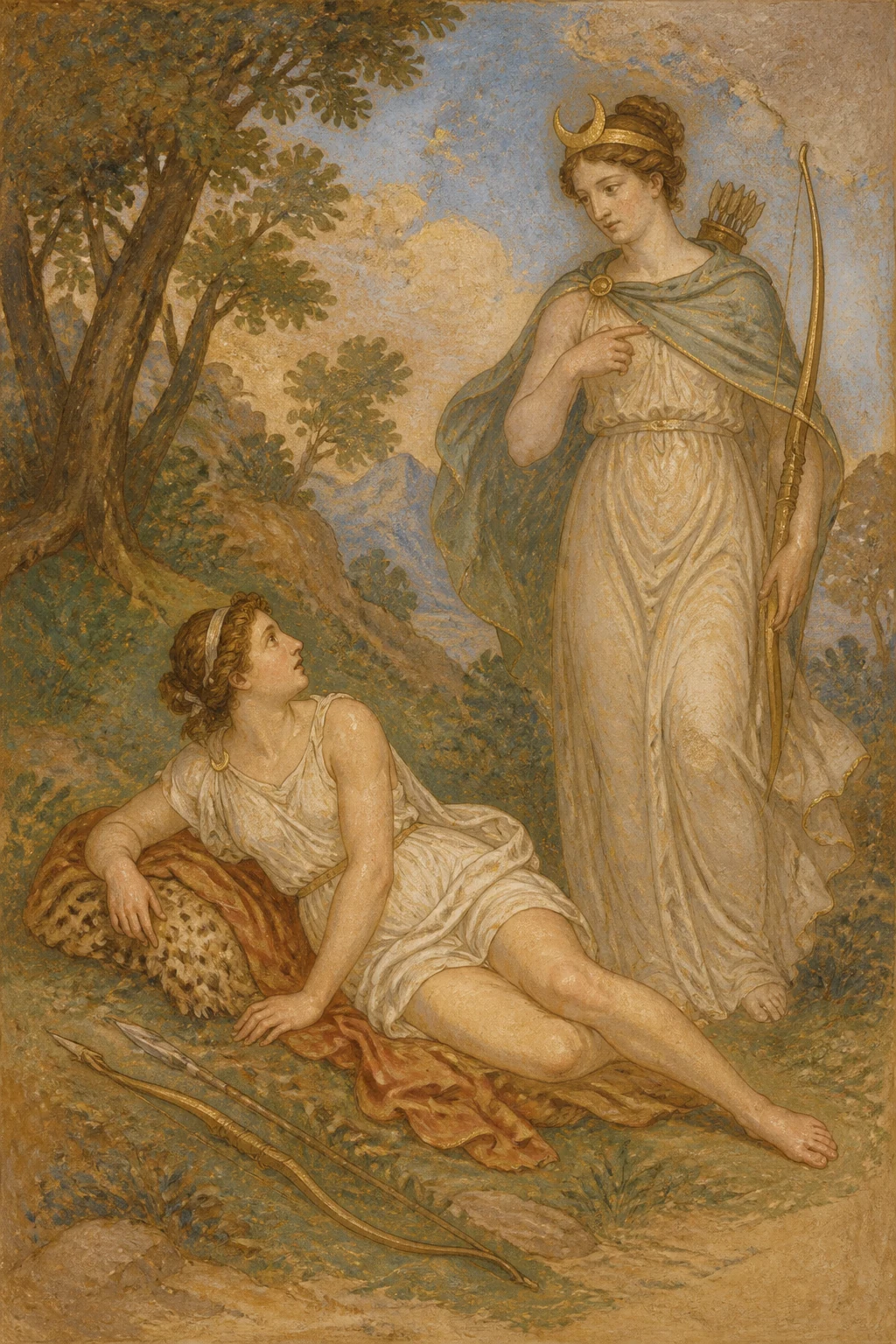
Kalisto in Arkad
But the almighty father circles the vast walls of heaven, examining them, lest anything weakened by the fire’s force should fall. Once he sees that they stand firm, their strength unimpaired, he surveys the earth and the works of humankind. Yet his own Arcadia claims his more devoted care: he restores the springs and rivers still afraid to flow, gives grass to the earth and leaves to the trees, and bids the ravaged forests grow green again.
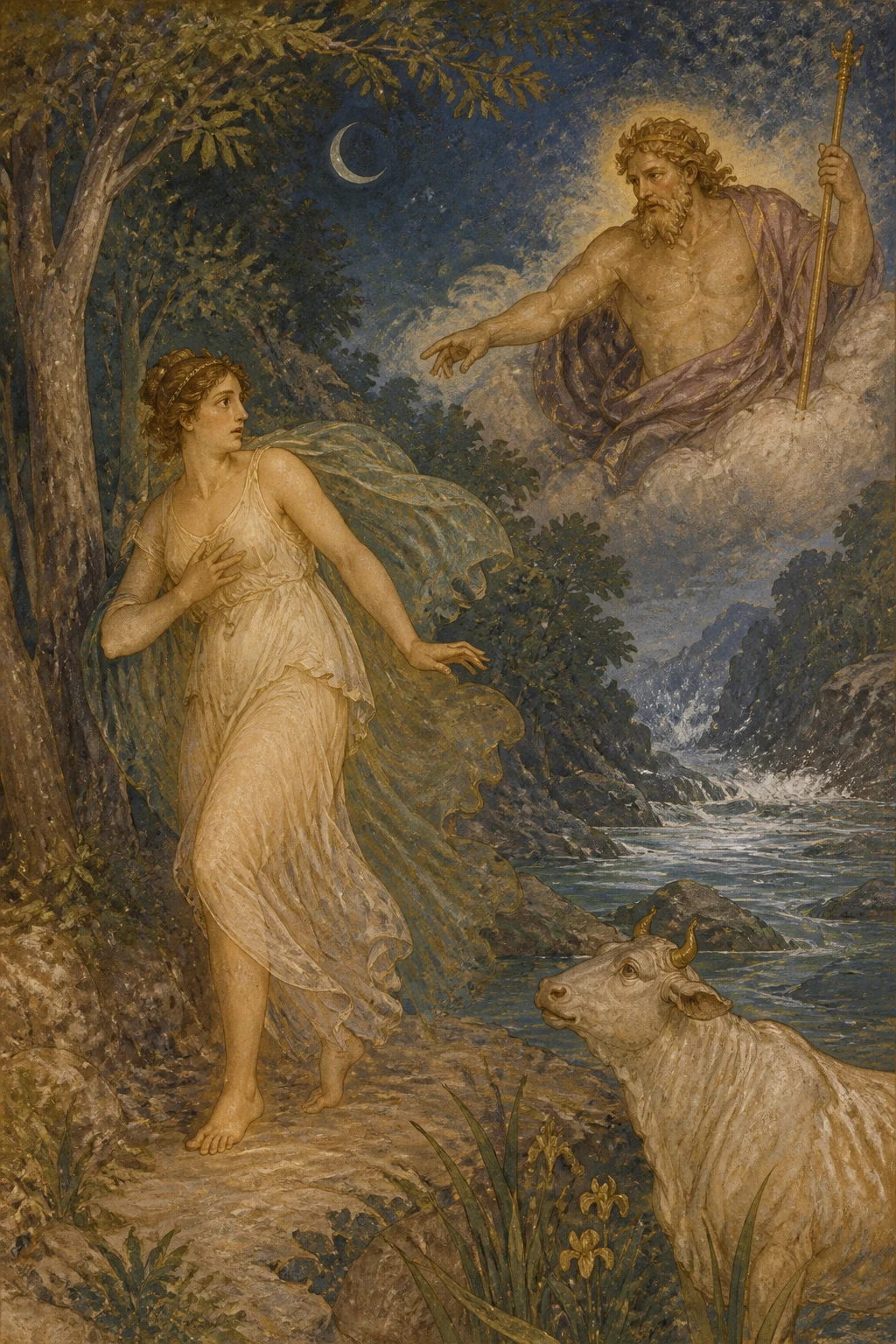
As he comes and goes about his work, his gaze rests on a maiden of Nonacris, and the fire he catches burns deep in his bones. It was not her task to soften wool by drawing it out, nor to arrange her hair in changing styles; once a clasp held her dress and a white ribbon bound her unkempt hair, with now a light javelin in her hand, now a bow, she was a soldier of Phoebe: no maiden ever trod Maenalus dearer to Trivia than she. But no favor lasts forever.
The sun stood high, beyond the middle of its course, when she entered a grove no age had ever felled. Here she slipped the quiver from her shoulder and unstrung her supple bow, then lay down on the grass-covered ground, resting her neck upon her painted quiver. When Jupiter saw her weary and unguarded, “Surely my wife will never learn of this stolen pleasure,” he said, “or, if she does, her quarrels are—oh, they are—worth the price.”
At once he assumes Diana’s face and dress and says, “Maiden, one of my companions, on what mountain ridges have you hunted?” From the turf the maiden rises. “Hail, goddess,” she says, “greater, in my judgment, than Jupiter, though he himself should hear.” He hears and laughs, delighted to be preferred to himself, and gives her kisses neither restrained enough nor such as a maiden ought to give.
As she prepares to tell him in what forest she has hunted, he stops her with an embrace, revealing himself through his crime. She fights against him with all the strength a woman can muster (if only you had seen her, daughter of Saturn: you would have been kinder!), she fights indeed: but whom could a girl overcome, and who could overcome Jupiter? Victorious, he seeks the heaven of the gods; she hates the grove, the forest that knows her secret.
As she leaves it, she almost forgets to take up her quiver and arrows, and the bow she had hung up. Now Dictynna, attended by her band, comes striding over lofty Maenalus, proud of the beasts she has slain. She sees the girl and calls her; at the call, the girl flees, fearing at first that Jupiter is hiding in her form. But when she sees the nymphs advancing beside her, she knows there is no trick and joins their company.
Alas, how hard it is not to betray a secret in one’s face! She can scarcely lift her eyes from the ground; no longer, as before, does she walk close beside the goddess, or lead the whole band, but keeps silent, her blush revealing her violated chastity; and, had Diana not been a virgin, she could have recognized the wrong by a thousand signs; the nymphs, they say, perceived it.
The moon’s horns were rising for the ninth time, when the goddess, weary from hunting in her brother’s heat, found a cool grove from which a murmuring stream flowed, rolling along its water-worn sands. She praised the spot, then touched the water’s surface with her foot; praising that too, she said, “There is no one here to watch us; let us bathe our naked bodies in the flowing water.”
The Parrhasian maiden blushed. All laid aside their clothes; she alone sought reasons to delay. As she hesitated, her dress was stripped away, and with her body bared, her secret lay revealed. As she stood stunned, trying to hide her belly with her hands, “Go far from here,” said Cynthia, “and do not defile these sacred springs,” and ordered her to leave their company.
The wife of the mighty Thunderer had long known of this and had postponed her harsh punishment until the proper time. Now there was no reason for delay: the boy Arcas had already been born to her rival, and this itself grieved Juno. As soon as she turned her savage thoughts and gaze upon her, “Of course, adulteress,” she said, “this alone remained: that you should bear a child, and through that birth make known the insult to me, and give proof of my Jupiter’s disgrace.
You shall not go unpunished: I shall strip you of that beauty that pleases you and pleases my husband, you shameless creature.” So saying, she seized the hair above her brow and flung her face down on the ground. She stretched out her arms in supplication: her arms began to bristle with black shaggy hair, her hands to curve and lengthen into hooked claws, serving as feet, while the face Jupiter had once praised grew hideous with a broad, gaping muzzle.
And lest her prayers and pleading words should soften any heart, her power of speech was taken away; an angry, threatening voice, full of terror, issued from her rasping throat. Yet even as a bear she kept her former mind, and, bearing witness to her anguish with incessant groans, she raised such hands as she now had toward heaven and the stars, feeling Jupiter’s ingratitude, though she could not speak of it.
Ah, how often, afraid to rest alone in the forest, she wandered before her house and through the fields once hers! Ah, how often the barking of hounds drove her over the rocks, and she who had hunted fled in terror from the hunters! Often, forgetting what she was, she hid at the sight of wild beasts; a bear herself, she shuddered to see bears upon the mountains and dreaded wolves, though her own father was among them.
Now came Arcas, the son of Lycaon’s daughter, ignorant of his mother, nearly fifteen years old. As he pursued wild beasts, seeking suitable woodland glades and enclosing the Erymanthian forests with woven nets, he came upon his mother. At the sight of Arcas she stood still, looking as though she recognized him. He drew back, unknowing, frightened by her unwavering gaze that never left him; and as she longed to draw nearer, he was about to pierce her breast with his deadly spear.
The Almighty stopped him, removing both of them and averting the crime; then, snatching them through the void on a swift wind, he set them in heaven and made them neighboring constellations. Juno swelled with anger when her rival shone among the stars, and descended to the sea, to white-haired Tethys and aged Ocean, whose revered presence had often moved the gods. When they asked the reason for her coming, she began: “You ask why I, the queen of the gods, have left my heavenly dwelling and come here? Another holds heaven in my place.
Call me a liar if, when night has darkened the world, you do not see those stars, lately honored with a place in highest heaven—wounds to my heart—there where the circle farthest north and shortest in its course surrounds the pole. What reason, indeed, has anyone to avoid offending Juno or fear her anger, when by harming others I only help them? Oh, what I have accomplished! How vast my power is!
I forbade her to be human: she has become a goddess. Such are the punishments I inflict on the guilty; such is my mighty sovereignty. Let him restore her former shape, strip away her beastly features, as he did before for the Argive daughter of Phoroneus. Why not drive Juno out, marry her, install her in my bed, and take Lycaon for his father-in-law? But you, if this contempt for the foster-daughter you reared moves you, keep the seven stars of the Bear from your blue depths; drive away these stars, admitted to heaven as the reward for adultery, and never let that rival bathe in your pure waters.”
Izvirnik
Callisto and Arcas
Naslednje strani prikazujejo izvirno besedilo za primerjavo.
Source ID: ovid_metamorphoses_story_012 Citation: Ovid, Metamorphoses 2.401-2.530 Original language: Latin Source: PerseusDL canonical-latinLit Source URL: https://github.com/PerseusDL/canonical-latinLit/blob/master/data/phi0959/phi006/phi0959.phi006.perseus-lat2.xml Segmentation certainty: medium 401: At pater omnipotens ingentia moenia caeli 402: circuit et ne quid labefactum viribus ignis 403: corruat explorat. Quae postquam firma suique 404: roboris esse videt terras hominumque labores 405: perspicit. Arcadiae tamen est impensior illi 406: cura suae: fontes et nondum audentia labi
407: flumina restituit dat terrae gramina, frondes 408: arboribus, laesasque iubet revirescere silvas. 409: Dum redit itque frequens, In virgine Nonacrina 410: haesit et accepti caluere sub ossibus ignes. 411: Non erat huius opus lanam mollire trahendo 412: nec positu variare comas; ubi fibula vestem, 413: vitta coercuerat neglectos alba capillos, 414: et modo leve manu iaculum, modo sumpserat arcum, 415: miles erat Phoebes: nec Maenalon attigit ulla 416: gratior hac Triviae. Sed nulla potentia longa est.
417: Ulterius medio spatium sol altus habebat, 418: cum subit illa nemus, quod nulla ceciderat aetas. 419: Exuit hic umero pharetram lentosque retendit 420: arcus, inque solo, quod texerat herba, iacebat 421: et pictam posita pharetram cervice premebat. 422: Iuppiter ut vidit fessam et custode vacantem, 423: “hoc certe furtum coniunx mea nesciet” inquit, 424: “aut si rescierit sunt o sunt iurgia tanti.”
425: Protinus induitur faciem cultumque Dianae 426: atque ait: “O comitum, virgo, pars una mearum, 427: in quibus es venata iugis?” De caespite virgo 428: se levat et “salve numen, me indice”, dixit 429: “audiat ipse licet maius Iove.” Ridet et audit, 430: et sibi praeferri se gaudet et oscula iungit 431: nec moderata satis nec sic a virgine danda. 432: Qua venata foret silva, narrare parantem 433: impedit amplexu, nec se sine crimine prodit.
434: Illa quidem contra, quantum modo femina possit 435: (adspiceres utinam, Saturnia: mitior esses !), 436: illa quidem pugnat: sed quem superare puella, 437: quisve Iovem poterat? — Superum petit aethera victor 438: Iuppiter: huic odio nemus est et conscia silva. 439: Unde pedem referens paene est oblita pharetram 440: tollere cum telis et quem suspenderat arcum.
441: Ecce, suo comitata choro Dictynna per altum 442: Maenalon ingrediens et caede superba ferarum 443: adspicit hanc visamque vocat: clamata refugit, 444: et timuit primo, ne Iuppiter esset in illa. 445: Sed postquam pariter nymphas incedere vidit, 446: sensit abesse dolos numerumque accessit ad harum. 447: Heu quam difficile est crimen non prodere vultu! 448: Vix oculos attollit humo, nec, ut ante solebat, 449: iuncta deae lateri, nec toto est agmine prima, 450: sed silet et laesi dat signa rubore pudoris; 451: et nisi quod virgo est poterat sentire Diana 452: mille notis culpam; nymphae sensisse feruntur.
453: Orbe resurgebant lunaria cornua nono, 454: cum dea venatu, fraternis languida flammis, 455: nacta nemus gelidum, de quo cum murmure labens 456: ibat et attritas versabat rivus harenas. 457: Ut loca laudavit, summas pede contigit undas: 458: his quoque laudatis “procul est” ait “arbiter omnis; 459: nuda superfusis tingamus corpora lymphis.” 460: Parrhasis erubuit. Cunctae velamina ponunt: 461: una moras quaerit. Dubitanti vestis adempta est; 462: qua posita nudo patuit cum corpore crimen.
463: Attonitae manibusque uterum celare volenti 464: “i procul hinc” dixit “nec sacros pollue fontes” 465: Cynthia; deque suo iussit secedere coetu. 466: Senserat hoc olim magni matrona Tonantis 467: distuleratque graves in idonea tempora poenas. 468: Causa morae nulla est, et iam puer Arcas (id ipsum 469: indoluit Iuno) fuerat de paelice natus. 470: Quo simul obvertit saevam cum lumine mentem, 471: “scilicet hoc etiam restabat, adultera” dixit, 472: “ut fecunda fores, fieretque iniuria partu 473: nota, Iovisque mei testatum dedecus esset.
474: Haud impune feres: adimam tibi nempe figuram, 475: qua tibi, quaque places nostro, importuna, marito.” 476: Dixit et adversa prensis a fronte capillis 477: stravit humi pronam. Tendebat bracchia supplex: 478: bracchia coeperunt nigris horrescere villis 479: curvarique manus et aduncos crescere in ungues 480: officioque pedum fungi, laudataque quondam 481: ora Iovi lato fieri deformia rictu.
482: Neve preces animos et verba precantia flectant 483: posse loqui eripitur; vox iracunda minaxque 484: plenaque terroris rauco de gutture fertur. 485: Mens antiqua tamen facta quoque mansit in ursa, 486: adsiduoque suos gemitu testata dolores 487: qualescumque manus ad caelum et sidera tollit 488: ingratumque Iovem, nequeat cum dicere, sentit. 489: A quotiens, sola non ausa quiescere silva, 490: ante domum quondamque suis erravit in agris!
491: A quotiens per saxa canum latratibus acta est 492: venatrixque metu venantum territa fugit! 493: Saepe feris latuit visis, oblita quid esset, 494: ursaque conspectos in montibus horruit ursos 495: pertimuitque lupos, quamvis pater esset in illis. 496: Ecce, Lycaoniae proles, ignara parentis, 497: Arcas adest, ter quinque fere natalibus actis: 498: dumque feras sequitur, dum saltus eligit aptos 499: nexilibusque plagis silvas Erymanthidas ambit, 500: incidit in matrem; quae restitit Arcade viso 501: et cognoscenti similis fuit. Ille refugit 502: inmotosque oculos in se sine fine tenentem
503: nescius extimuit propiusque accedere aventi 504: vulnifico fuerat fixurus pectora telo. 505: Arcuit omnipotens pariterque ipsosque nefasque 506: sustulit, et celeri raptos per inania vento 507: imposuit caelo vicinaque sidera fecit. 508: Intumuit Iuno, postquam inter sidera paelex 509: fulsit et ad canam descendit in aequora Tethyn 510: Oceanumque senem, quorum reverentia movit 511: saepe deos, causamque viae scitantibus infit: 512: “Quaeritis, aetheriis quare regina deorum 513: sedibus huc adsim? pro me tenet altera caelum.
514: Mentiar, obscurum nisi nox cum fecerit orbem, 515: nuper honoratas summo, mea vulnera, caelo 516: videritis stellas illic, ubi circulus axem 517: ultimus extremum spatioque brevissimus ambit. 518: Est vero, cur quis Iunonem laedere nolit 519: offensamque tremat, quae prosum sola nocendo? 520: O ego quantum egi! quam vasta potentia nostra est! 521: Esse hominem vetui: facta est dea. Sic ego poenas 522: sontibus impono, sic est mea magna potestas.
523: Vindicet antiquam faciem vultusque ferinos 524: detrahat, Argolica quod in ante Phoronide fecit. 525: Cur non et pulsa ducit Iunone meoque 526: collocat in thalamo socerumque Lycaona sumit? 527: At vos si laesae tangit contemptus alumnae, 528: gurgite caeruleo septem prohibete triones 529: sideraque in caelo, stupri mercede, recepta 530: pellite, ne puro tingatur in aequore paelex.”
Nadaljuj z branjem