Prevod
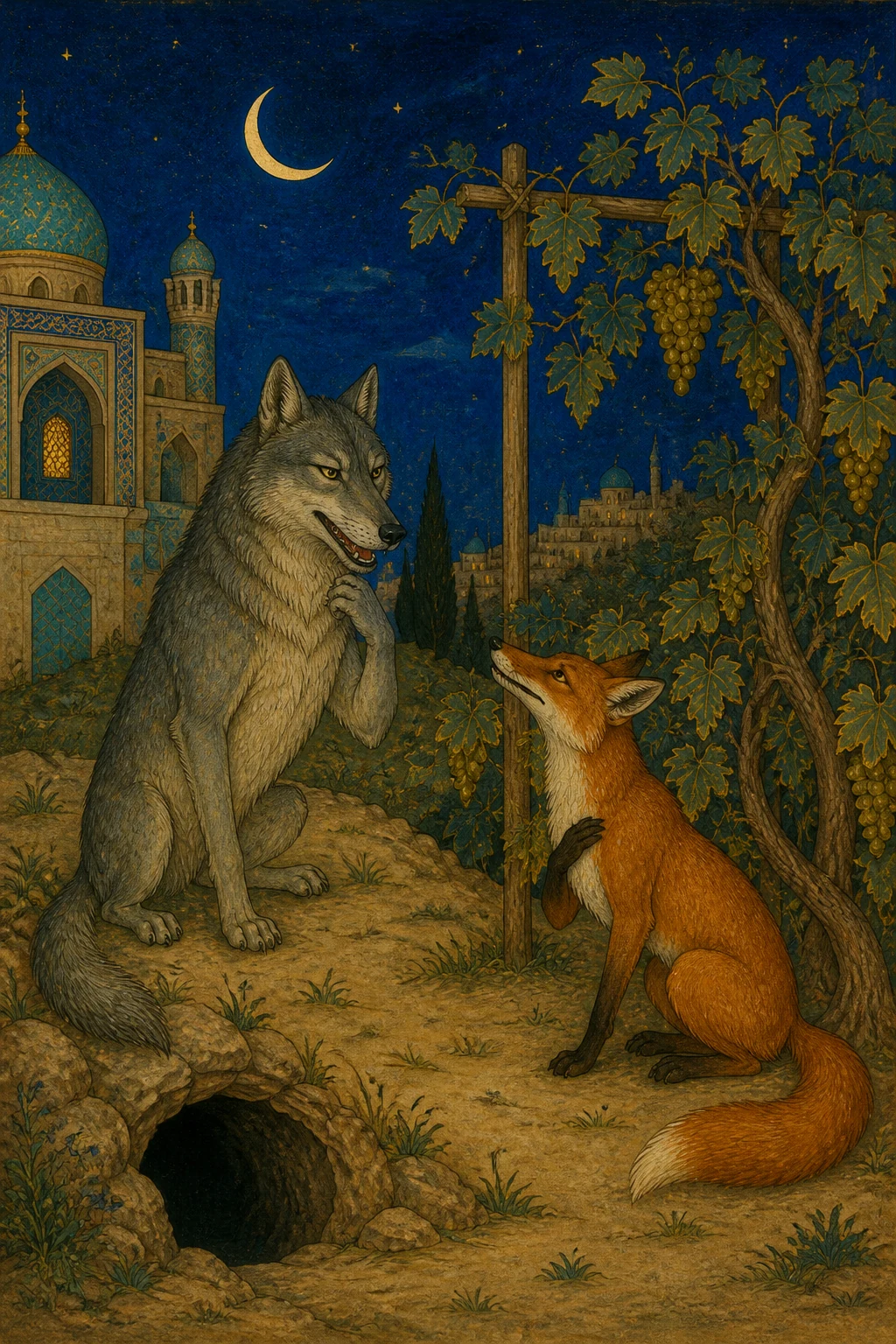
It is told that a fox made his home in a den in a mountain. Whenever he had a cub and it had grown strong, he would eat it out of hunger, for if he did not eat his young, hunger would torment him. A crow used to roost on the summit of that mountain, and the fox said to himself, “I should establish a friendship with this crow and make him my companion in solitude and my helper in finding food, for he can reach things that I cannot.” So the fox approached the crow until he was near enough for him to hear his words, greeted him, and said, “My neighbor, a Muslim neighbor has two claims upon his Muslim neighbor: the claim of neighborliness and the claim of Islam. Know that you are my neighbor, and you have a claim upon me which I am bound to honor, especially since we have lived beside one another so long. Moreover, I cherish an affection for you in my heart which has moved me to approach you kindly and seek your brotherhood. What answer will you give me?” The crow replied, “Know that the best words are the truest. Yet a tongue may sometimes speak what is not in the heart, and I fear that your brotherhood may be only on your lips, while enmity lies within. For you are an eater, and I am one who may be eaten; thus our affections must remain apart, and we cannot form a bond. What has prompted you to seek what we cannot attain and desire what cannot be? You belong to the beasts, and I to the birds. Such a brotherhood cannot hold.” The fox said, “One who knows where true friends are to be found, and chooses wisely among them, may gain the benefits of brotherhood. I have come to desire your company and have chosen you as my companion, so that we may help one another achieve our aims and our friendship may bear the fruit of success. I know tales of the blessings of friendship, and if you wish to hear them, I will tell them to you.” The crow said, “You have my leave to relate them. Tell them to me, so that I may understand their purpose.”
The fox said, “Listen, my friend. There is a tale of a flea and a mouse which bears out what I have told you.” “How was that?” asked the crow. The fox replied, “They say that a mouse lived in the house of a wealthy merchant. One night a flea found his way into the merchant’s bed and discovered a tender body. Being thirsty, he drank some of the man’s blood. The merchant felt the pain of the bite, woke from sleep, sat upright, and called for some of his servants. They hurried to him, rolled up their sleeves, and began searching for the flea. When the flea realized he was being hunted, he fled, came upon the mouse’s hole, and slipped inside. When the mouse saw him, she said, ‘What has brought you into my home? You are neither of my kind nor of my species, and you have no assurance that I will not treat you harshly or harm you.’ The flea replied, ‘I fled to your home and saved myself from death. I have come to seek your protection, not to covet your dwelling, nor will any harm come to you through me that might drive you from your home. I hope to repay your kindness with every good turn, and in time you will praise the outcome of what I say.’ When the mouse heard the flea’s words…” But morning overtook Shahrazad, and she fell silent, leaving her tale untold.
When the one hundred and fifty-first night came
She said, “It has reached me, O fortunate King, that when the mouse heard the flea’s words, she said, ‘If matters are as you say, make yourself at ease here and fear no harm. You shall find only what pleases you, and nothing shall befall you that does not befall me. I freely offer you my friendship. Do not regret the merchant’s blood you have missed, nor grieve for the nourishment you drew from him. Be content with whatever sustenance comes readily to you, for that is safer. I once heard a preacher, O flea, recite these verses:
I chose contentment and a life apart, and passed my days on whatever came to hand: a crust of bread, a draught of water, coarse salt, and a threadbare robe. If God grants ease in my livelihood, well and good; if not, I am content with what He has bestowed.’ When the flea heard the mouse’s words, he said, ‘My sister, I have heard your counsel and submit to your wishes. I could not bring myself to disobey you, and shall hold to this good resolve until my life is done.’ The mouse replied, ‘Sincerity of affection is proof enough of a good intention.’ So a bond of friendship was formed between them. Thereafter the flea would visit the merchant’s bed, taking no more than he needed, and spend the day with the mouse in her home. One night the merchant came home with a great many dinars and began turning them over in his hands. Hearing the clink of the coins, the mouse poked her head out of her hole and watched them until the merchant put them beneath a pillow and went to sleep. Then she said to the flea, ‘Do you see this opportunity, this splendid stroke of luck? Have you some device by which we might obtain those dinars?’ The flea replied, ‘There is no good in pursuing an aim unless one has the strength to achieve it. If one is too weak, one falls into the very danger one fears and fails to attain one’s desire. However firmly one lays one’s schemes, one may be like the sparrow that pecks at the grain, falls into the net, and is caught by the hunter. You have not the strength to take the dinars and carry them out of the house, while I have no power to do so either; indeed, I cannot carry so much as a single dinar. The coins, then, are your affair.’ The mouse said, ‘I have made seventy exits from this hole of mine, through which I can leave whenever I wish, and I have prepared a secure place for storing treasures. If you can contrive to get the merchant out of the house, I have no doubt of success, provided fortune favors me.’ The flea replied, ‘I undertake to get him out of the house for you.’
Then the flea went to the merchant’s bed and bit him so fiercely that he had never felt the like before. He withdrew to a place where he would be safe from the merchant, who woke and searched for him but found nothing. The merchant lay down on his other side, and the flea gave him a second bite, worse than the first. In distress, the merchant left his bed and went out to a raised bench beside his door, where he slept without waking until morning. Meanwhile the mouse set about carrying away the dinars until she had left not a single one. When morning came, the merchant began accusing people and entertaining all manner of suspicions.” Then the fox said to the crow, “Know, O discerning, wise, and experienced crow, that I have told you this only so that you may receive the reward of your kindness to me, just as the mouse was rewarded for her kindness to the flea. Consider how handsomely he repaid her, and how generously he rewarded her.” The crow replied, “One who would do a kindness may choose whether or not to do it. Kindness is no duty toward one who seeks a bond that will end in severance. If I were kind to you, though you are my enemy, I should bring about my own destruction. You, fox, are full of cunning and deceit, and one whose nature is treachery cannot be trusted to keep a covenant. Where a covenant cannot be trusted, there is no safety. I recently heard that you betrayed your companion the wolf and plotted against him until you destroyed him through your treachery and wiles. You did all this to him though he was of your own kind and you had been his companion for a long time, yet you showed him no mercy. How, then, can I trust you to wish me well? If this is how you treat a companion of your own kind, how will you treat an enemy of another kind? Your dealings with me are like those of the falcon with the birds of prey.” The fox asked, “What is the story of the falcon and the birds of prey?” The crow replied, “They say there was once a falcon, tyrannical and headstrong…” But morning overtook Shahrazad, and she fell silent, leaving her tale untold.