Prevod
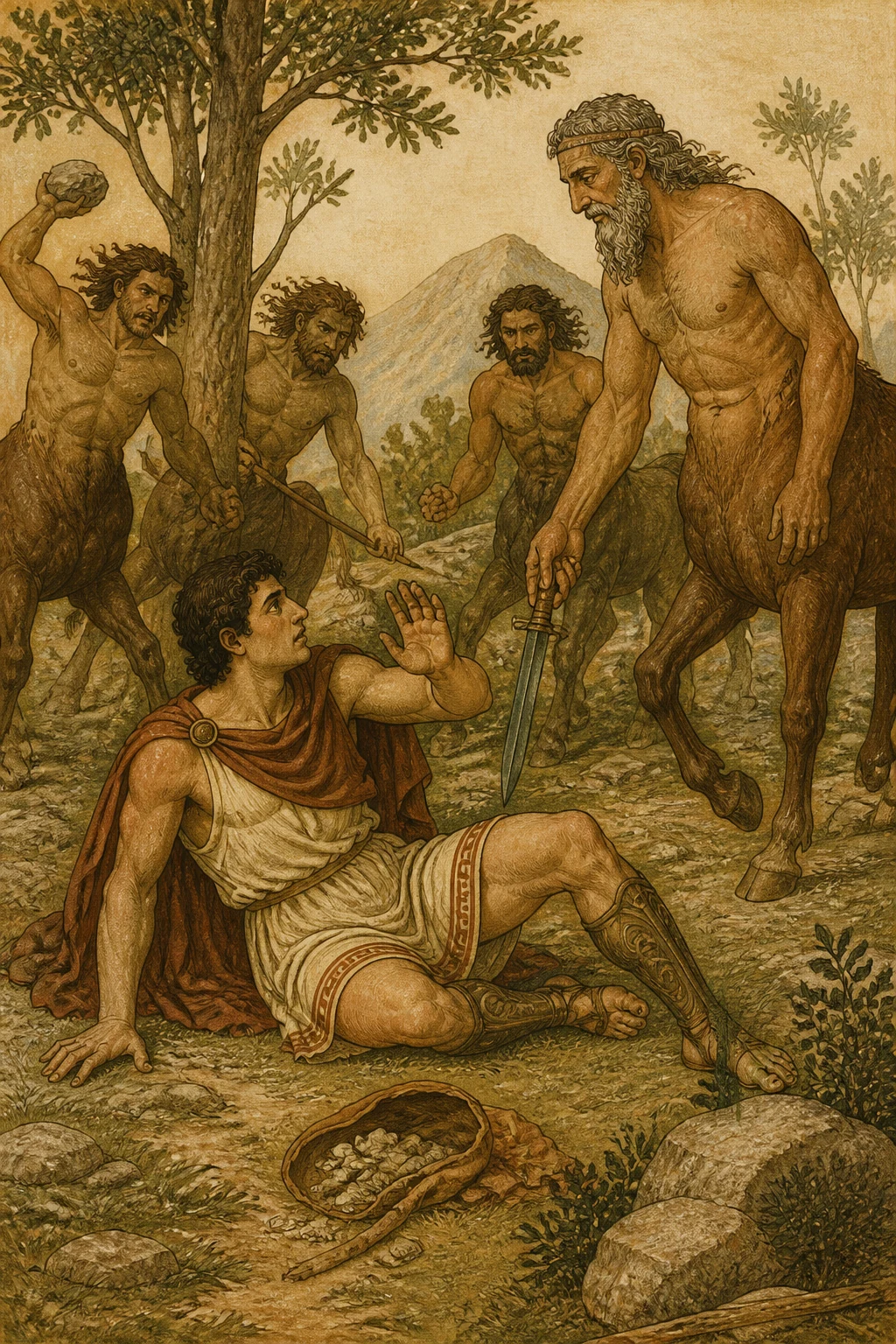
The son of bold Ixion had married Hippodame, and, setting tables out in rows, had ordered the wild cloud-born centaurs to recline in a cave roofed over with trees. The lords of Thessaly were there, and I myself was present; the palace rang with the mingled voices of the festive crowd. Now they sing the wedding hymn; the halls smoke with sacrificial fires, and the maiden enters, surrounded by wives and mothers, surpassing all in beauty. We called Pirithous fortunate to have such a bride—a blessing we nearly spoke in vain.
For you, Eurytus, fiercest of the fierce centaurs, burn as hotly at the sight of the maiden as with wine, and drunkenness, doubled by lust, masters you. At once overturned tables throw the feast into confusion, and the new bride is seized by the hair and dragged away by force. Eurytus snatches Hippodame; the others seize whichever women they fancy or can catch. It was like a city taken by storm.
The house rings with women's cries. In an instant we all spring up, and Theseus is the first to speak: “What madness drives you, Eurytus, to attack Pirithous while I am alive, not knowing that in wronging one you wrong us both?” And lest his noble words should prove an empty boast, he thrusts the attackers back and wrests the captive from their frenzy. Eurytus makes no answer—there are no words that can defend such deeds—but strikes his champion's face with insolent hands and pounds his noble breast.
By chance there stood nearby an ancient mixing-bowl, rough with figures in relief. Huge as it was, the son of Aegeus, huger still, lifted it and hurled it straight into his face. Spewing clots of blood, brains, and wine alike from mouth and wound, Eurytus falls backward on the sodden sand and kicks out his heels. Enraged by their brother's death, the double-bodied creatures all cry together, vying with one another: “Weapons! Weapons!”
Wine gave them courage. In the opening clash, drinking-cups flew through the air, with fragile jars and rounded cauldrons— things once meant for feasting, now fit for war and slaughter. Amycus, Ophion's son, was the first who dared to rob the inner shrine of its offerings, the first to snatch from the sanctuary a chandelier thick with blazing lamps. He raised it high, like a man preparing to cleave a bull's white neck with a sacrificial axe, and dashed it against the forehead of Celadon the Lapith, leaving his shattered face a jumble of unrecognizable bones.
His eyes sprang out; his facial bones were scattered, and his nose was driven back and lodged in the middle of his palate. Pelates of Pella tore a leg from a maple table and felled Amycus, forcing his chin down against his chest; then, as he spat out teeth mingled with black blood, a second wound sent him to the shades of Tartarus. Gryneus stood nearby. Gazing fiercely at the smoking altars, he said, “Why not use these?”
He lifted a massive altar, with its fires still burning, and hurled it into the midst of the Lapith ranks, crushing two men, Broteas and Orios. Orios's mother was Mycale, who was known by her spells to have drawn down the moon's reluctant horns again and again. “You shall pay for this, if only I can find a weapon!” Exadius cried, and found something to serve: the antlers of a stag, hung high on a pine as a votive offering.
With their two branches Gryneus is pierced through the eyes, which are gouged out: part clings to the antlers, part runs down into his beard and hangs there, clotted with blood. Now Rhoetus snatches from the altar's heart a blazing brand of plumwood and grazes Charaxus's right temple, sheltered beneath his tawny hair. Caught by the ravenous flame, his hair flares up like dry standing grain, and the blood seared in his wound gives a dreadful hiss, like iron glowing in the fire when a smith draws it out with curved tongs and plunges it into a trough: it shrieks and hisses, submerged in the warming water.
Wounded, he shakes the hungry fire from his shaggy hair, then wrenches a threshold stone from the ground and lifts it onto his shoulders, a wagon's load; its very weight prevents him from hurling it at his enemy. The mass of stone instead crushes his comrade Cometes, who stood too close. Rhoetus cannot restrain his joy. “May all the rest of your company be just as brave!” he cries.
He strikes again with the half-burnt brand, reopening the wound, and with three or four heavy blows shatters the seams of Charaxus's skull; the bones sink into the fluid brain. Victorious, he turns on Euagrus, Corythus, and Dryas. When Corythus, whose cheeks were covered with their first soft down, fell, Euagrus said, “What glory have you won by striking down a boy?” Rhoetus allows him no more words, but savagely thrusts the glowing flames into his open, speaking mouth and down into his breast.
You too, fierce Dryas, he pursues, whirling fire about your head; but yours was not the same fate. As he exults in his unbroken run of slaughter, you drive a fire-hardened stake where neck and shoulder join. Groaning, Rhoetus can barely wrench the stake from the hard bone, then flees, drenched in his own blood. Orneus flees too, and Lycabas, and Medon, wounded in the right shoulder, and Thaumas with Pisenor, and Mermeros, who lately had beaten everyone in a footrace—his wound now made him slower!— and Pholus, Melaneus, and Abas, hunter of boars, and Astylos the seer, who had vainly urged his people
against the battle. To Nessus, afraid of being wounded, he said, “Do not flee! You shall be kept for Hercules' bow.” But Eurynomus, Lycidas, Areos, and Imbreus did not escape death: Dryas's right hand struck them all as they faced him. You too, Crenaeus, though you had turned your back in flight, received your wound in front; for, looking back, you caught the heavy blade between your eyes, where the nose joins the lowest part of the forehead.
Amid all that uproar Aphidas lay in a deep, unbroken sleep, every vein steeped in wine, his slack hand still holding a cup of mingled wine and water, stretched out on the shaggy skin of a bear from Ossa. Phorbas saw him at a distance, uselessly wielding no weapon, and slipped his fingers into his spear's throwing-loop. “You shall drink your wine mixed with the Styx!” he said, and without delay hurled his javelin at the youth. As he lay upon his back, the iron-tipped ash shaft was driven through his neck.
He died without feeling it, and from his brimming throat black blood flowed over the couch and into the cup itself. I saw Petraeus trying to uproot an acorn-bearing oak. As he clasped it in his arms and shook it back and forth, rocking its loosened strength, Pirithous drove a lance into Petraeus's ribs, pinning the breast that wrestled with the stubborn trunk. They said that Lycus fell to Pirithous's prowess, and Chromis too. But neither brought his conqueror as much renown as Dictys and Helops did: Helops was struck by a javelin that pierced his temples, entering on the right and passing through to his left ear;
Dictys, slipping from a mountain's double ridge as he fled in terror from Ixion's pursuing son, plunged headlong, broke a great ash tree beneath his body's weight, and impaled his belly on its broken trunk. Aphareus comes forward to avenge them and tries to hurl a rock torn from the mountain. Before he can throw it, the son of Aegeus strikes with an oak club and shatters the massive bones of his elbow. He has neither time nor wish to finish off that useless body, but leaps upon the back of towering Bienor, which had never carried anyone but himself.
He braces his knees against the ribs, grasps the hair in his left hand, pulls back the head, and with the knotted oak smashes the face, the threatening mouth, and the rock-hard temples. With that oak he fells Nedymnus and Lycopes the spearman, Hippasos, whose flowing beard shielded his chest, Ripheus, who towered above the highest trees, and Thereus, who used to catch bears in Thessaly's mountains and carry them home alive and struggling.
Demoleon would not let Theseus enjoy his triumphs any longer. With a mighty effort he tried to wrench an ancient pine from the firm thicket; unable to uproot it, he snapped it off and hurled it at his enemy. But Theseus moved well clear of the oncoming missile, warned by Pallas—so he himself wished us to believe. Yet the tree did not fall without effect: it severed tall Crantor's chest and left shoulder from his neck.
He had been your father's armour-bearer, Achilles, given to the grandson of Aeacus by Amyntor, ruler of the Dolopians, as pledge and surety of peace when he was defeated in war. When Peleus saw him from afar, torn apart by that hideous wound, he cried, “Crantor, dearest of young men, accept this offering to your shade!” With a powerful arm and all his spirit's strength, he hurled his ash spear at Demoleon.
It broke through the cage of his ribs and lodged in the bones, quivering. Demoleon pulled out the shaft without its point— even that scarcely came away; the point remained in his lung. The pain itself gave fury strength. Wounded, he reared against his enemy and battered the man with his horse's hooves. Peleus caught the blows on his helmet and ringing shield, guarding his shoulders and holding his weapons out before him; then, striking through the forelegs, pierced both breasts with one thrust.
Before this he had killed Phlegraeus and Hyles from afar, and Iphinous and Clanis in close combat. To these was added Dorylas, whose head was covered with a wolfskin, and whose weapons were a bull's curved horns, deadly in his hands and red with streams of blood. To him I said—for my spirit gave me strength— “See how little your horns can do against my steel!” Then I hurled my javelin. Unable to avoid it, he thrust his right hand before his threatened forehead: hand and forehead were pinned together. A shout arose, and Peleus, who stood nearer, struck him with his sword below the belly, while he was trapped and helpless with the bitter wound.
He leapt forward fiercely, dragging his entrails on the ground, trod on them as he dragged them, tore them as he trod, entangled his legs in them, and fell with his belly emptied. Nor did your beauty save you in battle, Cyllarus, if beauty may be granted to a creature of your kind. Your beard was just beginning, golden in colour, and golden hair flowed from your head halfway down your shoulders.
Your face had a pleasing vigour; neck, shoulders, hands, and breast rivalled the sculptors' finest statues— all, indeed, that was human in you. Nor was the horse beneath misshapen or inferior to the man. Give it a head and neck, and it would be worthy of Castor: so well shaped was the back for riding, so high the chest swelled with muscle. He was blacker all over than darkest pitch, yet his tail was white, and his legs were white as well.
Many females of his own race sought him, but one alone won him: Hylonome, than whom no lovelier female among the half-wild creatures dwelt in the deep woods. She alone held Cyllarus with her caresses, with her love, and her avowal of it. She cared for her appearance too, as far as such a body allowed, smoothing her hair with a comb, entwining it now with rosemary, now with violets or roses, and sometimes wearing shining lilies.
Twice a day she washed her face in springs descending from the heights of Pagasae's woodland, twice bathed her body in the stream; and over her shoulder or left flank she draped only becoming skins, chosen from the finest beasts. Their love was equal: together they roamed the mountains, together entered caves. Together then they had entered the Lapith halls, and together fought that savage battle.
No one knows who cast it: a javelin came from the left and struck you, Cyllarus, low down where the breast joins the neck. The heart was touched by a slight wound, and when the weapon was withdrawn, it grew cold with all your body. At once Hylonome caught his dying limbs, laid her hand over the wound, pressed her mouth to his, and tried to hold his fleeing breath.
When she saw him dead, she spoke words which the uproar kept from my ears, then fell upon the weapon that had pierced him, and embraced her husband as she died. Before my eyes there still stands Phaeocomes, who had tied six lions' skins together with interlocking knots, covering both his human and his equine body. He hurled a log that two teams of oxen could scarcely move, and crushed Tectaphos, Olenus's son, from the crown of his head.
The broad dome of his skull was shattered, and through his mouth, his hollow nostrils, eyes, and ears his soft brain flowed, like curdled milk through a wicker frame of oak, or liquid oozing under pressure through a sieve, forced thickly through its crowded holes. But while he prepared to strip the fallen man of his armour, I plunged my sword—your father knows this— deep into the plunderer's groin. Chthonius and Teleboas also fell by my sword. The first had carried a forked branch, the second a javelin; with that javelin he wounded me.
You see the mark! The old scar still shows. That was when I should have been sent to capture Troy; then my weapons could have checked great Hector's, if not overcome them! But in those days Hector was not yet born, or was a boy; now my age betrays me. Why should I tell you of Periphas, who defeated the double-bodied Pyraethus, or of Ampyx, who drove a cornel shaft without a point straight into the face of four-footed Echeclus?
Macareus felled Erigdupus of Pelethronium, driving a crowbar into his breast; and I remember a hunting-spear, thrown by Nessus's hands, burying itself in Cymelus's groin. Nor should you think that Mopsus, son of Ampyx, only foretold the future: at a cast from Mopsus the two-formed Hodites fell, vainly trying to speak, his tongue pinned to his chin and his chin to his throat.
Caeneus had put five to death: Styphelus and Bromus, Antimachus, Elymus, and axe-bearing Pyracmes. I do not remember their wounds; I noted their number and names. Then Latreus rushed forward, armed in the spoils of Halesus of Emathia, whom he had killed, enormous in body and limb. His age lay between youth and old age; he had a young man's strength, but grey streaked his temples.
Conspicuous with shield, sword, and Macedonian pike, he turned his face towards both armies, rattled his weapons, rode in a measured circle, and boldly poured these words into the empty air: “Am I to put up with you too, Caenis? For to me you are always a woman, always Caenis. Does your birth not remind you, does it not come to mind, what deed earned you this reward, and at what price you bought this counterfeit appearance of a man?
Remember what you were born, or what you suffered. Go, take up your distaff and your baskets, twist the thread with your thumb, and leave war to men.” As he blustered, Caeneus hurled his spear and tore open the flank stretched out in his charge, where man and horse were joined. Maddened by pain, Latreus struck the young man of Phyllus in his unguarded face with his pike.
It bounced back like hail from a rooftop, or a little stone thrown against a hollow drum. He closed in and struggled to bury his sword in that hard flank; no part would yield to the blade. “You shall not escape! I will kill you with the edge, since the point is blunt,” he said, and turned his sword sideways, sweeping his long right arm across the belly. The blow rang out as though it had struck a body of marble, and the blade broke and flew apart against that hardened flesh.
When Caeneus had let him marvel long enough at his unharmed limbs, he said, “Come now, let us test your body with my steel!” He plunged his deadly sword to the hilt into Latreus's shoulder, worked the buried blade through his entrails, and twisted it, making wound within wound. Now the double-bodied creatures rush forward in fury with a mighty shout, all casting or thrusting their weapons at this one man.
The blunted weapons fall. Caeneus, Elatus's son, remains unpierced and bloodless under every blow. The strange sight left them stunned. “What monstrous shame!” Monychus cries. “A whole people beaten by one man, and scarcely a man at that! Yet he is a man, while our feeble deeds make us what he once was! What use are our enormous limbs? What use our double strength, or that our twofold nature has joined in us the strongest living creatures?
I cannot believe a goddess was our mother, or Ixion our father—he who was great enough to aspire to lofty Juno! We are beaten by a half-male enemy! Roll rocks and tree trunks, whole mountains, over him; hurl forests down and crush his stubborn life! Let the forest choke his throat; weight will serve instead of wounds.” He spoke, and finding by chance a trunk uprooted by the south wind's raging strength, hurled it at his powerful enemy.
His example was followed, and in a little while Othrys was bare of trees, and Pelion had lost its shade. Buried beneath that enormous mound, Caeneus struggles under the weight of trees, bearing the piled-up oaks on his unyielding shoulders. But as the burden rises above his face and head, and no air remains for him to draw breath, at times he weakens; at times he tries in vain to rise into the air and throw off the heaped-up forest; at times he stirs it, as though steep Ida, which we see there, were shaken by an earthquake.
His end is uncertain. Some said his body was driven down to empty Tartarus by the mass of timber; but the son of Ampyx denied it. From the heart of the mound he saw a bird with tawny feathers emerge into the clear air, a bird I saw then for the first time and the last. When Mopsus saw it circling its own comrades in gentle flight, filling the air around it with a mighty cry, he followed it with his eyes and his heart alike, and said, “Hail, glory of the Lapith race, Caeneus, once the greatest of men, now a bird without equal!”
We believed the story on his authority. Grief sharpened our anger; we could not bear that one man had been overwhelmed by so many foes. Nor did we cease to vent our sorrow with the sword until some were dead, and flight and night had carried off the rest.”