Prevod
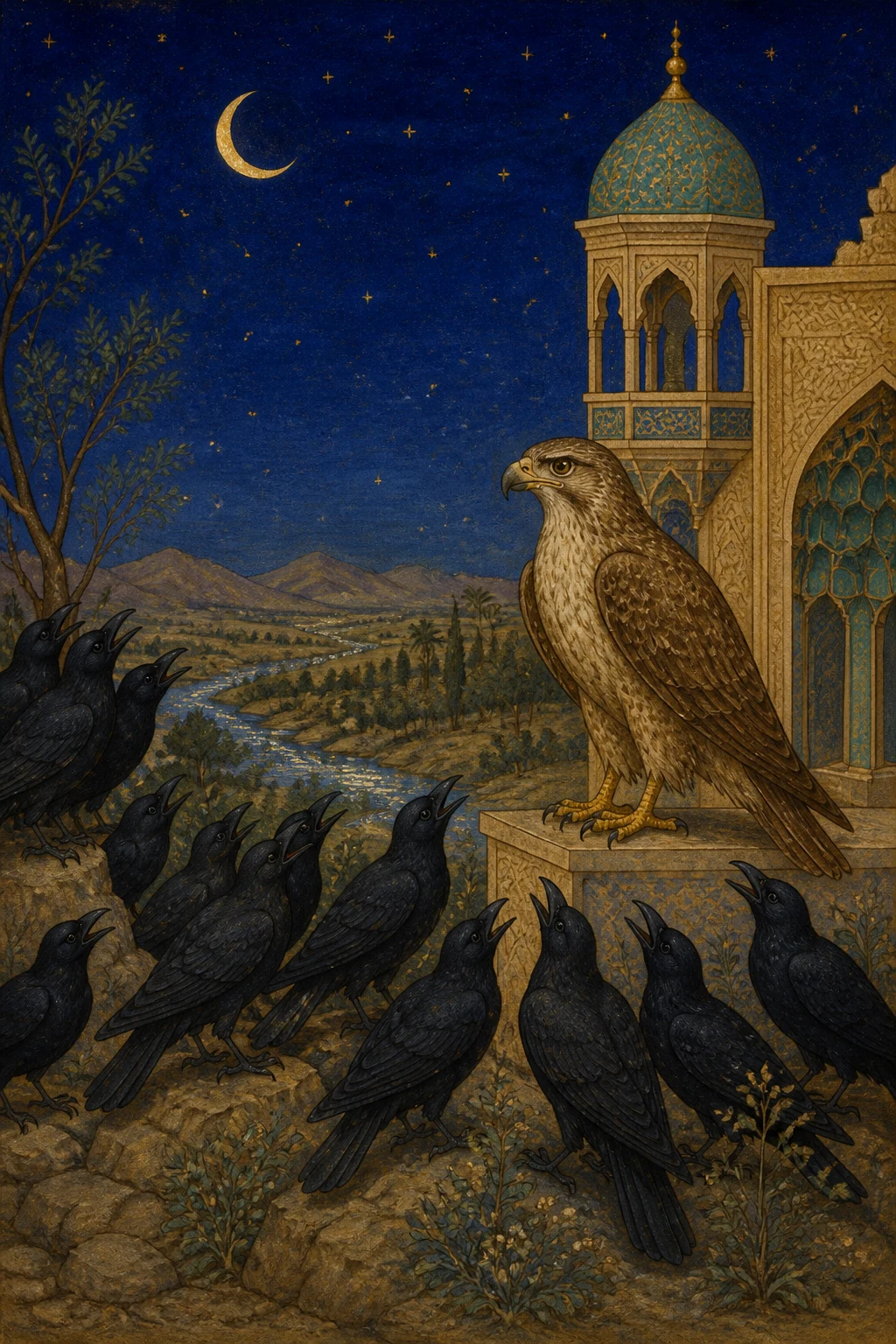
The vizier said, “Know, O King, that there was once a crow who lived with his wife in a tree, enjoying a life of ease, until their nesting season came, in the heat of summer. A snake emerged from its hole and made for that tree, winding its way among the branches until it reached the crow’s nest. There it settled and remained throughout the summer days, while the crow was driven out, finding neither a chance to return nor a place to rest. When the hot weather had passed, the snake went back to its own dwelling, and the crow said to his wife, ‘Let us thank God Most High, who has saved us and delivered us from this affliction, even though we have been deprived of our sustenance this year. God Most High will not disappoint our hopes, so let us thank Him for granting us safety and soundness of body. In Him alone do we trust, and if God wills that we live until next year, He will make good the loss of our brood.’ When their nesting season came again, the snake left its dwelling and made for the tree. As it clung to one of the branches, heading as usual for the crow’s nest, a kite suddenly swooped upon it and struck it on the head, tearing its skin. The snake fell senseless to the ground, where ants swarmed over it and devoured it. The crow and his wife then lived in safety and peace, raised many young, and thanked God for their deliverance and for the offspring He had granted them. And we, O King, must thank God for the blessing He has bestowed upon you and upon us in this blessed, fortunate child, after despair had overtaken us and all hope was gone. May God grant you a goodly reward and bring your affairs to a happy end.” And morning overtook Shahrazad, and she fell silent, leaving her tale untold.
When it was the nine hundred and fourth night
She said, “It has reached me, O fortunate King, that when the second vizier had finished speaking, he concluded with the words, ‘May God grant you a goodly reward and bring your affairs to a happy end.’ Then the third vizier rose and said, ‘Rejoice, O just King, in blessings here and rewards hereafter, for whoever is loved by the people of earth is loved by the people of heaven. God Most High has allotted you love and planted it in the hearts of the people of your kingdom. To Him, then, be thanks and praise from us and from you, that He may increase His blessings upon you, and upon us through you. Know, O King, that no man can accomplish anything except by the command of God Most High. He alone is the Giver, and every good thing a man possesses comes ultimately from Him. He apportions His blessings among His servants as He pleases: to some He grants abundant gifts; some He keeps occupied with earning their daily bread; some He makes rulers; and some He causes to renounce this world and turn their longing toward Him. For it is He who has said, “I am He who brings harm and benefit; I heal and cause sickness, enrich and impoverish, bring death and give life. In My hand are all things, and to Me is the return.” Thus it is the duty of all people to thank Him. And you, O King, are among the fortunate and righteous, as it has been said: “The most fortunate of the righteous is he for whom God unites the good of this world with the good of the next, who is content with what God has allotted him and thanks Him for the station in which He has placed him.” But whoever oversteps the bounds and seeks something other than what God has ordained for him, whether to his benefit or his loss, is like the wild ass and the fox.’ The king asked, ‘And what is their story?’”