O besedilu
Koronida, krokar in vrana
- Vir
- Ovidove preobrazbe
- Avtor
- Ovid
- Jezik branja
- English
- Jezik izvirnika
- Latin
- Čas branja
- 6 min branja
- Obseg
- 5 strani
- Naslov izvirnika
- Coronis, the Raven, and the Crow
O izvirniku
Ovidove preobrazbe
Pesniški tok antičnih preobrazb, kjer bogovi, ljudje in narava stalno menjavajo obliko. Bralni jezik je English, izvirnik pa prihaja iz vira Ovidove preobrazbe v jeziku Latin.
Besedilo
Koronida, krokar in vrana
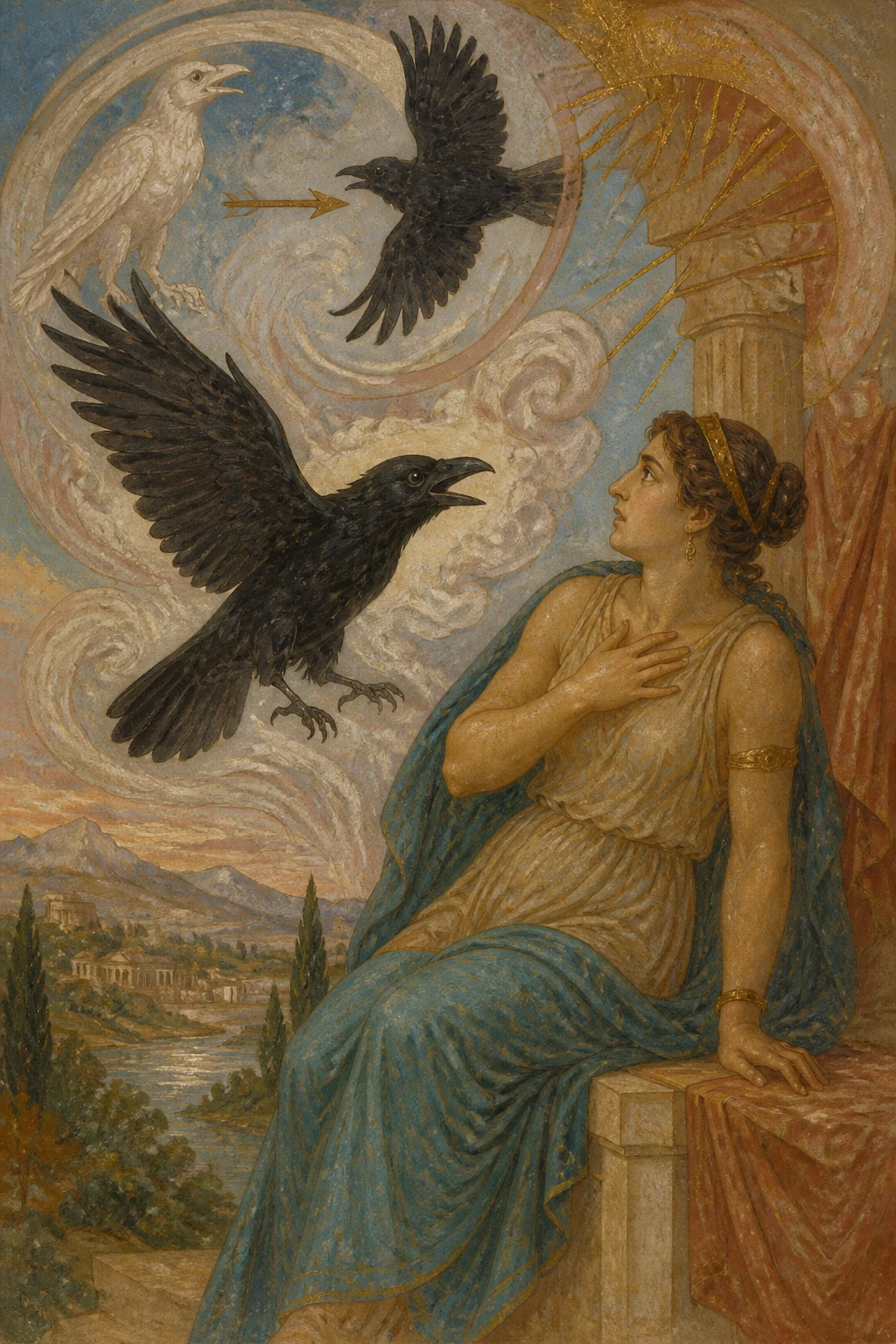
The gods of the sea had granted her wish: Saturn’s daughter, in her nimble chariot, rode through the clear air, drawn by brightly patterned peacocks, whose plumage had so recently been adorned when Argus was slain, just as you, too, had lately changed, once white, you talkative raven, your wings suddenly turning black. For once this bird was silver-white with snowy feathers, matching the spotless dove in every part, yielding nothing to the geese whose watchful cries would save the Capitol, or to the river-loving swan.
Its tongue was its undoing; because of its chattering tongue, the colour that was white is now white’s opposite. No woman in all Thessaly was lovelier than Coronis of Larissa: certainly she pleased you, god of Delphi, as long as she was faithful—or escaped detection. But Phoebus’s bird discovered her adultery and, bent on exposing her secret guilt, an informer no plea could soften, set off towards his master. A chattering crow, beating her wings, caught up with him, eager to learn everything, and, hearing the reason for his journey, said, “This road will do you no good: do not scorn my tongue’s warning.
Look at what I was and what I am, and ask what earned this change: you will find that loyalty brought me harm. For once Pallas shut Erichthonius, a child born without a mother, inside a basket woven of Attic willow, and entrusted it to the three virgin daughters of two-formed Cecrops, forbidding them to look upon her secret. Hidden among the airy leaves of a thick elm, I watched to see what they would do. Two kept faith with their charge, Pandrosos and Herse; but Aglauros called her sisters cowards and undid the knots with her own hand. Inside they saw a baby, with a serpent stretched beside him.
I told the goddess what had happened. My reward was to be driven from Minerva’s protection and placed beneath the bird of night. My punishment might well warn birds against courting danger with their voices. But perhaps you think she did not seek me out herself, though I had asked for no such favour? You may ask Pallas herself: angry as she is, her anger will not make her deny it.
For famous Coroneus, in the land of Phocis, was my father—I speak of things well known—and I was a royal maiden, wooed by wealthy suitors, so do not think me beneath you. My beauty brought me harm. For as I strolled along the shore with leisurely steps, as was my habit, over the sand’s surface, the sea god saw me and burned with desire. When he had wasted his time in pleading and honeyed words, he prepared to use force and pursued me. I fled, leaving the firm shore behind, only to tire myself in vain in the soft sand.
Then I called on gods and mortals; but my voice reached no mortal ear. A virgin took pity on a virgin and came to my aid. I was stretching my arms towards heaven: my arms began to darken with soft black feathers. I tried to fling my dress from my shoulders, but it was plumage, its roots sunk deep into my skin. I tried to beat my naked breast with my palms, but I no longer had either palms or a naked breast.
I ran, but the sand no longer held my feet as before: I was lifted above the ground. Soon I soared high through the air and became Minerva’s blameless companion. Yet what good is that, if Nyctimene, made a bird for a dreadful crime, has succeeded to my place of honour? Have you not heard the story known throughout all Lesbos, how Nyctimene defiled her father’s bed?
A bird she is indeed, but, conscious of her guilt, she shuns all eyes and daylight, hiding her shame in darkness, while every bird drives her from the sky.” As she spoke, the raven answered, “Keep these warnings for your own misfortune, I beg you: I scorn your empty omen.” He did not abandon his journey, but told his master that he had seen Coronis lying with a young Thessalian.
When the lover heard the charge, his laurel slipped away, and at once his expression changed, his plectrum fell, and the colour drained from the god’s face. His heart seething with swelling anger, he seized his accustomed weapons, bent his bow by drawing back its tips, and pierced that breast so often pressed against his own with a shaft she could not escape. Struck, she groaned, and, drawing the iron from her body, drenched her white limbs in crimson blood.
“You might have punished me, Phoebus,” she said, “but let me give birth first: now two will die in one.” That was all: her life poured out with her blood. The chill of death overtook her body, emptied of its soul. Alas, too late the lover regretted his cruel punishment, and hated himself for listening, for blazing into such fury; he hated the bird that had forced him to learn her guilt and the cause of his grief; he hated his bow, his hand, and, with that hand, the arrows, those reckless weapons.
He cradled her fallen body and, with help too late, struggled to conquer fate, practising his healing arts in vain. When all his efforts proved fruitless, and he saw the pyre being prepared, and her limbs destined for the final flames, then indeed—for tears may not wet the faces of the gods—he brought forth groans drawn from his heart’s depths, just as a cow moans when, before her eyes, a hammer, swung from beside the butcher’s right ear, shatters her suckling calf’s hollow temples with a ringing blow.
Yet when he had poured unavailing perfumes upon her breast, embraced her, and performed the unjust rites that duty required, Phoebus could not bear his own offspring to fall into those same ashes: he snatched his son from the flames and from his mother’s womb, and carried him to the cave of two-formed Chiron; and the raven, who hoped for a reward for his truthful tongue, he forbade ever again to take his place among white birds.
Izvirnik
Coronis, the Raven, and the Crow
Naslednje strani prikazujejo izvirno besedilo za primerjavo.
Source ID: ovid_metamorphoses_story_013 Citation: Ovid, Metamorphoses 2.531-2.632 Original language: Latin Source: PerseusDL canonical-latinLit Source URL: https://github.com/PerseusDL/canonical-latinLit/blob/master/data/phi0959/phi006/phi0959.phi006.perseus-lat2.xml Segmentation certainty: medium 531: Di maris adnuerant: habili Saturnia curru 532: ingreditur liquidum pavonibus aethera pictis, 533: tam nuper pictis caeso pavonibus Argo, 534: quam tu nuper eras, cum candidus ante fuisses, 535: corve loquax, subito nigrantes versus in alas.
536: Nam fuit haec quondam niveis argentea pennis 537: ales ut aequaret totas sine labe columbas 538: nec servaturis vigili Capitolia voce 539: cederet anseribus nec amanti flumina cycno. 540: Lingua fuit damno; lingua faciente loquaci 541: qui color albus erat, nunc est contrarius albo. 542: Pulchrior in tota, quam Larisaea Coronis, 543: non fuit Haemonia: placuit tibi, Delphice, certe, 544: dum vel casta fuit vel inobservata. Sed ales 545: sensit adulterium Phoebeius, utque latentem 546: detegeret culpam, non exorabilis index, 547: ad dominum tendebat iter. Quem garrula motis
548: consequitur pennis, scitetur ut omnia, cornix, 549: auditaque viae causa “non utile carpis” 550: inquit “iter: ne sperne meae praesagia linguae. 551: Quid fuerim quid simque vide, meritumque require: 552: invenies nocuisse fidem. Nam tempore quodam 553: Pallas Erichthonium, prolem sine matre creatam, 554: clauserat Actaeo texta de vimine cista 555: virginibusque tribus gemino de Cecrope natis 556: et legem dederat, sua ne secreta viderent.
557: Abdita fronde levi densa speculabar ab ulmo, 558: quid facerent. Commissa duae sine fraude tuentur, 559: Pandrosos atque Herse; timidas vocat una sorores 560: Aglauros nodosque manu diducit, et intus 561: infantemque vident adporrectumque draconem. 562: Acta deae refero. Pro quo mihi gratia talis 563: redditur, ut dicar tutela pulsa Minervae 564: et ponar post noctis avem. Mea poena volucres 565: admonuisse potest ne voce pericula quaerant.
566: At, puto, non ultro nec quicquam tale rogantem 567: me petiit? ipsa licet hoc a Pallade quaeras: 568: quamvis irata est, non hoc irata negabit. 569: Nam me Phocaica clarus tellure Coroneus 570: (nota loquor) genuit fueramque ego regia virgo 571: divitibusque procis (ne me contemne) petebar. 572: Forma mihi nocuit. Nam cum per litora lentis 573: passibus, ut soleo, summa spatiarer harena, 574: vidit et incaluit pelagi deus; utque precando 575: tempora cum blandis absumpsit inania verbis, 576: vim parat et sequitur. Fugio densumque relinquo 577: litus et in molli nequiquam lassor harena.
578: Inde deos hominesque voco; nec contigit ullum 579: vox mea mortalem: mota est pro virgine virgo 580: auxiliumque tulit. Tendebam bracchia caelo: 581: bracchia coeperunt levibus nigrescere pennis. 582: Reicere ex umeris vestem molibar: at illa 583: pluma erat inque cutem radices egerat imas. 584: Plangere nuda meis conabar pectora palmis: 585: sed neque iam palmas nec pectora nuda gerebam.
586: Currebam: nec, ut ante, pedes retinebat harena, 587: sed summa tollebar humo. Mox alta per auras 588: evehor et data sum comes inculpata Minervae. 589: Quid tamen hoc prodest, si diro facta volucris 590: crimine Nyctimene nostro successit honori? 591: An quae per totam res est notissima Lesbon, 592: non audita tibi est, patrium temerasse cubile 593: Nyctimenen? avis illa quidem, sed conscia culpae 594: conspectum lucemque fugit tenebrisque pudorem 595: celat et a cunctis expellitur aethere toto.”
596: Talia dicenti “tibi” ait “revocamina” corvus 597: “sint precor ista malo: nos vanum spernimus omen.” 598: Nec coeptum dimittit iter, dominoque iacentem 599: cum iuvene Haemonio vidisse Coronida narrat. 600: Laurea delapsa est audito crimine amanti, 601: et pariter vultusque deo plectrumque colorque 602: excidit. Utque animus tumida fervebat ab ira, 603: arma adsueta rapit flexumque a cornibus arcum 604: tendit et illa suo totiens cum pectore iuncta 605: indevitato traiecit pectora telo.
606: Icta dedit gemitum, tractoque a corpore ferro 607: candida puniceo perfudit membra cruore, 608: et dixit: “Potui poenas tibi, Phoebe, dedisse, 609: sed peperisse prius: duo nunc moriemur in una.” 610: Hactenus, et pariter vitam cum sanguine fudit. 611: Corpus inane animae frigus letale secutum est. 612: Paenitet heu sero poenae crudelis amantem, 613: seque, quod audierit, quod sic exarserit, odit; 614: odit avem, per quam crimen causamque dolendi 615: scire coactus erat, nec non arcumque manumque 616: odit, cumque manu temeraria tela sagittas 617: conlapsamque fovet seraque ope vincere fata
618: nititur et medicas exercet inaniter artes. 619: Quae postquam frustra temptata, rogumque parari 620: vidit et arsuros supremis ignibus artus, 621: tum vero gemitus (neque enim caelestia tingi 622: ora licet lacrimis) alto de corde petitos 623: edidit, haud aliter quam cum spectante iuvenca 624: lactentis vituli, dextra libratus ab aure 625: tempora discussit claro cava malleus ictu.
626: Ut tamen ingratos in pectora fudit odores 627: et dedit amplexus iniustaque iusta peregit, 628: non tulit in cineres labi sua Phoebus eosdem 629: semina, sed natum flammis uteroque parentis 630: eripuit geminique tulit Chironis in antrum; 631: sperantemque sibi non falsae praemia linguae 632: inter aves albas vetuit consistere corvum.
Nadaljuj z branjem