O besedilu
Odisej in Kiklop
- Vir
- Odiseja
- Avtor
- Homer
- Jezik branja
- English
- Jezik izvirnika
- Ancient Greek
- Čas branja
- 28 min branja
- Obseg
- 22 strani
- Naslov izvirnika
- Odysseus and the Cyclops
O izvirniku
Odiseja
Dolga vrnitev domov čez morja, otoke, preizkušnje in prepoznavanja. Bralni jezik je English, izvirnik pa prihaja iz vira Odiseja v jeziku Ancient Greek.
Besedilo
Odisej in Kiklop
Then resourceful Odysseus answered him: “Lord Alcinous, most renowned of all your people, it is indeed a fine thing to listen to a singer such as this, whose voice is like a god’s.
For I say there is no greater delight than when joy fills a whole people, and guests sit in rows throughout the hall listening to a singer, with tables beside them laden with bread and meat, while the cupbearer draws wine from the mixing bowl, carries it round, and pours it into their cups. To my mind, this is the loveliest thing of all.
But your heart has moved you to ask about my grievous sorrows, so that I must weep and groan still more. What shall I tell you first, and what last? For the gods who dwell in heaven have given me many troubles.
First I shall tell you my name, so that you too may know it, and so that, if I escape this merciless day, I may be your guest-friend hereafter, though my home is far away. I am Odysseus, son of Laertes, known to all men for my many stratagems, and my fame reaches heaven.
I live in clear-seen Ithaca, where Mount Neriton rises conspicuous, its leaves trembling in the wind. Around it lie many islands, close to one another: Dulichium, Same, and wooded Zacynthus.
Ithaca itself lies low in the sea, farthest toward the darkness of the west, while the others lie apart toward the dawn and the sun. It is a rugged land, but a good nurse of young men; and for myself, I can see nothing sweeter than one’s own country.
Calypso, that lovely goddess, kept me there in her hollow caves, longing to have me for her husband. So too did crafty Circe of Aeaea detain me in her halls, longing to have me for her husband. But neither ever won the heart within my breast.
So nothing is sweeter than one’s homeland and one’s parents, even if a man lives in a rich house far away, in a foreign country, apart from his parents. But come, let me tell you of my sorrow-laden journey home, which Zeus laid upon me as I came from Troy.
From Ilium the wind carried me to the Cicones, at Ismarus. There I sacked the city and killed its men. We took their wives and much treasure from the city and divided them, so that no one should go deprived of an equal share.
Then I urged us to flee with all speed, but in their great folly the men would not listen. They drank wine in abundance and slaughtered many sheep beside the shore, along with shambling, crook-horned cattle. Meanwhile the Cicones who had escaped went and called to their neighbors, Cicones who lived inland, more numerous and better fighters, skilled in battling men from chariots and, when need arose, on foot.
They came at dawn, as many as the leaves and flowers of spring. Then an evil doom from Zeus stood beside us, ill-fated men, bringing us much suffering. They drew up their ranks and fought beside the swift ships, and we hurled bronze-tipped spears at one another.
As long as it was morning and the sacred day grew brighter, we stood our ground and held them off, though they outnumbered us. But when the sun turned toward the hour when oxen are unyoked, the Cicones overpowered the Achaeans and drove them back.
From each ship six of my well-greaved companions died; the rest of us escaped death and destruction. From there we sailed onward, grieving at heart, glad to have escaped death, yet mourning the dear companions we had lost.
But my curved ships did not sail farther until we had called three times upon each of our unhappy comrades who had died on the plain, cut down by the Cicones. Then Zeus the cloud-gatherer roused the North Wind against our ships in a tremendous tempest, and shrouded land and sea alike in clouds. Night swept down from heaven.
The ships were driven sideways, and the force of the wind tore their sails into shreds. Fearing destruction, we lowered them into the ships and rowed hard for the mainland.
There we lay for two nights and two days without a break, our hearts consumed by weariness and grief. But when lovely-haired Dawn brought the third day, we raised the masts, hauled up the white sails, and sat down, while the wind and the helmsmen guided the ships.
And I might now have reached my homeland unharmed, but as I rounded Malea, the waves, the current, and the North Wind drove me off course and swept me past Cythera. From there, for nine days, deadly winds carried me over the fish-filled sea; on the tenth we landed in the country of the Lotus-Eaters, who feed on a flowering food.
There we went ashore and drew water, and my companions quickly took their meal beside the swift ships. When we had eaten and drunk, I sent some men to find out what people lived there and ate the bread of the land. I chose two men and sent a herald with them as a third.
They went at once and mingled with the Lotus-Eaters. The Lotus-Eaters had no thought of killing our companions, but gave them lotus to taste. Whoever ate the honey-sweet fruit of the lotus no longer wished to bring back word or return, but wanted to stay there among the Lotus-Eaters, feeding on lotus and forgetting his homeward journey.
I brought them back to the ships by force, weeping, and dragged them beneath the benches of the hollow ships and bound them there. Then I ordered the rest of my loyal companions to hurry aboard the swift ships, lest any of them should eat the lotus and forget his homeward journey.
They quickly boarded and took their places at the oarlocks, and sitting in rows they struck the gray sea with their oars. From there we sailed onward, grieving at heart, and came to the land of the Cyclopes, an arrogant and lawless people. Trusting in the immortal gods, they neither plant with their hands nor plow; everything grows unsown and untilled—wheat and barley and vines that yield wine from abundant clusters, nourished by the rain of Zeus.
They have no assemblies for counsel, no established laws, but live on the peaks of lofty mountains in hollow caves. Each rules over his own children and wives, and they take no heed of one another.
A wooded island lies outside the harbor, neither close to the Cyclopes’ land nor far away. Countless wild goats breed there, for no human footsteps disturb them, nor do hunters come there, men who endure hardship in the woods as they range over mountain heights.
No flocks or plowed fields occupy it. Unsown and untilled for all time, it lies empty of men and feeds bleating goats. For the Cyclopes have no red-cheeked ships, nor shipwrights who could build them well-benched vessels to serve their needs, visiting the cities of men, as men so often cross the sea in ships to visit one another. Such craftsmen could also have made this island a flourishing settlement.
For it is by no means poor land, and would bear every crop in season. Beside the shores of the gray sea lie soft, well-watered meadows, where vines would never fail. There is level land for plowing, where men could always reap a deep harvest in season, so rich is the soil beneath.
There is also a harbor with safe anchorage, where no mooring rope is needed, no anchor need be cast or stern cables fastened. Men can beach their ships and wait until their hearts urge them to sail and the breezes blow.
At the head of the harbor a spring of bright water flows from beneath a cave, with poplars growing round it. There we sailed in, and some god guided us through the murky night, for nothing could be seen ahead. A deep mist lay about the ships, and no moon shone down from heaven, hidden as it was by clouds.
Not one of us saw the island with his own eyes, nor did we see the long waves rolling toward the shore until we beached our well-benched ships. Once they were beached, we lowered all the sails and stepped out upon the seashore. There we fell asleep and waited for divine Dawn.
When early-born, rosy-fingered Dawn appeared, we roamed about the island, marveling at it. And the nymphs, daughters of aegis-bearing Zeus, stirred up the mountain goats so that my companions might have a meal.
At once we took our curved bows and long-socketed hunting spears from the ships, divided into three companies, and began to shoot. The god soon gave us game to our hearts’ content. Twelve ships had followed me, and each received nine goats; for me alone they chose ten.
So all that day until the sun went down we sat feasting on abundant meat and sweet wine. For the red wine aboard our ships had not yet run out; some remained, since each of us had drawn off plenty in jars when we took the sacred city of the Cicones.
We looked across to the nearby land of the Cyclopes and saw their smoke, and heard their voices and the bleating of their sheep and goats. When the sun went down and darkness came, we lay down to sleep upon the seashore.
When early-born, rosy-fingered Dawn appeared, I called an assembly and spoke before them all: ‘The rest of you, my loyal companions, stay here for now. I shall go with my own ship and crew to find out what sort of men these are: whether they are violent, savage, and unjust, or welcoming to strangers, with hearts that fear the gods.’
With that I boarded my ship and told my companions to come aboard themselves and loosen the stern cables. They quickly boarded and took their places at the oarlocks, and sitting in rows they struck the gray sea with their oars.
When we reached that nearby coast, we saw a lofty cave at its edge, close to the sea and overhung with laurels. Many sheep and goats were penned there at night, and round it a high enclosure had been built of stones sunk deep in the earth, tall pines, and lofty-crowned oaks.
There a monstrous man lived, who tended his flocks alone, far from others. He did not mingle with them, but lived apart, knowing no law. He was a monstrous wonder to behold, not like a man who eats bread, but like a wooded peak of the high mountains, standing out alone from the rest.
Then I ordered the rest of my loyal companions to stay there beside the ship and guard it, while I chose twelve of the best and set out. I took a goatskin of dark, sweet wine, given me by Maron, son of Euanthes, priest of Apollo, who watched over Ismarus. We had spared him, his child, and his wife out of reverence, for he lived in the wooded grove of Phoebus Apollo. He gave me splendid gifts: seven talents of well-wrought gold, a mixing bowl of solid silver, and wine drawn into twelve jars, sweet and unmixed, a divine drink. None of the slaves or serving women in his house knew of it, only himself, his dear wife, and a single housekeeper.
Whenever they drank that honey-sweet red wine, he would fill one cup and pour it into twenty measures of water, and a wondrously sweet fragrance rose from the mixing bowl. Then it was hard indeed to leave it untasted.
I carried a great skin filled with this wine, and provisions too in a bag, for my bold heart at once suspected that we would encounter a man endowed with enormous strength, a savage who knew neither justice nor law.
We soon reached the cave but did not find him inside; he was grazing his fat flocks in the pastures. We went into the cave and gazed in wonder at everything. Racks were heavy with cheeses, and the pens were crowded with lambs and kids, each age kept separate: the firstborn apart, the younger ones apart, and the newborns apart again. All his vessels brimmed with whey, the pails and bowls he had made for milking.
At first my companions begged me to take some cheeses and go back, then quickly drive the kids and lambs out of their pens to the swift ship and sail away over the salt water. But I would not listen—though it would have been far better—for I wanted to see the man himself and learn whether he would give me gifts of hospitality.
Yet his appearance was to bring my companions no joy. We lit a fire and made an offering, then took some cheeses ourselves and ate. We sat inside waiting for him until he came back with his flocks. He carried a huge load of dry wood for his supper, and flung it down inside the cave with a crash. In terror we fled to the cave’s deepest recess.
He drove his fat flocks into the broad cave, all those he milked, but left the males outside, the rams and he-goats, beyond the spacious yard.
Then he lifted a huge, heavy stone and set it in the doorway. Not even twenty-two good four-wheeled wagons could have shifted it from the ground, so immense was the towering rock he placed across the entrance.
He sat down and milked the ewes and bleating goats, all in proper order, and put her young beneath each mother. At once he curdled half the white milk, gathered it up, and laid it in woven baskets; the other half he left standing in vessels, to take and drink with his supper.
When he had briskly finished all his tasks, he lit the fire and saw us, and asked: ‘Strangers, who are you? Where have you sailed from over the watery ways?
‘Are you on some business, or do you wander aimlessly over the sea like pirates, who roam about risking their lives and bringing harm to foreign peoples?’ So he spoke, and our hearts broke within us, terrified by his deep voice and monstrous size.
Yet even so I answered him: ‘We are Achaeans, driven astray from Troy by every kind of wind across the great gulf of the sea. We were making for home, but have come by another road, by other paths. Such, it seems, was the will of Zeus.
‘We are proud to be men of Agamemnon, son of Atreus, whose fame is now greatest beneath heaven, so mighty a city did he sack, so many people did he destroy. Now we have come as suppliants to your knees, hoping you will offer us hospitality or give us some other gift, as is the custom toward strangers.
‘Respect the gods, good sir, for we are your suppliants. Zeus avenges suppliants and strangers, Zeus the god of guests, who attends upon strangers worthy of respect.’ So I spoke, and at once he answered me with a pitiless heart: ‘You are a fool, stranger, or you have come from far away, to tell me to fear or heed the gods. We Cyclopes care nothing for aegis-bearing Zeus or the blessed gods, since we are far stronger. Nor would I spare you or your companions to avoid the anger of Zeus, unless my own heart bade me.
‘But tell me where you moored your well-built ship when you came. Is it somewhere far away, or close at hand? I should like to know.’ So he spoke to test me, but I knew too much to miss his meaning, and answered him with crafty words: ‘Poseidon the Earth-shaker shattered my ship, dashing it against the rocks at the edge of your country, where he drove it against a headland. The wind swept it in from the open sea. But I and these men escaped utter destruction.’
So I spoke, but in his pitiless heart he gave me no answer. He sprang up, reached for my companions, seized two at once, and dashed them against the ground like puppies. Their brains spilled out upon the floor and soaked the earth.
He cut them limb from limb and made his supper, eating like a mountain lion, leaving nothing—entrails, flesh, or marrow-filled bones. We raised our hands to Zeus and wept at the dreadful sight, while helplessness possessed our hearts.
When the Cyclops had filled his great belly with human flesh and washed it down with undiluted milk, he stretched out inside the cave among his flocks. In my bold heart I planned to draw near, pull my sharp sword from beside my thigh, and stab him in the breast where the midriff holds the liver, feeling for the place with my hand. But another thought held me back.
For we too would have perished there in utter destruction: we could never have pushed aside with our hands the heavy stone he had set against the lofty doorway. So we groaned and waited for divine Dawn.
When early-born, rosy-fingered Dawn appeared, he lit the fire and milked his fine flocks, all in proper order, and put her young beneath each mother. When he had briskly finished all his tasks, he seized two more of my companions and made his breakfast.
After eating, he drove his fat flocks out of the cave, easily removing the great doorstone, then set it back again as lightly as a man might put the lid on a quiver. With loud whistling the Cyclops turned his fat flocks toward the mountains, while I remained behind, brooding on mischief, hoping to take revenge if Athena would grant me glory.
This seemed to my heart the best plan. Beside a pen lay the Cyclops’ great club, an olive trunk still green, which he had cut to carry once it dried. As we looked at it, we thought it as large as the mast of a black twenty-oared ship, a broad merchant vessel that crosses the great gulf of the sea. Such was its length and thickness to our eyes.
I went up to it, cut off a length of about a fathom, and gave it to my companions, telling them to smooth it down. They made it even, and I stood beside them and sharpened its end, then took it and hardened it in the blazing fire.
I hid it carefully beneath the dung that lay in great heaps throughout the cave, and ordered the others to cast lots to see who would dare help me lift the stake and twist it in his eye when sweet sleep came upon him.
The lot fell upon the very men I would have wished to choose, four of them, and I made the fifth. At evening he returned, driving his fine-fleeced flocks.
At once he drove all his fat flocks into the broad cave, leaving none outside in the spacious yard, either from some suspicion or because a god had prompted him. Then he lifted the great doorstone and put it in place, sat down, and milked the ewes and bleating goats, all in proper order, putting her young beneath each mother.
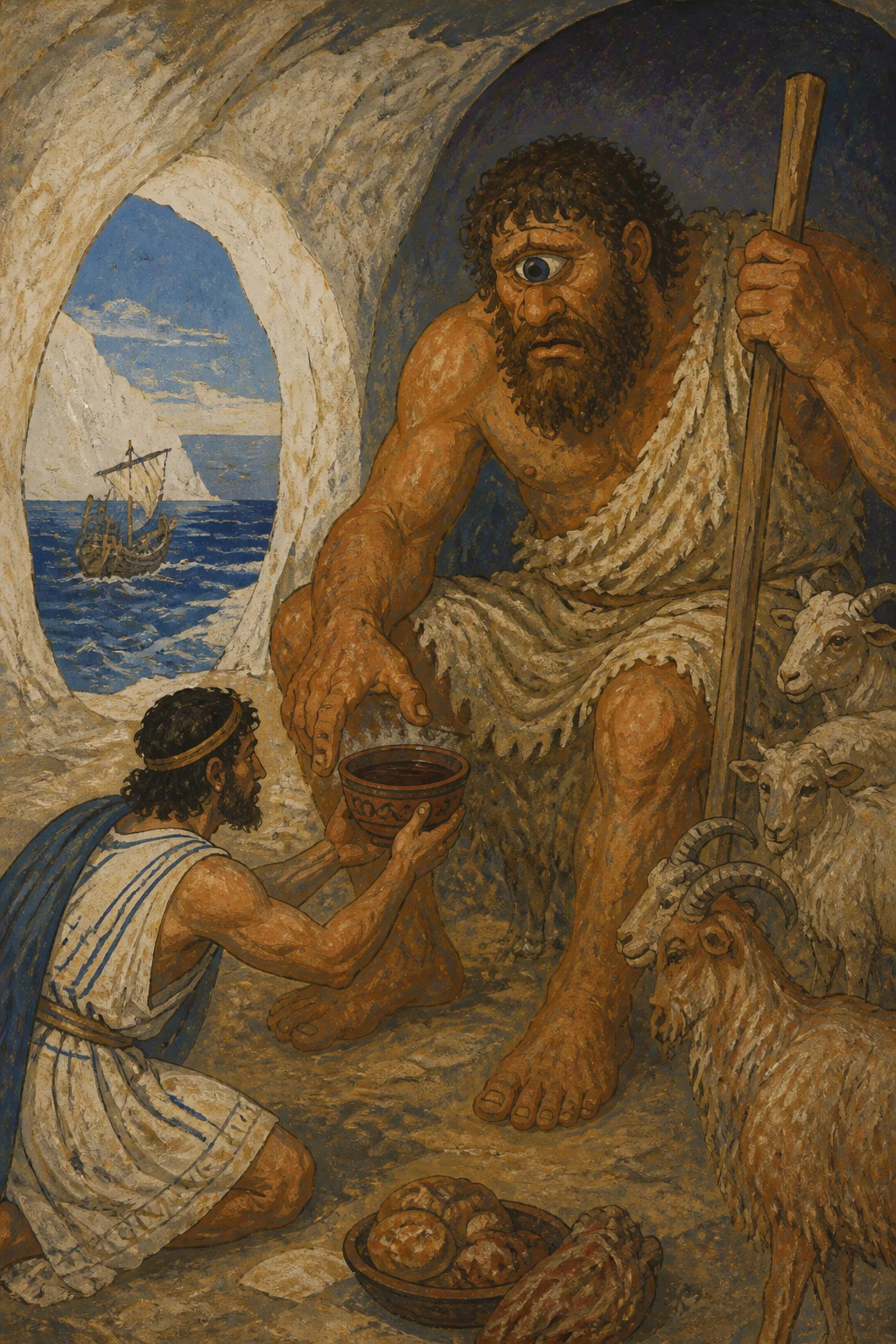
When he had briskly finished all his tasks, he seized two more of my companions and made his supper. Then I went up to the Cyclops and spoke, holding an ivywood cup of dark wine in my hands: ‘Here, Cyclops, drink some wine now that you have eaten human flesh, so that you may know what a drink our ship held. I brought it as an offering to you, hoping you might pity me and send me home. But your rage has passed all bounds.
‘Cruel creature, how could any other man among the many people of the world ever come to you again, after such lawless deeds?’ So I spoke, and he took the cup and drained it. He delighted greatly in the sweet drink and asked me for another: ‘Be generous and give me more, and tell me your name at once, so that I may give you a guest-gift that will please you. For the grain-giving earth yields wine from abundant clusters for the Cyclopes too, and the rain of Zeus nourishes it. But this is a stream of ambrosia and nectar.’
So he spoke, and again I gave him the gleaming wine. Three times I brought it, and three times he drained it in his folly. When the wine had stolen about the Cyclops’ wits, I spoke to him with soothing words: ‘Cyclops, you ask my famous name, and I will tell you. But give me the guest-gift you promised.
‘My name is Nobody. Nobody is what my mother and father call me, and all my companions too.’ So I spoke, and at once he answered me with a pitiless heart: ‘Nobody I shall eat last, after his companions; the others first. That shall be your guest-gift.’
With that he leaned back and fell upon his back, then lay with his thick neck bent sideways, and all-conquering sleep took hold of him. Wine and morsels of human flesh gushed from his throat as he belched in his drunken stupor.
Then I thrust the stake beneath the deep ashes to heat it, and encouraged all my companions, so that none might shrink back in fear. When the olive stake, green though it was, was about to catch fire and glowed fiercely, I brought it from the flames. My companions stood around me, and a divine power breathed great courage into us.
They took the olive stake, sharp at the tip, and drove it into his eye, while I threw my weight upon it from above and twisted it, as a man bores a ship’s timber with a drill, while others below pull a strap back and forth, grasping it at either end, and the drill spins steadily.
So we gripped the fire-sharpened stake and twisted it in his eye, and the blood flowed round the burning wood. The heat from the blazing eyeball scorched his eyelids and brows all round, and the roots of his eye crackled in the fire.
As when a smith plunges a great axe or adze into cold water, and it hisses loudly as he tempers it—for this gives iron its strength—so his eye hissed round the olive stake.
He gave a great, hideous howl, and the rock rang round him. We drew back in terror, while he pulled the stake from his eye, drenched in blood. In his frenzy he flung it away, then shouted loudly to the Cyclopes who lived around him in caves along the windy heights.
Hearing his cries, they came from every direction, and standing round the cave they asked what troubled him: ‘Polyphemus, what pain has made you cry out so loudly through the immortal night and keep us from our sleep?
‘Is some mortal driving off your flocks against your will? Is someone killing you by trickery or force?’ And mighty Polyphemus answered them from the cave: ‘My friends, Nobody is killing me by trickery, not by force.’
Then they answered him with winged words: ‘If nobody is attacking you and you are alone, there is no escaping a sickness sent by mighty Zeus. Pray to your father, Lord Poseidon.’
So they spoke and went away, and my heart laughed within me at how my name and flawless cunning had deceived them. The Cyclops, groaning and writhing in pain, felt about with his hands, removed the stone from the doorway, and sat in the entrance with his arms outstretched, hoping to catch anyone who tried to go out among the sheep. So foolish did he think me.
But I was considering how best to act, whether I could find some escape from death for my companions and myself. I wove every kind of trick and scheme, as a man will when his life is at stake, for great danger stood close beside us.
This seemed to my heart the best plan. There were well-fed, thick-fleeced rams, handsome and large, with wool dark as violets. Silently I bound them together in threes with the twisted willow withes on which that monstrous, lawless Cyclops slept. The middle ram carried a man, while the other two walked on either side, shielding my companions.
Three sheep carried each man. As for me, there was one ram far finer than all the flock. I caught hold of his back, curled beneath his shaggy belly, and lay there, clinging steadfastly with my hands twisted in his wondrous fleece, my heart enduring.
So we groaned and waited for divine Dawn. When early-born, rosy-fingered Dawn appeared, the male sheep rushed out to pasture, while the unmilked females bleated round the pens, their udders swollen. Their master, tormented by cruel pains, felt the backs of all the sheep as they stood before him. The fool did not see that men were bound beneath the breasts of the woolly sheep.
Last of the flock the ram made his way outside, weighed down by his fleece and by me with my busy thoughts. Mighty Polyphemus felt him and said: ‘Dear ram, why are you the last of the flock to hurry through the cave? You never used to lag behind the sheep. No, you were always first by far to stride out and graze on the tender flowers of the grass, first to reach the flowing streams, and first to long for home at evening. Yet now you are the very last. Surely you are grieving for your master’s eye, which an evil man blinded with his wretched companions, after overcoming my wits with wine—Nobody, who, I tell you, has not yet escaped destruction.
‘If only you could share my thoughts and find a voice to tell me where he hides from my fury! Then his brains would be dashed here and there throughout the cave as I beat him against the ground, and my heart would find relief from the misery that worthless Nobody has brought upon me.’
With that he sent the ram away from him and out of doors. When we were a little way from the cave and yard, I freed myself first from beneath the ram, then released my companions. Quickly we gathered the long-legged sheep, rich with fat, and drove them on until we reached the ship. Our dear companions welcomed us who had escaped death, but mourned the others with cries and tears.
But I would not let them weep. I raised my brows to each in warning and ordered them to load the many fine-fleeced sheep aboard at once and sail away over the salt water. They quickly boarded and took their places at the oarlocks, and sitting in rows they struck the gray sea with their oars.
When we were as far away as a man’s shout carries, I called to the Cyclops in mockery: ‘Cyclops, it was no coward’s companions you were destined to eat by brute force in your hollow cave.
‘Your evil deeds were bound to overtake you, cruel creature, since you did not shrink from eating guests in your own house. So Zeus and the other gods have punished you.’ So I spoke, and his heart grew still more furious. He tore off the summit of a great mountain and hurled it. It fell just beyond our dark-prowed ship, narrowly missing the tip of the steering oar. The sea surged beneath the falling rock, and the backwash, a great flood from the open water, carried the ship toward the mainland and drove it close to shore.
I seized a long pole in my hands and pushed us off, and, nodding my head, urged my companions to bend to their oars so that we might escape destruction. They threw themselves forward and rowed.
But when we had made twice that distance across the sea, I again called out to the Cyclops, though my companions tried from every side to restrain me with pleading words: ‘Reckless man, why do you want to provoke that savage?
‘Just now he hurled a missile into the sea and drove the ship back to land, and we thought we would die there. If he hears anyone speaking or calling out, he will crush our heads and the ship’s timbers with a jagged rock. He can throw that far!’
So they spoke, but they could not persuade my proud heart. I called back to him in anger: ‘Cyclops, if any mortal man asks you about the shameful blinding of your eye, tell him that Odysseus, sacker of cities, blinded you, the son of Laertes, whose home is in Ithaca.’
So I spoke, and with a groan he answered me: ‘Ah, now the prophecies spoken long ago have overtaken me! There was a seer here, a noble, mighty man, Telemus son of Eurymus, who excelled in prophecy and grew old foretelling the future among the Cyclopes. He told me all this would one day come to pass, that at the hands of Odysseus I would lose my sight.
‘But I always expected some great and handsome man to come here, endowed with enormous strength. Instead, a little, worthless weakling has blinded me, after overcoming me with wine.
‘But come here, Odysseus, so that I may give you gifts of hospitality and urge the renowned Earth-shaker to grant you safe passage. For I am his son, and he declares himself my father.
“He himself, if he chooses, will heal me, and no one else, neither among the blessed gods nor among mortal men.” So he spoke, and I answered him: “If only I could strip you of life and breath and send you down to the house of Hades, as surely as not even the Earth-shaker will heal your eye!”
So I spoke, and he prayed to lord Poseidon, stretching out his hands toward the starry sky: “Hear me, Poseidon, dark-haired lord who holds the earth! If I am truly your son, and you claim to be my father, grant that Odysseus, sacker of cities, son of Laertes, whose home is in Ithaca, may never reach his native land.
“But if it is his fate to see his loved ones again and return to his well-built house and his native land, let him come late and in misery, having lost all his companions, aboard another man’s ship, and let him find trouble in his home.”
So he prayed, and the dark-haired god heard him. Then once more he lifted a rock, far larger than before, whirled it round, and hurled it with all his boundless strength. It fell just behind our dark-prowed ship, narrowly missing the tip of the steering oar.
The sea surged beneath the falling rock, and the wave carried our ship onward and drove her toward land. When we reached the island where the other well-benched ships lay gathered, and our companions sat grieving around them, still watching for our return, we beached our ship on the sand and stepped out onto the seashore.
We took the Cyclops’ sheep out of the hollow ship and divided them, so that no one should go without his fair share. When the sheep were shared out, my well-greaved companions gave me the ram as a special prize. There on the shore I sacrificed him to Zeus of the dark clouds, son of Cronus, who rules over all, and burned the thighbones. But he paid no heed to my offerings; instead, he pondered how all my well-benched ships and my faithful companions might perish.
Then all day long, until the sun went down, we sat feasting on meat in abundance and sweet wine. When the sun had set and darkness came on, we lay down to sleep beside the breaking sea.
When early-born, rosy-fingered Dawn appeared, I roused my companions and ordered them to board the ships and loose the stern cables. They quickly went aboard and took their places at the oarlocks, and sitting in their rows, they struck the gray sea with their oars.
From there we sailed onward, grieving at heart, glad to have escaped death, yet mourning the dear companions we had lost.
Izvirnik
Odysseus and the Cyclops
Naslednje strani prikazujejo izvirno besedilo za primerjavo.
τὸν δʼ ἀπαμειβόμενος προσέφη πολύμητις Ὀδυσσεύς· Ἀλκίνοε κρεῖον, πάντων ἀριδείκετε λαῶν, ἦ τοι μὲν τόδε καλὸν ἀκουέμεν ἐστὶν ἀοιδοῦ τοιοῦδʼ οἷος ὅδʼ ἐστί, θεοῖς ἐναλίγκιος αὐδήν. οὐ γὰρ ἐγώ γέ τί φημι τέλος χαριέστερον εἶναι ἢ ὅτʼ ἐυφροσύνη μὲν ἔχῃ κάτα δῆμον ἅπαντα, δαιτυμόνες δʼ ἀνὰ δώματʼ ἀκουάζωνται ἀοιδοῦ ἥμενοι ἑξείης, παρὰ δὲ πλήθωσι τράπεζαι σίτου καὶ κρειῶν, μέθυ δʼ ἐκ κρητῆρος ἀφύσσων οἰνοχόος φορέῃσι καὶ ἐγχείῃ δεπάεσσι· τοῦτό τί μοι κάλλιστον ἐνὶ φρεσὶν εἴδεται εἶναι.
σοὶ δʼ ἐμὰ κήδεα θυμὸς ἐπετράπετο στονόεντα εἴρεσθʼ, ὄφρʼ ἔτι μᾶλλον ὀδυρόμενος στεναχίζω· τί πρῶτόν τοι ἔπειτα, τί δʼ ὑστάτιον καταλέξω; κήδεʼ ἐπεί μοι πολλὰ δόσαν θεοὶ Οὐρανίωνες. νῦν δʼ ὄνομα πρῶτον μυθήσομαι, ὄφρα καὶ ὑμεῖς εἴδετʼ, ἐγὼ δʼ ἂν ἔπειτα φυγὼν ὕπο νηλεὲς ἦμαρ ὑμῖν ξεῖνος ἔω καὶ ἀπόπροθι δώματα ναίων. εἴμʼ Ὀδυσεὺς Λαερτιάδης, ὃς πᾶσι δόλοισιν ἀνθρώποισι μέλω, καί μευ κλέος οὐρανὸν ἵκει.
ναιετάω δʼ Ἰθάκην ἐυδείελον· ἐν δʼ ὄρος αὐτῇ Νήριτον εἰνοσίφυλλον, ἀριπρεπές· ἀμφὶ δὲ νῆσοι πολλαὶ ναιετάουσι μάλα σχεδὸν ἀλλήλῃσι, Δουλίχιόν τε Σάμη τε καὶ ὑλήεσσα Ζάκυνθος. αὐτὴ δὲ χθαμαλὴ πανυπερτάτη εἰν ἁλὶ κεῖται πρὸς ζόφον, αἱ δέ τʼ ἄνευθε πρὸς ἠῶ τʼ ἠέλιόν τε, τρηχεῖʼ, ἀλλʼ ἀγαθὴ κουροτρόφος· οὔ τοι ἐγώ γε ἧς γαίης δύναμαι γλυκερώτερον ἄλλο ἰδέσθαι. ἦ μέν μʼ αὐτόθʼ ἔρυκε Καλυψώ, δῖα θεάων, ἐν σπέσσι γλαφυροῖσι, λιλαιομένη πόσιν εἶναι· ὣς δʼ αὔτως Κίρκη κατερήτυεν ἐν μεγάροισιν Αἰαίη δολόεσσα, λιλαιομένη πόσιν εἶναι·
ἀλλʼ ἐμὸν οὔ ποτε θυμὸν ἐνὶ στήθεσσιν ἔπειθον. ὣς οὐδὲν γλύκιον ἧς πατρίδος οὐδὲ τοκήων γίγνεται, εἴ περ καί τις ἀπόπροθι πίονα οἶκον γαίῃ ἐν ἀλλοδαπῇ ναίει ἀπάνευθε τοκήων. εἰ δʼ ἄγε τοι καὶ νόστον ἐμὸν πολυκηδέʼ ἐνίσπω, ὅν μοι Ζεὺς ἐφέηκεν ἀπὸ Τροίηθεν ἰόντι. Ἰλιόθεν με φέρων ἄνεμος Κικόνεσσι πέλασσεν, Ἰσμάρῳ. ἔνθα δʼ ἐγὼ πόλιν ἔπραθον, ὤλεσα δʼ αὐτούς· ἐκ πόλιος δʼ ἀλόχους καὶ κτήματα πολλὰ λαβόντες δασσάμεθʼ, ὡς μή τίς μοι ἀτεμβόμενος κίοι ἴσης.
ἔνθʼ ἦ τοι μὲν ἐγὼ διερῷ ποδὶ φευγέμεν ἡμέας ἠνώγεα, τοὶ δὲ μέγα νήπιοι οὐκ ἐπίθοντο. ἔνθα δὲ πολλὸν μὲν μέθυ πίνετο, πολλὰ δὲ μῆλα ἔσφαζον παρὰ θῖνα καὶ εἰλίποδας ἕλικας βοῦς· τόφρα δʼ ἄρʼ οἰχόμενοι Κίκονες Κικόνεσσι γεγώνευν, οἵ σφιν γείτονες ἦσαν, ἅμα πλέονες καὶ ἀρείους, ἤπειρον ναίοντες, ἐπιστάμενοι μὲν ἀφʼ ἵππων ἀνδράσι μάρνασθαι καὶ ὅθι χρὴ πεζὸν ἐόντα. ἦλθον ἔπειθʼ ὅσα φύλλα καὶ ἄνθεα γίγνεται ὥρῃ, ἠέριοι· τότε δή ῥα κακὴ Διὸς αἶσα παρέστη ἡμῖν αἰνομόροισιν, ἵνʼ ἄλγεα πολλὰ πάθοιμεν.
στησάμενοι δʼ ἐμάχοντο μάχην παρὰ νηυσὶ θοῇσι, βάλλον δʼ ἀλλήλους χαλκήρεσιν ἐγχείῃσιν. ὄφρα μὲν ἠὼς ἦν καὶ ἀέξετο ἱερὸν ἦμαρ, τόφρα δʼ ἀλεξόμενοι μένομεν πλέονάς περ ἐόντας. ἦμος δʼ ἠέλιος μετενίσσετο βουλυτόνδε, καὶ τότε δὴ Κίκονες κλῖναν δαμάσαντες Ἀχαιούς. ἓξ δʼ ἀφʼ ἑκάστης νηὸς ἐυκνήμιδες ἑταῖροι ὤλονθʼ· οἱ δʼ ἄλλοι φύγομεν θάνατόν τε μόρον τε. ἔνθεν δὲ προτέρω πλέομεν ἀκαχήμενοι ἦτορ, ἄσμενοι ἐκ θανάτοιο, φίλους ὀλέσαντες ἑταίρους.
οὐδʼ ἄρα μοι προτέρω νῆες κίον ἀμφιέλισσαι, πρίν τινα τῶν δειλῶν ἑτάρων τρὶς ἕκαστον ἀῦσαι, οἳ θάνον ἐν πεδίῳ Κικόνων ὕπο δῃωθέντες. νηυσὶ δʼ ἐπῶρσʼ ἄνεμον Βορέην νεφεληγερέτα Ζεὺς λαίλαπι θεσπεσίῃ, σὺν δὲ νεφέεσσι κάλυψε γαῖαν ὁμοῦ καὶ πόντον· ὀρώρει δʼ οὐρανόθεν νύξ. αἱ μὲν ἔπειτʼ ἐφέροντʼ ἐπικάρσιαι, ἱστία δέ σφιν τριχθά τε καὶ τετραχθὰ διέσχισεν ἲς ἀνέμοιο. καὶ τὰ μὲν ἐς νῆας κάθεμεν, δείσαντες ὄλεθρον, αὐτὰς δʼ ἐσσυμένως προερέσσαμεν ἤπειρόνδε.
ἔνθα δύω νύκτας δύο τʼ ἤματα συνεχὲς αἰεὶ κείμεθʼ, ὁμοῦ καμάτῳ τε καὶ ἄλγεσι θυμὸν ἔδοντες. ἀλλʼ ὅτε δὴ τρίτον ἦμαρ ἐυπλόκαμος τέλεσʼ Ἠώς, ἱστοὺς στησάμενοι ἀνά θʼ ἱστία λεύκʼ ἐρύσαντες ἥμεθα, τὰς δʼ ἄνεμός τε κυβερνῆταί τʼ ἴθυνον. καί νύ κεν ἀσκηθὴς ἱκόμην ἐς πατρίδα γαῖαν· ἀλλά με κῦμα ῥόος τε περιγνάμπτοντα Μάλειαν καὶ Βορέης ἀπέωσε, παρέπλαγξεν δὲ Κυθήρων. ἔνθεν δʼ ἐννῆμαρ φερόμην ὀλοοῖς ἀνέμοισιν πόντον ἐπʼ ἰχθυόεντα· ἀτὰρ δεκάτῃ ἐπέβημεν γαίης Λωτοφάγων, οἵ τʼ ἄνθινον εἶδαρ ἔδουσιν.
ἔνθα δʼ ἐπʼ ἠπείρου βῆμεν καὶ ἀφυσσάμεθʼ ὕδωρ, αἶψα δὲ δεῖπνον ἕλοντο θοῇς παρὰ νηυσὶν ἑταῖροι. αὐτὰρ ἐπεὶ σίτοιό τʼ ἐπασσάμεθʼ ἠδὲ ποτῆτος, δὴ τότʼ ἐγὼν ἑτάρους προΐειν πεύθεσθαι ἰόντας, οἵ τινες ἀνέρες εἶεν ἐπὶ χθονὶ σῖτον ἔδοντες ἄνδρε δύω κρίνας, τρίτατον κήρυχʼ ἅμʼ ὀπάσσας. οἱ δʼ αἶψʼ οἰχόμενοι μίγεν ἀνδράσι Λωτοφάγοισιν· οὐδʼ ἄρα Λωτοφάγοι μήδονθʼ ἑτάροισιν ὄλεθρον ἡμετέροις, ἀλλά σφι δόσαν λωτοῖο πάσασθαι.
τῶν δʼ ὅς τις λωτοῖο φάγοι μελιηδέα καρπόν, οὐκέτʼ ἀπαγγεῖλαι πάλιν ἤθελεν οὐδὲ νέεσθαι, ἀλλʼ αὐτοῦ βούλοντο μετʼ ἀνδράσι Λωτοφάγοισι λωτὸν ἐρεπτόμενοι μενέμεν νόστου τε λαθέσθαι. τοὺς μὲν ἐγὼν ἐπὶ νῆας ἄγον κλαίοντας ἀνάγκῃ, νηυσὶ δʼ ἐνὶ γλαφυρῇσιν ὑπὸ ζυγὰ δῆσα ἐρύσσας. αὐτὰρ τοὺς ἄλλους κελόμην ἐρίηρας ἑταίρους σπερχομένους νηῶν ἐπιβαινέμεν ὠκειάων, μή πώς τις λωτοῖο φαγὼν νόστοιο λάθηται.
οἱ δʼ αἶψʼ εἴσβαινον καὶ ἐπὶ κληῖσι καθῖζον, ἑξῆς δʼ ἑζόμενοι πολιὴν ἅλα τύπτον ἐρετμοῖς. ἔνθεν δὲ προτέρω πλέομεν ἀκαχήμενοι ἦτορ· Κυκλώπων δʼ ἐς γαῖαν ὑπερφιάλων ἀθεμίστων ἱκόμεθʼ, οἵ ῥα θεοῖσι πεποιθότες ἀθανάτοισιν οὔτε φυτεύουσιν χερσὶν φυτὸν οὔτʼ ἀρόωσιν, ἀλλὰ τά γʼ ἄσπαρτα καὶ ἀνήροτα πάντα φύονται, πυροὶ καὶ κριθαὶ ἠδʼ ἄμπελοι, αἵ τε φέρουσιν οἶνον ἐριστάφυλον, καί σφιν Διὸς ὄμβρος ἀέξει.
τοῖσιν δʼ οὔτʼ ἀγοραὶ βουληφόροι οὔτε θέμιστες, ἀλλʼ οἵ γʼ ὑψηλῶν ὀρέων ναίουσι κάρηνα ἐν σπέσσι γλαφυροῖσι, θεμιστεύει δὲ ἕκαστος παίδων ἠδʼ ἀλόχων, οὐδʼ ἀλλήλων ἀλέγουσιν. νῆσος ἔπειτα λάχεια παρὲκ λιμένος τετάνυσται, γαίης Κυκλώπων οὔτε σχεδὸν οὔτʼ ἀποτηλοῦ, ὑλήεσσʼ· ἐν δʼ αἶγες ἀπειρέσιαι γεγάασιν ἄγριαι· οὐ μὲν γὰρ πάτος ἀνθρώπων ἀπερύκει, οὐδέ μιν εἰσοιχνεῦσι κυνηγέται, οἵ τε καθʼ ὕλην ἄλγεα πάσχουσιν κορυφὰς ὀρέων ἐφέποντες.
οὔτʼ ἄρα ποίμνῃσιν καταΐσχεται οὔτʼ ἀρότοισιν, ἀλλʼ ἥ γʼ ἄσπαρτος καὶ ἀνήροτος ἤματα πάντα ἀνδρῶν χηρεύει, βόσκει δέ τε μηκάδας αἶγας. οὐ γὰρ Κυκλώπεσσι νέες πάρα μιλτοπάρῃοι, οὐδʼ ἄνδρες νηῶν ἔνι τέκτονες, οἵ κε κάμοιεν νῆας ἐυσσέλμους, αἵ κεν τελέοιεν ἕκαστα ἄστεʼ ἐπʼ ἀνθρώπων ἱκνεύμεναι, οἷά τε πολλὰ ἄνδρες ἐπʼ ἀλλήλους νηυσὶν περόωσι θάλασσαν· οἵ κέ σφιν καὶ νῆσον ἐυκτιμένην ἐκάμοντο.
οὐ μὲν γάρ τι κακή γε, φέροι δέ κεν ὥρια πάντα· ἐν μὲν γὰρ λειμῶνες ἁλὸς πολιοῖο παρʼ ὄχθας ὑδρηλοὶ μαλακοί· μάλα κʼ ἄφθιτοι ἄμπελοι εἶεν. ἐν δʼ ἄροσις λείη· μάλα κεν βαθὺ λήιον αἰεὶ εἰς ὥρας ἀμῷεν, ἐπεὶ μάλα πῖαρ ὑπʼ οὖδας. ἐν δὲ λιμὴν ἐύορμος, ἵνʼ οὐ χρεὼ πείσματός ἐστιν, οὔτʼ εὐνὰς βαλέειν οὔτε πρυμνήσιʼ ἀνάψαι, ἀλλʼ ἐπικέλσαντας μεῖναι χρόνον εἰς ὅ κε ναυτέων θυμὸς ἐποτρύνῃ καὶ ἐπιπνεύσωσιν ἀῆται.
αὐτὰρ ἐπὶ κρατὸς λιμένος ῥέει ἀγλαὸν ὕδωρ, κρήνη ὑπὸ σπείους· περὶ δʼ αἴγειροι πεφύασιν. ἔνθα κατεπλέομεν, καί τις θεὸς ἡγεμόνευεν νύκτα διʼ ὀρφναίην, οὐδὲ προυφαίνετʼ ἰδέσθαι· ἀὴρ γὰρ περὶ νηυσὶ βαθεῖʼ ἦν, οὐδὲ σελήνη οὐρανόθεν προύφαινε, κατείχετο δὲ νεφέεσσιν. ἔνθʼ οὔ τις τὴν νῆσον ἐσέδρακεν ὀφθαλμοῖσιν, οὔτʼ οὖν κύματα μακρὰ κυλινδόμενα προτὶ χέρσον εἰσίδομεν, πρὶν νῆας ἐυσσέλμους ἐπικέλσαι.
κελσάσῃσι δὲ νηυσὶ καθείλομεν ἱστία πάντα, ἐκ δὲ καὶ αὐτοὶ βῆμεν ἐπὶ ῥηγμῖνι θαλάσσης· ἔνθα δʼ ἀποβρίξαντες ἐμείναμεν Ἠῶ δῖαν. ἦμος δʼ ἠριγένεια φάνη ῥοδοδάκτυλος Ἠώς, νῆσον θαυμάζοντες ἐδινεόμεσθα κατʼ αὐτήν. ὦρσαν δὲ νύμφαι, κοῦραι Διὸς αἰγιόχοιο, αἶγας ὀρεσκῴους, ἵνα δειπνήσειαν ἑταῖροι. αὐτίκα καμπύλα τόξα καὶ αἰγανέας δολιχαύλους εἱλόμεθʼ ἐκ νηῶν, διὰ δὲ τρίχα κοσμηθέντες βάλλομεν· αἶψα δʼ ἔδωκε θεὸς μενοεικέα θήρην.
νῆες μέν μοι ἕποντο δυώδεκα, ἐς δὲ ἑκάστην ἐννέα λάγχανον αἶγες· ἐμοὶ δὲ δέκʼ ἔξελον οἴῳ. ὣς τότε μὲν πρόπαν ἦμαρ ἐς ἠέλιον καταδύντα ἥμεθα δαινύμενοι κρέα τʼ ἄσπετα καὶ μέθυ ἡδύ· οὐ γάρ πω νηῶν ἐξέφθιτο οἶνος ἐρυθρός, ἀλλʼ ἐνέην· πολλὸν γὰρ ἐν ἀμφιφορεῦσιν ἕκαστοι ἠφύσαμεν Κικόνων. ἱερὸν πτολίεθρον ἑλόντες. Κυκλώπων δʼ ἐς γαῖαν ἐλεύσσομεν ἐγγὺς ἐόντων, καπνόν τʼ αὐτῶν τε φθογγὴν ὀίων τε καὶ αἰγῶν.
ἦμος δʼ ἠέλιος κατέδυ καὶ ἐπὶ κνέφας ἦλθε, δὴ τότε κοιμήθημεν ἐπὶ ῥηγμῖνι θαλάσσης. ἦμος δʼ ἠριγένεια φάνη ῥοδοδάκτυλος Ἠώς, καὶ τότʼ ἐγὼν ἀγορὴν θέμενος μετὰ πᾶσιν ἔειπον· ἄλλοι μὲν νῦν μίμνετʼ, ἐμοὶ ἐρίηρες ἑταῖροι· αὐτὰρ ἐγὼ σὺν νηί τʼ ἐμῇ καὶ ἐμοῖς ἑτάροισιν ἐλθὼν τῶνδʼ ἀνδρῶν πειρήσομαι, οἵ τινές εἰσιν, ἤ ῥʼ οἵ γʼ ὑβρισταί τε καὶ ἄγριοι οὐδὲ δίκαιοι, ἦε φιλόξεινοι, καί σφιν νόος ἐστὶ θεουδής.
ὣς εἰπὼν ἀνὰ νηὸς ἔβην, ἐκέλευσα δʼ ἑταίρους αὐτούς τʼ ἀμβαίνειν ἀνά τε πρυμνήσια λῦσαι. οἱ δʼ αἶψʼ εἴσβαινον καὶ ἐπὶ κληῖσι καθῖζον, ἑξῆς δʼ ἑζόμενοι πολιὴν ἅλα τύπτον ἐρετμοῖς. ἀλλʼ ὅτε δὴ τὸν χῶρον ἀφικόμεθʼ ἐγγὺς ἐόντα, ἔνθα δʼ ἐπʼ ἐσχατιῇ σπέος εἴδομεν ἄγχι θαλάσσης, ὑψηλόν, δάφνῃσι κατηρεφές. ἔνθα δὲ πολλὰ μῆλʼ, ὄιές τε καὶ αἶγες, ἰαύεσκον· περὶ δʼ αὐλὴ ὑψηλὴ δέδμητο κατωρυχέεσσι λίθοισι μακρῇσίν τε πίτυσσιν ἰδὲ δρυσὶν ὑψικόμοισιν.
ἔνθα δʼ ἀνὴρ ἐνίαυε πελώριος, ὅς ῥα τὰ μῆλα οἶος ποιμαίνεσκεν ἀπόπροθεν· οὐδὲ μετʼ ἄλλους πωλεῖτʼ, ἀλλʼ ἀπάνευθεν ἐὼν ἀθεμίστια ᾔδη. καὶ γὰρ θαῦμʼ ἐτέτυκτο πελώριον, οὐδὲ ἐῴκει ἀνδρί γε σιτοφάγῳ, ἀλλὰ ῥίῳ ὑλήεντι ὑψηλῶν ὀρέων, ὅ τε φαίνεται οἶον ἀπʼ ἄλλων. δὴ τότε τοὺς ἄλλους κελόμην ἐρίηρας ἑταίρους αὐτοῦ πὰρ νηί τε μένειν καὶ νῆα ἔρυσθαι, αὐτὰρ ἐγὼ κρίνας ἑτάρων δυοκαίδεκʼ ἀρίστους βῆν· ἀτὰρ αἴγεον ἀσκὸν ἔχον μέλανος οἴνοιο ἡδέος, ὅν μοι ἔδωκε Μάρων, Ἐυάνθεος υἱός, ἱρεὺς Ἀπόλλωνος, ὃς Ἴσμαρον ἀμφιβεβήκει,
οὕνεκά μιν σὺν παιδὶ περισχόμεθʼ ἠδὲ γυναικὶ ἁζόμενοι· ᾤκει γὰρ ἐν ἄλσεϊ δενδρήεντι Φοίβου Ἀπόλλωνος. ὁ δέ μοι πόρεν ἀγλαὰ δῶρα· χρυσοῦ μέν μοι ἔδωκʼ ἐυεργέος ἑπτὰ τάλαντα, δῶκε δέ μοι κρητῆρα πανάργυρον, αὐτὰρ ἔπειτα οἶνον ἐν ἀμφιφορεῦσι δυώδεκα πᾶσιν ἀφύσσας ἡδὺν ἀκηράσιον, θεῖον ποτόν· οὐδέ τις αὐτὸν ἠείδη δμώων οὐδʼ ἀμφιπόλων ἐνὶ οἴκῳ, ἀλλʼ αὐτὸς ἄλοχός τε φίλη ταμίη τε μίʼ οἴη.
τὸν δʼ ὅτε πίνοιεν μελιηδέα οἶνον ἐρυθρόν, ἓν δέπας ἐμπλήσας ὕδατος ἀνὰ εἴκοσι μέτρα χεῦʼ, ὀδμὴ δʼ ἡδεῖα ἀπὸ κρητῆρος ὀδώδει θεσπεσίη· τότʼ ἂν οὔ τοι ἀποσχέσθαι φίλον ἦεν. τοῦ φέρον ἐμπλήσας ἀσκὸν μέγαν, ἐν δὲ καὶ ᾖα κωρύκῳ· αὐτίκα γάρ μοι ὀίσατο θυμὸς ἀγήνωρ ἄνδρʼ ἐπελεύσεσθαι μεγάλην ἐπιειμένον ἀλκήν, ἄγριον, οὔτε δίκας ἐὺ εἰδότα οὔτε θέμιστας. καρπαλίμως δʼ εἰς ἄντρον ἀφικόμεθʼ, οὐδέ μιν ἔνδον εὕρομεν, ἀλλʼ ἐνόμευε νομὸν κάτα πίονα μῆλα.
ἐλθόντες δʼ εἰς ἄντρον ἐθηεύμεσθα ἕκαστα. ταρσοὶ μὲν τυρῶν βρῖθον, στείνοντο δὲ σηκοὶ ἀρνῶν ἠδʼ ἐρίφων· διακεκριμέναι δὲ ἕκασται ἔρχατο, χωρὶς μὲν πρόγονοι, χωρὶς δὲ μέτασσαι, χωρὶς δʼ αὖθʼ ἕρσαι. ναῖον δʼ ὀρῷ ἄγγεα πάντα, γαυλοί τε σκαφίδες τε, τετυγμένα, τοῖς ἐνάμελγεν. ἔνθʼ ἐμὲ μὲν πρώτισθʼ ἕταροι λίσσοντʼ ἐπέεσσιν τυρῶν αἰνυμένους ἰέναι πάλιν, αὐτὰρ ἔπειτα καρπαλίμως ἐπὶ νῆα θοὴν ἐρίφους τε καὶ ἄρνας σηκῶν ἐξελάσαντας ἐπιπλεῖν ἁλμυρὸν ὕδωρ· ἀλλʼ ἐγὼ οὐ πιθόμην, ἦ τʼ ἂν πολὺ κέρδιον ἦεν, ὄφρʼ αὐτόν τε ἴδοιμι, καὶ εἴ μοι ξείνια δοίη.
οὐδʼ ἄρʼ ἔμελλʼ ἑτάροισι φανεὶς ἐρατεινὸς ἔσεσθαι. ἔνθα δὲ πῦρ κήαντες ἐθύσαμεν ἠδὲ καὶ αὐτοὶ τυρῶν αἰνύμενοι φάγομεν, μένομέν τέ μιν ἔνδον ἥμενοι, ἧος ἐπῆλθε νέμων. φέρε δʼ ὄβριμον ἄχθος ὕλης ἀζαλέης, ἵνα οἱ ποτιδόρπιον εἴη, ἔντοσθεν δʼ ἄντροιο βαλὼν ὀρυμαγδὸν ἔθηκεν· ἡμεῖς δὲ δείσαντες ἀπεσσύμεθʼ ἐς μυχὸν ἄντρου. αὐτὰρ ὅ γʼ εἰς εὐρὺ σπέος ἤλασε πίονα μῆλα πάντα μάλʼ ὅσσʼ ἤμελγε, τὰ δʼ ἄρσενα λεῖπε θύρηφιν, ἀρνειούς τε τράγους τε, βαθείης ἔκτοθεν αὐλῆς.
αὐτὰρ ἔπειτʼ ἐπέθηκε θυρεὸν μέγαν ὑψόσʼ ἀείρας, ὄβριμον· οὐκ ἂν τόν γε δύω καὶ εἴκοσʼ ἄμαξαι ἐσθλαὶ τετράκυκλοι ἀπʼ οὔδεος ὀχλίσσειαν· τόσσην ἠλίβατον πέτρην ἐπέθηκε θύρῃσιν. ἑζόμενος δʼ ἤμελγεν ὄις καὶ μηκάδας αἶγας, πάντα κατὰ μοῖραν, καὶ ὑπʼ ἔμβρυον ἧκεν ἑκάστῃ. αὐτίκα δʼ ἥμισυ μὲν θρέψας λευκοῖο γάλακτος πλεκτοῖς ἐν ταλάροισιν ἀμησάμενος κατέθηκεν, ἥμισυ δʼ αὖτʼ ἔστησεν ἐν ἄγγεσιν, ὄφρα οἱ εἴη πίνειν αἰνυμένῳ καί οἱ ποτιδόρπιον εἴη.
αὐτὰρ ἐπεὶ δὴ σπεῦσε πονησάμενος τὰ ἃ ἔργα, καὶ τότε πῦρ ἀνέκαιε καὶ εἴσιδεν, εἴρετο δʼ ἡμέας· ὦ ξεῖνοι, τίνες ἐστέ; πόθεν πλεῖθʼ ὑγρὰ κέλευθα; ἦ τι κατὰ πρῆξιν ἦ μαψιδίως ἀλάλησθε, οἷά τε ληιστῆρες, ὑπεὶρ ἅλα, τοί τʼ ἀλόωνται ψυχὰς παρθέμενοι κακὸν ἀλλοδαποῖσι φέροντες; ὣς ἔφαθʼ, ἡμῖν δʼ αὖτε κατεκλάσθη φίλον ἦτορ, δεισάντων φθόγγον τε βαρὺν αὐτόν τε πέλωρον. ἀλλὰ καὶ ὥς μιν ἔπεσσιν ἀμειβόμενος προσέειπον· ἡμεῖς τοι Τροίηθεν ἀποπλαγχθέντες Ἀχαιοὶ παντοίοις ἀνέμοισιν ὑπὲρ μέγα λαῖτμα θαλάσσης, οἴκαδε ἱέμενοι, ἄλλην ὁδὸν ἄλλα κέλευθα
ἤλθομεν· οὕτω που Ζεὺς ἤθελε μητίσασθαι. λαοὶ δʼ Ἀτρεΐδεω Ἀγαμέμνονος εὐχόμεθʼ εἶναι, τοῦ δὴ νῦν γε μέγιστον ὑπουράνιον κλέος ἐστί· τόσσην γὰρ διέπερσε πόλιν καὶ ἀπώλεσε λαοὺς πολλούς. ἡμεῖς δʼ αὖτε κιχανόμενοι τὰ σὰ γοῦνα ἱκόμεθʼ, εἴ τι πόροις ξεινήιον ἠὲ καὶ ἄλλως δοίης δωτίνην, ἥ τε ξείνων θέμις ἐστίν. ἀλλʼ αἰδεῖο, φέριστε, θεούς· ἱκέται δέ τοί εἰμεν, Ζεὺς δʼ ἐπιτιμήτωρ ἱκετάων τε ξείνων τε, ξείνιος, ὃς ξείνοισιν ἅμʼ αἰδοίοισιν ὀπηδεῖ.
ὣς ἐφάμην, ὁ δέ μʼ αὐτίκʼ ἀμείβετο νηλέι θυμῷ· νήπιός εἰς, ὦ ξεῖνʼ, ἢ τηλόθεν εἰλήλουθας, ὅς με θεοὺς κέλεαι ἢ δειδίμεν ἢ ἀλέασθαι· οὐ γὰρ Κύκλωπες Διὸς αἰγιόχου ἀλέγουσιν οὐδὲ θεῶν μακάρων, ἐπεὶ ἦ πολὺ φέρτεροί εἰμεν· οὐδʼ ἂν ἐγὼ Διὸς ἔχθος ἀλευάμενος πεφιδοίμην οὔτε σεῦ οὔθʼ ἑτάρων, εἰ μὴ θυμός με κελεύοι. ἀλλά μοι εἴφʼ ὅπῃ ἔσχες ἰὼν ἐυεργέα νῆα, ἤ που ἐπʼ ἐσχατιῆς, ἦ καὶ σχεδόν, ὄφρα δαείω.
ὣς φάτο πειράζων, ἐμὲ δʼ οὐ λάθεν εἰδότα πολλά, ἀλλά μιν ἄψορρον προσέφην δολίοις ἐπέεσσι· νέα μέν μοι κατέαξε Ποσειδάων ἐνοσίχθων πρὸς πέτρῃσι βαλὼν ὑμῆς ἐπὶ πείρασι γαίης, ἄκρῃ προσπελάσας· ἄνεμος δʼ ἐκ πόντου ἔνεικεν· αὐτὰρ ἐγὼ σὺν τοῖσδε ὑπέκφυγον αἰπὺν ὄλεθρον. ὣς ἐφάμην, ὁ δέ μʼ οὐδὲν ἀμείβετο νηλέι θυμῷ, ἀλλʼ ὅ γʼ ἀναΐξας ἑτάροις ἐπὶ χεῖρας ἴαλλε, σὺν δὲ δύω μάρψας ὥς τε σκύλακας ποτὶ γαίῃ κόπτʼ· ἐκ δʼ ἐγκέφαλος χαμάδις ῥέε, δεῦε δὲ γαῖαν.
τοὺς δὲ διὰ μελεϊστὶ ταμὼν ὡπλίσσατο δόρπον· ἤσθιε δʼ ὥς τε λέων ὀρεσίτροφος, οὐδʼ ἀπέλειπεν, ἔγκατά τε σάρκας τε καὶ ὀστέα μυελόεντα. ἡμεῖς δὲ κλαίοντες ἀνεσχέθομεν Διὶ χεῖρας, σχέτλια ἔργʼ ὁρόωντες, ἀμηχανίη δʼ ἔχε θυμόν. αὐτὰρ ἐπεὶ Κύκλωψ μεγάλην ἐμπλήσατο νηδὺν ἀνδρόμεα κρέʼ ἔδων καὶ ἐπʼ ἄκρητον γάλα πίνων, κεῖτʼ ἔντοσθʼ ἄντροιο τανυσσάμενος διὰ μήλων. τὸν μὲν ἐγὼ βούλευσα κατὰ μεγαλήτορα θυμὸν ἆσσον ἰών, ξίφος ὀξὺ ἐρυσσάμενος παρὰ μηροῦ, οὐτάμεναι πρὸς στῆθος, ὅθι φρένες ἧπαρ ἔχουσι, χείρʼ ἐπιμασσάμενος· ἕτερος δέ με θυμὸς ἔρυκεν.
αὐτοῦ γάρ κε καὶ ἄμμες ἀπωλόμεθʼ αἰπὺν ὄλεθρον· οὐ γάρ κεν δυνάμεσθα θυράων ὑψηλάων χερσὶν ἀπώσασθαι λίθον ὄβριμον, ὃν προσέθηκεν. ὣς τότε μὲν στενάχοντες ἐμείναμεν Ἠῶ δῖαν. ἦμος δʼ ἠριγένεια φάνη ῥοδοδάκτυλος Ἠώς, καὶ τότε πῦρ ἀνέκαιε καὶ ἤμελγε κλυτὰ μῆλα, πάντα κατὰ μοῖραν, καὶ ὑπʼ ἔμβρυον ἧκεν ἑκάστῃ. αὐτὰρ ἐπεὶ δὴ σπεῦσε πονησάμενος τὰ ἃ ἔργα, σὺν δʼ ὅ γε δὴ αὖτε δύω μάρψας ὡπλίσσατο δεῖπνον.
δειπνήσας δʼ ἄντρου ἐξήλασε πίονα μῆλα, ῥηιδίως ἀφελὼν θυρεὸν μέγαν· αὐτὰρ ἔπειτα ἂψ ἐπέθηχʼ, ὡς εἴ τε φαρέτρῃ πῶμʼ ἐπιθείη. πολλῇ δὲ ῥοίζῳ πρὸς ὄρος τρέπε πίονα μῆλα Κύκλωψ· αὐτὰρ ἐγὼ λιπόμην κακὰ βυσσοδομεύων, εἴ πως τισαίμην, δοίη δέ μοι εὖχος Ἀθήνη. ἥδε δέ μοι κατὰ θυμὸν ἀρίστη φαίνετο βουλή. Κύκλωπος γὰρ ἔκειτο μέγα ῥόπαλον παρὰ σηκῷ, χλωρὸν ἐλαΐνεον· τὸ μὲν ἔκταμεν, ὄφρα φοροίη αὐανθέν. τὸ μὲν ἄμμες ἐίσκομεν εἰσορόωντες ὅσσον θʼ ἱστὸν νηὸς ἐεικοσόροιο μελαίνης, φορτίδος εὐρείης, ἥ τʼ ἐκπεράᾳ μέγα λαῖτμα·
τόσσον ἔην μῆκος, τόσσον πάχος εἰσοράασθαι. τοῦ μὲν ὅσον τʼ ὄργυιαν ἐγὼν ἀπέκοψα παραστὰς καὶ παρέθηχʼ ἑτάροισιν, ἀποξῦναι δʼ ἐκέλευσα· οἱ δʼ ὁμαλὸν ποίησαν· ἐγὼ δʼ ἐθόωσα παραστὰς ἄκρον, ἄφαρ δὲ λαβὼν ἐπυράκτεον ἐν πυρὶ κηλέῳ. καὶ τὸ μὲν εὖ κατέθηκα κατακρύψας ὑπὸ κόπρῳ, ἥ ῥα κατὰ σπείους κέχυτο μεγάλʼ ἤλιθα πολλή· αὐτὰρ τοὺς ἄλλους κλήρῳ πεπαλάσθαι ἄνωγον, ὅς τις τολμήσειεν ἐμοὶ σὺν μοχλὸν ἀείρας τρῖψαι ἐν ὀφθαλμῷ, ὅτε τὸν γλυκὺς ὕπνος ἱκάνοι.
οἱ δʼ ἔλαχον τοὺς ἄν κε καὶ ἤθελον αὐτὸς ἑλέσθαι, τέσσαρες, αὐτὰρ ἐγὼ πέμπτος μετὰ τοῖσιν ἐλέγμην. ἑσπέριος δʼ ἦλθεν καλλίτριχα μῆλα νομεύων. αὐτίκα δʼ εἰς εὐρὺ σπέος ἤλασε πίονα μῆλα πάντα μάλʼ, οὐδέ τι λεῖπε βαθείης ἔκτοθεν αὐλῆς, ἤ τι ὀισάμενος, ἢ καὶ θεὸς ὣς ἐκέλευσεν. αὐτὰρ ἔπειτʼ ἐπέθηκε θυρεὸν μέγαν ὑψόσʼ ἀείρας, ἑζόμενος δʼ ἤμελγεν ὄις καὶ μηκάδας αἶγας, πάντα κατὰ μοῖραν, καὶ ὑπʼ ἔμβρυον ἧκεν ἑκάστῃ.
αὐτὰρ ἐπεὶ δὴ σπεῦσε πονησάμενος τὰ ἃ ἔργα, σὺν δʼ ὅ γε δὴ αὖτε δύω μάρψας ὡπλίσσατο δόρπον. καὶ τότʼ ἐγὼ Κύκλωπα προσηύδων ἄγχι παραστάς, κισσύβιον μετὰ χερσὶν ἔχων μέλανος οἴνοιο· Κύκλωψ, τῆ, πίε οἶνον, ἐπεὶ φάγες ἀνδρόμεα κρέα, ὄφρʼ εἰδῇς οἷόν τι ποτὸν τόδε νηῦς ἐκεκεύθει ἡμετέρη. σοὶ δʼ αὖ λοιβὴν φέρον, εἴ μʼ ἐλεήσας οἴκαδε πέμψειας· σὺ δὲ μαίνεαι οὐκέτʼ ἀνεκτῶς.
σχέτλιε, πῶς κέν τίς σε καὶ ὕστερον ἄλλος ἵκοιτο ἀνθρώπων πολέων, ἐπεὶ οὐ κατὰ μοῖραν ἔρεξας; ὣς ἐφάμην, ὁ δʼ ἔδεκτο καὶ ἔκπιεν· ἥσατο δʼ αἰνῶς ἡδὺ ποτὸν πίνων καὶ μʼ ᾔτεε δεύτερον αὖτις· δός μοι ἔτι πρόφρων, καί μοι τεὸν οὔνομα εἰπὲ αὐτίκα νῦν, ἵνα τοι δῶ ξείνιον, ᾧ κε σὺ χαίρῃς· καὶ γὰρ Κυκλώπεσσι φέρει ζείδωρος ἄρουρα οἶνον ἐριστάφυλον, καί σφιν Διὸς ὄμβρος ἀέξει· ἀλλὰ τόδʼ ἀμβροσίης καὶ νέκταρός ἐστιν ἀπορρώξ.
ὣς φάτʼ, ἀτάρ οἱ αὖτις ἐγὼ πόρον αἴθοπα οἶνον. τρὶς μὲν ἔδωκα φέρων, τρὶς δʼ ἔκπιεν ἀφραδίῃσιν. αὐτὰρ ἐπεὶ Κύκλωπα περὶ φρένας ἤλυθεν οἶνος, καὶ τότε δή μιν ἔπεσσι προσηύδων μειλιχίοισι· Κύκλωψ, εἰρωτᾷς μʼ ὄνομα κλυτόν, αὐτὰρ ἐγώ τοι ἐξερέω· σὺ δέ μοι δὸς ξείνιον, ὥς περ ὑπέστης. Οὖτις ἐμοί γʼ ὄνομα· Οὖτιν δέ με κικλήσκουσι μήτηρ ἠδὲ πατὴρ ἠδʼ ἄλλοι πάντες ἑταῖροι.
ὣς ἐφάμην, ὁ δέ μʼ αὐτίκʼ ἀμείβετο νηλέι θυμῷ· Οὖτιν ἐγὼ πύματον ἔδομαι μετὰ οἷς ἑτάροισιν, τοὺς δʼ ἄλλους πρόσθεν· τὸ δέ τοι ξεινήιον ἔσται. ἦ καὶ ἀνακλινθεὶς πέσεν ὕπτιος, αὐτὰρ ἔπειτα κεῖτʼ ἀποδοχμώσας παχὺν αὐχένα, κὰδ δέ μιν ὕπνος ᾕρει πανδαμάτωρ· φάρυγος δʼ ἐξέσσυτο οἶνος ψωμοί τʼ ἀνδρόμεοι· ὁ δʼ ἐρεύγετο οἰνοβαρείων. καὶ τότʼ ἐγὼ τὸν μοχλὸν ὑπὸ σποδοῦ ἤλασα πολλῆς, ἧος θερμαίνοιτο· ἔπεσσι δὲ πάντας ἑταίρους θάρσυνον, μή τίς μοι ὑποδείσας ἀναδύη.
ἀλλʼ ὅτε δὴ τάχʼ ὁ μοχλὸς ἐλάινος ἐν πυρὶ μέλλεν ἅψεσθαι, χλωρός περ ἐών, διεφαίνετο δʼ αἰνῶς, καὶ τότʼ ἐγὼν ἆσσον φέρον ἐκ πυρός, ἀμφὶ δʼ ἑταῖροι ἵσταντʼ· αὐτὰρ θάρσος ἐνέπνευσεν μέγα δαίμων. οἱ μὲν μοχλὸν ἑλόντες ἐλάινον, ὀξὺν ἐπʼ ἄκρῳ, ὀφθαλμῷ ἐνέρεισαν· ἐγὼ δʼ ἐφύπερθεν ἐρεισθεὶς δίνεον, ὡς ὅτε τις τρυπῷ δόρυ νήιον ἀνὴρ τρυπάνῳ, οἱ δέ τʼ ἔνερθεν ὑποσσείουσιν ἱμάντι ἁψάμενοι ἑκάτερθε, τὸ δὲ τρέχει ἐμμενὲς αἰεί.
ὣς τοῦ ἐν ὀφθαλμῷ πυριήκεα μοχλὸν ἑλόντες δινέομεν, τὸν δʼ αἷμα περίρρεε θερμὸν ἐόντα. πάντα δέ οἱ βλέφαρʼ ἀμφὶ καὶ ὀφρύας εὗσεν ἀυτμὴ γλήνης καιομένης, σφαραγεῦντο δέ οἱ πυρὶ ῥίζαι. ὡς δʼ ὅτʼ ἀνὴρ χαλκεὺς πέλεκυν μέγαν ἠὲ σκέπαρνον εἰν ὕδατι ψυχρῷ βάπτῃ μεγάλα ἰάχοντα φαρμάσσων· τὸ γὰρ αὖτε σιδήρου γε κράτος ἐστίν ὣς τοῦ σίζʼ ὀφθαλμὸς ἐλαϊνέῳ περὶ μοχλῷ. σμερδαλέον δὲ μέγʼ ᾤμωξεν, περὶ δʼ ἴαχε πέτρη, ἡμεῖς δὲ δείσαντες ἀπεσσύμεθʼ· αὐτὰρ ὁ μοχλὸν ἐξέρυσʼ ὀφθαλμοῖο πεφυρμένον αἵματι πολλῷ.
τὸν μὲν ἔπειτʼ ἔρριψεν ἀπὸ ἕο χερσὶν ἀλύων, αὐτὰρ ὁ Κύκλωπας μεγάλʼ ἤπυεν, οἵ ῥά μιν ἀμφὶς ᾤκεον ἐν σπήεσσι διʼ ἄκριας ἠνεμοέσσας. οἱ δὲ βοῆς ἀίοντες ἐφοίτων ἄλλοθεν ἄλλος, ἱστάμενοι δʼ εἴροντο περὶ σπέος ὅττι ἑ κήδοι· τίπτε τόσον, Πολύφημʼ, ἀρημένος ὧδʼ ἐβόησας νύκτα διʼ ἀμβροσίην καὶ ἀύπνους ἄμμε τίθησθα; ἦ μή τίς σευ μῆλα βροτῶν ἀέκοντος ἐλαύνει; ἦ μή τίς σʼ αὐτὸν κτείνει δόλῳ ἠὲ βίηφιν; τοὺς δʼ αὖτʼ ἐξ ἄντρου προσέφη κρατερὸς Πολύφημος· ὦ φίλοι, Οὖτίς με κτείνει δόλῳ οὐδὲ βίηφιν.
οἱ δʼ ἀπαμειβόμενοι ἔπεα πτερόεντʼ ἀγόρευον· εἰ μὲν δὴ μή τίς σε βιάζεται οἶον ἐόντα, νοῦσον γʼ οὔ πως ἔστι Διὸς μεγάλου ἀλέασθαι, ἀλλὰ σύ γʼ εὔχεο πατρὶ Ποσειδάωνι ἄνακτι. ὣς ἄρʼ ἔφαν ἀπιόντες, ἐμὸν δʼ ἐγέλασσε φίλον κῆρ, ὡς ὄνομʼ ἐξαπάτησεν ἐμὸν καὶ μῆτις ἀμύμων. Κύκλωψ δὲ στενάχων τε καὶ ὠδίνων ὀδύνῃσι χερσὶ ψηλαφόων ἀπὸ μὲν λίθον εἷλε θυράων, αὐτὸς δʼ εἰνὶ θύρῃσι καθέζετο χεῖρε πετάσσας, εἴ τινά που μετʼ ὄεσσι λάβοι στείχοντα θύραζε· οὕτω γάρ πού μʼ ἤλπετʼ ἐνὶ φρεσὶ νήπιον εἶναι.
αὐτὰρ ἐγὼ βούλευον, ὅπως ὄχʼ ἄριστα γένοιτο, εἴ τινʼ ἑταίροισιν θανάτου λύσιν ἠδʼ ἐμοὶ αὐτῷ εὑροίμην· πάντας δὲ δόλους καὶ μῆτιν ὕφαινον ὥς τε περὶ ψυχῆς· μέγα γὰρ κακὸν ἐγγύθεν ἦεν. ἥδε δέ μοι κατὰ θυμὸν ἀρίστη φαίνετο βουλή. ἄρσενες ὄιες ἦσαν ἐυτρεφέες, δασύμαλλοι, καλοί τε μεγάλοι τε, ἰοδνεφὲς εἶρος ἔχοντες· τοὺς ἀκέων συνέεργον ἐυστρεφέεσσι λύγοισιν, τῇς ἔπι Κύκλωψ εὗδε πέλωρ, ἀθεμίστια εἰδώς, σύντρεις αἰνύμενος· ὁ μὲν ἐν μέσῳ ἄνδρα φέρεσκε, τὼ δʼ ἑτέρω ἑκάτερθεν ἴτην σώοντες ἑταίρους.
τρεῖς δὲ ἕκαστον φῶτʼ ὄιες φέρον· αὐτὰρ ἐγώ γε— ἀρνειὸς γὰρ ἔην μήλων ὄχʼ ἄριστος ἁπάντων, τοῦ κατὰ νῶτα λαβών, λασίην ὑπὸ γαστέρʼ ἐλυσθεὶς κείμην· αὐτὰρ χερσὶν ἀώτου θεσπεσίοιο νωλεμέως στρεφθεὶς ἐχόμην τετληότι θυμῷ. ὣς τότε μὲν στενάχοντες ἐμείναμεν Ἠῶ δῖαν. ἦμος δʼ ἠριγένεια φάνη ῥοδοδάκτυλος Ἠώς, καὶ τότʼ ἔπειτα νομόνδʼ ἐξέσσυτο ἄρσενα μῆλα, θήλειαι δὲ μέμηκον ἀνήμελκτοι περὶ σηκούς· οὔθατα γὰρ σφαραγεῦντο. ἄναξ δʼ ὀδύνῃσι κακῇσι τειρόμενος πάντων ὀίων ἐπεμαίετο νῶτα ὀρθῶν ἑσταότων· τὸ δὲ νήπιος οὐκ ἐνόησεν,
ὥς οἱ ὑπʼ εἰροπόκων ὀίων στέρνοισι δέδεντο. ὕστατος ἀρνειὸς μήλων ἔστειχε θύραζε λάχνῳ στεινόμενος καὶ ἐμοὶ πυκινὰ φρονέοντι. τὸν δʼ ἐπιμασσάμενος προσέφη κρατερὸς Πολύφημος· κριὲ πέπον, τί μοι ὧδε διὰ σπέος ἔσσυο μήλων ὕστατος; οὔ τι πάρος γε λελειμμένος ἔρχεαι οἰῶν, ἀλλὰ πολὺ πρῶτος νέμεαι τέρενʼ ἄνθεα ποίης μακρὰ βιβάς, πρῶτος δὲ ῥοὰς ποταμῶν ἀφικάνεις, πρῶτος δὲ σταθμόνδε λιλαίεαι ἀπονέεσθαι ἑσπέριος· νῦν αὖτε πανύστατος. ἦ σύ γʼ ἄνακτος ὀφθαλμὸν ποθέεις, τὸν ἀνὴρ κακὸς ἐξαλάωσε σὺν λυγροῖς ἑτάροισι δαμασσάμενος φρένας οἴνῳ,
Οὖτις, ὃν οὔ πώ φημι πεφυγμένον εἶναι ὄλεθρον. εἰ δὴ ὁμοφρονέοις ποτιφωνήεις τε γένοιο εἰπεῖν ὅππῃ κεῖνος ἐμὸν μένος ἠλασκάζει· τῷ κέ οἱ ἐγκέφαλός γε διὰ σπέος ἄλλυδις ἄλλῃ θεινομένου ῥαίοιτο πρὸς οὔδεϊ, κὰδ δέ κʼ ἐμὸν κῆρ λωφήσειε κακῶν, τά μοι οὐτιδανὸς πόρεν Οὖτις. ὣς εἰπὼν τὸν κριὸν ἀπὸ ἕο πέμπε θύραζε. ἐλθόντες δʼ ἠβαιὸν ἀπὸ σπείους τε καὶ αὐλῆς πρῶτος ὑπʼ ἀρνειοῦ λυόμην, ὑπέλυσα δʼ ἑταίρους.
καρπαλίμως δὲ τὰ μῆλα ταναύποδα, πίονα δημῷ, πολλὰ περιτροπέοντες ἐλαύνομεν, ὄφρʼ ἐπὶ νῆα ἱκόμεθʼ. ἀσπάσιοι δὲ φίλοις ἑτάροισι φάνημεν, οἳ φύγομεν θάνατον, τοὺς δὲ στενάχοντο γοῶντες. ἀλλʼ ἐγὼ οὐκ εἴων, ἀνὰ δʼ ὀφρύσι νεῦον ἑκάστῳ, κλαίειν, ἀλλʼ ἐκέλευσα θοῶς καλλίτριχα μῆλα πόλλʼ ἐν νηὶ βαλόντας ἐπιπλεῖν ἁλμυρὸν ὕδωρ. οἱ δʼ αἶψʼ εἴσβαινον καὶ ἐπὶ κληῖσι καθῖζον, ἑξῆς δʼ ἑζόμενοι πολιὴν ἅλα τύπτον ἐρετμοῖς.
ἀλλʼ ὅτε τόσσον ἀπῆν, ὅσσον τε γέγωνε βοήσας, καὶ τότʼ ἐγὼ Κύκλωπα προσηύδων κερτομίοισι· Κύκλωψ, οὐκ ἄρʼ ἔμελλες ἀνάλκιδος ἀνδρὸς ἑταίρους ἔδμεναι ἐν σπῆι γλαφυρῷ κρατερῆφι βίηφι. καὶ λίην σέ γʼ ἔμελλε κιχήσεσθαι κακὰ ἔργα, σχέτλιʼ, ἐπεὶ ξείνους οὐχ ἅζεο σῷ ἐνὶ οἴκῳ ἐσθέμεναι· τῷ σε Ζεὺς τίσατο καὶ θεοὶ ἄλλοι. ὣς ἐφάμην, ὁ δʼ ἔπειτα χολώσατο κηρόθι μᾶλλον, ἧκε δʼ ἀπορρήξας κορυφὴν ὄρεος μεγάλοιο, κὰδ δʼ ἔβαλε προπάροιθε νεὸς κυανοπρῴροιο τυτθόν, ἐδεύησεν δʼ οἰήιον ἄκρον ἱκέσθαι, ἐκλύσθη δὲ θάλασσα κατερχομένης ὑπὸ πέτρης·
τὴν δʼ αἶψʼ ἤπειρόνδε παλιρρόθιον φέρε κῦμα, πλημυρὶς ἐκ πόντοιο, θέμωσε δὲ χέρσον ἱκέσθαι. αὐτὰρ ἐγὼ χείρεσσι λαβὼν περιμήκεα κοντὸν ὦσα παρέξ, ἑτάροισι δʼ ἐποτρύνας ἐκέλευσα ἐμβαλέειν κώπῃς, ἵνʼ ὑπὲκ κακότητα φύγοιμεν, κρατὶ κατανεύων· οἱ δὲ προπεσόντες ἔρεσσον. ἀλλʼ ὅτε δὴ δὶς τόσσον ἅλα πρήσσοντες ἀπῆμεν, καὶ τότε δὴ Κύκλωπα προσηύδων· ἀμφὶ δʼ ἑταῖροι μειλιχίοις ἐπέεσσιν ἐρήτυον ἄλλοθεν ἄλλος· σχέτλιε, τίπτʼ ἐθέλεις ἐρεθιζέμεν ἄγριον ἄνδρα; ὃς καὶ νῦν πόντονδε βαλὼν βέλος ἤγαγε νῆα αὖτις ἐς ἤπειρον, καὶ δὴ φάμεν αὐτόθʼ ὀλέσθαι.
εἰ δὲ φθεγξαμένου τευ ἢ αὐδήσαντος ἄκουσε, σύν κεν ἄραξʼ ἡμέων κεφαλὰς καὶ νήια δοῦρα μαρμάρῳ ὀκριόεντι βαλών· τόσσον γὰρ ἵησιν. ὣς φάσαν, ἀλλʼ οὐ πεῖθον ἐμὸν μεγαλήτορα θυμόν, ἀλλά μιν ἄψορρον προσέφην κεκοτηότι θυμῷ· Κύκλωψ, αἴ κέν τίς σε καταθνητῶν ἀνθρώπων ὀφθαλμοῦ εἴρηται ἀεικελίην ἀλαωτύν, φάσθαι Ὀδυσσῆα πτολιπόρθιον ἐξαλαῶσαι, υἱὸν Λαέρτεω, Ἰθάκῃ ἔνι οἰκίʼ ἔχοντα.
ὣς ἐφάμην, ὁ δέ μʼ οἰμώξας ἠμείβετο μύθῳ· ὢ πόποι, ἦ μάλα δή με παλαίφατα θέσφαθʼ ἱκάνει. ἔσκε τις ἐνθάδε μάντις ἀνὴρ ἠύς τε μέγας τε, Τήλεμος Εὐρυμίδης, ὃς μαντοσύνῃ ἐκέκαστο καὶ μαντευόμενος κατεγήρα Κυκλώπεσσιν· ὅς μοι ἔφη τάδε πάντα τελευτήσεσθαι ὀπίσσω, χειρῶν ἐξ Ὀδυσῆος ἁμαρτήσεσθαι ὀπωπῆς. ἀλλʼ αἰεί τινα φῶτα μέγαν καὶ καλὸν ἐδέγμην ἐνθάδʼ ἐλεύσεσθαι, μεγάλην ἐπιειμένον ἀλκήν· νῦν δέ μʼ ἐὼν ὀλίγος τε καὶ οὐτιδανὸς καὶ ἄκικυς ὀφθαλμοῦ ἀλάωσεν, ἐπεί μʼ ἐδαμάσσατο οἴνῳ.
ἀλλʼ ἄγε δεῦρʼ, Ὀδυσεῦ, ἵνα τοι πὰρ ξείνια θείω πομπήν τʼ ὀτρύνω δόμεναι κλυτὸν ἐννοσίγαιον· τοῦ γὰρ ἐγὼ πάϊς εἰμί, πατὴρ δʼ ἐμὸς εὔχεται εἶναι. αὐτὸς δʼ, αἴ κʼ ἐθέλῃσʼ, ἰήσεται, οὐδέ τις ἄλλος οὔτε θεῶν μακάρων οὔτε θνητῶν ἀνθρώπων. ὣς ἔφατʼ, αὐτὰρ ἐγώ μιν ἀμειβόμενος προσέειπον· αἲ γὰρ δὴ ψυχῆς τε καὶ αἰῶνός σε δυναίμην εὖνιν ποιήσας πέμψαι δόμον Ἄϊδος εἴσω, ὡς οὐκ ὀφθαλμόν γʼ ἰήσεται οὐδʼ ἐνοσίχθων.
ὣς ἐφάμην, ὁ δʼ ἔπειτα Ποσειδάωνι ἄνακτι εὔχετο χεῖρʼ ὀρέγων εἰς οὐρανὸν ἀστερόεντα· κλῦθι, Ποσείδαον γαιήοχε κυανοχαῖτα, εἰ ἐτεόν γε σός εἰμι, πατὴρ δʼ ἐμὸς εὔχεαι εἶναι, δὸς μὴ Ὀδυσσῆα πτολιπόρθιον οἴκαδʼ ἱκέσθαι υἱὸν Λαέρτεω, Ἰθάκῃ ἔνι οἰκίʼ ἔχοντα. ἀλλʼ εἴ οἱ μοῖρʼ ἐστὶ φίλους τʼ ἰδέειν καὶ ἱκέσθαι οἶκον ἐυκτίμενον καὶ ἑὴν ἐς πατρίδα γαῖαν, ὀψὲ κακῶς ἔλθοι, ὀλέσας ἄπο πάντας ἑταίρους, νηὸς ἐπʼ ἀλλοτρίης, εὕροι δʼ ἐν πήματα οἴκῳ.
ὣς ἔφατʼ εὐχόμενος, τοῦ δʼ ἔκλυε κυανοχαίτης. αὐτὰρ ὅ γʼ ἐξαῦτις πολὺ μείζονα λᾶαν ἀείρας ἧκʼ ἐπιδινήσας, ἐπέρεισε δὲ ἶνʼ ἀπέλεθρον, κὰδʼ δʼ ἔβαλεν μετόπισθε νεὸς κυανοπρῴροιο τυτθόν, ἐδεύησεν δʼ οἰήιον ἄκρον ἱκέσθαι. ἐκλύσθη δὲ θάλασσα κατερχομένης ὑπὸ πέτρης· τὴν δὲ πρόσω φέρε κῦμα, θέμωσε δὲ χέρσον ἱκέσθαι. ἀλλʼ ὅτε δὴ τὴν νῆσον ἀφικόμεθʼ, ἔνθα περ ἄλλαι νῆες ἐύσσελμοι μένον ἁθρόαι, ἀμφὶ δʼ ἑταῖροι ἥατʼ ὀδυρόμενοι, ἡμέας ποτιδέγμενοι αἰεί, νῆα μὲν ἔνθʼ ἐλθόντες ἐκέλσαμεν ἐν ψαμάθοισιν, ἐκ δὲ καὶ αὐτοὶ βῆμεν ἐπὶ ῥηγμῖνι θαλάσσης.
μῆλα δὲ Κύκλωπος γλαφυρῆς ἐκ νηὸς ἑλόντες δασσάμεθʼ, ὡς μή τίς μοι ἀτεμβόμενος κίοι ἴσης. ἀρνειὸν δʼ ἐμοὶ οἴῳ ἐυκνήμιδες ἑταῖροι μήλων δαιομένων δόσαν ἔξοχα· τὸν δʼ ἐπὶ θινὶ Ζηνὶ κελαινεφέι Κρονίδῃ, ὃς πᾶσιν ἀνάσσει, ῥέξας μηρίʼ ἔκαιον· ὁ δʼ οὐκ ἐμπάζετο ἱρῶν, ἀλλʼ ὅ γε μερμήριξεν ὅπως ἀπολοίατο πᾶσαι νῆες ἐύσσελμοι καὶ ἐμοὶ ἐρίηρες ἑταῖροι. ὣς τότε μὲν πρόπαν ἦμαρ ἐς ἠέλιον καταδύντα ἥμεθα δαινύμενοι κρέα τʼ ἄσπετα καὶ μέθυ ἡδύ· ἦμος δʼ ἠέλιος κατέδυ καὶ ἐπὶ κνέφας ἦλθε, δὴ τότε κοιμήθημεν ἐπὶ ῥηγμῖνι θαλάσσης.
ἦμος δʼ ἠριγένεια φάνη ῥοδοδάκτυλος Ἠώς, δὴ τότʼ ἐγὼν ἑτάροισιν ἐποτρύνας ἐκέλευσα αὐτούς τʼ ἀμβαίνειν ἀνά τε πρυμνήσια λῦσαι· οἱ δʼ αἶψʼ εἴσβαινον καὶ ἐπὶ κληῖσι καθῖζον, ἑξῆς δʼ ἑζόμενοι πολιὴν ἅλα τύπτον ἐρετμοῖς. ἔνθεν δὲ προτέρω πλέομεν ἀκαχήμενοι ἦτορ, ἄσμενοι ἐκ θανάτοιο, φίλους ὀλέσαντες ἑταίρους.
Nadaljuj z branjem