Prevod
When the heroes at last believed that a safe return lay before them, they sailed onward and made fast their cables on the land of the Hylleans. For many islands jutted out before them, with difficult passages between them for ships to navigate. Yet the Hylleans, as before, devised no harm against them; instead, they themselves helped them find their way, receiving as their reward a great tripod of Apollo.
For Phoebus had given Aeson’s son two tripods to carry far away, when he went to holy Pytho to consult the oracle about this very voyage. It was ordained that whatever land received them should never be laid waste by invading enemies.
And so, to this day, that tripod lies hidden in that country, near the fair city of Hyllis, deep beneath the earth, where it may remain forever unseen by mortal eyes. But they did not find King Hyllus still alive there, whom beautiful Melite bore to Heracles in the land of the Phaeacians. For Heracles had come to the house of Nausithous and to Macris, the nurse of Dionysus, to wash away the dreadful murder of his children. There he fell in love with Melite, the Naiad daughter of the river Aegaeus, and lay with her; and she bore mighty Hyllus.
When he grew to manhood, Hyllus had no wish to remain on that island beneath the haughty gaze of its ruler Nausithous. He gathered a company of native Phaeacians and set out for the Cronian Sea; the hero King Nausithous himself helped him prepare his voyage. There he settled, and there the Mentores killed him as he fought to defend his cattle in the fields.
But tell me, goddesses: how is it that beyond this sea, around the Ausonian land and the Ligystian islands called the Stoechades, unmistakable traces of the ship Argo are plainly to be seen? What necessity, what need carried them so far away? What winds brought them there?
When Apsyrtus fell with a mighty crash, Zeus himself, the king of the gods, was seized with anger at what they had done. He decreed that only after countless sufferings should they return home, once they had washed away the deadly blood through the rites of Circe of Aeaea. None of the heroes knew this. They sailed far away from the Hyllean land, leaving behind them all the Liburnian islands that had earlier been thronged with Colchians, island after island: Issa, Dysceladus, and lovely Pityeia.
After these they came past Corcyra, where Poseidon had settled the daughter of Asopus, fair-haired Corcyra, far from the land of Phlius, after carrying her off in love. Sailors, seeing the island dark against the sea with the dense woods that cover it, call it Black Corcyra.
Then, rejoicing in a gentle following wind, they passed Melite and lofty Cerossus, and Nymphaea, lying far beyond them, where Queen Calypso, the daughter of Atlas, dwelt. Already they thought they could make out the misty Ceraunian mountains. And then Hera perceived Zeus’s purpose concerning them and his great anger.
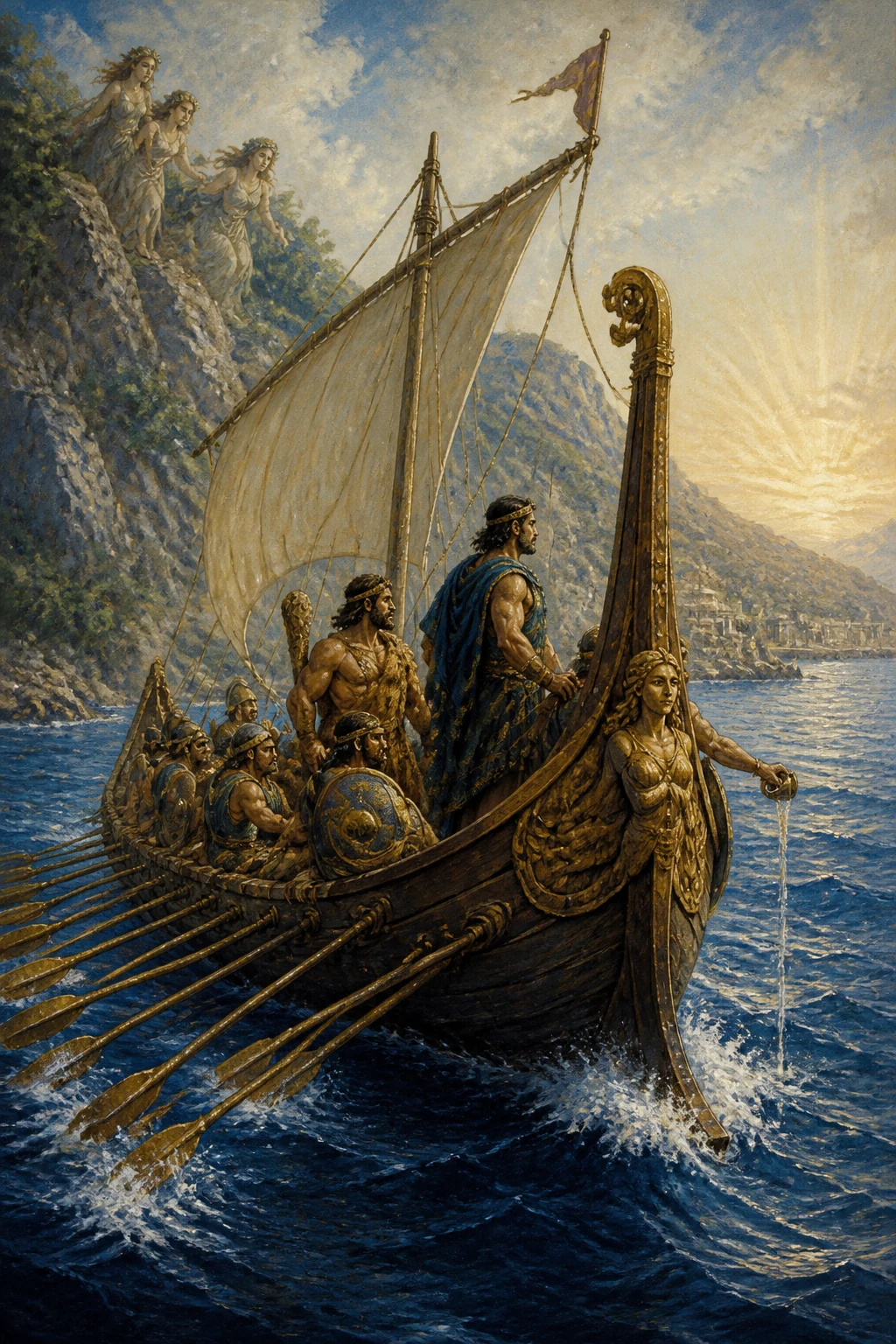
Intent on bringing their voyage to its destined end, she raised contrary gales, which swept them back toward the rocky island of Electris. Suddenly, as they sped along, the speaking timber of the hollow ship cried out in a human voice—the beam of Dodona’s oak that Athena had fitted into the midst of the prow.
Dread seized them as they heard its voice and learned of Zeus’s heavy wrath. It declared that they would escape neither the long sea’s wanderings nor its grievous storms unless Circe washed away the merciless murder of Apsyrtus. It bade Polydeuces and Castor pray to the immortal gods to grant them passage first to the Ausonian Sea, where they would find Circe, the daughter of Perse and Helios.
So Argo cried out in the gathering darkness. The sons of Tyndareus sprang up and raised their hands to the immortals, praying for all they had been told; the other Minyan heroes were bowed with sorrow. The ship sped far onward under sail, and they entered the innermost stream of the Eridanus. There once Phaethon, struck in the breast by a smoking thunderbolt, fell half-burned from the chariot of Helios into the waters of a deep lake. Even now it sends up heavy vapour from his smouldering wound.
No bird can spread its light wings and fly across those waters: halfway over, it plunges into the flames. All around, the daughters of Helios, enclosed in tall poplars, lament with piercing cries, poor mourners, and shed from their eyes bright drops of amber upon the ground. These dry in the sun upon the sand; but whenever the waters of the dark lake lash its shores beneath the blast of a loud-roaring wind, they all roll together into the Eridanus on its surging current. The Celts, however, have a tale that these are the tears of Apollo, Leto’s son, borne upon the eddies—the countless tears he shed long ago when he came to the sacred people of the Hyperboreans, leaving bright heaven at his father’s rebuke, in anger over his son, whom divine Coronis bore in rich Lacereia beside the mouths of the Amyrus.
Such is the story told among those people. But the heroes had no desire for food or drink, nor did their thoughts turn toward any pleasure. By day they were worn down and oppressed by the dreadful, unbearable stench that the streams of the Eridanus sent up from the smouldering Phaethon; by night they heard the shrill lament of the daughters of Helios, bitterly mourning. Their tears were borne upon the waters like drops of oil.
From there they entered the deep stream of the Rhodanus, which joins the Eridanus; at their meeting the mingled waters roar and churn. Rising from the earth’s farthest recesses, where stand the gates and dwelling places of Night, this river pours one branch toward the shores of Ocean, sends another into the Ionian Sea, and through seven mouths discharges another into the Sardonian Sea and its boundless gulf. From it they sailed into stormy lakes spread across the immense mainland of the Celts. There they would have met a wretched doom: for one channel led toward a gulf of Ocean, and in their ignorance they were about to enter it, never to return in safety.
But Hera darted down from heaven and cried out from the Hercynian rock. All alike shuddered in terror at her cry, for the vast heavens rang with its dreadful sound. At the goddess’s bidding they turned back, and discerned the route by which they were destined to return.
After a long while, under Hera’s guidance, they reached the salt sea’s shores, passing unharmed through countless tribes of Celts and Ligyans. For throughout their journey the goddess spread a fearsome mist about them.
They sailed their ship out through the middle mouth and reached the Stoechades islands safely, thanks to the sons of Zeus. There altars and sacred rites have been established in their honour forever. Nor was that voyage alone one in which they came as helpers: Zeus entrusted to them the ships of generations yet to come.
Leaving the Stoechades, they crossed to the island of Aethalia, where, exhausted, they wiped away their abundant sweat with pebbles. Pebbles stained like their skin still lie scattered along the beach; their throwing-discs and wondrous armour are there too, and a harbour bears the name of Argo.
From there they sailed swiftly over the swelling sea, keeping the Tyrrhenian shores of Ausonia in sight. They reached the famous harbour of Aeaea and cast their ship’s cables upon the nearby shore. There they found Circe cleansing her head with seawater, for she had been frightened by dreams in the night.
She had dreamed that her chambers and every wall of her house were streaming with blood, while a mass of flame devoured the herbs with which she had formerly bewitched whatever strangers came to her. She herself quenched the crimson blaze with murderous blood, scooping it up in her hands; then the dreadful terror ceased.
So when dawn came, she rose and washed her hair and garments in the sea. Creatures followed her in a throng, resembling neither flesh-eating beasts nor human beings in body, but compounded of limbs from different creatures, as sheep flock out of their folds behind their shepherd.
Such creatures the earth herself once brought forth from the primeval slime, fitted with mingled limbs, before she had been thoroughly hardened by the parching air or drained so much of her moisture by the rays of the scorching sun. In time these were sorted and brought into their separate kinds. Just so, creatures of indistinguishable form followed Circe.
Boundless wonder seized the heroes. Yet as each gazed at Circe’s stature and her eyes, they readily declared her to be Aeetes’ sister. When she had banished the terrors of her nightly dreams, she turned back toward her house, beckoning them to follow with a coaxing gesture of her hand, intent on her wiles.
At Aeson’s son’s command, the rest remained steadfastly where they were; but he drew the Colchian maiden with him. Together they followed the same path until they reached Circe’s hall. Bewildered by their coming, she invited them to sit on shining chairs.
But without a word they hurried to the hearth and sat down there, as is the custom of afflicted suppliants. She rested her forehead in both hands, while he planted in the ground the great hilted sword with which he had killed Aeetes’ son. Neither once raised their eyes to meet her gaze. At once Circe understood that they were fugitives burdened with the guilt of murder.
Therefore, revering the ordinance of Zeus, protector of suppliants, whose anger is great but whose aid to murderers is also great, she performed the rites by which bloodstained suppliants are purified when they approach a hearth.
First, to atone for the irrevocable murder, she held above them the young of a sow whose teats were still swollen from recent birth, cut its throat, and wetted their hands with its blood. Then she made propitiation with further libations, invoking Zeus the Purifier, who gives heed to the pleas of bloodstained suppliants.
The Naiad attendants who served her in everything carried all the polluted remnants out of the house together. Within, beside the hearth, she burned cakes and soothing offerings with prayers unaccompanied by wine, so that she might turn the terrible Erinyes from their wrath, and Zeus himself might look kindly and gently upon the pair, whether they had come with hands stained by a stranger’s blood or by the blood of their own kin.
When she had completed every rite, she raised them up and seated them on polished chairs, then sat down close by, facing them. At once she questioned them closely about their need and their voyage.
She asked from what land they had come to her country and her house, and why they had taken their places at her hearth in this fashion. For as she pondered, the hateful memory of her dreams entered her mind; and she longed to hear the maiden speak in the language of her kin, as soon as she saw her lift her eyes from the ground.
For all the race of Helios were unmistakable to behold, since from beneath their eyelids they cast far before them a flashing, golden radiance. corrected diacritic error (τέ) in the source text.
As Circe questioned her about each matter, the daughter of grim-hearted Aeetes answered gently in the Colchian tongue. κατελεξεν, corrected diacritic error (κατελεξεν) in the source text. She told of the heroes’ expedition and their travels, of all their sufferings in carrying out their arduous tasks, of how she had sinned at the prompting of her sorrow-laden sister, and how, together with the sons of Phrixus, she had fled far from her father’s overwhelming terrors. But she shrank from telling of Apsyrtus’s murder. It did not escape Circe’s understanding; yet she pitied the weeping girl, and spoke to her thus: “Unhappy child, what an evil and shameful homecoming you have contrived.
“I do not think you will long escape Aeetes’ heavy wrath. Soon he will come even to the lands of Greece to avenge his son’s murder, since you have done these intolerable deeds. But because you have come as my suppliant and are of my own blood, I will devise no further harm against you here. Leave my house, and go with this stranger, whoever he may be, whom you have chosen in your father’s place. Do not clasp my knees as a suppliant at my hearth: I will not approve your schemes or your shameful flight.”
So she spoke, and overwhelming grief seized the maiden. She drew her robe over her eyes and wept, until the hero took her by the hand and led her out of the hall, trembling with fear. And so they left the house of Circe.