Prevod
Nor did they escape the notice of the wife of Zeus, son of Cronus: Iris told her when she saw them leaving the palace. Hera herself had charged her to watch for their departure to the ship, and now she urged her on again: “Dear Iris, if ever you have carried out my commands, come now, speed away on your swift wings and bid Thetis rise from the sea and come to me.
“I have need of her. Then go to the shores where Hephaestus’ bronze anvils ring beneath his mighty hammers. Tell him to still the bellows of his fire until Argo has sailed past those shores. Go also to Aeolus—Aeolus, who rules the winds born of the clear sky—and tell him my wish: he must quiet every wind beneath the heavens, and let no breeze roughen the sea. Only let a fair west wind blow, until they reach Alcinous’ island of the Phaeacians.”
So she spoke, and at once Iris leapt from Olympus and swept through the air on outspread, weightless wings. She plunged into the Aegean Sea, where Nereus has his dwelling. First she came to Thetis, delivered Hera’s message as she had been instructed, and urged her to go to the goddess.
Next she went to Hephaestus and quickly stopped the work of his iron hammers; the soot-blackened bellows ceased their breathing. Third she came to Aeolus, the renowned son of Hippotas. While she rested her swift knees from their journey and gave him her message, Thetis left Nereus and her sisters and rose from the sea to Olympus to seek the goddess Hera. Hera seated her close beside her and spoke: “Listen now, divine Thetis, to what I long to tell you.
“You know how deeply I cherish the hero, Aeson’s son, and the others who share his quest, and how I saved them as they passed through the Clashing Rocks, where dreadful storms once roared and waves washed over the rugged crags.
“Now their course leads past Scylla’s great rock and Charybdis with her terrible belching. But I myself reared you from infancy and loved you beyond all the other dwellers in the sea, because you would not lie with Zeus when he desired you. For his thoughts are always on such things—sleeping with goddesses or with mortal women.
“Yet out of reverence for me, and fear in your heart, you shunned him. Then he swore a mighty oath that you should never be called the wife of an immortal god. Even so, he did not cease pursuing you against your will, until ancient Themis told him everything: that you were destined to bear a son greater than his father. Then, though he still desired you, he gave you up, afraid that some other immortal might rule as his equal, and determined to preserve his power forever.
“But I gave you the noblest man on earth for a husband, so that you might enjoy a happy marriage and bear children. I summoned all the gods alike to the feast, and I myself held the bridal torch in my hands, in return for your gracious respect for me.
“Come now, I will tell you something that shall surely come to pass. When your son reaches the Elysian plain—the son whom Naiads now tend in the dwelling of Chiron the Centaur, deprived of your milk—he is destined to marry Medea, daughter of Aeetes. Help your daughter-in-law, then, since you will be her husband’s mother, and help Peleus himself. Why does your anger remain so fixed?
“He acted blindly. Even the gods are visited by folly. I believe that at my command Hephaestus will stop fanning the fury of his fire, and Aeolus, son of Hippotas, will restrain the swift gusts of the winds, except for a steady west wind, until they reach the harbors of the Phaeacians. But you must devise a safe passage for them.
“The rocks and the overwhelming waves are your only cause for fear, and these you can turn aside with your sisters’ help. Do not let them blunder helplessly into Charybdis, lest she swallow them all and bear them away; nor let them sail past Scylla’s hateful lair—murderous Ausonian Scylla, whom night-wandering Hecate, called Crataeis, bore to Phorcys—lest she spring upon them with her dreadful jaws and destroy the choicest of the heroes. Guide the ship where there is at least some small escape from destruction.”
So she spoke, and Thetis answered: “If the force of the raging fire and the violent storms truly cease, then I can confidently promise to save the ship, even against the waves, while the west wind blows clear and shrill.
“But it is time to set out on my long, immeasurable journey, to seek my sisters, who will help me, and the place where the ship’s stern-cables are fastened, so that the men may think to set sail at dawn.”
With that she sprang away through the upper air and plunged into the swirling waters of the dark-blue sea. She called her own sisters, the other Nereids, to help her. Hearing her, they gathered together, and Thetis told them Hera’s commands. At once she sent them all toward the Ausonian Sea.
She herself, swifter than a flash of light or the sun’s rays when it rises high above the farthest land, sped swiftly through the water until she reached the Aeaean shore of the Tyrrhenian mainland.
She found the men beside their ship, taking their pleasure in throwing the discus and shooting arrows. Drawing near, she touched the fingertips of Peleus, son of Aeacus, for he was her husband. None of the others could see her plainly; she appeared to his eyes alone, and said: “Remain no longer here on the Tyrrhenian shore. At dawn loosen the stern-cables of your swift ship, obeying Hera, your helper. At her command all the Nereid maidens are coming to meet you and bring your ship safely through the rocks called the Planctae. That is the course appointed for you.
“But do not reveal me to anyone when you see me coming to meet you with my sisters. Take care not to anger me still more than you did before in your recklessness.” So she spoke and vanished into the depths of the sea. Bitter grief struck him, for he had not seen her come to him since she first left his chamber and his bed in anger, when glorious Achilles was still a little child.
For every midnight she would burn away his mortal flesh in the blaze of a fire, and by day anoint his tender body with ambrosia, so that he might become immortal and she might keep hateful old age from his flesh.
But Peleus sprang from his bed and saw his dear son struggling in the flames. At the sight he gave a terrible cry, the great fool. Hearing him, she snatched up the screaming child and cast him to the ground. Then, her form like a breath of wind, like a dream, she hurried from the hall and plunged angrily into the sea. Never afterward did she return.
So bewilderment bound his mind. Yet even so, he repeated all Thetis’ instructions to his companions. At once they broke off their games in the midst of them and busied themselves with supper and their beds. After eating, they spent the night upon them as before.
When light-bearing Dawn touched the summit of heaven, they went from the shore to their rowing-benches as the swift west wind blew down upon them. Joyfully they hauled the anchor-stones up from the depths and made all the tackle ready as required. They drew the sail aloft, stretching it on the yard’s leather lashings.
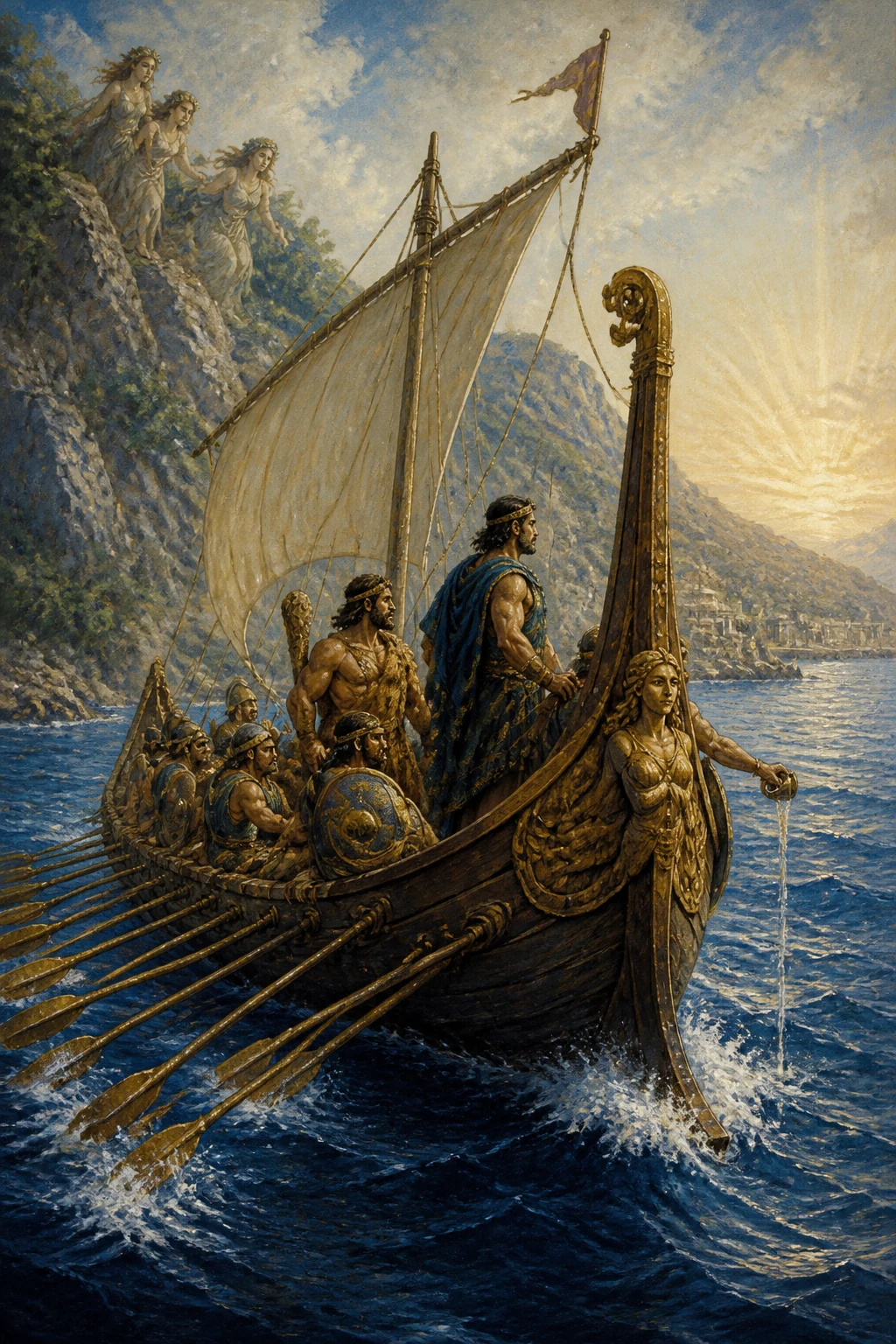
A steady wind carried the ship along. Soon they caught sight of the lovely island of Anthemoessa, where the clear-voiced Sirens, daughters of Achelous, used their sweet songs to enchant and destroy anyone who cast his mooring-rope there.
The lovely Terpsichore, one of the Muses, had borne them after lying with Achelous. Once they had attended Deo’s mighty daughter while she was still a virgin, singing together with her. But now their appearance was partly that of birds and partly that of maidens.
Always watching from their lookout above the sheltered harbor, they had often robbed many men of a sweet homecoming, wasting them away with longing. Now, without hesitation, they poured their lily-soft voices from their mouths for these men too. Already the heroes were about to cast their mooring-ropes ashore, had not Thracian Orpheus, son of Oeagrus, stretched the strings of his Bistonian lyre in his hands and struck up the ringing strains of a quick, impetuous tune, so that their ears might resound with the clamor of his playing. The lyre overpowered the maidens’ voices.
Together the west wind and the sounding wave, rising astern, bore the ship onward, and the Sirens’ song grew indistinct. Yet even so, one man, Butes, the noble son of Teleon, alone among his companions, sprang before the others from his polished bench into the sea, his heart delighted by the Sirens’ clear voices. Through the dark swell he swam, poor wretch, hoping to reach the shore. There and then they would have robbed him of his homecoming, but Cypris, the goddess who rules Eryx, pitied him and snatched him from the eddies. Graciously she came to his rescue and brought him to dwell on the headland of Lilybaeum.
Grieving, the others left the Sirens behind, but worse dangers awaited them where the sea-ways met, dangers that shatter ships. On one side Scylla’s smooth rock rose into view; on the other Charybdis seethed and roared without ceasing. Elsewhere the Wandering Rocks thundered beneath the great waves. Before, blazing flame had spurted from the summits of those crags, high above the fire-scorched rock, and smoke had darkened the sky so that the sun’s rays could not be seen. Now Hephaestus had ceased his work, but the sea still breathed out hot vapor.
There the Nereid maidens came to meet them from every side. Divine Thetis touched the blade of the steering-oar astern, to guide them through the Wandering Rocks. As dolphins in calm weather rise from the sea and wheel in schools around a speeding ship, appearing now ahead, now astern, now alongside, to the sailors’ delight, so the maidens darted forward and circled in throngs about Argo, while Thetis guided her course.
And when they were about to draw close to the Wandering Rocks, the maidens at once raised their skirts above their white knees and leapt here and there, spaced apart from one another, high upon the very crags and the breaking waves.
The current struck the ship as she hung to one side, and all around the fierce rising waves splashed and seethed upon the rocks. At times those rocks towered into the air like cliffs; at others they lay submerged, fixed deep beneath the lowest floor of the sea, while the wild swell surged far above them.
As girls beside a sandy beach, their skirts gathered up around their waists, play with a round ball, catching it one from another and sending it high into the air so that it never touches the ground, so the maidens passed the speeding ship from one to another, bearing her aloft over the waves and always far from the rocks. Around them the water boiled and bellowed.
Lord Hephaestus himself watched them from the summit of a smooth crag, standing with his heavy shoulder resting on the handle of his hammer. The wife of Zeus watched too, standing high in the radiant heavens, and flung her arms about Athena, so great was the fear that seized her at the sight.
For as long as a spring day lasts they toiled, heaving the ship through the echoing rocks. Then the men caught the wind once more and sped onward, quickly passing the meadows of Thrinacia, where the cattle of the Sun were pastured.
There the maidens plunged into the depths like seabirds, having fulfilled the commands of Zeus’s wife. The bleating of sheep came through the air to the men, and close at hand the lowing of cattle struck their ears.
Phaethusa, the younger of the Sun’s daughters, tended the sheep in the dewy glades, holding a silver crook in her hand. Lampetia followed the cattle, swinging a staff of shining mountain-bronze. The heroes themselves could see them grazing beside the river’s waters, over the plain and the marshy meadow. Not one among them was dark: all were milk-white, and they gloried in their golden horns.
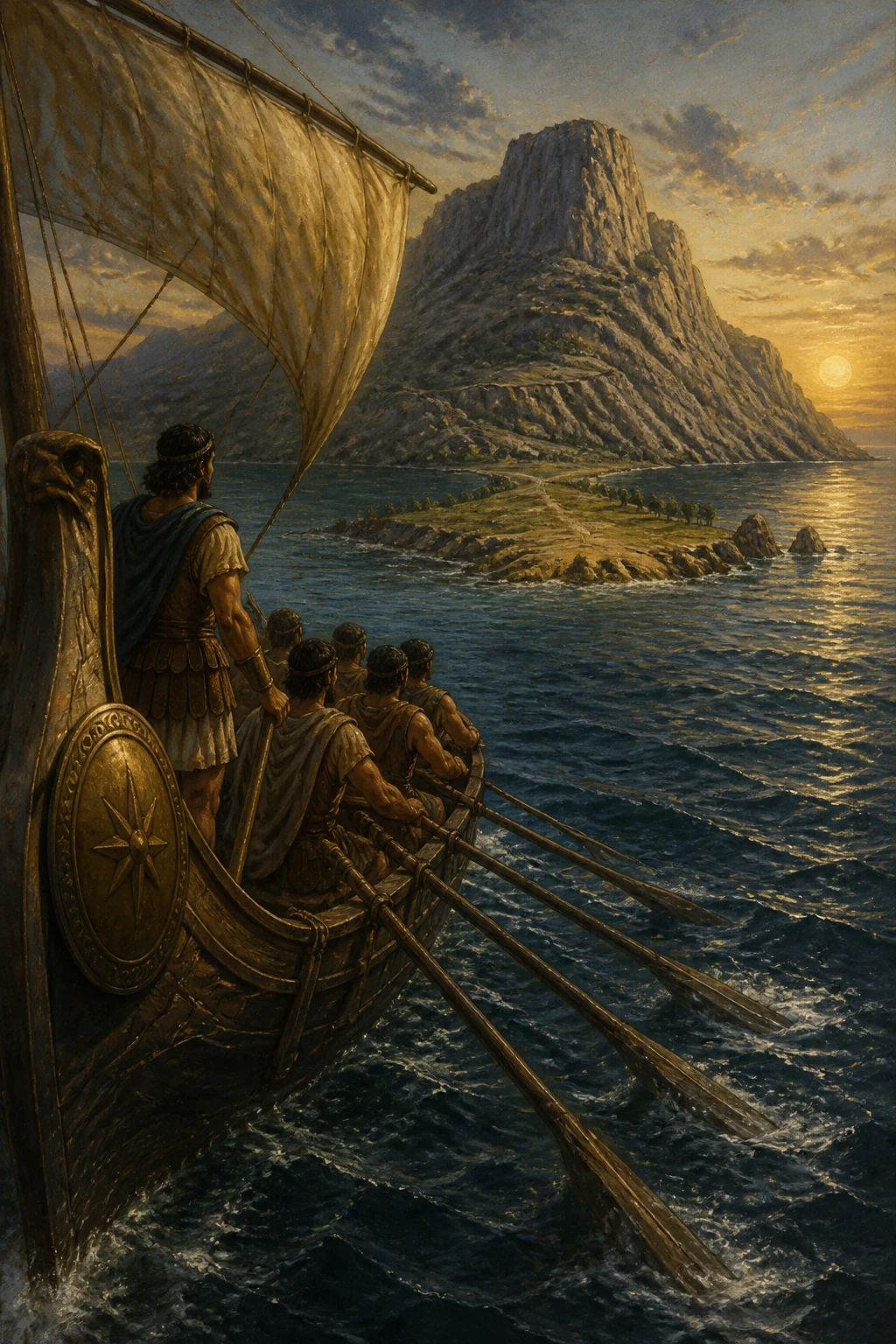
They passed them by during the day, and when night came they sailed joyfully over the sea’s broad gulf, until early-born Dawn once more cast her light upon them as they journeyed. Before the entrance to the Ionian Strait lies a broad and fertile island in the Ceraunian Sea. Beneath it, so the story goes, lies the sickle—forgive me, Muses; unwillingly I repeat the tale of those before me—with which Cronus ruthlessly cut off his father’s genitals. Others say it is the reaping-hook of Deo, goddess of the earth.
For Deo once dwelt in that land and taught the Titans to reap the nourishing ears of grain, out of love for Macris. Hence the island, sacred nurse of the Phaeacians, is called Drepane; and the Phaeacians themselves are descended from the blood of Uranus.
To them Argo came on the winds from the Thrinacian Sea, after enduring many hardships. Alcinous and his people welcomed the voyagers warmly with kindly sacrifices, and the whole city rejoiced over them. You would have thought they were delighting in their own sons.
The heroes too rejoiced amid the crowd, as though they had set foot in the very heart of Haemonia. Yet they were soon to arm themselves amid the din of battle. For close at hand appeared a vast host of Colchians, who had passed through the mouth of the Pontus and the Dark Rocks in pursuit of the heroes.
They demanded that Medea be surrendered to them and taken back to her father. Otherwise, they threatened harshly, they would raise the grievous cry of battle both now and later, when Aeetes came.
But lord Alcinous restrained them as they pressed toward war, for he wished to settle the bitter quarrel between the two sides without bloodshed. Overcome with deadly fear, the girl pleaded repeatedly with the companions of Aeson’s son, and repeatedly laid her hands upon the knees of Arete, Alcinous’ wife: “I implore you, queen: be gracious, and do not surrender me to the Colchians to be carried back to my father, if you too belong to the race of mortals, whose minds rush so swiftly into ruin through thoughtless errors.
“So my sound judgment deserted me, though not from wantonness. Let the sacred light of the Sun bear witness, and the secret rites of the night-wandering daughter of Perses: I did not willingly set out from there with foreign men. Dreadful fear persuaded me to think of flight after I had done wrong; there was no other course. My maiden’s girdle remains as it was in my father’s house, untouched and undefiled. But pity me, lady, and soften your husband’s heart. May the immortals grant you a life of fulfillment and splendor, children, and the glory of a city never sacked.”
Thus she pleaded with Arete, shedding tears, and then addressed each of the heroes in turn: “For you, greatest of all brave men, and for the hardships I endured in your struggles, I am in anguish. Through my help you yoked the bulls and mowed down the deadly harvest of earthborn men. Through me you will soon carry the golden fleece home to Haemonia.
“Here I stand, who have lost my country and my parents, my home and every joy of life. Yet I have made it possible for you to dwell again in your own country and homes, and you will still look upon your parents with loving eyes. But a cruel fate has taken my happiness from me, and I wander in misery among strangers.
“Fear your pledges and your oaths; fear the Fury who guards suppliants and the wrath of the gods, if I fall into Aeetes’ hands to be destroyed by grievous outrage. I take refuge in no temples, no protecting tower, no other shelter, but in you alone, you yourselves—you yourselves. corrected diacritic error (αὐτους) in the source text.
“Cruel men, pitiless in your hardness! Does no shame stir in your hearts when you see me helplessly stretching out my hands to the knees of a foreign queen? When you longed to win the fleece, you would have crossed spears with all the Colchians and with proud Aeetes himself. Now you have forgotten your courage, though these men are alone and cut off from the rest.”
So she pleaded. Each man whose knees she clasped encouraged her and sought to soothe her grief. They shook the sharp spears in their hands and drew their swords from their sheaths, declaring that they would not withhold their help if an unjust judgment should befall her.
While they moved restlessly among the crowd, night came, bringing rest from men’s labors and stilling all the earth. But sleep did not lull her even for a moment: her heart twisted in her breast with anguish.
As a hardworking woman turns her spindle in the night, while her orphaned children whimper around her in her widowhood, and tears stream down her cheeks as she remembers the sorrowful fate that has overtaken her, so Medea’s cheeks were wet, and her heart within her writhed, pierced by sharp pains.
Meanwhile, within their palace in the city, lord Alcinous and his honored wife Arete lay in their bed as usual, pondering the girl’s fate in the darkness. With loving words the wife appealed to her wedded husband: “Dear husband, come, save this sorely troubled girl from the Colchians, and show kindness to the Minyans. Argos and the men of Haemonia are near our island, but Aeetes does not live close by. We know nothing of Aeetes except by hearsay. This suffering girl has broken my heart with her pleas.
“My lord, do not give her to the Colchians to take back to her father. She acted blindly when first she gave Jason the drugs to charm the bulls. Then, seeking to cure one wrong with another—as we so often do in our errors—she fled her overbearing father’s heavy wrath. And Jason, I hear, has bound himself by solemn oaths to make her his lawful wife in his own halls. So, dear husband, do not willingly make Aeson’s son break his oath, nor let her father, through your doing, wreak unbearable harm upon his child in the anger of his heart.
“For parents are all too jealous of their children. Think what Nycteus devised against lovely Antiope, and what sufferings Danae endured upon the sea through her father’s recklessness. Only recently, and not far from here, brutal Echetus drove bronze spikes into his daughter’s eyes. Now she wastes away in a dreadful fate, grinding bronze in a dark chamber.”
So she pleaded, and his heart softened at his wife’s words. He answered: “Arete, I would even drive the Colchians away by force of arms, to favor the heroes for the girl’s sake.
“But I fear to disregard the righteous justice of Zeus. Nor is it wise to make light of Aeetes, as you suggest: no king is more truly a king than he. Far away though he is, he could bring war upon Greece if he wished.
“Therefore I must give the judgment that will be best in the eyes of all men, and I will not conceal it from you. If she is still a maiden, I decree that she be taken back to her father. But if she shares a husband’s bed, I will not part her from him; nor, if she carries a child in her womb, will I surrender it to enemies.”
So he spoke, and soon sleep lulled him. But she laid his prudent words to heart. At once she rose from her bed and went through the house, and her serving-women hurried after her, busily attending their mistress.
Quietly she summoned her herald and spoke to him. With wise advice she urged that Aeson’s son should lie with the girl, and not appeal to King Alcinous. For he himself would come and pronounce this judgment to the Colchians: if she were still a maiden, he would give her up to return to her father’s house; but if she shared a husband’s bed, he would no longer sever the bond of marriage.
So she spoke, and his feet quickly carried him from the palace to bring Jason Arete’s welcome message and the decision of god-fearing Alcinous. He found the heroes keeping armed watch beside their ship in the Hyllic harbor, near the city, and told them the whole message. Every hero’s heart rejoiced, for what he said was very much to their liking.
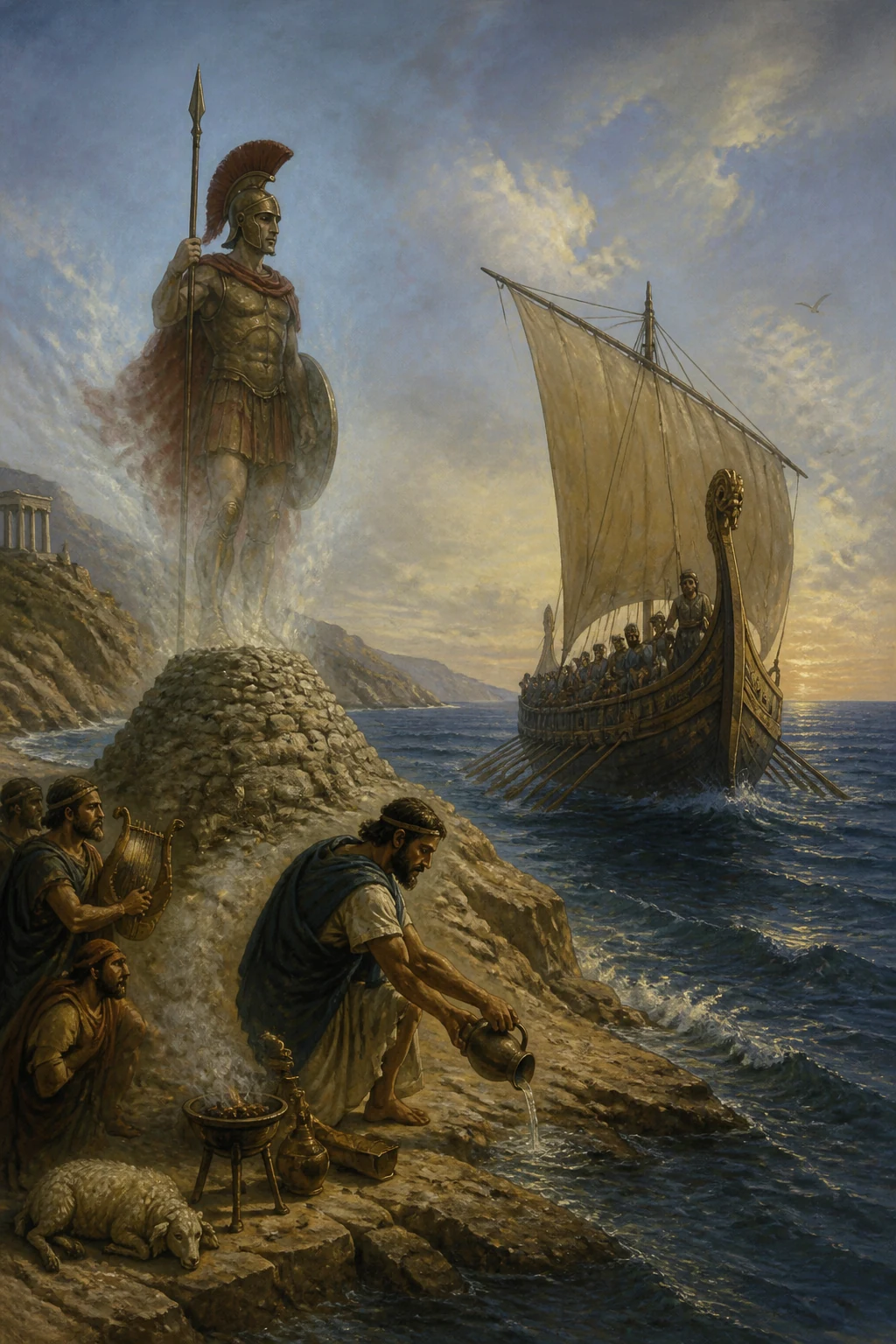
At once they mixed a bowl of wine for the blessed gods and, as custom required, reverently led sheep to the altar. That very night they prepared a bridal bed for the girl in a sacred cave where Macris had once lived, the daughter of kindly Aristaeus, who discovered the arts of beekeeping and the rich oil of the laboriously tended olive.
She it was who first received the Nysaean son of Zeus into her lap in Abantian Euboea, and moistened his dry lips with honey when Hermes brought him from the fire. But Hera saw her and, in anger, drove her from the whole island.
Far away she settled in the sacred cave of the Phaeacians and bestowed untold prosperity upon its inhabitants. There they now spread a great bed, and over it laid the shining golden fleece, so that the marriage might be honored and celebrated in song. Nymphs gathered bright flowers in their white laps and carried them in. A radiance like fire shone about them all, so brilliant was the light flashing from the golden tufts.
It kindled sweet desire in their eyes, but reverence restrained each one, eager though she was to lay her hand upon it. Some were called daughters of the river Aegaeus; others dwelt about the peaks of Mount Melite; others were woodland nymphs from the plains. Hera herself, the wife of Zeus, had stirred them to come, to bring honor to Jason.
Even to this day that sacred cave is called Medea’s cave, where the nymphs spread fragrant robes and brought the pair together. Meanwhile the heroes held their war-spears in their hands, lest a hostile throng should fall upon them without warning before they could defend themselves. With their heads wreathed in leafy branches, they sang the wedding hymn in measured harmony before the bridal chamber, while Orpheus played clear notes upon his lyre.
The hero, Aeson’s son, had not intended to celebrate his marriage in Alcinous’ land, but in his father’s halls after returning home to Iolcus. Medea too had cherished that hope. Now necessity drove them to unite.
For we, the tribes of suffering mortals, never set our whole foot upon the ground of happiness: some bitter grief always walks beside our joys. So, even as they warmed one another with sweet love, fear held them, lest Alcinous’ judgment should not be fulfilled.
Dawn rose with her immortal light and dissolved black night throughout the air. The island’s shores smiled, and far away the dewy paths across the plains. A murmur filled the streets. The inhabitants were stirring throughout the city, and far off the Colchians moved along the edges of the Macridian peninsula.
At once Alcinous set out, as agreed, to declare his decision concerning the girl. In his hand he held the golden scepter of judgment, beneath whose authority just decisions were given to his people throughout the city.
Beside him, rank upon rank, the noblest Phaeacians marched in a body, clad in their armor. Women went in crowds beyond the walls to look upon the heroes. Men from the countryside came to meet them too when they heard the news, for Hera had sent forth a true report. One brought a ram, the finest of his flock; another a heifer not yet put to work. Others set jars of wine close by for mixing, and the smoke of sacrifice rose far away.
The women brought finely wrought robes, as women do, and gifts of gold, and all the other ornaments with which newlyweds adorn themselves. They gazed in wonder at the stature and beauty of the splendid heroes, and at Oeagrus’ son among them, as he beat the ground again and again with his shining sandal to the music of his tuneful lyre and song.
Whenever his song recalled the marriage, all the nymphs together raised the lovely wedding hymn. At other times they sang alone, wheeling in a circle, through your favor, Hera; for it was you who put it into Arete’s heart to make known Alcinous’ prudent words.
And when he had first declared the terms of his just judgment, and the consummation of the marriage had been made known, he firmly upheld his decision throughout. Neither deadly fear nor the threat of Aeetes’ heavy wrath came upon him: he bound the matter fast with unbreakable oaths.
So when the Colchians learned that their demands were vain, and he ordered them either to abide by his judgments or to keep their ships far from his harbors and his land, they feared their own king’s threats and begged him to receive them as settlers. For a very long time they dwelt there on the island among the Phaeacians, until, in later days, the Bacchiads, a people descended from Ephyra, came to settle there. Then the Colchians crossed to an island opposite. From there they were destined to reach the Ceraunian mountains of the Abantes, the Nestaeans, and Oricum. But all this came to pass far later, as time pursued its course.
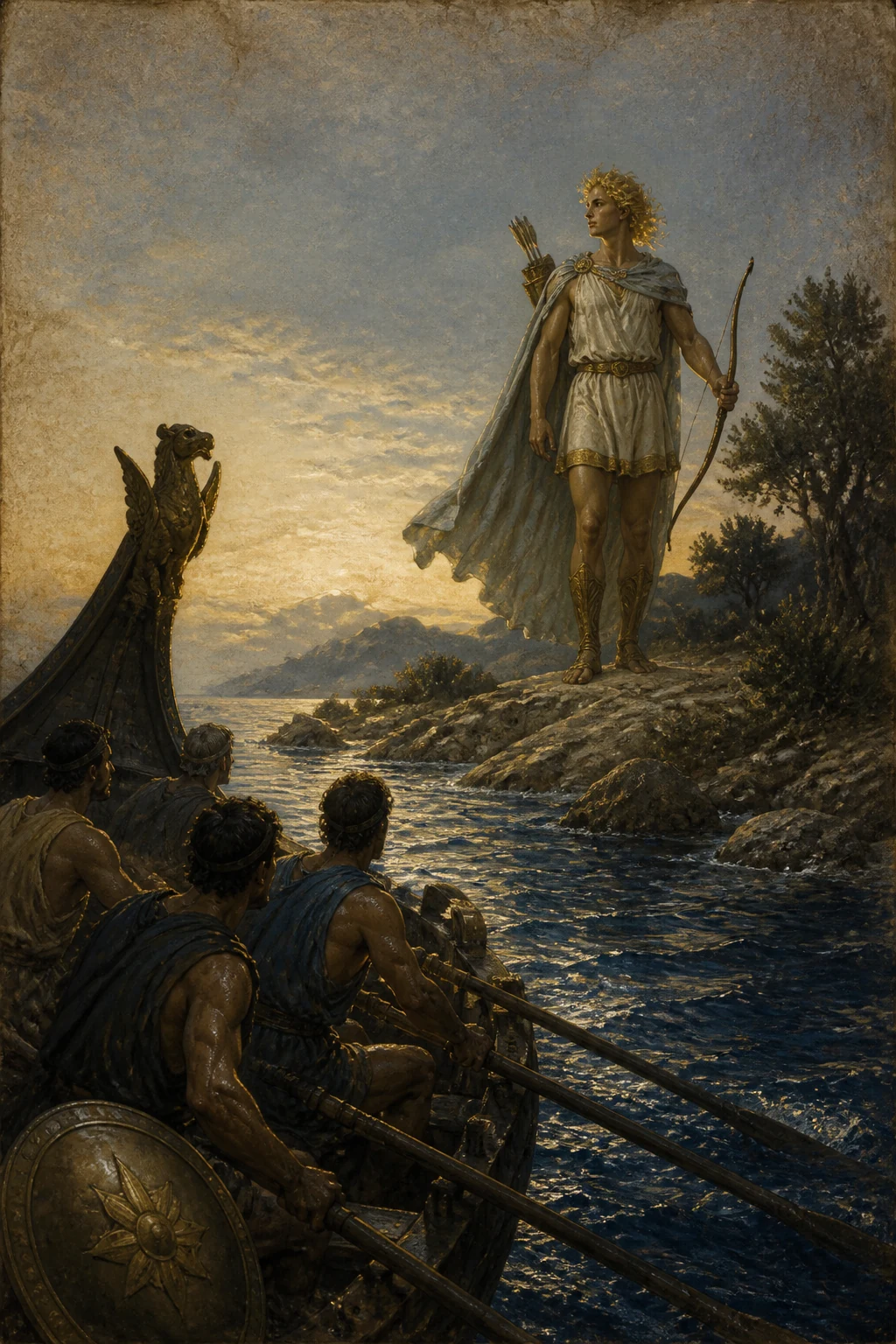
There still, in the sanctuary of Apollo the Shepherd, the altars of the Fates and the Nymphs that Medea established receive yearly sacrifices. Alcinous gave the departing Minyans many gifts of hospitality, and Arete gave many too. She also sent twelve Phaeacian serving-women from her palace to accompany Medea.