Prevod
Now I am going to tell you a story I heard when I was little, and every time I have thought of it since, it has seemed lovelier to me; for stories are like many people: they grow lovelier and lovelier with age, and that is such a pleasant thing!
You have been out in the country, haven’t you? You have seen a proper old farmhouse with a thatched roof, where moss and plants grow of their own accord. There is a stork’s nest on the ridge—you cannot do without the stork—and the walls are crooked and the windows low; indeed, only one of them can be opened. The baking oven bulges out like a little fat belly, and the elder bush leans over the fence, where there is a small puddle with a duck or some ducklings, just beneath the gnarled willow tree. And then there is a dog on a chain, barking at anyone and everyone.
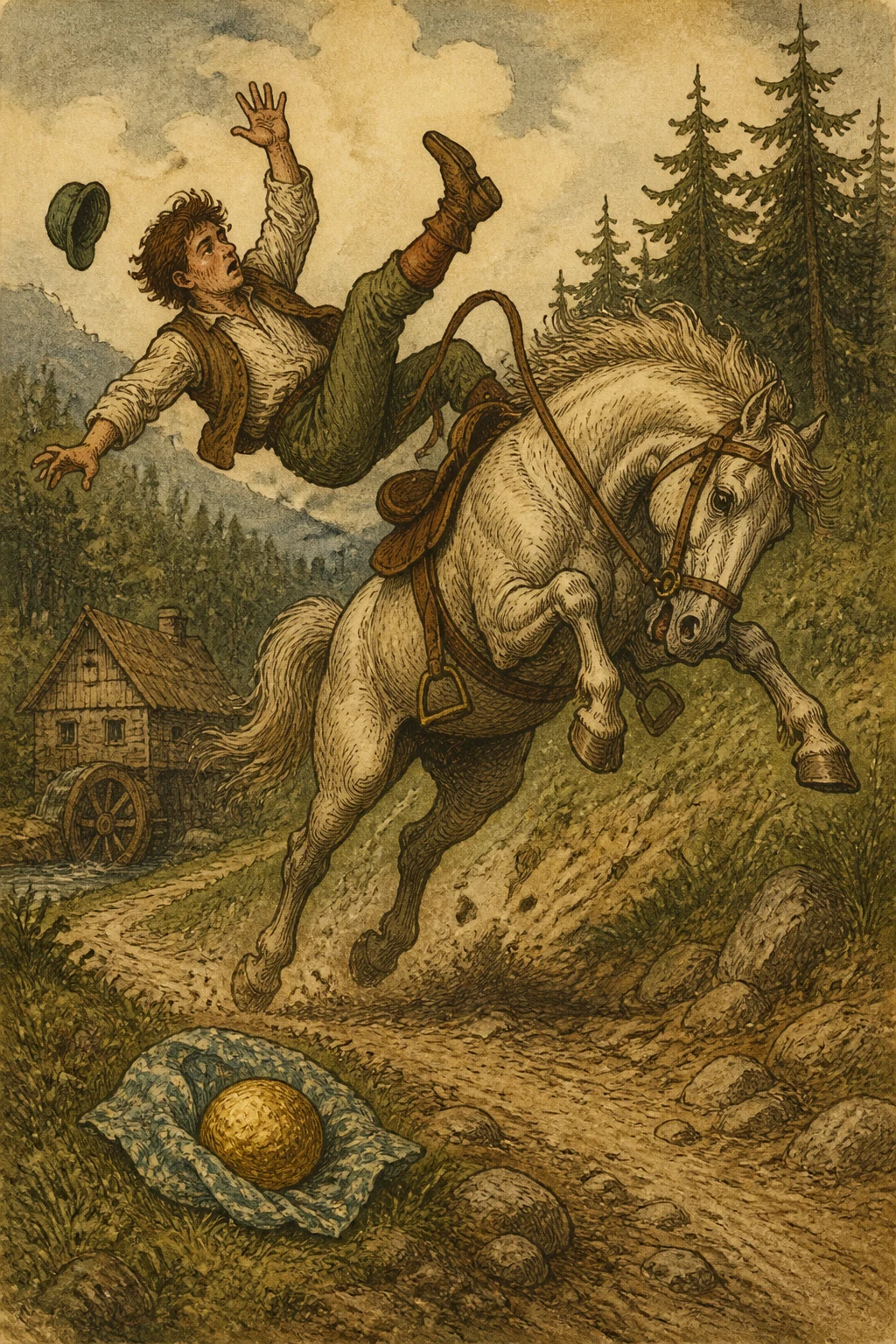
There was just such a farmhouse out in the country, and in it lived a couple, a farmer and his wife. Little as they had, there was one thing they could spare: a horse that grazed along the roadside ditch. Father rode it into town, and the neighbours borrowed it, doing him favours in return; but it would probably serve them better to sell the horse, or exchange it for something that would be of still more use to them. But what should that be?
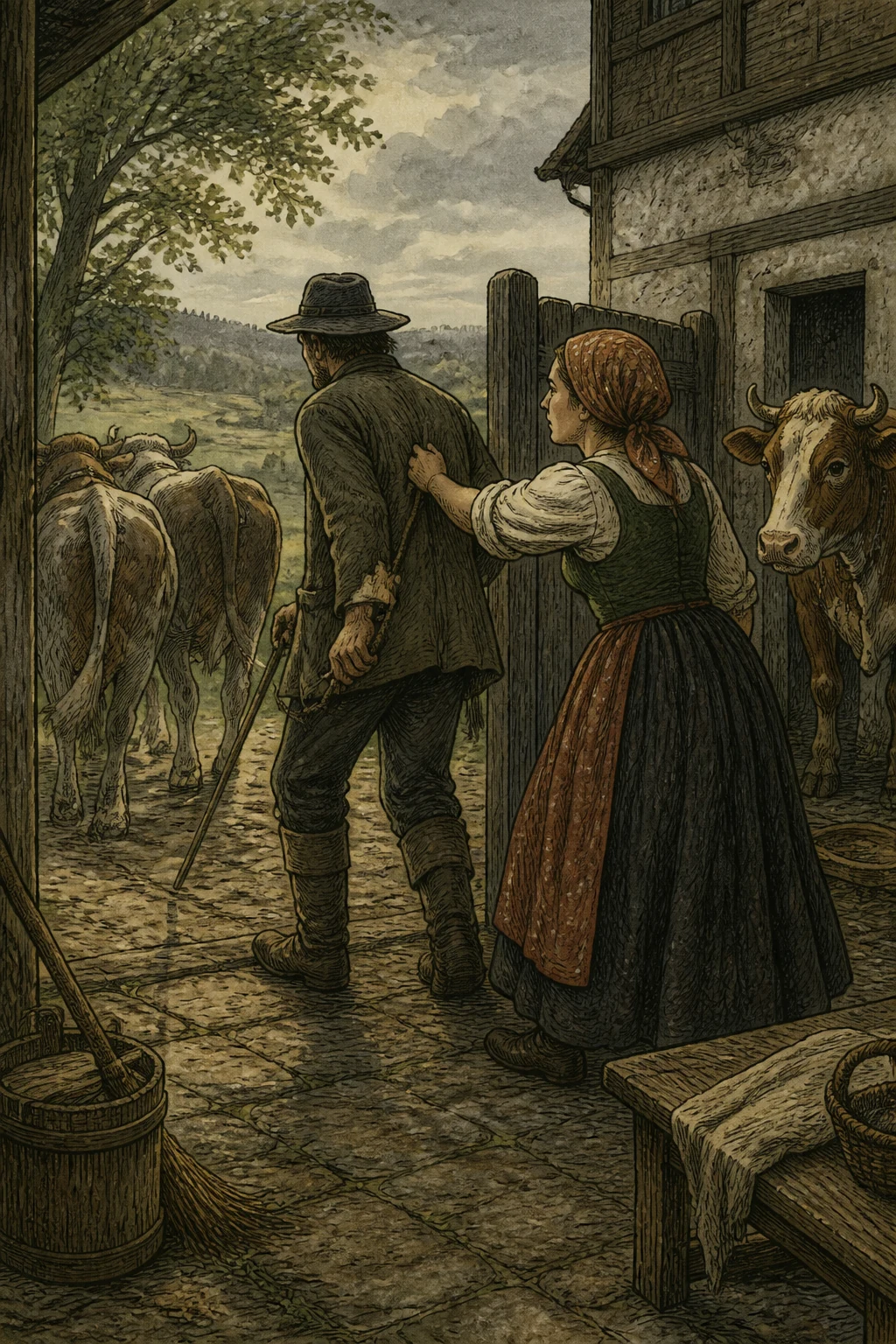
“You will know best, Father!” said his wife. “It is market day in town now. Ride in and get some money for the horse, or make a good exchange. Whatever you do is always right. Off you go to market!”
Then she tied his neckerchief, for that was something she understood better than he did. She tied it in a double bow, which looked very fine, and then she brushed his hat with the palm of her hand and kissed him on his warm lips. And off he rode on the horse that was to be sold or exchanged. Oh yes, Father knew what he was about.
The sun blazed, and there was not a cloud in the sky! The road was dusty, with so many people going to market, in carts, on horseback, and on their own two feet. The sun was scorching, and there was not a scrap of shade along the road.
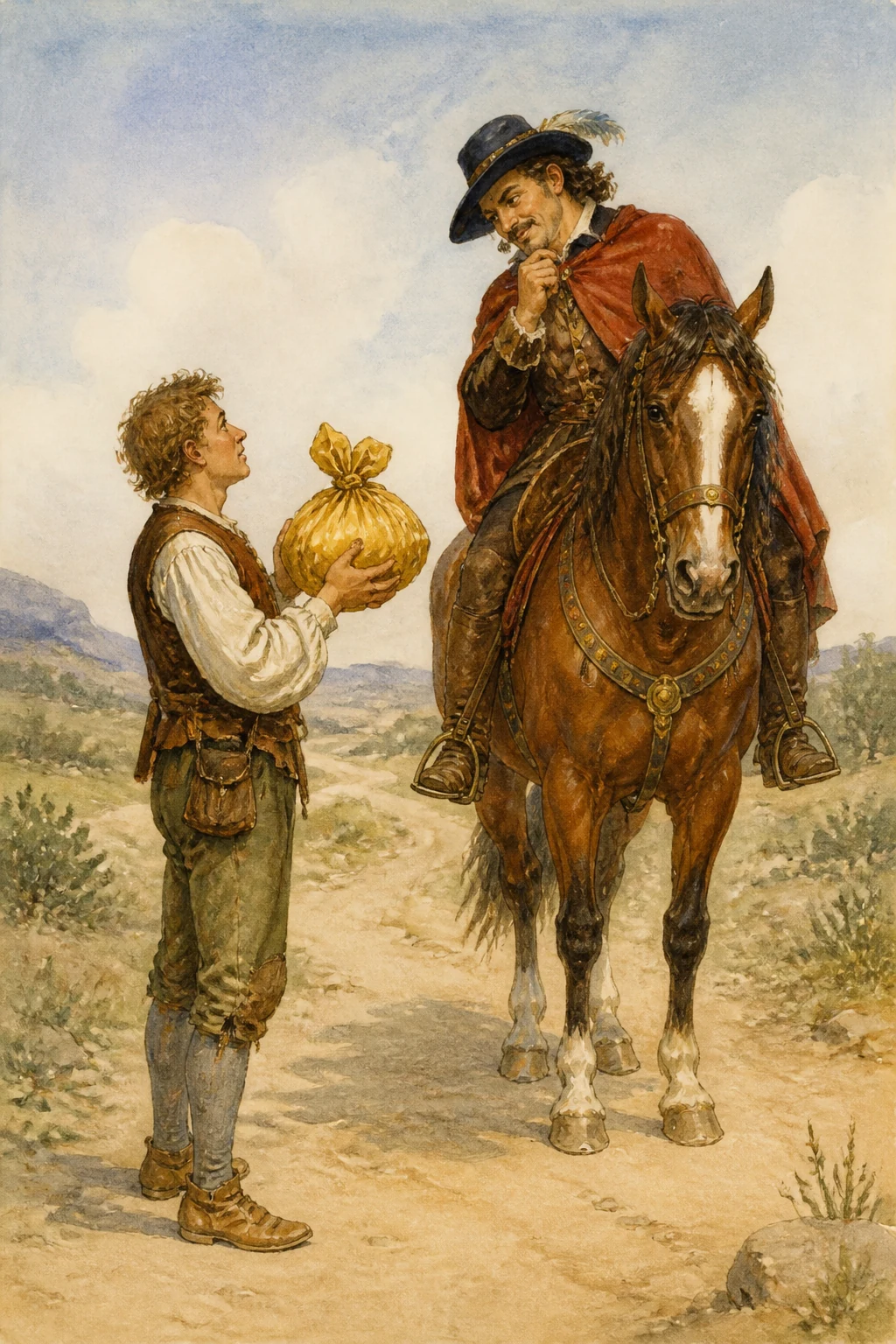
A man was walking along driving a cow, as pretty a cow as you could wish to see. “She must give lovely milk!” thought the farmer. It might be quite a good bargain to get her. “I say, you there with the cow!” he said. “Shall we have a little talk? You see, I believe a horse is worth more than a cow, but never mind that! I have more use for the cow. Shall we trade?”
“Gladly!” said the man with the cow, and so they traded. That was settled, and the farmer could have turned back, for he had done what he had set out to do; but as he had made up his mind to go to market, to market he would go, if only to look about. So he walked on with his cow. He stepped out briskly, and the cow stepped out briskly, and before long they found themselves walking beside a man leading a sheep. It was a fine sheep, well fed and with a good fleece.
“I should like to own that!” thought the farmer. “It would not go short of grazing along our ditch, and in winter we could bring it into the room with us. Really, it would make more sense for us to keep a sheep than a cow. Shall we trade?”
The man who owned the sheep was quite willing, and so the exchange was made, and the farmer walked on along the road with his sheep. There, by the stile, he saw a man with a large goose under his arm.
“That is a fine big one you have there!” said the farmer. “Plenty of feathers and fat! It would look well tethered beside our puddle. There would be something for Mother to save the peelings for! She has often said, ‘If only we had a goose!’ Now she can have one—and she shall! Will you trade? I will give you the sheep for the goose, and my thanks into the bargain!”
The other man was quite willing, and so they traded, and the farmer got the goose. He was close to town now, and the road was growing more crowded. People and livestock swarmed everywhere, along the road and through the ditch, right into the tollkeeper’s potatoes, where his hen was tethered so that she would not take fright and stray away and get lost. She was a short-tailed hen who winked one eye and looked very fine. “Cluck, cluck!” she said. What she was thinking, I cannot tell you, but when the farmer saw her, he thought: She is the finest hen I have ever seen! She is prettier than the parson’s broody hen. I should like to own her! A hen can always find a grain of corn; she can almost look after herself. I believe it would be a good bargain if I got her for the goose! “Shall we trade?” he asked. “Trade!” said the other. “Well, that would not be so bad!” And so they traded. The tollkeeper got the goose, and the farmer got the hen.
He had accomplished quite a lot on that journey to town; and it was hot, and he was tired. He needed a dram and a bite of bread. Now he had reached the inn, and in he meant to go; but the innkeeper’s lad was coming out, and he met him right in the doorway, swinging a sack full of something.
“What have you got there?” asked the farmer. “Rotten apples!” answered the lad. “A whole sackful for the pigs!” “Why, that is a tremendous lot! I wish Mother could see them. Last year we had only a single apple on the old tree by the peat shed. That apple had to be saved, and it stood on the chest of drawers until it split. ‘It is a sign of prosperity, all the same!’ Mother said. Here would be some prosperity for her to see! Yes, I should like her to have that!”
“Well, what will you give me?” asked the lad. “Give you? I will give you my hen in exchange.” And so he gave him the hen, took the apples, and went into the taproom, straight up to the bar. He set his sack of apples against the stove, which had a fire in it, though he did not think of that. There were many strangers in the room: horse dealers, cattle dealers, and two Englishmen, who are so rich that their pockets burst with gold coins. They like a wager, too, as you shall hear!
“Hiss! Hiss!” What was that sound by the stove? The apples were beginning to roast. “What is that?” Well, they soon found out! They heard the whole story of the horse that had been exchanged for the cow, and so on down to the rotten apples.
“Well! You will get a beating from your wife when you get home!” said the Englishmen. “There will be a fine to-do!” “I shall get kisses, not blows!” said the farmer. “Mother will say, ‘Whatever Father does is always right!’”
“Shall we wager on it?” they said. “Gold coins by the pound! A hundred pounds make a hundredweight!” “A bushelful will do!” said the farmer. “All I can put up is a bushelful of apples, with myself and Mother thrown in; but that is more than level measure—it is heaped!”
“Done! Done!” they said, and the wager was made. The innkeeper’s cart was brought round, the Englishmen climbed in, the farmer climbed in, the rotten apples were loaded in, and off they went to the farmer’s house.
“Good evening, Mother!” “And to you, Father!” “Well, I have made a trade!” “Yes, you know how to do that!” said his wife, putting her arms round his waist and forgetting both the sack and the strangers.
“I have traded the horse for a cow!” “Thank heaven for the milk!” said his wife. “Now we can have milk dishes, butter, and cheese on the table. That was a splendid trade!”
“Yes, but then I traded the cow for a sheep!” “That is certainly better still!” said his wife. “You are always so thoughtful. We have just enough grazing for a sheep. Now we can have sheep’s milk and sheep’s cheese and woollen stockings—yes, and a woollen nightshirt! A cow cannot give us that; she only sheds her hair! You are a wonderfully thoughtful man!”
“But I traded the sheep for a goose!” “Are we really to have roast goose for St Martin’s Day this year, dear Father? You are always thinking of ways to please me! What a lovely thought! We can tether the goose and let it grow fatter still before St Martin’s Day!”
“But I traded the goose for a hen!” said the man. “A hen! That was a good trade,” said his wife. “The hen will lay eggs and hatch them out; we shall have chickens, we shall have a poultry yard! That is just what I have wished for with all my heart!”
“Yes, but I traded the hen for a sack of rotten apples!” “Now I must kiss you!” said his wife. “Thank you, my own dear husband! Now I shall tell you something. While you were away, I thought I would make you a really good meal: an omelette with chives. I had the eggs, but I had no chives. So I went over to the schoolmaster’s, for I know they have chives, but his wife is a miser, the sweet old wretch! I asked if I might borrow some—‘Borrow?’ she said. ‘Nothing grows in our garden, not even a rotten apple! I could not lend you even that!’ Now I can lend her ten—yes, a whole sackful! What a laugh, Father!” And she kissed him right on the mouth.
“That is what I like to see!” said the Englishmen. “Always going downhill, and always just as cheerful! That is well worth the money!” And they paid a hundredweight of gold coins to the farmer, who got kisses and not blows.
Yes, it always pays when a wife understands and declares that Father is the wisest, and whatever he does is right. Now, there is a story for you! I heard it when I was little, and now you have heard it too, and you know that whatever Father does is always right.