Prevod
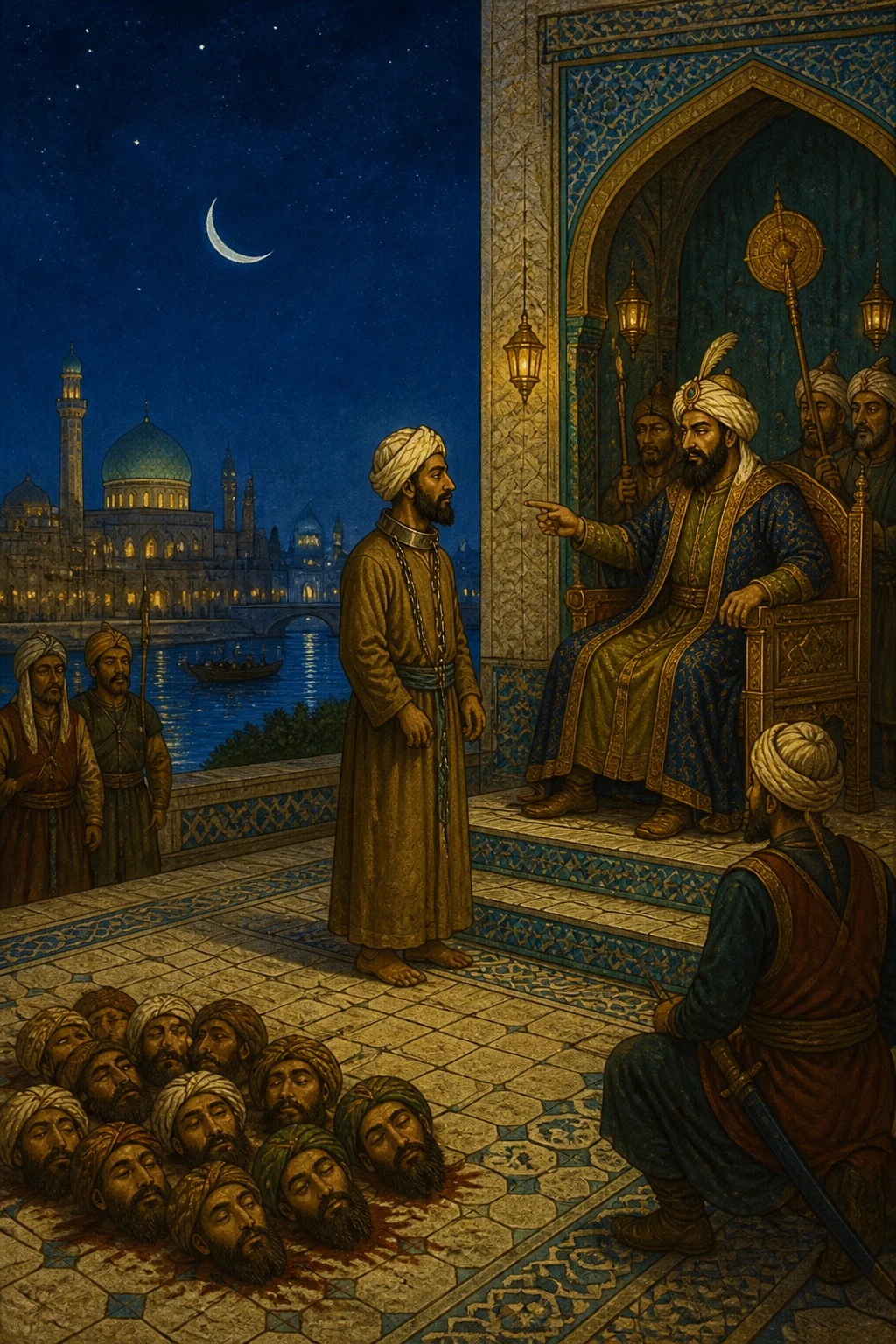
It is also told that Hisham ibn Abd al-Malik ibn Marwan went hunting one day and, catching sight of a gazelle, pursued it with his hounds. As he followed it, he saw a Bedouin boy tending sheep and said to one of his servants, “Boy, go and bring that lad to me.” The lad raised his head toward him and said, “You who know nothing of the worth of honorable men! You have looked on me with disdain and addressed me with contempt. Your speech is a tyrant’s, and your conduct a donkey’s.” Hisham said to him, “Woe to you! Do you not know me?” “Your ill manners have made you known to me,” he replied, “for you addressed me before offering a greeting.” “Woe to you!” he said. “I am Hisham ibn Abd al-Malik.” The Bedouin replied, “May God never bring your dwelling near, nor bid you welcome when you visit! How plentiful your words, and how scant your courtesy!” He had scarcely finished speaking when soldiers surrounded them on every side, each saying, “Peace be upon you, Commander of the Faithful.” Hisham said, “Enough of this talk. Keep hold of this boy.” So they seized him. When the boy saw the throng of chamberlains, ministers, and dignitaries, he paid them no heed and asked nothing about them. Instead, he rested his chin on his chest and watched where he set his feet until he reached Hisham. There he stood before him with his head bowed toward the ground, offering no greeting and refusing to speak. One of the attendants said to him, “You dog of the Arabs, what kept you from greeting the Commander of the Faithful?” The boy turned angrily toward the attendant and said, “You donkey’s saddlecloth! The long road, the climb up the steps, and the sweat kept me from it.” Hisham, his anger mounting, said, “Boy, you have come on the day when your appointed end has arrived, your hopes have deserted you, and your life has run its course.” He replied, “By God, Hisham, if my allotted span still has time to run and has not been cut short in the original decree, then nothing you say, great or small, can harm me.” The chamberlain said to him, “Have you risen so high, you vilest of Arabs, that you bandy words with the Commander of the Faithful?” He answered at once, “May madness seize you, and may misery and bereavement never leave you! Have you not heard the words of God Most High: ‘On the day when every soul shall come pleading for itself’?” At this Hisham flew into a terrible rage and said, “Executioner, bring me this boy’s head! He has talked too much and shown no fear of rebuke.” The executioner took the boy down to the leather execution mat, drew his sword over his head, and said, “Commander of the Faithful, here is your servant, so proud of himself, now bound for his grave. Shall I strike off his head, with no guilt upon me for his blood?” “Yes,” he said. The executioner asked permission a second time, and Hisham granted it. Then he asked a third time, and the youth understood that if permission were granted this time, he would be killed. So he laughed until his back teeth showed. Hisham grew still angrier and said, “Boy, I think you must be witless. Do you not see that you are about to leave this world? How can you laugh and make a mockery of yourself?” He replied, “Commander of the Faithful, if my life still has time to run, nothing, great or small, can harm me. But some verses have come to mind. Hear them, for you will not lose your chance to kill me.” Hisham said, “Recite them, and be brief.” So he recited these verses:
“I have been told a hawk once caught a sparrow of the fields, brought to him by fate. The sparrow spoke within his talons as the hawk flew on, intent upon his prey: ‘There is not enough in me to make a meal for one like you; if eaten, I would be a paltry morsel indeed.’ The proud hawk smiled in wonder—and the sparrow slipped away.” Hisham smiled and said, “By my kinship with the Messenger of God, may God bless him and grant him peace, had he spoken these words at the outset and asked for anything short of the caliphate, I would have given it to him. Attendant, fill his mouth with jewels and reward him handsomely.” The attendant gave him a lavish gift, which he took, and then went on his way. Thus ends the tale.