Prevod
And now the god had cast off the bull’s deceptive shape and revealed himself, and was dwelling in the fields of Dicte, when her father, knowing nothing, ordered Cadmus to search for his stolen daughter, adding exile as the penalty if he failed to find her—loving and cruel in the same act. After wandering through the world—for who could uncover Jupiter’s thefts?—the son of Agenor fled his homeland and his father’s anger, and humbly consulted Phoebus’ oracle, asking what land he should make his home.
“A cow,” said Phoebus, “will meet you in deserted fields, one that has never borne a yoke or drawn the curved plough. Take her as your guide, and where she rests upon the grass, build your city’s walls, and call the country Boeotia.” Scarcely had Cadmus come down from the Castalian cave when he saw an unguarded heifer walking slowly, her neck bearing no mark of servitude.
He followed, tracing her footsteps at a measured pace, and silently worshipped Phoebus, the guide of his journey. He had passed the shallows of Cephisus and the fields of Panope when the cow stopped, and lifting her fine brow with its tall horns towards heaven, filled the air with lowing. Then, looking back at the companions following behind her, she sank down and laid her flank upon the tender grass.
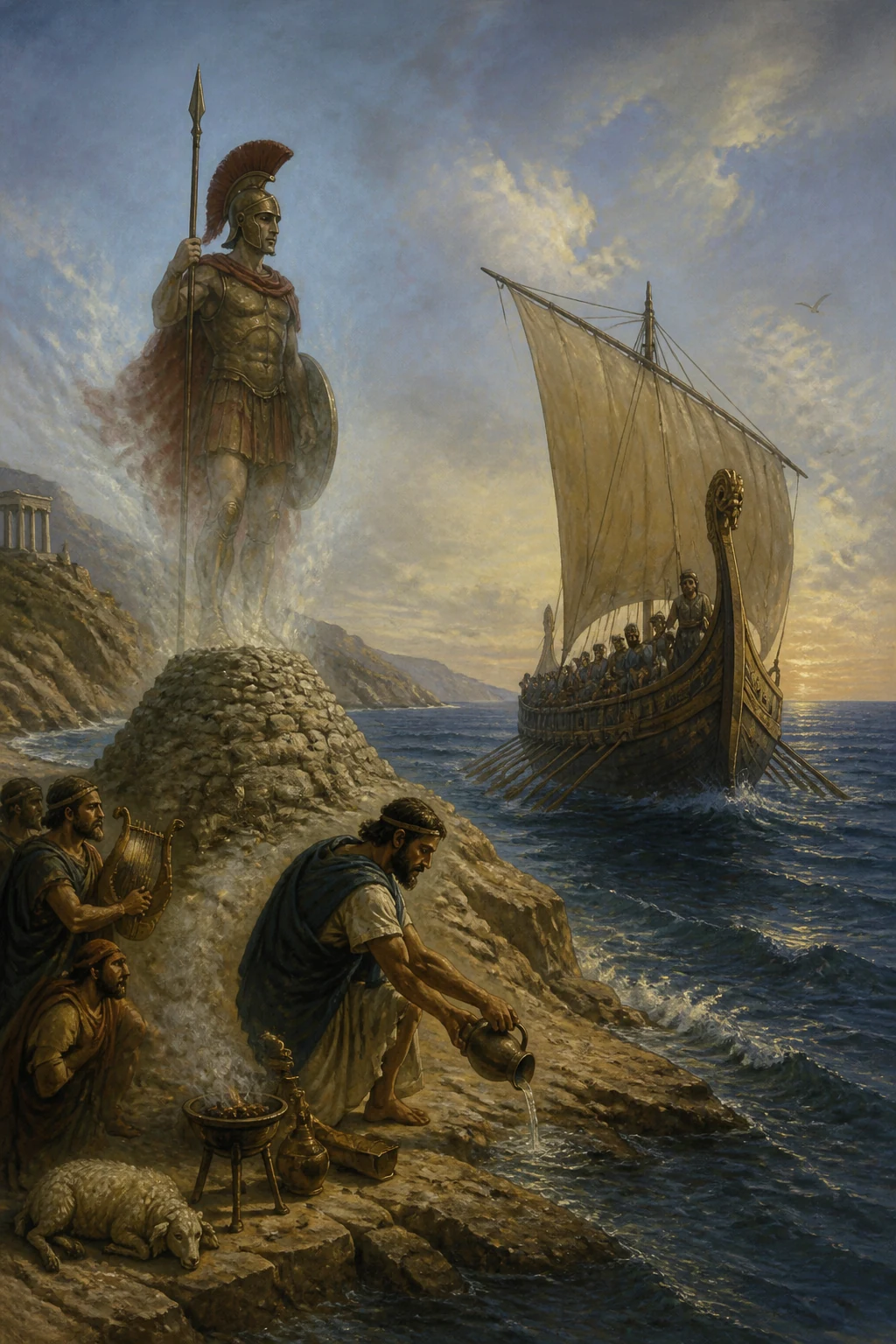
Cadmus gave thanks, pressed kisses upon the foreign soil, and greeted the unfamiliar mountains and fields. He was about to offer sacrifice to Jupiter, and ordered his servants to go and fetch water from a flowing spring for the libation. An ancient forest stood there, untouched by any axe, and in its midst a cave, thickly screened with branches and shoots, its fitted stones forming a low arch, rich in abundant water. Hidden within this cavern was a serpent sacred to Mars, splendid with a golden crest.
Its eyes flashed fire, its whole body swelled with venom, three tongues flickered, and its teeth stood in triple rows. When the men who had come from Tyre entered that grove with ill-fated steps, and a jar lowered into the water made a sound, the dark-blue serpent raised its head from the cavern’s depths and hissed in terror. The jars slipped from their hands, the blood drained from their bodies, and a sudden trembling seized their stunned limbs.
The serpent twisted its scaly coils in writhing knots, and with a leap bent itself into enormous arches. Rearing more than half its length into the weightless air, it looked down over the whole wood, its body as vast, if seen entire, as the serpent that divides the two Bears. Without delay it fell upon the Phoenicians, whether they were preparing to fight or flee, or fear itself prevented either.
Some it killed with its bite, others in its long coils, and others with the deadly corruption of its poisonous breath. Now the sun at its height had made the shadows small. Wondering what delayed his companions, Agenor’s son went in search of them. His covering was a skin stripped from a lion; his weapons, a spear with a gleaming iron point and a javelin, and courage greater than any weapon.
When he entered the wood and saw the slaughtered bodies and the victorious enemy, its enormous bulk stretched above them, licking their dreadful wounds with its bloodstained tongue, “My faithful friends,” he said, “I shall either avenge your deaths or join you.” Then with his right hand he lifted a millstone and hurled that great weight with a mighty effort. Its impact would have shaken lofty walls and their high towers; yet the serpent remained unharmed, protected by scales like a coat of mail, and the hardness of its dark hide turned the powerful blow aside.
But that same hardness could not withstand the javelin: it lodged midway along the curve of the supple backbone, and the iron point sank deep into the creature’s belly. Maddened by pain, it twisted its head towards its back, looked at the wound, and bit the embedded shaft. After wrenching it violently this way and that, it barely tore it from its back; the iron stayed fast in the bones.
Then indeed, when this fresh cause was added to its accustomed fury, its throat swelled with bulging veins, and whitish foam streamed round its pestilential jaws. The earth rang as its scales scraped over it, and the black breath issuing from its Stygian mouth poisoned the tainted air. Now it wound itself into coils that formed a vast circle, now stood straighter than a towering tree trunk, now rushed forward with tremendous force, like a river swollen by rain, sweeping the woods in its path aside with its breast.
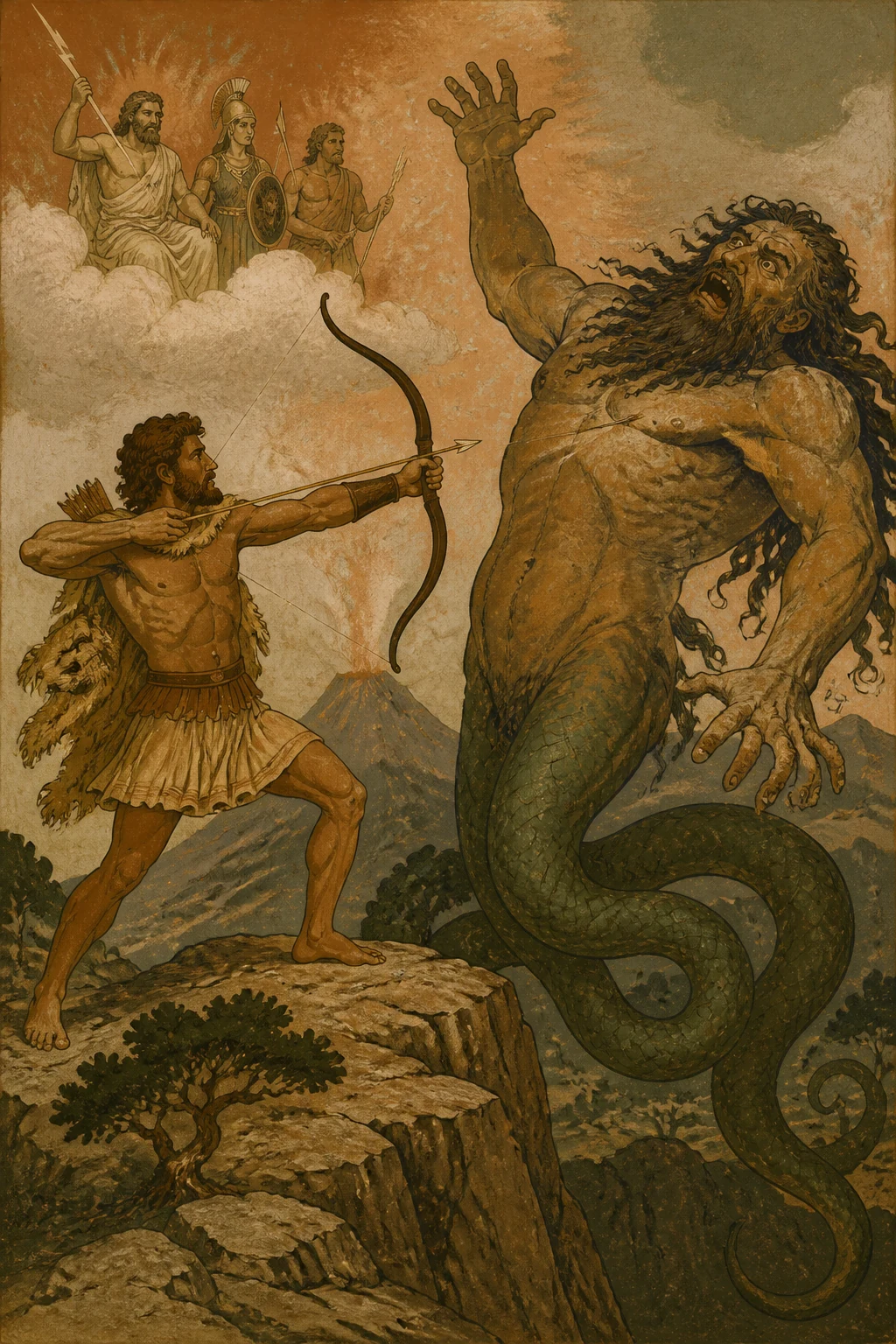
Agenor’s son gave ground a little, using the lion’s skin to withstand its onslaught, and checked the advancing jaws with his outstretched spear-point. It raged, biting in vain at the hard iron and fastening its teeth upon the point. Already blood had begun to flow from its venomous mouth, spattering and staining the green grass, but the wound was slight, for it drew back from the thrust, withdrawing its wounded neck and, by yielding, kept the blow from sinking home or driving deeper, until Agenor’s son, pressing the iron into its throat, followed it relentlessly, until an oak blocked its retreat and its neck was pinned fast to the trunk.
The tree bent beneath the serpent’s weight, and groaned as the creature’s tail lashed the lower part of its trunk. While the victor surveyed the vast length of his conquered foe, a voice was suddenly heard; from where, no one could readily tell, but it was heard: “Son of Agenor, why gaze at the serpent you have slain? You too shall be gazed on as a serpent.” For a long time he stood terrified, bereft of colour and sense alike, his hair bristling with icy fear.
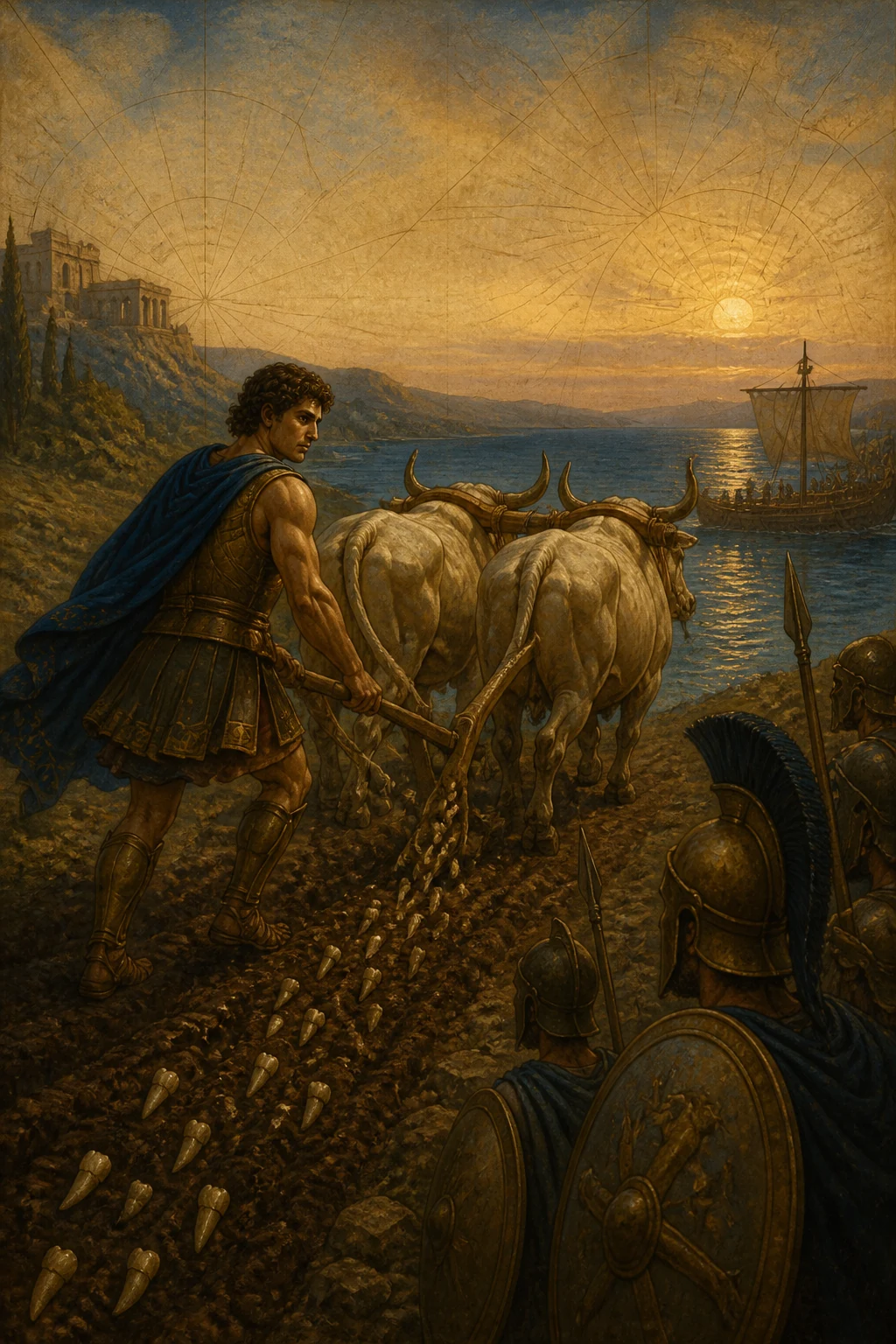
Then Pallas, his protectress, gliding down through the upper air, appeared and ordered him to bury in the broken earth the serpent’s teeth, the seeds of a people yet to come. He obeyed, and after pressing the plough to open a furrow, scattered the teeth as commanded—seeds of mortal men. Then, beyond belief, the clods began to stir, and first a spear-point showed above the furrows, then helmets with nodding, painted crests, then shoulders, breasts, and arms laden with weapons rose into view, and a shield-bearing crop of men grew up.
So, when the curtain rises in a theatre at a festival, the figures on it rise, revealing first their faces, then little by little the rest, until, drawn steadily upwards, they stand revealed entire, their feet upon the lower edge. Alarmed by this new enemy, Cadmus prepared to take up arms. “Do not arm yourself,” cried one of the people the earth had created, “or meddle in our civil war.”
With that he struck one of his earthborn brothers at close quarters with his hard sword, then fell to a javelin cast from afar. The man who killed him lived no longer than his victim, but breathed out the air he had only just received. The whole throng raged in the same way, and these sudden-born brothers fell by mutual wounds in a war of their own. Already the young men, allotted so brief a span of life, beat with their still-warm breasts upon their bloodstained mother, leaving only five alive, one of whom was Echion.
At the prompting of Triton’s goddess, he threw his weapons to the ground, and pledged and sought a brotherly peace. These were the companions the Sidonian stranger had in his labour when he founded the city ordained by Phoebus’ oracle. Now Thebes stood built; now, Cadmus, you might well have seemed fortunate in your exile. Mars and Venus had become your wife’s parents; add to this the offspring of so noble a bride, so many sons and daughters, and grandchildren, those dear pledges of love, who themselves had now grown to youth. Yet always a man’s last day must be awaited, and no one should be called happy before his death and final funeral rites.