Prevod
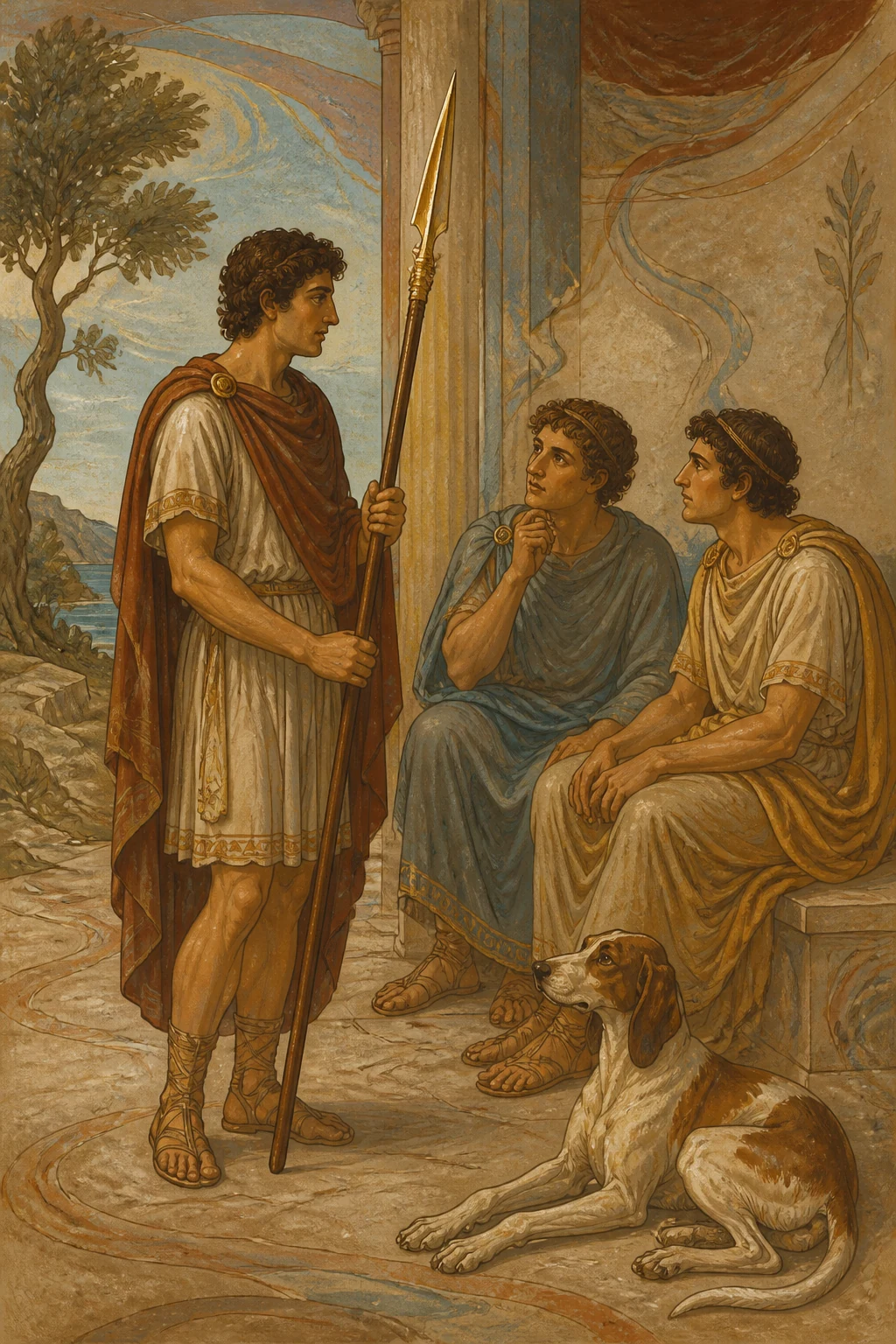
Amid such prosperity, Cadmus, your grandson first brought you grief, with the alien antlers set upon his brow, and you, hounds, gorged on your master's blood. Yet look closely, and you will find the fault was fortune's, not his own wickedness: what wickedness was there in a mistake? There was a mountain stained with the slaughter of many kinds of beasts; and now midday had shortened every shadow, and the sun stood midway between the limits of its course, when the young Hyantian calmly addressed his companions, who roamed through the wild woodland, sharing in his labors: “Friends, our nets and spears are wet with the blood of beasts, and the day has brought us good fortune enough. When another
Dawn rides in on saffron wheels and brings back the light, we shall take up our appointed task again. Now Phoebus stands equally far from either horizon and cracks the fields with heat. Break off your work for now, and gather up the knotted nets.” They obey his orders and leave off their toil. There was a valley thick with pines and pointed cypresses, called Gargaphie, sacred to Diana of the tucked-up tunic.
In its farthest recess lay a woodland cave, untouched by any art: nature, through her own genius, had imitated art, for out of living pumice and light tufa she had fashioned a natural arch. A spring murmurs on the right, its shallow waters crystal-clear, its broad basin girdled with a grassy rim. Here the goddess of the woods, weary from hunting, would often bathe her virgin limbs in the clear water.
When she entered, she handed one of her nymphs, her armor-bearer, her spear, her quiver, and her unstrung bow; another held out her arms to take the robe she laid aside; two unfastened the sandals from her feet, while Crocale, daughter of Ismenus, more skillful than the others, gathered the hair strewn over her neck into a knot, though her own hung loose. Nephele, Hyale, Rhanis, Psecas, and Phiale drew water and poured it from ample urns.
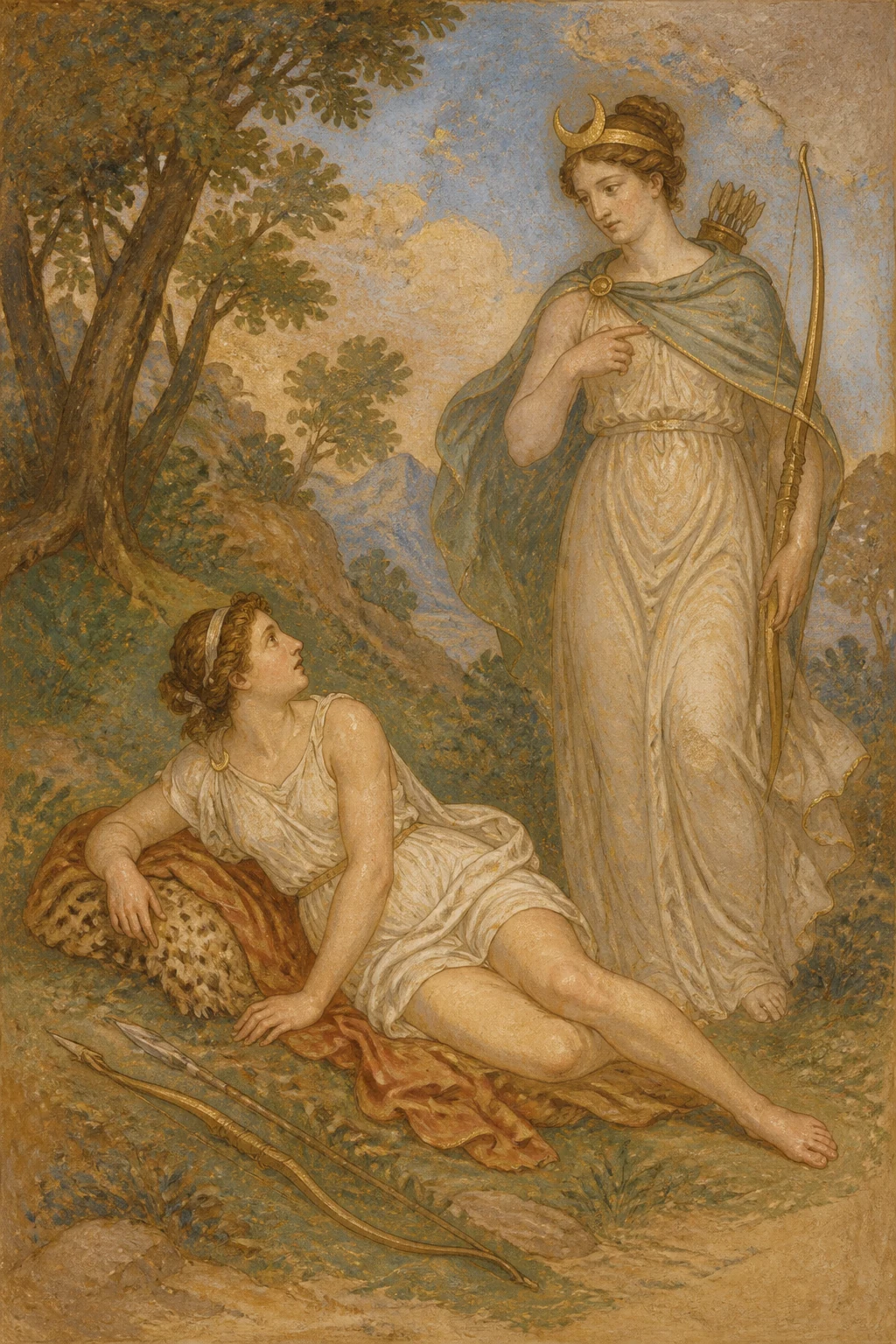
While the Titan's daughter bathed there in her accustomed waters, behold, Cadmus's grandson, having put off the rest of his day's work, came wandering aimlessly through the unfamiliar woods and reached the sacred grove: so fate was leading him. The moment he entered the cave, wet with its flowing springs, the nymphs, naked as they were, caught sight of a man and beat their breasts; their sudden screams filled the whole grove, and they crowded around Diana, shielding her with their bodies. Yet the goddess stood taller, her head and neck rising above them all.
The color that stains the clouds when struck by the sun's opposing rays, or flushes rosy dawn, spread over Diana's face when she was seen unclothed. Though surrounded by the throng of her attendants, she turned to stand sideways and bent her face back over her shoulder. How she wished her arrows lay ready! Instead she scooped up the water that was at hand and drenched the man's face; sprinkling his hair with those avenging drops, she added these words, foretelling his coming ruin: “Now you may tell how you saw me with my clothing laid aside— if you can tell it.” Without further threats, she gave his drenched head the antlers of a long-lived stag,
lengthened his neck, and sharpened the tips of his ears; she changed his hands to feet, his arms to long legs, and clothed his body in a spotted hide. Fear too was added. The son of Autonoe fled, marveling, even as he ran, at his own swiftness. But when he saw his face and antlers in the water, he tried to cry, “Poor wretch that I am!” No words came. He groaned: that was his voice. Tears streamed down cheeks no longer his own; only his mind remained unchanged.
What should he do? Return home to the royal palace, or hide in the woods? Shame barred the one, fear the other. While he hesitated, his hounds caught sight of him. First Melampus and keen-scented Ichnobates gave the signal with their barking— Ichnobates from Cnossus, Melampus of Spartan stock. Then the others rushed on, swifter than the racing wind: Pamphagus, Dorceus, and Oribasus, all Arcadians; powerful Nebrophonus, fierce Theron, and Laelaps; Pterelas, prized for his speed, and Agre for her nose; savage Hylaeus, lately wounded by a boar; Nape, sired by a wolf, and Poemenis, who had followed flocks, and Harpyia, accompanied by her two offspring;
Ladon of Sicyon, with his flanks drawn tight; Dromas, Canache, Sticte, Tigris, and Alce; Leucon with his snowy coat, Asbolus with his black; mighty Lacon and Aello, tireless in the chase; Thous and swift Lycisce with her Cyprian brother; Harpalos, his black brow marked with a white patch in the middle; Melaneus and shaggy-coated Lachne; Labros and Argiodus, born of a Dictaean sire and a Spartan dam; shrill-voiced Hylactor, and others it would take too long to name. Eager for prey, the pack pursued him over crags and cliffs and inaccessible rocks, where the going was hard and where there was no path at all.
He fled through places where he had often given chase; alas, he fled his own servants! He longed to cry, “I am Actaeon! Recognize your master!” But words failed his will; the air rang with barking. Melanchaetes dealt the first wound in his back, Therodamas the next; Oresitrophus fastened on his shoulder. They had started later, but by a shortcut across the mountain had overtaken him. While they held their master fast, the rest of the pack gathered and sank their teeth into his body.
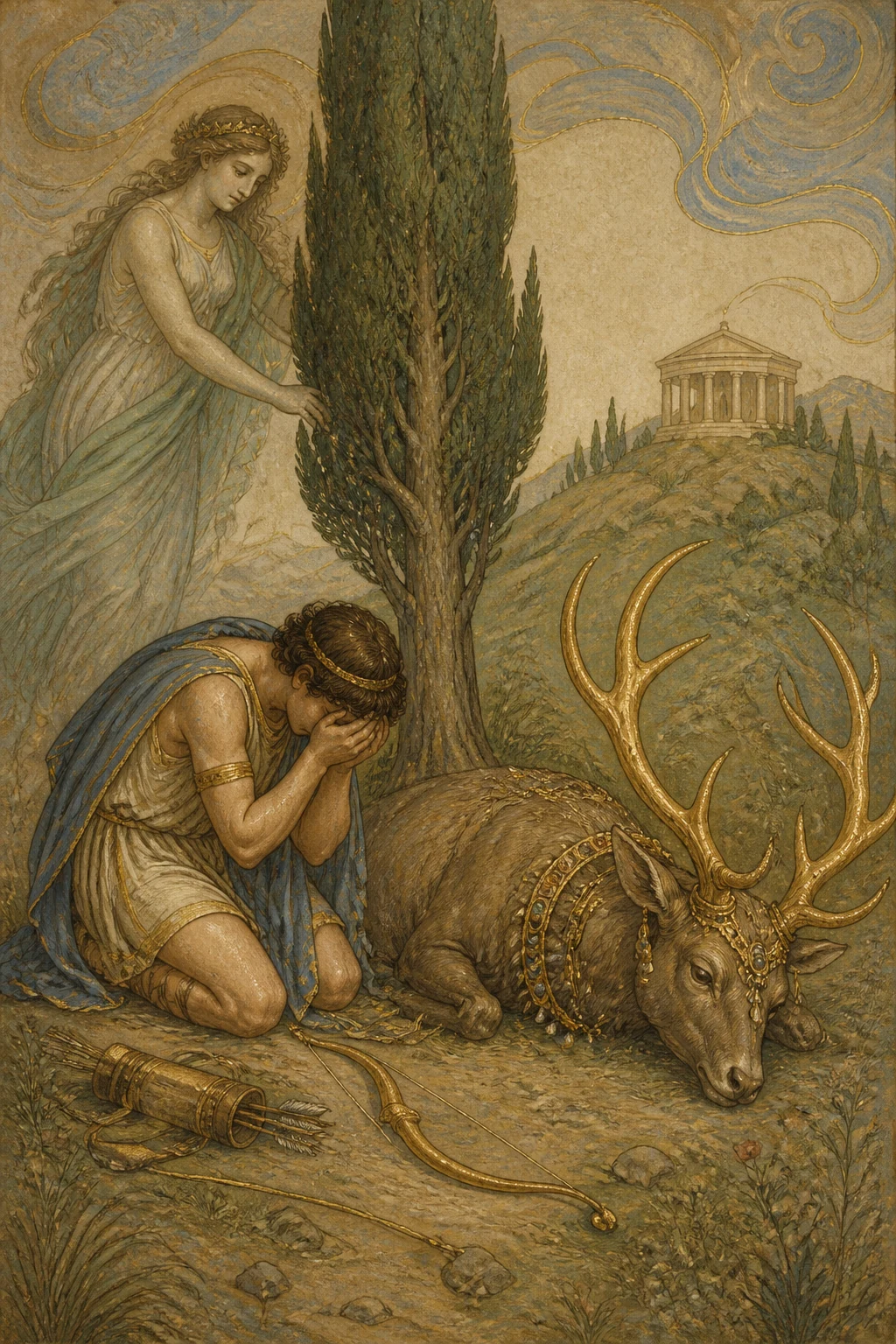
Soon there was no room for further wounds. He groaned, making a sound that, though not human, was still one no stag could utter, and filled the familiar heights with mournful cries. Down on his knees, like a suppliant begging for mercy, he turned his silent face about, as though it were his arms. But his companions, knowing nothing, urged on the ravening pack with their usual cries and looked around for Actaeon; as though he were absent, they vied in calling “Actaeon!”
(he turned his head at the name), and complained that he was missing, too idle to enjoy the sight of the quarry offered them. How he wished he were absent! But he was there; he wished to see, not also feel, the savage deeds of his own hounds. They ringed him on every side and, burying their muzzles in his flesh, tore their master apart beneath the deceptive likeness of a stag.
And only when his life had ended through those countless wounds, they say, was the wrath of quiver-bearing Diana appeased.