Prevod
I. “Soup from a Sausage Skewer.” “That was a splendid dinner yesterday!” said an old lady mouse to another who had not been at the feast. “I sat twenty-first from the old Mouse King; that is not so bad at all! Shall I tell you what was served? The dishes were very well chosen: mouldy bread, pork rind, tallow candles, and sausage—and then the same all over again; it was almost as good as having two dinners. There was a pleasant atmosphere and plenty of good-natured nonsense, just as in a family circle; not the least little thing was left except the sausage skewers. We began talking about those, and the question came up of making soup from a sausage skewer. Everyone had heard of it, of course, but no one had tasted that soup, let alone knew how to make it. A charming toast was proposed to the inventor: he deserved to be put in charge of poor relief! Wasn’t that witty? And the old Mouse King stood up and promised that whichever of the young lady mice could make the tastiest soup of that kind should become his queen. They were to have a year and a day to think it over.”
“That was not so bad at all!” said the other mouse. “But how does one make that soup?” “Yes, how does one make it! That was what all the lady mice asked, young and old alike. They were all eager to be queen, but none cared for the trouble of going out into the wide world to learn how, and that would probably be necessary! Still, not everyone is made to leave her family and the familiar nooks and crannies. Out there you cannot expect to walk on cheese rinds and smell pork crackling every day; no, you may go hungry, or perhaps even be eaten alive by a cat!”
These thoughts must also have frightened most of them away from setting out in search of knowledge. Only four mice came forward to make the journey, young and nimble, but poor. Each would go to one of the four corners of the world, and then it would be a question of whom fortune favoured. Each took a sausage skewer with her, to remind her what she was travelling for; it would serve as her walking stick.
They left at the beginning of May, and at the beginning of May the following year they returned—but only three of them. The fourth did not appear, nor was there any word from her, and now the day of decision had arrived.
“There must always be something sad mixed in with one’s greatest pleasures!” said the Mouse King. But he gave orders to invite all the mice for many miles around; they were to assemble in the kitchen. The three travelled mice stood in a row by themselves; for the fourth, who was missing, a sausage skewer had been set up, draped in black crape. No one dared give an opinion until the three had spoken and the Mouse King had said what else was to be said.
Now we shall hear! II. What the First Little Mouse Had Seen and Learned on Her Travels. “When I set out into the wide world,” said the little mouse, “I believed, like so many of my age, that I had swallowed all the wisdom in the world. But one has not; that takes many a year and a day. I went straight to sea, aboard a ship bound for the north. I had heard that at sea the cook must know how to make do, but it is easy to make do when you have plenty of sides of bacon, barrels of salt meat, and weevilly flour. You live in style! But you learn nothing that will turn a sausage skewer into soup. We sailed for many nights and days, with plenty of rolling and wet weather. When at last we reached our destination, I left the ship; we were far away in the north.
It is a strange thing to leave your own little nook at home, go aboard a ship—which is also a kind of nook—and then suddenly find yourself hundreds of miles away, standing in a foreign land. There were wild forests of fir and birch, with such a strong scent; I do not care for that! The wild herbs smelled so spicy that I sneezed and thought of sausage. There were great forest lakes, their water clear close at hand, but black as ink when seen from a distance. White swans floated on them; I took them for foam, they lay so still, but then I saw them fly and saw them walk, and knew what they were. They belong to the goose family; you can tell that by their walk. No one can deny their relations! I kept to my own kind and made friends with the wood mice and field mice, who, for that matter, know very little, especially about good food—and that was what I had gone abroad to learn about. The very thought that one might make soup from a sausage skewer struck them as so extraordinary that it spread at once through the whole forest. But as for actually solving the problem, they considered that impossible. Little did I think that here, that very night, I should be initiated into its making. It was midsummer; that was why the forest smelled so strong, they said, why the herbs were so spicy and the lakes so clear and yet so dark, with the white swans on them. At the edge of the forest, among three or four houses, a pole as tall as a mainmast had been raised, with wreaths and ribbons hanging at its top; it was the maypole. Girls and young men danced around it, singing as loudly as the fiddler played. There was great merriment at sunset and in the moonlight, but I did not join in. What business has a little mouse at a woodland ball? I sat in the soft moss, holding my sausage skewer. The moon shone especially brightly on one spot, where there was a tree covered with moss as fine—yes, I dare say as fine—as the Mouse King’s fur, only it was green, and so a blessing to the eyes. Suddenly the loveliest little people came marching up, no taller than my knee. They looked like human beings, only better proportioned. They called themselves elves, and wore fine clothes made of flower petals, trimmed with flies’ and gnats’ wings—not at all bad. At first they seemed to be looking for something, though I could not tell what. Then a couple of them came over to me, and the grandest of them pointed to my sausage skewer and said, ‘That is just what we need! It is cut to shape; it is excellent!’ And the longer he looked at my walking stick, the more delighted he became.
‘You may borrow it, but you may not keep it!’ I said. ‘Not keep it!’ they all said, taking hold of the sausage skewer. I let it go, and they danced away with it to that patch of fine moss, where they set it up in the middle of the green. They wanted a maypole too, and the one they now had might have been made for them. Then they decorated it—and what a sight it became!
Tiny spiders spun golden thread around it and hung it with fluttering veils and banners, so finely woven and bleached so snowy white in the moonlight that they dazzled my eyes. They took colours from butterflies’ wings and sprinkled them over the white fabric, and flowers and diamonds shone upon it. I no longer recognised my sausage skewer; surely there was no other maypole like it in the world. Only then did the really grand company of elves arrive, with no clothes on at all—nothing could have been finer—and I was invited to look at all the splendour, but from a distance, for I was too big for them.
Then the music began! It was as though a thousand glass bells were ringing, so full and strong. I thought it was the swans singing; indeed, I fancied I could hear the cuckoo and the thrush as well. At last it seemed as if the whole forest were joining in: there were children’s voices, chiming bells, and birdsong, the loveliest melodies, and all that beauty sounded from the elves’ maypole. It was a whole carillon—and it was my sausage skewer. I had never imagined that so much could come out of it, but I suppose it depends on whose hands it falls into. I was so deeply moved that I cried as only a little mouse can cry, out of sheer delight.
The night was far too short! But nights are no longer than that up there at that season. At dawn a breeze sprang up, the smooth surface of the forest lake rippled, and all the fine floating veils and banners flew away into the air. The swaying pavilions of cobweb, the suspension bridges and balustrades, or whatever they are called, which had been built from leaf to leaf, vanished as though they were nothing. Six elves came and brought me my sausage skewer, asking whether I had any wish they could grant. Then I asked them to tell me how to make soup from a sausage skewer.
‘How we do it!’ said the grandest elf, laughing. ‘Why, you have just seen! You could scarcely recognise your own sausage skewer!’ ‘Oh, that is what you mean!’ I said, and told them plainly why I was travelling and what those at home expected of my journey. ‘What use is it,’ I asked, ‘to the Mouse King and our whole mighty kingdom that I have seen all this beauty? I cannot shake it out of the sausage skewer and say, “Look, here is the skewer; now comes the soup!” Though it would at least make a sort of dish to serve when one had eaten one’s fill!’
Then the elf dipped his little finger into a blue violet and said to me, ‘Pay attention! I am stroking your walking stick, and when you come home to the Mouse King’s palace, touch your king’s warm breast with it. Violets will spring out all over the stick, even in the coldest winter weather. There, you have something to take home, and a little more besides!’” But before the little mouse said what that little more was, she turned her stick towards the King’s breast, and sure enough, the loveliest bouquet of violets sprang out. Their scent was so strong that the Mouse King ordered the mice standing nearest the fireplace to put their tails into the fire at once, so that there might be a little smell of scorching. The scent of violets was unbearable; it was not the sort of smell they liked.
“But what was that little more you spoke of?” asked the Mouse King. “Well,” said the little mouse, “it is what I believe they call the effect!” And she turned the sausage skewer round; the flowers vanished, and she held only the bare stick, which she raised like a conductor’s baton.
“‘Violets are for sight, smell, and touch,’ the elf told me, ‘but there are still hearing and taste to come!’” And then she beat time. There was music—not as it had sounded in the forest at the elves’ festival, but as it sounds in a kitchen. And what a commotion it was! Suddenly it was as though the wind were roaring through every chimney pipe. Kettles and pots boiled over, the fire shovel thundered against the brass kettle, and then, all at once, everything fell silent. The teakettle’s muffled song could be heard, so strange that one could not tell whether it was beginning or ending. And the little pot boiled and the big pot boiled, neither paying the slightest attention to the other; it was as though there were not a thought in either pot. And the little mouse waved her baton more and more wildly—the pots foamed, bubbled, and boiled over, the wind roared, the chimney whistled—hoo! ha! It grew so dreadful that the little mouse herself dropped the stick.
“That was a mighty soup!” said the old Mouse King. “Is the dish not to be served now?” “That was all!” said the little mouse, and curtsied. “All! Well, then, let us hear what the next one has to say!” said the Mouse King.
III. What the Second Little Mouse Had to Tell. “I was born in the palace library,” said the second mouse. “Neither I nor several others of my family have ever known the good fortune of entering the dining room, let alone the pantry. It was only when I went travelling, and again here today, that I ever saw a kitchen. We often went hungry in the library, but we acquired a great deal of knowledge. Word reached us there of the royal prize offered for making soup from a sausage skewer, and my old grandmother brought out a manuscript. She could not read it, but she had heard it read aloud, and it said: ‘If you are a poet, you can make soup from a sausage skewer.’ She asked me whether I was a poet. I knew I was innocent of that, and she said that in that case I must go out and see about becoming one. But what did that require, I asked, for it seemed as difficult to discover as how to make the soup. Grandmother, however, had heard books read aloud, and she said that three main ingredients were needed: ‘Understanding, imagination, and feeling! If you can go out and get those inside you, then you are a poet, and you will surely manage the sausage skewer.’
So I went westward into the wide world to become a poet. I knew that understanding is the most important thing in any undertaking; the other two ingredients are not held in such esteem! So I went first in search of understanding. But where does it live? Go to the ant, and be wise! A great king in the land of the Jews said that; I knew it from the library. And I did not stop until I reached the first large anthill. There I lay in wait, to become wise.
Ants are a very respectable race; they are all understanding. Everything about them is like a sum correctly worked out: it comes right. To work and lay eggs, they say, is to live in the present and provide for the future, and that is what they do. They divide themselves into clean ants and dirty ants; rank is a matter of numbers. The Ant Queen is number one, and hers is the only correct opinion. She has swallowed all wisdom, and that was important for me to know! She said a great many things, so wise that I thought them foolish. She said their anthill was the highest thing in the world; but close beside it stood a tree, which was higher, much higher. That could not be denied, so they did not speak of it. One evening an ant had strayed over there and climbed up the trunk—not even as far as the crown, but still higher than any ant had ever been before. When she turned back and found her way home, she told those in the anthill about something much higher outside. But all the ants considered this an insult to the whole community, and she was sentenced to be muzzled and kept in perpetual solitude. A short time later, however, another ant came to the tree and made the same journey and discovery. She spoke of it, as they put it, with moderation and vagueness; and since she was also a respected ant, one of the clean ones, they believed her. When she died, they set up an eggshell as a monument to her, for they held learning in high regard. I saw,” said the little mouse, “that the ants were continually running about with their eggs on their backs. One of them dropped hers and struggled hard to pick it up again, but could not manage it. Then two others came and helped with all their might, until they nearly dropped their own eggs; at that they immediately stopped, for one must look after oneself first. And the Ant Queen said that this had shown both heart and understanding. ‘Those two qualities place us ants highest among rational beings. Understanding must and ought to carry the greatest weight, and I have the most of it!’ Then she rose on her hind legs. She was so easy to recognise—I could not be mistaken—and I swallowed her. Go to the ant, and be wise! Now I had the queen!
I went closer to the great tree I have mentioned. It was an oak, with a lofty trunk and a mighty crown, and it was very old. I knew that a living being dwelt there, a woman called a dryad, who is born with the tree and dies with it; I had heard about that in the library. Now I saw such a tree and such an oak-maiden. She gave a dreadful scream when she saw me so close. Like all women, she was terribly afraid of mice, but she had more reason than the others, for I could gnaw through the tree, and her life depended on it. I spoke to her kindly and earnestly, reassuring her, and she took me in her delicate hand. When she learned why I had gone out into the wide world, she promised that perhaps that very evening I should receive one of the two treasures I was still seeking. She told me that Phantasus was a very good friend of hers, that he was as beautiful as the god of love, and that he often rested here beneath the leafy branches, which then rustled still more strongly above them both. He called her his dryad, she said, and the tree his tree. The gnarled, mighty, beautiful oak was just to his liking. Its roots spread deep and firm in the earth, while its trunk and crown rose high into the fresh air and knew the driving snow, the sharp winds, and the warm sunshine as they ought to be known. Yes, that was how she spoke. ‘The birds sing up there and tell of foreign lands! And on the one dead branch a stork has built its nest; it makes a fine ornament, and one hears a little about the land of the pyramids. Phantasus likes all that, but even that is not enough for him. I myself must tell him about life in the forest, from when I was little and the tree was so young that a nettle could hide it, until now, when it has grown so great and mighty. Sit over there beneath the woodruff and keep a sharp lookout. When Phantasus comes, I shall find a chance to pinch his wing and pluck out a little feather. Take it; no poet ever had a better one—then you will have enough!’
And Phantasus came, the feather was plucked, and I caught it,” said the little mouse. “I kept it in water until it softened! Even then it was very hard to digest, but I managed to gnaw it all up. It is not at all easy to gnaw your way to becoming a poet; there is so much you have to swallow. Now I had two things, understanding and imagination, and with their help I knew that the third was to be found in the library. For a great man has said and written that there are novels which exist solely to relieve human beings of their excess tears, and are therefore a sort of sponge for soaking up feelings. I remembered a couple of those books; they had always looked quite appetising to me. They were so well read, so greasy, they must have soaked up an endless flood.
I went home to the library and immediately ate almost a whole novel—that is to say, the soft part, the substance of it; I left the crust, the binding, alone. When I had digested it, and another besides, I could already feel something stirring inside me. I ate a little of a third, and then I was a poet. I told myself so, and I told the others too! I had a headache, a stomach ache—I cannot tell you all the aches I had. Then I began thinking what stories might be connected with a sausage skewer, and so many sticks came into my mind! The Ant Queen must have had an extraordinary understanding. I remembered the man who put a white stick in his mouth, and then both he and the stick became invisible. I thought of old ale with a stick in it, of being on tenterhooks, of putting a spoke in someone’s wheel, and then of the last nail in one’s coffin. All my thoughts ran to sticks! Surely one could make poetry about them if one were a poet—and I am; I have worked hard enough for it! So every day of the week I shall be able to serve you a stick, a story—and that is my soup!”
“Then let us hear the third!” said the Mouse King. “Squeak! Squeak!” came a sound at the kitchen door, and a little mouse—the fourth of them, the one they had believed dead—darted in. She knocked over the sausage skewer draped in black crape. She had run night and day, catching goods trains whenever she could, and still she had almost arrived too late. She pushed her way forward, looking dishevelled; she had lost her sausage skewer, but not her tongue. She began speaking at once, as though everyone had been waiting only for her and wanted to hear no one else, as though nothing else in the world concerned anyone in it. She began at once and spoke her piece. She had come so unexpectedly that no one had time to take exception to her or her speech while she was speaking. Now we shall hear!
IV. What the Fourth Mouse Had to Tell, Who Spoke Before the Third Had Spoken. “I went straight to the largest city,” she said. “I cannot remember its name; I have a poor memory for names. I came from the railway to the town hall among some confiscated goods, and there I made my way to the jailer. He was talking about his prisoners, especially one who had spoken some rash words, which had then been talked about and talked about, read and written about. ‘The whole thing is soup from a sausage skewer!’ he said. ‘But that soup may cost him his head!’ That made me interested in the prisoner,” said the little mouse, “and I seized my chance and slipped in to him. There is always a mousehole behind locked doors! He looked pale, with a great beard and large, shining eyes. The lamp smoked, and the walls were used to it; they grew no blacker. The prisoner scratched pictures and verses on them, white on black; I did not read them. I think he was bored; I was a welcome guest. He coaxed me with breadcrumbs, whistling, and gentle words. He was so pleased with me; I came to trust him, and so we became friends. He shared his bread and water with me and gave me cheese and sausage. I lived splendidly, but I must say it was his good company above all that kept me there. He let me run over his hand and arm, right up his sleeve; he let me creep into his beard and called me his little friend. I grew truly fond of him; such things are mutual, I suppose! I forgot my errand out in the wide world and forgot my sausage skewer in a crack in the floor; it is lying there still. I wanted to stay where I was. If I went away, the poor prisoner would have no one at all, and that is too little in this world! I stayed; he did not! The last time, he spoke to me so sadly, gave me twice as much bread and cheese rind, and blew me a kiss from his fingers. He went away and never came back. I do not know his story. ‘Soup from a sausage skewer!’ said the jailer, and I went to him. But I should not have trusted him. He did take me in his hand, but then he put me in a cage, in a treadmill. It is dreadful! You run and run, get no farther, and only make yourself ridiculous!
The jailer’s granddaughter was a darling little thing, with golden curls, such happy eyes, and a laughing mouth. ‘Poor little mouse!’ she said, peeping into my horrid cage. She pulled out the iron pin—and I leapt down onto the windowsill and out into the gutter. Free, free! That was all I thought of, not the purpose of my journey!
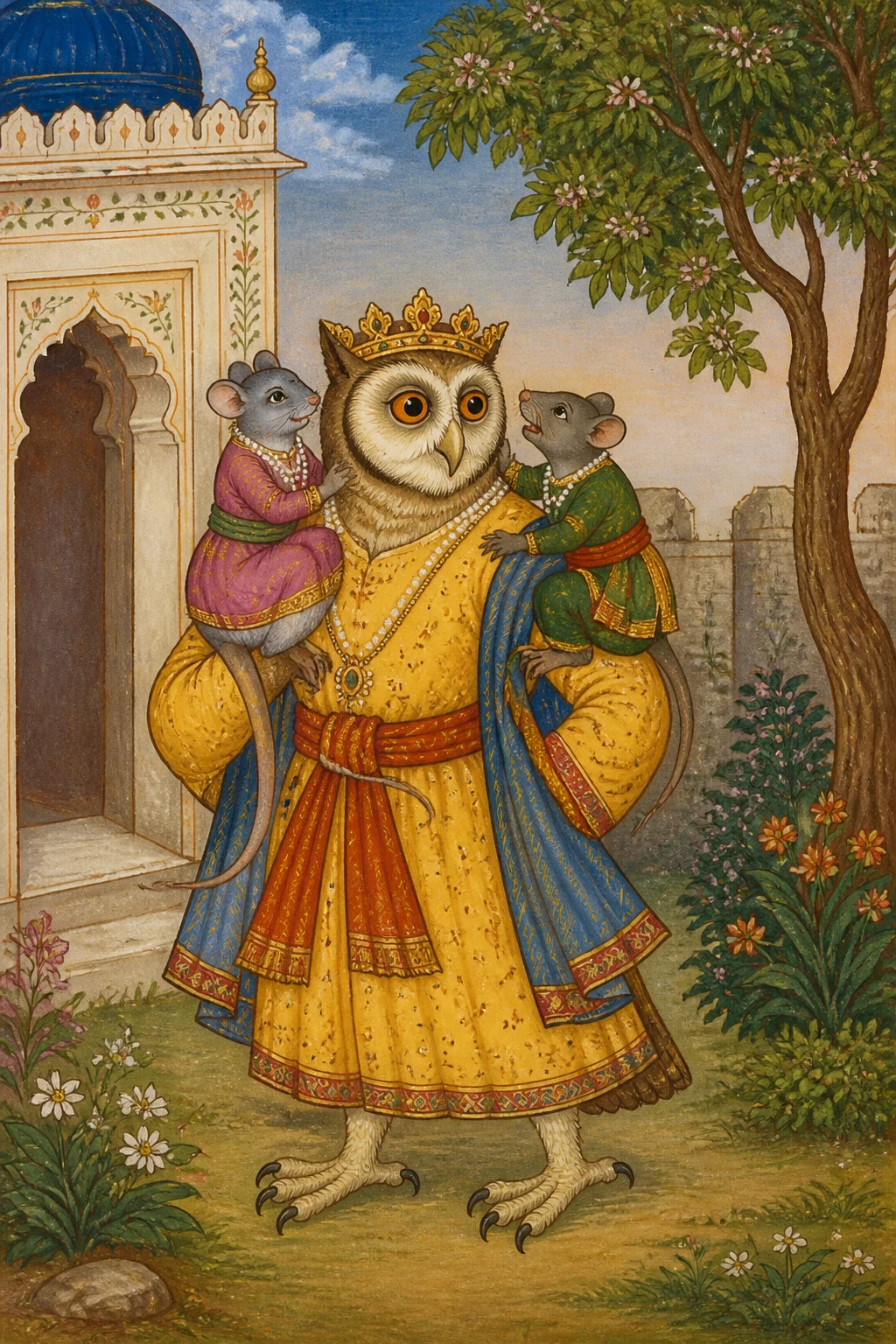
It was dark, close to nightfall, and I took shelter in an old tower where a watchman and an owl lived. I trusted neither of them, least of all the owl. She looks like a cat and has the great fault of eating mice. But one can be mistaken, and I was. She was a respectable, exceedingly cultivated old owl, who knew more than the watchman and just as much as I did. The young owls made a fuss about everything. ‘Do not make soup from a sausage skewer!’ she said. That was the harshest thing she could bring herself to say there, she was so devoted to her own family. I came to trust her so much that I squeaked from the crack where I was sitting. She was pleased by this confidence and assured me that I should be under her protection. No animal would be allowed to harm me; she would do that herself in winter, when food grew scarce.
She was wise in everything. She proved to me that the watchman could not hoot without a horn that hung loose at his side. ‘He is dreadfully conceited about it, and thinks himself the owl of the tower! It is meant to be something grand, but it amounts to very little! Soup from a sausage skewer!’ I asked her for the recipe, and then she explained it to me: ‘Soup from a sausage skewer is merely a human expression, understood in different ways, and everyone believes their own interpretation the best. But the whole thing is really nothing at all!’
‘Nothing at all!’ I said. It struck me forcibly! Truth is not always pleasant, but truth is the highest thing of all! The old owl said that too. I thought it over and saw that if I brought home the highest thing of all, I should be bringing far more than soup from a sausage skewer. So I hurried away to reach home in time and bring the highest and best: the truth. Mice are an enlightened race, and the Mouse King is above them all. He is capable of making me queen for the truth’s sake.”
“Your truth is a lie!” said the mouse who had not yet been allowed to speak. “I can make the soup, and I shall!” V. How It Was Made.
“I have not travelled,” said the fourth mouse. “I stayed in this country, which is the right thing to do! There is no need to travel; one can get everything just as well here. I stayed! I have not learned what I know from supernatural beings, nor eaten my way to it, nor talked to owls. I have thought it out for myself. Now, will you just have the kettle put on and filled with water, right to the top! Light a fire beneath it! Let it burn, bring the water to the boil; it must be at a rolling boil! Now throw in the skewer! Then will the Mouse King be so good as to put his tail into the boiling water and stir it round! The longer he stirs, the stronger the soup will be. It costs nothing! No other ingredients are needed—just keep stirring!”
"Can no one else do it?" asked the Mouse King. "No," said the mouse, "that power lies only in the Mouse King's tail!" And the water boiled furiously, and the Mouse King stood close beside it—almost dangerously close—and stretched out his tail, as mice do in the dairy when they skim the cream from a dish and then lick their tails. But he had scarcely put his into the hot steam before he leaped down again. "Of course, you shall be my queen!" he said. "We shall leave the soup until our golden wedding, so the poor in my kingdom will have something to look forward to, and a long time to enjoy the prospect!"
And so they held their wedding; but when they got home, several of the mice said, "You could hardly call that soup from a sausage peg—it was more like soup from a mouse's tail!" They thought this or that part of what had been told was quite well done, but the whole thing might have been different! "Now, I should have told it this way and that way—!"
That was the criticism, and criticism is always so wise—after the event. And the story went round the world; opinions about it were divided, but the story itself remained whole. And that is what matters most, in great things and small, and in soup from a sausage peg; only one must not expect any thanks for it!