Prevod
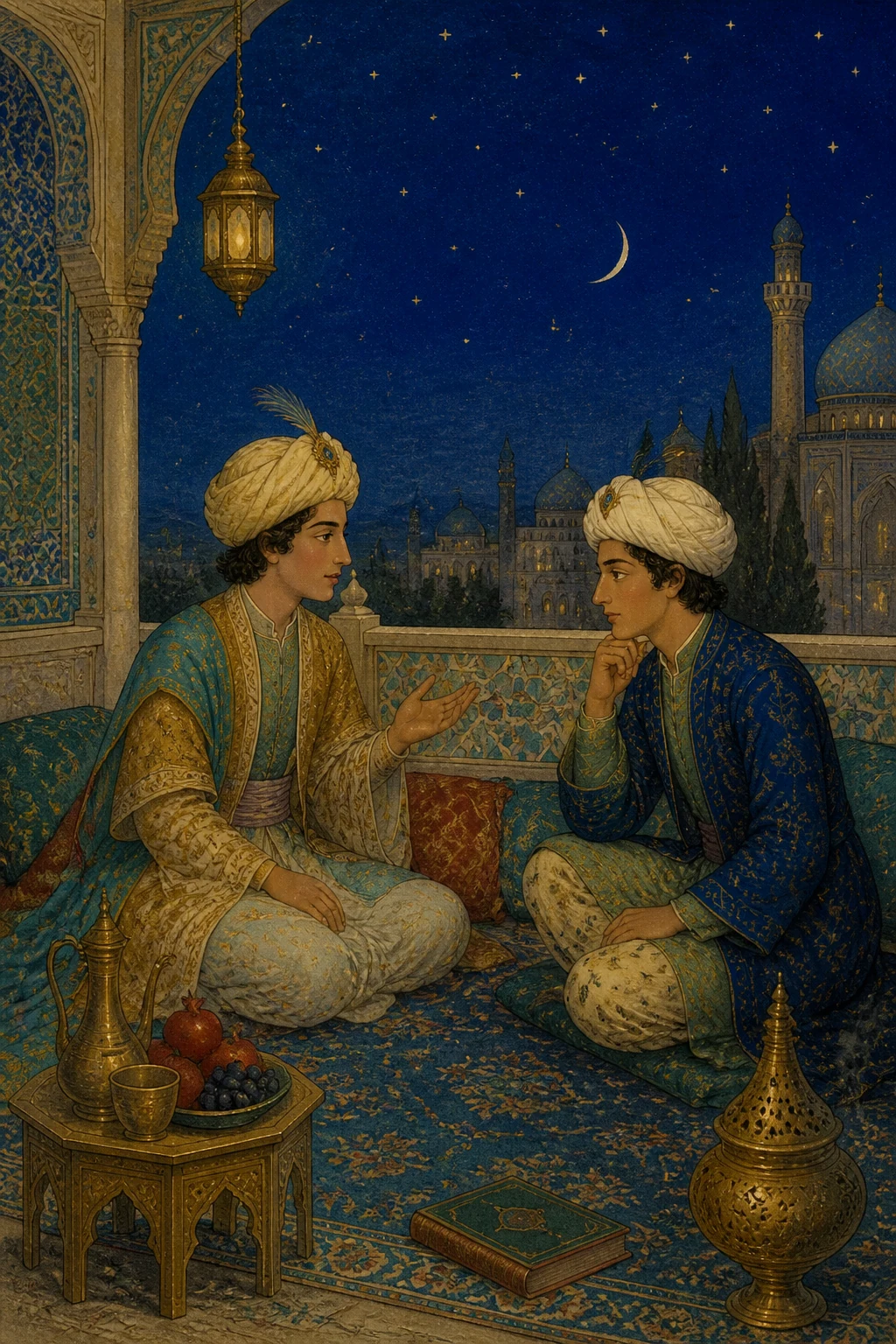
It is also related that Abu Ishaq Ibrahim al-Mawsili said: I asked al-Rashid to grant me a day to spend alone with my family and friends, and he gave me leave for a Saturday. I went home and began preparing my food and wine and everything else I should need. I ordered the doorkeepers to shut the doors and admit no one. As I sat in my chamber, with the women of my household gathered about me, an old man suddenly appeared, dignified and handsome, dressed in white garments and a fine shirt, with a shawl over his head and a staff with a silver grip in his hand. The fragrance of his perfume filled the house and the gallery. I was furious at his intrusion and thought of dismissing the doorkeepers, but he greeted me most graciously, so I returned his greeting and bade him sit. He sat down and began telling me tales of the Arabs and reciting their poetry, until my anger faded. I thought my servants must have admitted a man of such learning and wit in the hope of pleasing me. “Would you care for some food?” I asked him. “I have no need of it,” he replied. “And some wine?” I asked. “As you please,” he said. I drank a ratl of wine and gave him as much. Then he said, “Abu Ishaq, will you sing us something, so that we may hear a little of the art in which you have surpassed high and low alike?” His words angered me, but I made light of the matter to myself, took up the lute, and played and sang. “Well done, Abu Ishaq!” he said. Ibrahim continued: This only increased my anger, and I thought, “Not content with entering without permission and asking me to perform, he must now address me by name, knowing nothing of the respect due to me!” Then he said, “Will you give us more, and we shall repay you?” I bore the annoyance, took up the lute, and sang, taking particular care over my performance and doing it full justice because he had said, “We shall repay you.” But morning overtook Shahrazad, and she fell silent, leaving her tale untold.
When it was the six hundred and eighty-eighth night,
She said: It has reached me, O fortunate King, that when the old man said to Abu Ishaq, “Will you give me more, and we shall repay you?” Abu Ishaq said: I bore the annoyance and took up the lute, then sang, taking particular care over my performance and doing it full justice because he had said, “We shall repay you.” He was delighted and exclaimed, “Well done, my lord!” Then he asked, “Will you permit me to sing?” “As you wish,” I replied, thinking him feeble-minded to sing in my presence after what he had heard from me. He took up the lute and touched its strings, and, by Allah, I thought the instrument would speak in eloquent Arabic, in a sweet and mellow voice. Then he began to sing these verses:
My heart is sorely wounded: who will sell me, in exchange, a heart that bears no wounds? All men refuse it; none will buy it—and who would trade a sound heart for a sick one? I moan with the longing that dwells within my breast, like a wounded man who chokes upon his drink. Abu Ishaq said: By Allah, his voice was so beautiful that I thought the doors, the walls, and everything in the house were answering him and singing with him. Indeed, by Allah, I imagined I could hear my very limbs and clothes answering him. I sat bewildered, unable to speak or move, so deeply had his song entered my heart. Then he sang these verses:
O doves of al-Liwa, return once more, for your voices have filled me with sorrow. They returned to their thicket and almost brought me death; I nearly laid my secrets bare to them. With their cooing they called to a flock, as though drunk with wine or driven mad. Never have my eyes seen doves like these: they wept, yet no tears flowed from their eyes. Then he sang these verses also:
O east wind of Najd, when did you stir from Najd? Your passing has added longing to my longing. A grey dove called in the radiance of the morning, upon a bough amid the willow and the laurel. She wept with yearning as a little child weeps, revealing longings I had never dared reveal. They claim that lovers weary when brought near, and distance cures the anguish of desire. We tried both remedies, yet neither healed our pain; still, to dwell nearby is better than to dwell afar. Yet even nearness brings no benefit when the one you love feels no affection. Then he said, “Ibrahim, sing the songs you have heard, follow their manner in your singing, and teach them to your singing girls.” “Repeat them for me,” I said. “You have no need of repetition,” he replied. “You have learned them already, and that is done.” Then he vanished from before me. Astonished, I rose and drew my sword, then hurried to the door of the women’s quarters and found it shut. “What did you hear?” I asked the girls. “We heard the sweetest, most beautiful singing,” they replied. Bewildered, I went out to the door of the house and found that shut as well. I questioned the doorkeepers about the old man. “An old man!” they said. “By Allah, no one has entered your house today.” I returned, pondering the affair, when suddenly his voice called from one side of the house: “You have nothing to fear, Abu Ishaq. I am only Abu Murra. I have been your boon companion today, so do not be alarmed.” I rode to al-Rashid and told him what had happened. “Repeat the songs you learned from him,” he said. I took up the lute and played, and found them firmly lodged in my memory. Al-Rashid was delighted with them and began drinking as he listened, though he was not much given to wine. “Would that he had favoured us with his company for a single day, as he favoured you!” he said. Then he ordered a reward for me, which I took, and went on my way.