Prevod
There was an old manor house whose master and mistress were young and splendid people. They had wealth and blessings; they wished to enjoy themselves, and they did good. They wanted to make everyone as happy as they were themselves.
On Christmas Eve a beautifully decorated Christmas tree stood in the old great hall, where fires burned in the fireplaces and fir branches had been hung around the old portraits. Here the family and their guests gathered, and there was singing and dancing.
Earlier that evening there had already been Christmas merriment in the servants’ hall. Here, too, stood a great fir tree with lighted red and white candles, little Danish flags, paper swans, and fishing nets of coloured paper filled with “goodies.” The poor children of the parish had been invited, each with a mother in tow. She paid little attention to the tree; her eyes were on the Christmas tables, where woollens and linen lay, with cloth for dresses and trousers. Yes, that was where the mothers and the older children looked; only the very little ones stretched out their hands towards the candles, the tinsel, and the flags.
The whole company had arrived early in the afternoon and been given Christmas porridge and roast goose with red cabbage. Then, once they had admired the Christmas tree and the presents had been handed out, each received a little glass of punch and round fritters filled with apple.
They went home to their own poor rooms, where they talked about “the good living,” meaning the food, and took another good look at their presents.
Now there were Have-Kirsten and Have-Ole. They were husband and wife, and earned their home and daily bread by weeding and digging in the manor garden. Every Christmas they received a generous share of the gifts; they had five children, too, and the family at the manor provided clothes for all five.
“Our master and mistress are charitable people!” they said. “But then, they can afford it, and it gives them pleasure!” “Here are good clothes for the four children to wear out!” said Have-Ole. “But why is there nothing for the cripple? They usually remember him too, though he doesn’t come to the party!”
It was the eldest child they called “the cripple”; his real name was Hans. As a little boy he had been the brightest and liveliest of children, but then all at once he had gone “weak in the legs,” as they called it. He could neither stand nor walk, and now he was in his fifth year of lying in bed.
“Yes, I did get something for him too!” said his mother. “But it isn’t much, only a book for him to read!” “That won’t put any flesh on his bones!” said his father.
But Hans was delighted with it. He was a very bright boy who loved to read, but he also spent his time working, so far as he could make himself useful when he always had to lie in bed. He was clever with his hands and kept them busy, knitting woollen stockings and even whole bedspreads; the lady of the manor had praised them and bought them.
The book Hans had been given was a book of fairy tales; there was much in it to read, and much to think about. “It’s no sort of use in this house!” said his parents. “But let him read; it passes the time. He can’t always be knitting stockings!”
Spring came; flowers and green shoots began to sprout, and weeds as well, which is surely what one may call nettles, though the hymn speaks so beautifully of them: “Were all the kings to march in line, in all their might and power, they could not make the smallest leaf upon a nettle flower.”
There was much to do in the manor garden, not only for the gardener and his apprentices, but also for Have-Kirsten and Have-Ole. “It’s nothing but drudgery!” they said. “And once we’ve raked the paths and made them really neat, they’re trampled down again at once. There’s a constant stream of visitors to the manor. What it must cost! But our master and mistress are rich people!”
“Things are strangely divided!” said Ole. “We’re all God’s children, the parson says. Why should there be such a difference, then?” “It comes from the Fall!” said Kirsten.
They spoke of it again that evening, where Crippled Hans lay with his book of fairy tales. Hardship and toil had hardened their hands, but also their judgments and opinions; they could neither grapple with the matter nor make sense of it, and now they talked themselves into an ever more bitter and angry mood.
“Some people get wealth and happiness, and others nothing but poverty! Why should we suffer for our first parents’ disobedience and curiosity? We wouldn’t have behaved as those two did!”
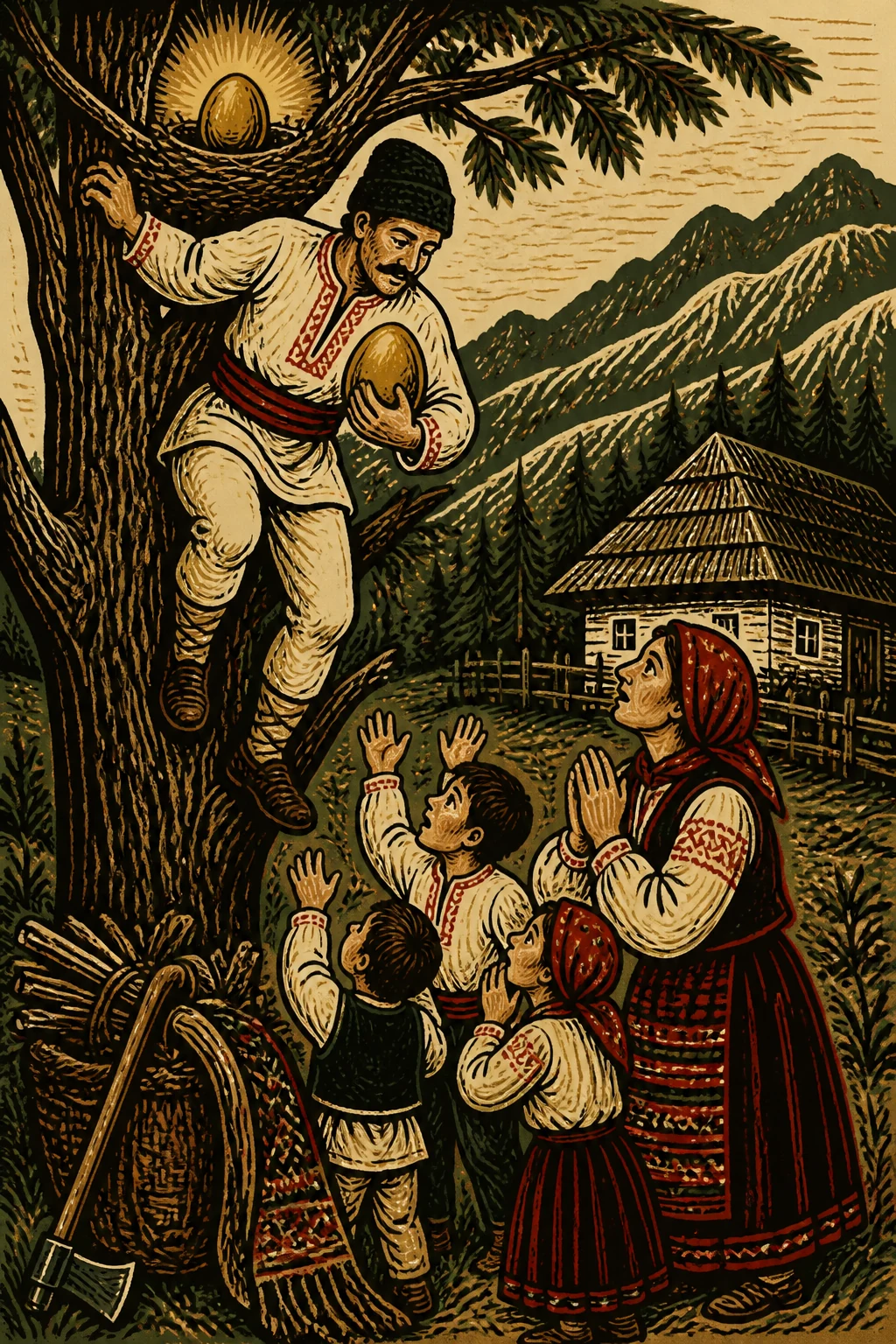
“Yes, we would!” Crippled Hans suddenly said. “It’s all here in this book!” “What’s in the book?” his parents asked. And Hans read them the old tale of the Woodcutter and His Wife: They too complained of Adam and Eve’s curiosity, which was to blame for their misfortune. Then the king of the country came by. “Come home with me!” he said. “You shall live as well as I do, with seven dishes to eat and one to look at. That one is in a covered tureen, and you must not touch it, or your life of luxury will be over!” — “What can be in the tureen?” said the wife. “That’s no concern of ours!” said the husband. “Well, I’m not curious!” said the wife. “I’d only like to know why we mustn’t lift the lid; there must be something delicious in it!” — “As long as there isn’t some mechanism!” said the husband. “Some sort of pistol shot that goes off with a bang and wakes the whole house!” — “Oh, come now!” said the wife, and did not touch the tureen. But that night she dreamed that the lid lifted of its own accord, and from it came the fragrance of the most delicious punch, such as they serve at weddings and funerals. In it lay a large silver coin inscribed: “If you drink this punch, you will become the two richest people in the world, and everyone else will be a beggar!” — Just then the wife woke and told her husband her dream. “You think too much about that thing!” he said. “We could lift it just a little, very gently!” said the wife. “Very gently!” said the husband. And the wife lifted the lid ever so quietly. — Out sprang two nimble little mice, and away they went into a mousehole. “Good night!” said the king. “Now you may go home and sleep in your own bed. Don’t complain about Adam and Eve any more; you yourselves have been just as curious and ungrateful!” — — “How did that story get into the book?” said Have-Ole. “It’s as though it were meant for us. It certainly gives you something to think about!”
The next day they went back to work; they were roasted by the sun and soaked to the skin by the rain. Inside them were bitter thoughts, which they chewed over and over.
It was still light that evening at home, and they had eaten their milk porridge. “Read us the story of the woodcutter again,” said Have-Ole. “There are so many lovely ones in this book!” said Hans. “So many you don’t know!”
“I don’t care about those!” said Have-Ole. “I want to hear the one I know!” And he and his wife heard it again. More than one evening they returned to that story.
“Still, it doesn’t really explain everything to me!” said Have-Ole. “People are like fresh milk when it curdles: some turn into fine curds, and others into thin, watery whey! Some people have luck in everything, sit at the high table all their lives, and know neither sorrow nor want!”
Crippled Hans heard this. His legs were feeble, but his mind was sharp. He read aloud to them from the book of fairy tales, read about “The Man Without Sorrow or Want.” Yes, where was he to be found? And found he must be:
The king lay ill and could not be cured unless he put on a shirt that had been worn next to the skin of someone who could truly say that he had never known sorrow or want.
Messengers were sent to every country in the world, to every castle and manor house, to all the prosperous and happy people; but when they questioned them closely, every one of them had known sorrow and want.
“I haven’t,” said the swineherd, who sat on the edge of a ditch, laughing and singing. “I’m the happiest man alive!” “Then give us your shirt,” said the messengers. “You shall be paid half a kingdom for it.”
But he had no shirt, and yet he called himself the happiest man alive. “There’s a fine fellow!” cried Have-Ole, and he and his wife laughed as they had not laughed in many a long day.
Just then the schoolmaster came by. “How cheerful you are!” he said. “That’s something new in this house. Have you won a prize in the lottery?” “No, nothing of that sort!” said Have-Ole. “It’s Hans who’s been reading to us from the book of fairy tales. He read about ‘The Man Without Sorrow or Want,’ and that fellow didn’t have a shirt. It melts the tears out of your eyes to hear a thing like that, and from a printed book, too. Everyone has his own load to pull, it seems; we’re not alone in it. There’s always some comfort in that!”
“Where did you get the book?” asked the schoolmaster. “Our Hans was given it at Christmas, more than a year ago. The family at the manor gave it to him. They know he’s so fond of reading, and of course he’s a cripple! At the time we’d rather he’d been given two blue linen shirts. But it’s a remarkable book; it almost seems to answer your thoughts!”
The schoolmaster took the book and opened it. “Let’s have that same story again!” said Have-Ole. “I haven’t quite got it into my head yet. Then you must read the other one about the woodcutter, too!”
Those two stories were, and remained, enough for Ole. They were like two rays of sunshine entering the poor room, entering the downtrodden thoughts that made them so sour and bitter.
Hans had read the whole book, read it many times. The fairy tales carried him out into the world, where he could not go himself, since his legs would not carry him.
The schoolmaster sat beside his bed; they talked together, and both enjoyed it. From that day on the schoolmaster came more often to see Hans while his parents were at work. Each visit was like a holiday for the boy. How eagerly he listened to what the old man told him about the size of the Earth and its many countries, and how the Sun was almost half a million times larger than the Earth, and so far away that a cannonball, travelling at its usual speed, would take a full twenty-five years to reach the Earth from the Sun, while rays of light could reach it in eight minutes.
Every able schoolboy knows all this nowadays, but to Hans it was new, and more wonderful still than anything in the book of fairy tales. A couple of times a year the schoolmaster dined with the family at the manor, and on one such occasion he told them what the book of fairy tales had meant in that poor home, where just two of its stories had brought enlightenment and blessing. Through his reading, the frail, bright little boy had brought thoughtfulness and joy into the house.
As the schoolmaster was leaving the manor, the lady pressed a couple of bright silver dollars into his hand for little Hans. “Father and Mother must have those!” said the boy when the schoolmaster brought him the money.
And Have-Ole and Have-Kirsten said, “Crippled Hans is a help and a blessing after all!” A few days later, while the parents were at work on the estate, the manor carriage drew up outside their home. It was the kind-hearted lady who had come, delighted that her Christmas present had brought such comfort and pleasure to the boy and his parents.
She brought fine bread, fruit, and a bottle of sweet fruit juice; but, more delightful still, she brought him a little black bird in a gilded cage, which could whistle most beautifully. The cage and bird were set on the old chest of drawers a little way from the boy’s bed, where he could see the bird and hear it; indeed, people out on the road could hear its song.
Have-Ole and Have-Kirsten did not come home until after the lady had driven away. They could tell how happy Hans was, but still they thought the gift was nothing but a nuisance.
“Rich people don’t think things through!” they said. “Now we have to look after that as well. Crippled Hans can’t do it, of course. It’ll end with the cat getting it!”
A week went by, and then another. During that time the cat had been in the room many times without frightening the bird, let alone harming it. Then a great event occurred. It was afternoon; the parents and the other children were at work, and Hans was quite alone. He held the book of fairy tales in his hand and was reading about the fisherman’s wife, who had all her wishes granted. She wanted to be king, and she became king; she wanted to be emperor, and she became emperor; but then she wanted to be the good Lord himself—and there she was again in the muddy ditch she had come from.
Now that story had nothing whatever to do with the bird or the cat, but it was the very story he was reading when the event took place; he always remembered that afterwards.
The cage stood on the chest of drawers, and the cat stood on the floor, staring up at the bird with its greenish-yellow eyes. There was something in the cat’s face that seemed to say to the bird, “How lovely you are! I’d like to eat you!”
Hans understood that; he could read it plainly in the cat’s face. “Away, cat!” he shouted. “Get out of the room, will you!” It looked as though it was gathering itself to spring.
Hans could not reach it, and had nothing to throw at it except his dearest treasure, the book of fairy tales. He threw it, but the binding was loose: the cover flew one way, and the book itself, with all its pages, flew another. The cat took a few slow steps back into the room and looked at Hans as though to say:
“Keep out of this, little Hans! I can walk and I can jump, and you can do neither!” Hans kept his eyes on the cat and was terribly anxious; the bird grew restless too. There was no one to call for help; it was as though the cat knew it. Once more it made ready to spring. Hans waved his bedspread—he could use his hands, after all—but the cat paid no attention to it; and when that too had been thrown at it to no avail, it leaped onto the chair and up into the windowsill, where it was nearer the bird.
Hans could feel the warm blood coursing through him, but he did not think of that; he thought only of the cat and the bird. The boy could not get himself out of bed; he could not stand on his legs, much less walk. It was as though his heart turned over inside him when he saw the cat spring from the window straight onto the chest of drawers and strike the cage so that it toppled over. The bird fluttered wildly about inside.
Hans gave a scream, a shock went through him, and without thinking he sprang out of bed, rushed to the chest of drawers, tore the cat away, and caught hold of the cage, where the bird seemed beside itself with terror. Holding the cage in his hand, he ran out through the door and onto the road.
Then the tears streamed from his eyes; he shouted for joy, crying at the top of his voice, “I can walk! I can walk!” He had regained the use of his legs; such things can happen, and it had happened to him.
The schoolmaster lived close by; Hans ran into his house barefoot, wearing only his shirt and jacket, and carrying the bird in its cage. “I can walk!” he cried. “Lord, my God!” And he sobbed for sheer joy.
And there was joy in the home of Have-Ole and Have-Kirsten. “We shall never see a happier day!” they both said. Hans was invited up to the manor; he had not walked that way for many years. It was as though the trees and hazel bushes, which he knew so well, nodded to him and said, “Good day, Hans! Welcome out here!” The sun shone into his face, straight into his heart.
The master and mistress, those blessed young people of the manor, had him sit beside them and looked as happy as if he had been one of their own family.
But happiest of all was the lady, who had given him the book of fairy tales and the little songbird. The bird was dead now, it was true, dead of fright; but it had been, as it were, the means of his recovery, and the book had brought enlightenment to him and his parents. He still had it, and he would keep it and read it, however old he grew. Now he could be useful to those at home as well. He wanted to learn a trade, preferably to become a bookbinder, “because,” he said, “then I can read all the new books!”
Later that afternoon the lady sent for both his parents. She and her husband had been talking about Hans; he was a good-hearted, clever boy, eager to read and quick to learn. Our Lord is always on the side of a good cause.
That evening his parents came home from the manor very happy, especially Kirsten; but a week later she wept, for little Hans was leaving. He had been fitted out with good clothes; he was a good boy; but now he was to cross the salt sea, far away, to be sent to a Latin school, and many years would pass before they saw him again.
He did not take the book of fairy tales with him; his parents wanted to keep it as a remembrance. And his father often read it, but never anything except the two stories, for those he knew.
And they received letters from Hans, each happier than the last. He was living with kind people, in comfortable circumstances; and the most delightful thing of all was going to school. There was so much to learn and to know; now he wished only to live to be a hundred, and one day to become a schoolmaster.
“If only we live to see it!” said his parents, clasping each other’s hands as though at Holy Communion. “What things have happened to Hans!” said Ole. “Our Lord thinks of a poor man’s child, too! And it had to be the cripple who showed us that! Isn’t it just as though Hans might read it aloud to us out of the book of fairy tales!”