Prevod
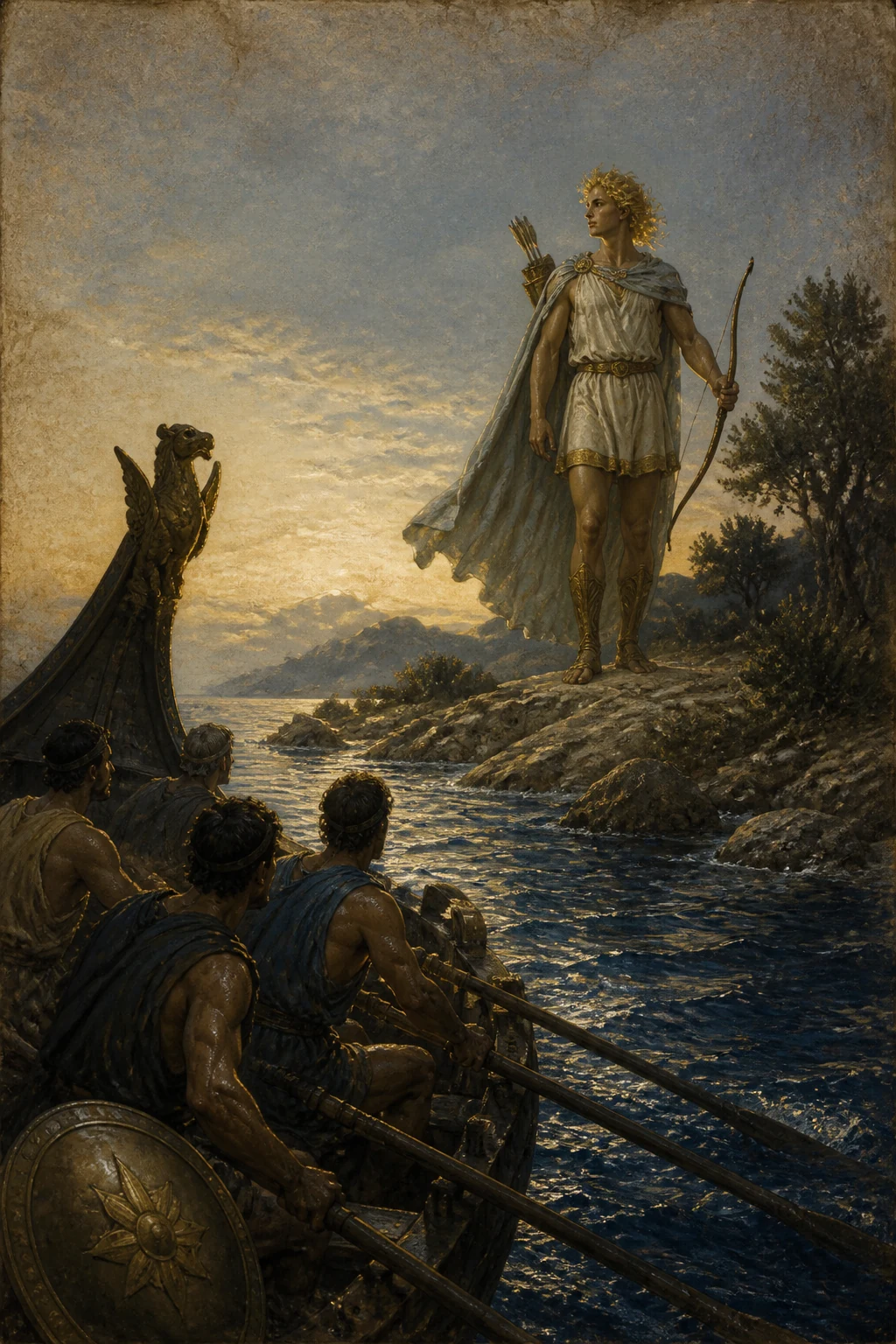
So he spoke, and was the first to board the ship; the other heroes followed, and, sitting in their places one after another, took the oars in their hands. Argus untied the stern cables from the sea-washed rock, and they struck the water mightily with their long fir oars.
At evening, on Orpheus’ advice, they put in at the island of Electra, daughter of Atlas, so that, instructed through gentle rites of initiation in mysteries that must not be spoken, they might sail more safely over the chilling sea.
Of these I shall tell no more. May the island itself look kindly on me, and likewise the divine inhabitants to whose keeping those mysteries belong, which it is not lawful for us to sing.
From there they pressed onward with their oars through the depths of the Gulf of Melas, with the land of the Thracians on one side and Imbros opposite, above them, on the other. Just as the sun was setting, they reached the projecting Chersonese.
There a swift south wind blew for them. They set their sails to the following breeze and entered the headlong waters named for Athamas’ daughter. By morning they had left the open sea behind; through the night they measured their course inside the headland of Rhoeteum, keeping the land of Ida on their right.
Leaving Dardania, they drew on toward Abydos, and after it passed Percote, the sandy shore of Abarnis, and sacred Pityeia. That night, as the ship sped onward, they crossed the Hellespont, dark and seething with eddies.
Within the Propontis lies a steep island, extending into the sea a little way from the grain-rich mainland of Phrygia. A low-lying isthmus, washed by the waves, slopes down to join it to the mainland. It has two shores, and lies beyond the waters of the Aesepus.
The neighboring people call it the Mountain of Bears. Savage, violent Earthborn men dwell there, a great marvel for those who live around them to behold. Each has six mighty arms: two spring from his sturdy shoulders, and four more are fixed below along his monstrous sides.
The Doliones inhabited the isthmus and the plain. Their king was the hero Cyzicus, son of Aeneus, whom Aenete, daughter of noble Eusorus, had borne. Terrible though they were, the Earthborn did the Doliones no harm, for Poseidon protected them: from him the Doliones traced their earliest descent.
There the Argo put in, driven onward by Thracian winds, and Fair Harbor received her as she sped along. On Tiphys’ advice they unfastened their small anchor stone and left it beneath a spring, the spring of Artace, choosing another, heavier stone that suited their purpose. In later years, at the command of the Far-shooter’s oracle, the Ionian descendants of Neleus dedicated that first stone, as sacred custom required, in the sanctuary of Jasonian Athena.
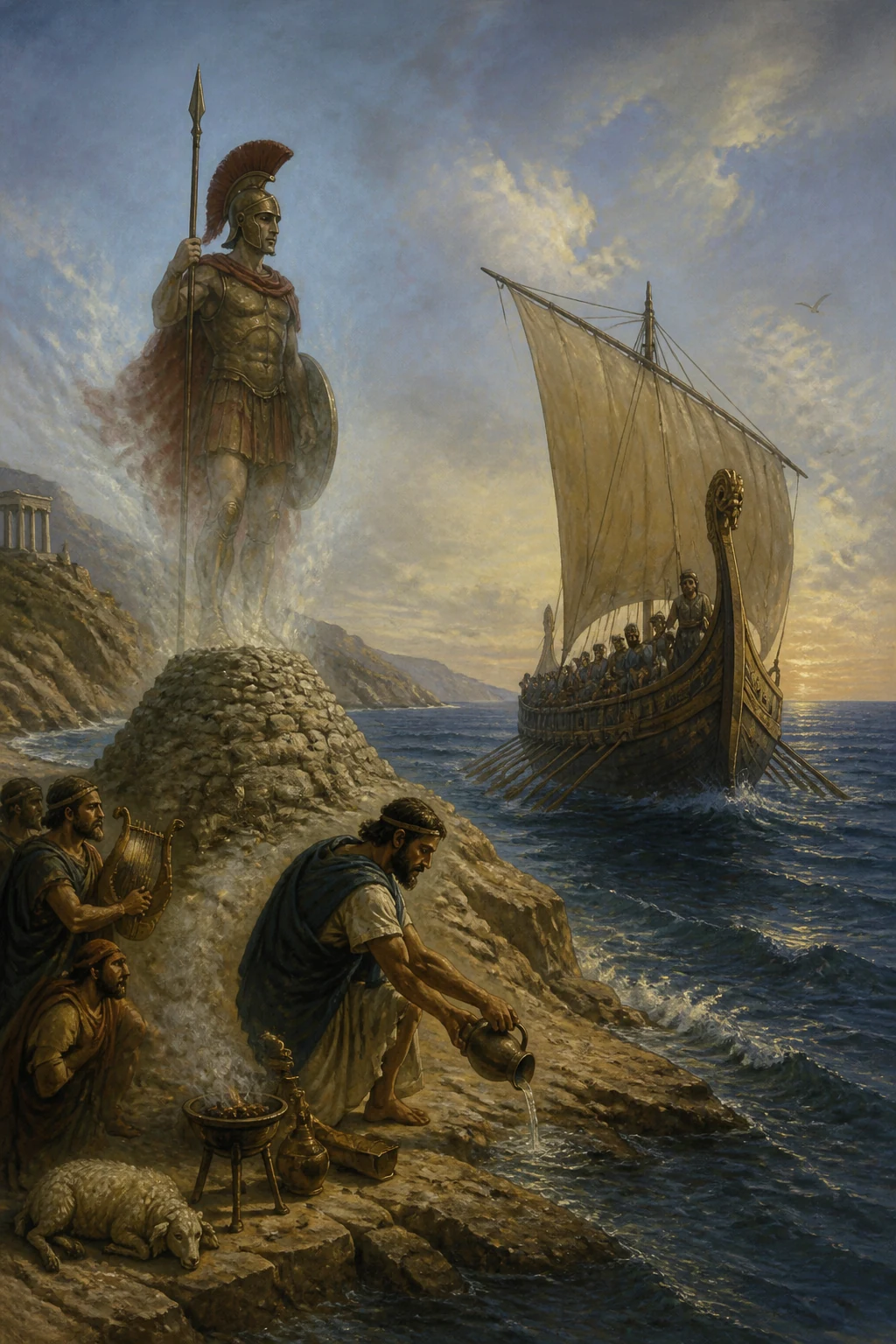
The Doliones and Cyzicus himself came together to meet them in friendship. When they had heard the purpose of their voyage and learned who they were and from what families they came, they welcomed them warmly. They persuaded them to row farther on and fasten their ship’s stern cables in the city’s harbor. There, beside the shore, the heroes built an altar to Apollo, Protector of Landings, and attended to the sacrifice.
The king himself gave them sweet wine and sheep to supply their needs. For he had been warned that, whenever a divine company of heroes arrived, he must at once receive them graciously and have no thought of war.
Like Jason, he was only just growing his first beard, and had not yet been granted the joy of children. His wife still lived in his house untouched by the pains of childbirth: lovely-haired Cleite, daughter of Merops of Percote, whom he had only lately brought from her father’s home across the water, after giving a splendid bride-price.
Yet even so he left his bridal chamber and his young wife’s bed to oversee their feast, putting his fears from his heart. They questioned one another in turn. He asked about the goal of their voyage and the commands of Pelias; they asked about the cities of the neighboring peoples and the whole broad gulf of the Propontis. But of the regions farther on, which they longed to learn about, he could tell them nothing.
At dawn they climbed lofty Dindymum to see for themselves the passages through that sea. They had brought the ship out from her former anchorage into the harbor of Chytus; and the path they climbed is known as Jason’s Way.
But the Earthborn rushed down from the other side of the mountain and blocked the seaward mouth of spacious Chytus with boulders, as though trapping a wild beast within. Heracles, however, had been left there with the younger men. Quickly bending his recurved bow, he brought them to the ground one after another, while they in turn lifted jagged rocks and hurled them at him.
For Hera, the wife of Zeus, had surely reared those dreadful monsters too as a trial for Heracles. Meanwhile the other warrior heroes turned back and came to face them before they reached the lookout. They joined in slaughtering the Earthborn, meeting their attack with arrows and spears, until they had killed them all, despite their fierce and furious resistance.
As when woodcutters lay long timbers, freshly hewn with axes, in rows along the surf, so that, soaked through, they may hold the stout fastening pegs, so the bodies lay stretched in rows at the entrance to the gray harbor. Some had plunged their heads and chests together into the salt water, while their limbs lay stretched upon the land; others lay the opposite way, their heads upon the sandy beach and their feet reaching into the depths. Thus they were to become the prey of birds and fish alike.
When the heroes had finished their task without further fear, they loosed the ship’s cables to the blowing wind and sailed onward across the swelling sea. All day she sped under sail. But when night came, the breeze no longer held steady: contrary squalls seized her and swept her backward, until they brought her once more among the hospitable Doliones. They went ashore that same night; and the rock around which they hastily cast the ship’s cables is still called the Sacred Rock.
None of them recognized the island as the same one. Nor in the darkness did the Doliones clearly perceive that the returning men were the heroes. They supposed that a Pelasgian war band from the Macrians had landed.
So they armed themselves and raised their hands against them. Ashen spears and shields clashed together, like a fierce rush of fire that falls upon dry brushwood and mounts into flame. A dreadful, furious tumult descended on the people of the Doliones.
Nor was their king destined to escape the battle and return home to his bridal chamber and marriage bed. As he charged straight at Jason, the son of Aeson leapt forward and struck him in the middle of the chest; the bone shattered around the spear. He sank into the sand and fulfilled his fate. For no mortal may ever escape it: on every side its great net is spread.
So that very night fate ensnared him as he fought against the heroes, though he had thought himself beyond the reach of bitter destruction. Many others who came to his aid were slain. Heracles killed Telecles and Megabrontes; Acastus slew Sphodris; Peleus brought down Zelys and Gephyrus, swift in battle.
Telamon, skilled with the spear, killed Basileus. Idas slew Promeus, and Clytius Hyacinthus; the two sons of Tyndareus killed Megalossaces and Phlogius. The son of Oeneus also slew bold Itymoneus and Artaceus, a leader among men. All these the inhabitants still honor with the worship due to heroes.
The rest gave way and fled, as doves in a flock flee before swift-winged hawks. With a great clamor they crowded through the gates, and the city was soon filled with cries of grief as the battle recoiled upon it.
At dawn both sides understood their fatal, irreparable mistake. Bitter sorrow seized the Minyan heroes when they saw before them Cyzicus, the son of Aeneus, lying in the dust and blood.
For three whole days they mourned and tore their hair, the heroes and the Dolionian people alike. Then, after circling his tomb three times in bronze armor, they buried him with due honors and held funeral games, as custom required, on the meadow plain. There his burial mound still stands for later generations to behold.
Nor did Cleite survive her dead husband. She added another, crueler grief to their misfortune by fastening a noose around her neck. Even the woodland nymphs lamented her death, and all the tears the goddesses shed from their eyes upon the ground they made into a spring. They call it Cleite, preserving the renowned name of the unhappy bride.
That was the most dreadful day Zeus ever brought upon the women and men of the Doliones. Not one of them could bring himself to taste food; and for a long time, in their grief, they gave no thought to the labor of grinding grain. Instead, they kept themselves alive on food just as it was, uncooked.
And even now, whenever the Ionians who dwell in Cyzicus pour their yearly libations for the dead, they always grind the meal for their sacrificial cakes at the public mill. After this, fierce storms arose for twelve days and nights together, keeping the heroes there and preventing them from sailing. On the following night, the other heroes lay overcome by sleep during the last watch, while Acastus and Mopsus, son of Ampycus, kept guard over the soundly sleeping men.
Then a halcyon fluttered above the fair head of Aeson’s son, foretelling in its clear cry the end of the raging winds. Mopsus heard and understood the shorebird’s prophetic voice.
A god turned the bird away again, and it darted upward to perch upon the ship’s high stern ornament. Mopsus went to Jason, who lay wrapped in soft sheepskins, shook him awake, and said: “Son of Aeson, you must climb this holy height of rugged Dindymum and win the favor of the Mother of all the blessed gods, seated upon her fair throne. Then these violent storms will cease. Such is the message I have just heard from the sea-halcyon, which fluttered above you as you slept and made all this known to me.
“For on her depend the winds and the sea, and all the earth below, and the snowy seat of Olympus. When she rises from the mountains into the great heavens, Zeus himself, the son of Cronus, gives way before her. So too the other blessed immortals pay reverence to the dread goddess.”
So he spoke, and Jason welcomed his words. Gladly he rose from his bed and roused all his companions in haste. When they were awake, he told them the prophecy of Mopsus, son of Ampycus.
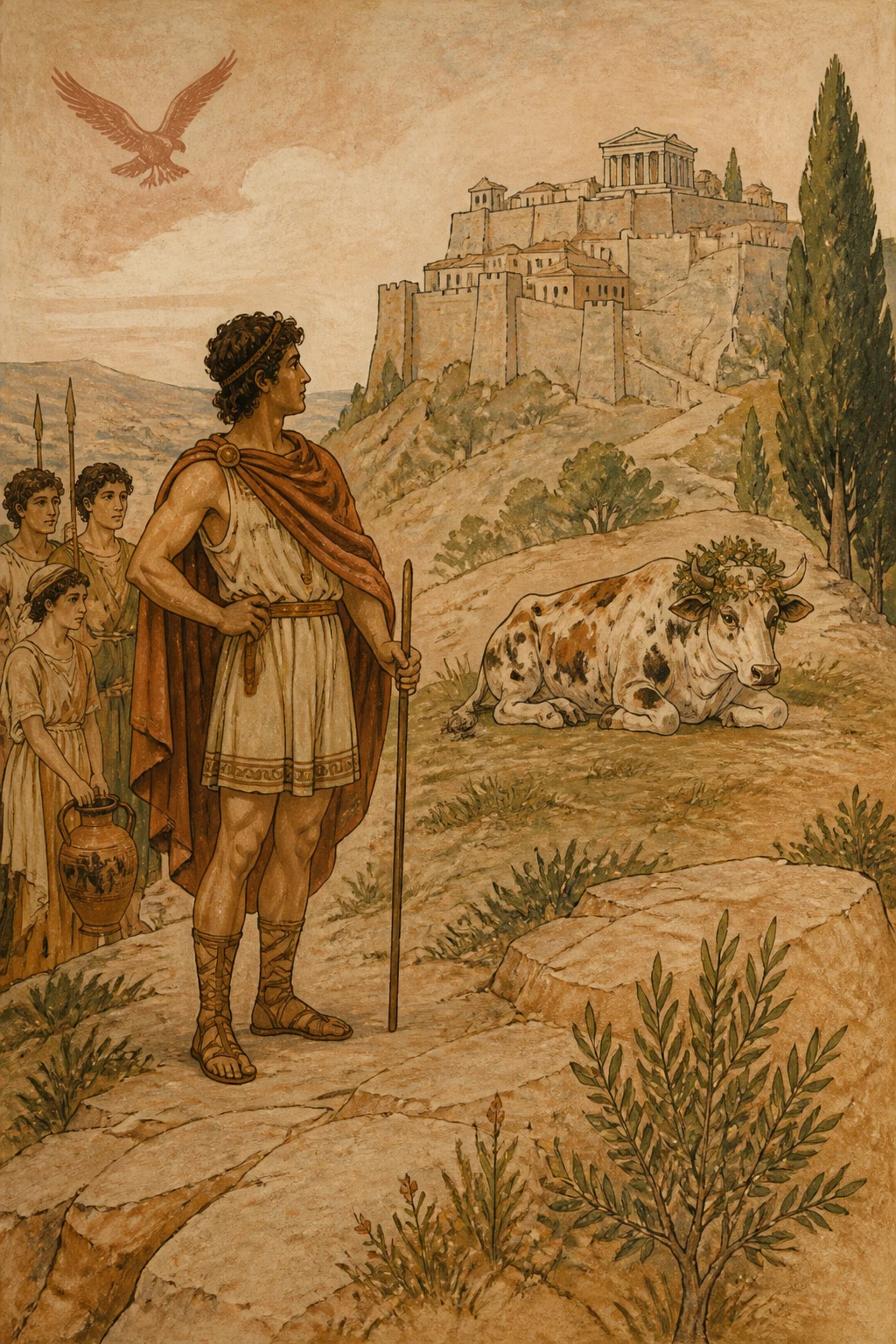
At once the younger men drove cattle from the stalls and led them to the mountain’s steep summit. The others untied the cables from the Sacred Rock and rowed into the Thracian harbor. Then they too climbed the mountain, leaving only a few of their companions aboard.
Before their eyes the Macrian heights and all the opposite coast of Thrace lay as clear as though within their hands. They could see the misty mouth of the Bosporus and the hills of Mysia; on the other side lay the course of the Aesepus, the city of Adrasteia, and its Nepeian plain.
There was a sturdy, ancient vine stock growing in the woods. They cut it down to make a sacred image of the mountain goddess. Argus carved it with skill, and they set it upon a rugged hill, sheltered by the tallest oaks, which grew higher than all the rest.
They piled up an altar of small stones, and, crowning themselves with oak leaves, attended to the sacrifice. They invoked the all-powerful Mother of Dindymum, who dwells in Phrygia, and with her Titias and Cyllenus. Of all the Cretan Idaean Dactyls, these alone are called dispensers of destiny and attendants of the Idaean Mother. The nymph Anchiale once brought them forth in the Dictaean cave, clutching the earth of Oaxus with both her hands.
The son of Aeson poured libations upon the burning offerings and earnestly entreated the goddess to turn the storms away. At Orpheus’ bidding, the young men leapt and danced an armed dance, beating their shields with their swords, so that the ill-omened sound of the people’s lamentation, still rising in grief for their king, might be scattered through the air. Ever since then the Phrygians have propitiated Rhea with the whirring wheel and drum.
The goddess turned a gracious heart toward their holy sacrifices, and fitting signs appeared. The trees shed fruit in abundance, and around their feet the earth of itself put forth flowers among the tender grass.
Wild beasts left their lairs and woodland thickets and came up to them, fawning with their tails. And she worked another wonder. Until then no water had flowed on Dindymum; but now, from its thirsty summit, a stream gushed forth for them without ceasing. In later times the people who live around it called that spring Jason’s Fountain.
Then they held a feast in honor of the goddess on the Mountain of Bears, singing the praises of all-powerful Rhea. At dawn, when the winds had fallen, they left the island under oars. A spirit of rivalry stirred each hero to strive to be the last to tire. For the windless air had smoothed the eddies all around and lulled the sea to sleep.
Trusting in the calm, they drove the ship forcefully onward. Not even Poseidon’s storm-footed horses could have caught her as she darted across the sea. But when the swell rose beneath the strong breezes that begin to blow from the rivers toward evening, the men grew weary and rested from their labor. Heracles, however, dragged them all onward by the strength of his arms, toiling with all his might, and made the ship’s fitted timbers tremble.
But as they pressed eagerly toward the Mysian mainland, passing within sight of the mouths of the Rhyndacus and the great burial mound of Aegaeon a little beyond Phrygia, he bore down against the surging waves and snapped his oar in the middle. Holding one piece in both hands, he fell sideways; the sea carried the other away on its backward wash. He sat up in silence, staring about him, for his hands were unaccustomed to lying idle.
At the hour when a gardener or a plowman gladly comes home from the fields, longing for his supper, and bends his weary knees upon the threshold, caked with dust, then looks at his chafed hands and curses his belly bitterly—at that hour they reached the lands of Cius, around Mount Arganthonium and the mouths of the river Cius.
The Mysians who inhabited that country welcomed them with friendly hospitality, giving them provisions, sheep, and wine in abundance to supply their needs. Some of the heroes then brought dry wood, while others cut and carried great heaps of meadow herbage to spread for bedding. Some worked the fire sticks; others mixed wine in bowls and prepared the feast, after sacrificing at dusk to Apollo, Protector of Landings.
But the son of Zeus, after bidding his companions enjoy their meal, set off into the forest, intending first to fashion an oar to fit his hand. As he wandered, he found a fir, neither burdened with many branches nor grown too large, but like a shoot of slender poplar: such it seemed in height and girth alike.
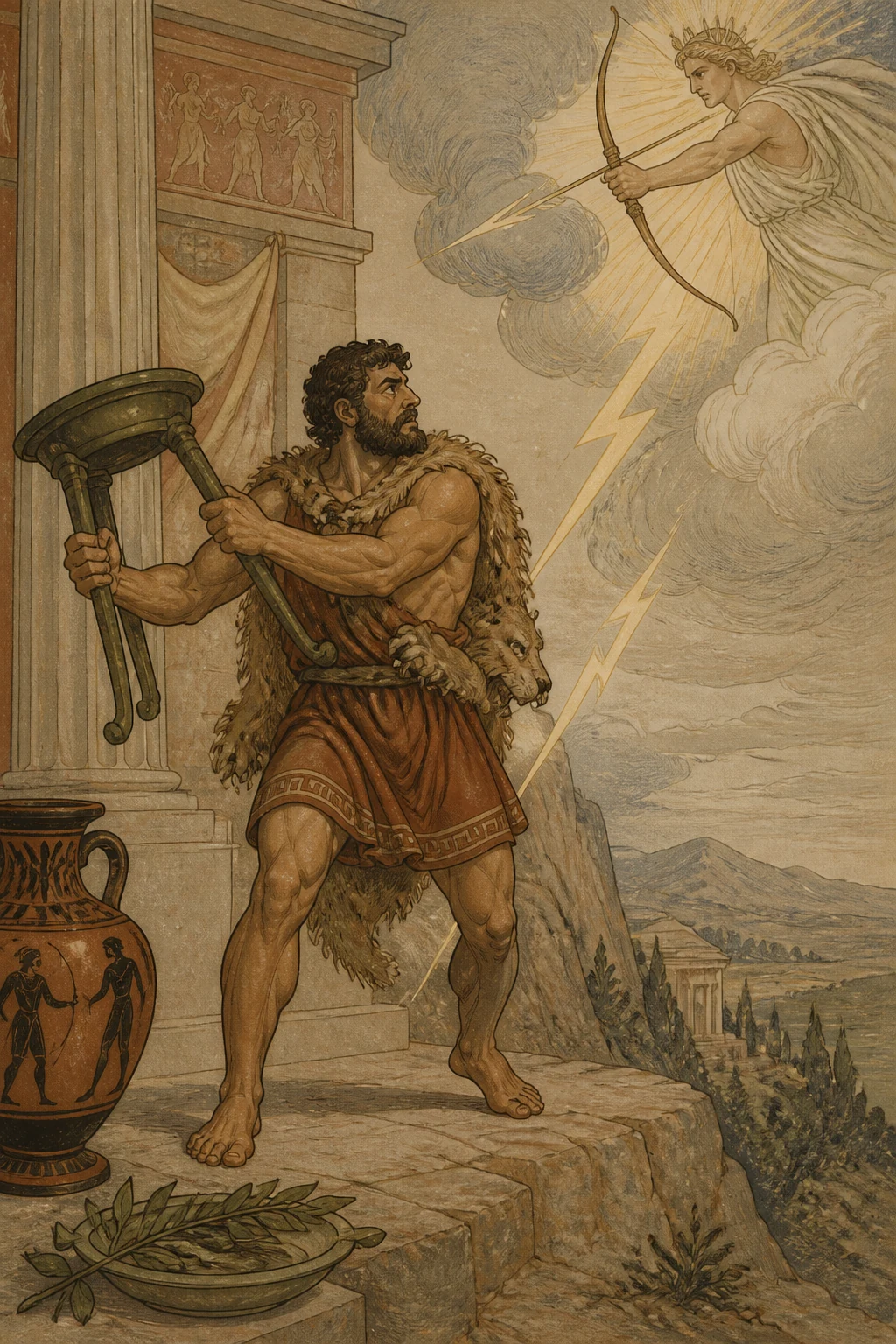
Quickly he laid his quiver of arrows on the ground, together with his bow, and stripped off his lion skin. First he shook the tree loose at its base with his bronze-weighted club, then clasped both hands around its trunk, trusting in his strength. Planting his feet firmly, he braced his broad shoulder against it, and, deep-rooted though it was, wrested it from the ground, bringing up with it the very clods in which it held fast.
As when a sudden, swift gust strikes a ship’s mast from above, especially at the stormy setting of deadly Orion, and tears it, wedges and all, free of its stays, so he lifted the tree. Then, gathering up his bow and arrows, his skin and club, he set off on his way back.
Meanwhile Hylas, carrying a bronze pitcher, had gone apart from the company to seek the sacred water of a spring. He wished to draw water in time for Heracles’ supper and have everything else promptly set in order for his return.
For Heracles himself had reared him to such habits, ever since he took him as a little child from the house of his father, noble Theiodamas. Him he had pitilessly killed among the Dryopians when they quarreled over a plowing ox.
Theiodamas was painfully laboring to cut the furrows of a fallow field with his plow, and Heracles ordered him to surrender a plowing ox against his will. For he wished to find a grievous pretext for war against the Dryopians, who lived without any regard for justice.
But that would lead me far astray from my song. Hylas soon reached the spring which the neighboring people call Pegae. The nymphs’ dances were just beginning, for all the nymphs who dwelt about that lovely height were wont to celebrate Artemis with nightly songs.
Those whose province was the mountain peaks or the glens, the woodland nymphs, were coming in from far away. But the water nymph was just rising from the fair-flowing spring, and close at hand she saw him, radiant with beauty and sweet grace.
For the full moon, shining from the sky, cast its light upon him. Cypris set the nymph’s heart aflutter, and in her bewilderment she could scarcely gather her wits. But as soon as he leaned sideways and dipped the pitcher into the stream, and the water roared loudly as it poured into the ringing bronze, she threw her left arm around his neck, eager to kiss his tender mouth. With her right hand she caught his elbow and dragged him down into the midst of the swirling water.
Of all his companions, only the hero Polyphemus, son of Eilatus, heard his cry. He had gone farther along the path, waiting for mighty Heracles to return. He rushed toward Pegae like a wild beast that has heard the bleating of sheep far away and, burning with hunger, follows the sound, yet cannot find the flock, for the shepherds have already shut it in the folds. It groans and roars without ceasing until it is exhausted. So the son of Eilatus groaned aloud and roamed about the place calling out; but his voice was of no avail.
Quickly drawing his great sword, he hurried in pursuit, fearing that Hylas had fallen prey to wild beasts, or that men had ambushed him alone and were carrying him off as easy plunder. Then, as he rushed along the path with his naked sword in hand, he met Heracles. Through the gloom he clearly recognized him hurrying toward the ship. At once, his chest laboring for breath, he told him of the dreadful misfortune: “My poor friend, I shall be the first to bring you bitter news.
“Hylas went to the spring and has not come safely back. Either robbers have fallen upon him and are carrying him away, or wild beasts are tearing him. I heard him cry out.” So he spoke. As Heracles listened, sweat streamed from his temples, and the dark blood boiled beneath his heart.
In fury he flung the fir tree to the ground and raced along whatever path his feet carried him in his headlong rush. As when a bull, stung by a gadfly, leaves the meadows and marshland behind and charges off, heeding neither herdsmen nor herd, now running without pause, now halting and lifting his broad neck to bellow, tormented by the maddening sting—so Heracles in his frenzy sometimes sped on with tireless strides, and sometimes ceased from running to send a mighty, piercing shout far into the distance.
Soon the morning star rose over the highest ridges, and breezes swept down. Tiphys quickly urged them to embark and take advantage of the wind. Eagerly they went aboard, hoisted the ship’s anchors, and hauled back the cables.
The wind bellied the sail in the middle, and joyfully they were borne far from shore past Cape Poseidon. But when bright dawn began to shine from the far horizon, and the paths grew clear and the dewy plains gleamed in the radiant light, they realized that they had left the others behind without knowing it.
A fierce quarrel broke out among them, and an immense uproar, because they had sailed away leaving the best of their companions behind. The son of Aeson, overwhelmed by helplessness, said neither this nor that, but sat consuming his heart in the depth of his grief. Anger seized Telamon, and he said: “Yes, sit there at your ease! It suited you well to leave Heracles behind. This scheme came from you, so that his glory should not overshadow yours throughout Greece, if the gods grant us a safe return home.
“But what pleasure is there in words? I shall go, even without those companions of yours who helped contrive this treachery.” So he spoke, and sprang at Tiphys, son of Hagnias. His eyes flashed like sparks of blazing fire.
And they would have returned to the land of the Mysians, forcing their way over the sea against the wind’s ceaseless roar, had not the two sons of Thracian Boreas restrained the son of Aeacus with harsh words. Reckless men! In later days they paid a bitter price at the hands of Heracles, because they had prevented the others from searching for him.
For as they returned from the funeral games of the dead Pelias, he killed them on sea-girt Tenos, heaped earth over their bodies, and set two pillars above them. One of these, a great wonder for men to see, sways beneath the blast of the roaring north wind.
These things were to come to pass in later time. But now Glaucus appeared to them from the depths of the sea, the wise interpreter of divine Nereus. Lifting his shaggy head and chest high out of the water, he reached up from below with his strong hand and seized the ship’s keel. Then he called to the hurrying men: “Why do you strive, against the will of mighty Zeus, to bring bold Heracles to the city of Aeetes?
“It is his fate to toil for reckless Eurystheus in Argos and fulfill all twelve labors, and then to dwell at the same hearth with the immortals, when he has accomplished the few that still remain. Therefore let there be no yearning for him.
“Likewise it is ordained that Polyphemus shall build a renowned city for the Mysians at the mouths of the Cius, and then fulfill his fate in the boundless land of the Chalybes. As for Hylas, a divine nymph has taken him in love to be her husband; and it was on his account that those two strayed away and were left behind.”
He spoke, then sank beneath the water and wrapped himself in the restless waves. Around him the dark water foamed and swirled in eddies, washing over the hollow ship as it rolled across the sea. The heroes rejoiced, and Telamon, son of Aeacus, hastened to Jason. Clasping his hand, he embraced him and said: “Son of Aeson, do not be angry with me if I wronged you in my folly. Grief overwhelmed me and made me speak with an arrogance I could not restrain. Let us give my fault to the winds and be friends as before.”
The son of Aeson answered him thoughtfully: “My friend, you did indeed revile me with bitter words, declaring before them all that I had betrayed a good man. Yet I shall bear you no lasting anger, though I was hurt at first. For it was not over flocks of sheep or possessions that your wrath flared up, but over a companion. I trust that you would quarrel with another on my behalf as well, should such a thing ever happen.”
So he spoke, and, reconciled, they sat down as before. By the will of Zeus, the two who had been left behind were destined for different paths. Polyphemus, son of Eilatus, was to found a city among the Mysians and name it after the river; Heracles was to return and labor once more at the tasks of Eurystheus. He threatened to lay waste the Mysian land on the spot unless they found Hylas for him, dead or alive.
They chose the noblest sons of their people and gave them to him as pledges, swearing never to cease from the labor of searching. That is why, even now, the people of Cius seek Hylas, son of Theiodamas, and maintain their ties with well-built Trachis. For there Heracles settled the boys whom they had sent with him as hostages.
All day and all night a strong wind blew and carried the ship onward. But when dawn rose, not the faintest breeze was stirring. Seeing a headland that stretched out from the gulf, very broad to the eye, they put in under oars as the sun rose.