Prevod
The shouting did not escape Nestor, though he was drinking. He spoke winged words to the son of Asclepius: “Consider, noble Machaon, how these things will end. The shouting of the young warriors beside the ships is growing louder.
“But sit here for now and drink the gleaming wine, until lovely-haired Hecamede has heated warm water and washed the bloody gore from you. I will go at once to a lookout and see what is happening.”
With that he took up the finely made shield of his son Thrasymedes, tamer of horses, which lay in the hut, shining with bronze; Thrasymedes himself was carrying his father’s shield. He took a stout spear tipped with sharp bronze and stood outside the hut. At once he saw a shameful sight: his own men driven in confusion, and the proud Trojans pressing hard behind them. The Achaeans’ wall had fallen.
As the great sea heaves with a soundless swell, foreseeing the swift paths of the shrill winds, yet rolls neither this way nor that until some settled wind comes down from Zeus, so the old man pondered, his heart divided between two courses: whether to join the host of the Danaans with their swift horses, or seek Agamemnon, son of Atreus, shepherd of the people.
As he reflected, it seemed wiser to seek the son of Atreus. Meanwhile the warriors fought and slew one another, and the unyielding bronze rang about their bodies as they thrust with swords and double-edged spears.
The kings cherished by Zeus met Nestor as they came up from the ships—all those wounded by the bronze: the son of Tydeus, Odysseus, and Agamemnon, son of Atreus. Their ships had been drawn up far from the fighting, on the shore of the gray sea; for the first ships had been hauled toward the plain, and the wall built along their sterns.
Wide though it was, the beach could not hold all the ships, and the men were crowded. So they had drawn them up in rows, one behind another, filling the long sweep of the shore between the enclosing headlands.
Thus they walked together, leaning on their spears, eager to see the shouting and the battle, their hearts heavy within their breasts. Old Nestor met them, and fear struck the hearts of the Achaeans.
Lord Agamemnon addressed him: “Nestor, son of Neleus, great glory of the Achaeans, why have you left the man-destroying battle and come here? I fear mighty Hector will fulfill the threat he once uttered before the Trojans: that he would not return to Ilios from the ships until he had burned them with fire and killed us too.
“So he declared, and now it is all coming true. Ah, surely the other well-greaved Achaeans, like Achilles, are storing anger against me in their hearts and will not fight beside the sterns of the ships.”
Then Nestor, the Gerenian horseman, answered him: “Indeed, these things have come to pass, and not even Zeus himself, who thunders on high, could now contrive to undo them. The wall has fallen, though we trusted it would be an unbroken defense for our ships and ourselves. They are fighting a relentless battle by the swift ships, without a pause. However keenly you watched, you could no longer tell from which side the Achaeans are being driven in confusion: they are killed in a mingled mass, and the shouting reaches heaven.
“But let us consider what is to be done, if counsel can accomplish anything. I do not urge us to enter the battle ourselves: a wounded man cannot fight.” Then Agamemnon, lord of men, replied: “Nestor, since they are fighting at the very sterns of the ships, and neither the wall we built nor the trench has helped us—though the Danaans labored hard upon it and hoped in their hearts that it would be an unbroken defense for our ships and ourselves—it must please almighty Zeus that the Achaeans should perish here without a name, far from Argos.
“I knew when he was willing to defend the Danaans, and now I know that he honors our enemies like the blessed gods, while he has bound our strength and our hands. Come, let us all do as I say.
“Let us haul down the ships that stand in the foremost row nearest the sea, launch them all upon the holy water, and moor them offshore at anchor until immortal night comes—if the Trojans will cease fighting even then. Afterward we can launch all the remaining ships.
“There is no shame in fleeing ruin, even by night. Better to flee and escape disaster than be caught.” But resourceful Odysseus glared at him and said: “Son of Atreus, what words have escaped the barrier of your teeth? Accursed man, I wish you commanded some other, worthless army, instead of ruling us, to whom Zeus has granted the task of winding out harsh wars from youth to old age, until each one of us dies.
“Is this how you mean to abandon the broad streets of Troy, for whose sake we have endured so many miseries? Be silent, lest some other Achaean hear this proposal—a thing no man should ever let pass his lips if he knew in his heart how to speak soundly, and bore a scepter, and commanded as many men as you rule among the Argives. Now I utterly condemn your judgment for what you have said. You urge us, while battle and shouting rage, to haul our well-benched ships to sea, so that the Trojans, already victorious, may have their wishes still more fully granted, while sheer destruction falls upon us. For the Achaeans will not hold their ground once the ships are being hauled to sea: they will keep looking behind them and abandon the fight.
“Then your counsel will be our ruin, leader of the people.” Agamemnon, lord of men, answered him: “Odysseus, your harsh rebuke has struck deep into my heart. Yet I do not command the sons of the Achaeans to haul their well-benched ships to sea against their will.
“If anyone, young or old, can offer a better plan than this, I shall gladly hear it.” Then Diomedes, good at the war cry, spoke among them: “The man is near at hand; we shall not search long, if you will listen and none of you resent my words because I am the youngest among you. I too claim descent from a noble father, Tydeus, whom a mound of earth covers at Thebes.
“For Portheus had three worthy sons, who lived in Pleuron and steep Calydon: Agrius and Melas, and the third was the horseman Oeneus, my father’s father, who surpassed the others in valor.
“He remained there, but my father wandered away and settled in Argos, for so Zeus and the other gods must have wished. He married one of Adrastus’ daughters and lived in a house rich in substance. He had abundant wheat-bearing fields, many orchards round about, and great flocks; and with the spear he excelled all the Achaeans. You must have heard these things, if they are true.
“So you cannot dismiss my words, if I speak wisely, on the grounds that my birth is base and cowardly. Come, let us go to the battle, wounded though we are: necessity demands it. Once there, let us keep clear of the fighting, beyond the missiles, lest one of us receive a wound upon his wound. But we can urge the others on and send them into battle—those who have hitherto indulged their own hearts and stood apart without fighting.”
So he spoke, and they listened readily and obeyed. They set out, and Agamemnon, lord of men, led them. Nor had the renowned Earth-shaker kept a careless watch. He came among them in the likeness of an old man, took the right hand of Agamemnon, son of Atreus, and spoke winged words: “Son of Atreus, surely Achilles’ deadly heart rejoices within his breast as he watches the Achaeans slaughtered and routed: he has not the slightest sense.
“May he perish as he is, and may a god bring him to disgrace! But the blessed gods are not yet utterly angry with you. The leaders and lords of the Trojans shall yet raise dust across the wide plain, and you yourself shall see them fleeing from the ships and huts toward their city.”
With that he rushed across the plain and shouted mightily. As loud as nine or ten thousand men cry out in war when they join in the strife of Ares, so great a cry did the lord Earth-shaker send from his breast. He put mighty strength into every Achaean’s heart, to wage war and fight without ceasing.
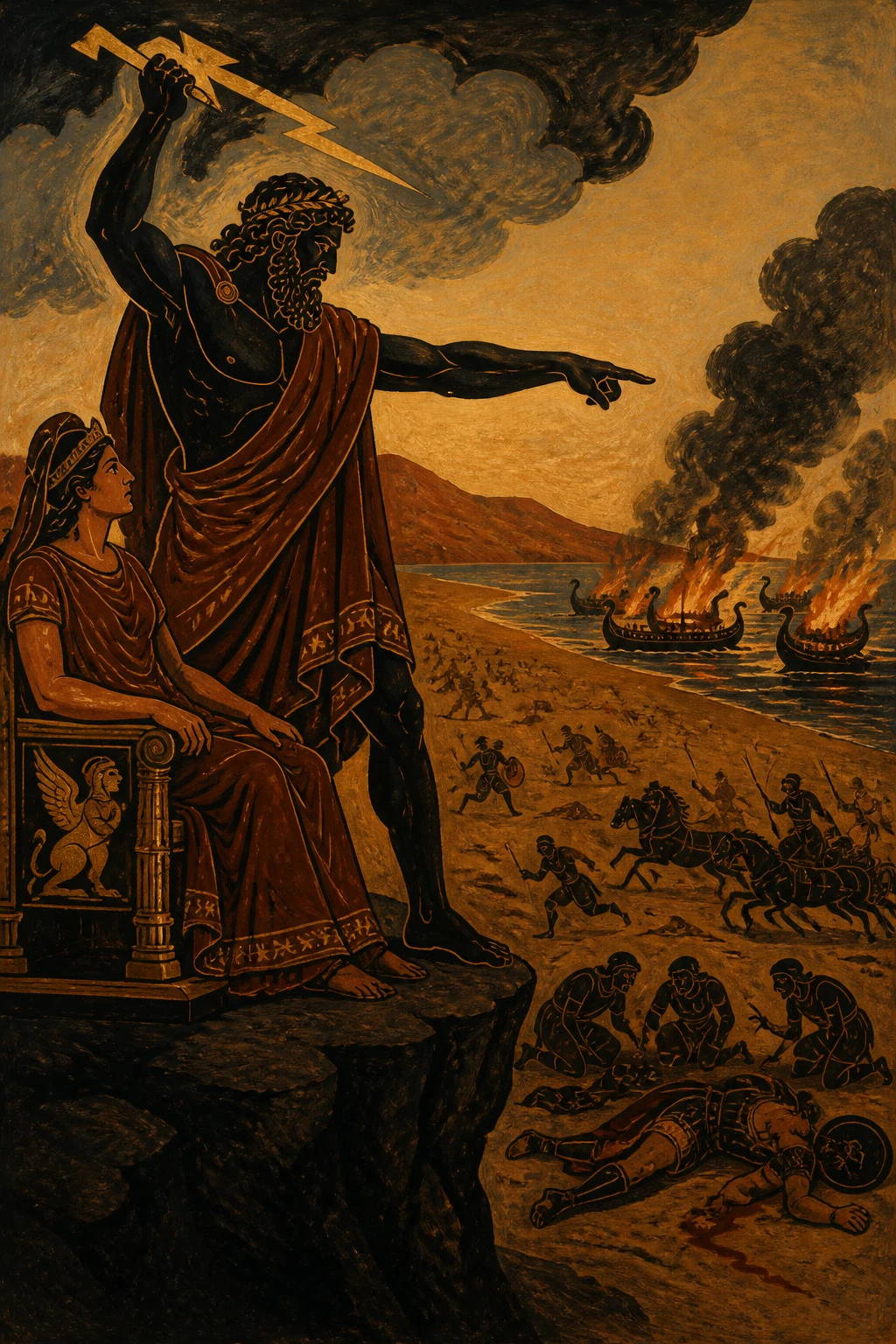
Hera of the golden throne stood on a peak of Olympus and looked out. At once she recognized her own brother and brother-in-law, busy amid the battle that brings men glory, and her heart rejoiced. But she saw Zeus seated on the highest summit of Ida with its many springs, and the sight of him filled her heart with hatred.
Then ox-eyed queen Hera pondered how to deceive the mind of Zeus who bears the aegis. This seemed the best plan: to array herself in all her beauty and go to Ida, in the hope that he would desire to lie beside her and embrace her body in love, and she might pour a gentle, soothing sleep upon his eyelids and his shrewd mind.
She went to the chamber her dear son Hephaestus had built for her, fitting stout doors to the posts with a secret bolt that no other god could open. She entered and shut the shining doors behind her.
First she cleansed every stain from her lovely body with ambrosia, then richly anointed herself with sweet, ambrosial oil, fragrant with perfume. Merely stirring it in Zeus’s bronze-floored house sent its scent abroad through earth and heaven.
When she had anointed her fair body and combed her hair, she braided with her hands the shining locks, lovely and divine, that fell from her immortal head. She put on an ambrosial robe that Athena had woven and finished for her, working many intricate patterns into it, and fastened it across her breast with golden brooches.
She bound about her a girdle fitted with a hundred tassels, and in her pierced ears set earrings of three clustered drops, rich as mulberries, from which great beauty shone. Over her head the queen of goddesses drew a lovely, newly made veil, bright as the sun, and beneath her shining feet she bound beautiful sandals.
When she had adorned her body with every ornament, she left her chamber and called Aphrodite apart from the other gods. “Would you grant me a favor, dear child, if I asked,” she said, “or would you refuse in anger because I help the Danaans while you help the Trojans?”
Aphrodite, daughter of Zeus, answered her: “Hera, revered goddess, daughter of mighty Cronus, tell me what you have in mind. My heart urges me to fulfill it, if I can, and if it is a thing that can be done.”
With guile in her heart, queen Hera replied: “Give me now the love and desire with which you subdue all immortals and mortal men. For I am going to visit the limits of the all-nourishing earth, and Ocean, the source of the gods, and mother Tethys. They brought me up tenderly and cherished me in their house, receiving me from Rhea when far-seeing Zeus thrust Cronus beneath the earth and the barren sea. I am going to see them and settle their endless quarrel. For a long time now they have kept apart from one another’s bed and love, since anger fell upon their hearts.
“If I could persuade their hearts with my words and bring them back to bed together, united in love, they would forever call me dear and honored.” Smiling Aphrodite answered her: “It is neither possible nor fitting to refuse your request, for you sleep in the arms of Zeus, the greatest of the gods.”
She spoke, and unfastened from her breast the embroidered band in which all her enchantments were fashioned. In it were love and longing, lovers’ whispers and the beguilement that steals the wits even of the wise.
She placed it in Hera’s hands and said: “Here, take this embroidered band and hide it in your bosom. Everything is fashioned within it, and I tell you that you will not return unsuccessful in whatever your heart desires.”
So she spoke, and ox-eyed queen Hera smiled, and smiling hid it in her bosom. Aphrodite, daughter of Zeus, returned to her house, while Hera sprang away and left the peak of Olympus. She passed over Pieria and lovely Emathia, then sped above the snowy mountains and highest peaks of the horse-breeding Thracians, never touching the earth with her feet. From Athos she stepped out over the surging sea and reached Lemnos, the city of godlike Thoas.
There she met Sleep, the brother of Death, clasped his hand, and said: “Sleep, lord of all gods and all men, you have listened to my words before; obey me now once more, and I shall be grateful to you all my days.
“Lull the bright eyes of Zeus beneath his brows as soon as I have lain beside him in love. I will give you a beautiful golden throne, imperishable forever. My own son Hephaestus, lame in both legs, shall fashion it with all his skill, and set beneath it a footstool on which you may rest your shining feet when you feast.”
Sweet Sleep answered her: “Hera, revered goddess, daughter of mighty Cronus, any other of the everlasting gods I could easily lull to sleep, even the streams of the river Ocean, from whom they all have sprung. But Zeus, the son of Cronus, I would not approach or lull to sleep unless he himself commanded it.
“Once before your bidding taught me a lesson, on the day when that high-hearted son of Zeus was sailing from Ilios after sacking the Trojans’ city. I poured sweetly about the mind of aegis-bearing Zeus and lulled him, while you devised harm for his son, rousing blasts of furious winds over the sea and carrying him away to well-peopled Cos, far from all his friends. Zeus awoke in fury, flinging the gods about his house, and searching above all for me. He would have hurled me from the upper air into the sea, out of sight forever, had Night, who subdues gods and men, not saved me. I fled to her for refuge, and he stopped, angry though he was.
“For he shrank from doing anything displeasing to swift Night. And now you bid me undertake another impossible deed.” Ox-eyed queen Hera answered him: “Sleep, why do you brood on these things in your heart?
“Do you think far-seeing Zeus will defend the Trojans as fiercely as he raged for his own son Heracles? Come, I will give you one of the younger Graces to marry and call your wife.”
So she spoke, and Sleep rejoiced. He answered her: “Come now, swear to me by the inviolable water of Styx. Lay one hand on the all-nourishing earth and the other on the shining sea, so that all the gods below, who dwell about Cronus, may be witnesses between us: swear that you will give me one of the younger Graces, Pasithea, whom I long for all my days.”
So he spoke, and white-armed Hera did not refuse. She swore as he commanded, naming all the gods beneath Tartarus who are called Titans. When she had sworn and completed the oath, the two left the cities of Lemnos and Imbros, clothed in mist, and swiftly made their way.
They reached Ida of the many springs, mother of wild beasts, at Lectum, where they first left the sea. They walked overland, and the tops of the forest shook beneath their feet. There Sleep remained, before the eyes of Zeus could see him, and climbed a towering fir, the tallest then growing on Ida, which pierced the mist and reached the upper air. There he perched, hidden among the fir branches, in the likeness of the clear-voiced mountain bird that the gods call chalcis, but men cymindis.
Hera hastened toward Gargarus, the summit of lofty Ida, and Zeus the cloud-gatherer saw her. The moment he saw her, desire enveloped his shrewd mind, as it had when first they joined in love, stealing to their bed without their dear parents’ knowledge.
He stood before her and said: “Hera, where are you bound, that you have come down here from Olympus? Your horses and the chariot you would ride in are not with you.”
With guile in her heart, queen Hera answered: “I am going to visit the limits of the all-nourishing earth, and Ocean, the source of the gods, and mother Tethys, who brought me up tenderly and cherished me in their house. I am going to see them and settle their endless quarrel. For a long time now they have kept apart from one another’s bed and love, since anger fell upon their hearts.
“My horses are standing at the foot of Ida with its many springs, ready to carry me over land and water. But I have come down here from Olympus for your sake, lest you should be angry afterward if I went in silence to the house of deep-flowing Ocean.”
Zeus the cloud-gatherer answered her: “Hera, you can set out for that place later. Come now, let us lie down and turn to love. Never before has desire for goddess or woman so flooded and mastered the heart within my breast—not when I loved Ixion’s wife, who bore Peirithous, a counselor equal to the gods; nor fair-ankled Danaë, daughter of Acrisius, who bore Perseus, renowned above all men; nor the daughter of far-famed Phoenix, who bore me Minos and godlike Rhadamanthys; nor Semele, nor Alcmene in Thebes, who bore my strong-hearted son Heracles, while Semele bore Dionysus, a joy to mortals; nor queen Demeter of the lovely hair, nor glorious Leto, nor even you yourself—as I love you now, and sweet longing takes hold of me.”
With guile in her heart, queen Hera answered: “Dread son of Cronus, what a thing to say! If you now long to lie with me in love on the heights of Ida, everything here lies open to view. What if one of the everlasting gods saw us sleeping together and went to tell all the others? I could never rise from that bed and return to your house: it would be shameful.
“But if you truly wish it, and your heart desires it, you have a chamber that your dear son Hephaestus built for you, fitting stout doors to the posts. Let us go and lie down there, since bed is what you crave.”
Zeus the cloud-gatherer answered her: “Hera, do not fear that any god or man will see us. I shall wrap us in a golden cloud through which not even the Sun could see, though his light is keenest of all for seeing.”
With that the son of Cronus took his wife in his arms. Beneath them the holy earth brought forth fresh grass, dewy lotus, crocus, and hyacinth, thick and soft, holding them high above the ground.
There they lay, and wrapped themselves in a beautiful golden cloud, from which glistening dewdrops fell. So the Father slept peacefully on the summit of Gargarus, overcome by sleep and love, his wife in his arms. Sweet Sleep ran to the Achaean ships to carry word to the Earth-holder, the Earth-shaker. He stood close beside him and spoke winged words: “Now, Poseidon, give the Danaans your willing help, and grant them glory, if only for a little while, as long as Zeus still sleeps. I have wrapped him in soft slumber, and Hera beguiled him into lying beside her in love.”
With that he departed among the renowned tribes of men, leaving Poseidon still more eager to defend the Danaans. At once the god sprang far forward among the foremost fighters and called: “Argives, are we once more yielding victory to Hector, son of Priam, so that he may take our ships and win the glory?
“That is what he says and boasts, because Achilles remains beside the hollow ships with anger in his heart. But we shall not miss him greatly if the rest of us rouse ourselves to defend one another.
“Come, let us all do as I say. Let us take the best and largest shields in the army, cover our heads with gleaming helmets, grasp the longest spears, and advance. I myself will lead, and I say that Hector, son of Priam, will not stand his ground, eager though he is.
“Let any man who is steadfast in battle but carries a small shield on his shoulder give it to a lesser fighter and take up a larger one.” So he spoke, and they listened readily and obeyed. The kings themselves, wounded though they were—the son of Tydeus, Odysseus, and Agamemnon, son of Atreus—set them in order. They went among them all, exchanging their weapons of war: the better man put on the better armor and gave the worse to the lesser man.
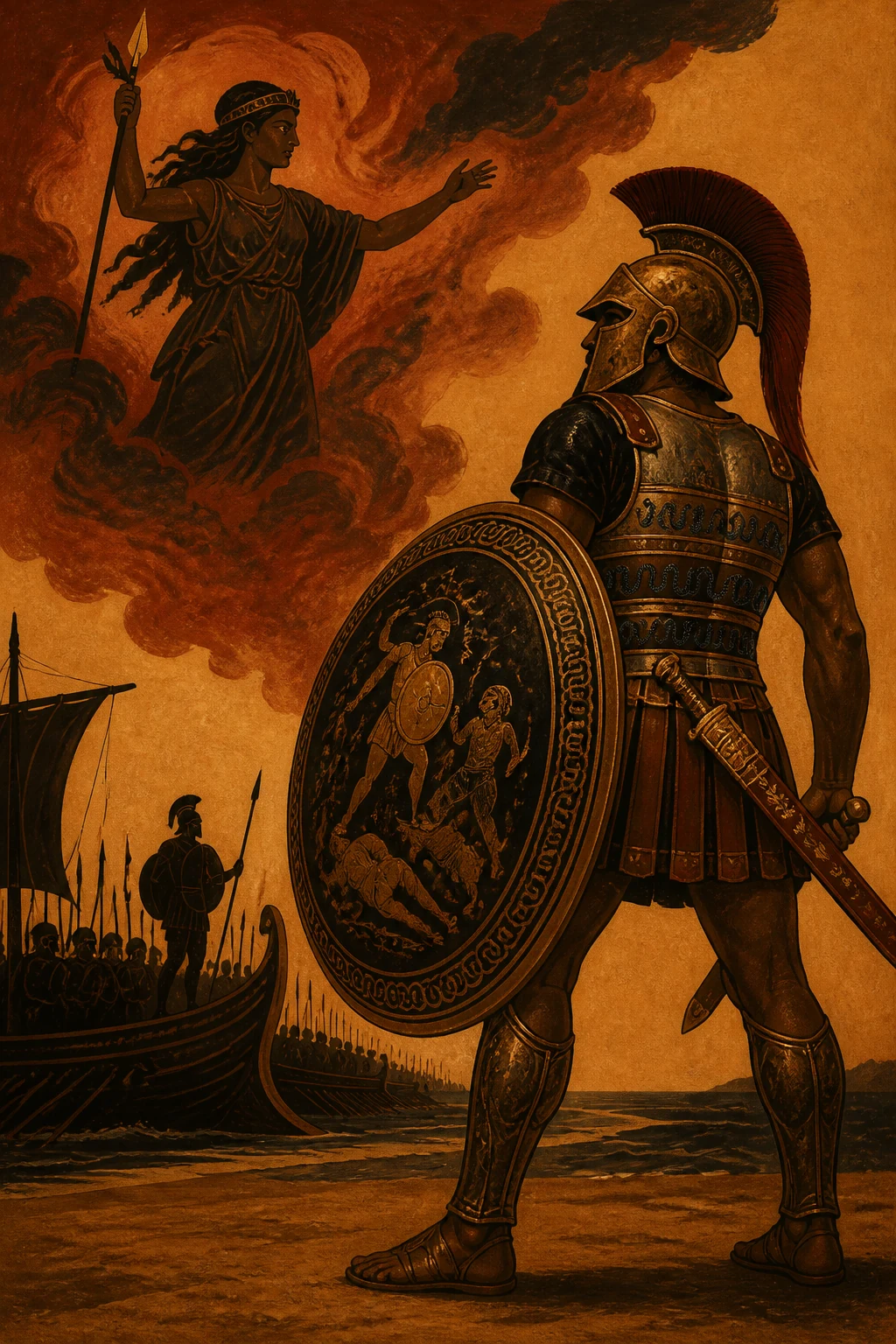
When they had arrayed their bodies in gleaming bronze, they advanced. Poseidon the Earth-shaker led them, holding in his mighty hand a dreadful long-edged sword like lightning. No man may face it in grievous battle: terror holds men back.
On the other side glorious Hector marshaled the Trojans. Then dark-haired Poseidon and glorious Hector stretched the strife of war to its fiercest pitch, the one helping the Argives, the other the Trojans.
The sea surged against the Argives’ huts and ships, and the armies met with a mighty shout. Not so loudly does a wave roar from the sea against the shore, driven by the cruel blast of the North Wind; nor so loudly does fire thunder in the mountain glens when it rises to burn the forest; nor does the wind cry so loudly among the high-crowned oaks, though it roars most mightily in its fury, as the voices of Trojans and Achaeans rang out in dreadful shouts when they rushed upon one another.
Glorious Hector was first to cast his spear at Ajax, who stood facing him. He did not miss, but struck where two straps crossed upon his breast, one bearing his shield, the other his silver-studded sword. They saved his tender flesh. Hector was angry that his swift missile had flown uselessly from his hand, and drew back into the mass of his companions to escape death.
As he withdrew, great Ajax, son of Telamon, lifted one of the many stones used to shore up the swift ships, which lay rolling among the fighters’ feet, and struck him in the chest above the shield’s rim, close to the neck. The blow sent him spinning like a top, whirling round and round.
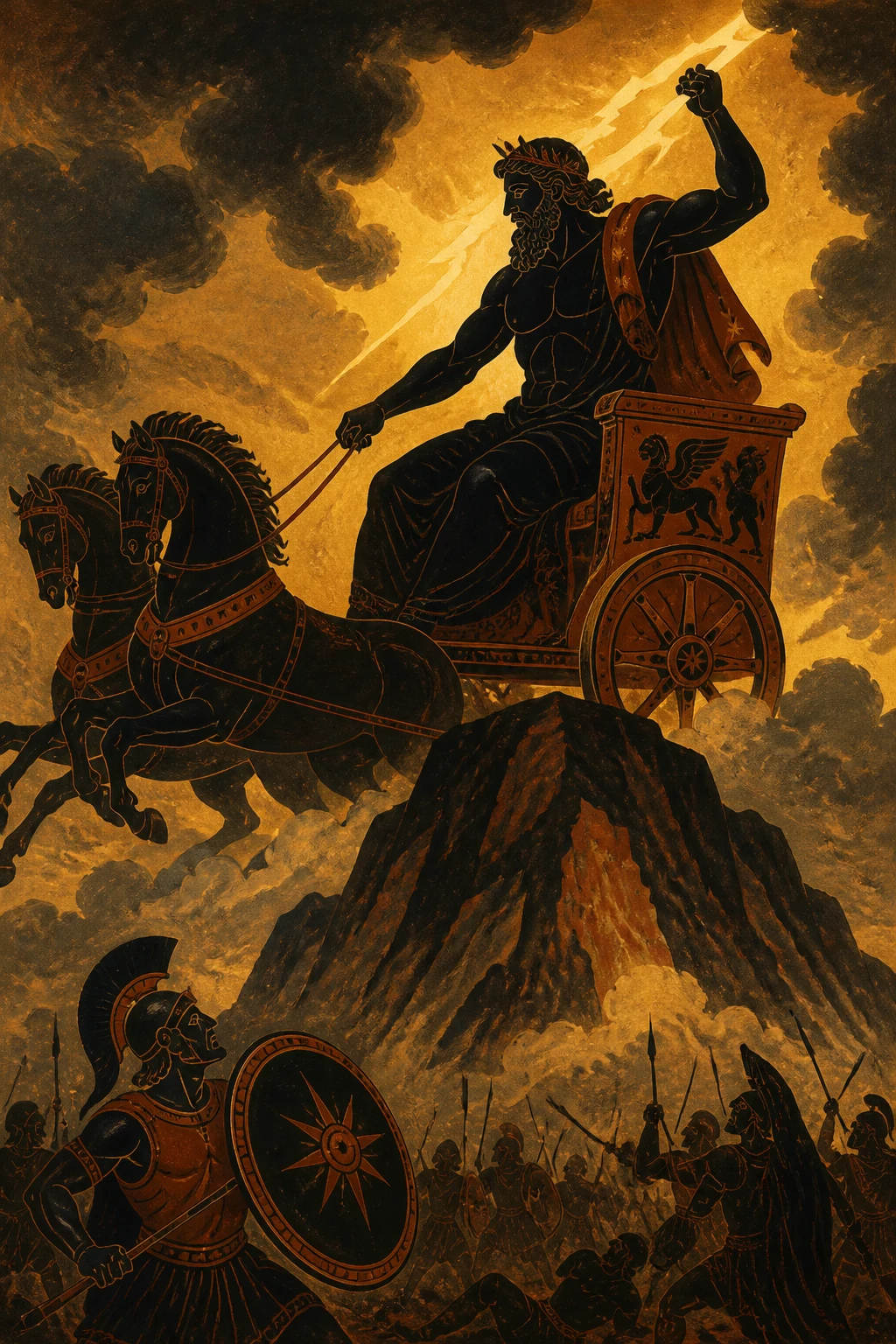
As an oak falls uprooted beneath a stroke from father Zeus, and a dreadful smell of sulfur rises from it, while any man nearby who sees it loses courage—for terrible is the thunderbolt of mighty Zeus—so mighty Hector fell swiftly to the ground in the dust. He dropped his spear, his shield and helmet fell upon him, and his intricate bronze armor clashed around him.
The sons of the Achaeans rushed forward with loud cries, hoping to drag him away, and hurled their spears thick and fast. But none could wound or strike the shepherd of the people, for the bravest had already closed around him: Polydamas, Aeneas, noble Agenor, Sarpedon, leader of the Lycians, and worthy Glaucus.
Nor did any of the others neglect him: they held their rounded shields before him. His companions lifted him in their arms and carried him from the fighting until he reached his swift horses, which stood behind the battle with his charioteer and ornate chariot. They bore him toward the city, groaning heavily.
But when they reached the ford of the fair-flowing, eddying river Xanthus, whom immortal Zeus begot, they lowered him from the chariot to the ground and poured water over him. He revived and opened his eyes, rose to his knees, and vomited dark blood. Then he sank backward to the earth again, and black night covered both his eyes: the blow still overcame his spirit.
When the Argives saw Hector taken from the field, they sprang still harder upon the Trojans and remembered their fighting spirit. Far ahead of the rest, swift Ajax, son of Oileus, leaped forward and wounded Satnius with his sharp spear—the son of Enops, whom a lovely water-nymph bore to Enops as he tended cattle beside the banks of the Satnioeis.
The son of Oileus, famed for his spear, came close and struck him in the flank. He fell backward, and around him Trojans and Danaans joined in fierce battle. Polydamas, the spear-wielding son of Panthous, came to defend him, and struck Prothoenor, son of Areilycus, in the right shoulder. The heavy spear drove through his shoulder, and he fell in the dust, clutching the earth.
Polydamas shouted aloud in terrible triumph: “Surely, I think, the spear has not leaped in vain from the strong hand of the high-hearted son of Panthous! Some Argive has taken it into his flesh, and I think he will lean on it as a staff as he goes down into the house of Hades.”
So he spoke, and his boasting brought grief to the Argives. Above all it stirred the heart of warlike Ajax, son of Telamon, for Prothoenor had fallen close beside him. Swiftly he cast his shining spear at Polydamas as he withdrew.
Polydamas himself escaped black death by springing aside, but Archelochus, son of Antenor, received the spear: the gods had decreed his destruction. It struck him where head and neck meet, at the highest joint of the spine, and sheared through both tendons. As he fell, his head, mouth, and nose struck the earth long before his shins and knees.
Then Ajax called to noble Polydamas: “Consider, Polydamas, and tell me truly: is not this man’s death a worthy payment for Prothoenor? He does not look base to me, nor born of base men, but a brother or son of Antenor, tamer of horses, for he bears the closest family likeness.”
So he spoke, knowing him well, and grief seized the Trojans’ hearts. Then Acamas stood over his brother and stabbed the Boeotian Promachus with his spear as he was dragging the body away by the feet. Over him Acamas shouted aloud in terrible triumph: “Argive bowmen, never sated with threats, suffering and misery shall not be ours alone: you too shall be killed like this.
“See how your Promachus sleeps, overcome by my spear, so that vengeance for my brother should not long remain unpaid. Thus a man may well pray to leave a kinsman in his house to ward off ruin.”
So he spoke, and his boasting brought grief to the Argives. Above all it stirred the heart of warlike Peneleos. He rushed at Acamas, but Acamas did not wait for lord Peneleos’ charge. Instead Peneleos struck Ilioneus, son of Phorbas, rich in flocks, whom Hermes loved above all the Trojans and had granted wealth. To him his wife had borne Ilioneus, their only child.
Peneleos stabbed him beneath the brow, at the base of the eye, and thrust out the eyeball. The spear went straight through the eye and out through the nape, and he sank down with both hands outspread. Peneleos drew his sharp sword, struck him in the middle of the neck, and dashed his head to the ground, helmet and all. The heavy spear was still in the eye. Lifting the head like a poppy, he displayed it to the Trojans and cried in triumph: “Trojans, tell the dear father and mother of noble Ilioneus to mourn him in their halls. For neither shall the wife of Promachus, son of Alegenor, rejoice in her dear husband’s return when we young Achaeans sail home from Troy.”
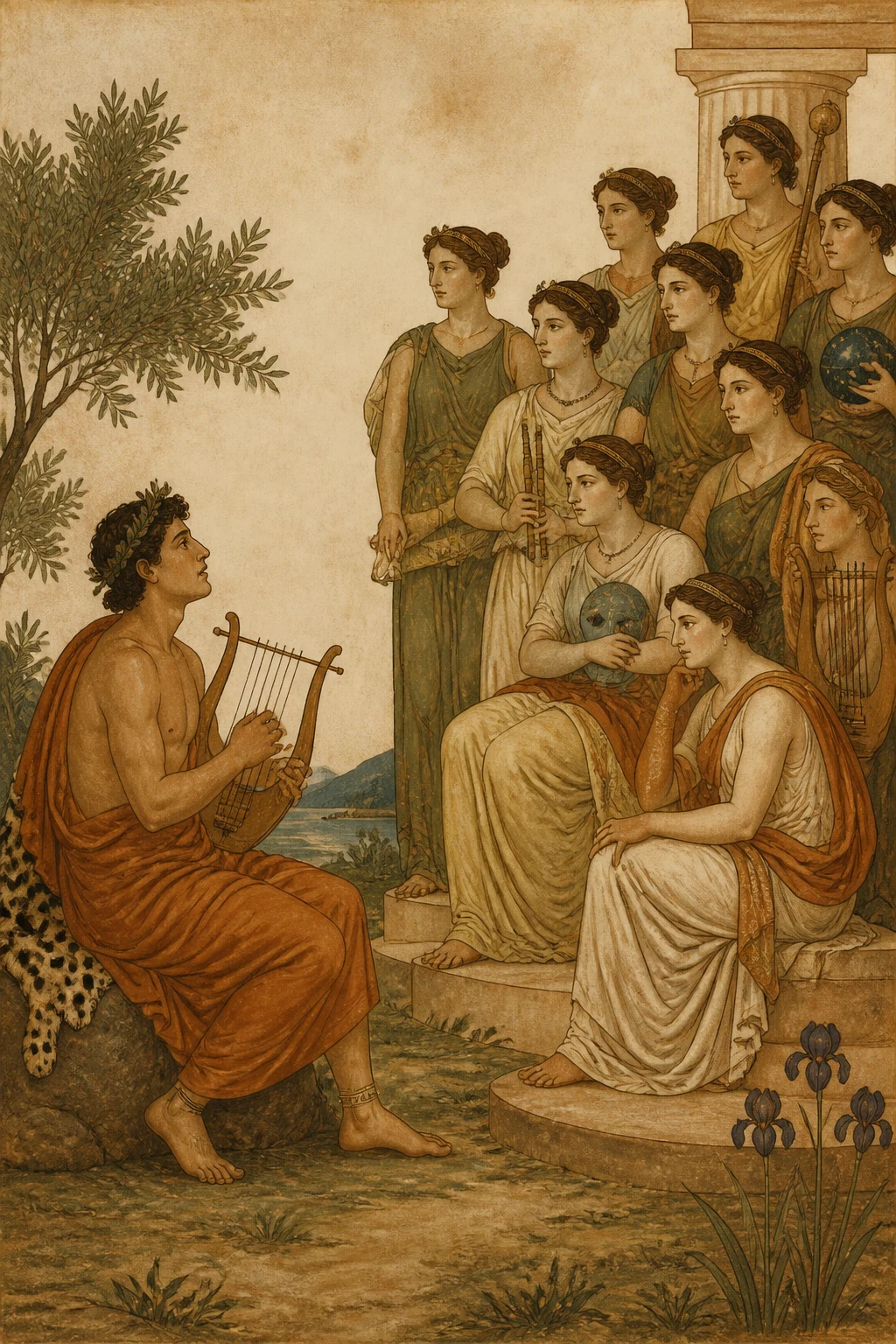
So he spoke, and trembling seized the limbs of them all. Each man looked about for a way to escape sheer destruction. Tell me now, Muses who dwell in the halls of Olympus, which of the Achaeans first took bloodstained spoils from the slain after the renowned Earth-shaker turned the tide of battle.
First Ajax, son of Telamon, struck Hyrtius, son of Gyrtius, leader of the stout-hearted Mysians. Antilochus slew Phalces and Mermerus; Meriones killed Morys and Hippotion; Teucer slew Prothoon and Periphetes. Then the son of Atreus struck Hyperenor, shepherd of the people, in the flank, and the bronze tore through his bowels, ravaging them. His life rushed out through the wound, and darkness covered his eyes.
But swift Ajax, son of Oileus, killed the most. No man could match him in speed of foot when pursuing warriors in flight, once Zeus had driven them to rout.