Prevod
It is also told that Ja‘far al-Barmaki was drinking with al-Rashid one night when al-Rashid said, “Ja‘far, I hear that you have bought a certain slave girl whom I have long been seeking. She is supremely beautiful, and love of her has filled my heart. Sell her to me.” “I will not sell her, Commander of the Faithful,” he replied. “Then give her to me.” “I will not give her to you.” Al-Rashid said, “Zubayda shall be thrice divorced if you do not sell her to me or give her to me.” Ja‘far said, “My wife shall be thrice divorced if I sell her or give her to you.” Then, when they had recovered from their intoxication, they realized that they had fallen into a grave predicament, and could find no way out of it. Al-Rashid said, “This is a matter for none but Abu Yusuf.” So they sent for him at midnight. When the messenger arrived, he rose in alarm and said to himself, “I can only have been summoned at such an hour because some calamity has befallen Islam.” He hurried out and mounted his mule, saying to his servant, “Bring the mule’s nosebag with you, for she may not have finished her feed. When we enter the caliph’s palace, put it on her so that she can eat what remains of tonight’s ration while I am inside.” “I hear and obey,” said the servant. When he entered al-Rashid’s presence, the caliph rose to greet him and seated him beside him on his couch, an honor he granted to no one else. He said, “We have summoned you at this hour only because of an important matter. Such and such has happened, and we have been unable to devise a way out.” “Commander of the Faithful,” he replied, “nothing could be easier.” Then he said, “Ja‘far, sell the Commander of the Faithful half of her, and give him the other half. In this way you will both be clear of your oaths.” The Commander of the Faithful was delighted, and the two men did as he had instructed. Then al-Rashid said, “Bring the girl here at once…” But morning overtook Shahrazad, and she fell silent, leaving her tale untold.
When it was the two hundred and ninety-seventh night
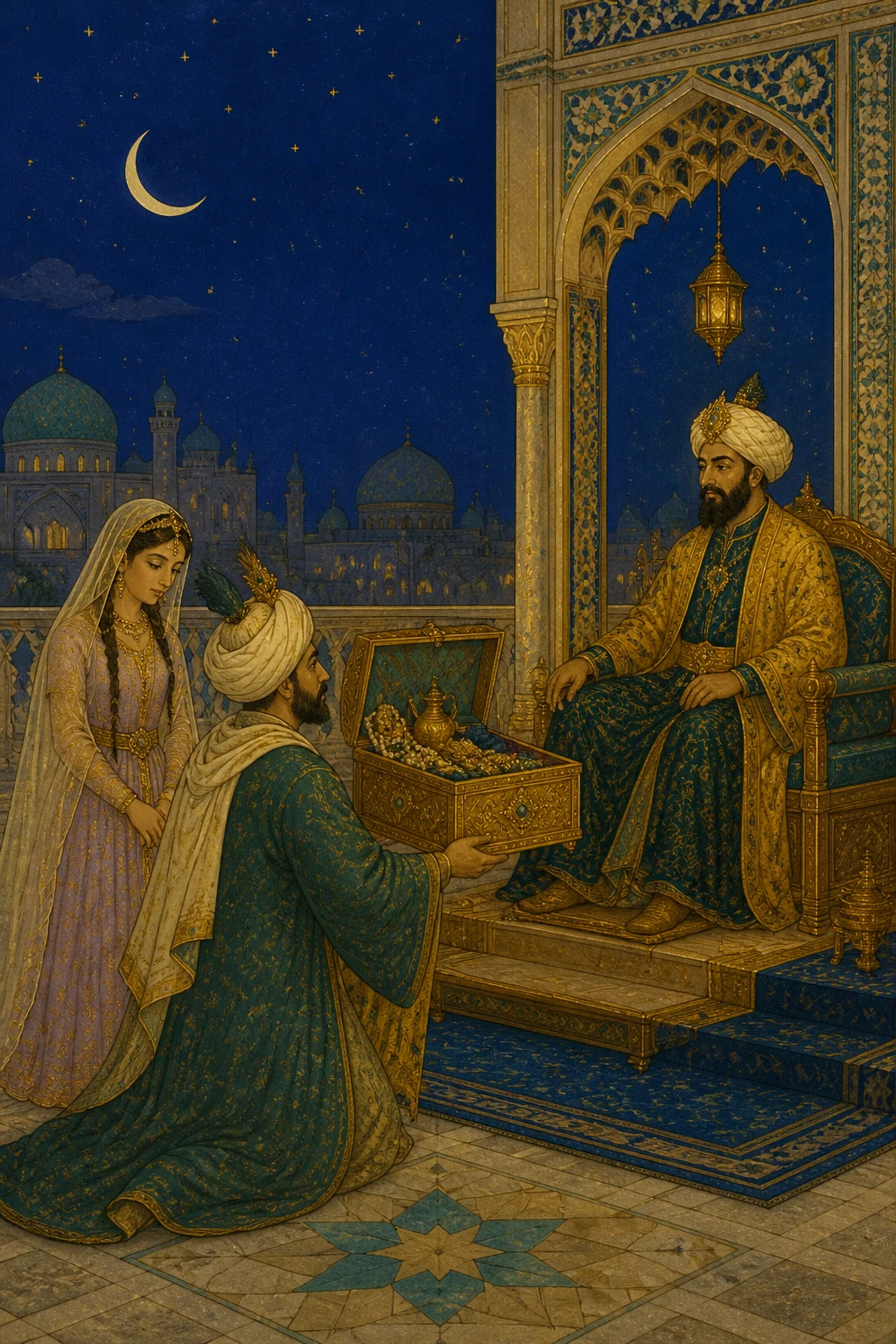
She said: It has reached me, O fortunate king, that the caliph Harun al-Rashid said, “Bring the girl here at once, for I am consumed with longing for her.” So they brought her, and he said to the judge Abu Yusuf, “I wish to lie with her now, for I cannot bear to wait until the period for ascertaining that she is not pregnant has passed. What way is there around this?” Abu Yusuf said, “Bring me one of the Commander of the Faithful’s male slaves who has not been granted his freedom.” They brought a slave, and Abu Yusuf said, “Give me leave to marry her to him. Then he can divorce her before consummating the marriage, and it will be lawful for you to lie with her at once, without any waiting period.” This pleased al-Rashid even more than the first solution. When the slave appeared, the caliph said to the judge, “I authorize you to conclude the marriage.” The judge pronounced the marriage offer, and the slave accepted it. Then the judge said to him, “Divorce her, and you shall have a hundred dinars.” “I will not,” he replied. The judge kept raising the sum, but the slave continued to refuse, until he had offered him a thousand dinars. Then the slave asked the judge, “Does the right to divorce her belong to me, to you, or to the Commander of the Faithful?” “To you,” he replied. “By God, then, I shall never do it.” The Commander of the Faithful grew furious and said, “What can be done, Abu Yusuf?” Judge Abu Yusuf replied, “Commander of the Faithful, do not be troubled. The matter is simple: make this slave the girl’s property.” “I have given him to her,” he said. The judge told her, “Say, ‘I accept.’” “I accept,” she said. Then the judge declared, “I rule that the two are separated, for he has become her property, and the marriage is therefore dissolved.” The Commander of the Faithful sprang to his feet and said, “It is men like you who should be judges in my reign!” He called for trays of gold, which were emptied before the judge, and asked him, “Have you anything to put it in?” Remembering the mule’s nosebag, he sent for it, and it was filled with gold for him. He took it and went home. When morning came, he said to his companions, “There is no easier or shorter road to the blessings of this world and the next than the pursuit of learning. For answering two or three questions, I have been given this great fortune.” Consider, then, gentle reader, the charm of this incident and the many fine qualities it reveals: the vizier’s easy familiarity with al-Rashid, the caliph’s learning, and the judge’s still greater learning. May God Most High have mercy on all their souls.