Prevod
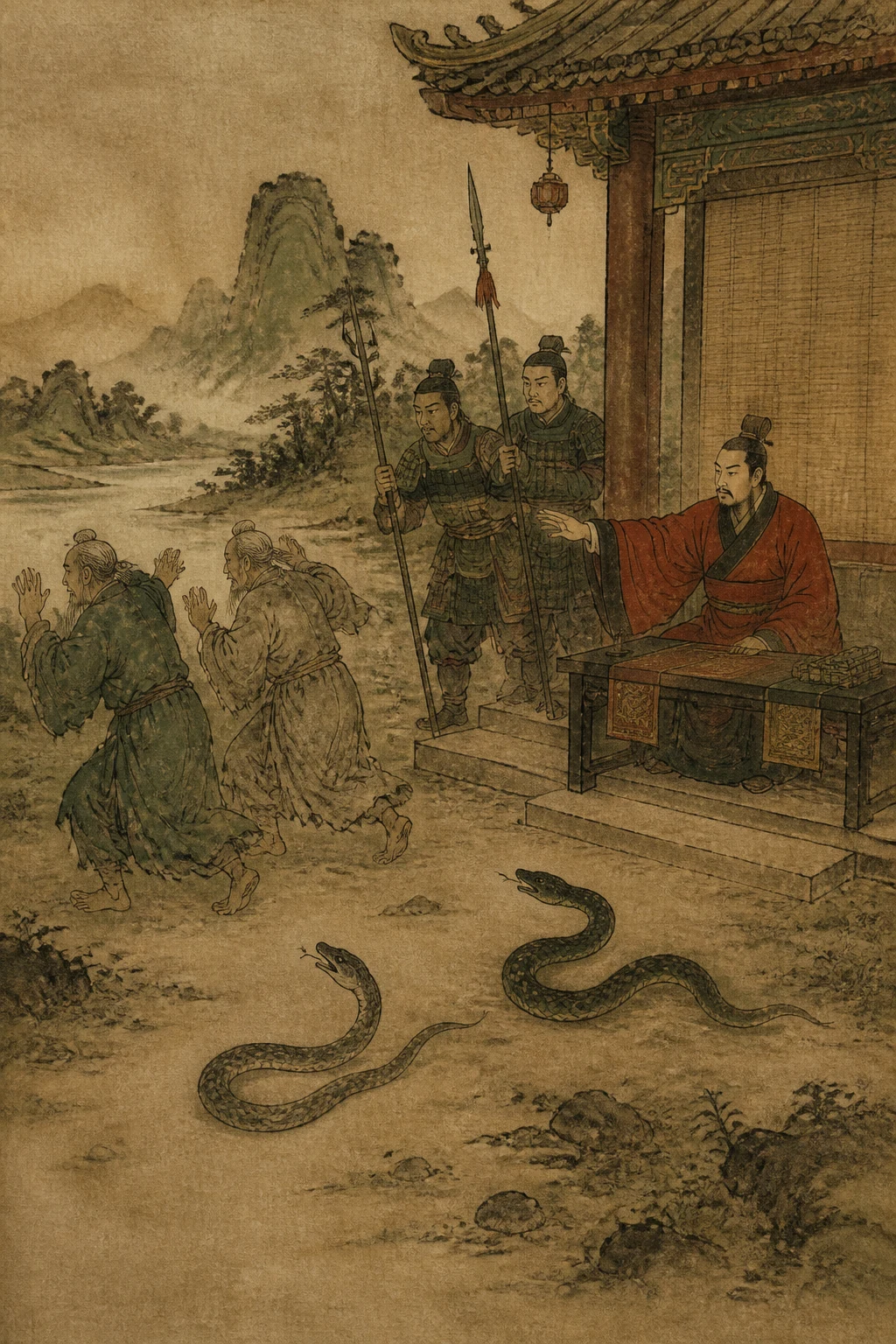
Guan Lu, courtesy name Gongming, was a native of Pingyuan, skilled in divination through the Book of Changes. Wang Ji of Donglai, courtesy name Boyu, was governor of Anping. His household had repeatedly been troubled by strange occurrences, and he sent for Guan Lu to divine their meaning. When the hexagram was complete, Guan Lu said, “Your hexagram shows that a woman of low station gave birth to a boy who, the moment he touched the ground, ran into the stove and died. It also shows a great snake appearing on a bed with a writing brush in its mouth. Everyone in the household, young and old, watched it, and after a little while it went away. Then a crow entered the house and fought with a swallow. The swallow died, and the crow departed. These are the three signs.” Greatly astonished, Wang Ji said, “To think that such penetrating insight could reach this far! Pray tell me whether these things bode good or ill.” Guan Lu replied, “There is no other calamity behind them. It is simply that the guest lodging (another version reads ‘official residence’) is very old, and spirits and goblins have joined together to work their mischief. The newborn child did not run of his own accord: it was the demon Song Wuji that carried him into the stove. The great snake holding a brush was merely an old clerk, and the crow that fought the swallow was merely an old bell attendant. The upright power of the divine cannot be harmed by uncanny beings, nor can the transformations of all things be arrested by the Way. The wandering essences of long ages must also have their appointed limits. Now, the hexagram reveals these manifestations but shows no misfortune. Thus I know that they are instances of spirits assuming borrowed forms, not omens of supernatural disaster, and you have nothing to fear. In ancient times, Gaozong’s cauldron was no place for a pheasant to crow, nor were Taiwu’s steps a place for mulberry and paper-mulberry trees to grow. Yet after a wild bird crowed just once, Wuding became Gaozong; and after those trees sprang up for a brief time, Taiwu’s fortunes flourished. Knowing that these three occurrences are not auspicious signs, I hope that Your Excellency will live in peace and cultivate virtue, calmly allowing it to shine ever more brightly. Do not let the mischief of spirits stain or burden your innate purity.” In the end, no further trouble came. Later, after Wang Ji had been promoted to Military Supervisor for Pacifying the South, a fellow townsman of Guan Lu’s in Taiyuan asked him, “When you explained those strange occurrences to Governor Wang, you said, ‘An old clerk became the snake, and an old bell attendant became the crow.’ These were both originally human beings. Why should they have changed into such lowly creatures? Did you see this in the lines of the hexagram, or was it your own interpretation?” Guan Lu replied, “Except in matters of human nature and the Way of Heaven, how could I turn my back on the images in the hexagram’s lines and rely on my own imaginings? The transformations of all things have no constant form, and the changes that befall human beings have no fixed shape. Sometimes the great becomes small; sometimes the small becomes great. There is no inherent superiority or inferiority in this. The transformations of all things follow one and the same principle. Thus Gun of Xia was the father of a Son of Heaven, and Ruyi, Prince of Zhao, was the son of Emperor Gao of Han; yet Gun became a yellow bear, and Ruyi a dark hound. Even those of the most exalted rank became creatures with black muzzles. Moreover, the snake corresponds to the earthly branches Chen and Si, while the crow lodges in the essence of the sun. These are radiant manifestations amid the soaring darkness, streaming rays of the bright sun. For a clerk and a bell attendant, each a person of humble standing, to become a snake and a crow—was that not already more than they could have expected?”