Prevod
To Monsieur ***. Had I yielded to all the different opinions offered me on the work I am sending you, nothing would have remained but the bare, unadorned tale; and in that case I should have done better not to touch it, but to leave it in the blue paper in which it has lain for so many years. I first read it to two friends. “Why,” said one, “dwell at such length on your hero’s character? What need have we to know what he did in his council in the morning, and still less how he amused himself in the afternoon? All that should be cut. — Pray remove,” said the other, “the playful answer he gives the deputies of his people when they urge him to marry; it ill becomes a grave and serious prince. You will also allow me,” he continued, “to advise you to suppress the long description of your hunt. What has any of that to do with the substance of your story? Believe me, these are vain and ambitious ornaments that impoverish your poem instead of enriching it. The same is true,” he added, “of the preparations for the prince’s marriage; all that is idle and unnecessary. As for your ladies, who lower their headdresses, cover their bosoms, and lengthen their sleeves, that is feeble wit, as is the joke about the orator who applauds his own eloquence.
— I also insist,” resumed the first speaker, “that you remove Griselidis’s Christian reflections, when she says that God wishes to try her: it is a sermon out of place. Nor can I endure your prince’s cruelties, which make me angry: I would suppress them.
It is true they belong to the story, but no matter. I would also remove the episode of the young lord, who is there only to marry the young princess:
it makes your tale far too long. — But,” I said, “the tale would end badly without it. — I cannot say,” he replied; “I would remove it all the same.”
A few days later, I read the same work to two other friends, who said not a word about the passages I have just mentioned, but found fault with a great many others. “Far from complaining of the severity of your criticism,” I told them, “I complain that it is not severe enough: you have let countless passages pass that others consider highly deserving of censure. — Such as?” they asked. “— They think,” I replied, “that the prince’s character is described at too great a length, and that there is no need to know what he did in the morning, still less in the afternoon. — They are making sport of you,” both said at once, “when they offer such criticisms. — They object,” I continued, “to the answer the prince gives those who urge him to marry, as too playful and unworthy of a grave and serious prince. — Nonsense!” answered one of them;
“and where is the harm if a young prince of Italy—a country where one is accustomed to hearing jests from the gravest men and those of the highest rank—who, moreover, makes a point of speaking ill of women and marriage, subjects so open to raillery, should amuse himself a little on that score? Be that as it may, I beg you to spare that passage, as well as the one about the orator who thought he had converted the prince, and the lowering of the headdresses; for those who disliked the prince’s playful answer look very much as though they would have laid violent hands on those two passages too. — You have guessed correctly,” I told him. “But, on the other hand, those who like nothing but amusement could not endure the princess’s Christian reflections, when she says that God wishes to try her;
they maintain that it is an ill-timed sermon. — Ill-timed?” replied the other. “Not only do those reflections suit the subject; they are absolutely necessary to it. You needed to make your heroine’s patience credible;
and what other means had you than to make her regard her husband’s ill-treatment as coming from the hand of God? Without that, she would be taken for the most witless of women, which would certainly not produce a good effect.
— They also object,” I told them, “to the episode of the young lord who marries the young princess. — They are wrong,” he replied. “Since your work is a true poem, though you give it the title of a Tale, it must leave nothing to be desired when it ends. Yet if the young princess returned to her convent unmarried, after having expected to marry, she would not be satisfied, nor would the readers of the tale.”
After this discussion, I resolved to leave my work much as it was when read before the Academy. In short, I have taken care to correct those things I was shown to be faulty in themselves;
but as for those in which I could find no fault beyond their failure to please certain people, perhaps a little too fastidious, I thought it best not to touch them.
Is it reason enough to banish a good dish from a feast, because among the guests there happens to be one who does not like it? Everyone must have his share;
and dishes, if they are to please us all, must differ as our tastes do. Be that as it may, I thought I should leave the matter to the public, which always judges well. From it I shall learn what to think of my work, and I shall follow all its advice to the letter, should I ever bring out a second edition.
At the foot of the famous mountains where the Po, escaping from beneath the reeds, carries its newborn waters through the heart of the neighbouring countryside, there lived a young and valiant prince, the delight of his province. In fashioning him, Heaven had poured upon him all at once its rarest gifts, those it commonly divides among its favourites, and grants together only to great kings.
Endowed with every gift of body and soul, he was strong, skilful, well suited to the trade of Mars; and through the secret impulse of a divine flame, he loved the fine arts with ardour.
He loved battles, he loved victory, great designs, deeds of valour, and all that keeps a noble name alive in history; but his tender and generous heart was still more alive to the lasting glory of making his people happy.
This heroic nature was clouded by a dark mist which, gloomy and melancholy, made him see, in his heart of hearts, all womankind as faithless and deceitful. In the woman who shone with the rarest merit, he saw a hypocritical soul, a mind drunk with pride, a cruel enemy whose sole and ceaseless aim was to gain absolute dominion over the unhappy man delivered into her hands.
Frequent dealings with the world, where husbands are seen only as subjugated or betrayed, together with the jealous temper of the country, deepened this profound aversion. More than once he swore that even if Heaven, in its tenderness for him, should fashion another Lucretia, he would never submit to the laws of marriage.
Thus, when in the morning, which he devoted to affairs of state, he had wisely settled all matters necessary to the welfare of his government, upheld the rights of the helpless orphan and the oppressed widow, or abolished some tax imposed long before by an unavoidable war, the other half of the day was given over to hunting. There, wild boars and bears, for all their fury and their weapons, caused him less alarm than the charming sex he always shunned.
His subjects, meanwhile, whose own interests urged them to secure a successor who might one day govern them with equal kindness, constantly entreated him to give them a son.
One day they came as a body to the palace to make a final effort. An orator of solemn appearance, and the finest of his day, said all that could be said on such an occasion.
He spoke of their pressing desire to see the prince produce a fortunate line of heirs who would keep their state prosperous for ever; he even told him, in conclusion, that he saw a rising star, born of his chaste marriage, which would make the Crescent pale.
In a simpler tone and a less resounding voice, the prince answered his subjects thus: “The ardent zeal with which I see you urging me today towards the bonds of marriage pleases me, and is a welcome proof of your love;
I am deeply touched by it, and wish I could satisfy you tomorrow. But to my mind marriage is a business in which the more prudent a man is, the more perplexed he finds himself.
Observe all young women closely: so long as they remain within their families, they are all virtue, goodness, modesty, and sincerity. But as soon as marriage puts an end to the disguise, and, their future secured, good behaviour no longer matters, they cast off the role that has cost them so much effort, and each sets up her household as she pleases.
One, sour-tempered and pleased by nothing, becomes an excessive devotee, forever scolding and complaining; another fashions herself into a coquette, forever listening or chattering, who can never have lovers enough;
this one, madly enamoured of the fine arts, pronounces haughtily on everything, and, finding fault with the most skilful author, assumes the airs of a lady of exquisite learning; another sets herself up as a gambler and loses everything—money, jewels, rings, costly furniture, and even the clothes she wears.
Among the many paths they follow, I see only one thing on which they all agree in the end: they mean to lay down the law.
Now I am convinced that in marriage there can be no happiness when both command. If, then, you wish me to enter wedlock, find me a young beauty without pride or vanity, perfectly obedient, of proven patience, and with no will of her own. I shall marry her when you have found her.”
Having ended this moral discourse, the prince sprang upon his horse and raced at breakneck speed to join his pack, which awaited him in the middle of the plain.
After crossing meadows and ploughed fields, he found his huntsmen lying on the green grass. All rose, and all, alert, went off to make the dwellers of the forest tremble at their horns.
The barking tribe of hounds flashed here and there among the stubble, while the keen-eyed bloodhounds, returning to their stations from the beast’s covert, strained towards it and dragged at the sturdy servants who held them back.
Having learned from one of his men that everything was ready and the trail found, he at once ordered the hunt to begin and the stag to be given to the hounds.
The ringing horns, the neighing horses, and the piercing cries of the eager hounds filled the forest with tumult and commotion; and as the echoes endlessly redoubled them, the sounds plunged with the hunters into the deepest recesses of the wood.
The prince, by chance or destiny, took a winding path where none of the huntsmen followed. The farther he rode, the farther he drew away, until at last he had strayed so far that he could no longer hear the hounds or horns.
The place to which his strange adventure brought him, bright with streams and dark with greenery, filled the mind with a secret awe. Nature showed herself there so simple and artless, so beautiful and pure, that a thousand times he blessed his error. Filled with the gentle reveries inspired by great woods, waters, and meadows, he suddenly felt his heart and eyes struck by the most delightful, the sweetest and most lovable sight he had ever seen beneath the heavens.
It was a young shepherdess spinning beside a stream, who, as she tended her flock, turned her nimble spindle with a deft and thrifty hand.
She could have tamed the wildest hearts. Her complexion had the whiteness of lilies, and its natural freshness had always been sheltered in the shade of groves. Her mouth had all the charm of childhood, and her eyes, softened by dark lashes, were bluer than the firmament, and brighter too.
Enraptured, the prince slipped among the trees and gazed at the beauty that stirred his soul; but the noise he made as he passed caused the fair maid to turn her eyes towards him;
as soon as she saw that she had been observed, the swift, vivid warmth of a brilliant blush redoubled the splendour of her lovely complexion, and, spreading over her face, made modesty triumphant there.
Beneath the innocent veil of this sweet confusion, the prince discovered a simplicity, a gentleness, a sincerity of which he had thought womankind incapable, and which he now saw in all their beauty.
Seized by a fear entirely new to him, he approached, disconcerted and more timid than she, and told her in a trembling voice that he had lost all trace of his huntsmen, asking whether the hunt had passed anywhere through the wood.
“Nothing has appeared, my lord, in this solitude,” she said, “and no one but you has come here. But do not be troubled: I shall lead you back to a path you know.”
“I cannot thank the gods enough,” he told her, “for my happy fortune. I have frequented these places for a long time, but until today I never knew their greatest treasure.”
Just then she saw the prince stoop upon the damp bank of the stream to quench his burning thirst in its flowing waters.
“My lord, wait a moment,” she said, and, running swiftly to her cottage, she fetched a cup, which she offered with pleasure and good grace to this new lover.
The precious vessels of crystal and agate, in which gold gleamed in a thousand places, shaped with such care by ingenious art, had never, in their useless splendour, seemed to him as beautiful as the earthen cup the shepherdess gave him.
Meanwhile, to find an easy road that would lead the prince to the town, they crossed woods and steep rocks intersected by torrents;
the prince took no new path without carefully observing everything around it, and his resourceful love, already thinking of a return, made a faithful map.
At last the shepherdess led him into a cool, dark grove, where, beneath the thick branches, he could see far away in the heart of the plain the gilded roofs of his magnificent palace.
Parting from the fair maid, pierced by a sharp sorrow, he drew slowly away from her, bearing the arrow that had wounded his heart; the memory of his tender adventure accompanied him pleasantly home.
But the very next day he felt his wound, and found himself overwhelmed with sadness and longing. As soon as he could, he returned to the hunt, where he deftly slipped away from his attendants to lose himself so happily again.
The lofty treetops and mountain peaks he had observed with such care, and the secret promptings of his faithful love, guided him so well that, despite the crossings of a hundred different paths, he found his young shepherdess’s home.
He learned that she had only her father left, that her name was Griselidis, that they lived contentedly on the milk of their sheep, and that from the wool, which she spun alone, they made their own clothes, without having to go to town.
The more he saw her, the more he was inflamed by the radiant beauty of her soul. Seeing so many precious gifts, he understood that if the shepherdess was so lovely, it was because a faint spark of the spirit that animated her had passed into her eyes.
He felt the utmost joy at having bestowed his first love so well. Without further delay, that very day he summoned his council and addressed it thus: “At last, in accordance with your wishes, I am about to submit to the laws of marriage;
I shall not take my wife from a foreign land, but from among you—beautiful, virtuous, and well born—as my forefathers have done more than once. But I shall wait until the great day to tell you whom I have chosen.”
No sooner was the news known than it spread everywhere. Words cannot tell with what fervour the public joy expressed itself on every side;
happiest of all was the orator, who believed his moving speech alone had brought about this great blessing. What a man of consequence he felt himself!
“Nothing can withstand great eloquence,” he kept saying to himself. It was a pleasure to see the fruitless efforts of all the beauties in the town to attract and earn the choice of the prince their lord, who, as he had said a hundred times, was charmed above all else, and indeed by nothing else, by a chaste and modest air.
They all changed their dress and bearing, coughed in a pious manner, softened their voices, lowered their headdresses by half a foot, covered their bosoms, lengthened their sleeves, until scarcely the tips of their fingers could be seen.
Throughout the town, every art was busily at work for the approaching wedding day. Here magnificent chariots were being made in wholly novel shapes, so beautiful and so ingeniously contrived that the gold glittering everywhere was the least of their attractions.
There long stands were being erected, from which the full splendour of the spectacle could be seen with ease and without obstruction; here great triumphal arches celebrated the warrior prince’s glory and Love’s brilliant victory over him.
There, with industrious art, were fashioned those fires which, with the crashes of a harmless thunder, alarm the earth and adorn the heavens with a thousand new stars.
There the graceful extravagance of an ingenious ballet was being carefully rehearsed, and there could be heard the melodious airs of an opera peopled by a thousand gods, the finest Italy had ever produced.
At last the great day of the famous wedding arrived. Scarcely had rosy Dawn mingled gold with azure against the clear, bright sky than everywhere the fair sex started awake;
the curious people poured out on every side; guards were stationed at various points to restrain the populace and compel it to make way.
The whole palace rang with clarions, flutes, oboes, and rustic bagpipes, while all around nothing could be heard but drums and trumpets.
At last the prince emerged, surrounded by his court. A long cry of joy arose; but great was the surprise when, at the first turning, he was seen to take the road to the neighbouring forest, just as he did every day.
“There,” people said, “his inclination carries him away; despite Love, hunting is still the strongest of his passions.” He swiftly crossed the ploughed fields of the plain and, reaching the hillside, entered the wood, to the great astonishment of the company attending him.
After following various winding paths, which his loving heart delighted to recognise, he found at last the rustic cottage that sheltered his tender love.
Griselidis, who had learned of the wedding through the voice of Fame, had put on her best clothes; and, meaning to go and see its magnificent splendour, was at that very moment coming out of her humble dwelling.
“Where are you hurrying, so swiftly and lightly?” the prince said as he approached, gazing tenderly at her. “Do not make such haste, most lovely shepherdess. The wedding you are going to, at which I am the bridegroom, cannot take place without you.
Yes, I love you, and out of a thousand young beauties I have chosen you to spend the rest of my life with, if only you do not reject my suit.”
“Ah, my lord!” she said. “I dare not believe that I am destined for so great an honour; you are amusing yourself.” “No, no,” he said, “I am sincere. I already have your father’s consent.” (The prince had taken care to have him informed.)
“Deign, shepherdess, to give yours; that is all that remains to be done. But so that lasting peace may reign between us for ever, you must swear that you will never have any will but mine.”
“I swear it,” she said, “and I promise it to you. Had I married the humblest man in the village, I would obey him, and his yoke would be sweet to me. Ah, how much more so, then, if I find in you both my sovereign and my husband!”
Thus the prince declared his choice, and while the court applauded it, he persuaded the shepherdess to allow herself to be arrayed in the ornaments bestowed upon the brides of kings.
The women whose duties called them to this task entered the cottage, and there diligently brought all their knowledge and skill to lending grace to every detail of her dress.
In this crowded hut, the ladies never ceased to admire the art with which poverty was concealed beneath cleanliness; and the rustic cottage, shaded and cooled by a spreading plane tree, seemed to them an enchanted dwelling.
At last, from this retreat, the charming shepherdess emerged in dazzling splendour. There was nothing but applause for her beauty and her attire; yet beneath this unfamiliar magnificence, the prince had already more than once regretted the innocent simplicity of the shepherdess’s ornaments.
Upon a great chariot of gold and ivory, the shepherdess seated herself in majesty; the prince proudly mounted beside her, finding no less glory in sitting at her side as her lover than in riding in triumph after a victory;
the court followed, each keeping the rank assigned by office or nobility of blood. Almost the whole town had come out into the fields and covered the surrounding plains; informed of the prince’s choice, they awaited his return with impatience.
He appeared; they hurried to meet him. Through the dense crowd, which parted before it, the chariot could scarcely move. At the long cries of joy, renewed at every moment, the startled, agitated horses reared, stamped, and plunged, moving backwards more than forwards.
At last they reached the temple, and there, through the eternal bond of a solemn promise, the bride and bridegroom united their destinies. Then they went to the palace, where a thousand pleasures awaited them, where dancing, games, races, and tournaments spread rejoicing in every quarter;
towards evening, golden-haired Hymen crowned the day with his chaste delights. The next day, the various estates of the whole province hastened to address the princess and the prince through the voices of their magistrates.
Surrounded by her ladies, Griselidis, without seeming disconcerted, heard them as a princess and answered them as a princess. She did everything with such wisdom that it seemed Heaven had poured its treasures even more abundantly upon her soul than upon her body.
Through her intelligence and keen understanding, she immediately acquired the manners of the great world, even from the very first day. She learned so much about the talents and temperaments of the ladies of her court that her good sense, never at a loss, found it easier to guide them than the sheep she had tended in former days.
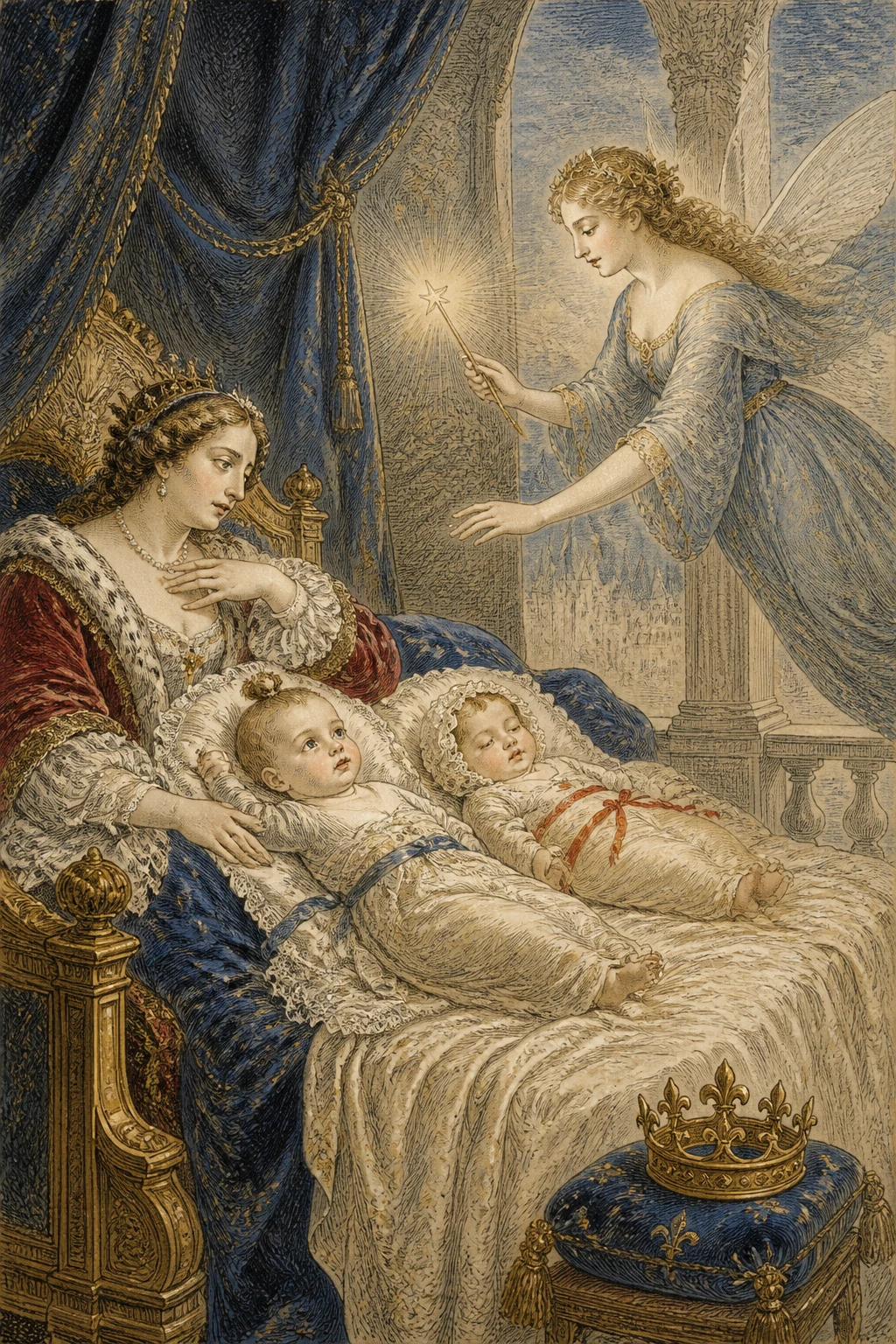
Before the year was out, Heaven blessed their happy bed with the fruits of marriage. It was not a prince, much as one had been wished for; but the young princess was so beautiful that everyone thought only of keeping her alive;
her father, who found her sweet and charming, came to see her at every moment, while her mother, more delighted still, gazed at her ceaselessly. She wished to nurse the child herself. “Ah!” she said, “how could I excuse myself from the duty her cries ask of me without the deepest ingratitude?
For some motive contrary to Nature, could I wish to be only half a mother to the child I love?” Whether the prince’s soul burned a little less fiercely than in the first days of his passion, or whether the smouldering mass of his ill humour had flared up again, clouding his senses with its thick smoke and corrupting his heart, in everything the princess did he imagined that he saw little sincerity.
Her very excess of virtue wounded him: it was a snare laid for his credulity. His restless, troubled mind believed every suspicion it entertained, and took pleasure in calling into doubt the fullness of his happiness.
To cure the sorrows that afflict his soul, he follows her, watches her, and delights in troubling her with the vexations of restraint, the alarms of fear, and everything that might distinguish truth from pretense.
“Too long,” he says, “have I allowed myself to be lulled to sleep. If her virtues are genuine, the most intolerable treatment will only strengthen them.” He keeps her closely confined within his palace, far from all the pleasures of the court; and into the chamber where she lives alone and secluded, he scarcely lets the daylight enter. Convinced that finery and splendid dress are the sweetest enchantment for the sex that Nature fashioned to give pleasure, he harshly demands the pearls, rubies, rings, and jewels he gave her as tokens of his tenderness when, from her lover, he became her husband.
She, whose life is spotless, and who has never cared for anything but the fulfillment of her duty, gives them to him without distress. Indeed, seeing how it pleases him to take them back, she feels no less joy in returning them than she felt in receiving them. “My husband torments me to put me to the test,” she says, “and I can see that he makes me suffer only to awaken my languishing virtue, which a long and gentle peace might destroy.
“If that is not his purpose, at least I am certain that such is the Lord’s design for me, and that the weary duration of so many trials serves only to exercise my constancy and faith.
“While so many unfortunate women wander at the bidding of their desires along a thousand dangerous paths in pursuit of false and empty pleasures; while the Lord, slow in his justice, lets them stray to the edge of the precipice without intervening in their peril, he chooses me, through the sheer impulse of his supreme goodness, as a child he loves, and takes pains to correct me.
“Let us therefore love his sternness, cruel for our good. We are happy only in proportion as we have suffered. Let us love his fatherly goodness, and the hand through which it works.”
Though the Prince sees her freely obey his every absolute command, it is in vain. “I see the foundation of this feigned virtue,” he says, “and what makes all my blows useless: they have struck only at things on which her love no longer rests.
“In her child, in the young Princess, she has placed all her tenderness. If I am to succeed in testing her, that is where I must strike; that is where I shall learn the truth.”
She had just suckled the tender object of her ardent love, who lay upon her breast, playing with her and laughing as she gazed at her. “I see that you love her,” he said, “yet I must take her from you while she is still so young, to shape her character and preserve her from certain ill-bred ways she might acquire with you.
“Good fortune has led me to a lady of understanding, who will know how to bring her up in all the virtues and refinements a princess ought to possess.
“Prepare to part with her. Someone will come to carry her away.” With these words he leaves her, lacking the courage, or eyes inhuman enough, to watch the sole pledge of their love being torn from her arms.
She bathes her face in a thousand tears, and in bleak despair awaits the fatal moment of her misfortune. As soon as the odious agent of so sad and cruel a deed appeared before her, “I must obey,” she told him.
Then, taking her child, she gazed at her and kissed her with a mother’s fervor; and as the little one clasped her tenderly in her small arms, she surrendered her, weeping.
Ah, how bitter was her anguish! To tear the child or the heart from the breast of so tender a mother is the same pain. Near the town stood a convent, renowned for its antiquity, where virgins lived under an austere rule, watched over by an abbess distinguished for her piety.
There the child was left in secret, with no disclosure of her birth, together with valuable rings and the promise of a reward worthy of the care bestowed upon her.
The Prince, who tried through hunting to drive away the keen remorse that troubled him for his excessive cruelty, dreaded seeing the Princess again, as one dreads meeting a fierce tigress whose cub has just been taken from her.
Yet she treated him with gentleness, with affection, and even with the tenderness she had shown him in the happiest days of her prosperity. Such ready and complete devotion moved him to regret and shame.
But his dark temper still prevailed. Thus, two days later, with feigned tears, he came to tell her, in order to wound her still more deeply, that death had ended the life of their lovely child.
This unexpected blow wounded her to the soul. Yet, despite her grief, seeing her husband change color, she seemed to forget her own misfortune and to have no tenderness left except to comfort him in his false sorrow. Such goodness, such matchless ardor of wifely devotion, suddenly disarmed the Prince’s sternness, touched him to the depths, and changed his heart so far that he longed to reveal that their child was still alive.
But his proud, bitter temper rose and forbade him to disclose a secret it might be useful to keep. From that blessed day onward, such was the tenderness between the two spouses that no lover and mistress ever felt a livelier love in their sweetest moments.
Fifteen times the Sun, bringing round the seasons, passed in turn through his twelve houses without seeing anything divide them. And if sometimes, on a whim, the Prince took pleasure in vexing her, it was only to keep their love from growing cool, like a blacksmith who, pressing on with his labor, sprinkles a little water on the embers of his fading furnace to redouble its heat. Meanwhile, the young Princess grew in understanding and wisdom.
To the gentleness and innocence she inherited from her lovely mother, she added the gracious, noble pride of her illustrious father. The union of all that was pleasing in each character made her a perfect beauty.
Everywhere she shone like a star; and a young lord of the court, well formed and fairer than the day, happened to see her at the convent grille and conceived a passionate love for her.
Through that instinct Nature has given the fair sex, by which every beauty perceives the invisible wound her eyes inflict at the very moment they inflict it, the Princess became aware that she was tenderly loved.
After resisting for a time, as one ought before surrendering, she returned his love with equal tenderness. There was nothing to reproach in this lover: he was handsome, valiant, and descended from illustrious ancestors; and for a long time, as a future son-in-law,
the Prince had had his eye upon him. Thus it was with joy that he learned of the tender, mutual passion burning in these young lovers.
But a strange desire seized him to make them purchase the greatest happiness of their lives with cruel torments. “I shall take pleasure,” he said, “in making them happy.
“But first anxiety, in all its harshest forms, must make their passion still more constant. At the same time I shall exercise my wife’s patience, not, as I have until now, to satisfy my foolish mistrust—I must no longer doubt her love—
“but to display before the whole world her goodness, her gentleness, her profound wisdom, so that the earth, finding itself adorned with such great and precious gifts, may be filled with reverence and give thanks to Heaven in gratitude.”
He declares in public that, having no offspring in whom the state might one day find its ruler, since the daughter born of his foolish marriage died almost as soon as she was born, he must seek better fortune elsewhere;
that the bride he has chosen is of illustrious birth, that until this day she has been brought up in innocence within a convent, and that he is about to crown his love with marriage.
One may judge how cruel this dreadful news was to the two young lovers. Then, showing neither sorrow nor distress, he informs his faithful wife that he must part from her to avert a terrible misfortune;
that the people, indignant at her lowly birth, compel him to seek a worthy alliance elsewhere. “You must withdraw,” he says, “beneath your roof of thatch and bracken, after putting on again your shepherdess’s clothes, which I have had made ready for you.” With quiet, silent constancy, the Princess heard her sentence pronounced.
Beneath a serene countenance she swallowed her grief, and, without sorrow diminishing her beauty, great tears fell from her lovely eyes, as sometimes, when spring returns, the sun shines while the rain falls.
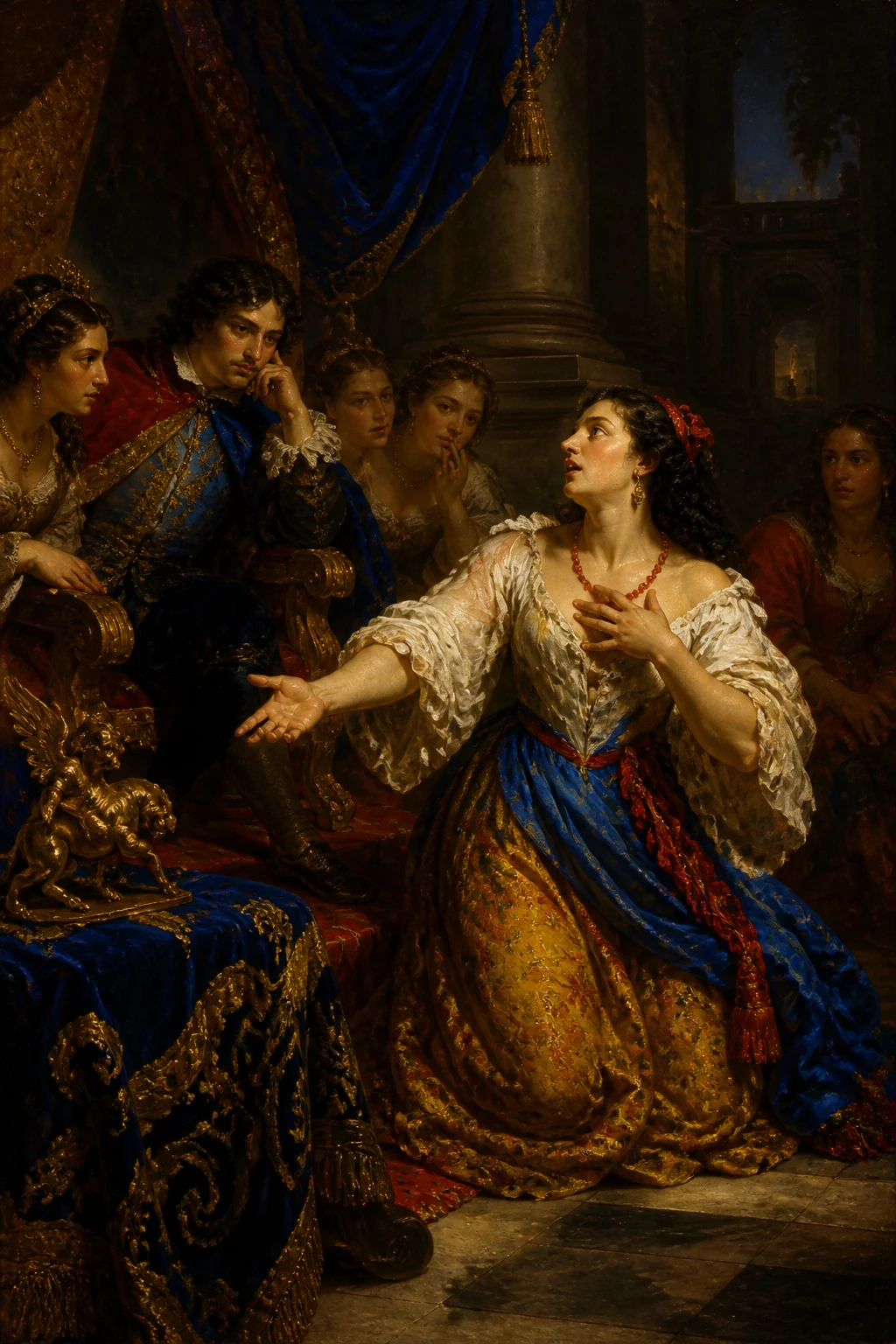
“You are my husband, my lord, and my master,” she said with a sigh, on the point of fainting, “and however dreadful what I have just heard, I shall show you that nothing is dearer to me than obeying you.” At once she withdraws alone to her chamber, and there, stripping off her rich attire, she calmly and silently puts on the clothes she wore when tending her sheep, though her heart sighs within her.
In this humble, simple dress, she approaches the Prince and speaks to him thus: “I cannot leave you without your forgiveness for having displeased you.
“I can bear the weight of my misery, but I cannot, my lord, bear your anger. Grant this favor to my sincere regret, and I shall live content in my sorrowful retreat, without time ever diminishing either my humble respect or my faithful love.”
Such submission and such greatness of soul beneath so poor a dress, awakening in the Prince’s heart at that very moment every memory of his first passion, almost made him revoke the sentence of her banishment.
Moved by such powerful charms and ready to shed tears, he was beginning to step forward to embrace her when suddenly the imperious pride of remaining firm in his resolve triumphed over his love, and made him answer harshly: “I have forgotten all the past. I am satisfied with your repentance. Go; it is time to leave.” She departs at once, and, looking at her father, who had been dressed again in his rustic clothes and whose heart, pierced with bitter sorrow, mourned so swift and sudden a change, she says, “Let us return to our shadowy groves; let us return to our dwellings in the wild, and leave the splendor of palaces without regret.
“Our cottages have less magnificence, but there, with greater innocence, one finds a surer rest, a sweeter peace.” Scarcely has she reached her secluded home before she takes up her distaff and spindles again, and goes to spin beside the very waters where the Prince had found her.
There her heart, peaceful and free of bitterness, asks Heaven a hundred times a day to heap glory and riches upon her husband, and deny him nothing that he desires.
A love nourished by caresses is no more ardent than hers. This dear husband, for whom she longs, wishing to test her yet again, sends word to her retreat that she must come to him.
“Griselidis,” he says as soon as she appears, “the Princess whose hand I am to take tomorrow in the temple must be pleased with both you and me.
“I ask you to devote all your care to this, and I want you to help me please the object of my vows. You know the manner in which I must be served: spare nothing, hold nothing back.
“Let everything proclaim the Prince, and the Prince in love. Use all your skill to adorn her apartments; let abundance, richness, cleanliness, and elegance be equally apparent there.
“Above all, remember constantly that she is a young Princess whom I love tenderly. To make you still more attentive to your duty, I wish to show you here the woman whom my command requires you to serve well.”
As the newborn Dawn appears at the gates of the East, so the Princess appeared on her arrival, lovelier still. At her approach, Griselidis felt deep within her heart a sweet stirring of maternal tenderness.
The memory of the past, of her happy days, returns to her heart. “Alas!” she says to herself, “if kindly Heaven had heard my prayers, my daughter would be almost as tall, and perhaps as beautiful.”
At that very moment she conceived so keen and ardent an affection for the young Princess that, as soon as the girl had gone, she spoke to the Prince in this way, unknowingly following the instinct that stirred within her: “Allow me, my lord, to point out that this charming Princess, whose husband you are about to become, nurtured in comfort, splendor, and royal purple, could not endure the treatment I have received from you without losing her life.
“Poverty and my humble birth had hardened me to toil, and I could bear every kind of hardship without difficulty, and even without complaint.
“But she, who has never known sorrow, will die at the slightest harshness, at the least word spoken a little sharply or severely. Alas, my lord, I beg you to treat her gently.”
“See to serving me as best you can,” the Prince tells her sternly. “A mere shepherdess must not presume to lecture me or instruct me in my duty.”
At these words, Griselidis lowers her eyes and withdraws without a word. Meanwhile, the lords invited to the wedding arrived from every quarter.
In a magnificent hall, where the Prince assembled them before lighting the nuptial torch, he addressed them thus: “Nothing in the world, after Hope, is more deceptive than Appearance.
“Here you may see a striking example. Who would not believe that my young beloved, whom marriage is about to make a princess, is happy and content at heart?
“Yet it is not so. Who could help believing that this young warrior, enamored of glory, is pleased to see this marriage, he who will triumph over all his rivals in the tournaments?
“Yet that is not true. Who would not also believe that Griselidis, in her rightful anger, is weeping and despairing? She makes no complaint, she consents to everything, and nothing has been able to exhaust her patience.
“Who, finally, would not believe that no fortune could equal the happy course of mine, seeing the charms of the object of my vows? Yet if marriage bound me to her, I should feel profound sorrow, and of all the princes in the world I should be the most unhappy.
“The riddle seems hard for you to understand. A few words will explain it, and those few words will dispel all the misfortunes you have just heard.
“Know,” he continued, “that the lovely person whom you believe to have wounded my heart is my daughter, and that I give her in marriage to this young lord, who loves her passionately and is equally loved by her.
“Know also that, deeply moved by the patience and devotion of the wise and faithful wife whom I so shamefully drove away, I take her back, so that through all the sweetness love can offer I may make amends for the harsh and barbarous treatment she received from my jealous temper.
“I shall take greater pains to anticipate her every desire than, in my uneasiness, I ever took to overwhelm her with sorrow. And if the memory of the afflictions that could not crush her heart must live for all time, I wish still more to be said of the glory with which I shall have crowned her supreme virtue.”
As when a heavy cloud has darkened the day, and the sky, black on every side, threatens a dreadful storm, if the winds part that dusky veil and a brilliant ray of light falls across the landscape, everything smiles and regains its beauty;
so, in every eye where sadness had reigned, lively gladness suddenly shines. At this swift revelation, the young Princess, delighted to learn that she owes her life to the Prince, throws herself at his knees and embraces them fervently.
Her father, moved by so dear a daughter, raises her, kisses her, and leads her to her mother, whom too much happiness at once had almost deprived of all feeling.
Her heart, which so often, assailed by misfortune’s sharpest darts, had borne sorrow so well, succumbs beneath the sweet weight of joy. She could scarcely clasp in her arms the lovely child Heaven had restored to her; she could only weep.
“At another time you will have ample leisure to indulge these bonds of blood,” the Prince tells her. “Put on again the clothes your rank requires. We have a wedding to celebrate.”
The two young lovers were led to the temple, where their mutual promise to cherish one another tenderly confirmed their sweet bond forever.
There is nothing but pleasure, magnificent tournaments, games, dancing, music, and delicious feasts, where every eye turns toward Griselidis, and her proven patience is exalted to the skies in a thousand glorious praises. Such is the rejoicing people’s indulgence toward their capricious Prince that they go so far as to praise his cruel test, to which they owe so perfect a model of a virtue so beautiful, so becoming to the fair sex, and so rare anywhere.
TO MADEMOISELLE***. In offering you, young and wise beauty, this model of patience, I have never flattered myself that you would imitate her in every respect.
In all conscience, that would be too much. But Paris, where men are polished, where the fair sex, born to please, finds its happiness complete, is so full on every side of examples of the contrary vice
that, at any season, one cannot have too much antidote, whether to guard against it or to be cured of it. A lady as patient as the one whose worth I celebrate here would be astonishing anywhere;
but in Paris she would be a marvel. Women reign supreme there; everything is ordered according to their wishes. In short, it is a happy land inhabited by queens alone.
Thus I see that, in every way, Griselidis will be little esteemed there, and that her over-antiquated lessons will make her an object of ridicule. Not that patience is no virtue of the ladies of Paris:
but through long practice they have learned the art of making their own husbands exercise it.