Prevod
Once upon a time there was a poor couple who had nothing in the world but three sons. What the two eldest were called I do not know, but the youngest was called Peer. When their parents died, the children were to inherit what they had left, but there was nothing to be had except a pot, a griddle, and a cat. The eldest, who was to have the best, took the pot. “Whenever I lend the pot, I shall always be allowed to scrape it,” he said. The second took the griddle;
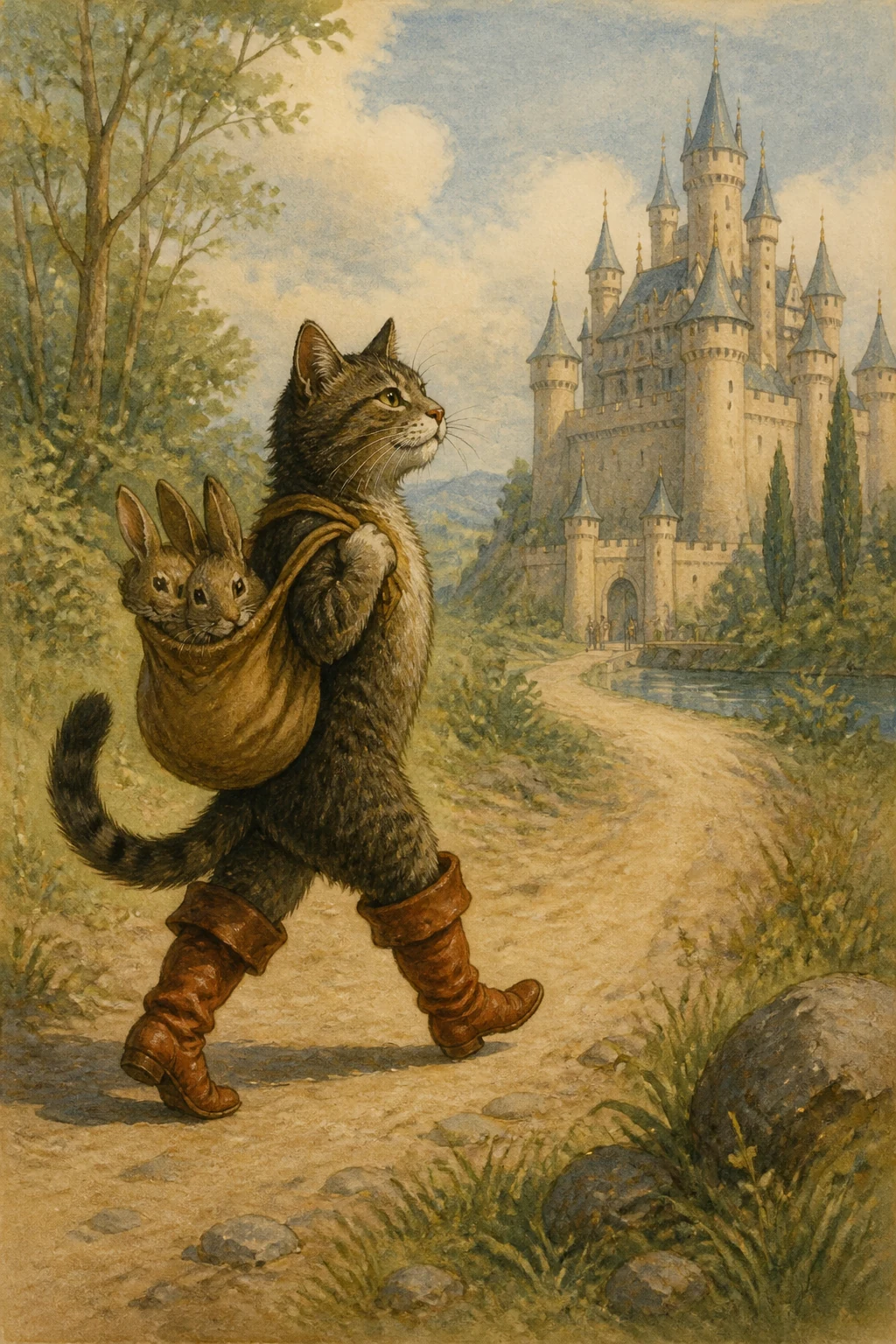
“For whenever I lend the griddle, I shall always get a piece of lefse to taste,” he said. But the youngest had no choice left; if he wanted anything at all, it would have to be the cat. “If I lend the cat, I shall get nothing for her,” he said. “If the cat gets a little milk, she will want it all herself. Still, I shall take her with me; it would be a shame to leave her here to perish.” So the brothers went out into the world to seek their fortunes, and each took a different road. But when the youngest had walked a little way, the cat said, “You shall be repaid for not leaving me behind in the old cottage to perish. Now I shall go into the forest and catch some fine animals, and you must go up to the king’s palace, which you can see over there, and tell the king you have brought him a little gift. When he asks who it is from, you must say it is from Herrepeer.” Well, Peer had not waited long before the cat came out of the forest with a reindeer. She had leapt onto its head, and when she had settled herself between its antlers, she said, “Unless you go straight to the king’s palace, I shall scratch your eyes out.” The reindeer dared do nothing else. When Peer reached the palace, he went into the kitchen with the reindeer and said, “I have brought a little gift for the king, if he will not disdain it.” The king came out into the kitchen, and when he saw the great, handsome reindeer, he was delighted. “But, my dear fellow!
Who has sent me such a splendid gift?” said the king. “Oh, it comes from Herrepeer!” said the lad. “Herrepeer!” said the king. “Now, where does he live?” For he thought it shameful that he should not know so worthy a man. But the lad would not tell him; he dared not, on account of his master, he said. So the king gave Peer a generous reward and asked him to take his warmest greetings home, with many thanks for the gift.
The next day the cat went into the forest again, leapt onto a stag’s head, settled herself between its eyes, and threatened it until it went to the palace. Once again Peer took it into the kitchen and said he had brought a little gift for the king, if he would not disdain it.
The king was even more pleased with the stag than he had been with the reindeer, and again he asked who could have sent him such a splendid gift. “It is from Herrepeer,” said the lad. But when the king wanted to know where Herrepeer lived, he received the same answer as the day before, and this time he gave Peer an even larger reward.
On the third day the cat brought an elk. When Peer went into the palace kitchen, he said he had a little gift for the king, if he would not disdain it. The king came out into the kitchen at once, and when he saw the great, handsome elk, he was so delighted he could scarcely stand still. That day he gave Peer a far, far greater reward; it must have been a hundred dalers.
He was determined to find out where Herrepeer lived, and questioned and probed about this and that, but the lad said he dared not tell him, for his master had strictly forbidden it. “Then ask Herrepeer to visit me!” said the king. Yes, the lad said, he would do that. But when he came out of the palace again and met the cat, Peer said, “You have got me into a fine fix! Now the king wants me to visit him, and I have nothing but the rags I stand in.” “Oh, do not worry about that,” said the cat. “In three days you shall have horses and a carriage, and clothes so fine that gold will drip from you; then you can certainly visit the king. But whatever you see at the king’s palace, you must say you have something far finer and grander at home. You must not forget that.” No, Peer thought he would be sure to remember. When the three days were up, the cat came with a carriage and horses and clothes and everything Peer needed, all so magnificent that no one had ever seen the like. So he set off, and the cat ran along with him. The king gave him a very warm welcome, but whatever the king offered him and whatever he showed him, Peer said it was fine enough, but he had things far grander and finer at home. The king did not like this very much, but Peer stuck to his story, and at last the king grew so angry that he could no longer contain himself. “Now I shall go home with you,” said the king, “and see whether it is true that you have things so much better and finer. But if you are lying, then God help you—that is all I shall say!” “You have got me into a fine fix!” said Peer to the cat. “Now the king wants to come home with me, but my home will not be so easy to find.” “Oh, never mind that,” said the cat. “Just drive wherever I run ahead.” So off they went, Peer first, driving after the cat as she ran ahead, and then the king with all his retinue.
When they had driven a good way, they came upon a great flock of beautiful sheep, with wool so long that it almost reached the ground. “If you will say this flock of sheep belongs to Herrepeer when the king asks you, you shall have this silver spoon,” said the cat to the shepherd. She had brought it with her from the palace. Yes, he would gladly do that. When the king came along, he said to the shepherd boy, “Never have I seen such a large and beautiful flock of sheep! Who owns it, my little lad?” “It belongs to Herrepeer,” said the boy.
A little farther on they came upon a vast herd of beautiful brindled cows, so fat that their coats shone. “If you will say this herd belongs to Herrepeer when the king asks you, you shall have this silver ladle,” said the cat to the girl who tended them. The silver ladle, too, she had brought from the palace. “Yes, gladly,” said the girl. When the king came along, he was quite astonished at the great, splendid herd, for he thought he had never seen such fine cattle before. So he asked the girl tending them who owned all those brindled cows. “Oh, Herrepeer does!” said the girl.
They travelled a little farther, and came upon a great, great herd of horses. They were the finest horses anyone could wish to see, big and sleek, with six of every colour—chestnut, dun, and blue-grey. “If you will say this herd of horses belongs to Herrepeer when the king asks you, you shall have this silver goblet,” said the cat to the herdsman.
The goblet, too, she had brought from the palace. Yes, the lad said, he would do that. When the king came along, he was quite astonished at the great, splendid herd of horses, for he had never seen their like, he said. So he asked the herdsman who owned the chestnut, dun, and blue-grey horses.
“They belong to Herrepeer,” said the lad. When they had travelled another good stretch, they came to a castle. First there was a gate of brass, then one of silver, and then one of gold. The castle itself was made of silver, so bright that it dazzled their eyes, for the sun was shining on it just as they arrived. In they went, and the cat told Peer to say that this was where he lived. Inside, the castle was even more magnificent than outside:
Everything was made of gold—chairs, tables, and benches alike. When the king had gone about looking at everything, upstairs and down, he felt thoroughly ashamed. “Yes, Herrepeer has finer things than I do; there is no use denying it,” he said;
and he was about to leave again. But Peer asked him to stay and have supper with him, and the king did, though he was sour and ill-tempered the whole time. While they were sitting at table, the troll who owned the castle came and knocked at the gate. “Who is in there eating my food and swilling my mead like pigs?” roared the troll. As soon as the cat heard him, she ran out to the gate. “Wait a little, and I shall tell you how the farmer goes about growing winter rye,” said the cat; and she began to tell him all about winter rye at great length. “First the farmer ploughs his field,” she said, “then he spreads the manure, and then he ploughs it again.” Just then the sun rose. “Look round, and you will see the lovely, beautiful maiden behind you!” said the cat to the troll. So the troll turned round, saw the sun, and burst.
“Now all this is yours,” said the cat to Herrepeer. “And now you must cut off my head; that is all I ask of you in return for what I have done for you.” “No,” said Herrepeer, “I will do no such thing.” “Yes,” said the cat, “and if you do not, I shall scratch your eyes out.” So Herrepeer had to do it, much as he hated to; he cut off the cat’s head. But that very instant she turned into the most beautiful princess anyone could ever set eyes on, and Herrepeer fell head over heels in love with her. “Yes, all this splendour was mine before,” said the princess, “but that troll bewitched me, so that I had to live as a cat with your parents. Now you may do as you please, and take me for your queen or not;
for you are now king of the whole kingdom,” said the princess. Oh yes, you may be sure Herrepeer wanted her for his queen! So there was a wedding and feasting for eight days, and after that I stayed no longer with Herrepeer and his queen.