O besedilu
Gos
- Vir
- Pentameron
- Avtor
- Giambattista Basile
- Jezik branja
- English
- Jezik izvirnika
- Neapolitan
- Čas branja
- 7 min branja
- Obseg
- 6 strani
- Naslov izvirnika
- Jornata V I LA PAPARA
O izvirniku
Pentameron
Baročna, divja starejša plast evropske pravljice, polna obratov in pretiravanj. Bralni jezik je English, izvirnik pa prihaja iz vira Pentameron v jeziku Neapolitan.
Besedilo
Gos
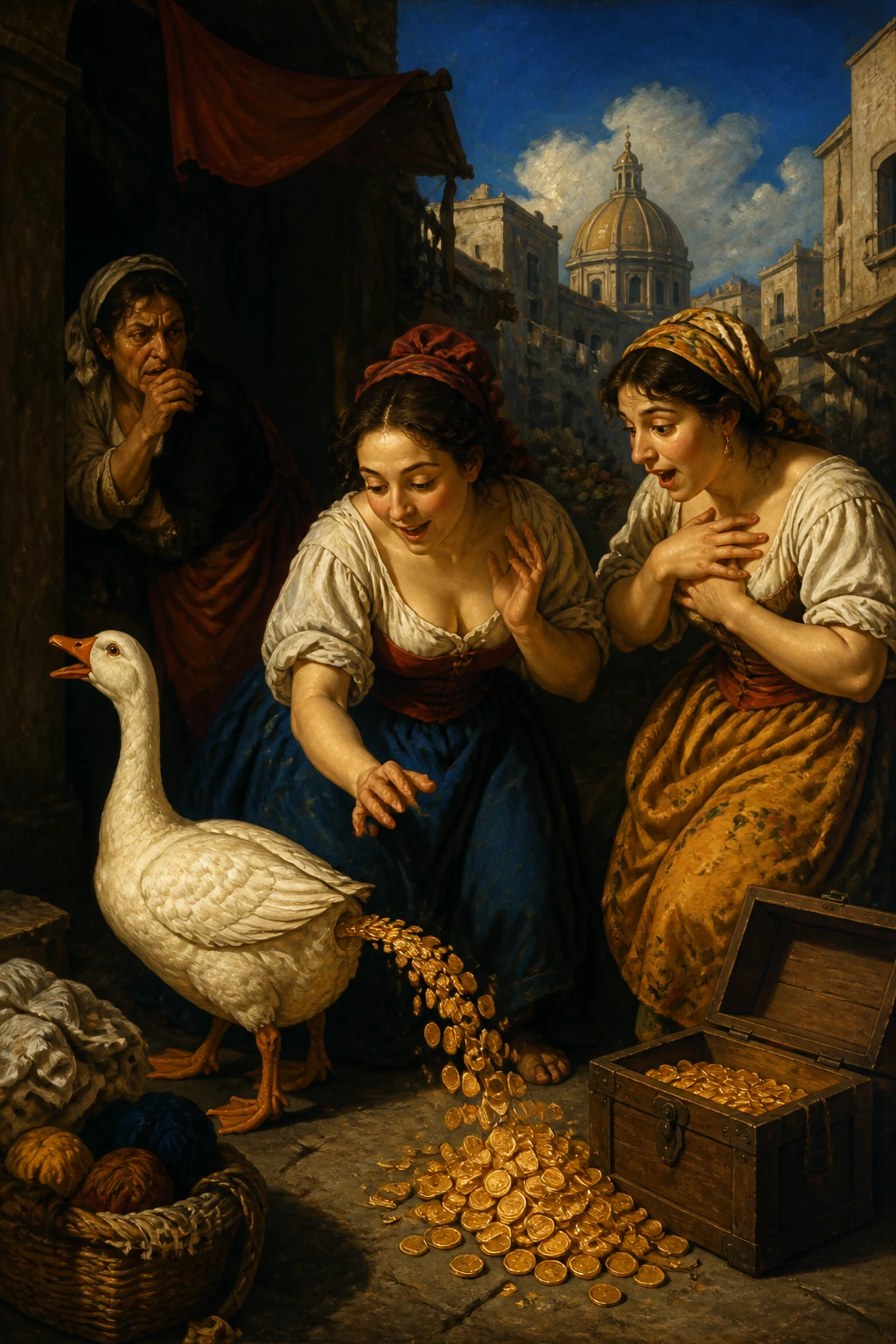
_Lilla and Lolla buy a goose at the market that lays money. A neighbor borrows it, but finding that it produces quite the opposite, kills it and throws it out of a window. It fastens onto the backside of a Prince as he is relieving himself, and no one can pry it loose except Lolla, whom the Prince therefore takes for his wife._ _A fine saying was that of the great and worthy man: the craftsman envies the locksmith, the musician the musician, the neighbor the neighbor, and the pauper the beggar; for there is no cranny in the fabric of the world where that accursed spider, envy, does not spin its web. It feeds on nothing but the ruin of others, as you shall hear more particularly in the tale I am about to tell._ Once upon a time there were two sisters so utterly reduced to poverty that they kept themselves alive only by wetting their fingers from morning till night and spinning a little thread to sell. Yet for all their wretched toil, it seemed impossible to keep the ball of necessity from striking the ball of honor clean out of play. So Heaven, which is as generous in rewarding goodness as it is ingenious in punishing wickedness, put it into the poor girls’ heads to go to market, sell a few skeins of thread, and buy a goose with the little money they received. This they did, and when they had brought the goose home, they grew so fond of her that they cared for her as though she were their own sister, even letting her sleep in their bed. Then, when dawn broke and a fair day began, the good goose started shitting bright gold crowns. Dropping by dropping, they filled a whole chest, and so abundant was this golden dung that the sisters began to hold their heads high and look sleek and flourishing. One day, some women of their acquaintance got together for a gossip and said to one another, “Have you seen, neighbor Vasta, how Lilla and Lolla, who only the other day hadn’t a place to drop down dead, have polished themselves up and now put on the airs of great ladies? Look at their windows, always decked out with chickens and great hunks of meat that fairly slap you in the face! What can it mean? Either they’ve tapped the barrel of their honor, or they’ve found a treasure.” “It leaves me dumb as a mummy, my dear neighbor Perna,” replied Vasta. “They were falling down privies, and now I see them perched so high and mighty that I think I must be dreaming.” With such talk, and other words prompted by envy, they made a hole in the wall of their house that looked into the two girls’ rooms, so that they could spy on them and perhaps find something to feed their curiosity. They kept such a close watch that one evening, when the Sun slaps his broad palm of rays upon the shores of the Indian Ocean to give the hours of daylight leave to rest, they saw Lilla and Lolla spread sheets on the floor and set the goose upon them, whereupon she began squirting out streams of gold crowns. At this sight, their eyes bulged and their throats swelled at the very same moment. Next morning, when Apollo conjures the shadows away with his golden wand, Vasta went to visit the girls. After a thousand twists and turns of talk, drawing it out this way and that, she came to the point and begged them to lend her the goose for a couple of hours, to help some goslings they had bought grow accustomed to the house. She pleaded and coaxed so cleverly that the two simpleton sisters, partly because they were too good-natured to refuse and partly because they did not wish to arouse their neighbor’s suspicions, lent her the goose on condition that she bring her straight back.
The neighbor went to join the other women, and they promptly spread sheets on the floor and set the goose upon them. But instead of revealing a mint beneath her tail and coining gold crowns, she opened a sewer and worked the poor women’s linen over with yellow earth, whose smell spread through the whole neighborhood like that of the meat-and-greens stew on a Sunday. Seeing this, they thought that if they fed her well, she would produce the substance of the philosopher’s stone and satisfy their wishes. So they stuffed her until the food came up into her throat and put her on another clean sheet. If the goose had shown herself loose-bowelled before, she now proved downright dysenteric, for indigestion played its part. At this the women flew into such a fury that they wrung the goose’s neck and threw her out of the window into a little dead-end lane where rubbish was dumped. But as luck would have it—for the bean sprouts where you least expect it—a King’s son happened to be passing that way on a hunt, when his bowels began to stir so urgently that he handed his sword and horse to a servant and went into the alley to empty his belly. When he had finished, finding no paper in his pocket to wipe himself with, he saw the freshly killed goose and used her as a rag. But the goose, who was not dead, fastened her beak so firmly into the poor Prince’s buttocks that he began to scream. All his servants came running, but though they tried to tear her from his flesh, it was impossible: she had attached herself like a feathered Salmacis to a hairy Hermaphroditus. Unable to bear the pain, and seeing that his servants’ efforts were wasted, the Prince had himself carried in their arms to the royal palace. There he summoned all the physicians, who consulted on the spot and tried every means of remedying the mishap, applying ointments, wielding pincers, and sprinkling powders. But when he saw that the goose was a tick that even quicksilver could not dislodge, a leech that even vinegar could not loosen, he immediately had a proclamation issued: whoever believed they could rid him of this torment to his backside would receive half his kingdom if a man, or become his wife if a woman. Then you should have seen the people crowding in to try their hand! But the more remedies they applied, the harder the goose squeezed and pinched the unfortunate Prince. It seemed that all Galen’s prescriptions, Hippocrates’ Aphorisms, and Mesue’s remedies had conspired against Aristotle’s Posterior Analytics to torment the poor wretch. But as fortune would have it, among the many, many people who came to make the attempt was Lolla, the younger of the two sisters. As soon as she saw the goose, she recognized her and cried, “My little plump one, my little plump one!” Hearing the voice of the girl who loved her, the goose immediately let go and ran into her lap, caressing and kissing her, quite unconcerned at exchanging a Prince’s A. for a country girl’s mouth. Astonished at this marvel, the Prince demanded to know the whole story. When he learned of the neighbors’ trick, he had them whipped through the town and sent into exile. Then he married Lolla, with the goose that shat a hundred treasures as her dowry, and found Lilla a very, very rich husband. They lived more happily than anyone in the world, to the spite of the neighbors, who, in trying to bar their way to the riches Heaven had sent them, had opened another road by which Lolla became a queen, and learned at last, _That a hindrance often proves a help._
Izvirnik
Jornata V I LA PAPARA
Naslednje strani prikazujejo izvirno besedilo za primerjavo.
_Lilla, e Lolla accattaro na papara a lo mercato, che le cacava denare, ll’è cercata mpriesteto da na commare, e trovanno lo contrario, nce l’accide, e la jetta pe na fenestra, s’attacca a lo tafanario de no Prencepe, mentre faceva de lo cuorpo, ne nce lo pò scrastare nesciuno fora che Llolla, pe la quale cosa lo Prencepe se la piglia pe mmogliere._ _Gran settenza fu chella de chillo grann’ommo da bene, che l’artesciano lo chiavettiero, lo museco lo museco, lo vecino lo vecino, e lo poveriello lo pezzente, pocca non c’è pertuso a la fraveca de lo Munno, dove non faccia la tela sto mmarditto Ragno de la nvidia, la quale non se pasce d’autro, che de le rroine de lo prossemo, comme particolaremente sentarrite da lo cunto che ve
derraggio._ Era na vota doje sore carnale accossì redotte ’n chiana terra, che tanto campavano quanto sputazzianno da la matina a la sera le ddeta, facevano quarche poco de felato a bennere, ma co tutta sta negra vita, non era possibele, che la palla de la necessità truccanno chella de lo nnore, la mannasse fora: pe la quale cosa lo Cielo, ch’è accossì largo a rremunerare lo bene, comm’è sottile a castecare lo mmale, mese ’n capo a ste ppovere fegliole, che ghiessero a lo mmercato a bennere certe mmatasse de filato, e de chello ppoco che nne cacciassero, n’accattassero na papara; la quale cosa fatto, e pportatase la papara a la casa, le mesero tanto ammore, che la covernavano, comme se le fosse sore carnale, facennola dormire a lo propio lietto. Ma scoppa dì,
e fa buono juorno, la bona papara commenzaje a ccacare scute riccie, de manera che a cacata a cacata, se ne nchiero no cascione, e fu tale lo cacatorio, che commenzaro ad auzare capo, e se le vedde lucere lo pilo, de manera, che certe commare lloro trovannose no juorno nziemme a fare parlamiento, decettero fra loro: Aje visto, commare Vasta, Lilla co Llolla, che l’autr’jere non avevano a dove cadere morte, e mo se so repolute de manera, che sforgiano da Segnore? Le bide le ffenestre sempre aparate de galline, e mmuodole de carne che te scioncano ’n facce, che cosa pò essere? o cheste hanno puosto mano a la votta de l’onore, o cheste hanno trovato lo tresoro. Io nne resto na Mummia, respose Vasta, Commare Perna mia, pocca dove cadevano cesse, mo le
veo mperteca, e resagliute, che mme pare no suonno. Dicenno cheste cose, ed autre stimolate da la nvidia facettero no pertuso da la casa loro, che rresponneva a le cammare de ste doje fegliole pe fare le guattarelle, e bedere se potessero dare quarche pasto a la curiosetà loro, e ttanto facettero la spia, che na sera quanno lo Sole dà co la sparmata de li ragge ncoppa le banche de lo maro dell’Innia pe dare feria a l’ora de lo juorno, veddero Lilla, e Llolla, che mmesero le llenzola ’n terra, e facennoce saglire la papara, chella accommenzaje a sghizzare frusce de scute, pe la quale cosa le scettero a no medesemo tiempo le bisole dell’uocchie, e la vozza de la canna; e benuta la matina, quanno Apollo co la verga d’oro sconciura l’ombre
a rreterarese, venuta Vasta a trovare ste ffegliole, e dapò mille giravote de parlamiento tira, e longa, venne a lo quateno, pregannole a prestarele pe doje ora la papara, pe ffare pigliare ammore a la casa a ccerte ppaparelle, che avevano accattato, e tanto seppe dicere, e pregare, che le nzembrecune de le ddoje sore parte ped essere accossì abbonate, che non sapevano negare, parte pe non mettere a mmalizia la Commare, nce la prestattero co ppatto, che nce la tornasse subeto.
Juta la commare a trovare l’autre, stesero subeto lenzola ’n terra, e facettero saglire la papara, che pe pparte de mostrare na zecca a lo fonnamiento, che cognasse scute, nce aperette no connutto de latrina, che lavoraje la biancaria a cheste scure de terra gialla, che l’addore ne jeva pe tutto lo quartiero, comme và de le ppegnate mmaretate la Dommeneca, la quale cosa vedenno, penzaro che covernannola bona, farria sostanza de lapis filosoforo, pe sodisfare la voglia loro. E accossì la cevaro tanto, che l’arrevava ncanna, e postola ncoppa a n’autro lenzulo nietto, se primma la papara se mostraje lubreca, mo se scoperse a besentierio, che la ndegestione fece la parte soja. Pe la quale cosa le commare sdegnate vennero ntanta collera, che ttuorto lo cuollo a
la papera la jetaro pe la fenestra a na stratella, che non spontava, addove se jettava la monnezza. Ma comme voze la sciorte, che dove manco te cride fa nascere la fava, passaje pe cchella parte no figlio de Rrè, che ghieva a ccaccia, dove se le moppe lo cuorpo de manera, che dato a tenere la spata, e lo cavallo a no servetore, trasette a chillo vicuozzolo a scarrecare lo ventre, e fatto ch’appe lo servizio, non trovannose carta a la saccocciola pe stojarese, visto chella papara accisa de frisco, se ne servette pe pezza. Ma la papara, che n’era morta, s’afferraje de manera co lo pizzo a le pporpe de lo nigro Prencepe, che commenzanno a gridare nce corzero tutte li serveture, e bolennola sciccare da la carne, non fu possibile, che s’era attaccata
comme na Sarmace de penne a n’Ermafrodito de pile. De sciorte, che lo Prencepe non potenno resistere de lo dolore, e bedenno le ffatiche de li serveture jettate a lo viento, se fece portare ’n braccia a lo palazzo Riale, dove fatto chiammare tutte li miedece, e conferitese sopra la facce de lo luoco, fecero tutte le pprove lloro pe rremediare a sto azzedente, mettenno onziune, adopranno tenaglie, jettannoce porvere. Ma vista che la papera era na zecca, che non se scrastava pe argiento vivo, na sangozuca, che non se levava pe acito, fece subeto jettare no banno, che chi se confidasse levarele chillo frusciamiento de tafanario, s’era ommo l’averria dato miezo Regno, e si era femmena l’averria pigliata pe mmogliere. Lloco te vediste la gente a mmorra a
ddarence de naso: ma quanto chiù nce facevano remmedio, cchiù la papera stregneva, e ttenagliava lo scuro Prencepe, che pareva, che se fossero confarfate tutte le rrezette de Galeno, l’Aforisme de Ippocreto, e li remmedie de Mesoe contra la posteriore de Ristotele pe ttrommiento de chillo sbentorato. Ma comme voze la sciorte fra tante e tante, che bennero a fare sta prova, nce arrivaje Lolla la cchiù peccerella de le doje sore, la quale comme vedde la papara, la canoscette, e gridaje, Ntrofatella mia, ntrofatella: la papara, che ssentette la voce de chella, che le voleva bene, lassaje subeto la presa, e le corze ’n sino, facennole tante carizze, e basannola, no se curanno de cagnare lo C. de lo Prencepe, co na vocca de na Villana. Lo Prencepe, che
bedde sta maraviglia, voze sapere comme cammenava lo fatto, e benuto ’n conziderazione de la burla de le Ccommare, le ffece frustare pe la terra, e mmannare ’nn asilio, e pigliatose Lolla pe mmogliere co la papara ’n dote, che ccacava ciento tresore, dette n’autro marito ricco ricco a Lilla, e stettero li cchiù conzolate de lo Munno a ddespietto de le Ccommare, le quale volennole chiudere na strata a le recchezze, che le mannaje lo cielo, le aperzero n’autra ad essere Regina, conoscenno a la fine, _Ch’ogn’impiedeco è spisso jovamiento._
Nadaljuj z branjem