Prevod
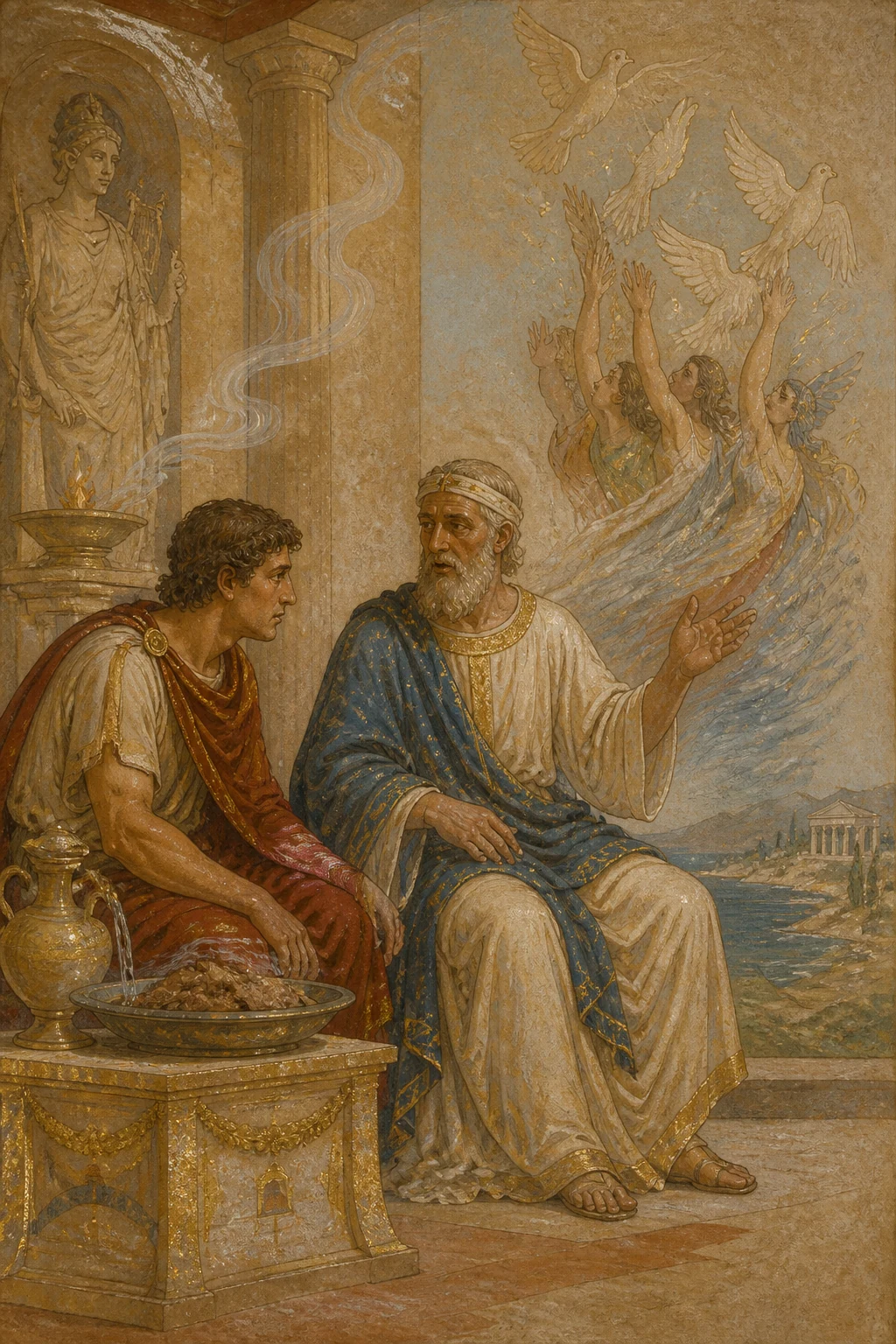
Reveal now, Muses, ever-present powers who inspire poets (for you know, and the vast reach of antiquity cannot deceive you), how the island encircled by the deep Tiber's waters brought Coronis's son among the sacred powers of Romulus's city. Once a dreadful plague had tainted the air of Latium, and pale bodies wasted away with a blood-draining sickness. When, weary of funerals, the people saw that human efforts were useless, that the physicians' arts could do nothing, they sought heavenly help and journeyed to Delphi, the earth's central place, where Phoebus speaks his oracles.
They begged him to relieve their misery with a saving prophecy and end the sufferings of so great a city. The shrine, the laurel, and the quiver the god himself carried all trembled together, and from the sanctuary's depths the tripod uttered these words, stirring their frightened hearts: “What you seek here, Roman, you should have sought nearer home; seek it nearer home even now! It is not Apollo you need to lessen your grief, but Apollo's son.
Go under favorable omens, and summon my offspring!” When the wise senate received the god's commands, they inquired what city the son of Phoebus inhabited, and sent envoys to sail for the shores of Epidaurus. As soon as the envoys reached them in their curved ship, they approached the council and the elders of Greece, begging that they grant them the god, whose presence would end the deaths among the Ausonian people: so the unerring oracle declared.
Their opinions differed and divided: some thought such help should not be refused; many urged that they keep their protector, not send him away or surrender their divine power. While they hesitated, twilight drove out the lingering daylight, and the earth's shadow had spread darkness over the world, when the healing god appeared in a dream, standing before your bed, Roman, just as he appears in his temple, holding a rustic staff in his left hand, and with his right smoothing the strands of his long beard, and speaking these words from his tranquil heart: “Lay aside your fears! I shall come and leave my image behind.
Only look closely at this serpent coiled around my staff, and study it well, so that you may recognize it! I shall take its shape, but shall be larger, appearing as great as heavenly bodies should when they assume another form.” At once the god vanished with his words, and with words and god sleep departed; kindly daylight followed the flight of sleep. The next dawn had driven away the fires of the stars.
Uncertain what to do, the leaders came to the splendid temple of the god they sought, and prayed that he would show by heavenly signs where he himself wished to dwell. They had scarcely finished when the god, a serpent gleaming with a lofty golden crest, hissed to announce his coming, and at his arrival shook the statue, the altars, the doors, the marble pavement, and the golden roof.
He reared breast-high in the middle of the temple and looked around with eyes that flashed with fire. The frightened crowd trembled. The priest, his sacred hair bound with a white band, recognized the divine presence. “Behold the god, the god!” he cried. “All who are here, be reverent in heart and tongue! Most glorious one, may your appearance bring us good fortune; help the peoples who observe your rites!”
All who were there worshipped the god they had seen, and all repeated the priest's words; the descendants of Aeneas offered their own devout homage in heart and voice. The god assented, and by shaking his crest gave them a sure pledge, hissing again with his flickering tongue. Then he glided down the shining steps, turned his head backward, and, as he left, looked at his ancient altars, bidding farewell to his familiar home, the temple he had inhabited.
Then, immense, he slithered over ground strewn thick with flowers, bending his coils, and through the city's midst made his way to the harbor sheltered by a curving breakwater. Here he paused and, seeming with a tranquil look to dismiss his escort and the dutiful crowd that followed him, laid his body in the Ausonian ship. It felt the divine burden, and its hull sank beneath the god's weight.
The descendants of Aeneas rejoiced, and, sacrificing a bull on shore, untied the twisted mooring ropes of their garlanded ship. A gentle breeze drove the vessel onward. The god towered high, his neck resting heavily upon the curving stern, and gazed down at the blue waters. With gentle west winds he crossed the Ionian Sea, and at the sixth rising of Dawn, daughter of Pallas, reached Italy, sailing past Lacinian shores, renowned for the goddess's temple, and the coast of Scylaceum.
He left Iapygia behind, passed the Amphrisian rocks with the oars to his left and steep Celennia to his right, and skirted Romethium, Caulon, and Narycian shores. He passed the strait and the narrows of Sicilian Pelorus, the home of King Aeolus, son of Hippotas, and the mines of Temese, then headed for Leucosia and the rose gardens of warm Paestum. Next he skirted Capreae, Minerva's headland, the hills rich in Surrentine vines, Hercules' city, Stabiae, and Parthenope, born for ease, and beyond it the shrine of the Cumaean Sibyl.
From there he reached the hot springs and Liternum, where mastic trees grow, and the Volturnus, dragging great loads of sand beneath its swirling waters; Sinuessa, thronged with snow-white doves; unwholesome Minturnae; the place where Aeneas buried his nurse; the home of Antiphates; Trachas, hemmed in by marshland; Circe's land; and Antium on its crowded shore. When the sailors turned their sailing ship toward this harbor (for the sea was now rough), the god uncoiled himself and, gliding in many curves and mighty coils, entered his father's temple beside the yellow sands.
When the sea grew calm, the Epidaurian left his father's altars, having enjoyed the hospitality of his divine kinsman, and furrowed the shore's sand with his dragging, rattling scales. Resting against the rudder, he laid his head high on the stern, until he came past Castrum and the sacred dwelling place of Lavinium to the Tiber's mouth. Here all the people, crowds of mothers and fathers, rushed from every side to meet him, with those who tend your fires, Trojan Vesta, and hailed the god with joyful cries.
Wherever the swift ship was drawn against the current, incense crackled on altars set in rows along the banks on either side, scenting the air with smoke, and slaughtered victims warmed the knives plunged into them. Now he had entered Rome, the capital of the world. The serpent rose and moved his neck, which had leaned against the mast's top, looking about for a fitting home.
The river divides into two branches, flowing around a place called the Island, and on either side stretches equal arms about the land between. Here the serpent son of Phoebus left the Latin ship and, resuming his heavenly form, brought an end to mourning, coming to the city as its healer. Yet he came as a stranger to join the gods of our shrines: