Prevod
Once upon a time there were two brothers, one rich and the other poor. The rich brother was a goldsmith and wicked at heart; the poor one earned his living by making brooms and was good and honest. The poor man had two children, twin boys, who were as alike as two drops of water. From time to time the boys went to the rich man’s house and were sometimes given a few scraps to eat. One day, when the poor man went into the forest to gather brushwood, he saw a bird that was all gold, and more beautiful than any he had ever seen. He picked up a little stone, threw it at the bird, and managed to hit it, but only a single golden feather fell to the ground, and the bird flew away. The man took the feather to his brother, who examined it and said, “This is pure gold,” and gave him a great deal of money for it. The next day the man climbed a birch tree to cut off a few branches. The same bird flew out, and when the man searched the tree, he found a nest with a golden egg in it. He took the egg home and brought it to his brother, who said again, “This is pure gold,” and paid him what it was worth. At last the goldsmith said, “I should like to have the bird itself.” The poor man went into the forest a third time and once more saw the golden bird perched in the tree. He took a stone, knocked it down, and brought it to his brother, who gave him a great heap of gold for it. Now I shall be able to get by, he thought, and went home content.
The goldsmith was clever and cunning, and knew very well what sort of bird this was. He called his wife and said, “Roast the golden bird for me, and take care that none of it goes missing. I mean to eat it all myself.” Now this was no ordinary bird, but one of such wondrous nature that whoever ate its heart and liver would find a gold coin beneath his pillow every morning. The wife prepared the bird, put it on a spit, and set it to roast. It so happened that while it was over the fire, and the woman had been obliged to leave the kitchen to attend to some other work, the poor broom-maker’s two children ran in, stood before the spit, and turned it a few times. Just then two little pieces fell out of the bird into the pan, and one boy said, “Let’s eat those little bits. I’m so hungry, and no one will ever notice.” So the two of them ate the pieces. But the woman came in, saw that they were eating something, and said, “What have you eaten?” “A few little pieces that fell out of the bird,” they answered. “That was the heart and liver!” cried the woman in alarm, and so that her husband would not miss anything and grow angry, she quickly killed a young cockerel, took out its heart and liver, and put them beside the golden bird. When it was done, she served it to the goldsmith, who ate it all by himself and left nothing. But the next morning, when he reached beneath his pillow, expecting to draw out a gold coin, there was no more gold to be found there than on any other morning.
The two children, meanwhile, knew nothing of the good fortune that had come their way. The next morning, when they got up, something fell to the floor with a chink, and when they picked it up, they found two gold coins. They took them to their father, who marvelled and said, “How can this have happened?” But when they found two more the following morning, and every day after that, he went to his brother and told him the strange story. The goldsmith understood at once what had happened, and that the children had eaten the heart and liver of the golden bird. To take his revenge, and because he was envious and hard-hearted, he said to their father, “Your children are in league with the Evil One. Do not take their gold, and do not let them stay in your house any longer, for he has power over them and may yet bring you to ruin too!” The father feared the Evil One, and though it grieved him sorely, he led the twins out into the forest and left them there with a heavy heart.
The two children wandered about the forest, looking for the way home, but they could not find it and only strayed farther and farther. At last they met a huntsman, who asked, “Whose children are you?” “We are the poor broom-maker’s boys,” they answered, and told him that their father would no longer keep them in his house because a gold coin lay beneath each of their pillows every morning. “Well,” said the huntsman, “there is nothing so very bad about that, provided you remain honest and do not grow idle.” The good man took a liking to the children, and as he had none of his own, he took them home with him and said, “I shall be your father and bring you up.” They learned the huntsman’s craft from him, and he put aside the gold coin each of them found on rising, in case they should need it in years to come.
When they were grown, their foster father took them into the forest one day and said, “Today you shall fire your trial shots, so that I may declare your apprenticeship over and make you huntsmen.” They went with him to lie in wait and waited a long time, but no game appeared. The huntsman looked up and saw a flock of snow geese flying in a triangle, and said to one of the brothers, “Now shoot one down from each corner.” He did so, and thus passed his trial. Soon another flock flew over in the shape of the number two. The huntsman told the other brother to shoot one down from each corner as well, and he too passed his trial. Then their foster father said, “I declare your apprenticeship over. You are fully trained huntsmen!” After this the two brothers went into the forest together, took counsel, and agreed upon a plan. That evening, when they sat down to supper, they said to their foster father, “We shall not touch our food or eat a single bite until you have granted us a request.” “What is your request?” he asked. They answered, “We have finished our apprenticeship, and now we must try our fortunes in the world. Give us leave to set out on our travels.” The old man said gladly, “You speak like true huntsmen. What you ask has been my own wish for you. Set forth, and may you prosper.” Then they ate and drank merrily together.
When the appointed day came, their foster father gave each of them a good gun and a dog, and let each take as many of his saved gold coins as he wished. Then he went part of the way with them, and at parting gave them a bright knife, saying, “If ever you go your separate ways, thrust this knife into a tree at the crossroads. Then, if one of you returns, he will be able to see how his absent brother has fared, for the side facing the way that brother has gone will rust if he dies; but as long as he lives, it will remain bright.” The two brothers went on and on until they came to a forest so vast that they could not possibly pass through it in a single day. They spent the night there and ate what they had put into their hunting bags. But they walked all the second day as well and still did not reach the other side. Since they had nothing left to eat, one said, “We must shoot something, or we shall go hungry.” He loaded his gun and looked about him. When an old hare came running by, he took aim, but the hare cried:
“Dear huntsman, let me live, I have two young ones I will give.” It sprang straight into the bushes and brought out two young hares. But the little creatures played so merrily and were so charming that the huntsmen could not bring themselves to kill them. They kept them instead, and the little hares followed close at their heels. Soon afterwards a fox slipped past, and they were about to shoot it, but the fox cried:
“Dear huntsman, let me live, I have two young ones I will give.” It too brought out two little foxes, and the huntsmen could not bear to kill these either. They put them with the hares, and the foxes followed them. Before long a wolf stepped out of the thicket. The huntsmen took aim, but the wolf cried:
“Dear huntsman, let me live, I have two young ones I will give.” The huntsmen put the two young wolves with the other animals, and they followed along. Then came a bear, who wished to go on roaming a while longer, and cried:
“Dear huntsman, let me live, I have two young ones I will give.” The two young bears joined the others, and now there were eight. And who came at last? A lion came, shaking his mane. But the huntsmen were not frightened and took aim at him. The lion, however, said likewise:
“Dear huntsman, let me live, I have two young ones I will give.” He too fetched his cubs, and now the huntsmen had two lions, two bears, two wolves, two foxes, and two hares, who followed them and served them. Their hunger, however, had not been satisfied by all this, so they said to the foxes, “Listen, you sly creatures, find us something to eat. You are cunning and crafty enough.” They answered, “Not far from here is a village where we have taken many a chicken. We will show you the way.” So they went to the village, bought themselves something to eat, had their animals fed, and then travelled on. The foxes knew their way about wherever there were poultry yards and could guide the huntsmen everywhere. They wandered for a while, but could find no employment that would allow them to stay together, so they said, “There is no help for it. We must part.” They divided the animals, so that each had a lion, a bear, a wolf, a fox, and a hare. Then they said farewell, pledged their brotherly love until death, and thrust the knife their foster father had given them into a tree. One went east and the other west.
The younger brother came with his animals to a town that was draped entirely in black crepe. He went to an inn and asked the innkeeper whether he could put up his animals. The innkeeper gave them a stable with a hole in the wall. The hare crept out through it and fetched a cabbage, and the fox fetched a hen, and when he had eaten that, the cock as well. But the wolf, the bear, and the lion were too large to get out. So the innkeeper had them taken to a place where a cow was lying on the grass, and they ate their fill. Only after the huntsman had seen to his animals did he ask the innkeeper why the town was hung with mourning crepe. “Because our king’s only daughter is to die tomorrow,” said the innkeeper. “Is she mortally ill?” asked the huntsman. “No,” answered the innkeeper, “she is hale and hearty, but she must die all the same.” “How can that be?” asked the huntsman. “Outside the town there is a high mountain where a dragon lives. Every year he must have a pure maiden, or he lays waste to the whole country. All the maidens have already been given to him, and no one is left but the king’s daughter. Yet there is no mercy: she must be handed over to him, and that is to happen tomorrow.” “Why is the dragon not killed?” asked the huntsman. “Ah,” answered the innkeeper, “so many knights have tried, but every one of them has lost his life. The king has promised his daughter in marriage to whoever defeats the dragon, and after his death that man shall inherit the kingdom as well.”
The huntsman said no more, but the next morning he took his animals and climbed with them up the dragon’s mountain. At the top stood a little church, and on its altar were three full goblets, beside which was written: Whoever drains these goblets will become the strongest man on earth and will wield the sword that lies buried before the threshold. The huntsman did not drink at first, but went outside and found the sword in the earth. Yet he could not move it from its place. Then he went back and drained the goblets, and now he was strong enough to lift the sword and could wield it with the greatest ease. When the hour came for the maiden to be given to the dragon, the king, the marshal, and the courtiers escorted her out. From afar she saw the huntsman high on the dragon’s mountain and thought it was the dragon standing there waiting for her. She would not go up, but at last, since the whole town would otherwise be lost, she had to make the dreadful journey. The king and his courtiers returned home in deep sorrow, but the king’s marshal was to remain behind and watch everything from a distance.
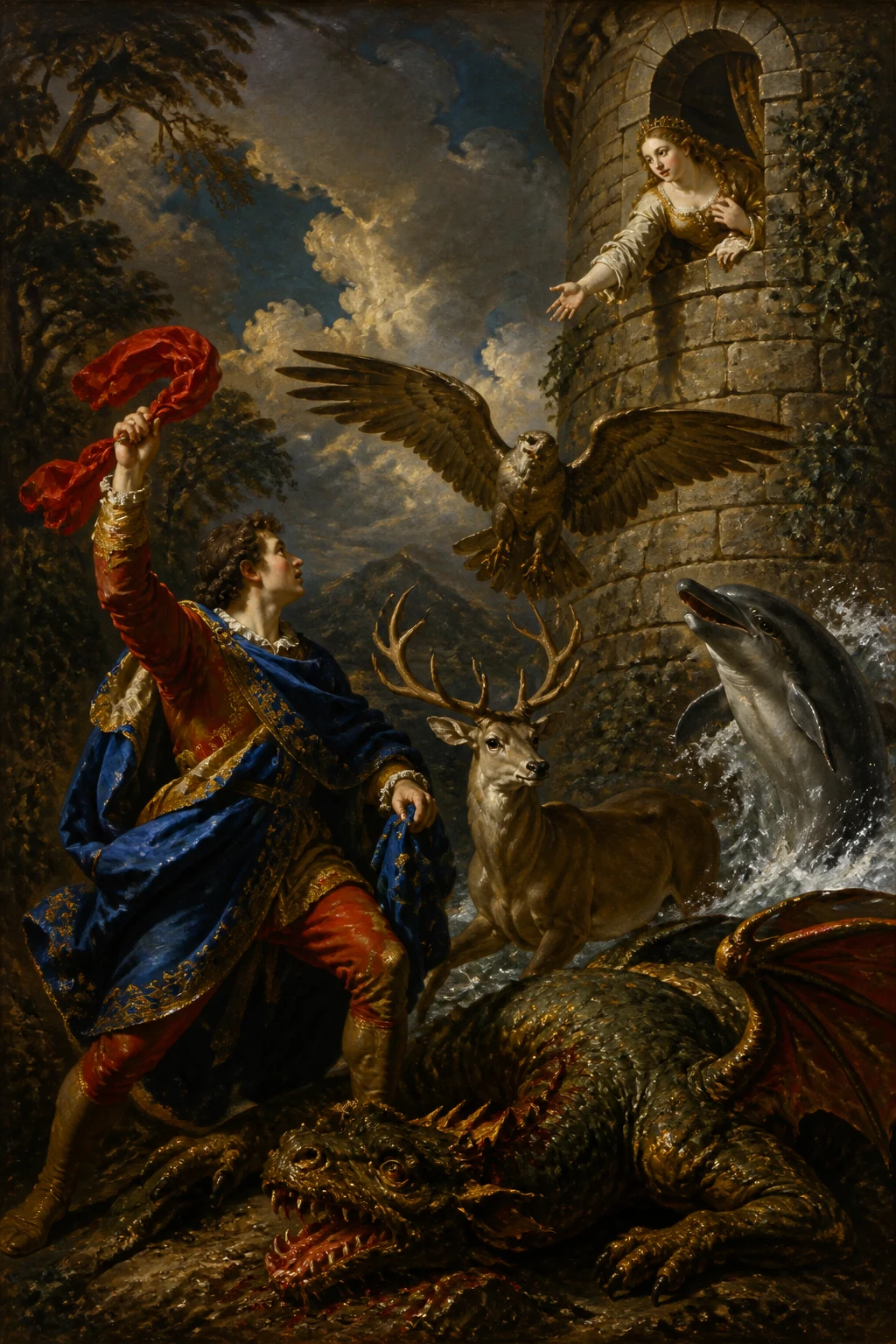
When the king’s daughter reached the mountaintop, it was not the dragon standing there but the young huntsman. He comforted her and said he would save her, then led her into the church and locked her inside. Before long the seven-headed dragon came rushing up with a mighty roar. When he caught sight of the huntsman, he was astonished and said, “What business have you here on this mountain?” The huntsman answered, “I mean to fight you!” “Many a knight has lost his life here,” said the dragon. “I shall make short work of you too,” and he breathed fire from his seven jaws. The fire was to set the dry grass alight, so that the huntsman would suffocate in the heat and smoke, but the animals came running and stamped out the flames. Then the dragon lunged at the huntsman, but he swung his sword so that it sang through the air and struck off three of the dragon’s heads. Now the dragon grew truly furious, rose into the air, breathed flames over the huntsman, and tried to swoop down upon him. But the huntsman raised his sword once more and cut off another three heads. The monster grew weak and sank to the ground, yet still tried to attack him. With the last of his strength the huntsman struck off its tail, and when he could fight no longer, he called his animals, who tore the creature to pieces. When the battle was over, the huntsman unlocked the church and found the king’s daughter lying on the floor, for she had fainted from fear and terror during the struggle. He carried her outside, and when she came to herself and opened her eyes, he showed her the mangled dragon and told her she was now delivered. She rejoiced and said, “Now you shall be my dearest husband, for my father has promised me to whoever kills the dragon.” Then she took off her coral necklace and divided it among the animals as their reward, and the lion received its little gold clasp. She gave her handkerchief, with her name on it, to the huntsman, who went and cut the tongues out of the dragon’s seven heads, wrapped them in the cloth, and put them away safely. When this was done, being weak and weary from the fire and the battle, he said to the maiden, “We are both so tired and worn out. Let us sleep a little.” She agreed, and they lay down on the ground. The huntsman said to the lion, “You must keep watch, so that no one attacks us in our sleep!” Then both fell asleep. The lion lay down beside them to keep watch, but he too was tired from the battle, so he called the bear and said, “Lie down beside me. I must sleep a little, and if anything comes, wake me!” The bear lay down beside him, but he too was tired, and called the wolf, saying, “Lie down beside me. I must sleep a little, and if anything comes, wake me!” The wolf lay down beside him, but he too was tired, and called the fox, saying, “Lie down beside me. I must sleep a little, and if anything comes, wake me!” The fox lay down beside him, but he too was tired, and called the hare, saying, “Lie down beside me. I must sleep a little, and if anything comes, wake me!” The hare sat down beside him, but the poor hare was tired too, and had no one left to call upon to keep watch, so he fell asleep. And there slept the king’s daughter, the huntsman, the lion, the bear, the wolf, the fox, and the hare, all deep in slumber.
Now the marshal, who was supposed to watch from a distance, saw that the dragon had not flown away with the maiden, and that all was quiet on the mountain. He took courage and climbed up. There lay the dragon on the ground, hacked and torn to pieces, and not far away were the king’s daughter and a huntsman with his animals, all sunk in a deep sleep. Since he was wicked and godless, he drew his sword and struck off the huntsman’s head, then took the maiden in his arms and carried her down the mountain. She awoke in terror, but the marshal said, “You are in my power. You shall say it was I who killed the dragon!” “I cannot,” she answered, “for a huntsman and his animals did it.” Then he drew his sword and threatened to kill her unless she obeyed, and so forced her to promise. He brought her before the king, who was beside himself with joy to see his dear child alive again, for he had believed her torn to pieces by the monster. The marshal said to him, “I have killed the dragon and delivered the maiden and the whole kingdom. Therefore I claim her as my wife, as was promised.” The king asked the maiden, “Is what he says true?” “Ah, yes,” she answered, “it must be true, but I insist that the wedding shall not be held until a year and a day have passed,” for she hoped to hear something of her dear huntsman in that time. Meanwhile, on the dragon’s mountain, the animals still lay sleeping beside their dead master. A large bumblebee came and settled on the hare’s nose, but the hare brushed it away with his paw and slept on. The bumblebee came a second time, but the hare brushed it away again and went on sleeping. Then it came a third time and stung his nose, so that he woke. As soon as the hare was awake, he woke the fox, and the fox woke the wolf, and the wolf the bear, and the bear the lion. When the lion awoke and saw that the maiden was gone and his master dead, he began to roar terribly and cried, “Who has done this? Bear, why did you not wake me?” The bear asked the wolf, “Why did you not wake me?” And the wolf asked the fox, “Why did you not wake me?” And the fox asked the hare, “Why did you not wake me?” The poor hare alone had no answer, and all the blame fell upon him. They were about to set upon him, but he pleaded, “Do not kill me. I will bring our master back to life. I know a mountain where a root grows that heals every illness and every wound in anyone who holds it in his mouth. But the mountain is two hundred hours’ journey from here.” The lion said, “You must run there and back within twenty-four hours and bring the root with you.” The hare bounded away, and within twenty-four hours he was back with the root. The lion put the huntsman’s head back on, and the hare placed the root in his mouth. At once everything joined together again, his heart began to beat, and life returned. The huntsman awoke and was alarmed to find the maiden gone. She must have left while I was sleeping to be rid of me, he thought. In his great haste, the lion had put his master’s head on backwards, but the huntsman was so lost in sorrowful thoughts of the king’s daughter that he did not notice. Only at midday, when he wanted something to eat, did he discover that his head faced towards his back. He could not understand it, and asked the animals what had happened to him in his sleep. The lion told him that they too had fallen asleep from weariness, and on waking had found him dead with his head cut off. The hare had fetched the root of life, but in his haste the lion had held the head the wrong way round. He would, however, put his mistake right. Then he tore the huntsman’s head off again and turned it round, and the hare healed it firmly in place with the root.
But the huntsman was sorrowful and wandered about the world, making his animals dance for people. It so happened that, just as a year had passed, he returned to the very town where he had delivered the king’s daughter from the dragon, and this time the whole town was hung with scarlet cloth. He said to the innkeeper, “What does this mean? A year ago the town was draped in black crepe. Why the scarlet cloth today?” The innkeeper answered, “A year ago our king’s daughter was to be given to the dragon, but the marshal fought it and killed it, and tomorrow their wedding is to be celebrated. That is why the town was hung with black crepe in mourning then, and is hung with scarlet cloth in rejoicing today.”
The next day, when the wedding was to take place, the huntsman said to the innkeeper at about noon, “Do you believe, Master Innkeeper, that I mean to eat bread from the king’s table here in your inn today?” “Why,” said the innkeeper, “I would wager a hundred gold pieces that you will do no such thing!” The huntsman accepted the wager and staked a purse containing as many gold pieces. Then he called the hare and said, “Go, dear Jumper, and fetch me some of the bread the king eats!” Now the little hare was the humblest of the animals and could not pass the task on to anyone else, but had to set off himself. Oh dear, he thought, if I go hopping through the streets all alone, the butchers’ dogs will be after me. And so it happened: the dogs came running after him, intent on tearing his good hide. But he bounded away in the twinkling of an eye and took refuge in a sentry box without the soldier noticing him. The dogs came up and tried to get him out, but the soldier would stand no nonsense and struck at them with the butt of his musket until they ran away yelping and howling. When the hare saw that the coast was clear, he hopped into the palace and went straight to the princess, sat down under her chair, and scratched her foot. “Go away!” she said, thinking it was her dog. The hare scratched her foot a second time, and again she said, “Go away!” thinking it was her dog. But the hare would not be put off and scratched a third time. Then she looked down and recognized him by his collar. She took him onto her lap, carried him to her chamber, and said, “Dear hare, what do you want?” He answered, “My master, who killed the dragon, is here, and he has sent me to ask for a loaf of the bread the king eats.” She was filled with joy and sent for the baker, whom she ordered to bring a loaf of the bread the king ate. “But the baker must carry it there for me,” said the little hare, “so that the butchers’ dogs cannot hurt me.” The baker carried it as far as the door of the inn’s taproom. There the hare stood on his hind legs, took the loaf in his forepaws, and brought it to his master. “You see, Master Innkeeper,” said the huntsman, “the hundred gold pieces are mine.” The innkeeper was astonished. But the huntsman went on, “Well, Master Innkeeper, I have the bread; now I mean to eat some of the king’s roast meat as well.” “I should like to see that,” said the innkeeper, but he would make no more wagers. The huntsman called the fox and said, “My little fox, go and fetch me some roast meat of the kind the king eats!” The red fox knew his way about better, and slipped round corners and through alleyways without a dog seeing him. He sat down under the princess’s chair and scratched her foot. She looked down, recognized the fox by his collar, took him into her chamber, and said, “Dear fox, what do you want?” He answered, “My master, who killed the dragon, is here, and he has sent me to ask for some roast meat of the kind the king eats.” She sent for the cook, who had to prepare a roast such as the king ate and carry it to the door for the fox. There the fox took the dish from him, first whisked away with his tail the flies that had settled on the meat, and then brought it to his master. “You see, Master Innkeeper,” said the huntsman, “here are bread and meat; now I mean to have vegetables of the kind the king eats as well.” Then he called the wolf and said, “Dear wolf, go and fetch me some vegetables of the kind the king eats!” The wolf went straight into the palace, for he feared no one. When he came into the princess’s room, he tugged at the back of her dress so that she had to turn round. She recognized him by his collar, took him into her chamber, and said, “Dear wolf, what do you want?” He answered, “My master, who killed the dragon, is here, and I am to ask for some vegetables of the kind the king eats.” She sent for the cook, who had to prepare vegetables such as the king ate and carry them to the door for the wolf. There the wolf took the dish from him and brought it to his master. “You see, Master Innkeeper,” said the huntsman, “now I have bread, meat, and vegetables, but I mean to eat sweetmeats of the kind the king eats as well.” He called the bear and said, “Dear bear, you are fond of licking up sweet things. Go and fetch me some sweetmeats of the kind the king eats!” The bear trotted off to the palace, and everyone got out of his way. But when he reached the guard, they lowered their muskets and would not let him into the royal palace. He reared up, however, and dealt a few blows to the right and left with his paws, sending the whole guard sprawling. Then he went straight to the princess, stood behind her, and gave a little growl. She looked round, recognized the bear, and told him to come into her chamber. “Dear bear,” she said, “what do you want?” He answered, “My master, who killed the dragon, is here, and I am to ask for some sweetmeats of the kind the king eats.” She sent for the confectioner, who had to bake sweetmeats such as the king ate and carry them to the door for the bear. The bear first licked up the sugarplums that had rolled off, then stood upright, took the dish, and brought it to his master. “You see, Master Innkeeper,” said the huntsman, “now I have bread, meat, vegetables, and sweetmeats, but I mean to drink wine of the kind the king drinks as well!” He called his lion and said, “Dear lion, you enjoy drinking yourself merry. Go and fetch me some wine of the kind the king drinks!” The lion strode down the street, and the people fled before him. When he reached the guard, they tried to bar his way, but he gave a single roar, and they all scattered. The lion went to the door of the royal chamber and knocked with his tail. The princess came out and nearly took fright at the sight of him, but she recognized him by the golden clasp from her necklace, told him to come into her chamber, and said, “Dear lion, what do you want?” He answered, “My master, who killed the dragon, is here, and I am to ask for some wine of the kind the king drinks.” She sent for the cupbearer, who was to give the lion wine of the kind the king drank. “I shall come with you,” said the lion, “and see that I get the right kind.” So he went down with the cupbearer, and when they reached the cellar, the man tried to draw him some of the ordinary wine drunk by the king’s servants. But the lion said, “Stop! I shall taste the wine first.” He drew himself half a measure and swallowed it in one gulp. “No,” he said, “that is not the right kind.” The cupbearer gave him a sour look, but went to draw some from another cask, which was intended for the king’s marshal. “Stop!” said the lion. “I shall taste the wine first.” He drew himself half a measure and drank it. “That is better, but it is still not the right kind.” Then the cupbearer grew angry and said, “What does a stupid beast like you know about wine!” But the lion gave him a blow behind the ears that sent him tumbling heavily to the ground. When he had picked himself up, he led the lion without another word into a small, separate cellar where the king’s wine was kept, which no one else ever got to drink. The lion first drew himself half a measure and tasted the wine, then said, “This may be the right kind,” and ordered the cupbearer to fill six bottles. They went upstairs, but when the lion came out of the cellar into the open air, he swayed from side to side and was a little drunk, so the cupbearer had to carry the wine to the door for him. There the lion took the basket by its handle in his mouth and brought it to his master. “You see, Master Innkeeper,” said the huntsman, “here I have bread, meat, vegetables, sweetmeats, and wine, just as the king does. Now I shall dine with my animals.” He sat down, ate and drank, and gave the hare, the fox, the wolf, the bear, and the lion their share of the food and wine. He was in good spirits, for he saw that the princess still loved him.
When he had finished his meal, he said, “Master Innkeeper, now I have eaten and drunk as the king eats and drinks. Next I shall go to the king’s court and marry the princess.” The innkeeper asked, “How can that be, when she already has a bridegroom and the wedding is to be celebrated today?” Then the huntsman took out the handkerchief the princess had given him on the Dragon Mountain, in which the monster’s seven tongues were wrapped, and said, “What I hold here in my hand will help me do it.” The innkeeper looked at the cloth and said, “I might believe anything else, but I do not believe that, and I am willing to stake my house and home on it.” The huntsman took a purse containing a thousand gold pieces, set it on the table, and said, “I stake this against them!”
Now, at the royal table, the king said to his daughter, “What did all those wild animals want, coming to you and going in and out of my palace?” She answered, “I must not say, but send for the master of those animals, and you will do well.” The king sent a servant to the inn to invite the stranger, and the servant arrived just as the huntsman had made his wager with the innkeeper. “You see, Master Innkeeper,” said the huntsman, “the king has sent a servant to invite me, but I shall not go as I am.” And he said to the servant, “I beg His Majesty to send me royal clothes, a carriage drawn by six horses, and servants to attend me.” When the king heard the reply, he said to his daughter, “What should I do?” She said, “Have him brought here as he asks, and you will do well.” So the king sent royal clothes, a carriage drawn by six horses, and servants to attend him. When the huntsman saw them coming, he said, “You see, Master Innkeeper, now they have come to fetch me just as I asked.” He put on the royal clothes, took the cloth with the dragon’s tongues, and drove to the king. When the king saw him coming, he said to his daughter, “How should I receive him?” She answered, “Go out to meet him, and you will do well.” So the king went out to meet him and led him upstairs, with his animals following behind. The king gave him a place beside himself and his daughter; the marshal sat on the other side as bridegroom, but he no longer recognized the huntsman. Just then the dragon’s seven heads were brought in for display, and the king said, “The marshal cut these seven heads off the dragon, and that is why I am giving him my daughter in marriage today.” Then the huntsman stood up, opened the seven jaws, and said, “Where are the dragon’s seven tongues?” The marshal took fright, turned pale, and did not know what to answer. At last, in his terror, he said, “Dragons have no tongues.” “Liars should have none,” said the huntsman, “but the dragon’s tongues are the proof of victory.” He unfolded the cloth, and there lay all seven. Then he placed each tongue in the mouth where it belonged, and it fitted exactly. After that he took the handkerchief, on which the princess’s name was embroidered, showed it to her, and asked to whom she had given it. She answered, “To the man who killed the dragon.” Then he called his animals, took the collar from each of them and the golden clasp from the lion, showed them to the princess, and asked to whom they belonged. She answered, “The necklace and the golden clasp were mine. I divided them among the animals that helped defeat the dragon.” Then the huntsman said, “While I was resting and sleeping, weary from the battle, the marshal came and cut off my head. Then he carried the princess away and claimed that he was the one who had killed the dragon. These tongues, the handkerchief, and the necklace prove that he lied.” He went on to tell how his animals had healed him with a miraculous root, how he had wandered about with them for a year, and how he had at last returned here, where the innkeeper’s account had revealed the marshal’s deceit to him. Then the king asked his daughter, “Is it true that this man killed the dragon?” She answered, “Yes, it is true. Now I may reveal the marshal’s wicked deed, because it has come to light without any help from me, for he forced me to promise to keep silent. But that was why I insisted that the wedding should not be held until a year and a day had passed.”
Then the king summoned twelve councillors to pass judgment on the marshal, and they sentenced him to be torn apart by four oxen. Thus the marshal was put to death, but the king gave his daughter to the huntsman and appointed him to rule over the whole kingdom in his stead. The wedding was celebrated with great rejoicing, and the young king sent for his father and his foster-father and showered them with treasures. Nor did he forget the innkeeper. He had him brought before him and said, “You see, Master Innkeeper, I have married the princess, and your house and home are mine.” “Yes,” said the innkeeper, “that is only just.” But the young king said, “Mercy shall prevail: you shall keep your house and home, and I shall give you the thousand gold pieces into the bargain.”
Now the young king and the young queen were happy and lived contentedly together. He often went out hunting, for that was his delight, and his faithful animals had to accompany him. Nearby, however, lay a forest that was said to be haunted, and anyone who ventured into it was unlikely to come out again. But the young king was very eager to hunt there and gave the old king no peace until he granted permission. So he rode out with a large company, and when he reached the forest, he saw a snow-white doe among the trees and said to his men, “Wait here until I return. I mean to hunt that beautiful creature.” He rode after it into the forest, and only his animals followed him. The men stayed and waited until evening, but he did not return. Then they rode home and told the young queen, “The young king chased a white doe into the enchanted forest and has not come back.” She was filled with anxiety for him.
Meanwhile, he had kept riding after the beautiful creature but could never catch up with it. Whenever he thought it was within range, he saw it bounding away in the distance again, until at last it vanished altogether. Now he realized that he had strayed deep into the forest. He took his horn and blew it, but received no answer, for his men could not hear him. And as night was falling, he saw that he could not get home that day, so he dismounted, made a fire beside a tree, and prepared to spend the night there. As he sat by the fire with his animals lying beside him, he thought he heard a human voice. He looked around but could see nothing. Soon he heard another groan, seeming to come from above, and when he looked up, he saw an old woman sitting in the tree, wailing without cease, “Ooh, ooh, ooh, how cold I am!” “Come down and warm yourself if you are cold,” he said. But she answered, “No, your animals will bite me.” “They will not hurt you, old mother,” he replied. “Just come down.” But she was a witch, and she said, “I shall throw a switch down from the tree. If you strike them across the back with it, they will not hurt me.” She threw down a little switch, and he struck them with it. At once they lay still and were turned to stone. Once the witch was safe from the animals, she jumped down and touched him with a switch as well, turning him to stone. Then she laughed and dragged him and his animals into a ditch where many other such stones already lay.
When the young king still did not return, the queen’s fear and anxiety grew ever greater. Now it happened that at this very time the other brother, who had gone east when they parted, came into the kingdom. He had looked for work and found none, and had since wandered here and there, making his animals dance. Then he thought he would go and look at the knife they had thrust into a tree trunk when they parted, to find out how his brother was faring. When he reached it, his brother’s side was half rusted, though the other half was still bright. He was alarmed and thought, Some great misfortune must have befallen my brother, but perhaps I can still save him, for half the knife is still bright. He set off westward with his animals, and when he came to the city gate, the guard stepped forward and asked whether he should announce him to his wife, saying that the young queen had been greatly distressed by his absence for several days and feared he had perished in the enchanted forest. The guard was quite certain that he was the young king himself, for he looked exactly like him and likewise had the wild animals running behind him. Then he realized that they were speaking of his brother and thought, I had best pass myself off as him; that should make it easier to save him. So he allowed the guard to escort him to the palace, where he was received with great joy. The young queen had no doubt that he was her husband and asked why he had been away so long. He answered, “I lost my way in a forest and could not find my way out any sooner.”
That evening he was led to the royal bed, but he laid a double-edged sword between himself and the young queen. She did not know what this meant, but did not dare to ask.
He stayed a few days, meanwhile finding out all he could about the enchanted forest. At last he said, “I must go hunting there once more.” The king and the young queen tried to dissuade him, but he insisted and rode out with a large company. When he reached the forest, the same thing happened to him as had happened to his brother: he saw a white doe and said to his men, “Stay here and wait until I return. I mean to hunt that beautiful creature.” He rode into the forest, and his animals ran after him. But he could not catch up with the doe, and he strayed so deep into the forest that he had to spend the night there. When he had made a fire, he heard a groaning above him: “Ooh, ooh, ooh, how cold I am!” He looked up, and there sat the same witch in the tree. “If you are cold, come down, old mother, and warm yourself,” he said. She answered, “No, your animals will bite me.” But he said, “They will not hurt you.” Then she called, “I shall throw you down a switch. If you strike them with it, they will not hurt me.” When the huntsman heard that, he mistrusted the old woman and said, “I will not strike my animals. Come down, or I shall fetch you.” Then she cried, “What do you think you can do? You cannot hurt me!” But he answered, “If you do not come down, I shall shoot you down.” “Shoot away,” she said. “I am not afraid of your bullets.” So he took aim and fired at her, but the witch was proof against all lead bullets. She laughed shrilly and cried, “You shall not hit me yet!” The huntsman knew what to do. He tore three silver buttons from his coat and loaded them into his gun, for against these her magic was powerless. When he fired, she at once fell down with a shriek. Then he set his foot on her and said, “Old witch, if you do not tell me this instant where my brother is, I shall seize you with both hands and throw you into the fire!” In great terror she begged for mercy and said, “He lies turned to stone in a ditch with his animals.” He forced her to go there with him, threatening her and saying, “You old monkey, bring my brother and every creature lying here back to life this instant, or into the fire you go!” She took a switch and touched the stones, and his brother and the animals came back to life. Many others—merchants, craftsmen, and shepherds—rose up too, thanked him for setting them free, and went home. When the twin brothers saw each other again, they kissed and rejoiced with all their hearts. Then they seized the witch, bound her, and laid her in the fire. When she had burned to death, the forest opened of its own accord and grew bright and clear, and the royal palace could be seen three hours’ journey away.
Now the two brothers set off home together, telling each other their adventures along the way. When the younger said that he ruled over the whole country in the king’s stead, the other replied, “I gathered as much, for when I came into the city and was mistaken for you, I was shown every royal honour. The young queen took me for her husband, and I had to eat at her side and sleep in your bed.” When the other heard this, he grew so jealous and angry that he drew his sword and cut off his brother’s head. But when his brother lay dead and he saw the red blood flowing, he was overcome with remorse. “My brother saved me,” he cried, “and I have killed him in return!” And he lamented aloud. Then his hare came and offered to fetch some of the root of life. He bounded away and brought it back in time, and the dead man was restored to life, with no trace of his wound.
After that they went on, and the younger said, “You look just like me, you wear royal clothes as I do, and the animals follow you just as they follow me. Let us enter by opposite gates and come before the old king from two sides at once.” So they parted, and the guards from the two gates came to the old king at the same time, each announcing that the young king had returned from the hunt with his animals. “That is impossible,” said the king. “The gates are an hour’s journey apart.” Just then the two brothers entered the palace courtyard from opposite sides, and both came upstairs. The king said to his daughter, “Tell me, which is your husband? They look exactly alike; I cannot tell.” She was greatly troubled and could not say. At last she remembered the necklace she had given to the animals, searched, and found her little golden clasp on one of the lions. Then she cried happily, “The man this lion follows is my true husband!” The young king laughed and said, “Yes, that is the right one.” They sat down together at table, ate and drank, and were merry. That evening, when the young king went to bed, his wife said, “Why did you always lay a double-edged sword in our bed these past few nights? I thought you meant to kill me.” Then he knew how faithful his brother had been.