Prevod
It was long, long ago, perhaps as much as two thousand years, that there lived a rich man who had a beautiful, pious wife. They loved each other dearly, but they had no children. Yet they longed for children, and the woman prayed for them day and night; but none ever came. In front of their house was a courtyard, and in it stood a juniper tree. One winter’s day the woman stood beneath it peeling an apple, and as she peeled she cut her finger, and the blood fell into the snow. “Ah,” said the woman, sighing deeply as she looked at the blood before her, her heart full of sorrow, “if only I had a child as red as blood and as white as snow.” And as she said this, her heart grew glad; she felt quite sure that something would come of it. Then she went into the house, and a month passed, and the snow melted away; after two months everything turned green; after three months the flowers sprang from the earth; and after four months all the trees put forth new growth, and their green branches intertwined. Then the little birds sang until the whole forest rang, and the blossoms fell from the trees, and the fifth month was over. Still she stood beneath the juniper tree, which smelled so sweet. Her heart leaped for joy, and she fell to her knees and could scarcely contain herself. And when the sixth month had passed, the fruit grew plump and strong, and she became very quiet. In the seventh month she reached for the juniper berries and ate them greedily, and then she grew sad and ill. The eighth month passed, and she called her husband and wept and said, “If I die, bury me beneath the juniper tree.” Then she felt comforted and was happy until the ninth month had passed. Then she bore a child as white as snow and as red as blood, and when she saw him, she was so happy that she died.
Her husband buried her beneath the juniper tree, and he began to weep bitterly. This went on for a time, then his tears flowed less freely, and when he had wept a little longer, he stopped, and after that he took another wife.
By his second wife he had a daughter; the child of his first wife, however, was a little boy, as red as blood and as white as snow. Whenever the woman looked at her daughter, she felt great love for her; but then she would look at the little boy, and it pierced her heart, and she felt as though he stood in her way at every turn. She was forever thinking how she might secure the whole inheritance for her daughter, and the Evil One put it into her head to hate the little boy. She pushed him from one corner to another, cuffing him here and thumping him there, so that the poor child lived in constant fear. When he came home from school, there was nowhere he could be left in peace.
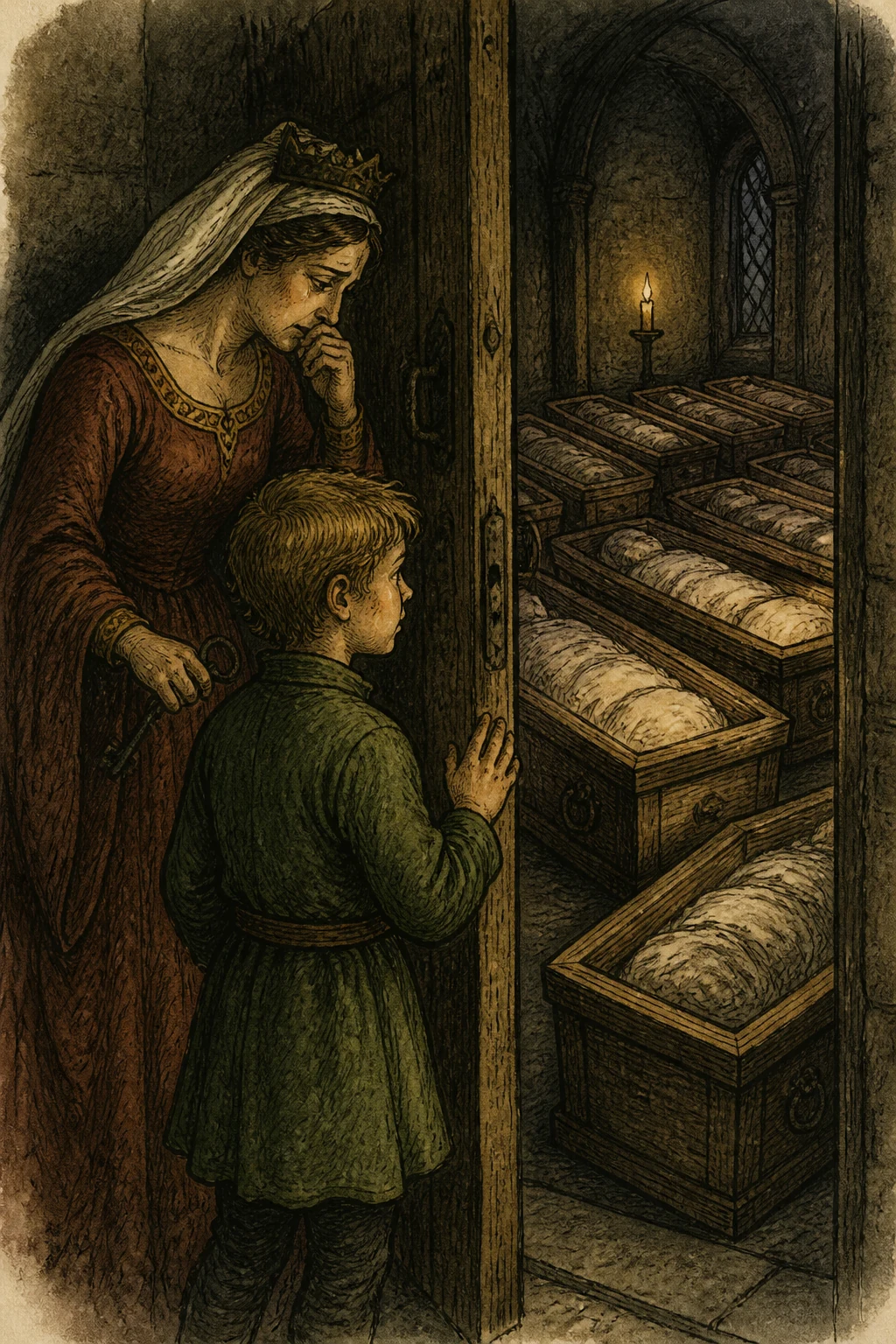
One day the woman had gone upstairs to the storeroom, and her little daughter came up too and said, “Mother, give me an apple.” “Yes, my child,” said the woman, and gave her a fine apple from the chest. Now the chest had a great heavy lid with a large, sharp iron lock. “Mother,” said the little girl, “shouldn’t my brother have one too?” This vexed the woman, but she said, “Yes, when he comes home from school.” And when she caught sight of him through the window, it was just as though the Evil One had entered into her. She snatched the apple back from her daughter and said, “You shall not have it before your brother does.” Then she threw the apple into the chest and shut it. The little boy came in at the door, and the Evil One prompted her to say kindly, “My son, would you like an apple?” Yet she looked at him with such fury. “Mother,” said the little boy, “how dreadful you look! Yes, give me an apple!” Then she felt she must coax him. “Come with me,” she said, opening the lid. “Take an apple out for yourself!” And as the little boy bent into the chest, the Evil One urged her on, and crash! She slammed down the lid so that his head flew off and fell among the red apples. Then terror swept over her, and she thought, “If only I could shift the blame from myself!” She went downstairs to her room, opened the top drawer of her chest of drawers, and took out a white cloth. Then she set his head back on his neck and tied the cloth around it so that nothing could be seen, sat him on a chair outside the door, and put the apple in his hand.
After this, Marlenchen came to her mother in the kitchen. She was standing by the fire with a pot of hot water before her, stirring it all the while. “Mother,” said Marlenchen, “my brother is sitting outside the door, looking quite white, with an apple in his hand. I asked him to give me the apple, but he won’t answer me, and it frightened me.” “Go to him again,” said her mother, “and if he won’t answer you, give him a box on the ear.” So Marlenchen went and said, “Brother, give me the apple!” But he said nothing, and she gave him a box on the ear. Then his head fell off, and she was so terrified that she began to weep and scream. She ran to her mother and said, “Oh, Mother, I’ve knocked my brother’s head off!” And she wept and wept and could not be comforted. “Marlenchen,” said her mother, “what have you done! But keep quiet, so that no one finds out. It cannot be helped now; we shall make him into a sour stew.” Then the mother took the little boy and chopped him into pieces, put them into the pot, and made him into a sour stew. But Marlenchen stood beside her and wept and wept, and all her tears fell into the pot, so that they needed no salt.
Then the father came home, sat down at the table, and said, “Where is my son?” The mother brought in a great, great dish of black sour stew, and Marlenchen wept and could not stop. Again the father said, “Where is my son?” “Oh,” said the mother, “he has gone out into the country to visit his mother’s relations. He wanted to stay there a while.” “What is he doing there? He didn’t even say goodbye to me!” “Oh, he was so eager to go, and he asked me whether he might stay for six weeks. They will take good care of him there.” “Ah,” said the man, “I feel so sad at heart. It isn’t right; he might at least have said goodbye to me.” With that he began to eat and said, “Marlenchen, why are you crying? Your brother will come back.” “Ah, wife,” he said then, “how delicious this food is! Give me some more!” And the more he ate, the more he wanted, and he said, “Give me more. You mustn’t save any of it; I feel as though it all belongs to me.” And he ate and ate, throwing all the bones under the table, until he had finished everything. But Marlenchen went to her chest of drawers and took her best silk kerchief from the bottom drawer. She gathered all the little bones from beneath the table, tied them up in the silk kerchief, and carried them outside, weeping tears of blood. There she laid them in the green grass beneath the juniper tree, and when she had laid them there, her heart suddenly grew light, and she wept no more. Then the juniper tree began to move, and its branches parted and came together again, just as someone might clap their hands for heartfelt joy. A mist rose from the tree, and in the midst of the mist something burned like fire, and out of the fire flew a beautiful bird, singing gloriously, and soared high into the air. When it was gone, the juniper tree was just as it had been before, and the cloth with the bones had vanished. But Marlenchen felt so lighthearted and happy, just as though her brother were still alive. She went merrily back into the house, sat down at the table, and ate. The bird, meanwhile, flew away, perched on the roof of a goldsmith’s house, and began to sing:
“My mother, she butchered me, my father, he ate me, my sister Marlenichen gathered all my little bones, tied them in a silken cloth, laid them beneath the juniper tree.
Tweet, tweet, what a beautiful bird am I!” The goldsmith was sitting in his workshop making a golden chain when he heard the bird singing on his roof, and he thought its song most beautiful. He rose, and as he crossed the threshold he lost a slipper. Yet he went right out into the middle of the street, wearing just one slipper and one stocking. He still had his leather apron on, and held the golden chain in one hand and his tongs in the other; and the sun shone brightly upon the street. There he stood, looking at the bird. “Bird,” he said, “how beautifully you sing! Sing that song for me again!” “No,” said the bird, “I do not sing twice for nothing. Give me the golden chain, and I will sing it for you once more.” “Here,” said the goldsmith, “take the golden chain. Now sing it for me again!” Then the bird came down, took the golden chain in its right claw, perched before the goldsmith, and sang: “My mother, she butchered me, my father, he ate me, my sister Marlenichen gathered all my little bones, tied them in a silken cloth, laid them beneath the juniper tree. Tweet, tweet, what a beautiful bird am I!”
Then the bird flew away to a shoemaker’s house, perched upon his roof, and sang: “My mother, she butchered me, my father, he ate me, my sister Marlenichen gathered all my little bones, tied them in a silken cloth, laid them beneath the juniper tree. Tweet, tweet, what a beautiful bird am I!”
The shoemaker heard it and ran outside in his shirtsleeves. He looked up at his roof and had to shade his eyes with his hand to keep the sun from dazzling him. “Bird,” he said, “how beautifully you sing!” Then he called through the doorway, “Wife, come outside! There’s a bird here. Look at that bird; how beautifully it sings!” Then he called his daughter and the children, the journeymen, the apprentices, and the maids, and they all came out into the street and looked at the bird, to see how beautiful it was. It had such lovely red and green feathers, and all about its neck was like pure gold, and its eyes shone in its head like stars. “Bird,” said the shoemaker, “now sing that song for me again!” “No,” said the bird, “I do not sing twice for nothing. You must give me something.” “Wife,” said the man, “go up to the attic. On the very top shelf there is a pair of red shoes. Bring them here!” So the woman went and fetched the shoes. “There, bird,” said the man, “now sing the song for me again!” Then the bird came down, took the shoes in its left claw, flew back up to the roof, and sang:
“My mother, she butchered me, my father, he ate me, my sister Marlenichen gathered all my little bones, tied them in a silken cloth, laid them beneath the juniper tree.
Tweet, tweet, what a beautiful bird am I!” And when it had finished singing, it flew away, with the chain in its right claw and the shoes in its left. It flew far away to a mill, and the mill went clickety-clack, clickety-clack, clickety-clack. Inside the mill sat twenty millers’ men, dressing a millstone with their hammers: chip-chop, chip-chop, chip-chop; and the mill went clickety-clack, clickety-clack, clickety-clack. The bird perched in a lime tree that stood before the mill and sang, “My mother, she butchered me”—then one man stopped; “my father, he ate me”—then two more stopped and listened; “my sister Marlenichen”—then another four stopped; “gathered all my little bones, tied them in a silken cloth”—now only eight were still chipping; “laid them beneath”—now only five; “the juniper tree”—now only one; “Tweet, tweet, what a beautiful bird am I!” Then the last man stopped too, having heard only the very end. “Bird,” he said, “how beautifully you sing! Let me hear it too; sing it for me again!” “No,” said the bird, “I do not sing twice for nothing. Give me the millstone, and I will sing it once more.” “Well,” he said, “if it belonged to me alone, you should have it.” “Yes,” said the others, “if it sings once more, it shall have it.” Then the bird came down, and all twenty millers took hold of wooden poles and heaved up the stone. “Heave-ho! Heave-ho! Heave-ho!” The bird put its neck through the hole, wore the stone like a collar, flew back up into the tree, and sang:
“My mother, she butchered me, my father, he ate me, my sister Marlenichen gathered all my little bones, tied them in a silken cloth, laid them beneath the juniper tree.
Tweet, tweet, what a beautiful bird am I!” And when it had finished singing, it spread its wings, with the chain in its right claw, the shoes in its left, and the millstone about its neck, and flew far away to its father’s house.
Inside the house, the father, the mother, and Marlenchen were sitting at the table, and the father said, “Ah, how light my heart feels! I feel so happy.” “No,” said the mother, “I feel terribly afraid, just as though a dreadful thunderstorm were coming.” But Marlenchen sat and wept and wept. Then the bird came flying up, and as it perched on the roof, the father said, “Ah, I feel so joyful, and the sun is shining so beautifully. I feel just as though I were about to see an old friend again!” “No,” said the woman, “I am afraid. My teeth are chattering, and I feel as though there were fire in my veins.” And she tore open her dress to get some air. But Marlenchen sat in the corner weeping, with her apron over her eyes, and she wept until the apron was wet through. Then the bird perched in the juniper tree and sang, “My mother, she butchered me”—and the mother stopped her ears and squeezed her eyes shut, wishing neither to see nor to hear, but there was a roaring in her ears like the fiercest storm, and her eyes burned and flashed like lightning. “My father, he ate me”—“Ah, wife,” said the man, “there is a beautiful bird out there, singing so gloriously, and the sun is shining so warmly, and everything smells of pure cinnamom.” (Cinnamon.) “My sister Marlenichen”—then Marlenchen laid her head on her knees and went on weeping. But the man said, “I am going outside. I must see the bird close at hand.” “Oh, don’t go,” said the woman. “I feel as though the whole house were shaking and in flames.” But the man went outside and looked at the bird—“gathered all my little bones, tied them in a silken cloth, laid them beneath the juniper tree. Tweet, tweet, what a beautiful bird am I!”
With that the bird let the golden chain fall, and it dropped straight around the man’s neck, settling so neatly that it fitted him beautifully. Then he went inside and said, “Look what a beautiful bird it is! It has given me this lovely golden chain, and it is so beautiful itself.” But the woman was so terrified that she fell full length upon the floor, and her cap fell off her head. Then the bird sang again: “My mother, she butchered me”—“Oh, if only I were a thousand fathoms beneath the earth, so that I need not hear it!”—“My father, he ate me”—then the woman fell down as though dead. “My sister Marlenichen”—“Oh,” said Marlenchen, “I shall go outside too, and see whether the bird will give me something.” So she went outside. “Gathered all my little bones, tied them in a silken cloth”—then it threw the shoes down to her. “Laid them beneath the juniper tree. Tweet, tweet, what a beautiful bird am I!”
Then her heart felt light and glad. She put on the new red shoes and came dancing and skipping into the house. “Oh,” she said, “I was so sad when I went out, and now my heart is so light. What a wonderful bird it is! It has given me a pair of red shoes!” “No,” said the woman, springing up, her hair standing on end like flames of fire, “I feel as though the world were coming to an end. I shall go outside too, so that I may feel better.” And as she came out of the door, crash! The bird dropped the millstone onto her head, crushing her to death. The father and Marlenchen heard it and went outside. Smoke and flames and fire rose from the spot, and when they had passed, there stood the little brother. He took his father and Marlenchen by the hand, and all three were very happy. They went into the house, sat down at the table, and ate.
Izvirnik
Ein Märchen der Brüder Grimm
Das ist nun lange her, wohl an die zweitausend Jahre, da war einmal ein reicher Mann, der hatte eine schöne fromme Frau, und sie hatten sich beide sehr lieb, hatten aber keine Kinder. Sie wünschten sich aber sehr welche, und die Frau betete darum soviel Tag und Nacht; aber sie kriegten und kriegten keine. Vor ihrem Hause war ein Hof, darauf stand ein Machandelbaum. Unter dem stand die Frau einstmals im Winter und schälte sich einen Apfel, und als sie sich den Apfel so schälte, da schnitt sie sich in den Finger, und das Blut fiel in den Schnee. "Ach," sagte die Frau und seufzte so recht tief auf, und sah das Blut vor sich an, und war so recht wehmütig: "Hätte ich doch ein Kind, so rot wie Blut und so weiss wie Schnee." Und als sie das sagte, da wurde ihr so recht fröhlich zumute: Ihr war so recht, als sollte es etwas werden. Dann ging sie nach Hause, und es ging ein Monat hin, da verging der Schnee; und nach zwei Monaten, da wurde alles grün; nach drei Monaten, da kamen die Blumen aus der Erde; und nach vier Monaten, da schossen alle Bäume ins Holz, und die grünen Zweige waren alle miteinander verwachsen. Da sangen die Vöglein, dass der ganze Wald erschallte, und die Blüten fielen von den Bäumen, da war der fünfte Monat vergangen, und sie stand immer unter dem Machandelbaum, der roch so schön. Da sprang ihr das Herz vor Freude, und sie fiel auf die Knie und konnte sich gar nicht lassen. Und als der sechste Monat vorbei war, da wurden die Früchte dick und stark, und sie wurde ganz still. Und im siebenten Monat, da griff sie nach den Machandelbeeren und ass sie so begehrlich; und da wurde sie traurig und krank. Da ging der achte Monat hin, und sie rief ihren Mann und weinte und sagte: "Wenn ich sterbe, so begrabe mich unter dem Machandelbaum." Da wurde sie ganz getrost und freute sich, bis der neunte Monat vorbei war: da kriegte sie ein Kind so weiss wie der Schnee und so rot wie Blut, und als sie das sah, da freute sie sich so, dass sie starb.
Da begrub ihr Mann sie unter dem Machandelbaum, und er fing an, so sehr zu weinen; eine Zeitlang dauerte das, dann flossen die Tränen schon sachter, und als er noch etwas geweint hatte, da hörte er auf, und dann nahm er sich wieder eine Frau.
Mit der zweiten Frau hatte er eine Tochter; das Kind aber von der ersten Frau war ein kleiner Sohn, und war so rot wie Blut und so weiss wie Schnee. Wenn die Frau ihre Tochter so ansah, so hatte sie sie sehr lieb; aber dann sah sie den kleinen Jungen an, und das ging ihr so durchs Herz, und es dünkte sie, als stünde er ihr überall im Wege, und sie dachte dann immer, wie sie ihrer Tochter all das Vermögen zuwenden wollte, und der Böse gab es ihr ein, dass sie dem kleinen Jungen ganz gram wurde, und sie stiess ihn aus einer Ecke in die andere, und puffte ihn hier und knuffte ihn dort, so dass das arme Kind immer in Angst war. Wenn er dann aus der Schule kam, so hatte er keinen Platz, wo man ihn in Ruhe gelassen hätte.
Einmal war die Frau in die Kammer hoch gegangen; da kam die kleine Tochter auch herauf und sagte: "Mutter, gib mir einen Apfel." - "Ja, mein Kind," sagte die Frau und gab ihr einen schönen Apfel aus der Kiste; die Kiste aber hatte einen grossen schweren Deckel mit einem grossen scharfen eisernen Schloss. "Mutter," sagte die kleine Tochter, "soll der Bruder nicht auch einen haben?" Das verdross die Frau, doch sagte sie: "Ja, wenn er aus der Schule kommt." Und als sie ihn vom Fenster aus gewahr wurde, so war das gerade, als ob der Böse in sie gefahren wäre, und sie griff zu und nahm ihrer Tochter den Apfel wieder weg und sagte; "Du sollst ihn nicht eher haben als der Bruder." Da warf sie den Apfel in die Kiste und machte die Kiste zu. Da kam der kleine Junge in die Tür; da gab ihr der Böse ein, dass sie freundlich zu ihm sagte: "Mein Sohn, willst du einen Apfel haben?" und sah ihn so jähzornig an. "Mutter," sagte der kleine Junge, "was siehst du so grässlich aus! Ja, gib mir einen Apfel!" - "Da war ihr, als sollte sie ihm zureden. "Komm mit mir," sagte sie und machte den Deckel auf, "hol dir einen Apfel heraus!" Und als der kleine Junge sich hineinbückte, da riet ihr der Böse; bratsch! Schlug sie den Deckel zu, dass der Kopf flog und unter die roten Äpfel fiel. Da überlief sie die Angst, und sie dachte: "Könnt ich das von mir bringen!" Da ging sie hinunter in ihre Stube zu ihrer Kommode und holte aus der obersten Schublade ein weisses Tuch und setzt den Kopf wieder auf den Hals und band das Halstuch so um, dass man nichts sehen konnte und setzt ihn vor die Türe auf einen Stuhl und gab ihm den Apfel in die Hand.
Darnach kam Marlenchen zu ihrer Mutter in die Küche. Die stand beim Feuer und hatte einen Topf mit heissem Wasser vor sich, den rührte sie immer um. "Mutter," sagte Marlenchen, "der Bruder sitzt vor der Türe und sieht ganz weiss aus und hat einen Apfel in der Hand. Ich hab ihn gebeten, er soll mir den Apfel geben, aber er antwortet mir nicht; das war mir ganz unheimlich." - "Geh noch einmal hin," sagte die Mutter, "und wenn er dir nicht antwortet, dann gib ihm eins hinter die Ohren." Da ging Marlenchen hin und sagte: "Bruder, gib mir den Apfel!" Aber er schwieg still; da gab sie ihm eins hinter die Ohren. Da fiel der Kopf herunter; darüber erschrak sie und fing an zu weinen und zu schreien und lief zu ihrer Mutter und sagte: "Ach, Mutter, ich hab meinem Bruder den Kopf abgeschlagen," und weinte und weinte und wollte sich nicht zufrieden geben. "Marlenchen," sagte die Mutter, "was hast du getan! Aber schweig nur still, dass es kein Mensch merkt; das ist nun doch nicht zu ändern, wir wollen ihn in Sauer kochen." Da nahm die Mutter den kleinen Jungen und hackte ihn in Stücke, tat sie in den Topf und kochte ihn in Sauer. Marlenchen aber stand dabei und weinte und weinte, und die Tränen fielen alle in den Topf, und sie brauchten kein Salz.
Da kam der Vater nach Hause und setzte sich zu Tisch und sagte: "Wo ist denn mein Sohn?" Da trug die Mutter eine grosse, grosse Schüssel mit Schwarzsauer auf, und Marlenchen weinte und konnte sich nicht halten. Da sagte der Vater wieder: "Wo ist denn mein Sohn?" - "Ach," sagte die Mutter, "er ist über Land gegangen, zu den Verwandten seiner Mutter; er wollte dort eine Weile bleiben." - "Was tut er denn dort? Er hat mir nicht mal Lebewohl gesagt!" - "Oh, er wollte so gern hin und bat mich, ob er dort wohl sechs Wochen bleiben könnte; er ist ja gut aufgehoben dort." - "Ach," sagte der Mann, "mir ist so recht traurig zumute; das ist doch nicht recht, er hätte mir doch Lebewohl sagen können." Damit fing er an zu essen und sagte: "Marlenchen, warum weinst du? Der Bruder wird schon wiederkommen." - "Ach Frau," sagte er dann, "was schmeckt mir das Essen schön! Gib mir mehr!" Und je mehr er ass, um so mehr wollte er haben und sagte: "Gebt mir mehr, ihr sollt nichts davon aufheben, das ist, als ob das alles mein wäre." Und er ass und ass, und die Knochen warf er alle unter den Tisch, bis er mit allem fertig war. Marlenchen aber ging hin zu ihrer Kommode und nahm aus der untersten Schublade ihr bestes seidenes Tuch und holte all die Beinchen und Knochen unter dem Tisch hervor und band sie in das seidene Tuch und trug sie vor die Tür und weinte blutige Tränen. Dort legte sie sie unter den Machandelbaum in das grüne Gras, und als sie sie dahin gelegt hatte, da war ihr auf einmal ganz leicht, und sie weinte nicht mehr. Da fing der Machandelbaum an, sich zu bewegen, und die zweige gingen immer so voneinander und zueinander, so recht, wie wenn sich einer von Herzen freut und die Hände zusammenschlägt. Dabei ging ein Nebel von dem Baum aus, und mitten in dem Nebel, da brannte es wie Feuer, und aus dem Feuer flog so ein schöner Vogel heraus, der sang so herrlich und flog hoch in die Luft, und als er weg war, da war der Machandelbaum wie er vorher gewesen war, und das Tuch mit den Knochen war weg. Marlenchen aber war so recht leicht und vergnügt zumute, so recht, als wenn ihr Bruder noch lebte. Da ging sie wieder ganz lustig nach Hause, setzte sich zu Tisch und ass. Der Vogel aber flog weg und setzte sich auf eines Goldschmieds Haus und fing an zu singen:
"Mein Mutter der mich schlacht,
mein Vater der mich ass,
mein Schwester der Marlenichen
sucht alle meine Benichen,
bindt sie in ein seiden Tuch,
legt's unter den Machandelbaum.
Kiwitt, kiwitt, wat vör'n schöön Vagel bün ik!"
Der Goldschmied sass in seiner Werkstatt und machte eine goldene Kette; da hörte er den Vogel, der auf seinem Dach sass und sang, und das dünkte ihn so schön. Da stand er auf, und als er über die Türschwelle ging, da verlor er einen Pantoffel. Er ging aber so recht mitten auf die Strasse hin, mit nur einem Pantoffel und einer Socke; sein Schurzfell hatte er vor, und in der einen Hand hatte er die goldene Kette, und in der anderen die Zange; und die Sonne schien so hell auf die Strasse. Da stellte er sich nun hin und sah den Vogel an. "Vogel," sagte er da, "wie schön kannst du singen! Sing mir das Stück noch mal!" - "Nein," sagte der Vogel, "zweimal sing ich nicht umsonst. Gib mir die goldene Kette, so will ich es dir noch einmal singen." - "Da," sagte der Goldschmied, "hast du die goldene Kette; nun sing mir das noch einmal!" Da kam der Vogel und nahm die goldene Kette in die rechte Kralle, setzte sich vor den Goldschmied hin und sang: "Mein Mutter der mich schlacht, mein Vater der mich ass, mein Schwester der Marlenichen, sucht alle meine Benichen, bindt sie in ein seiden Tuch, legt's unter den Machandelbaum. Kiwitt, kiwitt, wat vör'n schöön Vagel bün ik!"
Da flog der Vogel fort zu einem Schuster, und setzt sich auf sein Dach und sang: "Mein Mutter der mich schlacht, mein Vater der mich ass, mein Schwester der Marlenichen, sucht alle meine Benichen, bindt sie in ein seiden Tuch, legt's unter den Machandelbaum. Kiwitt, kiwitt, wat vör'n schöön Vagel bün ik!"
Der Schuster hörte das und lief in Hemdsärmeln vor seine Tür und sah zu seinem Dach hinauf und musste die Hand vor die Augen halten, dass die Sonne ihn nicht blendete. "Vogel," sagte er, "was kannst du schön singen." Da rief er zur Tür hinein: "Frau, komm mal heraus, da ist ein Vogel; sieh doch den Vogel, der kann mal schön singen." Dann rief er noch seine Tochter und die Kinder und die Gesellen, die Lehrjungen und die Mägde, und sie kamen alle auf die Strasse und sahen den Vogel an, wie schön er war; und er hatte so schöne rote und grüne Federn, und um den Hals war er wie lauter Gold, und die Augen blickten ihm wie Sterne im Kopf. "Vogel," sagte der Schuster, "nun sing mir das Stück noch einmal!" - "Nein," sagte der Vogel, "zweimal sing ich nicht umsonst, du musst mir etwas schenken." - "Frau," sagte der Mann, "geh auf den Boden, auf dem obersten Wandbrett, da stehen ein paar rote Schuh, die bring mal her!" Da ging die Frau hin und holte die Schuhe. "Da, Vogel," sagte der Mann, "nun sing mir das Lied noch einmal!" Da kam der Vogel und nahm die Schuhe in die linke Kralle und flog wieder auf das Dach und sang:
"Mein Mutter der mich schlacht,
mein Vater der mich ass,
mein Schwester der Marlenichen
sucht alle meine Benichen,
bindt sie in ein seiden Tuch,
legt's unter den Machandelbaum.
Kiwitt, kiwitt, wat vör'n schöön Vagel bün ik!"
Und als er ausgesungen hatte, da flog er weg; die Kette hatte er in der rechten und die Schuhe in der linken Kralle, und er flog weit weg, bis zu einer Mühle, und die Mühle ging: Klippe klappe, klippe klappe, klippe klappe. Und in der Mühle sassen zwanzig Mühlknappen, die klopften einen Stein und hackten: Hick hack, hick hack, hick hack; und die Mühle ging klippe klappe, klippe klappe, klippe klappe. Da setzte sich der Vogel auf einen Lindenbaum, der vor der Mühle stand und sang: "Mein Mutter der mich schlacht," da hörte einer auf; "mein Vater der mich ass," da hörten noch zwei auf und hörten zu; "mein Schwester der Marlenichen" da hörten wieder vier auf; "sucht alle meine Benichen, bindt sie in ein seiden Tuch," nun hackten nur acht; "legt's unter," nun nur noch fünf; "den Machandelbaum" – nun nur noch einer; "Kiwitt, kiwitt, wat vör'n schöön Vagel bün ik!" Da hörte der letzte auch auf, und er hatte gerade noch den Schluss gehört. "Vogel," sagte er, "was singst du schön!" Lass mich das auch hören, sing mir das noch einmal!" - "Neun," sagte der Vogel, "zweimal sing ich nicht umsonst; gib mir den Mühlenstein, so will ich das noch einmal singen." - "Ja," sagte er, "wenn er mir allein gehörte, so solltest du ihn haben." - "Ja," sagten die anderen, "wenn er noch einmal singt, so soll er ihn haben." Da kam der Vogel heran und die Müller fassten alle zwanzig mit Bäumen an und hoben den Stein auf, "hu uh uhp, hu uh uhp, hu uh uhp!" Da steckte der Vogel den Hals durch das Loch und nahm ihn um wie einen Kragen und flog wieder auf den Baum und sang:
"Mein Mutter der mich schlacht,
mein Vater der mich ass,
mein Schwester der Marlenichen
sucht alle meine Benichen,
bindt sie in ein seiden Tuch,
legt's unter den Machandelbaum.
Kiwitt, kiwitt, wat vör'n schöön Vagel bün ik!"
Und als er das ausgesungen hatte, da tat er die Flügel auseinander und hatte in der echten Kralle die Kette und in der linken die Schuhe und um den Hals den Mühlenstein, und flog weit weg zu seines Vaters Haus.
In der Stube sass der Vater, die Mutter und Marlenchen bei Tisch, und der Vater sagte: "Ach, was wird mir so leicht, mir ist so recht gut zumute." - "Nein," sagte die Mutter, "mir ist so recht angst, so recht, als wenn ein schweres Gewitter käme." Marlenchen aber sass und weinte und weinte. Da kam der Vogel angeflogen, und als er sich auf das Dach setzte, da sagte der Vater: "Ach, mir ist so recht freudig, und die Sonne scheint so schön, mir ist ganz, als sollte ich einen alten Bekannten wiedersehen!" - "Nein," sagte die Frau, "mir ist angst, die Zähne klappern mir und mir ist, als hätte ich Feuer in den Adern." Und sie riss sich ihr Kleid auf, um Luft zu kriegen. Aber Marlenchen sass in der Ecke und weinte, und hatte ihre Schürze vor den Augen und weinte die Schürze ganz und gar nass. Da setzte sich der Vogel auf den Machandelbaum und sang: "Meine Mutter die mich schlacht" - Da hielt sich die Mutter die Ohren zu und kniff die Augen zu und wollte nicht sehen und hören, aber es brauste ihr in den Ohren wie der allerstärkste Sturm und die Augen brannten und zuckten ihr wie Blitze. "Mein Vater der mich ass" - "Ach Mutter," sagte der Mann, "da ist ein schöner Vogel, der singt so herrlich und die Sonne scheint so warm, und das riecht wie lauter Zinnamom." (Zimt) "Mein Schwester der Marlenichen" - Da legte Marlenchen den Kopf auf die Knie und weinte in einem fort. Der Mann aber sagte: "Ich gehe hinaus; ich muss den Vogel in der Nähe sehen." - "Ach, geh nicht," sagte die Frau, "mir ist, als bebte das ganze Haus und stünde in Flammen." Aber der Mann ging hinaus und sah sich den Vogel an - "sucht alle meine Benichen, bindt sie in ein seiden Tuch, legt's unter den Machandelbaum. Kiwitt, kiwitt, wat vör'n schöön Vagel bün ik!"
Damit liess der Vogel die goldene Kette fallen, und sie fiel dem Mann gerade um den Hals, so richtig herum, dass sie ihm ganz wunderschön passte. Da ging er herein und sagte: "Sieh, was ist das für ein schöner Vogel, hat mir eine so schöne goldene Kette geschenkt und sieht so schön aus." Der Frau aber war so angst, dass sie lang in die Stube hinfiel und ihr die Mütze vom Kopf fiel. Da sang der Vogel wieder: "Mein Mutter der mich schlacht" - "Ach, dass ich tausend Klafter unter der Erde wäre, dass ich das nicht zu hören brauchte!" - "Mein Vater der mich ass" - Da fiel die Frau wie tot nieder. "Mein Schwester der Marlenichen" - "Ach," sagte Marlenchen, "ich will doch auch hinausgehen und sehn, ob mir der Vogel etwas schenkt?" Da ging sie hinaus. "Sucht alle meine Benichen, bindt sie in ein seiden Tuch" - Da warf er ihr die Schuhe herunter. "Legt's unter den Machandelbaum. Kiwitt, kiwitt, wat vör'n schöön Vagel bün ik!"
Da war ihr so leicht und fröhlich. Sie zog sich die neuen roten Schuhe an und tanzte und sprang herein. "Ach," sagte sie, "mir war so traurig, als ich hinausging, und nun ist mir so leicht. Das ist mal ein herrlicher Vogel, hat mir ein Paar rote Schuhe geschenkt!" - "Nein," sagte die Frau und sprang auf, und die Haare standen ihr zu Berg wie Feuerflammen, "mir ist, als sollte die Welt untergehen; ich will auch hinaus, damit mir leichter wird." Und als sie aus der Tür kam, bratsch! Warf ihr der Vogel den Mühlstein auf den Kopf, dass sie ganz zerquetscht wurde. Der Vater und Marlenchen hörten das und gingen hinaus. Da ging ein Dampf und Flammen und Feuer aus von der Stätte, und als das vorbei war, da stand der kleine Bruder da, und er nahm seinen Vater und Marlenchen bei der Hand und waren alle drei so recht vergnügt und gingen ins Haus, setzten sich an den Tisch und assen.