Prevod
It was long, long ago, perhaps as much as two thousand years, that there lived a rich man who had a beautiful, pious wife. They loved each other dearly, but they had no children. Yet they longed for children, and the woman prayed for them day and night; but none ever came. In front of their house was a courtyard, and in it stood a juniper tree. One winter’s day the woman stood beneath it peeling an apple, and as she peeled she cut her finger, and the blood fell into the snow. “Ah,” said the woman, sighing deeply as she looked at the blood before her, her heart full of sorrow, “if only I had a child as red as blood and as white as snow.” And as she said this, her heart grew glad; she felt quite sure that something would come of it. Then she went into the house, and a month passed, and the snow melted away; after two months everything turned green; after three months the flowers sprang from the earth; and after four months all the trees put forth new growth, and their green branches intertwined. Then the little birds sang until the whole forest rang, and the blossoms fell from the trees, and the fifth month was over. Still she stood beneath the juniper tree, which smelled so sweet. Her heart leaped for joy, and she fell to her knees and could scarcely contain herself. And when the sixth month had passed, the fruit grew plump and strong, and she became very quiet. In the seventh month she reached for the juniper berries and ate them greedily, and then she grew sad and ill. The eighth month passed, and she called her husband and wept and said, “If I die, bury me beneath the juniper tree.” Then she felt comforted and was happy until the ninth month had passed. Then she bore a child as white as snow and as red as blood, and when she saw him, she was so happy that she died.
Her husband buried her beneath the juniper tree, and he began to weep bitterly. This went on for a time, then his tears flowed less freely, and when he had wept a little longer, he stopped, and after that he took another wife.
By his second wife he had a daughter; the child of his first wife, however, was a little boy, as red as blood and as white as snow. Whenever the woman looked at her daughter, she felt great love for her; but then she would look at the little boy, and it pierced her heart, and she felt as though he stood in her way at every turn. She was forever thinking how she might secure the whole inheritance for her daughter, and the Evil One put it into her head to hate the little boy. She pushed him from one corner to another, cuffing him here and thumping him there, so that the poor child lived in constant fear. When he came home from school, there was nowhere he could be left in peace.
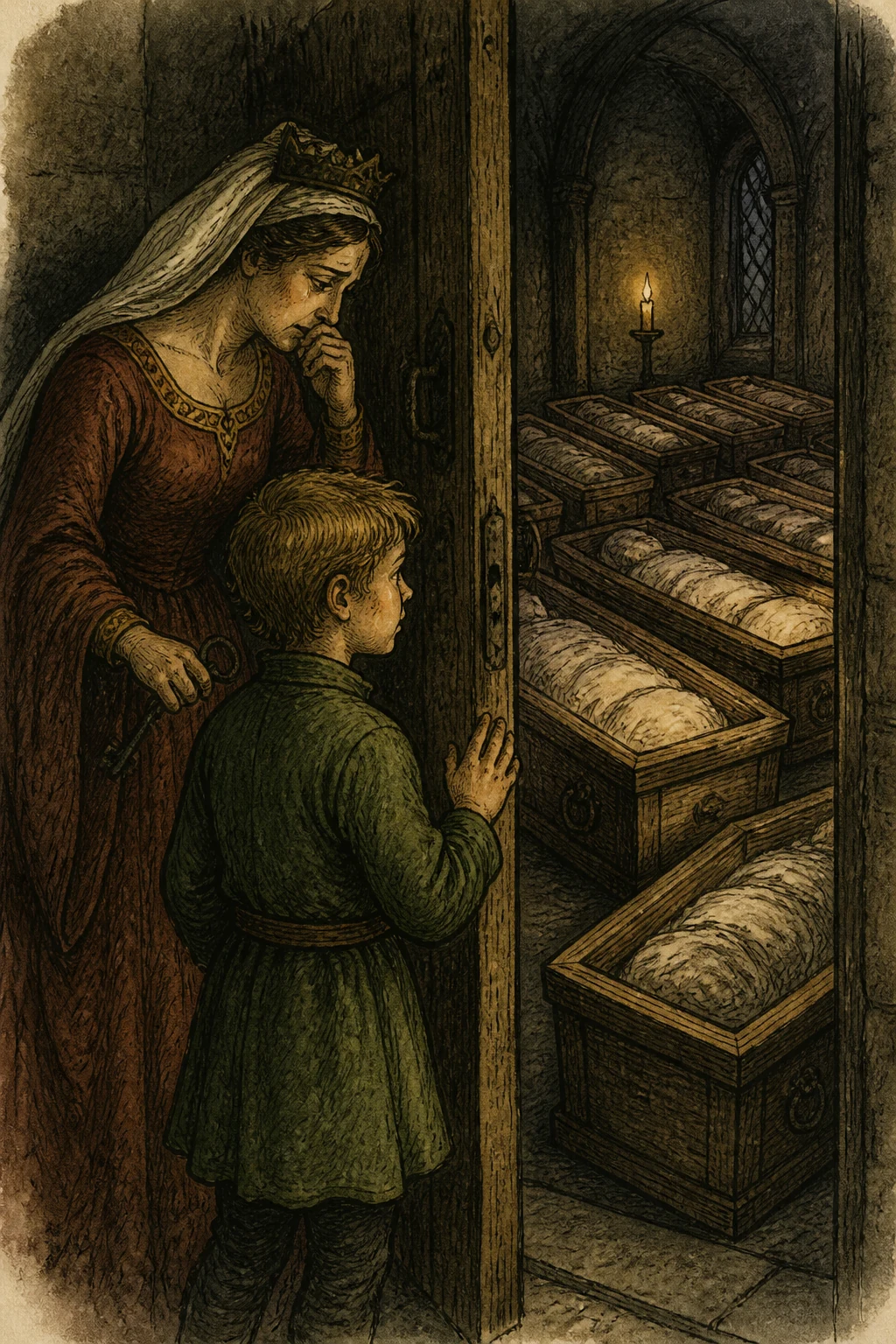
One day the woman had gone upstairs to the storeroom, and her little daughter came up too and said, “Mother, give me an apple.” “Yes, my child,” said the woman, and gave her a fine apple from the chest. Now the chest had a great heavy lid with a large, sharp iron lock. “Mother,” said the little girl, “shouldn’t my brother have one too?” This vexed the woman, but she said, “Yes, when he comes home from school.” And when she caught sight of him through the window, it was just as though the Evil One had entered into her. She snatched the apple back from her daughter and said, “You shall not have it before your brother does.” Then she threw the apple into the chest and shut it. The little boy came in at the door, and the Evil One prompted her to say kindly, “My son, would you like an apple?” Yet she looked at him with such fury. “Mother,” said the little boy, “how dreadful you look! Yes, give me an apple!” Then she felt she must coax him. “Come with me,” she said, opening the lid. “Take an apple out for yourself!” And as the little boy bent into the chest, the Evil One urged her on, and crash! She slammed down the lid so that his head flew off and fell among the red apples. Then terror swept over her, and she thought, “If only I could shift the blame from myself!” She went downstairs to her room, opened the top drawer of her chest of drawers, and took out a white cloth. Then she set his head back on his neck and tied the cloth around it so that nothing could be seen, sat him on a chair outside the door, and put the apple in his hand.
After this, Marlenchen came to her mother in the kitchen. She was standing by the fire with a pot of hot water before her, stirring it all the while. “Mother,” said Marlenchen, “my brother is sitting outside the door, looking quite white, with an apple in his hand. I asked him to give me the apple, but he won’t answer me, and it frightened me.” “Go to him again,” said her mother, “and if he won’t answer you, give him a box on the ear.” So Marlenchen went and said, “Brother, give me the apple!” But he said nothing, and she gave him a box on the ear. Then his head fell off, and she was so terrified that she began to weep and scream. She ran to her mother and said, “Oh, Mother, I’ve knocked my brother’s head off!” And she wept and wept and could not be comforted. “Marlenchen,” said her mother, “what have you done! But keep quiet, so that no one finds out. It cannot be helped now; we shall make him into a sour stew.” Then the mother took the little boy and chopped him into pieces, put them into the pot, and made him into a sour stew. But Marlenchen stood beside her and wept and wept, and all her tears fell into the pot, so that they needed no salt.
Then the father came home, sat down at the table, and said, “Where is my son?” The mother brought in a great, great dish of black sour stew, and Marlenchen wept and could not stop. Again the father said, “Where is my son?” “Oh,” said the mother, “he has gone out into the country to visit his mother’s relations. He wanted to stay there a while.” “What is he doing there? He didn’t even say goodbye to me!” “Oh, he was so eager to go, and he asked me whether he might stay for six weeks. They will take good care of him there.” “Ah,” said the man, “I feel so sad at heart. It isn’t right; he might at least have said goodbye to me.” With that he began to eat and said, “Marlenchen, why are you crying? Your brother will come back.” “Ah, wife,” he said then, “how delicious this food is! Give me some more!” And the more he ate, the more he wanted, and he said, “Give me more. You mustn’t save any of it; I feel as though it all belongs to me.” And he ate and ate, throwing all the bones under the table, until he had finished everything. But Marlenchen went to her chest of drawers and took her best silk kerchief from the bottom drawer. She gathered all the little bones from beneath the table, tied them up in the silk kerchief, and carried them outside, weeping tears of blood. There she laid them in the green grass beneath the juniper tree, and when she had laid them there, her heart suddenly grew light, and she wept no more. Then the juniper tree began to move, and its branches parted and came together again, just as someone might clap their hands for heartfelt joy. A mist rose from the tree, and in the midst of the mist something burned like fire, and out of the fire flew a beautiful bird, singing gloriously, and soared high into the air. When it was gone, the juniper tree was just as it had been before, and the cloth with the bones had vanished. But Marlenchen felt so lighthearted and happy, just as though her brother were still alive. She went merrily back into the house, sat down at the table, and ate. The bird, meanwhile, flew away, perched on the roof of a goldsmith’s house, and began to sing:
“My mother, she butchered me, my father, he ate me, my sister Marlenichen gathered all my little bones, tied them in a silken cloth, laid them beneath the juniper tree.
Tweet, tweet, what a beautiful bird am I!” The goldsmith was sitting in his workshop making a golden chain when he heard the bird singing on his roof, and he thought its song most beautiful. He rose, and as he crossed the threshold he lost a slipper. Yet he went right out into the middle of the street, wearing just one slipper and one stocking. He still had his leather apron on, and held the golden chain in one hand and his tongs in the other; and the sun shone brightly upon the street. There he stood, looking at the bird. “Bird,” he said, “how beautifully you sing! Sing that song for me again!” “No,” said the bird, “I do not sing twice for nothing. Give me the golden chain, and I will sing it for you once more.” “Here,” said the goldsmith, “take the golden chain. Now sing it for me again!” Then the bird came down, took the golden chain in its right claw, perched before the goldsmith, and sang: “My mother, she butchered me, my father, he ate me, my sister Marlenichen gathered all my little bones, tied them in a silken cloth, laid them beneath the juniper tree. Tweet, tweet, what a beautiful bird am I!”
Then the bird flew away to a shoemaker’s house, perched upon his roof, and sang: “My mother, she butchered me, my father, he ate me, my sister Marlenichen gathered all my little bones, tied them in a silken cloth, laid them beneath the juniper tree. Tweet, tweet, what a beautiful bird am I!”
The shoemaker heard it and ran outside in his shirtsleeves. He looked up at his roof and had to shade his eyes with his hand to keep the sun from dazzling him. “Bird,” he said, “how beautifully you sing!” Then he called through the doorway, “Wife, come outside! There’s a bird here. Look at that bird; how beautifully it sings!” Then he called his daughter and the children, the journeymen, the apprentices, and the maids, and they all came out into the street and looked at the bird, to see how beautiful it was. It had such lovely red and green feathers, and all about its neck was like pure gold, and its eyes shone in its head like stars. “Bird,” said the shoemaker, “now sing that song for me again!” “No,” said the bird, “I do not sing twice for nothing. You must give me something.” “Wife,” said the man, “go up to the attic. On the very top shelf there is a pair of red shoes. Bring them here!” So the woman went and fetched the shoes. “There, bird,” said the man, “now sing the song for me again!” Then the bird came down, took the shoes in its left claw, flew back up to the roof, and sang:
“My mother, she butchered me, my father, he ate me, my sister Marlenichen gathered all my little bones, tied them in a silken cloth, laid them beneath the juniper tree.
Tweet, tweet, what a beautiful bird am I!” And when it had finished singing, it flew away, with the chain in its right claw and the shoes in its left. It flew far away to a mill, and the mill went clickety-clack, clickety-clack, clickety-clack. Inside the mill sat twenty millers’ men, dressing a millstone with their hammers: chip-chop, chip-chop, chip-chop; and the mill went clickety-clack, clickety-clack, clickety-clack. The bird perched in a lime tree that stood before the mill and sang, “My mother, she butchered me”—then one man stopped; “my father, he ate me”—then two more stopped and listened; “my sister Marlenichen”—then another four stopped; “gathered all my little bones, tied them in a silken cloth”—now only eight were still chipping; “laid them beneath”—now only five; “the juniper tree”—now only one; “Tweet, tweet, what a beautiful bird am I!” Then the last man stopped too, having heard only the very end. “Bird,” he said, “how beautifully you sing! Let me hear it too; sing it for me again!” “No,” said the bird, “I do not sing twice for nothing. Give me the millstone, and I will sing it once more.” “Well,” he said, “if it belonged to me alone, you should have it.” “Yes,” said the others, “if it sings once more, it shall have it.” Then the bird came down, and all twenty millers took hold of wooden poles and heaved up the stone. “Heave-ho! Heave-ho! Heave-ho!” The bird put its neck through the hole, wore the stone like a collar, flew back up into the tree, and sang:
“My mother, she butchered me, my father, he ate me, my sister Marlenichen gathered all my little bones, tied them in a silken cloth, laid them beneath the juniper tree.
Tweet, tweet, what a beautiful bird am I!” And when it had finished singing, it spread its wings, with the chain in its right claw, the shoes in its left, and the millstone about its neck, and flew far away to its father’s house.
Inside the house, the father, the mother, and Marlenchen were sitting at the table, and the father said, “Ah, how light my heart feels! I feel so happy.” “No,” said the mother, “I feel terribly afraid, just as though a dreadful thunderstorm were coming.” But Marlenchen sat and wept and wept. Then the bird came flying up, and as it perched on the roof, the father said, “Ah, I feel so joyful, and the sun is shining so beautifully. I feel just as though I were about to see an old friend again!” “No,” said the woman, “I am afraid. My teeth are chattering, and I feel as though there were fire in my veins.” And she tore open her dress to get some air. But Marlenchen sat in the corner weeping, with her apron over her eyes, and she wept until the apron was wet through. Then the bird perched in the juniper tree and sang, “My mother, she butchered me”—and the mother stopped her ears and squeezed her eyes shut, wishing neither to see nor to hear, but there was a roaring in her ears like the fiercest storm, and her eyes burned and flashed like lightning. “My father, he ate me”—“Ah, wife,” said the man, “there is a beautiful bird out there, singing so gloriously, and the sun is shining so warmly, and everything smells of pure cinnamom.” (Cinnamon.) “My sister Marlenichen”—then Marlenchen laid her head on her knees and went on weeping. But the man said, “I am going outside. I must see the bird close at hand.” “Oh, don’t go,” said the woman. “I feel as though the whole house were shaking and in flames.” But the man went outside and looked at the bird—“gathered all my little bones, tied them in a silken cloth, laid them beneath the juniper tree. Tweet, tweet, what a beautiful bird am I!”
With that the bird let the golden chain fall, and it dropped straight around the man’s neck, settling so neatly that it fitted him beautifully. Then he went inside and said, “Look what a beautiful bird it is! It has given me this lovely golden chain, and it is so beautiful itself.” But the woman was so terrified that she fell full length upon the floor, and her cap fell off her head. Then the bird sang again: “My mother, she butchered me”—“Oh, if only I were a thousand fathoms beneath the earth, so that I need not hear it!”—“My father, he ate me”—then the woman fell down as though dead. “My sister Marlenichen”—“Oh,” said Marlenchen, “I shall go outside too, and see whether the bird will give me something.” So she went outside. “Gathered all my little bones, tied them in a silken cloth”—then it threw the shoes down to her. “Laid them beneath the juniper tree. Tweet, tweet, what a beautiful bird am I!”
Then her heart felt light and glad. She put on the new red shoes and came dancing and skipping into the house. “Oh,” she said, “I was so sad when I went out, and now my heart is so light. What a wonderful bird it is! It has given me a pair of red shoes!” “No,” said the woman, springing up, her hair standing on end like flames of fire, “I feel as though the world were coming to an end. I shall go outside too, so that I may feel better.” And as she came out of the door, crash! The bird dropped the millstone onto her head, crushing her to death. The father and Marlenchen heard it and went outside. Smoke and flames and fire rose from the spot, and when they had passed, there stood the little brother. He took his father and Marlenchen by the hand, and all three were very happy. They went into the house, sat down at the table, and ate.