Waltey
Tkalec Somilaka in usoda
Pančatantra · indijska zbirka pripovediO besedilu
Tkalec Somilaka in usoda
- Vir
- Pančatantra
- Avtor
- indijska zbirka pripovedi
- Jezik branja
- English
- Jezik izvirnika
- Sanskrit
- Čas branja
- 15 min branja
- Obseg
- 12 strani
- Naslov izvirnika
- Tantra 02 mitra-samprapti chunk 4
O izvirniku
Pančatantra
Indijske zgodbe o zvijači, prijateljstvu in modrosti v svetu živali in vladarjev. Bralni jezik je English, izvirnik pa prihaja iz vira Pančatantra v jeziku Sanskrit.
Besedilo
Tkalec Somilaka in usoda
The hardships this foolish man endures in his pursuit of wealth—
if a seeker of liberation endured even a hundredth of them, he would attain release.
What land is home, and what land foreign, to a brave and resolute man?
Whatever country he settles in, he makes his own through the might of his arm.
When a lion enters a forest, armed with fangs, claws, and tail,
there he quenches his thirst with the blood of mighty elephants he has slain.
A wise man, though penniless and far from home, never loses heart, whatever his circumstances. For it is said:
What burden is too heavy for the capable? What place is too far for the enterprising?
What country is foreign to the learned? Who is a stranger to those who speak kindly?
You are a treasure-house of wisdom, no ordinary man. Or again:
A man full of energy, prompt in action, skilled in his work, free from vice,
brave, grateful, and steadfast in friendship—such a man Lakshmi herself longs to make her home.
Moreover, even wealth already acquired is lost when past deeds bring their consequences. It was yours only for those many days. Not for a moment may one enjoy what is not allotted to one. Even what comes of itself is taken away by fate.
A luckless man may earn wealth, yet never enjoy it,
like foolish Somilaka when he reached the great forest.
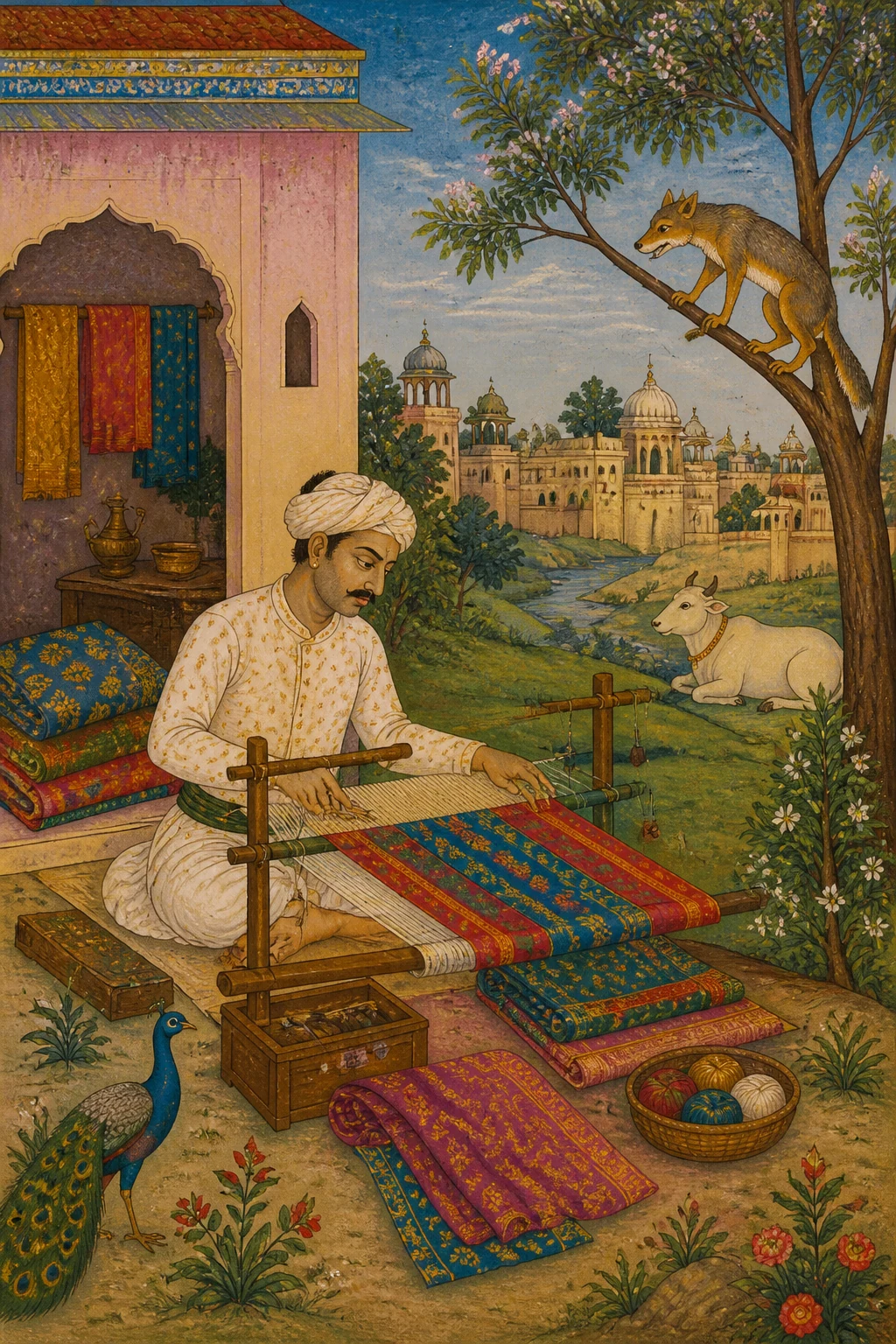
Hiranyaka asked, “How was that?” He replied: Story 5 The Story of Somilaka In a certain town there lived a weaver named Somilaka. He was always making cloth fit for kings, adorned with a rich variety of colored patterns. Yet, skilled though he was in weaving these many patterns, he could never earn more than enough for food and clothing. Meanwhile, the other ordinary weavers there, who knew only how to make coarse cloth, had grown very wealthy. Seeing them, he said to his wife, “My dear, look at these makers of coarse cloth, rich in money and gold! This place offers me no livelihood. I shall go elsewhere to earn my fortune.” She replied, “My dearest, it is idle talk to say that people gain wealth by going elsewhere but cannot gain it at home. For it is said:
Though birds soar into the sky and swoop down to the earth,
even they receive only what fate has allotted them, and nothing that has not been given.
And again: What is not destined will never happen;
what is destined comes to pass even without effort.
Even what lies in the palm of one's hand is lost
if one is not destined to possess it.
As a calf finds its mother among a thousand cows,
so the deeds of a former life follow the one who performed them.
They lie down with him when he lies down, and follow him when he goes;
a man's past deeds remain forever at his side.
As light and shade are always closely bound together,
so deed and doer are inseparably joined.
The weaver said, “My dear, you are mistaken. Without exertion, past deeds bear no fruit. For it is said:
Just as one hand alone cannot make a clap,
so fate, without effort, is said to yield no fruit.
Look: even food that fate provides at mealtime
will never enter the mouth unless the hand makes an effort.
And again: Lakshmi comes to the enterprising lion among men;
only cowards say, ‘Fate must bestow it.’
Cast fate aside and exert yourself with all your strength. If you strive and still fail, what fault is yours?
And again:
Tasks are accomplished through effort, not through wishes;
deer do not walk into the mouth of a sleeping lion. Without effort, O king, wishes do not come true;
only the fainthearted prattle, ‘What is to be will be.’
If a man works with all his strength and still does not succeed,
he cannot be blamed: fate has thwarted his endeavor.
“And so I must go to another country.”
Having made up his mind, he went to the city of Vardhamana. He stayed there for three years, earned three hundred gold coins, and set out for home. About halfway along his journey, while he was passing through a forest, the blessed sun went down. Afraid of wild beasts, he climbed onto the broad trunk of a banyan tree and fell asleep. At midnight he heard two fearsome-looking figures talking to one another.
One of them said, “Maker, do you not know perfectly well that this Somilaka is entitled to no more than food and clothing? Why, then, have you given him three hundred gold coins?”
The other replied, “Karma, I must reward those who exert themselves. But the final outcome rests with you.” When the weaver awoke and looked at the bundle containing his gold, he found it empty. Distraught, he thought, “Alas! What is this? The wealth I earned with such hardship has vanished in an instant. Penniless, with all my labor wasted, how can I face my wife and friends?” With this thought, he returned to the same city. There, in just one year, he earned five hundred gold coins and once more set out for home. Again, halfway through his journey, the blessed sun set while he was in the forest. This time, fearing that he might lose his gold, he would not rest, exhausted though he was. Longing for home, he hurried on. Just then he saw two figures like the others approaching and heard them talking. One said, “Maker! Why have you given this man five hundred gold coins? Do you not know that he is entitled to nothing beyond food and clothing?” The other replied, “Karma! I must reward those who exert themselves. The outcome rests with you. Why do you reproach me?”
On hearing this, Somilaka looked at his bundle and found that the gold was gone. Overwhelmed with grief, he thought, “Alas, what use is life to me without wealth? I shall hang myself from this banyan tree and put an end to it.” Having resolved on this, he twisted a rope of darbha grass, placed the noose around his neck, and fastened it to a branch. He was just about to throw himself down when a figure in the sky cried out, “Somilaka! Stop! Do not do anything so rash. I am the one who takes away your wealth. I will not allow you even a cowrie beyond what you need for food and clothing. Go home. Yet your daring has pleased me, and an encounter with me must not be fruitless. Ask, then, for whatever boon you wish.”
Somilaka said, “If that is so, give me abundant wealth.”
The figure replied, “But what will you do with wealth you cannot enjoy, since you are allotted nothing beyond food and clothing? For it is said:
What use is wealth kept to oneself like a secluded bride,
instead of being shared like a courtesan, to be enjoyed by travelers?
Somilaka said, “Even if I cannot enjoy it, let me have wealth nevertheless. For it is said:
Though miserly and lowborn, a man who has a store of wealth
is always courted in this world by people seeking his protection.
And again:
Loose, yet firmly fastened—will they fall, or will they not?
My dear, I have watched them for fifteen years.
The figure asked, “What is that story?” Somilaka replied: Story 6 The Story of Tikshnavishana and the Jackal In a certain place there lived a great bull named Tikshnavishana. Full of pride and vigor, he left his own herd and roamed the forest at will, tearing up riverbanks with his horns and eating grass as green as emeralds. In that same forest lived a jackal named Pralobhaka. One day he was sitting comfortably beside the river with his wife when Tikshnavishana came down to that very stretch of sand to drink. Seeing his dangling testicles, the she-jackal said to her husband, “Husband, look at those two lumps of flesh hanging from that bull! In a moment, or perhaps a few hours, they will fall off. You must follow him and be ready.” The jackal replied, “My dear, there is no knowing whether they will ever fall at all. Why set me to such pointless labor? If I stay here, I can eat the mice that come to drink, and share them with you. This is their usual path. But if I leave you and follow that bull Tikshnavishana, someone else will come and take this place. It would be unwise. For it is said:
Whoever abandons what is certain to pursue what is uncertain
loses the certain, while the uncertain is already as good as lost.
The she-jackal said, “What a coward you are, content with whatever little comes your way! For it is said:
A little stream is easily filled, a mouse's paws are easily filled,
and a craven fellow is easily contented, satisfied with the smallest thing.
“A man should therefore always be enterprising. For it is said:
Where energetic effort is made, where idleness is checked,
where sound judgment and courage unite, there prosperity surely remains.
Let no one abandon effort, thinking, ‘It all depends on fate’;
without pressing, no oil comes from sesame seeds.
Moreover:
The dull-witted man who is content with even a little
is so unfortunate that even wealth bestowed on him is swept away.
“And as for your saying that we do not know whether those two will fall or not, that too is mistaken. For it is said:
The resolute deserve honor; no one can slight their lofty spirit.
What is that little chataka bird, that Indra himself should carry water for it?
“Besides, I am tired of mouse flesh. Those two lumps of meat look ready to fall. You must do as I say, and nothing else.” On hearing this, he abandoned the place where he caught mice and followed Tikshnavishana. Well indeed is it said:
A man remains his own master in all he does
only until the goad of a woman's words pierces him and forces him along.
He thinks the improper proper, the impassable easy to travel,
and the inedible fit to eat, when driven by a woman's words.
So he wandered after the bull with his wife for a very long time, but the two never fell. At last, in the fifteenth year, the jackal grew weary of it all and said to his wife, “Loose, yet firmly fastened…” (141), and the rest.
“They will not fall in the future either. Let us go back to our old home.” That is why I say, “Loose, yet firmly fastened…” (141).
*********************************************************************** The figure said, “If that is what you wish, go once more to the city of Vardhamana. Two merchants live there: one is Guptadhana, and the other Upabhuktadhana. Learn what each is like, then ask to be granted the lot of one of them. If you want wealth that is never enjoyed, I shall make you like Guptadhana. But if you want wealth to give away and enjoy, I shall make you like Upabhuktadhana.” With these words he vanished. Somilaka, filled with wonder, returned once more to Vardhamana. Weary from his journey, he reached the city toward evening. He asked for Guptadhana's house, found it with difficulty, and entered after sunset. Although Guptadhana, his wife, and his children scolded him, he forced his way inside and sat down. At mealtime they gave him a little food, without any kindness. After eating, he lay down to sleep there. At midnight he saw those same two figures consulting together. One said, “Maker! Why have you imposed this extra expense on Guptadhana by making him feed Somilaka? You have done wrong.” The other replied, “Karma! I am not to blame. I must give a man the chance to acquire what is due to him; the outcome, however, rests with you.” By the time Somilaka rose, Guptadhana was suffering from a violent bowel disorder and lay racked with pain. The following day he fasted because of his illness. In the morning Somilaka left his house and went to Upabhuktadhana's. This man rose to welcome him and honored him with food, clothing, and every courtesy. Somilaka lay down on a splendid bed in his host's house and slept. At midnight he again saw the same two figures talking together. One said, “Maker! This man has spent a great deal in entertaining Somilaka. Tell me, how will he repay the debt? He has borrowed everything from a moneylender.”
The other replied, “Karma! This is my duty. The outcome rests with you.” Then, at daybreak, a royal officer arrived with money bestowed by the king and presented it to Upabhuktadhana.
Seeing this, Somilaka thought, “Though he has no hoard, this Upabhuktadhana is far better off than that miser Guptadhana. For it is said:
The Vedas bear fruit in the fire offering; learning bears fruit in virtuous conduct;
a wife bears fruit in love and children; wealth bears fruit in giving and enjoyment.
“May the Creator make me one whose wealth is given and enjoyed. I have no use for hoarded wealth.” And so Somilaka became one who gave and enjoyed his wealth. That is why I say, “A luckless man may earn wealth…”
If men are rich because of money buried inside their houses,
why should we not be rich by virtue of that very same money?
“So, my good Hiranyaka, understand this and do not grieve over wealth. Even wealth that exists must be regarded as nonexistent if it cannot be enjoyed. For it is said:
The only way to preserve acquired wealth is to let it go,
as water stored in a reservoir is preserved by an outlet.
And again:
The only way to preserve acquired wealth is to let it go,
as water stored in a reservoir is preserved by an outlet.
Moreover:
Wealth has three possible ends: giving, enjoyment, and loss. Whoever neither gives nor enjoys it meets the third.
“Knowing this, a discerning man should not acquire wealth merely to keep it, for that brings sorrow. For it is said:
The fools who hope to find happiness in wealth and possessions
seek coolness by sitting beside a fire in the summer heat.
Snakes drink the wind, yet they are not weak;
forest elephants grow strong on dry grass.
Great sages pass their days on roots and fruit:
contentment alone is a man's supreme treasure.
The happiness of tranquil souls, satisfied with the nectar of contentment—
how could it be known to those who race here and there in their greed for wealth?
Those who drink contentment like nectar find perfect peace;
but the discontented suffer without cease.
When the mind is restrained, all the senses are restrained as well;
when clouds veil the sun, its rays too are hidden.
The great sages, at peace within themselves, call the ending of desire true well-being.
Possessions no more extinguish desire than tending a fire quenches thirst. Men condemn the blameless and loudly praise the unworthy:
what will mortals not do for the sake of wealth?
Even the desire for wealth to further righteousness brings no good;
better to keep far from mud than to wash it off afterward.
There is no treasure equal to generosity,
no greater enemy on earth than greed,
no ornament equal to good character,
and no wealth equal to contentment.
The deepest poverty is poverty of self-respect.
Shiva's wealth is an old bull, yet he is the Supreme Lord.
“Knowing this, my friend, you should be content.” Hearing Mantharaka's words, the crow said, “My friend, take what Mantharaka says to heart. Indeed, it is well said:
Men who always say what pleases are easy to find, O king;
rare are those who speak, or listen to, unwelcome but wholesome truths.
Those who tell a man what is good for him, however unwelcome,
are called his true friends; the rest are friends in name alone.”
While they were talking in this way, a deer named Chitranga, terrified by a hunter, entered that very lake. Seeing him rush toward them in alarm, Laghupatanaka flew up into a tree, Hiranyaka slipped into a clump of reeds, and Mantharaka took shelter in the water. Then Laghupatanaka, having taken a good look at the deer, called to Mantharaka, “Come out, come out, my friend Mantharaka! It is a deer, come here thirsty and entered the lake. The sound we heard was his, not a man's.” Hearing this, Mantharaka replied with due regard for their circumstances, “Laghupatanaka, look how heavily this deer is breathing and how he glances behind him with frightened eyes. He is not merely thirsty; surely he has been frightened by a hunter. Find out whether any hunters are following him. For it is said:”
Izvirnik
Tantra 02 mitra-samprapti chunk 4
Naslednje strani prikazujejo izvirno besedilo za primerjavo.
Source ID: panchatantra_gretil_tantra_02_chunk_04 Source URL: https://gretil.sub.uni-goettingen.de/gretil/1_sanskr/5_poetry/4_narr/vispancu.htm arthārthī yāni kaṣṭāni mūḍho 'yaṃ sahate janaḥ | śatāṃśenāpi mokṣārthī tāni cen mokṣam āpnuyāt ko dhīrasya manasvinaḥ sva-viṣayaḥ ko vā videśaḥ smṛto yaṃ deśaṃ śrayate tam eva kurute bāhu-pratāpārjitam | yad daṃṣṭrānakhalāṅgula-praharaṇaiḥ siṃho vanaṃ gāhate tasmin eva hata-dvipendra-rudhirais tṛṣṇāṃ chinatty ātmanaḥ artha-hīnaḥ pare deśe gato 'pi yaḥ prajñāvān bhavati sa kathañcid api na sīdati | uktaṃ ca- ko 'tibhāraḥ samarthānāṃ kiṃ dūraṃ vyavasāyinām | ko videśaḥ suvdyānāṃ kaḥ paraḥ priya-vādinām tat prajñā-nidhir bhavān na prākṛta-puruṣa-tulyaḥ | athavā-
utsāha-sampannam adīrgha-sūtraṃ kriyā-vidhijñaṃ vyasaneṣv asaktam | śūraṃ kṛtajñaṃ dṛḍha-sauhṛdaṃ ca- lakṣmīḥ svayaṃ vāñchati vāsa-hetoḥ aparaṃ prāpto 'py arthaḥ karma-prāptyā naśyati | tad etāvanti dināni tvadīyam āsīt | muhūrtam apy anātmīyaṃ bhoktuṃ na labhyate | svayam āgatam api vidhināpahriyate | arthasyopārjanaṃ kṛtvā naivābhāgyaḥ samaśnute | araṇyaṃ mahadāsādya mūḍhaḥ somilako yathā hiraṇyaka āha--katham etat ?
sa āha- kathā 5 somilaka-kathā asti kasmiṃścid adhiṣṭhāne somilako nāma kauliko vasati sma | so 'neka-vidha-paṭṭa-racanārañjitāni pārthivocitāni sadaiva vastrāṇy utpādayati | paraṃ tasya cāneka-vidha-paṭṭa-racana-nipuṇasyāpi na bhojanācchādanābhyadhikaṃ katham apy artha-mātraṃ sampadyate | athānye tatra sāmānya-kaulikāḥ sthūla-vastra-sampādana-vijñānino mahardhi-sampannāḥ | tān avalokya sa sva-bhāryām āha-priye ! paśyaitān sthūla-paṭṭa-kārakān dhana-kanaka-samṛddhān | tad adhāraṇakaṃ mamaitat sthānam | tad anyatropārjanāya gacchāmi | sā prāha-bhoḥ priyatama ! mithyā pralapitam etad yad anyatra-gatānāṃ dhanaṃ bhavati, sva-sthāne na bhavati | uktaṃ ca- utpatanti yad ākāśe nipatanti mahītale | pakṣiṇāṃ tad api prāptyā nādattam upatiṣṭhati
tathā ca- na hi bhavati yan na bhāvyaṃ bhavati ca bhāvyaṃ vināpi yatnena | kara-tala-gatam api naśyati yasya tu bhavitavyatā nāsti yathā dhenu-sahasreṣu vatso vindati mātaraṃ | tathā pūrva-kṛtaṃ karma kartāram anugacchati śete saha śayānena gacchantam anugacchati | narāṇāṃ prāktanaṃ karma tiṣṭhati tu sahātmanā yathā chāyā-tapau nityaṃ susambaddhau parasparaṃ | evaṃ karma ca kartā ca saṃśliṣṭāv itaretaram kaulika āha-priye ! na samyag abhihitaṃ bhavatyā | vyavasāyaṃ vinā na karma phalati | uktaṃ ca-
yathaikena na hastena tālikā saṃprapadyate | tathodyama-parityaktaṃ na phalaṃ karmaṇaḥ smṛtam paśya karma-vaśāt prāptaṃ bhojyakāle'pi bhojanam | hastodyamaṃ vinā vaktre praviśen na kathañcana tathā ca- udyoginaṃ puruṣa-siṃham upaiti lakṣmīr daivena deyam iti kāpuruṣā vadanti | daivaṃ nihatya kuru pauruṣam ātma-śaktyā yatne kṛte yadi na sidhyati ko 'tra doṣaḥ tathā ca- udyamena hi sidhyanti kāryāṇi na manorathaiḥ | na hi suptasya siṃhasya viśanti vadane mṛgāḥ udyamena vinā rājan na sidhyanti manorathāḥ | kātarā iti jalpanti yad bhāvyaṃ tad bhaviṣyati
sva-śaktyā kurvataḥ karma na cet siddhiṃ prayacchati | nopālabhyaḥ pumāṃs tatra daivāntarita-pauruṣaḥ tan mayāvaśyaṃ deśāntaraṃ gantavyam | iti niścitya vardhamāna-puraṃ gatvā tatra varṣa-trayaṃ sthitvā suvarṇa-śata-trayopārjanaṃ kṛtvā bhūyaḥ sva-gṛhaṃ prasthitaḥ | athārdha-pathe gacchatas tasya kadācid aṭavyāṃ paryaṭato bhagavān ravir astam upāgataḥ | tatra ca vyāla-bhayāt sthūlatara-vaṭa-skandha ārūhya prasupto yāvat tiṣṭhati tāvan niśīthe dvau puruṣau raudrākārau parasparaṃ jalpantāv aśṛṇot | tatraika āha-bhoḥ kartaḥ tvaṃ kiṃ samyaṅ na vetsi yad asya somilakasya bhojanācchādanād ṛte'dhikā samṛddhir nāsti | tat kiṃ tvayāsya suvarṇa-śata-trayaṃ dattam | sa āha-bhoḥ karman mayāvaśyaṃ dātavyaṃ vyavasāyināṃ tatra ca tasya pariṇatis tvad āyatteti | atha yāvad asau kaulikaḥ prabuddhaḥ suvarṇa-granthim avalokayati tāvad riktaṃ paśyati |
tataḥ sākṣepaṃ cintayāmāsa | aho kim etat ? mahatā kaṣṭenopārjitaṃ vittaṃ helayā kvāpi gatam | yad vyartha-śramo 'kiñcanaḥ kathaṃ sva-patnyā mitrāṇāṃ ca mukhaṃ darśayiṣyāmi | iti niścitya tad eva pattanaṃ gataḥ | tatra ca varṣa-mātreṇāpi suvarṇa-śata-pañcakam upārjya bhūyo 'pi sva-sthānaṃ prati prasthitaḥ | yāvad ardha-pathe bhūyo 'ṭavī-gatasya bhagavān bhānur astaṃjagāmātha suvarṇa-nāśa-bhayāt suśrānto 'pi na viśrāmyati kevalaṃ kṛta-gṛhotkaṇṭhaḥ satvaraṃ vrajati | atrāntare dvau puruṣau tādṛṣau dṛṣṭi-deśe samāgacchantau jalpantau ca śṛṇoti | tatraikaḥ prāha-bhoḥ kartaḥ ! kiṃ tvayaitasya suvarṇa-śata-pañcakaṃ dattam ? tat kiṃ na vetsi yad bhojanācchādanābhyadhikam asya kiṃcin nāsti | sa āha-bhoḥ karman ! mayāvaśyaṃ deyaṃ vyavasāyinām | tasya pariṇāmas tvad-āyattaḥ | tat kiṃ mām upālambhayasi ?
tac chrutvā somilako yāvad granthim avalokayati tāvat suvarṇaṃ nāsti | tataḥ paraṃ duḥkham āpanno vyacintayat-aho kiṃ mama dhana-rahitasya jīvitena ? tad atra vaṭa-vṛkṣa ātmānam udbadhya prāṇāṃs tyajāmi | evaṃ niścitya darbha-mayīṃ rajjuṃ vidhāya sva-kaṇṭhe pāśaṃ niyojya śākhāyām ātmānaṃ nibadhya yāvat prakṣipati tāvad ekaḥ pumān ākāśa-stha evedam āha-bho bhoḥ somilaka ! maivaṃ sāhasaṃ kuru | ahaṃ te vittāpahārako na te bhojanācchādanābhyadhikaṃ varāṭikām api sahāmi | tad gaccha sva-gṛhaṃ prati | anyac ca bhavadīya-sāhasenāhaṃ tuṣṭaḥ | tathā me na syād vyarthaṃ darśanam | tat prārthyatām abhīṣṭo varaḥ kaścit | somilaka āha-yady evaṃ tad dehi me prabhūtaṃ dhanam | sa āha-bhoḥ ! kiṃ kariṣyasi bhoga-rahitena dhanena yatas tava bhojanācchādanābhyadhikā prāptir api nāsti ? uktaṃ ca-
kiṃ tayā kriyate lakṣmyā yā vadhūr iva kevalā | yā na veśyeva sāmānyā pathikair upabhujyate somilaka āha-yady api bhogo nāsti tathāpi bhavatu me dhanam | uktaṃ ca- kṛpaṇo 'py akulīno 'pi sadā saṃśrita-mānuṣaiḥ | sevyate sa naro loke yasya syād vitta-sañcayaḥ tathā ca- śithilau ca subaddhau ca patataḥ patato na vā | nirīkṣitau mayā bhadre daśa varṣāṇi pañca ca puruṣa āha-kim etat ?
so 'bravīt- kathā 6 tīkṣṇa-viṣāṇa-śṛgāla-kathā kasmiṃścid adhiṣṭhāne tīkṣṇaviṣāṇo nāma mahā-vṛṣabho vasati | sa ca madātirekāt parityakta-nija-yūṭhaḥ śṛṅgābhyāṃ nadī-taṭāni vidārayan svecchayā marakata-sadṛśāni śaṣpāṇi bhakṣayann araṇya-caro babhūva | atha tatraiva vane pralobhako nāma śṛgālaḥ prativasati sma | sa kadācit sva-bhāryayā saha nadī-tīre sukhopaviṣṭas tiṣṭhati | atrāntare sa tīkṣṇaviṣāṇo jalārthaṃ tad eva pulinam avatīrṇaḥ | tataś ca tasya lambamānau vṛṣaṇāv ālokya śṛgālyā śṛgālo 'bhihitaḥ-svāmin ! paśyāsya vṛṣabhasya māṃsa-piṇḍau lambamānau yathā sthitau | tataḥ kṣaṇena prahareṇa vā patiṣyataḥ | evaṃ jñātvā bhavatā pṛṣṭha-yāyinā bhāvyaṃ | śṛgāla āha-priye ! na jñāyate kadācid etayoḥ patanaṃ bhaviṣyati vā na vā | tat kiṃ vṛthā śramāya māṃ niyojayasi ? atra-sthas tāvaj jalārtham āgatān mūṣakān bhakṣayiṣyāmi samaṃ tvayā | mārgo 'yaṃ yatas teṣām | atha yadā tvāṃ muktvāsya tīkṣṇaviṣāṇasya vṛṣabhasya pṛṣṭhe gamiṣyāmi tadāgatyānyaḥ kaścid etat sthānaṃ samāśrayiṣyati | naitad yujyate kartum | uktaṃ ca-
yo dhruvāṇi parityajyādhruvāṇi niṣevate | dhruvāṇi tasya naśyanti adhruvaṃ naṣṭam eva ca śṛgāly āha-bhoḥ kāpuruṣas tvaṃ yat kiṃcit prāptaṃ tenāpi santoṣaṃ karoṣi | uktaṃ ca- supūrā syāt kunadikā supūro mūṣikāñjaliḥ | susantuṣṭaḥ kāpuruṣaḥ svalpakenāpi tuṣyati tasmāt puruṣeṇa sadaivotsāhavatā bhāvyam | uktaṃ ca- yatrotsāha-samārambho yatrālasya-vinigrahaḥ | naya-vikrama-saṃyogas tatra śrīr acalā dhruvaṃ tad daivam iti sañcintya tyajen nodyogam ātmanaḥ | anuyogaṃ vinā tailaṃ tilānāṃ nopajāyate anyac ca- yaḥ stokenāpi santoṣaṃ kurute mandadhīr janaḥ |
tasya bhāgya-vihīnasya dattā śrīr api mārjyate yac ca tvaṃ vadasi | etau patiṣyato na veti | tad apy ayuktam | uktaṃ ca- kṛta-niścayino vandyās tuṅgimā nopabhujyate | cātakaḥ ko varāko 'yaṃ yasyendro vārivāhakaḥ aparaṃ mūṣaka-māṃsasya nirviṇṇāham | etau ca māṃsa-piṇḍau patana-prāyau dṛśyete | tat sarvathā nānyathā kartavyam iti | athāsau tad ākarṇya mūṣaka-prāpti-sthānaṃ parityajya tīkṣṇaviṣāṇasya pṛṣṭham anvagacchat | atha vā sādhv idam ucyate- tāvat syāt sarva-kṛtyeṣu puruṣo 'tra svayaṃ prabhuḥ | strī-vākyāṅkuśa-vikṣuṇṇo yāvan no dhriyate balāt akṛtyaṃ manyate kṛtyaṃ agamyaṃ manyate sugam | abhakṣyaṃ manyate bhakṣyaṃ strī-vākya-prerito naraḥ evaṃ sa tasya pṛṣṭhataḥ sa-bhāryaḥ paribhramaṃś cira-kālam anayat | na ca tayoḥ patanam abhūt | tataś ca nirvedāt pañcadaśe varṣe śṛgālaḥ svabhāryām āha-śithilau ca subaddhau ca (141) ityādi |
tayos tat-paścād api pāto na bhaviṣyati | tat tad eva sva-sthānaṃ gacchāvaḥ | ato 'haṃ bravīmi-śithilau ca subaddhau ca (141) iti | *********************************************************************** puruṣa āha-yady evaṃ tad gaccha bhūyo 'pi vardhamāna-puram | tatra dvau vaṇik-putrau vasataḥ | eko gupta-dhanaḥ | dvitīya upabhukta-dhanaḥ | tatas tayoḥ svarūpaṃ buddhvaikasya varaḥ prārthanīyaḥ | yadi te dhanena prayojanam abhakṣitena tatas tvām api gupta-dhanaṃ karomi | athavā datta-bhogyena dhanena te prayojanaṃ tad upabhukta-dhanaṃ karomīti | evam uktvādarśanaṃ gataḥ | somilako 'pi vismita-manā bhūyo 'pi vardhamāna-puraṃ gataḥ | atha sandhyā-samaye śrāntaḥ katham api tat-puraṃ prāpto guptadhana-gṛhaṃ pṛcchan kṛcchrāl labdhvāstamita-sūrye praviṣṭaḥ | athāsau bhāryā-putra-sametena guptadhanena nirbhartsyamāno haṭhād gṛhaṃ praviśyopaviṣṭaḥ | tataś ca bhojana-velāyāṃ tasyāpi bhakti-varjitaṃ kiṃcid aśanaṃ dattam | tataś ca bhuktvā tatraiva yāvat supto niśīthe paśyati tāvat tāv api dvau puruṣau parasparaṃ mantrayataḥ | tatraika āha-bhoḥ kartaḥ ! kiṃ tvayāsya guptadhanasyānyo 'dhiko vyayo nirmito yat somilakasyānena bhojanaṃ dattam | tad ayuktaṃ tvayā kṛtam |
sa āha-bhoḥ karman ! na mamātra doṣaḥ | mayā puruṣasya lābha-prāptir dātavyā | tat-pariṇatiḥ punas tvad-āyatteti | athāsau yāvad uttiṣṭhati tāvad guptadhano visūcikayā khidyamāno rujābhibhūtaḥ kṣaṇaṃ tiṣṭhati | tato dvitīye'hni tad-doṣeṇa kṛtopavāsaḥ sañjātaḥ | somilako 'pi prabhāte tad-gṛhān niṣkramya upabhuktadhana-gṛhaṃ gataḥ | tenāpi cābhyutthādinā sat-kṛto vihita-bhojanācchādana-saṃmānas tasyaiva gṛhe bhavya-śayyām āruhya suṣvāpa | tataś ca niśīthe yāvat paśyati tāvat tāv eva dvau puruṣau mitho mantrayataḥ | atra tayor eka āha-bhoḥ kartaḥ ! anena somilakasyopakāraṃ kurvatā prabhūto vyayaḥ kṛtaḥ | tat kathaya katham asyoddhāraka-vidhir bhaviṣyati | anena sarvam etad vyavahāraka-gṛhāt samānītam | sa āha-bhoḥ karman ! mama kṛtyam etat | pariṇatis tvad-āyatteti | atha prabhāta-samaye rāja-puruṣo rāja-prasādajaṃ vittam ādāya samāyāta upabhukta-dhanāya samarpayām āsa |
tad dṛṣṭvā somilakaś cintayāmāsa | sañcaya-rahito 'pi varam eṣa upabhuktadhano nāsau kadaryo guptadhanaḥ | uktaṃ ca- agnihotra-phalā vedāḥ śīla-vṛtta-phalaṃ śrutam | rati-putra-phalā dārā datta-bhukta-phalaṃ dhanam tad vidhātā māṃ datta-bhukta-dhanaṃ karotu | na kāryaṃ me guptadhanena | tataḥ somilako dattabhuktadhanaḥ saṃjātaḥ | ato 'haṃ bravīmi-arthasyopārjanaṃ kṛtvā iti | gṛha-madhya-nikhātena dhanena dhanino yadi | bhavāmaḥ kiṃ na tenaiva dhanena dhanino vayaṃ tad bhadra ! hiraṇyakaivaṃ jñātvā dhana-viṣaye santāpo na kāryaḥ | atha vidyamānam api dhanaṃ bhojya-bandhyatayā tad-avidyamānaṃ mantavyam | uktaṃ ca- upārjitānām arthānāṃ tyāga eva hi rakṣaṇam | taḍāgodara-saṃsthānāṃ parīvāha ivāmbhasām tathā ca- upārjitānām arthānāṃ tyāga eva hi rakṣaṇam |
taḍāgodara-saṃsthānāṃ parivāha ivāmbhasām anyac ca- dānaṃ bhogo nāśas tisro gatayo bhavanti vittasya | yo na dadāti na bhuṅkte tasya tṛtīyā gatir bhavati evaṃ jñātvā vivekinā na sthity-arthaṃ vittopārjanaṃ kartavyaṃ yato duḥkhāya tat | uktaṃ ca- dhanādikeṣu vidyante ye'tra mūrkhāḥ sukhāśayāḥ | tapta-grīṣmeṇa sevante śaityārthaṃ te hutāśanam sarpāḥ pibanti pavanaṃ na ca durbalās te śuṣkais tṛṇair vana-gajā balino bhavanti | kandaiḥ phalair muni-varā gamayanti kālaṃ santoṣa eva puruṣasya paraṃ nidhānam santoṣāmṛta-tṛptānāṃ yat sukhaṃ śānta-cetasām | kutas tad-dhana-lubdhānām itaś cetaś ca dhāvatām
pīyūṣam iva saṃtoṣaṃ pibatāṃ nirvṛtiḥ parā | duḥkhaṃ nirantaraṃ puṃsām asaṃtoṣavatāṃ punaḥ nirodhāc cetaso 'kṣāṇi niruddhāny akhilāny api | ācchādite ravau meghaiḥ sañchannāḥ syur gabhastayaḥ vāñchā-vicchedanaṃ prāhuḥ svāsthyaṃ śāntā maha-rṣayaḥ | vāñchā nivartate nārthaiḥ pipāsevāgni-sevanaiḥ anindyam api nindanti stuvanty astutyam uccakaiḥ | svāpateya-kṛte martyāḥ kiṃ kiṃ nāma na kurvate dharmārthaṃ yasya vittehā tasyāpi na śubhāvahā | prakṣālanādd hi paṅkasya dūrād asparśanaṃ varam dānena tulyo nidhir asti nānyo lobhāc ca nānyo 'sti paraḥ pṛthivyām | vibhūṣaṇaṃ śīla-samaṃ na cānyat
santoṣa-tulyaṃ dhanam asti nānyat dāridryasya parā mūrtir yan māna-draviṇālpatā | jarad-gava-dhanaḥ śarvas tathāpi parameśvaraḥ evaṃ jñātvā bhadra tvayā santoṣaḥ kārya iti | mantharakavacanam ākarṇya vāyasa āha-bhadra mantharako yad evaṃ vadati tat tvayā citte kartavyam | athavā sādhv idam ucyate- sulabhāḥ puruṣā rājan satataṃ priya-vādinaḥ | apriyasya ca pathyasya vaktā śrotā ca durlabhaḥ apriyāṇy api pathyāni ye vadanti nṛṇām iha | ta eva suhṛdaḥ proktā anye syur nāma-dhārakāḥ athaivaṃ jalpatāṃ teṣāṃ citrāṅgo nāma hariṇo lubdhaka-trāsitas tasminn eva sarasi praviṣṭaḥ | athāyāntaṃ sa-sambhramam avalokya laghupatanako vṛkṣam ārūḍhaḥ | hiraṇyakaḥ śarastambaṃ praviṣṭaḥ | mantharakaḥ salilāśayam āsthitaḥ | atha laghupatanako mṛgaṃ samyak parijñāya mantharakam uvāca-ehy ehi sakhe mantharaka ! mṛgo 'yaṃ tṛṣārto 'tra samāyātaḥ sarasi praviṣṭaḥ | tasya śabdo 'yaṃ na mānuṣa-sambhava iti |
tac chrutvā mantharako deśa-kālocitam āha-bho laghupatanaka ! yathāyaṃ mṛgo dṛśyate prabhūtam ucchvāsam udvahann udbhrānta-dṛṣṭyā pṛṣṭhato 'valokayati tan na tṛṣārta eṣa nūnaṃ lubdhaka-trāsitaḥ | taj jñāyatām asya pṛṣṭhe lubdhakā āgacchanti na veti | uktaṃ ca-
Nadaljuj z branjem