Prevod
He said, “My child, even in these circumstances there is a broader course of action beyond the six measures of statecraft. I shall adopt it and go myself to secure victory over him. I shall deceive our enemies and kill them. For it is said:
Cunning men, resourceful and discerning, can deceive
Even the mighty, as the rogues deceived the Brahmin over his goat.
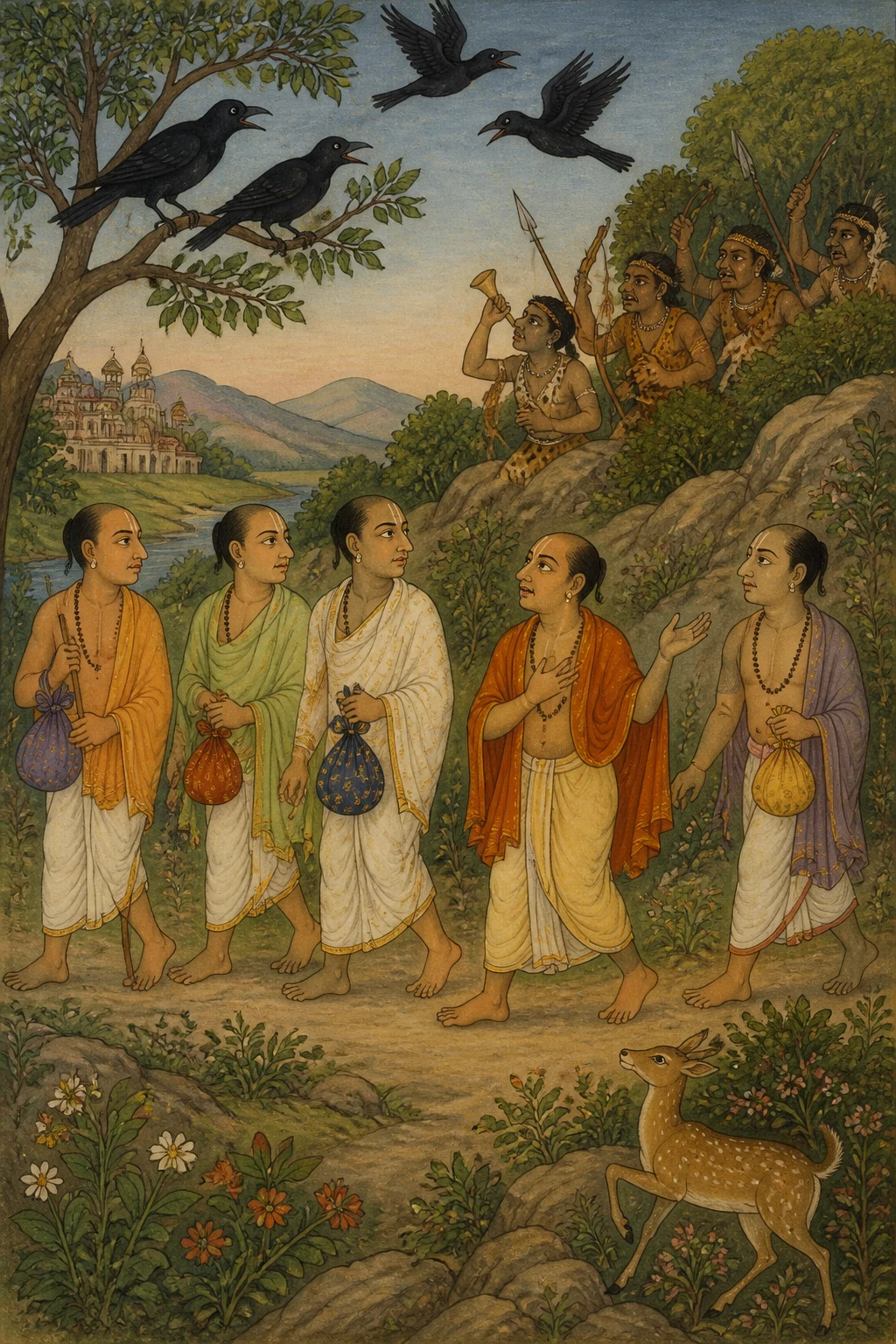
Meghavarṇa asked, “How was that?” He replied: Story 3. The Tale of the Brahmin Mitraśarman. In a certain town lived a Brahmin named Mitraśarman, who maintained the sacred sacrificial fire. Once, in the month of Māgha, when a gentle breeze was blowing, clouds covered the sky, and rain was falling softly, he went to another village to ask for a sacrificial animal. He approached one of his patrons and said, “Good sir, I intend to perform a sacrifice at the coming new moon. Please give me an animal for it.”
The patron gave him a plump animal of the kind prescribed by the sacred texts. Finding it strong and apt to wander this way and that, the Brahmin hoisted it onto his shoulder and set off briskly toward his own town.
As he went along the road, he encountered three rogues, their throats parched with hunger. Seeing the plump animal riding on his shoulder, they said to one another, “Ah! A meal of that beast would make today’s bitter cold count for nothing. Let us trick him out of it and fortify ourselves against the chill.” One of them changed his appearance, approached the keeper of the sacred fire by a side path, and said, “Ho there, you foolish sacrificer! Why are you making yourself a laughingstock, doing something everyone condemns? Why are you carrying that unclean dog on your shoulder? For it is said:
Dogs, cocks, and outcastes are declared equally defiling to the touch;
Donkeys and camels are especially so. Therefore one should never touch them.
Overcome with anger, the Brahmin replied, “What! Are you blind, calling a sacrificial animal a dog?”
The rogue said, “Brahmin, there is no need to be angry. Go wherever you please.”
When he had gone a little farther along the road, the second rogue came up to him and said, “Oh, Brahmin, what a dreadful sight! Fond as you may be of this dead calf, it is hardly proper to carry it on your shoulder. For it is said:
The fool who touches a dead creature, whether beast or man,
Must purify himself with the five products of the cow or by the lunar fast.
The Brahmin answered angrily, “Are you blind, calling a sacrificial animal a dead calf?”
The other replied, “Reverend sir, do not be angry. I spoke out of ignorance. Do whatever you think best.”
When he had gone a short distance farther into the woods, the third rogue approached him in a different guise and said, “Sir, this is improper! Why are you carrying a donkey on your shoulder? Put it down. For it is said:
If a mortal touches a donkey, knowingly or unknowingly,
He is prescribed a bath with all his clothes on, to wash away the sin.
So put it down before anyone else sees you.”
Now believing the animal to be a donkey, the Brahmin flung it to the ground in terror and took to his heels toward home. The three rogues then came together, took the animal, and began feasting on it to their hearts’ content.
*********************************************************************** “That is why I say, ‘Cunning men, resourceful and discerning’ (116). Or, as the saying aptly puts it:
By a new servant’s humility, a guest’s flattering words, a courtesan’s tears,
And a rogue’s torrent of talk—there is no one in this world who has never been deceived.
“Moreover, one should not make enemies of a multitude, even if they are weak. For it is said:
Do not oppose the many: a multitude is hard to overcome.
Ants devour even a mighty serpent, though it writhes and struggles.
Meghavarṇa asked, “How was that?” Sthirajīvin told him: Story 4. The Tale of the Serpent Atidarpa. In a certain anthill lived an enormous black serpent named Atidarpa. One day, instead of following the usual passage out of his hole, he tried to emerge through another, narrower opening. As fate would have it, his great body was wounded as he forced it through the little gap. Drawn by the smell of blood from the wound, ants swarmed all over him and tormented him. How many could he kill, how many strike away? They were so numerous that they opened countless wounds, until Atidarpa, mangled all over, met his death. ***********************************************************************
“That is why I say, ‘Do not oppose the many’ (121). Now I have a proposal to make. Listen carefully, and do as I advise.”
Meghavarṇa said, “Give me your instructions. Your orders shall not be disobeyed.”
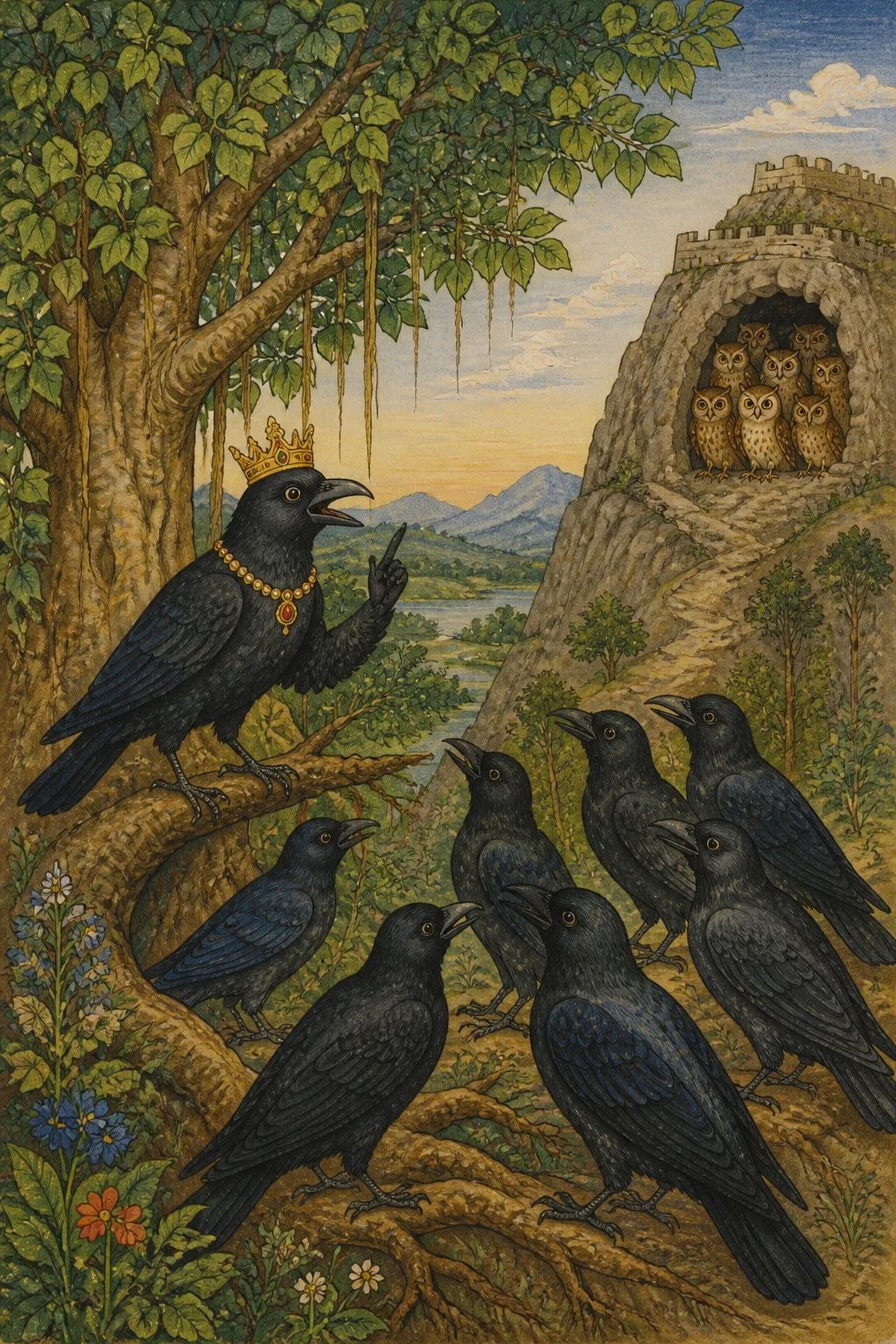
Sthirajīvin said, “Then listen, my child. I have devised a fifth expedient, beyond conciliation and the other customary methods. Treat me as an enemy and abuse me in harsh words. Then, to convince the enemy’s spies, smear me with blood brought for the purpose, throw me beneath this very banyan tree, and depart for Mount Ṛṣyamūka. Remain there with your followers until, by a carefully laid plan, I have gained all our enemies’ confidence and won them over. Once I have accomplished my purpose and learned the interior of their stronghold, I shall bring you there by day, when they are blind, and have them slaughtered. I am quite certain that we have no other way to succeed. This stronghold of ours has no escape route and will serve only as a place of slaughter. For it is said:
The knowledgeable call only a place with an escape route a fortress;
Without a way out, it is a prison masquerading as a fortress.
“And you must feel no pity on my account. For it is said:
When war breaks out, regard your servants as so much dry fuel,
Though you have cherished and nurtured them and loved them as your own life.
And again:
Guard your servants as your life and nourish them as your own body,
Always with that one day in mind when you must face the enemy.
“So you must not hinder me in this matter.” With these words, he began a sham quarrel with the king. Seeing Sthirajīvin speaking so insolently, the other servants made ready to kill him, but Meghavarṇa said, “Stand back, all of you! I shall punish this villain myself for siding with the enemy.” So saying, he climbed onto Sthirajīvin, struck him lightly with his beak, and drenched him in the blood that had been brought. Then he departed with his followers for Mount Ṛṣyamūka, as Sthirajīvin had advised.
Meanwhile, Kṛkālikā, who served as a spy for the enemy, reported everything: the minister’s ill-treatment and the king’s departure with his followers to some unknown place.
When the owl king heard this, he set out at sunset with his ministers and attendants to slaughter the crows. “Hurry, hurry!” he said. “Only by good fortune does one find an enemy frightened and intent on flight. For it is said:
An enemy is vulnerable when he leaves his former station and seeks another;
Amid the confusion of his royal servants, he falls into one’s power.
With these words, he surrounded the foot of the banyan tree on every side. Finding not a single crow, Arimardana climbed to the tip of a branch and, delighted, while his heralds sang his praises, addressed his followers: “Find out which way they went! By what road did the crows escape? We must follow and kill them before they reach a fortress. For it is said:
An enemy who has secured even a livelihood may be beyond a conqueror’s power to destroy;
How much more so one established in a fortress abundantly supplied!
At this point Sthirajīvin thought, “If these enemies of ours go back as they came, without learning what has happened to us, I shall have accomplished nothing. For it is said:
The first sign of wisdom is not to undertake an enterprise rashly;
The second is to carry through to the end what one has begun.
“Better not to begin than to let an undertaking fail. I shall make a sound and reveal myself to them.” Having resolved on this, he uttered a faint cry. Hearing it, all the owls rushed forward to kill him. But he said, “Wait! I am Sthirajīvin, Meghavarṇa’s minister. It was Meghavarṇa himself who reduced me to this state. Inform your master. I have much to tell him.”
When they reported this, the owl king was astonished. He went to him at once and said, “Tell me, how did you come to be in such a plight?”
Sthirajīvin replied, “Your Majesty, listen to the cause of my misfortune. Yesterday that villain Meghavarṇa, distressed by the great number of crows you had killed, was overcome with grief and rage and prepared to march against you. I told him, ‘My lord, it is not wise for you to attack them. They are strong, and we are weak. For it is said: A weaker man who desires prosperity
Should not even dream of fighting one stronger than himself.
He who bends like a reed escapes destruction;
He who behaves like a moth is certain to perish.
“‘It is therefore best to make peace with him by offering gifts. For it is said:
When faced with a powerful enemy, a wise man should surrender even all he owns
To save his life; with his life preserved, he may gain wealth again.’
“Hearing this, he was incited to anger by wicked men and, suspecting me of favoring your cause, reduced me to this condition. Now your feet are my refuge. What need is there for further entreaty? As soon as I am able to move, I shall lead you to his dwelling and bring about the destruction of every crow.” Hearing this, Arimardana consulted the ministers whose offices had descended to them from their fathers and grandfathers. He had five ministers: Raktākṣa, Krūrākṣa, Dīptākṣa, Vakranāsa, and Prākārakarṇa. First he asked Raktākṣa, “My good fellow, here is our enemy’s minister, fallen into my hands. What should be done?” Raktākṣa replied, “Your Majesty, what is there to consider? Kill him without hesitation, for:
An enemy should be killed while weak, before he grows strong;
Once he has regained his strength and valor, he is hard to overcome.
“Besides, people say that Fortune curses the man who turns her away when she comes of her own accord. For it is said:
Opportunity comes but once to the man who waits for it;
If he wishes to act later, he will find it hard to regain.
“There is also this tale:
A cruel hunter, vile in conduct, like Death to living creatures,
Wandered through a vast forest with his hounds.
Arimardana asked, “How was that?” Raktākṣa told him: Story 5. The Tale of the Brahmin and the Serpent. In a certain town lived a Brahmin named Haridatta. Though he labored at farming, season after season passed without profit. One day, toward the end of the hot season, oppressed by the heat, he was lying in the shade of a tree in the middle of his field when he saw, not far away, a fearsome serpent stretched upon an anthill, its broad hood spread. He thought, “Surely this is the guardian deity of my field, and I have never once worshipped it. That must be why my farming yields nothing. Today I shall pay it homage.” Having made up his mind, he begged some milk, poured it into a dish, approached the anthill, and said, “Guardian of the field, all this time I have not known that you lived here, and so I have offered you no worship. Please forgive me now.” With these words he offered the milk and went home. When he returned the next morning, he found a gold dinar in the dish. Thereafter he came alone every day, gave the serpent milk, and took away a dinar. One day the Brahmin went to another village, instructing his son to carry the milk. The son took it there, set it down, and returned home. When he went back the following day, he found the dinar and took it, thinking, “This anthill must be full of gold dinars. I shall kill the serpent and take them all at once.” Having resolved on this, the Brahmin’s son brought the milk the next day and struck the serpent with a club. By a stroke of fortune the serpent escaped death, and in its fury bit him with such venomous fangs that
He died on the spot. His relatives cremated him on a pile of wood not far from the field.
The next day his father returned. When he heard from his relatives how his son had died, he accepted the justice of it and said:
He who shows no kindness to creatures that seek his protection
Loses the wealth he has gained, as happened to the swans in the lotus lake.
The people asked, “How was that?” The Brahmin told them: Story 6. The Tale of the Golden Swans. In a certain city ruled a king named Citraratha. He possessed a lake called Padmasaras, well guarded by his soldiers. Many swans of pure gold lived there, and every six months each of them shed a single feather. One day a great golden bird arrived at the lake. The swans told him, “You may not live among us. We have secured this lake by giving the king one feather apiece every six months.” In short, a quarrel arose between them. The newcomer sought the king’s protection and said, “Your Majesty, these birds say, ‘What can the king do to us? We shall not let anyone else live here.’
“I told them, ‘It is not right for you to speak like that. I shall go and report this to the king.’ Such is the situation; Your Majesty must decide.”
The king then told his servants, “Go! Kill every one of those birds and bring them here at once.” No sooner had the order been given than they set out.
When the birds saw the king’s men approaching with clubs in their hands, an old bird among them said, “My kinsfolk, disaster is upon us. We must all rise into the air together.” And so they did.
***********************************************************************
“That is why I say, ‘He who shows no kindness to creatures’ (133).”
Having said this, the Brahmin once more took milk at dawn, went to the anthill, and praised the serpent in a loud voice. The serpent remained hidden for a long time inside the entrance, then answered him: “You have come here out of greed, putting aside even your grief for your son. There can be no friendship between us now. In the recklessness of youth your son struck me, and I bit him. How can I forget the blow of his club? And how can you forget the anguish of losing your son?” With these words it withdrew into its hole. The Brahmin took the jewel and returned home, condemning his son’s folly. “That is why I say, ‘Look at the blazing funeral pyre.’ If this crow is killed, your kingdom will be rid of its thorn without further effort.” Having heard Raktākṣa’s advice, the king asked Krūrākṣa, “My good fellow, what do you think?”
He replied, “Your Majesty, what he has said is merciless. One who seeks refuge must not be killed. There is an excellent tale on this subject:
We hear that a dove duly honored an enemy who sought shelter,
And offered him its own flesh for food.
Arimardana asked, “How was that?” Krūrākṣa told him: Story 7. The Tale of the Dove and the Hunter.
A certain cruel fowler, vile in conduct, like Death to living creatures,
Wandered through a vast forest.
He had neither friend nor relation nor kinsman;
All had abandoned him because of his cruel occupation.
Indeed:
Merciless, wicked men who take the lives of living creatures
Are a terror to all beings, like savage beasts.
Taking a little cage, a snare, and a club,
He went into the forest every day, dealing harm to every living thing.
One day, as he wandered in the woods, a female dove
Fell into his hands, and he put her in his cage.
Then, while he was still in the forest, clouds darkened every quarter,
And a mighty storm of wind and rain arose, as though the world were ending.
His heart filled with terror, and trembling again and again,
He sought shelter and came upon a great tree.
After a while he saw the sky clear and bright with stars.
Having reached the tree, he spoke: “Whoever dwells here,
I have come to him for refuge. Let him protect me,
For I am racked with cold and faint with hunger.”
Now a male dove had long made his home in that tree.
Bereft of his wife, he sat there lamenting in deep sorrow:
“The wind and rain have been fierce, and my beloved has not returned.
Without her, my home is empty today.
Devoted to her husband, living for him, intent upon his happiness and welfare—
Blessed is the man on earth who has such a wife!
A house, they say, is not a home: it is the wife who makes the home.
A house without its mistress is no better than the wilderness.”
Hearing her husband’s sorrowful words from within the cage,
The female dove was filled with joy and said to herself:
“She whose husband finds no happiness in her should not be called a wife.
When her husband is pleased, all the gods are pleased with a woman.
Like a vine with its clusters of blossoms scorched by a forest fire,