Waltey
Vojna med vranami in sovami
Pančatantra · indijska zbirka pripovediO besedilu
Vojna med vranami in sovami
- Vir
- Pančatantra
- Avtor
- indijska zbirka pripovedi
- Jezik branja
- English
- Jezik izvirnika
- Sanskrit
- Čas branja
- 16 min branja
- Obseg
- 13 strani
- Naslov izvirnika
- Tantra 03 kakolukiya chunk 1
O izvirniku
Pančatantra
Indijske zgodbe o zvijači, prijateljstvu in modrosti v svetu živali in vladarjev. Bralni jezik je English, izvirnik pa prihaja iz vira Pančatantra v jeziku Sanskrit.
Besedilo
Vojna med vranami in sovami
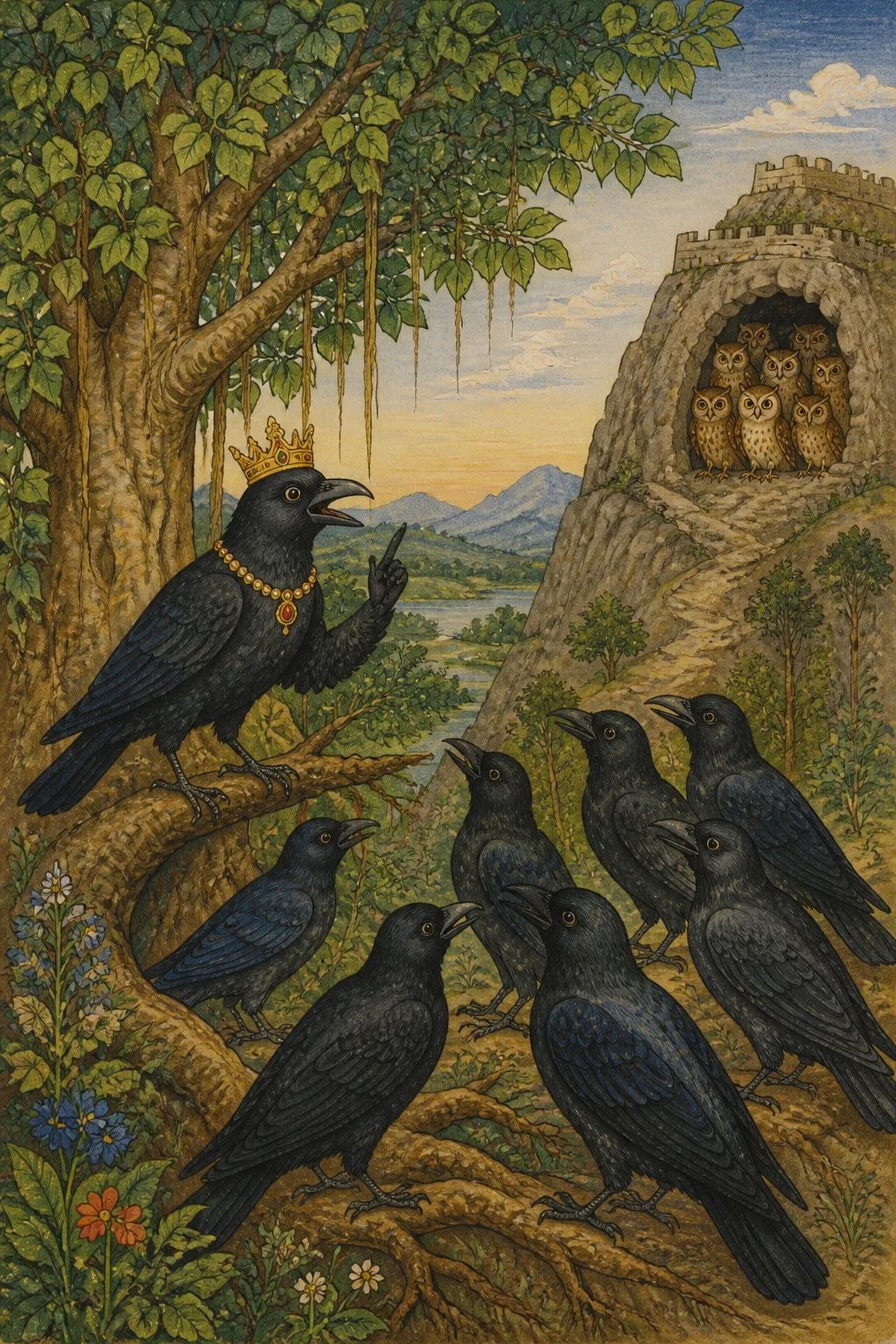
Now begins the third book, called “Crows and Owls.” Its opening verse is this: Never trust a former foe, even when that enemy has become a friend. Behold the cave, crowded with owls, burned to ashes by fire brought there by a crow. The story is told as follows. In the southern country there was a city called Mahilāropya. Near it stood a banyan tree with countless branches, clothed in exceedingly thick foliage. There lived Meghavarṇa, king of the crows, surrounded by a great company of his kind. He had fortified the tree and passed his days there with his followers. Elsewhere lived a king of the owls named Arimardana, with an innumerable host of owls, sheltered in the stronghold of a mountain cave. Every night he came and circled the banyan tree. Because of their ancient enmity, whenever the owl king encountered a crow, he killed it and went on his way. Through these nightly attacks he gradually cleared the whole area around the banyan stronghold of crows. Indeed, this is only to be expected, for it is said:
He who idly neglects an enemy advancing unchecked, or a disease, is gradually destroyed by it. And again: He who fails to subdue an enemy or an illness at its first appearance, however mighty he may be, is destroyed by it when it has grown strong. One day the crow king summoned all his ministers and said, “Friends, our enemy is formidable, energetic, and skilled in choosing his moment. Every night he comes and slaughters our people. How are we to resist him? We cannot see at night, nor do we know where his stronghold is, so that we might go and attack it by day. Which course, then, should we choose: peace, war, marching out, holding our ground, seeking protection, or a double policy?” They replied, “Your Majesty has done well to raise this question. For it is said:
Even unasked, a minister should offer counsel; when asked, he must above all tell his king what serves his welfare. A minister who, when asked, fails to give advice that will bring lasting good, and speaks only to please, is to be regarded as an enemy. Therefore, Your Majesty, let us take counsel in private, so that we may devise a means to bring him under control.
For it is said: Those who bow before the stronger and strike when the time is right do not find their fortunes flowing backward, like rivers against their course. An enemy who is truthful, righteous, noble, strong, supported by brothers, and victorious in many battles is one with whom peace should be made. One should make peace even with an ignoble foe when life is in danger, for while life is preserved, everything may yet be preserved.
When a conqueror of many battles enters into an alliance with someone, his influence soon brings that ally’s enemies into submission. One should seek peace even with an equal, for victory in battle is uncertain. ‘Do not embark on a doubtful undertaking,’ said Bṛhaspati. Victory is uncertain for those who fight in this world; therefore war should be undertaken only after the other three expedients have failed.
Blinded by pride, a man who refuses peace even with an equal is utterly crushed; the stronger will not rest until he has smashed him like an unbaked pot. For the weak, battle with the powerful brings only death; the stronger remains unhurt, like a stone that has shattered an earthen pot. And further: Land, an ally, or gold—these are the three fruits of war. If none of these can be gained, one should not wage it.
A lion digging into a rat’s hole strewn with shards of stone will break his claws, and his reward, at best, will be a mouse. Therefore, where no substantial gain is possible and there is nothing but fighting, one should never bring such a war upon oneself. When assailed by someone stronger, take the way of the reed, if you wish your prosperity to endure—never the way of the serpent.
He who follows the reed’s example attains great prosperity; he who follows the serpent’s way earns only death. Draw yourself in like a tortoise and endure even blows; then, when the moment comes, rise wisely like a black cobra. A wise man should use expedients to quiet a conflict that has arisen; since victory is uncertain, he should not rush headlong into battle.
There is no sound precedent for fighting one stronger than oneself; a cloud never advances against the wind. One should not make peace with an enemy, however firmly the treaty is bound; water, though heated to the utmost, still puts out fire. And it is said: Never make peace with one devoid of truth and righteousness; what is corrupt by nature soon spoils, however sweetly perfumed.
“Therefore, in my judgment, we must fight him. For it is said: An enemy who is cruel, greedy, lazy, false, careless, cowardly, fickle, foolish, and contemptuous of his warriors is easily destroyed. “Besides, he has already defeated us. If we now speak of peace, his anger will only grow fiercer. For it is said: To conciliate an enemy who can be subdued only by force is to do harm.
What wise physician pours cold water on a fresh fever that calls for sweating? Words of conciliation only inflame an angry enemy, like drops of water suddenly falling into overheated ghee. Though the rutting elephant far exceeds him in size, the lion, relying on his great courage, sets his paw upon its head. A lesser foe, endowed with energy and strength, may kill a greater one, as the lion kills the elephant—so declares Bhāradvāja.
Enemies who cannot be slain by force must be slain by cunning, as Bhīma killed Kīcaka after assuming a woman’s guise. And again: Enemies submit to a king whose punishments are as terrible as death; but a king who endures everything they value no more than a blade of grass. What use is the birth of one whose fire never quenches the fire of mighty foes, and who has merely robbed his mother of her youth?
Prosperity whose body is not anointed with the saffron of an enemy’s blood, however lovely, brings no delight to the proud-hearted. What glory is there in the life of a king whose land has not been watered with his enemies’ blood and the tears of their wives? Against a wicked enemy, overwhelming in strength and restrained by no bounds, neither peace nor war is commended: departure alone is best.
Departure is of two kinds: one preserves life and wealth; the other is a military expedition undertaken by one who seeks conquest. A would-be conqueror of superior strength should march into an enemy’s country in Kārttika or Caitra, and not at other times. But any season is declared suitable for a sudden attack upon an enemy afflicted by calamity or weakened by some vulnerability.
Having secured his own territory with loyal, valiant, powerful warriors, he should enter the foreign country, sending spies ahead. He who invades another kingdom without knowing its forests, routes, reinforcements, water, and crops will never return to his own. “Therefore you should withdraw. And further: My lord, the second kind of departure, an expedition, is not advisable; neither war nor peace is fitting with that powerful villain.
“Moreover, the wise withdraw with a purpose. For it is said: The ram steps back only to strike; the angry lion crouches before he springs. Keeping their intentions in their hearts and their plans concealed, the wise endure, weighing some purpose of their own. And further: He who leaves his country at the sight of a powerful enemy lives to regain his realm, as Yudhiṣṭhira did.
The weak man who proudly fights against the stronger fulfills his enemy’s wish and destroys his own family. “Assailed as we are by a powerful foe, this is the time to withdraw, not to make peace or war.” Such was Anujīvin’s counsel, advocating retreat. Having heard him, the king said to Prajīvana, “Good sir, you too must tell us your opinion.” He replied, “Your Majesty, none of the three—peace, war, or departure—appeals to me. Holding our ground seems decidedly best. For it is said: A crocodile in its own element can drag down even a lordly elephant; but once displaced, it can be humbled even by a dog.
And again: When attacked by a stronger enemy, remain watchfully within your fortress, and from there summon friends to secure your deliverance. He who hears of an enemy’s approach and abandons his position, his heart distraught with fear, will never enter it again. Like a serpent without fangs or an elephant bereft of rut, a king deprived of his position is at the mercy of every creature.
Even a single man, standing in his own position, can withstand a hundred powerful enemies in battle; therefore one must not abandon one’s ground. Therefore make your fortress strong, supplied with brave warriors and provisions, protected by ramparts and moats, and furnished with weapons and all necessities. Remain within it, steadfastly resolved to fight: if you live, you will gain your kingdom; if you die, you will go to heaven. (A pair of verses.)
And further: Even the weak, united in one refuge, cannot be overcome by the strong, just as plants growing together withstand even a hostile wind. A solitary tree, though great, strong, and firmly rooted, can be violently overthrown by the wind. But trees growing close together, firmly rooted on every side, are not destroyed even by a furious gale, because they shelter one another.
So too, a man standing alone, however brave, is thought vulnerable by his enemies, who then strike him down. Such was Prajīvana’s counsel. This is the policy called holding one’s ground. Having heard this, the king said to Cirañjīvin, “Good sir, you too must tell us your opinion.” He replied, “Your Majesty, of the six policies, seeking protection seems to me the best. That is the course we should adopt. For it is said: What can even a capable and valiant man accomplish without help?
A blazing fire dies out of itself when there is no wind. Union benefits men, especially union with their own kind; rice grains stripped even of their husks will not sprout. “Remain here, then, and seek the protection of someone powerful who can remedy your misfortune. If, however, you abandon your own home and go elsewhere, no one will help you even with a word. For it is said: The wind befriends the fire that burns a forest, yet the same wind puts out a lamp. Who shows friendship to the weak?
“Nor is it absolutely necessary to seek the protection of a single powerful ally. Alliance even with the weak can provide security. For it is said: Just as a bamboo surrounded by a dense stand of other bamboos cannot be uprooted, so even a weak king is safe when supported by allies. “And if one gains the protection of someone truly great, what more need be said? For it is said: Who does not rise through association with the great?
A drop of water on a lotus leaf takes on the beauty of a pearl. “Thus, in my opinion, there is no remedy without seeking protection.” Such was Cirañjīvin’s counsel. When they had spoken, King Meghavarṇa bowed to an aged minister of his father’s, a long-lived crow named Sthirajīvin, who had mastered the whole science of statecraft, and said, “Father, although you were here, I questioned these ministers in order to test them, so that, after hearing everything, you might tell me what is best. Please now give me whatever instructions you think fitting.” He replied, “My child, all these ministers have spoken in accordance with the science of statecraft. Every one of their counsels is useful in its proper season. But this is the time for a double policy. For it is said:
When faced with a wicked and more powerful enemy, adopt a double policy, using both peace and war, while never laying aside distrust. “By winning an enemy’s confidence while placing no confidence in him, and by tempting him with gain, one may easily destroy him. For it is said: The wise sometimes strengthen an enemy whom they intend to destroy, just as phlegm, first increased with molasses, may then be wholly expelled.
And again: A man who is wholly open with women, an enemy, a false friend, and especially with courtesans, will not live long. One must act single-heartedly toward the gods, Brahmins, oneself, and one’s teacher; in all other dealings one should keep a double purpose. Singleness of heart is always commended in ascetics whose souls are disciplined, but not in those who covet prosperity, and least of all in kings.
“By adopting a double policy, you will remain in your own home and lure the enemy to his ruin through greed. Moreover, if you discover a weakness in him, you can go and strike him down.” Meghavarṇa said, “Father, I do not even know where he lives. How am I to discover his weaknesses?” Sthirajīvin replied, “My child, through spies I shall reveal not only his dwelling but his weaknesses as well. For it is said: Cows see by scent, Brahmins see through the Vedas, kings see through spies, and other people through their eyes.
And on this subject it is said: A king who, through secret agents, knows the key offices on his own side, and especially on the enemy’s, will not come to grief. Meghavarṇa said, “Father, what are these key offices? How many are there? And what sort of secret agents should be employed? Please explain it all.” He replied, “On this subject the venerable Nārada told Yudhiṣṭhira that there are eighteen key offices on the enemy’s side and fifteen on one’s own. Each should be investigated by three secret agents. Once these are known, both one’s own side and the enemy’s can be kept under control. For Nārada said to Yudhiṣṭhira: Do you keep watch over the eighteen key offices among your enemies and the fifteen on your own side,
using three unrecognized spies for each? “The term ‘key office’ refers to an official’s function. If its conduct is corrupt, it brings harm to the ruler; if excellent, it promotes his prosperity. Such officials include the minister, the royal chaplain, the commander of the army, the crown prince, the gatekeeper, the chamberlain, the chief administrator, the revenue collector, the keeper of stores, the magistrate, the herald, the superintendent of military resources, the superintendent of elephants, the treasurer, and the commanding officers responsible for forts, taxes, and frontiers. By sowing dissension among them, an enemy can quickly be overcome. On one’s own side there are the queen, the queen mother, the chamberlain, the gardener, the keeper of the bedchamber, the chief of spies, the astrologer, the physician, the betel-bearer, the teacher, the bodyguard, the quartermaster, the parasol-bearer, and the royal mistress. Hostility among these can undermine one’s own side. And again:
Physicians, astrologers, and teachers make suitable spies within one’s own circle; snake charmers and those disguised as madmen learn everything among the enemy. And again: Let secret agents skilled in their work gain a footing within the key offices and sound the depths of the vast waters of the enemy’s affairs. Having heard the minister’s words, Meghavarṇa then asked, “Father, what caused this ceaseless, deadly enmity between crows and owls?” He replied, “My child, once all the birds—swans, parrots, cuckoos, cātakas, owls, peacocks, pigeons, doves, ground birds, and the rest—gathered together and began anxiously to take counsel. ‘Alas,’ they said, ‘our king is Garuḍa, son of Vinatā, but he is devoted to Vāsudeva and gives us no thought at all. What use is such a king in name only, who does nothing to protect us when we are constantly caught in hunters’ snares? For it is said:
He who does not protect frightened creatures continually oppressed by others is surely Death himself in the guise of a king. If a king does not guide his subjects rightly, they founder like a ship at sea without a helmsman. A man should abandon these six as he would a shattered boat upon the ocean: a teacher who does not teach, a sacrificial priest who does not study, a king who does not protect, a wife who speaks harshly, a cowherd who longs for the village, and a barber who longs for the forest. (A pair of verses.)
“‘Let us therefore consider the matter and choose another king for the birds.’ Then, seeing an owl of auspicious appearance, they all declared, ‘This owl shall be our king. Bring everything needed for the royal consecration!’ Water was fetched from many sacred places; a collection of one hundred and eight herbs was prepared; a throne was set in place; a picture of the earth, adorned with its seven continents, oceans, and mountains, was drawn; a tiger skin was spread out; golden jars were filled; lamps, musical instruments, mirrors, and other auspicious objects were made ready. The foremost bards recited their praises, the Brahmins chanted the Vedas with radiant faces, and the young women sang. Kṛkālikā, the chief queen, had been brought forward, and the owl was just taking his seat upon the throne for the consecration when a crow appeared from somewhere. He thought, ‘Well, what is this gathering of all the birds, and this great celebration?’ When the birds saw him, they said to one another, ‘The crow is reputed to be clever among birds. For it is said:
Among men the barber is cunning; among birds, the crow; among fanged beasts, the jackal; and among ascetics, the white-robed mendicant.
Izvirnik
Tantra 03 kakolukiya chunk 1
Naslednje strani prikazujejo izvirno besedilo za primerjavo.
Source ID: panchatantra_gretil_tantra_03_chunk_01 Source URL: https://gretil.sub.uni-goettingen.de/gretil/1_sanskr/5_poetry/4_narr/vispancu.htm athedam ārabhyate kākolūkīyaṃ nāma tṛtīyaṃ tantram | yasyāyam ādyaḥ ślokaḥ- na viśvaset pūrva-virodhitasya śatroś ca mitratvam upāgatasya | dagdhāṃ guhāṃ paśya ulūka-pūrṇāṃ kāka-praṇītena hutāśanena tad yathānuśruyate-asti dakṣiṇātye janapade mahilāropyaṃ nāma nagaram | tasya samīpastho 'neka-śākhāsanātho 'tighanatara-patra-cchanno nyagrodha-pādapo 'sti | tatra ca megha-varṇo nāma vāyasa-rājo 'neka-kāka-parivāraḥ prativasati sma | sa tatra vihita-durga-racanaḥ saparijanaḥ kālaṃ nayati | tathānyo 'ri-mardano nāmolūka-rājo 'saṅkhyolūka-parivāro giri-guhā-durgāśrayaḥ prativasati sma | sa ca rātrāv abhyetya sadaiva tasya nyagrodhasya samantāt paribhramati | atholūkarājaḥ pūrva-virodha-vaśādyaṃ kañcid vāyasa-samāsādayati | taṃ vyāpādya gacchati | evaṃ nityābhigamanāc chanaiḥ śanais tan nyagrodha-pādapad-durgaṃ tena samantān nirvāyasaṃ kṛtam | athavā bhavaty evam | uktaṃ ca-
ya upekṣeta śatruṃ svaṃ prasarantaṃ yadṛcchayā | rogaṃ cālasya-saṃyuktaḥ sa śanais tena hanyate tathā ca- jāta-mātraṃ na yaḥ śatruṃ vyādhiṃ ca praśamaṃ nayet | mahābalo 'pi tenaiva vṛddhiṃ prāpya sa hanyate athānyedyuḥ sa vāyasa-rājaḥ sarvān sacivān āhūya provāca-bhoḥ ! utkaṭas tāvad asmākaṃ śatrur udyama-sampannaś ca kālavic ca nityam eva niśāgame sametyāsmat-pakṣa-kadanaṃ karoti | tat katham asya prativighātavyam ? vayaṃ tāvad rātrau na paśyāmaḥ | na ca divā durgaṃ vijānīmo yena gatvā praharāmaḥ | tad atra kiṃ yujyate sandhi-vigraha-yānāsana-saṃśraya-dvaidhī-bhāvānāṃ madhyāt | atha te procuḥ-yuktam abhihitaṃ devena yad eṣa praśnaḥ kṛtaḥ | uktaṃ ca- apṛṣṭenāpi vaktavyaṃ sacivenātra kiṃcana | pṛṣṭena tu viśeṣeṇa vācyaṃ pathyaṃ mahīpateḥ
yo na pṛṣṭo hitaṃ brūte pariṇāme sukhāvaham | mantro na priya-vaktā ca kevalaṃ sa ripuḥ smṛtam tasmād ekāntam āsādya kāryo mantro mahīpate | yena tasya vayaṃ kurmo niyamaṃ kāraṇaṃ tathā uktaṃ ca- balīyasi praṇamatāṃ kāle praharatām api | sampado nāvagacchanti pratīpam iva nimnagāḥ satyāḍhyo dhārmikaś cāryo bhrātṛ-saṅghātavān balī | aneka-vijayī caiva sandheyaḥ sa ripur bhavet sandhiḥ kāryo 'py anāryeṇa vijñāya prāṇa-saṃśayam | prāṇaiḥ saṃrakṣitaiḥ sarvaṃ yato bhavati rakṣitam aneka-yuddha-vijayī sandhānaṃ yasya gacchati |
tat-prabhāveṇa tasyāśu vaśaṃ gacchanty arātayaḥ sandhim icchet samenāpi sandigdho vijayī yudhi | na hi sāṃśayikaṃ kuryād ity uvāca bṛhaspatiḥ sandigdho vijayo yuddhe janānām iha yuddhyatām | upāya-tritayād ūrdhvaṃ tasmād yuddhaṃ samācaret asandadhāno mānāndhaḥ samenāpi hato bhṛśam | āmakumbham ivābhittvā nāvatiṣṭheta śaktimān samaṃ śaktimatā yuddham aśaktasya hi mṛtyave | vṛṣatkumbhaṃ yathā bhittvā tāvat tiṣṭhati śaktimān anyac ca- bhūmir mitraṃ hiraṇyaṃ vā vigrahasya phala-trayam | nāsty ekam api yady eṣāṃ vigrahaṃ na samācaret
khanann ākhu-bilaṃ siṃhaḥ pāṣāṇa-śakalākulam | prāpnoti nakha-bhaṅgaṃ hi phalaṃ vā mūṣako bhavet tasmān na syāt phalaṃ yatra puṣṭaṃ yuddhaṃ tu kevalam | na hi tat svayam utpādyaṃ kartavyaṃ na kathañcana balīyasā samākrānto vaitasīṃ vṛttim āśrayet | vāñchann abhraṃśinīṃ lakṣmīṃ na bhaujaṅgī kadācana kurvan hi vaitasīṃ vṛttiṃ prāpnoti mahatīṃ śriyam | bhujaṅga-vṛttim āpanno vadham arhati kevalam kaurmaṃ saṅkocam āsthāya prahārān api marṣayet | kāle kāle ca matimān uttiṣṭhet kṛṣṇa-sarpavat āgataṃ vigrahaṃ vidvān upāyaiḥ praśamaṃ nayet | vijayasya hy anityatvād rabhasena na sampatet
balinā saha yoddhavyam iti nāsti nidarśanam | prativātaṃ na hi ghanaḥ kadācid upasarpati śatruṇā na hi sandadhyāt suśliṣṭenāpi sandhinā | sutaptam api pānīyaṃ śamayaty eva pāvakam uktaṃ ca- satya-dharma-vihīnena na sandadhyāt kathañcana | sugandhito 'py asādhutvād acirād yāti vikriyām tasmāt tena yoddhavyam iti me matiḥ | uktaṃ ca yataḥ- krūro lubdho 'laso 'satyaḥ pramādī bhīrur asthiraḥ | mūḍho yodhāvamantā ca sukhocchedyo bhaved ripuḥ aparaṃ tena parābhūtā vayam | tad yadi sandhāna-kīrtanaṃ kariṣyāmas tad bhūyo 'tyantaṃ kopaṃ kariṣyati | uktaṃ ca- caturthopāya-sādhye tu ripau sāntvam apakriyā |
svedyam āma-jvaraṃ prājñaḥ ko 'mbhasā pariṣiñcati sāmavādāḥ sakopasya śatroḥ pratyuta dīpikāḥ | prataptasyeva sahasā sarpiṣas toya-bindavaḥ pramāṇābhyadhikasyāpi mahat-sattvam adhiṣṭhitaḥ | padaṃ mūrdhni samādhatte kesarī matta-dantinaḥ utsāha-śakti-sampanno hanyāc chatruṃ laghur gurum | yathā kaṇṭhīravo nāgaṃ bhāradvājaḥ pracakṣate māyayā śatravo vadhyā avadhyāḥ syur balena ye | yathā strī-rūpam āsthāya hato bhīmena kīcakaḥ tathā ca- mṛtyor ivogra-daṇḍasya rājño yānti vaśaṃ dviṣaḥ | sarvaṃsahaṃ tu manyante tṛṇāya ripavaś ca tam
na jātu śamanaṃ yasya tejas tejasvi-tejasām | vṛthā jātena kiṃ tena mātur yauvana-hāriṇā yā lakṣmīr nānuliptāṅgī vair-śoṇita-kuṅkumaiḥ | kāntāpi manasaḥ prītiṃ na sā dhatte manasvinām ripu-raktena saṃsiktā tat-strī-netrāmbubhis tathā | na bhūmir yasya bhūpasya kā ślāghā tasya jīvite balotkaṭena duṣṭena maryādā-rahitena ca | na sandhi-vigrahau naiva vinā yānaṃ praśasyate dvidhākāraṃ bhaved yānaṃ bhavet prāṇārtha-rakṣaṇam | ekam anyaj jigīṣoś ca yātrālakṣaṇam ucyate kārttike vātha caitre vā vijigīṣoḥ praśasyate | yānam utkṛṣṭa-vīryasya śatru-deśe na cānyadā
avaskanda-pradānasya sarve kālāḥ prakīrtitāḥ | vyasane vartamānasya śatrocchidrānvitasya ca svasthānaṃ sudṛḍhaṃ kṛtvā śūraiś cātair mahābalaiḥ | para-deśaṃ tato gacchet praṇidhi-vyāptam agrataḥ ajñātavī-vadhāsāra-toya-śasyo vrajet tu yaḥ | para-rāṣṭraṃ na bhūyaḥ sa sva-rāṣṭram adhigacchati tat te yuktaṃ kartum apasaraṇam | anyac ca- tan na yuktaṃ prabho kartuṃ dvitīyaṃ yānam eva ca | na vigraho na sandhānaṃ balinā tena pāpinā aparaṃ kāraṇāpekṣayāpasaraṇaṃ kriyate budhaiḥ | uktaṃ ca- yad apasarati meṣaḥ kāraṇaṃ tat prahartuṃ mṛga-patir api kopāt saṅkucaty utpatiṣṇuḥ |
hṛdaya-nihita-bhāvā gūḍha-mantra-pracārāḥ kim api vigaṇayanto buddhimantaḥ sahante anyac ca- balavantaṃ ripuṃ dṛṣṭvā deśa-tyāgaṃ karoti yaḥ | yudhiṣṭhira ivāpnoti punar jīvan sa medinīm yudhyate'haṅkṛtiṃ kṛtvā durbalo yo balīyasā | sa tasya vāñchitaṃ kuryād ātmanaś ca kula-kṣayam tad balavatābhiyuktsyāpasaraṇa-samayo 'yaṃ na sandher vigrahasya ca | evam anujīvi-mantro 'pasaraṇasya | atha tasya vacanam ākarṇya prajīvanam āha-bhadra ! tvam apy ātmano 'bhiprāyaṃ vada | so 'bravīt-deva ! mama sandhi-vigraha-yānāni trīṇy api na pratibhānti | viśeṣataś cāsanaṃ pratibhāti | uktaṃ ca- nakraḥ sva-sthānam āsādya gajendram api karṣati | sa eva pracyutaḥ sthānāc chunāpi paribhūyate
tathā- abhiyukto balavatā tiṣṭhan durge prayatnavān | tatrasthaḥ suhṛdāhvānaṃ kurvītātma-vimuktaye yo ripor āgamaṃ śrutvā bhaya-santrasta-mānasaḥ | sva-sthānaṃ hi tyajet tatra na tu bhūyo viśec ca saḥ daṃṣṭrā-virahitaḥ sarpo mada-hīno yathā gajaḥ | sthāna-hīnas tathā rājā gamyaḥ syāt sarva-jantuṣu nija-sthāna-sthito 'py ekaḥ śataṃ yoddhuṃ sahen naraḥ | śaktānām api śatrūṇāṃ tasmāt sthānaṃ na santyajet tasmād durgaṃ dṛḍhaṃ kṛtvā subhaṭāsāra-saṃyutam | prākāra-parikhā-yuktaṃ śastrādibhir alaṅkṛtam tiṣṭhen madhya-gato nityaṃ yuddhāya kṛta-niścayaḥ |
jīvan samprāptsyati rājyaṃ mṛto vā svargam eṣyati (yugmakam) anyac ca- balināpi na bādhyante laghavo 'py eka-saṃśrayāḥ | vipakṣeṇāpi marutā yathaika-sthāna-vīrudhāḥ mahān apy ekajo vṛkṣaḥ balavān supratiṣṭhitaḥ | prasahya iva vātena śakyo dharṣayituṃ yataḥ atha ye saṃhatā vṛkṣā sarvataḥ supratiṣṭhitāḥ | te na raudrānilenāpi hanyante hy eka-saṃśrayāt evaṃ manuṣyam apy ekaṃ śauryeṇāpi samanvitam | śakyaṃ dviṣanto manyante hiṃsanti ca tataḥ param evaṃ prajīva-mantraḥ | idam āsana-saṃjñakam | etat samākarṇya cirañjīvinaṃ prāha-bhadra ! tvam api svābhiprāyaṃ vada |
so 'bravīt-deva ! ṣāḍguṇya-madhye mama saṃśrayaḥ samyak pratibhāti | tat tasyānuṣṭhānaṃ kāryam | uktaṃ ca- asahāyaḥ samartho 'pi tejasvī kiṃ kariṣyati | nirvāte jvalito vahniḥ svayam eva praśāmyati saṅgatiḥ śreyasī puṃsāṃ sva-pakṣe ca viśeṣataḥ | tuṣair api paribhraṣṭā na prarohanti taṇḍulāḥ tad atraiva sthitena tvayā kaścit samarthaḥ samāśrayaṇīyaḥ, yo vipat-pratikāraṃ karoti | yadi punas tvaṃ sva-sthānaṃ tyaktvānyatra yāsyasi | tat ko 'pi te vāṅ-mātreṇāpi sahāyatvaṃ na kariṣyati | uktaṃ ca, yataḥ- vanāni dahato vahneḥ sakhī bhavati mārutaḥ | sa eva dīpa-nāśāya kṛśe kasyāsti sauhṛdam athavā naitad ekāntaṃ yad balinam ekaṃ samāśrayet | laghūnām api saṃśrayo rakṣāyai eva bhavati | uktaṃ ca, yataḥ- saṅghātavān yathā veṇur niviḍair veṇubhir vṛtaḥ |
na śakyeta samucchettuṃ durbalo 'pi yathā nṛpaḥ yadi punar uttama-saṃśrayo bhavati tat kim ucyate ? uktaṃ ca- mahājanasya samparkaḥ kasya nonnati-kārakaḥ | padma-patra-sthitaṃ toyaṃ dhatte muktā-phala-śriyam tad evaṃ saṃśrayaṃ vinā na kaścit pratīkāro bhavati iti me'bhiprāyaḥ | evaṃ cirañjīvi-mantraḥ | athaivam abhihite sa meghavarṇo rājā cirantanaṃ pitṛ-sacivaṃ dīrghāyuṣaṃ sakala-nīti-śāstra-pāraṅgataṃ sthirajīvi-nāmānaṃ praṇamya provāca-tāta ! yad ete mayā pṛṣṭāḥ sacivās tāvad atra-sthitasyāpi tava tat-parīkṣārtham, yena tvaṃ sakalaṃ śrutvā yad ucitaṃ tan me samādiśasi | tad yady uktaṃ bhavati tas samādeśyam | sa āha-vatsa ! sarvair apy etair nīti-śāstrāśrayam uktaṃ sacivaiḥ | tad upayujyate sva-kālocitaṃ sarvam eva | param eṣa dvaidhībhāvasya kālaḥ | uktaṃ ca-
aviśvāsaṃ sadā tiṣṭhet sandhinā vigraheṇa ca | dvaidhī-bhāvaṃ samāśritya pāpe śatrau balīyasi tac chatruṃ viśvāsyāviśvastair lobhaṃ darśayadbhiḥ sukhenocchidyate ripuḥ | uktaṃ ca- ucchedyam api vidvāṃso vardhayanty arim ekadā | guḍena vardhitaḥ śleṣmā yato niḥśeṣatāṃ vrajet tathā ca- strīṇāṃ śatroḥ kumitrasya paṇya-strīṇāṃ viśeṣataḥ | yo bhaved eka-bhāvo 'tra na sa jīvati mānavaḥ kṛtyaṃ deva-dvijātīnām ātmanaś ca guros tathā | eka-bhāvena kartavyaṃ śeṣaṃ dvaidha-samāśritam eko bhāvaḥ sadā śasto yatīnāṃ bhāvitātmanām | śrī-lubdhānāṃ na lokānāṃ viśeṣeṇa mahī-bhujām
tad dvaidhībhāvaṃ saṃśritasya tava sva-sthāne vāso bhaviṣyati, lobhāśrayāc ca śatrum uccāṭayiṣyasi aparaṃ-yadi kiñcic chidraṃ tasya paśyasi, tad gatvā vyāpādayiṣyasi | meghavarṇa āha-tāta mayā so 'vidita saṃśrayaḥ | tat kathaṃ tasya chidraṃ jñāsyāmi ? sthirajīvy āha-vatsa ! na kevalaṃ sthānaṃ, chidrāṇy api tasya prakaṭīkariṣyāmi praṇadhibhiḥ | uktaṃ ca- gāvo gandhena paśyanti vedaiḥ paśyanti vai dvijāḥ | cārai paśyanti rājānaś cakṣurbhyām itare janāḥ uktaṃ cātra viṣaye- yas tīrthāni nije pakṣe para-pakṣe viśeṣataḥ | guptaiś cārair nṛpo vetti na sa durgatim āpnuyāt meghavarṇa āha-tāta, kāni tīrthāny ucyante ? kati saṅkhyāni ca ? kīdṛśā guptacarāḥ ? tat sarvaṃ nivedyatām iti | sa āha-atra viṣaye bhagavatā nāradena yudhiṣṭhiraḥ proktaḥ | yac chatru-pakṣe'ṣṭādaśa-tīrthāni, sva-pakṣe pañcadaśa | tribhis tribhir guptacarais tāni jñeyāni | tair jñātaiḥ sva-pakṣaḥ para-pakṣaś ca vaśyo bhavati | uktaṃ ca nāradena yudhiṣṭhiraṃ prati-
kaccid aṣṭadaśāny eṣu sva-pakṣe daśa pañca ca | tribhis tribhir avijñātair vetsi tīrthāni cārakaiḥ tīrtha-śabdenāyukta-karmābhidhīyate | tad yadi teṣāṃ kutsitaṃ bhavati tat svāmino 'bhighātāya, yadi pradhānaṃ bhavati tad-vṛddhaye syād iti | tad yathā-mantrī, purohitaḥ, senāpatiḥ, yuvarājaḥ, dauvārikaḥ, antarvāsikaḥ, praśāsakaḥ, samāhartṛ-sannidhātṛ-pradeṣṭṛ-jñāpakāḥ, sādhanādhyakṣaḥ, gajādhyakṣaḥ, kośādhyakṣaḥ, durgapāla-karapāla-sīmāpāla-protkaṭa-bhṛtyāḥ | eṣāṃ bhedena drāg ripuḥ sādhyate | sva-pakṣe ca devī, jananī, kañcukī, mālikaḥ, śayyā-pālakaḥ, spaśādhyakṣaḥ, sāṃvatsarikaḥ, bhiṣag, tāmbūla-vāhakaḥ, ācāryaḥ, aṅga-rakṣakaḥ, sthāna-cintakaḥ, chatradharaḥ, vilāsinī | eṣāṃ vaira-dvāreṇa sva-pakṣe vighātaḥ | tathā ca-
vaidya-sāṃvatsarācāryāḥ sva-pakṣe'dhikṛtāś carāḥ | tathāhi-tuṇḍikonmattāḥ sarvaṃ jānanti śatruṣu tathā ca- kṛtvā kṛtya-vidas tīrtheṣv antaḥ praṇidhayaḥ padam | vidāṅkurvantu mahatas talaṃ vidviṣad-ambhasaḥ evaṃ mantri-vākyam ākarṇyātrāntare meghavarṇa āha-tāta ! atha kiṃ nimittam evaṃvidhaṃ prāṇāntikaṃ sadaiva vāyasolūkānāṃ vairam ? sa āha-vatsa ! kadācid dhaṃsa-śuka-kokila-cātaka-ulūka-mayūra-kapāta-pārāvata-viṣkira-prabhṛtayaḥ sarve'pi pakṣiṇaḥ sametya sodvegaṃ mantrayitum ārabdhāḥ | aho asmākaṃ tāvad vainateyo rājā, sa ca vāsudeva-bhakto na kām api cintām asmākaṃ karoti | tat kiṃ tena vṛthāsvāminā ? yo lubdhaka-pāśair nityaṃ nibadhyamānānāṃ na rakṣāṃ vidhatte | uktaṃ ca- yo na rakṣati vitrastān pīḍyamānān paraiḥ sadā |
jantūn pārthiva-rūpeṇa sa kṛtānto na saṃśayaḥ yadi na syān narapatiḥ samyaṅ netāḥ tataḥ prajāḥ | akarṇadhārā jaladhau viplaveteha naur iva ṣaḍ imān puruṣo jahyād bhinnāṃ nāvam ivārṇave | apravaktāram ācāryam anadhīyānam ṛtvijam arakṣitāraṃ rājānaṃ bhāryāṃ cāpirya-vādinīm | grāma-kāmaṃ ca gopālaṃ vana-kāmaṃ ca nāpitam (yugmam) tat, sañcityānyaḥ kaścid rājā vihaṅgamānāṃ kriyatām iti | atha tair bhadrākāram ulūkam avalokya sarvair abhihitam-yad eṣa ulūko rājāsmākaṃ bhaviṣyati, tad ānīyantāṃ nṛpābhiṣeka-sambandhinaḥ sambhārāḥ iti | atha sādhite vividha-tīrthodake, praguṇīkṛte'ṣṭottara-śata-mūlikā-saṅghāte pradatte siṃhāsane, vartite saptadvīpa-samudra-bhūdhara-vicitre dharitrī-maṇḍale, prastārite vyāghra-carmaṇi āpūriteṣu hema-kumbheṣu dīpeṣu vādyeṣu ca sajjīkṛteṣu darpaṇādiṣu māṅgalya-vastuṣu, paṭhatsu vandi-mukhyeṣu, vedoccāraṇa-pareṣu samudita-mukheṣu brāhmaṇeṣu, gīta-pare yuvati-jane, ānītāyām agra-mahiṣyāṃ kṛkālikāyām, ulūko 'bhiṣekārthaṃ yāvat siṃhāsane upaviśati tāvat kuto 'pi vāyasaḥ samāyātaḥ so 'cintayat-aho ! kim eṣa sakala-pakṣi-samāgamo mahotsavaś ca ? atha te pakṣiṇas taṃ dṛṣṭvā mithaḥ procuḥ | pakṣiṇāṃ madhye vāyasaś caturaḥ śrūyate | uktaṃ ca-
narāṇāṃ nāpito dhūrtaḥ pakṣiṇāṃ caiva vāyasaḥ | daṃṣṭriṇāṃ ca śṛgālas tu śvebhikṣus tapasvinām
Nadaljuj z branjem