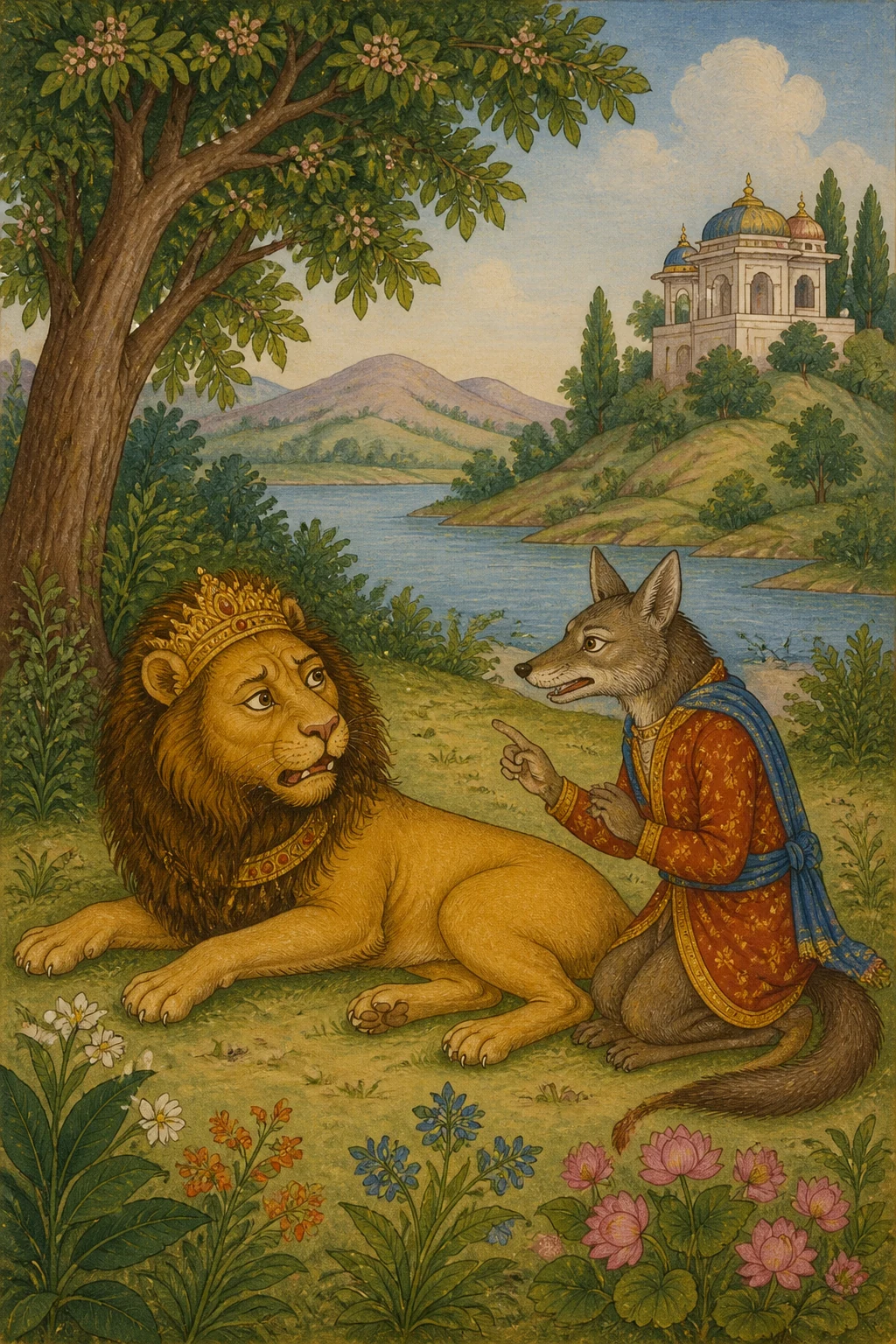
Waltey
Šakal seje razdor med levom in bikom
Pančatantra · indijska zbirka pripovediO besedilu
Šakal seje razdor med levom in bikom
- Vir
- Pančatantra
- Avtor
- indijska zbirka pripovedi
- Jezik branja
- English
- Jezik izvirnika
- Sanskrit
- Čas branja
- 16 min branja
- Obseg
- 13 strani
- Naslov izvirnika
- Tantra 01 mitra-bheda chunk 7
O izvirniku
Pančatantra
Indijske zgodbe o zvijači, prijateljstvu in modrosti v svetu živali in vladarjev. Bralni jezik je English, izvirnik pa prihaja iz vira Pančatantra v jeziku Sanskrit.
Besedilo
Šakal seje razdor med levom in bikom
Even unasked, one should offer sound advice to anyone whose downfall one would prevent.
Hearing the hidden meaning in his words, Piṅgalaka said, “What is it you wish to say? Tell me whatever needs to be said.”
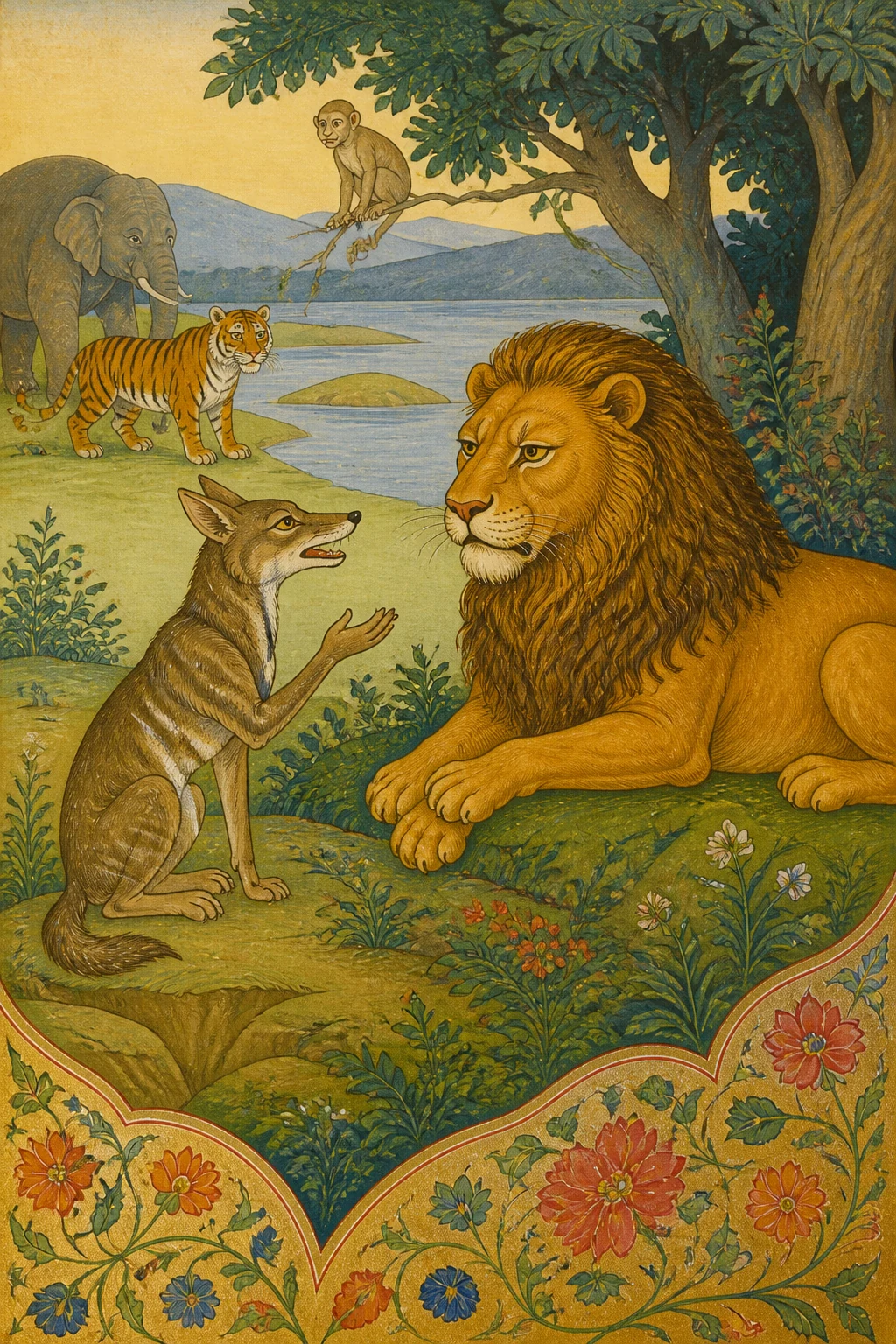
Damanaka replied, “Your Majesty, Sañjīvaka is plotting against you. Having taken me into his confidence, he told me privately, ‘Damanaka, I have discovered just how much—and how little—this Piṅgalaka is worth. I shall kill him and assume sovereignty over all the animals, with you as my minister.’” On hearing these terrible words, which struck him like a thunderbolt, Piṅgalaka was stunned and could not utter a word. Seeing his condition, Damanaka thought, “He is still deeply attached to Sañjīvaka. Surely this minister will bring the king to ruin. As the saying goes:
When a king makes one minister the sole authority in his kingdom, delusion gives rise to pride in that man, and pride makes him weary of service.
Once he is weary, a longing for independence takes root in his heart; and from that longing he begins to plot against his sovereign’s life.
“What, then, is the right course here?” Meanwhile, Piṅgalaka recovered his senses and managed to say, “Sañjīvaka is a servant as dear to me as life itself. How could he plot against me?”
Damanaka said, “Your Majesty, one cannot be certain who is a servant and who is not. As the saying goes:
There is no man who does not covet a king’s fortune.
Only those who lack the power to seize it remain in attendance on a sovereign.
Piṅgalaka said, “My good fellow, even so, my feelings toward him do not change. Indeed, it is well said:
Who does not cherish his own body, though it is tainted by countless faults?
One who is dear remains dear, even when he does us wrong.
Damanaka said, “That is precisely the trouble. As the saying goes:
Whatever man the king regards with special favor,
Whether lowborn or nobly born, becomes a vessel of prosperity.
“Besides, what particular merit does Your Majesty see in this worthless Sañjīvaka that you keep him so close? Perhaps you think, ‘He is huge; with his help I shall destroy my enemies.’ But he cannot serve that purpose, for he eats grass, while Your Majesty’s enemies eat flesh. His assistance will not enable you to overcome them. Therefore, find a charge against him and have him killed.” Piṅgalaka said:
One who has praised a man’s virtues before the assembly
Should not proclaim his faults, if he fears breaking his word.
“Moreover, at your urging I gave him my pledge of safety. How, then, can I kill him myself? In every way, Sañjīvaka is our friend. I feel no anger toward him. As the saying goes:
Through me that demon gained his prosperity; it is not fitting that through me he should be destroyed.
Even a poisonous tree, once one has nurtured it, should not be cut down by one’s own hand.
Either do not bestow affection on those who seek your love,
Or, once bestowed, nourish it day by day.
To raise someone up only to cast him down brings shame;
One who stands upon the ground has no fear of falling.
What merit is there in being good to those who help us?
The truly good, say the virtuous, are those who are good even to those who harm them.
“So even if he plots against me, I must not act against him.”
Damanaka said, “My lord! It is no part of a king’s duty to pardon a traitor. As the saying goes:
A servant equal in wealth and power, who knows his master’s weaknesses and is resolute,
Will seize half the kingdom; the king who does not kill him will himself be killed.
“Moreover, through friendship with him you have abandoned all your royal duties, and because you neglect them, your entire retinue has become estranged. Sañjīvaka eats grass; you eat flesh, as do your followers. Unless you hunt and kill, where are they to get meat? Deprived of it, they will leave you, and then you will be ruined. Yet through associating with him, you will never again feel inclined to hunt. As the saying goes:
Whatever the character of those who serve a man, and of those whose company he keeps,
Such, in time, he himself becomes—of this there is no doubt.
And again: A drop of water falling on red-hot iron vanishes without a trace;
The same drop on a lotus leaf gleams like a pearl.
Falling into an oyster’s shell in the sea under the star Svāti, it becomes a pearl indeed.
Thus inferiority, mediocrity, and excellence generally arise from the company one keeps.
And again:
Through the corrupting company of the wicked, even a good mind goes astray;
A piece of wood left among muñja grass for a single night is used to hang a man.
“That is why good people avoid the company of the base. As the saying goes:
Never give shelter to one whose character you do not know.
Through the bedbug’s fault, Mandavisarpiṇī was killed.
Piṅgalaka asked, “How did that happen?” Damanaka replied: Story 9. The Tale of the Louse Named Mandavisarpiṇī. “A certain king had a lovely bedchamber. There, between two spotless white sheets, lived a louse named Mandavisarpiṇī. Feeding on the king’s blood, she passed her days in comfort. One day a bedbug named Agnimukha, wandering about, found his way onto the bed. At the sight of him, her face fell, and she said, ‘Agnimukha! How have you come to this place where you do not belong? Leave at once, before anyone discovers you.’ He replied, ‘Good lady, that is no way to speak even to a scoundrel who has come to your home. As the saying goes:
“Come, welcome! Take this seat. Why have you not visited for so long? What news? You look very frail. Are you well? I am delighted to see you.”
To the houses of those who greet their visiting friends with such affectionate courtesy, one may always go without apprehension.
“‘Besides, I have tasted the blood of many kinds of people, but because of their poor diet it has been pungent, bitter, astringent, or sour. Never have I tasted sweet blood. If you will grant me the favor, I should like to delight my tongue by tasting this king’s sweet blood, enriched by all the delicious food he eats—dishes of every kind, drinks, things to suck, and things to lick. As the saying goes:
The pleasure of the tongue is held to be the same for a pauper as for a king. That alone is reckoned the essence of enjoyment, and it is for that that people strive.
If there were no work in this world that gratified the tongue, no one would become a servant or submit to another’s authority. Whatever lies a mortal tells, whatever unworthy master he serves, whatever foreign lands he travels to—all is for the sake of his belly.
“‘So, having come to your home tormented by hunger, I must ask you for a meal. It is not right for you to feast alone on this king’s blood.’
“Hearing this, Mandavisarpiṇī said, ‘Bedbug, I drink this king’s blood only after he has fallen asleep.
“‘You, on the other hand, are fiery-mouthed and restless. If you will drink only when I do, then stay and taste the blood you so desire.’
“He replied, ‘Good lady, I shall do exactly that. I swear by the gods and my teacher that I will not taste the king’s blood before you have tasted it first.’
“While the two were talking, the king came to the bed and lay down. But the bedbug, driven to frenzy by his greedy tongue, bit the king while he was still awake. Indeed, it is well said:
Instruction cannot alter one’s nature. Water, however fiercely heated, grows cold again. Even if fire were to become cold and the moon to burn, the nature of mortals could not be changed.
“Feeling as though he had been pierced by a needle, the king sprang out of bed at once. ‘Look here!’ he cried. ‘There must be a bedbug or a louse in these bedclothes—it has bitten me!’ The attendants standing nearby quickly took up the sheets and examined them closely. Meanwhile, the nimble bedbug had slipped into a crevice in the bedstead. But Mandavisarpiṇī, hiding in a seam of the cloth, was discovered and killed. That is why I say, ‘Never give shelter to one whose character you do not know.’” *********************************************************************** “Knowing this, you must kill him. Otherwise he will kill you. As the saying goes:
He who casts out his intimates and takes outsiders into his confidence
Meets his death, as did King Kakuddruma.
Piṅgalaka asked, “How did that happen?” Damanaka replied: Story 10. The Tale of the Jackal Named Caṇḍarava. “In a certain part of the forest lived a jackal named Caṇḍarava. One day, tormented by hunger and craving something tasty, he entered a town. When the town dogs saw him, they rushed at him from every side, barking and tearing at him with their sharp fangs. As they bit him, he fled in fear for his life into a nearby dyer’s house. A large vat full of indigo dye stood ready there. Pursued by the dogs, he fell into it. When he climbed out, he had turned blue. The dogs no longer recognized him as the jackal they had chased and went off in different directions. Caṇḍarava, meanwhile, made his way far from the town and headed for the forest. Now, indigo never loses its fast color. As the saying goes:
A fool, a woman, a crab, a fish, an adamantine adhesive, indigo dye, and strong drink—each holds fast to what it has seized.
“When the forest dwellers—lions, tigers, leopards, wolves, and the rest—saw this strange creature, dark as the poison in Śiva’s throat or the tamāla tree, they fled in every direction, their hearts filled with terror. ‘We do not know how this creature behaves or what strength it possesses,’ they said. ‘Let us keep well away. As the saying goes:
A wise man who desires his own prosperity should never trust anyone
Whose conduct, lineage, and prowess he does not know.
“Seeing their terror, Caṇḍarava called out, ‘Ho there, beasts of the forest! Why do you flee in fright at the mere sight of me? You have nothing to fear. Today Brahmā himself created me and said, “The beasts have no king. Therefore I anoint you today as lord of all the beasts, under the name Kakuddruma. Go down to earth and protect them all.” That is why I have come here. All of you must live beneath the shelter of my royal parasol. I, King Kakuddruma, have become renowned throughout the three worlds.’ Hearing this, the animals, with the lion and tiger at their head, gathered around him, saying, ‘Master! Lord! Give us your commands.’ He appointed the lion his minister, the tiger the guardian of his bedchamber, the leopard his betel-bearer, and the wolf his doorkeeper. But he would not so much as speak to the jackals, his own kin. He had them all seized by the neck and driven away. As he thus conducted the affairs of his kingdom, the lions and other beasts killed animals and laid them before him. He, fulfilling a sovereign’s duty, divided the meat and distributed it among them all. Time passed in this way. Then one day, while holding court, he heard in the distance the clamor of a pack of jackals howling. At the sound, his hair bristled with delight and tears of joy filled his eyes. He sprang up and began to howl at the top of his voice. Hearing that piercing cry, the lions and the others realized that he was a jackal. For a moment they stood with their heads lowered in shame; then they said, ‘This wretched jackal has duped us! Kill him!’
“Hearing this, he tried to escape, but the lions and the others tore him to pieces and killed him on the spot.
“That is why I say, ‘He who casts out his intimates and takes outsiders into his confidence…’”
***********************************************************************
After hearing this, Piṅgalaka said, “Damanaka, what proof is there that he bears me ill will?”
Damanaka replied, “Today, in my presence, he declared his resolve: ‘Tomorrow morning I shall kill Piṅgalaka.’ Here is how you may know it: when he comes to court in the morning, his face and eyes will be red, his lips will quiver, and he will look about in every direction. He will seat himself where he does not belong and glare at you fiercely. Recognize these signs and do what is necessary.” Having said this, Damanaka went to Sañjīvaka, bowed, and sat down. Sañjīvaka had seen him approaching slowly, with a troubled expression, and greeted him with particular warmth. “Welcome, my friend! It has been a long time since I saw you. Is all well with you? Tell me what I can give you, now that you have come to my home—even if it is something I would give to no one else. As the saying goes:
Blessed are they, discerning and truly gracious among the people of this earth,
To whose homes friends come when they need help.
Damanaka said, “My friend, how can all be well with a servant?
Their fortunes depend on others; their minds are never at peace;
Even their own lives are uncertain—such is the lot of those who serve a king.
And again:
See what servants have done in their desire to gain wealth through service:
The fools have forfeited even their freedom over their own bodies.
First comes birth, a source of great suffering; then lifelong poverty;
And on top of that, earning one’s bread through service—alas, what a chain of sorrows!
In the Bhārata, we are told of five who are dead though still alive:
The poor man, the sick man, the fool, the exile, and the lifelong servant.
He cannot eat when he wishes; anxiety robs him of sleep, yet he cannot rise when he chooses;
He cannot speak without fear—and still they say a servant lives!
Those who call service a dog’s life speak falsely:
A dog roams at will, but a servant moves at another’s command.
Sleeping on the ground, chastity, a lean body, and scanty food—
A servant shares these with an ascetic; the difference lies in the sinful purpose of his life.
The hardships of cold and heat that a servant endures for money
Would be but a small price to pay for liberation, if endured for righteousness.
What use is even a sweetmeat, soft, round, well made, and enticing,
If one must obtain it through service?
Sañjīvaka said, “But what is it you wish to tell me?” Damanaka replied, “My friend, it is not right for ministers to reveal state secrets. As the saying goes:
One who, appointed to the ministry, betrays his master’s counsel
Ruins the king’s enterprise and himself goes to hell.
A minister who betrays a king’s secret
Has slain him without a weapon—so says Nārada.
“Nevertheless, bound by my affection for you, I have revealed his counsel. For it was on my assurance that you placed your trust in this court and entered it. As the saying goes:
If a man meets his death through having trusted another,
The guilt for that killing falls upon the one he trusted—so Manu declared.
“Piṅgalaka has turned against you. Today, when we were alone together, he told me, ‘Tomorrow morning I shall kill Sañjīvaka and, after all this time, give my entire animal retinue a satisfying meal.’
“I said to him, ‘My lord! It is not right to sustain your life by betraying a friend. As the saying goes:
Even one who has killed a Brahmin may be purified by penance;
But no penance, however rigorously performed, can ever purify a betrayer of friends.
“Then he said to me angrily, ‘You fool! Sañjīvaka eats grass, while we eat flesh. We are natural enemies. Why, then, should an enemy be spared? I shall kill him by conciliation or whatever other means are needed, and there will be no sin in his death. As the saying goes:
A wise man should kill an enemy whom no other means can overcome, even if he must first give him his daughter in marriage.
There is no guilt in killing such a foe.
A warrior engaged in battle should not consider what is right or wrong:
Long ago, Droṇa’s son killed Dhṛṣṭadyumna while he slept.
“Having learned his resolve, I have come to you. Now I am free of the guilt of betraying your trust: I have disclosed his closely guarded secret. Do whatever seems best to you.” On hearing these words, dreadful as a thunderbolt, Sañjīvaka fainted. When he recovered his senses, he said in disillusionment, “Ah, how true the saying is:
Women are won by scoundrels; a king is generally devoid of affection;
Wealth follows misers, and clouds rain upon inaccessible mountains.
The fool who thinks, ‘I am held in honor by the king,’
Should be known for an ox without horns.
Better the forest, better begging, better to earn one’s bread by carrying burdens;
Better even sickness than wealth acquired through office.
“How ill-advised I was to make friends with him! As the saying goes:
Friendship and marriage are fitting between those equal in wealth and equal in lineage,
Not between the prosperous and the destitute.
And again:
Izvirnik
Tantra 01 mitra-bheda chunk 7
Naslednje strani prikazujejo izvirno besedilo za primerjavo.
Source ID: panchatantra_gretil_tantra_01_chunk_07 Source URL: https://gretil.sub.uni-goettingen.de/gretil/1_sanskr/5_poetry/4_narr/vispancu.htm apṛṣṭo 'pi hitaṃ vakṣyed yasya necchet parābhavam atha tasya sābhiprāyaṃ vacanam ākarṇya piṅgalaka āha-kiṃ vaktu-manā bhavān ? tat kathyatāṃ yat kathanīyam asti | sa prāha-deva sañjīvako yuṣmat-pādānām upari droha-buddhir iti | viśvāsa-gatasya mama vijane idam āha-bho damanaka ! dṛṣṭā mayāsya piṅgalakasya sārāsāratā | tad aham enaṃ hatvā sakala-mṛgādhipatyaṃ tvat-sācivya-padavī-samanvitaṃ kariṣyāmi | piṅgalako 'pi tad-vajra-sāra-prahāra-sadṛśaṃ dāruṇaṃ vacaḥ samākarṇya moham upagato na kiñcid apy uktavān | damanako 'pi tasya tam ākāram ālokya cintitavān-ayaṃ tāvat sañjīvaka-nibaddha-rāgaḥ | tan nūnam anena mantriṇā rājā vināśam avāpsyati iti | uktaṃ ca-
ekaṃ bhūmi-patiḥ karoti sacivaṃ rājye pramāṇaṃ yadā taṃ mohāc chrayate madaḥ sa ca madād dāsyena nirvidyate | nirviṇṇasya padaṃ karoti hṛdaye tasya svatantra-spṛhā- svātantrya-spṛhayā tataḥ sa nṛpateḥ prāṇān abhidruhyati tat kim atra yuktam iti | piṅgalako 'pi cetanāṃ samāsādya katham api tam āha-sañjīvakas tāvat prāṇa-samo bhṛtyaḥ | sa kathaṃ mamopari droha-buddhiṃ karoti | damanaka āha-deva, bhṛtyo 'bhṛtya ity anekāntikam etat | uktaṃ ca- na so 'sti puruṣo rājñāṃ yo na kāmayate śriyam | aśaktā eva sarvatra narendraṃ paryupāsate piṅgalaka āha-bhadra, tathāpi mama tasyopari citta-vṛttir na vikṛtiṃ yāti | athavā sādhv idam ucyate- aneka-doṣa-duṣṭasya kāyaḥ kasya na vallabhaḥ | kurvann api vyalīkāni yaḥ priyaḥ priya eva saḥ
damanaka āha-ata evāyaṃ doṣaḥ | uktaṃ ca- yasminn evādhikaṃ cakṣur āropayati pārthivaḥ | akulīnaḥ kulīno vā sa śriyā bhājanaṃ naraḥ aparaṃ kena gaṇa-viśeṣeṇa svāmī sañjīvakaṃ nirguṇakam api nikaṭe dhārayati | atha deva, yady evaṃ cintayasi mahā-kāyo 'yam | anena ripūn vyāpādayiṣyāmi | tad asmān na sidhyati, yato 'yaṃ śaṣpa-bhojī | deva-pādānāṃ punaḥ śatravo māṃsāśinaḥ | tad-ripu-sādhanam asya sāhāyyena na bhavati | tasmād enaṃ dūṣayitvā hanyatām iti | piṅgalaka āha- ukto bhavati yaḥ pūrvaṃ guṇavān iti saṃsadi | tasya doṣo na vaktavyaḥ pratijñā-bhaṅga-bhīruṇā anyac ca | mayāsya tava vacanenābhaya-pradānaṃ dattam | tat kathaṃ svayam eva vyāpādayāmi | sarvathā sañjīvako 'yaṃ suhṛd asmākam | na taṃ prati kaścin manyur iti | uktaṃ ca-
itaḥ sa daityaḥ prāpta-śrīr neta evārhati kṣayam | viṣa-vṛkṣo 'pi saṃvardhya svayaṃ chettum asāmpratam ādau na vā praṇayināṃ praṇayo vidheyo datto 'thavā pratidinaṃ paripoṣaṇīyaḥ | utkṣipya yat kṣipati tat prakaroti lajjāṃ bhūmau sthitasya patanād bhayam eva nāsti upakāriṣu yaḥ sādhuḥ sādhutve tasya ko guṇaḥ | apakāriṣu yaḥ sādhuḥ sa sādhuḥ sadbhir ucyate tad-droha-buddher api mayāsya na viruddham ācaraṇīyam | damanaka āha-svāmin ! naiṣa rāja-dharmo yad droha-buddhir api kṣamyate | uktaṃ ca- tulyārthaṃ tulya-sāmarthyaṃ marmajñaṃ vyavasāyinam | ardha-rājya-haraṃ bhṛtyaṃ yo na hanyāt sa hanyate
aparaṃ tvayāsya sakhitvāt sarvo 'pi rāja-dharmaḥ parityaktaḥ rāja-dharmābhāvāt sarvo 'pi parijano viraktiṃ gataḥ | yaḥ sañjīvakaḥ śaṣpa-bhojī | bhavān māṃsādaḥ | tava prakṛtayaś ca yat tavāvadhyavyasāya-bāhyaṃ kutas tāsāṃ māṃsāśanam | yad-rahitās tvāṃ tyaktvā yāsyanti | tato 'pi tvaṃ vinaṣṭa eva | asya saṅgatyā punas te na kadācid ākheṭake matir bhaviṣyati | uktaṃ ca- yādṛśaiḥ sevyate bhṛtyair yādṛśāṃś copasevate | kadācin nātra sandehas tādṛg bhavati pūruṣaḥ tathā ca- santaptāyasi saṃsthitasya payaso nāmāpi na jñāyate mukta-kāratayā tad eva nalinī-patra-sthitaṃ rājate | svātau sāgara-śukti-kukṣi-patitaṃ taj jāyate mauktikaṃ prāyeṇādhama-madhyamottama-guṇaḥ saṃvāsato jāyate tathā ca- asatāṃ saṅga-doṣeṇa satī yāti matir bhramam |
eka-rātri-pravāsena kāṣṭhaṃ muñje pralambitam ata eva santo nīca-saṅgaṃ varjayanti | uktaṃ ca- na hy avijñāta-śīlasya pradātavyaḥ pratiśrayaḥ | mat-kuṇasya ca doṣeṇa hatā manda-visarpiṇī piṅgalaka āha--katham etat ? so 'bravīt- kathā 9 manda-visarpiṇī-nāma-yūkā-kathā asti kasyacin mahīpater manoramaṃ śayana-sthānam | tatra śvetatara-paṭa-yugala-madhya-saṃsthitā manda-visarpiṇī yūkā prativasati sma | sā ca tasya mahīpate raktam āsvādayantī sukhena kālaṃ nayamānā tiṣṭhati | anye-dyuś ca tatra śayane kvacid bhrāmyann agnimukho nāma matkuṇaḥ samāyātaḥ | atha taṃ dṛṣṭvā sā viṣaṇṇa-vadanā provāca | bho 'gnimukha kutas tvam atrānucita-sthāne samāyātaḥ | tad yāvan na kaścid vetti tāvac chīghraṃ gamyatām iti | sa āha-bhagavati gṛhāgatasyāsādhor api naitad yujyate vaktum | uktaṃ ca-
ehy āgaccha samāviśāsanam idaṃ kasmāc cirād dṛśyase kā vārteti sudurbalo 'si kuśalaṃ prīto 'smi te darśanāt | evaṃ ye samupāgatān praṇayinaḥ pratyālapanty ādarāt teṣāṃ yuktam aśaṅkitena manasā harmyāṇi gantuṃ sadā aparaṃ mayāneka-mānuṣāṇām aneka-vidhāni rudhirāṇy āsvāditāny āhāra-doṣāt kaṭu-tikta-kaṣāyāmla-rasāsvādāni na ca kadācin madhura-raktaṃ samāsvāditam | tad yadi tvaṃ prasādaṃ karoṣi tad asya nṛpater vividha-vyañjanānna-pāna-coṣya-lehya-svādv-āhāra-vaśād asya śarīre yan miṣṭaṃ raktaṃ saṃjātaṃ tad-āsvādanena saukhyaṃ sampādayāmi jihvāyā iti | uktaṃ ca- raṅkasya nṛpater vāpi jihvā-saukhyaṃ samaṃ smṛtam | tan-mātraṃ ca smṛtaṃ sāraṃ tad-arthaṃ yatate janaḥ yady eva na bhavel loke karma jihvā-pratuṣṭidam | tan na bhṛtyo bhavet kaścit kasyacid vaśago 'tha vā yad asatyaṃ vaden martyo yad vāsevyaṃ ca sevate | yad gacchati videśaṃ ca tat sarvam udarārthataḥ
tan mayā gṛhāgatena bubhukṣayā pīḍyamānenāpi tvat-sakāśād bhojanam arthanīyam | tan na tvayaikākinyāsya bhūpate rakta-bhojanaṃ kartuṃ yujyate | tac chrutvā mandavisarpiṇy āha-bho matkuṇa ! asya nṛpater nidrā-vaśaṃ gatasya raktam āsvādayāmi | punas tvam agnimukhaś capalaś ca-tad yadi mayā saha rakta-pānaṃ karoṣi tat tiṣṭha | abhīṣṭatara-raktam āsvādaya | so 'bravīt-bhagavaty evaṃ kariṣyāmi | yāvat tvaṃ nāsvādayasi prathamaṃ nṛpa-raktaṃ tāvan mama deva-guru-kṛtaḥ śapathaḥ syād yadi tad āsvādayāmi | evaṃ tayoḥ parasparaṃ vadatoḥ sa rājā tac-chayanam āsādya prasuptaḥ | athāsau matkuṇo jihvā-laulyotkṛṣṭautsukyāj jāgratam api taṃ mahī-patim adaśat | atha vā sādhv idam ucyate | svabhāvo nopadeśena śakyate kartum anyathā | sutaptam api pānīyaṃ punar gacchati śītatām yadi syāc chītalo vahniḥ śītāṃśur dahanātmakaḥ | na svabhāvo 'tra martyānāṃ śakyate kartum anyathā
athāsau mahīpatiḥ sūcy-agra-viddha iva tac-chayanaṃ tyaktvā tat-kṣaṇād evotthitaḥ | aho jñāyatām atra pracchādana-paṭe matkuṇo yūkā vā nūnaṃ tiṣṭhati yenāhaṃ daṣṭa iti | atha ye kañcukinas tatra sthitās te satvaraṃ pracchādana-paṭaṃ gṛhītvā sūkṣma-dṛṣṭyā vīkṣāṃ cakruḥ | atrāntare sa matkuṇaś cāpalyāt khaṭvāntaṃ praviṣṭaḥ sā mandavisarpiṇy api vastra-sandhy-antar-gatā tair dṛṣṭā vyāpāditā ca | ato 'haṃ bravīmi-na hy avijñāta-śīlasya iti | *********************************************************************** evaṃ jñātvā tvayiṣa vadhyaḥ | no cet tvāṃ vyāpādayiṣyatīti | uktaṃ ca- tyaktāś cābhyantarā yena bāhyāś cābhyantarīkṛtāḥ | sa eva mṛtyum āpnoti yathā rājā kakud-drumaḥ piṅgalaka āha--katham etat ?
so 'bravīt- kathā 10 caṇḍarava-nāma-śṛgāla-kathā asti kasmiṃścid vanoddeśe caṇḍaravo nāma śṛgālaḥ prativasati sma | sa kadācit kṣudhāviṣṭo jihvā-laulyān nagara-madhye praviṣṭaḥ | atha taṃ nagara-vāsinaḥ sārameyā avalokya sarvataḥ śabdāyamānāḥ paridhāvya tīkṣṇa-daṃṣṭṛāgrair bhakṣitum ārabdhāḥ | so 'pi tair bhakṣyamāṇaḥ prāṇa-bhayāt pratyāsanna-rajaka-gṛhaṃ praviṣṭaḥ | tatra nīlī-rasa-paripūrṇaṃ mahā-bhāṇḍam sajjīkṛtam āsīt | tatra sārameyair ākrānto bhāṇḍa-madhye patitaḥ | atha yāvan niṣkrāntas tāvan nīlī-varṇaḥ sañjātaḥ | tatrāpare sārameyās taṃ śṛgālam ajānanto yathābhīṣṭa-diśaṃ jagmuḥ | caṇḍaravo 'pi dūrataraṃ pradeśam āsādya kānanābhimukhaṃ pratasthe | na ca nīla-varṇena kadācin nija-raṅgas tyajyate | uktaṃ ca- vajra-lepasya mūrkhasya nārīṇāṃ karkaṭasya ca | eko grahas tu mīnānāṃ nīlīmadyapayor yathā
atha taṃ hara-gala-garala-tamāla-sama-prabham apūrvaṃ sattvam avalokya sarve siṃha-vyāghra-dvīpi-vṛka-prabhṛtayo 'raṇya-nivāsino bhaya-vyākulita-cittāḥ samantāt palāyana-kriyāṃ kurvanti | kathayanti ca-na jñāyate'sya kīdṛg viceṣṭitaṃ pauruṣaṃ ca | tad dūrataraṃ gacchāmaḥ | uktaṃ ca- na yasya ceṣṭitaṃ vidyān na kulaṃ na parākramam | na tasya viśvaset prājño yadīcchec chriyam ātmanaḥ caṇḍaravo 'pi bhaya-vyākulitān vijñāyedam āha-bho bhoḥ śvāpadāḥ ! kiṃ yūyaṃ māṃ dṛṣṭvaiva saṃtrastā vrajatha | tan na bhetavyam | ahaṃ brahmaṇādya svayam eva sṛṣṭvābhihitaḥ-yac chvāpadānāṃ kaścid rājā nāsti, tat tvaṃ mayādya sarva-śvāpada-prabhutve'bhiṣiktaḥ kakud-drumābhidhaḥ | tato gatvā kṣiti-tale tān sarvān paripālayeti | tato 'ham atrāgataḥ | tan mama cchatra-cchāyāyāṃ sarvair api śvāpadair vartitavyam | ahaṃ kakuddrumo nāma rājā trailokye'pi sañjātaḥ |
tac chrutvā siṃha-vyāghra-puraḥ-sarāḥ śvāpadāḥ svāmin prabho samādiśeti vadantas taṃ parivavruḥ | atha tena siṃhasyāmātya-padavī pradattā | vyāghrasya śayyā-pālakatvam | dvīpinas tāmbūlādhikāraḥ | vṛkasya dvāra-pālakatvam | ye cātmīyāḥ śṛgālās taiḥ sahālāpa-mātram api na karoti | śṛgālāḥ sarve'py adharma-candraṃ dattvā niḥsāritāḥ | evaṃ tasya rājya-kriyayāṃ vartamānasya te siṃhādayo mṛgān vyāpādya tat-purataḥ prakṣipanti | so 'pi prabhu-dharmeṇa sarveṣāṃ tān pravibhajya prayacchati | evaṃ gacchati kāle kadācit tena samāgatena dūra-deśe śabdāyamānasya śṛgāla-vṛndasya kolāhalo 'śrāvi | taṃ śabdaṃ śrutvā pulakita-tanur ānandāśru-pūrṇa-nayana utthāya tāra-svareṇa virotum ārabdhavān | atha te siṃhādayas taṃ tāra-svaram ākarṇya śṛgālo 'yam iti matvā lajjāyādho-mukhāḥ kṣaṇaṃ sthitvā procuḥ-bhoḥ ! vāhitā vayam anena kṣudra-śṛgālena | tad vadhyatām iti |
so 'pi tad ākarṇya palāyitum icchaṃs tatra sthāna eva siṃhādibhiḥ khaṇḍaśaḥ kṛto mṛtaś ca | ato 'haṃ bravīmi-tyaktāś cābhyantarā yena iti | *********************************************************************** tad ākarṇya piṅgalaka āha-bho damanaka ! kaḥ pratyayo 'tra viṣaye yat sa mamopari duṣṭa-buddhiḥ | sa āha-yad adya mamāgre tena niścayaḥ kṛto yat prabhāte piṅgalakaṃ vadhiṣyāmi | tad atraiva pratyayaḥ | prabhāte'vasara-velāyām ārakta-mukha-nayanaḥ sphuritādharo diśo 'valokayann anucita-sthānopaviṣṭas tvāṃ krūra-dṛṣṭyā vilokayiṣyati | evaṃ jñātvā yad ucitaṃ tat kartavyam | iti kathayitvā sañjīvaka-sakāśaṃ gatas taṃ praṇamyopaviṣṭaḥ | sañjīvako 'pi sodvegākāraṃ manda-gatyā samāyāntaṃ tam udvīkṣya sādarataram uvāca-bho mitra ! svāgatam | cirād dṛṣṭo 'si | api śivaṃ bhavataḥ | tat kathaya yenādeyam api tubhyaṃ gṛhāgatāya prayacchāmi | uktaṃ ca-
te dhanyās te viveka-jñās te sabhyā iha bhūtale | āgacchanti gṛhe yeṣāṃ kāryārthaṃ suhṛdo janāḥ damanaka āha-bhoḥ ! kathaṃ śivaṃ sevaka-janasya | sampattayaḥ parāyattāḥ sadā cittam anirvṛtam | sva-jīvite'py aviśvāsas teṣāṃ ye rāja-sevakāḥ tathā ca- sevayā dhanam icchadbhiḥ sevakaiḥ paśya yat kṛtam | svātantryaṃ yac charīrasya mūḍhais tad api hāritam tāvaj janmāti-duḥkhāya tato durgatatā sadā | tatrāpi sevayā vṛttir aho duḥkha-paramparā jīvanto 'pi mṛtāḥ pañca śrūyante kila bhārate | daridro vyādhito mūrkhaḥ pravāsī nitya-sevakaḥ
nāśnāti svacchayotsukyād vinidro na prabudhyate | na niḥśaṅkaṃ vaco brūte sevako 'py atra jīvati sevā śva-vṛttir ākhyātā yais tair mithyā prajalpitam | svacchandaṃ carati svātra sevakaḥ para-śāsanāt bhū-śayyā brahmacaryaṃ ca kṛśatvaṃ laghu-bhojanam | sevakasya yater yadvad viśeṣaḥ pāpa-dharmajaḥ śītātapādi-kaṣṭāni sahate yāni sevakaḥ | dhanāya tāni cālpāni yadi dharmān na mucyate mṛdunāpi suvṛttena suśliṣṭenāpi hāriṇā | modakenāpi kiṃ tena niṣpattir yasya sevayā sañjīvaka āha-atha bhavān kiṃ vaktu-manāḥ ?
so 'bravīt-mitra, sacivānāṃ mantra-bhedaṃ na yujyate | uktaṃ ca- yo mantraṃ svāmino bhidyāt sācivye san-niyojitaḥ | sa hatvā nṛpa-kāryaṃ tat svayaṃ ca narakaṃ vrajet yena yasya kṛto bhedaḥ sacivena mahīpateḥ | tenāśastra-vadhas tasya kṛta ity āha nāradaḥ tathāpi mayā tava sneha-pāśa-baddhena mantra-bhedaḥ kṛtaḥ | yatas tvaṃ mama vacanenātra rāja-kule viśvastaḥ praviṣṭaś ca | uktaṃ ca- viśrambhād yasya yo mṛtyum avāpnoti kathañcana | tasya hatyā tad-utthā sā prāhedaṃ vacanaṃ manuḥ tat tavopari piṅgalako 'yaṃ duṣṭa-buddhiḥ kathitaṃ cādyānena mat-purataś catuṣkarṇatayā-yat prabhāte sañjīvakaṃ hatvā samasta-mṛga-parivāraṃ cirāt tṛptiṃ neṣyāmi | tataḥ sa mayoktaḥ-svāmin ! na yuktam idaṃ yan mitra-droheṇa jīvanaṃ kriyate | uktaṃ ca-
api brahma-vadhaṃ kṛtvā prāyaścittena śudhyati | tad-arthena vicīrṇena na kathañcit suhṛd-druhaḥ tatas tenāhaṃ samarṣeṇoktaḥ-bho duṣṭa-buddhe, sañjīvakas tāvac chaṣpa-bhojī, vayaṃ māṃsāśinaḥ | tad asmākaṃ svābhāvikaṃ vairam iti kathaṃ ripur upekṣyate ? tasmāt sāmādibhir upāyair hanyate | na ca hate tasmin doṣaḥ syāt | uktaṃ ca- dattvāpi kanyakāṃ vairī nihantavyo vipaścitā | anyopāyair aśakyo yo hate doṣo na vidyate kṛtyākṛtyaṃ na manyeta kṣatriyo yudhi saṅgataḥ | prasupto droṇa-putreṇa dhṛṣṭadyumnaḥ purā hataḥ tad ahaṃ tasya niścayaṃ jñātvā tvat-sakāśam ihāgataḥ | sāmprataṃ me nāsti viśvāsa-ghātaka-doṣaḥ | mayā sugupta-mantras tava niveditaḥ | atha yat te pratibhāti tat kuruṣva iti | atha sañjīvakas tasya tadvajra-pāta-dāruṇaṃ vacanaṃ śrutvā moham upagataḥ | atha cetanāṃ labdhvā sa-vairāgyam idam āha-bho sādhv idam ucyate-
durjana-gamyā nāryaḥ prāyeṇāsnehavān bhavati rājā | kṛpaṇānusāri ca dhanaṃ megho giri-durga-varṣī ca ahaṃ hi saṃmato rājño ya evaṃ manyate kudhīḥ | balīvardaḥ sa vijñeyo viṣāṇa-parivarjitaḥ varaṃ vanaṃ varaṃ bhaikṣaṃ varaṃ bhāropajīvanam | varaṃ vyādhir manuṣyāṇāṃ nādhikāreṇa sampadaḥ tad yuktaṃ mayā kṛtaṃ tad anena saha maitrī vihitā | uktaṃ ca- yayor eva samaṃ vittaṃ yayor eva samaṃ kulam | tayor maitrī vivāhaś ca na tu puṣṭa-vipuṣṭayoḥ tathā ca-
Nadaljuj z branjem