Prevod
This story takes place in the sixteenth century, in one of those Italian cities ruled by a tyrant. Let us call the city Montenero, if you like, and its tyrant Orso Amadei.
Orso was a man of his age: fierce, ruthless, secretive in his rancor, implacable in revenge. Brave in battle, lavish in his generosity, and exquisite in his artistic tastes, he entertained painters and poets in his palace, as the Medici did, and received in his private chamber the dubious alchemists of the day, who, though they never managed to manufacture gold, knew well enough how to distill potent poisons.
When some nobleman stood in Orso’s way, he would entice him into his company, swear friendship, share communion with him—horrible sacrilege!—from the same host, and seat him at his table... Then, in the midst of the banquet, the guest would rise, his eyes wild and his mouth foaming, and fall back, writhing... while his host, with hypocritical concern, felt his body to make certain that the ice of death was already coursing through his veins.
Orso wasted no such ceremony on commoners: he had them crippled with blows or left them to waste away from hunger in a dungeon. Orso had been widowed twice: he had dispatched his first wife with a dagger thrust, out of jealousy; the second, the only woman he ever loved, had been killed in revenge by Landolfo dei Fiori, the first wife’s brother. The first had left no children; the second had borne him a daughter and two sons. The boys perished in an obscure military encounter, an ambush perhaps laid by Landolfo himself, and the girl Lucía was left to carry on the accursed family of Amadei.
Her father the Prince was already considering whom she should marry when Lucía declared that she wished to take the veil. Orso was in despair, for in his own way he adored this last shoot of his line; but there was no help for it. Lucía’s will prevailed, and the girl entered a convent of the Order of Saint Dominic, in which Catherine, called Euphrosyne, whom the world now venerates as Saint Catherine of Siena, had flourished.
The tender youth, innocent beauty, and illustrious birth of the tyrant’s daughter made her penance all the more astonishing. In an age already pagan, she revived the harsh austerities of more fervent times.
Her food was a handful of boiled greens; her bed, two sacks without straw; her undergarment, a coarse fabric of Cilicia that left sores on her delicate skin. And when she rose to pray on January nights, after taking an hour’s rest on the damp flagstones that racked every bone in her body, she could scarcely stand from weakness, and the words of her prayers grew confused upon her lips.
For Lucía, a daughter of the Amadei after all, had not been born for mortification and suffering, but to drink the pleasures of life to the full: to delight in the sweet sound of the mandolin, in the harmonious rhythm of the poets’ stanzas, in the magic of color, in the sweet and mysterious stillness of gardens where the eternal beauty of Greek statues smiled—and only the burden of others’ sins and her longing for atonement had driven her, trembling with anguish and terror, to the foot of the altars, where at every moment her thoughts strayed unbidden to the world and its delights.
Like Catherine of Siena, she found herself assailed more than once by impure temptations and deceptive, mocking visions; but clinging to the cross, she resisted heroically. She wept, wounded her flesh, and at last knew she had triumphed by the peace that descended upon her spirit. Raptures and ineffable sweetness followed her faintness, and Lucía felt consoled.
Christmas came, the anniversary of her profession. Christmas Eve arrived with heavy snow; yet the thicker the shroud that covered the convent garden, the greater the warmth Lucía felt in her solitary cell. A strange illusion showed her, through the leaded panes, not snowflakes but thousands of pure white lilies raining down upon the branches of the trees and the hard earth, delicate as feathers plucked from angels’ wings.
Everything was strewn with lilies, and the whiteness of the garden gave off a radiance that lit the cell with moonbeams brighter and more lustrous than silver itself. Suddenly, wrapped in waves of gentle light, Lucía saw a beautiful Child, a little creature who smiled and held out his tiny arms, and whom the nun received into her own in an ecstasy of joy.
“Tonight,” said the Child lovingly, “I have chosen to bestow a favor upon you, Lucía, and instead of being born in the manger, I shall be born in the cell where you have called upon me so often.”
For a few moments Lucía remained beside herself; the favor was extraordinary, and in her humility she did not believe herself worthy of it. As soon as she could recover herself, she clasped her hands and fell prostrate, pleading with the Child.
“If you wish your servant to be happy, Child, beloved Child of my soul... grant what I am about to ask you. Ah! It is a great and difficult thing—but if you cannot accomplish the impossible, who can? Remember how I have struggled, remember my sufferings... and instead of being born here, deign to be born in another place, dark, horrible, desolate... The heart of my father, Orso Amadei.”
Stroking the penitent’s face with his little hands, the Child looked at her sorrowfully. “Do you know what you are asking, Lucía? Do you know that this heart in which you wish me to be born is harder than stone, bloodier than the scaffold, fouler than the grave? Do you know that to enter it I shall have to push aside thorns, briars, and poisonous weeds with my naked body, and feel vipers coil about my neck and cold reptiles crawl up my legs? I have endured the most shameful of deaths; but when it came to being born, I sought tenderness and love. I was born among simple shepherds, not ravening wolves! Yet, Lucía, since you have fought for me, I shall not deny you what you desire... Tonight my stable in Bethlehem shall be your father’s savage heart!”
On hearing the Child’s promise, Lucía felt a joy so great that she could not bear it. She fell motionless upon the flagstones. The light, the vision, the fragrance of the lilies all vanished, and through the leaded panes nothing could be seen but the garden shrouded in snow.
At that very hour, Orso Amadei was holding a feast in his palace—or rather, an orgy. It was no supper where witty sayings and merry tales made the hours fly, and the presence of ladies, encouraging gallantry, restrained brutality. Orso had given many such suppers, but he also enjoyed wilder gatherings, attended only by his half-bandit captains, his jesters, and his intimates, cynical and vicious men.
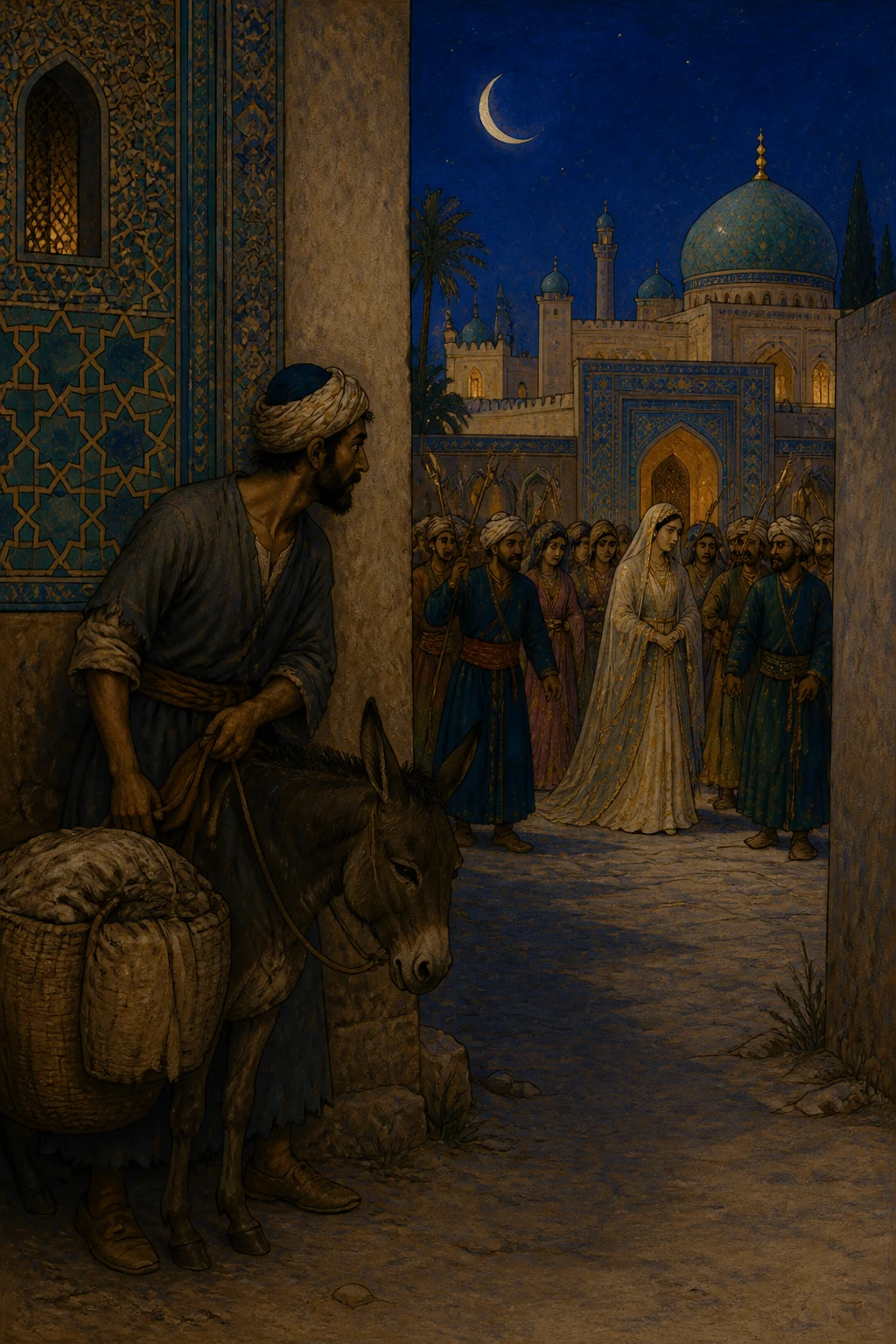
If any woman found herself among them, she was some unfortunate strolling performer seized in the public square, who, after serving as the guests’ plaything, would turn up the next day bruised and half dead, dumped in some alley of the city. That night Ridolfi, one of Orso’s captains, had announced better prey: he had just caught a very pretty young woman—so much the worse for her if she was out in the street at such an hour! The drinkers grew boisterous. Roaring with laughter, Orso ordered the girl brought in. She entered, pushed forward by the soldiers, trembling, her fair hair disheveled, and the men swelled with satisfaction at the sight of her, for she was indeed supremely beautiful.
Orso fixed his lustful eyes upon her, reached out his hand, brushed aside her golden curls... and recoiled in astonishment. In the helpless girl placed there for him to violate, he saw the face of his daughter Lucía: the same features, the cheeks, the brow, flushed with shame.
“Release that woman!” Orso shouted. “Have her escorted home with the utmost respect. Let no one harm her... Woe to anyone who touches a hair of her head! Let her be treated as you would treat me...”
The drunken men, astonished, obeyed without understanding. The feast continued, but Orso, troubled and brooding, no longer drained his cup. Eager to cheer him, Ridolfi made a sign, instantly understood, and a few minutes later a prisoner dying of hunger was brought into the banqueting hall. They often amused themselves by taking one of these men from his dungeon, after depriving him of food for days, seating him at the table, and offering him some exquisite delicacy; then, just as he was about to gulp it down, sobbing and howling with delight, they would snatch it from his mouth and pour into it the burning wax from the torches that lit the orgy.
The prisoner was young, and Orso, jesting, held out to him a plate of steaming roast meat and a cup of Lacrima wine; but on seeing him close at hand, he uttered a curse. The eyes that gazed at him with painful reproach from that wasted martyr’s face, the mouth that thanked him, were Lucía’s mouth and eyes, her very gaze, which her father could not fail to recognize: a gaze reflecting affection, the light of a soul seeking another light like its own.
“Set this man free,” Orso ordered. “First give him plenty to eat, as much as he wishes. And make him a gift of two golden pitchers, and as much wine as he wants... Let him be treated as you would treat me... Do you hear? As you would treat me!”
Grumbling, Ridolfi carried out the order. Almost at the very moment the prisoner was leaving, an old woman appeared in the banqueting hall with a little child in her arms. “Mercy, great lord!” she cried. “Mercy for the child you see here. This little one is the son of your brother-in-law Landolfo dei Fiori, whom you hate, and some soldiers, on your orders, they say, mean to dash him against a wall. You cannot have given so cruel an order, and I place him under your protection.” At the hated name of Landolfo, Orso shook with fury, and drawing his dagger, was about to plunge it into the little one’s throat... But the child smiled serenely at him, and his smile was Lucía’s enchanting, unforgettable smile when her father caressed her in the days of her childhood. Overcome, Orso fell to his knees and, beating his breast, began to confess his sins aloud; for Jesus, faithful to his promise, had just been born in that heart darker than the abyss of hell...
The following morning, Orso received word that his daughter had breathed her last at the stroke of midnight. The tyrant tied a rope about his neck, walked barefoot through the city streets begging the inhabitants’ forgiveness, and, leaning on a staff, slowly departed. He was never heard of again. Blessed are those in whose hearts the Child is born!