Prevod
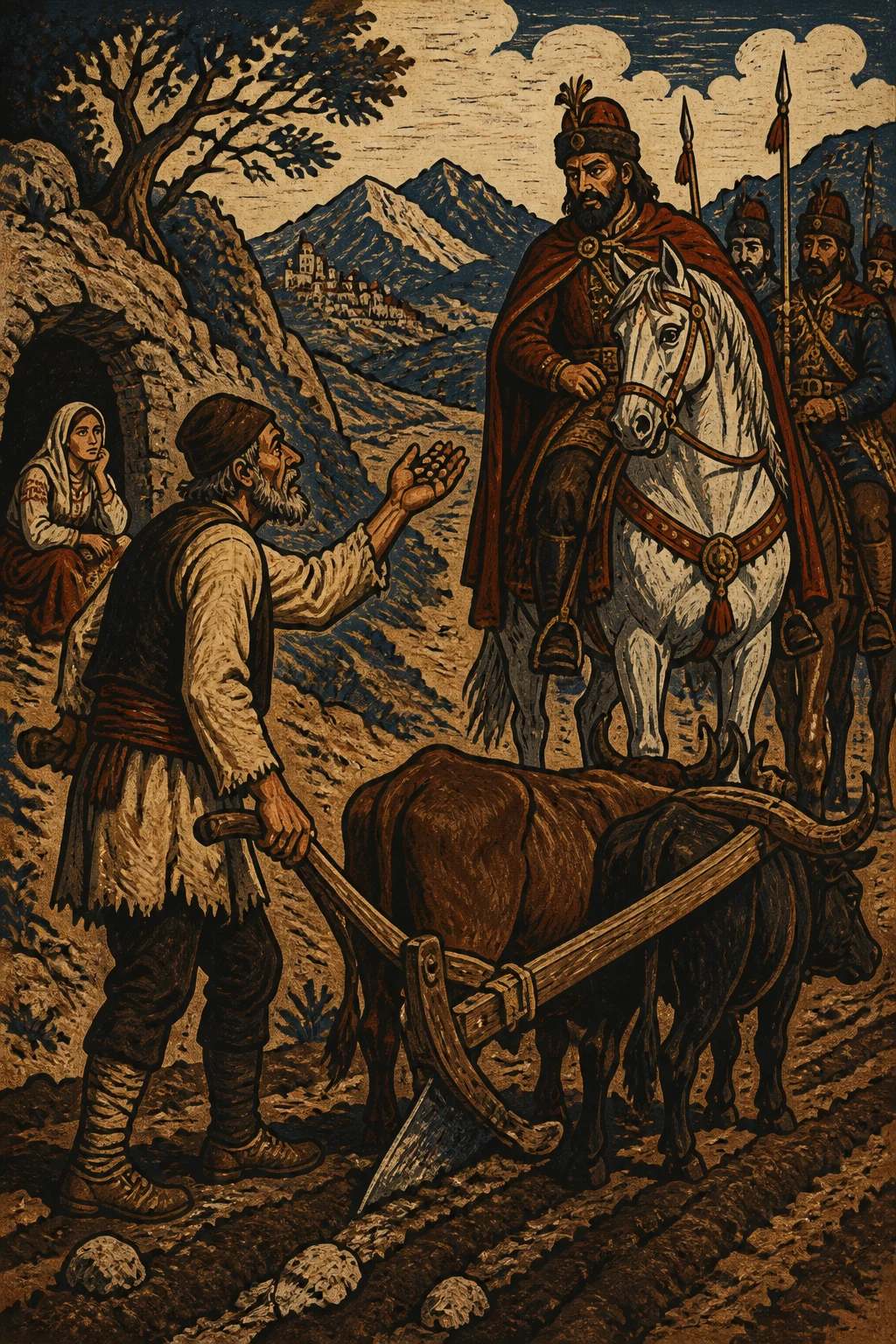
Once upon a time, as never before, and so on, there lived a man and a woman. They were so poor they had not so much as a crust to follow a drink of water. No house, no table, nothing at all, not a blessed thing did they possess. The poor man worked from dawn till late at night beside his wife, sweating his very soul out, but as for getting ahead—not a chance. Luck followed them, you see, as dust follows dogs, as the saying goes. They wandered from place to place with their few belongings, but nowhere could they settle. For who would take in two paupers with such a brood of children trailing after them? Ah, I forgot to tell you: these people had a whole swarm of children. The eldest were all girls, while the boys were still little things who clung to their parents’ heels. Heaven forbid you should ever have been there when the man came home from work: you would have lost your wits. They all rushed out to meet him, scrawny and potbellied, like little savages, thin and sickly—in short, swollen with hunger—and descended upon the poor man, crying, “Father, I’m hungry! Father, I’m starving!” Their father grew bewildered and did not know which way to turn. He gave them everything he had earned that day, but how could the pittance he brought home feed them all? It was scarcely enough to fill a hollow tooth. Their poor father and mother often went to bed without a bite. Their hearts broke with pity, but there was nothing they could do. To quiet the children, he promised to bring them more the next day. And so, with soothing words and little coaxings, the poor children would fall asleep, hoping that tomorrow would be better.
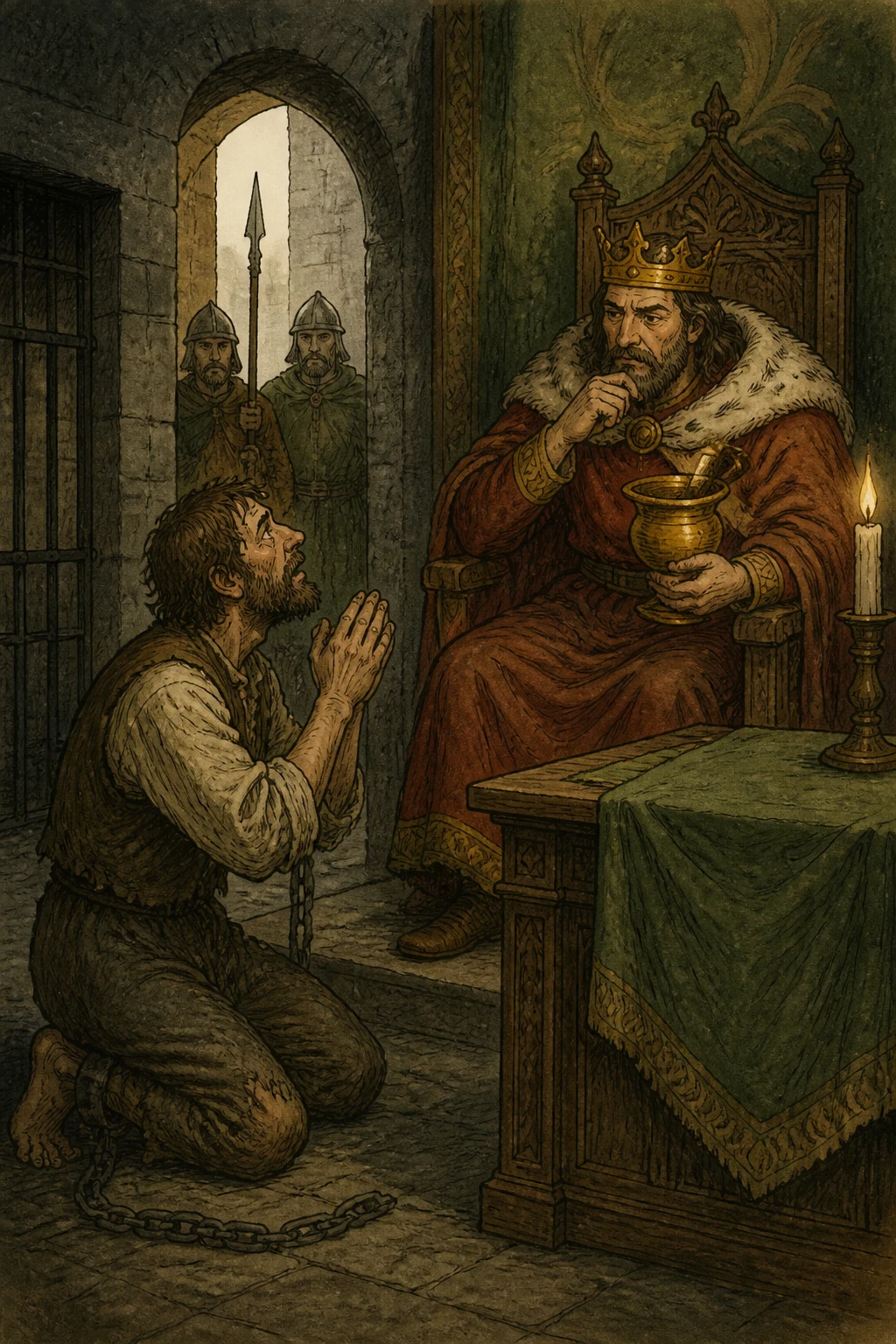
Of all the children, the eldest girl was the quietest and the most sensible. When their parents went out to work, she stayed with her younger sisters and brothers, looked after them, scolded them, and urged them to be more patient and forbearing, so as not to grieve their parents quite so much. But it was like beating a drum at a deaf man’s ear. And, after all, what could you say? They might well have been more patient and understanding, but their bellies often drove them to be unreasonable. Now the boyar on whose estate these people lived, as though forsaken by God himself, took pity on them. One day, when the man came to beg for somewhere to live, he said, “My good man, I can see you are hardworking. You toil till your back nearly breaks, yet I can see you cannot make two ends meet. Well, I shall take pity on you and give you a patch of land to be yours forever. Go and choose whatever patch you like, and set about digging yourself a dwelling at once.” “God reward you, master, and may he accept your kindness. May the spring from which you give never run dry,” answered the poor man. He went and chose a little plot, and by evening he had finished digging the pit for his sunken hut. But ill luck was his portion. As chance would have it, the spot he had chosen lay next to the land of a rich peasant so proud that you could not have reached his nose with a pole. During the night, nobody knew how it happened or how it came about, one of the rich man’s cattle fell into the pit and died. The next morning, when the rich man saw his animal lying dead, he flew at the poor fellow with loud accusations, seized him by the chest, and dragged him off to the boyar’s manor to have their case judged. The boyar was astonished to see them and asked what they wanted. The rich peasant said, “Master, this wretched fellow, this stranger who has come into our village—may we be rid of him!—after you were charitable enough to give him a piece of land, chose the very spot beside mine to build his hut. That is the first thing. Mark my words: poor as he is, he still holds his nose in the air. Secondly, the pit he dug for his dwelling is enormous, and he did not even take care to cover it with something overnight, all so that he could do me harm. One of my cattle fell into it and broke its neck. Now judge for yourself: is he not bound to pay me for it? He says he has nothing to pay with. What is that to me?” “Master,” answered the poor man humbly, with tears as big as fists in his eyes, “master, I have nothing to say. Kill me, hang me, there is nothing I can do, since this misfortune has fallen upon me. It is as my rich neighbour says. And since God loves the truth, I shall tell you honestly what is true. I dug the pit, and a large one too, so that the dwelling would hold all my family, but I never thought of doing anyone harm. Nor was there any pride in my heart when I chose a spot beside this gentleman’s, for what have I to be proud of? Now may God enlighten you, master, and may you judge justly.” The boyar hesitated. He did not know whom to find in favour of. He could see that the poor man had done wrong, but not on purpose. After thinking a little, he said, “Now, good people, I shall ask you three questions. Whichever of you answers them better shall win the case. I give you three days to think. In three days, come back and answer my riddles. Remember them well. The first question is: What is the fattest thing in the world? The second: What is the best? And the third: What runs fastest? Off you go now. But there is one more thing you should know: if neither of you can answer any of my questions, your heads will lie where your feet now stand.” Both men returned home. The rich man boasted that he would solve the riddles, for what could be easier than to say that the pig in his yard was the fattest thing, since it had fat a hand’s breadth thick upon its back? But the poor man wept enough to flood the earth, wondering what he could possibly say. When each had reached his own house, the rich man rejoiced that he was going to win his case, while the poor man sat brooding and sighing. His children gathered round him and watched, but did not dare ask him anything. They too began to cry, and such weeping and lamentation arose in that house that it would have wrung your heart with pity. Only the eldest girl plucked up courage and asked what made him so sad. “What could it be, my girl? A calamity sent by God. The boyar has ordered us to answer some questions that even learned men could not answer, let alone a poor ignorant fellow like me.” “Tell us too. Perhaps we might be able to help you somehow.” “What help could you give me, you who do not even know how to eat your polenta yet?” “You never know, Father, what we might be good for. And what harm can there be in telling us?” Then the poor man said, “This, that, and the other is what the boyar has told us to guess; and if we cannot, our heads will lie where our feet now stand.” The eldest girl fell to thinking, and after she had thought for a good while, she went up to her father and said, “There now, Father, do not be so downhearted. God will not forsake us. When you go to give the boyar your answers, I shall tell you what to say. And perhaps God will grant that you come away with honour.” The poor man seemed somewhat comforted, but only for show: his own heart knew the truth. He did not want, you see, to grieve his children any further. On the morning when he was to appear before the boyar and answer the riddles, his daughter told him what to say. He looked pleased, but still had his doubts. The two men came before the boyar: the rich man proud, with his chest thrust out; the poor man humble, his shoulders so drawn together that his ragged homespun coat seemed ready to split. The boyar asked the rich man first, “Well, my man, what is the fattest thing in this world?” The rich man answered boldly, “Why, master, what could be fatter than the pig in my yard? It has fat a hand’s breadth thick upon it.” “That is false,” answered the boyar. Then he asked the poor man, who replied timidly, “Well, master, in my simple way of thinking, the earth must be the fattest thing in the world, for it gives us all the good things we possess.” “That is so,” answered the boyar. Then he turned again to the rich man. “Now, what runs fastest in this world?” “My stallion, master,” answered the rich man. “When I let him loose, he races over hill and dale so fast you cannot see his hooves.” “Well, master, my wits do not carry me so far,” the poor man answered in his turn, “but I reckon nothing runs as fast as thought.” “You are right. The other fellow is talking nonsense.” Finally, he asked the rich man once more, “What is the best thing in this world?” “Nothing in this world is better, gracious lord,” he answered, “than Your Lordship’s righteous judgment.” “Well, master, simple as I am, it seems to me that nothing in this world is better than God, who suffers us to live upon it despite all our wickedness.” “Indeed, that is so,” said the boyar. And turning to the rich man, he added, “Out with you, you sly, ill-mannered peasant, or I shall have the soles of your feet beaten more than you can bear!” The rich man went out with his tail between his legs. Then the boyar called the poor man nearer and asked him kindly, “Tell me, my good fellow, who taught you to answer so aptly? For I do not believe such wise words came out of that empty head of yours.” The poor man began to hesitate. He was reluctant to tell the truth,
for fear that something might happen to him. But when he found himself cornered, he told everything just as it was. Marvelling to himself at the girl’s cleverness, the boyar ordered him to bring her to the manor the following day. She was to come neither dressed nor undressed, neither riding nor on foot, neither on the road nor beside it. When the poor man heard such things, he began to weep and wail until you could scarcely bear to listen to him, and so he went home to his family. When the eldest girl heard what he had to tell her, she said, “Do not be afraid, Father dear. I shall find a way to deal with him. Only find me two cats.” At daybreak, the girl threw a fishing net over herself, tucked the cats under her arms, mounted a billy goat, and set off for the boyar’s manor. As she went along, she was neither riding nor walking, for the goat was so small that first one of her feet and then the other touched the ground. She went neither on the road nor beside it, for the goat would not keep a straight course: now it strayed towards a fence to snatch a shoot from some little tree, now it wandered to the other side. With the net thrown over her, she was neither dressed nor undressed. And so, with much trouble and difficulty, she reached the manor. When the boyar and his household saw her coming in such a fashion, they stood astonished. But the boyar, you see, did not want to admit defeat, and ordered two great watchdogs that he kept chained in the yard to be let loose. As soon as they saw the poor man’s daughter and her strange procession, they rushed at her. But she let the cats go at once, and the dogs took off after them, while she reached the manor steps exactly as the boyar had commanded. Seeing this further proof of the girl’s cleverness, the boyar had no choice but to receive her. He then ordered her to be bathed, had her dressed in clothes fit for a bride, and decided to marry her to a young man in his household who served him faithfully. But when he saw her clean and arrayed like a bride—and she had a winsome charm about her too—she seemed lovelier to him than ever. He changed his mind and wanted her for his own wife, all the more since he was a bachelor, and so he married her himself. Before the wedding, the boyar said to her, “I shall take you for my wife, but you must understand that you are never to pass judgment without me.” She agreed. Some time after their wedding, the boyar went out one day on business about the estate. In his absence, two peasants came to the manor with a dispute. Learning that the boyar was away, and seeing his lady on the veranda, they began to lay their complaints before her. She listened without speaking. One of them said, “I had to go to a certain place, but a wheel on my cart had broken. I could not harness my mare to a cart with only three wheels, especially as she was about to foal. So I asked this neighbour of mine, who is standing here, to lend me a wheel. To be fair, last night he did lend me the wheel I asked for, so that I could set off about my business before daybreak. And then, honoured lady, what should happen? During the night my mare gave birth to a foal.” The peasant who owned the wheel interrupted him. “Do not believe him, my lady, and may God preserve you! It was my wheel that gave birth to the foal.” The lady listened from the veranda and said nothing. The peasants waited and waited, and when they saw that she would not judge between them, they asked, “But where has the master gone, my lady?” “Why,” she answered, “he has gone to look at a field of millet we have beside a pond, for every night the frogs come out of it and eat the millet.” The peasants stared, then went away. When they reached the gate of the manor yard, they began asking one another, “What sort of thing was that the lady said, neighbour? How can frogs eat millet?” They talked it over and took counsel together until at last they went back to ask her what she had meant. Coming before the veranda again, they began, “But, my lady, what did you mean by what you told us? Can frogs eat millet?” “I do not know whether frogs can eat millet or not,
” answered the lady, “but I do know that a wheel cannot give birth to foals.” Only then did the peasants come to their senses. Now they understood the cleverness of her words, marvelled at such wisdom, and settled their quarrel as best they could. When the boyar came home, he asked, “Who has been here while I was away? What has happened?” “What should have happened?” she answered. “These men came, this was their affair, and this is what I told them.” As soon as the boyar heard, he said, “Since you have broken your promise and passed judgment without me, we can no longer live together. Take whatever you wish from me, whatever is dearest to you in my house, and go home to your father.” His wife said, “Your words, husband, are sacred to me, for a husband is a husband. I am guilty of nothing, for I did not judge between those who came to complain; I merely told them where their master was. But if you think it right to drive me away, I submit without a murmur, and thank you from the bottom of my heart for being so kind as to let me choose what is dearest to me in your house. I ask only one more thing: since you are sending me away, let me make merry once more in the house of my lord and husband. Give a feast and invite our friends and acquaintances, so that we may enjoy ourselves together and be merry for the last time.” Her husband yielded and ordered a magnificent feast to be prepared, inviting their friends and those closest to them. They ate, made merry, and drank to their hearts’ content. But his wife kept filling the boyar’s glass, and he kept drinking it. She gave him another, and then another, until she had made him thoroughly drunk. He was so drunk he lay as limp as a rag. Then his wife hoisted him neatly onto her back, without his feeling a thing, and carried him to her father’s house, where she laid him on the warm stove ledge to sleep until he had sobered up. The following day, when he awoke and found himself in such surroundings, the boyar asked where he was. His wife answered, “At
my father’s house. When you drove me away, you gave me leave to take from your house whatever was dearest to me. That is just what I have done. Nothing was dearer to me than my husband. I trust you will not blame me for taking him.” When the boyar heard such sensible words, he thought for a while, then answered, “Come, wife, let us go home and live as though we were in paradise, for now I understand what a wife I have won.” And I mounted a saddle, and told you the tale; I mounted a wheel, and told it in full.