O besedilu
Apolon in Dafne
- Vir
- Ovidove preobrazbe
- Avtor
- Ovid
- Jezik branja
- English
- Jezik izvirnika
- Latin
- Čas branja
- 7 min branja
- Obseg
- 5 strani
- Naslov izvirnika
- Apollo and Daphne
O izvirniku
Ovidove preobrazbe
Pesniški tok antičnih preobrazb, kjer bogovi, ljudje in narava stalno menjavajo obliko. Bralni jezik je English, izvirnik pa prihaja iz vira Ovidove preobrazbe v jeziku Latin.
Besedilo
Apolon in Dafne
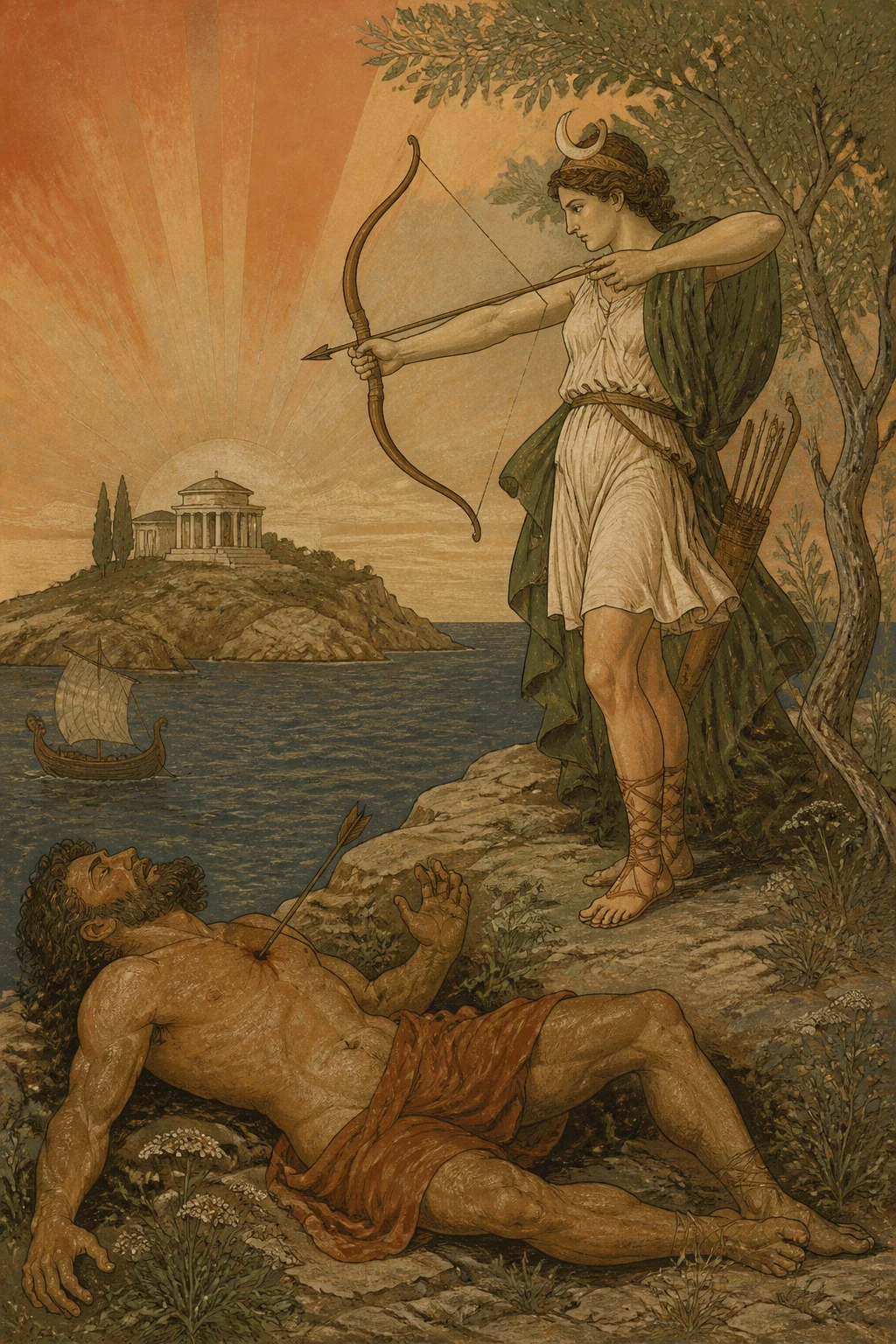
Phoebus’s first love was Daphne, daughter of Peneus, a love bestowed not by blind chance, but by Cupid’s savage anger. The Delian god, proud of his recent conquest of the serpent, had seen Cupid bending his bow by drawing back the string. “What have you to do with warriors’ weapons, wanton boy?” he had said. “Such burdens suit my shoulders, for I can deal sure wounds to beasts and enemies alike, and lately brought down swollen Python, whose deadly belly covered so many acres, with countless arrows.
Be content to kindle whatever loves you will with your torch, and do not lay claim to my glory.” Venus’s son replied, “Your bow may pierce all things, Phoebus, but mine shall pierce you. As all living creatures yield to a god, so much does your glory fall below mine.” He spoke, and beating the air with his wings, swiftly alighted on the shady summit of Parnassus. From his arrow-bearing quiver he drew two shafts with opposite powers: one banishes love, the other kindles it.
The one that kindles love is golden, with a gleaming, sharpened point; the one that banishes it is blunt, with lead beneath its shaft. This one the god lodged in the nymph, Peneus’s daughter; with the other he pierced Apollo through the bones to the marrow. At once he loves; she shuns the very name of lover, delighting in the forest’s shadows and the skins of captured beasts, emulating the unmarried Phoebe.
A ribbon bound her loosely flowing hair. Many sought her hand, but she rejected all her suitors; unwilling to endure or know a man, she roamed the pathless woods, caring nothing for Hymen, or Love, or what marriage might be. Often her father said, “Daughter, you owe me a son-in-law.” Often her father said, “My child, you owe me grandchildren.” But she, loathing the marriage torch as though it were a crime, would flush with a modest blush across her lovely face, and, clinging with coaxing arms about her father’s neck, say, “Dearest father, let me enjoy perpetual virginity. Diana’s father granted her this before.”
He indeed consents; but that beauty of yours forbids you to be what you desire. Your loveliness resists your prayer. Phoebus loves Daphne at first sight and longs to marry her; he hopes for what he longs for, deceived by his own prophetic powers. As light stubble burns when the ears of grain are gathered, as hedges catch fire from torches that a passing traveler has chanced to hold too close, or left behind at daybreak, so the god went up in flames; so all his heart burns, and with hope he feeds a fruitless love.
He sees her unadorned hair hanging down her neck and says, “What if it were arranged?” He sees her eyes flashing with fire like stars; he sees her lips, which merely seeing cannot satisfy. He praises her fingers, hands, and arms, bare more than halfway to the shoulder. Whatever lies hidden he imagines lovelier still. She flees swifter than the light breeze, nor stops at his words calling her back: “Nymph, daughter of Peneus, stay, I beg you! I am no enemy pursuing you.
Nymph, stay! So a lamb flees a wolf, a deer a lion, so doves flee an eagle on fluttering wings, each fleeing its own enemy. Love is my reason for pursuing you. Ah, wretched me! Take care you do not fall headlong, or brambles scratch your legs, too fair to suffer, and I cause you pain. The ground you hurry over is rough. Run more slowly, I beg you; check your flight, and I too will follow more slowly.
At least ask who it is you please. I am no mountain dweller, no shepherd, no shaggy herdsman watching over cattle and flocks here. Rash girl, you do not know, you do not know whom you flee, and that is why you flee. The land of Delphi, Claros, Tenedos, and the royal city of Patara serve me. Jupiter is my father. Through me, what shall be, what has been, and what is are revealed; through me, songs accord with strings.
My arrow is sure, yet one arrow is surer than mine: the one that wounded my heart, till then untouched. Medicine is my invention; throughout the world I am called the bringer of aid, and the power of healing herbs is subject to me. Alas, no herb can cure love, and the arts that help all others cannot help their master.” He would have said more, but Peneus’s daughter fled in frightened haste, leaving him and his unfinished words behind, lovely even then. The winds laid bare her body, the opposing gusts fluttered her garments against her, and the light breeze swept her streaming hair behind her; flight only heightened her beauty. But the youthful god can no longer bear
to waste his coaxing words, and, urged on by Love himself, follows her at full speed. As when a Gallic hound has seen a hare in an open field, and one runs for its prey, the other for its life: the hound seems about to fasten on it, hopes at every moment to seize it, and grazes its heels with outstretched muzzle; the hare, unsure whether it is already caught, snatches itself from the very jaws and escapes the mouth that brushes it: so raced the god and maiden, he swift with hope, she with fear.
Yet the pursuer, aided by the wings of Love, is faster, allows her no rest, and looms over her fleeing back, his breath upon the hair scattered across her neck. Her strength exhausted, she grew pale, and, overcome by the effort of her headlong flight, looked toward Peneus’s waters. “Help me, Father!” she cried. “If you rivers have divine power, Earth, either gape to swallow me, whose beauty pleased too well, or else destroy by changing it this form that brings me harm.
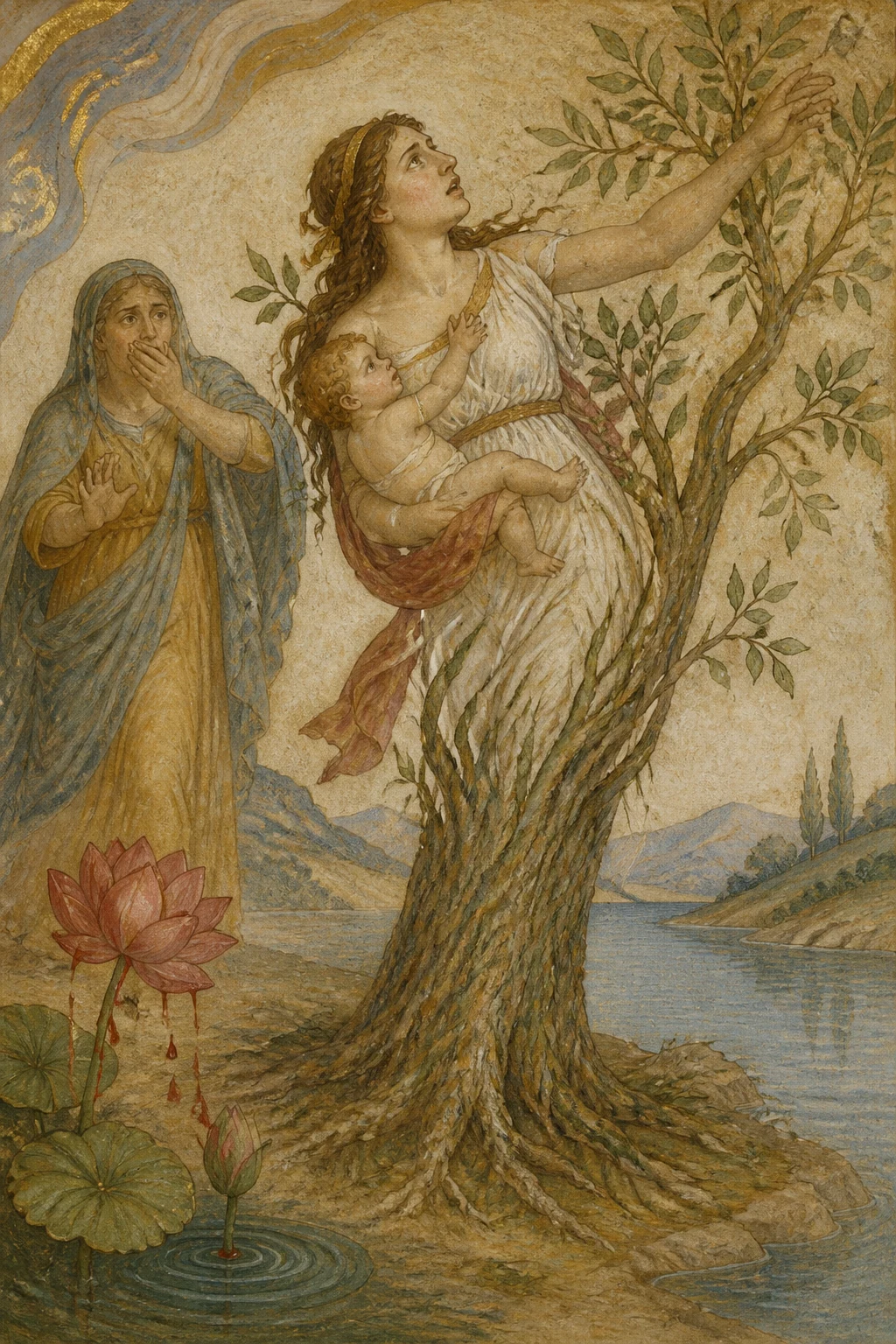
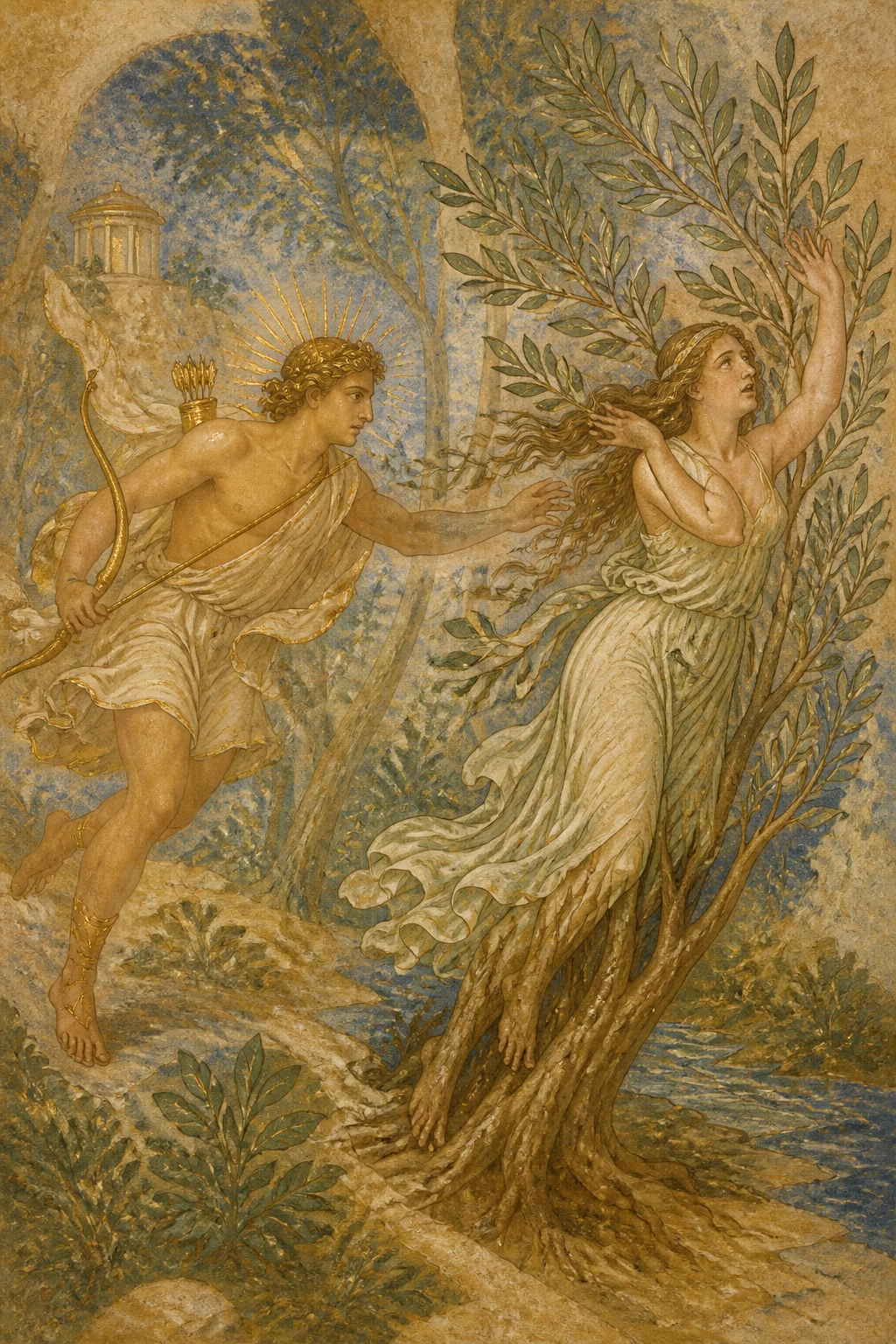
Destroy by changing it this form that pleased too well!” Scarcely had her prayer ended when a heavy numbness seized her limbs. Her soft breast was enclosed in a thin layer of bark; her hair grew into leaves, her arms into branches; her feet, so swift a moment before, clung fast in sluggish roots; her face became the treetop. Only her radiance remained. Even so, Phoebus loves her. Laying his right hand on the trunk, he feels her heart still trembling beneath the new bark, and, clasping the branches in his arms as though they were her limbs, he kisses the wood; yet the wood shrinks from his kisses.
The god said to her, “Since you cannot be my bride, you shall at least be my tree. Always you shall adorn my hair, my lyre, my quiver, O laurel. You shall attend the leaders of Latium when joyful voices sing their triumph and the Capitol beholds their long processions. You too shall stand before Augustus’s doors, a most faithful guardian of his doorway, and keep watch over the oak between them.
And as my head is ever youthful, its hair unshorn, so you too shall wear forever the glory of undying leaves.” Paean had finished. The laurel nodded with its newly fashioned branches and seemed to bow its crown as though it were a head.
Izvirnik
Apollo and Daphne
Naslednje strani prikazujejo izvirno besedilo za primerjavo.
Source ID: ovid_metamorphoses_story_007 Citation: Ovid, Metamorphoses 1.452-1.567 Original language: Latin Source: PerseusDL canonical-latinLit Source URL: https://github.com/PerseusDL/canonical-latinLit/blob/master/data/phi0959/phi006/phi0959.phi006.perseus-lat2.xml Segmentation certainty: medium 452: Primus amor Phoebi Daphne Peneia, quem non 453: fors ignara dedit, sed saeva Cupidinis ira.
454: Delius hunc, nuper victa serpente superbus, 455: viderat adducto flectentem cornua nervo 456: “quid” que “tibi, lascive puer, cum fortibus armis?” 457: dixerat, “ista decent umeros gestamina nostros, 458: qui dare certa ferae, dare vulnera possumus hosti, 459: qui modo pestifero tot iugera ventre prementem 460: stravimus innumeris tumidum Pythona sagittis. 461: Tu face nescio quos esto contentus amores 462: inritare tua, nec laudes adsere nostras.”
463: Filius huic Veneris “figat tuus omnia, Phoebe, 464: te meus arcus:” ait “quantoque animalia cedunt 465: cuncta deo tanto minor est tua gloria nostra.” 466: Dixit et eliso percussis aere pennis 467: inpiger umbrosa Parnasi constitit arce 468: eque sagittifera prompsit duo tela pharetra 469: diversorum operum: fugat hoc, facit illud amorem. 470: Quod facit, auratum est et cuspide fulget acuta; 471: quod fugat, obtusum est et habet sub harundine plumbum.
472: Hoc deus in nympha Peneide fixit, at illo 473: laesit Apollineas traiecta per ossa medullas. 474: Protinus alter amat, fugit altera nomen amantis 475: silvarum tenebris captivarumque ferarum 476: exuviis gaudens innuptaeque aemula Phoebes. 477: Vitta coercebat positos sine lege capillos. 478: Multi illam petiere, illa aversata petentes 479: inpatiens expersque viri nemora avia lustrat, 480: nec quid Hymen, quid Amor, quid sint conubia curat.
481: Saepe pater dixit “generum mihi, filia, debes,” 482: saepe pater dixit “debes mihi nata, nepotes:” 483: illa, velut crimen taedas exosa iugales, 484: pulchra verecundo suffunditur ora rubore, 485: inque patris blandis haerens cervice lacertis 486: “da mihi perpetua, genitor carissime,” dixit 487: “virginitate frui: dedit hoc pater ante Dianae.” 488: Ille quidem obsequitur, sed te decor iste quod optas 489: esse vetat. Votoque tuo tua forma repugnat: 490: Phoebus amat visaeque cupit conubia Daphnes, 491: quodque cupit, sperat, suaque illum oracula fallunt.
492: Utque leves stipulae demptis adolentur aristis, 493: ut facibus saepes ardent, quas forte viator 494: vel nimis admovit vel iam sub luce reliquit, 495: sic deus in flammas abiit, sic pectore toto 496: uritur et sterilem sperando nutrit amorem. 497: Spectat inornatos collo pendere capillos 498: et “quid, si comantur?” ait. Videt igne micantes 499: sideribus similes oculos, videt oscula, quae non 500: est vidisse satis; laudat digitosque manusque 501: bracchiaque et nudos media plus parte lacertos.
502: Siqua latent, meliora putat. Fugit ocior aura 503: illa levi neque ad haec revocantis verba resistit: 504: “Nympha, precor, Penei, mane! Non insequor hostis: 505: nympha, mane! sic agna lupum, sic cerva leonem, 506: sic aquilam penna fugiunt trepidante columbae, 507: hostes quaeque suos: amor est mihi causa sequendi. 508: Me miserum! ne prona cadas indignave laedi 509: crura notent sentes et sim tibi causa doloris.
510: Aspera, qua properas, loca sunt. Moderatius, oro, 511: curre fugamque inhibe; moderatius insequar ipse. 512: Cui placeas, inquire tamen. Non incola montis, 513: non ego sum pastor, non hic armenta gregesque 514: horridus observo. Nescis, temeraria, nescis 515: quem fugias, ideoque fugis. Mihi Delphica tellus 516: et Claros et Tenedos Patareaque regia servit, 517: Iuppiter est genitor; per me quod eritque fuitque 518: estque patet; per me concordant carmina nervis.
519: Certa quidem nostra est, nostra tamen una sagitta 520: certior, in vacuo quae vulnera pectore fecit. 521: Inventum medicina meum est, opiferque per orbem 522: dicor, et herbarum subiecta potentia nobis: 523: ei mihi, quod nullis amor est sanabilis herbis 524: nec prosunt domino, quae prosunt omnibus, artes.” 525: Plura locuturum timido Peneia cursu 526: fugit cumque ipso verba inperfecta reliquit, 527: tum quoque visa decens. Nudabant corpora venti, 528: obviaque adversas vibrabant flamina vestes, 529: et levis inpulsos retro dabat aura capillos, 530: auctaque forma fuga est. Sed enim non sustinet ultra
531: perdere blanditias iuvenis deus, utque monebat 532: ipse Amor, admisso sequitur vestigia passu. 533: Ut canis in vacuo leporem cum Gallicus arvo 534: vidit, et hic praedam pedibus petit, ille salutem: 535: alter inhaesuro similis iam iamque tenere 536: sperat et extento stringit vestigia rostro, 537: alter in ambiguo est, an sit conprensus, et ipsis 538: morsibus eripitur tangentiaque ora relinquit: 539: sic deus et virgo est hic spe celer, illa timore.
540: Qui tamen insequitur pennis adiutus Amoris, 541: ocior est requiemque negat tergoque fugacis 542: inminet et crinem sparsum cervicibus adflat. 543: Viribus absumptis expalluit illa citaeque 544: victa labore fugae spectans Peneidas undas 545: “fer pater” inquit “opem si flumina numen habetis. 546: qua nimium placui, tellus aut hisce vel istam, 547: quae facit ut laedar, mutando perde figuram.
547: Qua nimium placui, mutando perde figuram!” 548: Vix prece finita torpor gravis occupat artus: 549: mollia cinguntur tenui praecordia libro, 550: in frondem crines, in ramos bracchia crescunt, 551: pes modo tam velox pigris radicibus haeret, 552: ora cacumen habet; remanet nitor unus in illa. 553: Hanc quoque Phoebus amat, positaque in stipite dextra 554: sentit adhuc trepidare novo sub cortice pectus 555: conplexusque suis ramos, ut membra, lacertis 556: oscula dat ligno: refugit tamen oscula lignum.
557: Cui deus “at quoniam coniunx mea non potes esse, 558: arbor eris certe” dixit “mea. Semper habebunt 559: te coma, te citharae, te nostrae, laure, pharetrae: 560: tu ducibus Latiis aderis, cum laeta triumphum 561: vox canet et visent longas Capitolia pompas: 562: postibus Augustis eadem fidissima custos 563: ante fores stabis mediamque tuebere quercum, 564: utque meum intonsis caput est iuvenale capillis, 565: tu quoque perpetuos semper gere frondis honores.”
566: Finierat Paean: factis modo laurea ramis 567: adnuit utque caput visa est agitasse cacumen.
Nadaljuj z branjem