Prevod
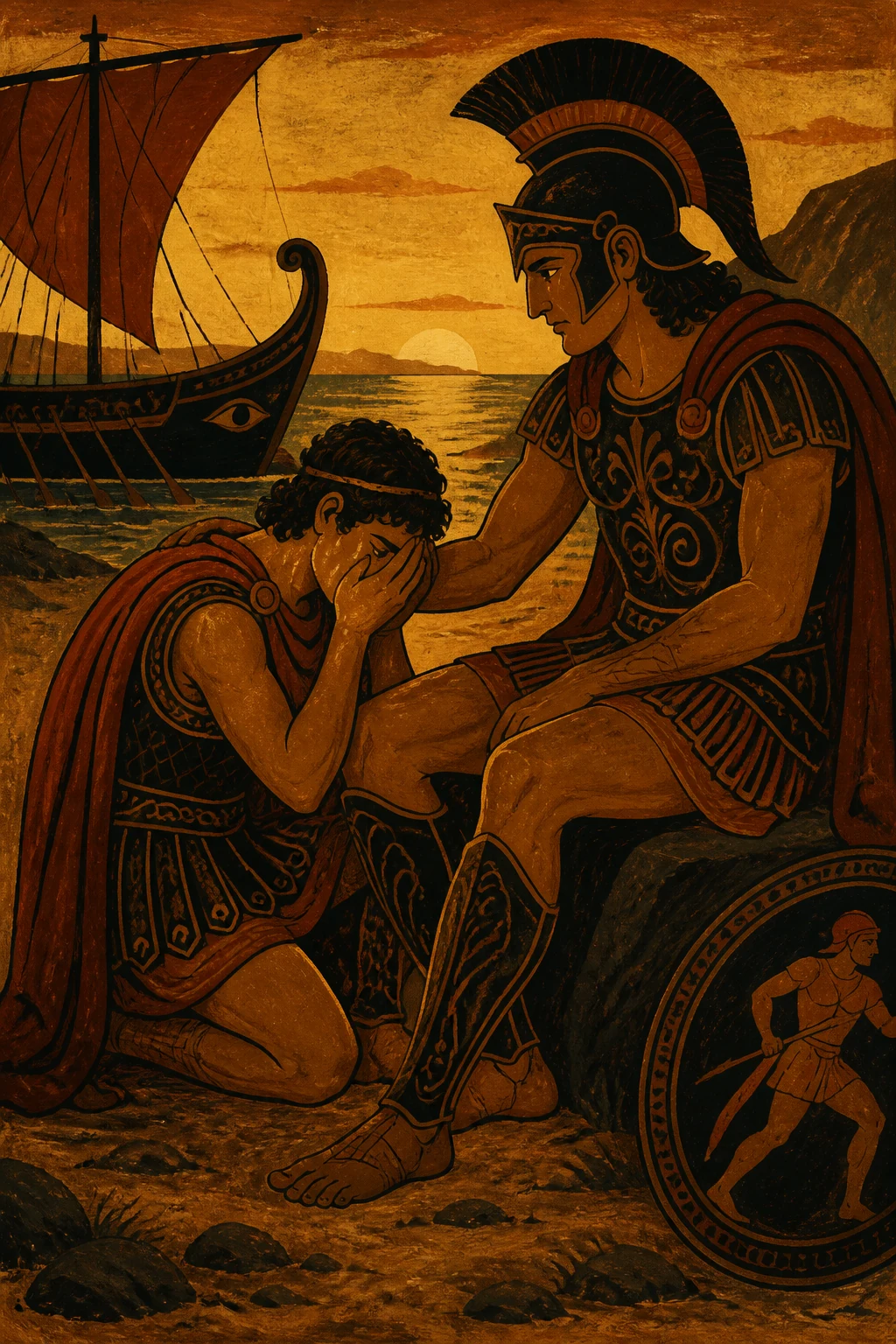
Saffron-robed Dawn rose from the streams of Ocean to bring light to immortals and mortals alike, and Thetis reached the ships, bearing the god’s gifts. She found her dear son clasping Patroclus and weeping bitterly, while many of his companions mourned around him. The radiant goddess stood among them, took his hand, and spoke: “My child, grieve though we must, let us leave him lying here, since he has fallen by the gods’ decree. But take from Hephaestus this glorious armor, so beautiful that no man has ever worn its like upon his shoulders.”
With these words the goddess laid the armor before Achilles, and all its intricate workmanship rang aloud. Trembling seized every Myrmidon; none dared look straight at it, but they shrank away. Yet when Achilles saw it, his anger sank deeper into him, and his eyes flashed terribly beneath their lids, like a blaze of fire. He delighted in holding the god’s splendid gifts in his hands.
When he had satisfied his heart by gazing at the intricate work, he spoke winged words to his mother: “Mother, the god has given me armor such as only immortals could fittingly make; no mortal man could fashion it.
“Now I shall arm myself. But I am terribly afraid that meanwhile flies will creep into the wounds bronze has cut in Menoetius’ valiant son, breed maggots there, and defile his corpse. His life is gone, and all his flesh may rot.”
Then silver-footed Thetis answered him: “My child, let none of this trouble your heart. I shall try to keep those savage swarms of flies away from him, the flies that devour men slain in battle. Even if he lies here until a whole year has passed, his flesh will remain unchanged, or better still.
“But summon the Achaean warriors to assembly, renounce your anger against Agamemnon, shepherd of the people, and arm yourself at once for battle. Clothe yourself in courage.” With these words she breathed bold strength into him, and into Patroclus’ nostrils she dripped ambrosia and red nectar, so that his flesh might remain unchanged.
Then noble Achilles went along the seashore with a terrible shout and roused the Achaean warriors. Even those who had always stayed within the gathering of the ships—the helmsmen who handled the ships’ steering oars, and the stewards who remained beside the ships to dole out food—even these came to the assembly now, because Achilles had appeared after so long an absence from grievous battle.
Two servants of Ares came limping, the steadfast warrior Diomedes, son of Tydeus, and noble Odysseus, leaning on their spears, for their painful wounds still troubled them. They made their way to the front of the assembly and sat down.
Last came Agamemnon, lord of men, still wounded, for Coon, Antenor’s son, had struck him with a bronze-tipped spear in the fierce fighting. When all the Achaeans had gathered, swift-footed Achilles rose and addressed them: “Son of Atreus, was it truly better for us both, for you and me, that in our hearts’ anguish we raged against each other in soul-devouring strife over a girl?
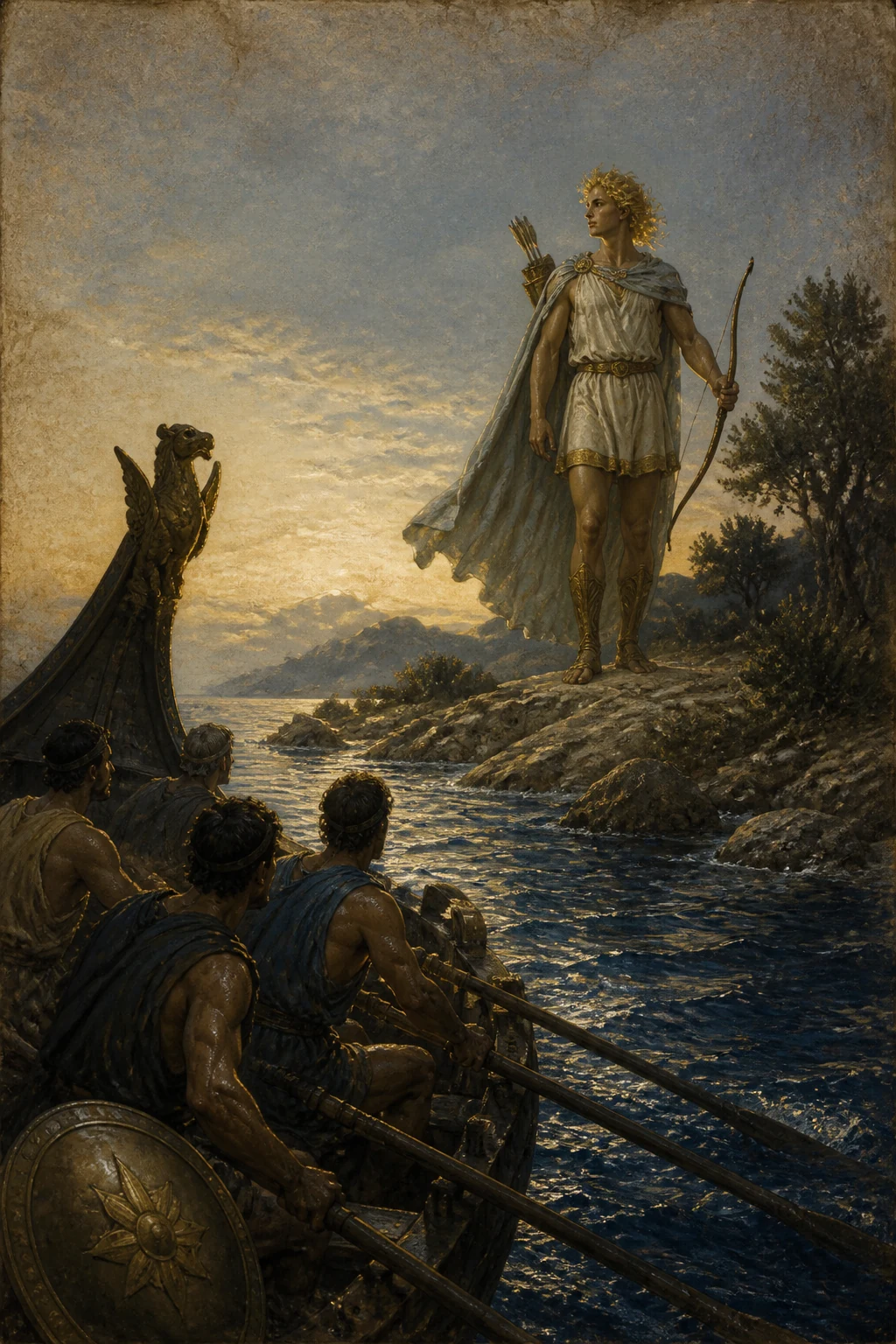
“If only Artemis had killed her with an arrow beside the ships on the day I took her, when I sacked Lyrnessus! Then not so many Achaeans would have bitten the boundless earth beneath their enemies’ hands while I held back in anger.
“Hector and the Trojans gained by it, but the Achaeans, I think, will long remember this quarrel of yours and mine. Still, let us leave what is past behind us, though it hurts, and master the hearts within our breasts because we must. Now I put an end to my anger. I ought not to rage relentlessly forever. Come, rouse the long-haired Achaeans to battle without delay, so that I may face the Trojans and discover whether they still wish to spend the night beside our ships. Some of them, I think, will gladly bend their knees to rest, if they escape my spear alive from the fury of battle.”
So he spoke, and the well-greaved Achaeans rejoiced that great-hearted Peleus’ son had renounced his wrath. Then Agamemnon, lord of men, addressed them from his seat, without rising to stand in their midst: “Friends, Danaan warriors, servants of Ares, it is right to listen to a man who stands to speak, and wrong to interrupt him. That is hard even for a practiced speaker.
“How could anyone hear or speak amid the uproar of so many men? Even a clear-voiced speaker is thwarted. I shall explain myself to Peleus’ son; the rest of you Argives, listen and let each man mark my words.
“Often the Achaeans have spoken to me of this and reproached me. Yet I am not to blame, but Zeus and Fate and the Fury who walks in darkness: they cast a savage delusion into my mind at the assembly, that day when I myself took away Achilles’ prize.
“But what could I do? A god brings all things to their end. Delusion is Zeus’s eldest daughter, accursed, who blinds us all. Her feet are delicate: she never treads upon the ground, but walks over the heads of men, doing them harm, and catches one or another in her snares.
“Even Zeus was once deluded, though they say he is the greatest of gods and men. Hera, female though she is, deceived even him with her cunning on the day when Alcmene was about to give birth to mighty Heracles in fair-crowned Thebes.
“He spoke boastfully before all the gods: ‘Listen to me, all you gods and goddesses, while I tell you what the heart within my breast commands. Today Eileithyia, goddess of labor’s pains, will bring into the light a man who shall rule over all his neighbors, a man of the race descended from my blood.’
“Then queenly Hera answered him with cunning in her heart: ‘You will prove false and never fulfill your word. Come now, Olympian, swear me a mighty oath that the man who falls today between a woman’s feet, born of those men who spring from your blood, shall indeed rule over all his neighbors.’
“So she spoke, and Zeus did not perceive her cunning. He swore the great oath, and bitterly was he deceived. Hera darted away from Olympus’ peak and swiftly reached Achaean Argos, where she knew the noble wife of Sthenelus, Perseus’ son, was living.
“She was carrying a son, and her seventh month had come. Hera brought him into the light before his time, but stopped Alcmene’s labor and held back the goddesses of childbirth.
“Then she herself brought the news to Zeus, son of Cronus: ‘Father Zeus, lord of the bright thunderbolt, I have something to tell you. A noble man has now been born who shall rule the Argives: Eurystheus, son of Sthenelus, Perseus’ son, of your own blood. It is fitting that he should rule the Argives.’
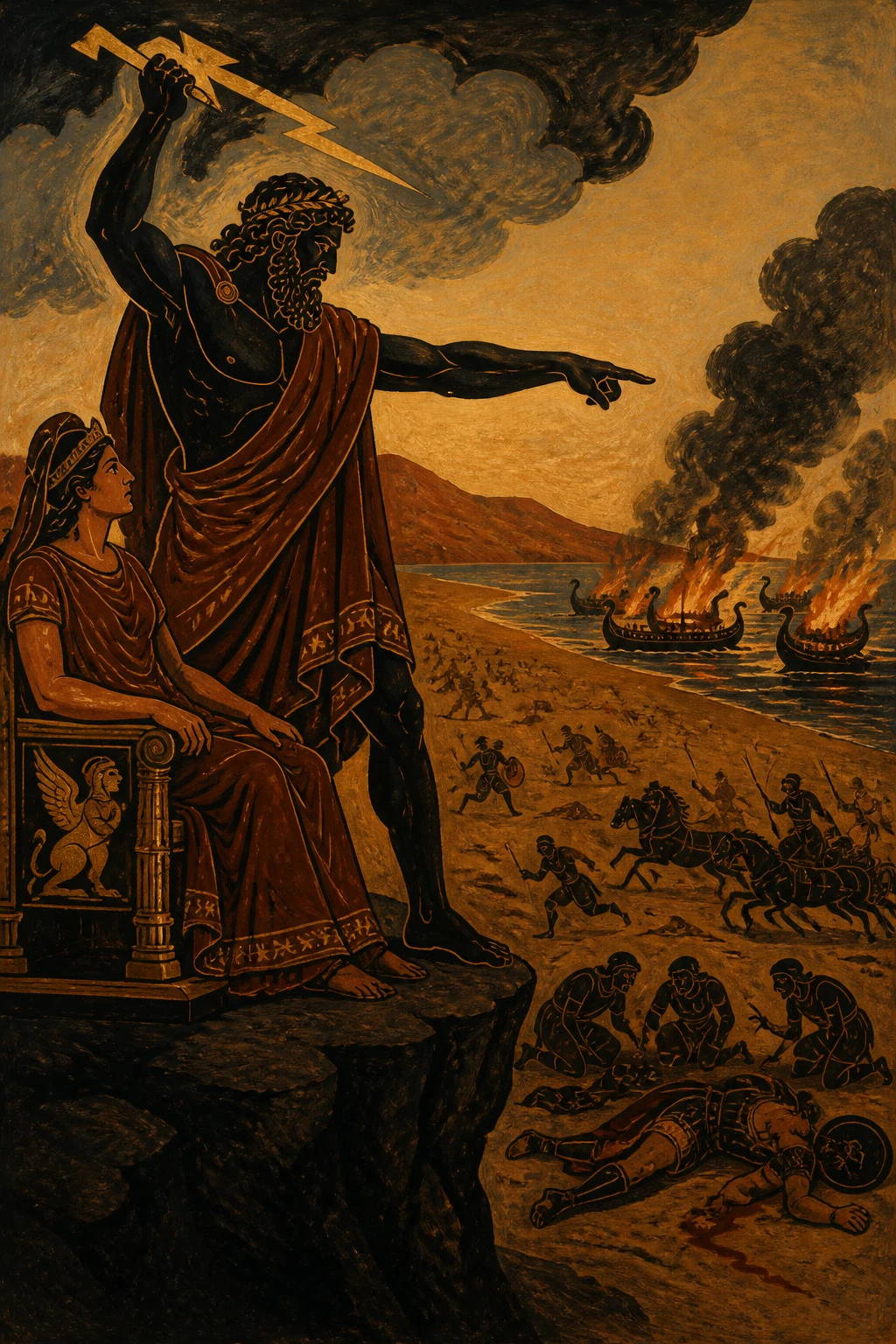
“So she spoke, and sharp anguish struck deep into his heart. At once, raging within, he seized Delusion by her shining hair and swore a mighty oath that never again should Delusion, who blinds us all, return to Olympus and the starry heavens.
“With that he swung her in his hand and flung her from the starry heavens, and swiftly she came down among the works of men. Yet he always groaned at her doing whenever he saw his dear son burdened with shameful toil in the labors Eurystheus imposed upon him.
“So it was with me. Whenever great Hector of the flashing helmet was slaughtering the Argives beside the sterns of our ships, I could not forget the Delusion that had first blinded me. But since I was deluded, and Zeus robbed me of my senses, I am willing to make amends and give boundless recompense. Rise now for battle, and rouse the rest of the army.
“I stand ready to give you all the gifts that noble Odysseus promised when he came to your hut yesterday. Or, if you wish, wait here, eager though you are for war, and my servants will fetch the gifts from my ship, so that you may see how pleasing they will be.”
Swift-footed Achilles answered him: “Most glorious son of Atreus, Agamemnon, lord of men, give the gifts if you wish, as is fitting, or keep them for yourself. Now let us turn our thoughts to battle at once. We should not stand here chattering and wasting time: a great task still lies undone. Let men see Achilles once again among the foremost, destroying the Trojan ranks with his bronze spear.
“Let each of you bear that in mind and fight his man.” Then resourceful Odysseus answered him: “Not so, godlike Achilles, mighty though you are. Do not drive the Achaeans’ sons toward Ilium to fight the Trojans without food. The struggle will last no little time once the ranks of men have clashed and a god breathes strength into both sides.
“Instead, tell the Achaeans to take food and wine beside the swift ships, for these give strength and courage. No man can fight the enemy all day until sunset without tasting food. However eager his heart may be for battle, his limbs grow heavy unawares, thirst and hunger overtake him, and his knees fail as he moves.
“But the man who has had his fill of food and wine and fights the enemy all day has a steadfast heart within him, and his limbs do not tire until all have withdrawn from battle.
“Come, dismiss the army and order them to make their meal. Let Agamemnon, lord of men, bring the gifts into the middle of the assembly, so that all the Achaeans may see them with their own eyes and your heart may be gladdened.
“Let him stand among the Argives and swear to you that he has never entered her bed or lain with her, as is the way, my lord, of men and women. And let your own heart be reconciled.
“Then let him make amends to you with a rich feast in his hut, so that you lack nothing of your due. And you, son of Atreus, will be more just toward others hereafter. There is no disgrace in a king’s appeasing a man when he himself was first to give offense.”
Then Agamemnon, lord of men, spoke to him: “Son of Laertes, I am glad to hear your words. Everything you have set forth is right and fitting. I am willing to swear this oath; my heart commands it, and I shall not swear falsely before the gods. But let Achilles remain here for the present, eager though he is for war. All the rest of you remain assembled too, until the gifts come from my hut and we seal our faithful oath with sacrifice.
“And to you yourself I give this charge: choose the best young men of all the Achaeans and bring from my ship the gifts we promised Achilles yesterday, and bring the women too.
“Let Talthybius quickly make ready a boar in the broad Achaean camp, to be sacrificed to Zeus and the Sun.” Swift-footed Achilles answered him: “Most glorious son of Atreus, Agamemnon, lord of men, you would do better to attend to these things another time, when there is some respite from war and the fury in my breast is less.
“Now our men lie mangled, those whom Hector, Priam’s son, brought down when Zeus granted him glory, and you two urge us to eat. For my part, I would command the Achaeans’ sons to fight now without food, fasting, and prepare a great supper at sunset, when we have avenged our shame.
“Until then, neither food nor drink shall pass my throat, while my companion lies dead in my hut, torn by the sharp bronze, his feet turned toward the door, and his companions mourn around him. These things do not concern me now: only slaughter and blood and the bitter groans of men.”
Resourceful Odysseus answered him: “Achilles, son of Peleus, by far the mightiest of the Achaeans, you are stronger than I am and far better with the spear. Yet in judgment I may surpass you by much, for I was born before you and have learned more.
“So let your heart endure my words. Men soon have their fill of battle, where bronze strews the earth with stalks in plenty, but the harvest is scant, when Zeus inclines his scales—Zeus, who governs the warfare of men.
“The Achaeans cannot mourn the dead with their bellies. Too many fall, thick and fast, day after day. When could anyone draw breath from grief? We must bury the man who dies, weeping for him that day, but hardening our hearts. Those who survive hateful war must remember food and drink, so that we may fight the enemy all the more fiercely and without respite, our bodies clothed in unyielding bronze. Let no man hang back, waiting for another call to arms. This call will bring disaster to anyone who stays behind beside the Argive ships. Let us charge together and rouse fierce battle against the horse-taming Trojans.”
With that he took with him the sons of glorious Nestor, Meges son of Phyleus, Thoas, Meriones, Lycomedes son of Creon, and Melanippus. They went to the hut of Agamemnon, son of Atreus.
No sooner was the order spoken than the work was done. From the hut they carried seven tripods, as he had promised, twenty gleaming cauldrons, and twelve horses. They quickly brought out seven women skilled in flawless handiwork, and as the eighth, fair-cheeked Briseis.
Odysseus weighed out ten full talents of gold and led the way, while the other young Achaeans carried the gifts. They set them in the middle of the assembly, and Agamemnon rose. Beside the shepherd of the people stood Talthybius, whose voice was like a god’s, holding the boar in his hands.
The son of Atreus drew the knife that always hung beside his sword’s great scabbard, cut the first hairs from the boar, and raised his hands to Zeus in prayer. All the Argives sat where they were in silence, listening in due order to their king.
Looking up into the broad heavens, he prayed: “Let Zeus first be my witness, highest and greatest of the gods, and Earth and the Sun, and the Furies who beneath the earth punish men who swear falsely: I have never laid a hand on the girl Briseis, neither to take her to bed nor for any other purpose.
“She has remained untouched in my hut. If any part of this oath is false, may the gods send me griefs in plenty, all that they inflict upon a man who sins against them by a false oath.”
With that he cut the boar’s throat with the pitiless bronze. Talthybius swung it round and hurled it into the great gulf of the gray sea as food for the fish. Then Achilles rose and addressed the war-loving Argives: “Father Zeus, great indeed are the delusions you send upon men! Otherwise the son of Atreus could never have stirred the anger in my breast so deeply, nor carried off the girl against my will, stubborn as he was. But Zeus, it seems, wished death to come upon many of the Achaeans.
“Now go and eat, so that we may join battle.” So he spoke and quickly dismissed the assembly. The men scattered, each to his own ship, while the great-hearted Myrmidons took charge of the gifts and carried them to noble Achilles’ ship.
They set the gifts in the hut and brought the women to their seats, while the proud attendants drove the horses into the herd. Then Briseis, lovely as golden Aphrodite, saw Patroclus torn by the sharp bronze. She flung herself upon him with a piercing cry, and with her hands tore at her breast, her tender neck, and her lovely face.
Weeping, the woman who was like the goddesses spoke: “Patroclus, dearest to my wretched heart, I left you alive when I went from this hut, and now, returning, I find you dead, leader of men. So for me one sorrow always follows another.
“The husband to whom my father and honored mother gave me I saw torn by sharp bronze before our city, and my three beloved brothers, all born of the same mother as I, met their day of doom.
“Yet you would not let me weep when swift Achilles killed my husband and sacked the city of noble Mynes. You told me you would make me noble Achilles’ wedded wife, take me in the ships to Phthia, and hold my wedding feast among the Myrmidons.
“So I mourn you without end, now you are dead, you who were always kind.” Thus she spoke in tears, and the women joined her lament, mourning Patroclus, but each grieving for her own sorrows. Around Achilles the Achaean elders gathered, begging him to eat. But he refused them with a groan: “If any of my dear companions will listen to me, I beg you, do not ask me to satisfy my heart with food or drink before the time. Terrible grief has come upon me. I shall wait until sunset and bear it as I am.”
With these words he sent the other kings away. But the two sons of Atreus remained, and noble Odysseus, Nestor, Idomeneus, and the old horseman Phoenix, seeking to comfort him in his deep distress. Yet no comfort would enter his heart until he plunged into the jaws of bloody war.
Remembering, he sighed deeply and said: “Once you too, ill-fated, dearest of my companions, would set a savory meal before me here in the hut, swiftly and eagerly, whenever the Achaeans hastened to bring tearful war upon the horse-taming Trojans.
“Now you lie mangled, and my heart refuses food and drink, though they are here within, because I long for you. No worse sorrow could ever come upon me, not even if I heard that my father had died, who now perhaps in Phthia sheds tender tears for the loss of such a son, while I fight the Trojans in a foreign land for the sake of accursed Helen. Nor if I heard of my dear son, who is being reared for me on Scyros—if godlike Neoptolemus is still alive.
“Before this, the heart within my breast had hoped that I alone would die here in Troy, far from horse-pasturing Argos, and that you would return to Phthia. Then you could bring my child from Scyros in your swift black ship and show him everything: my possessions, my servants, and my great high-roofed house.
“For I think Peleus must already be dead, or else, with little life remaining, he grieves in hateful old age, always awaiting the bitter news of my death.”
So he spoke in tears, and the elders groaned with him, each remembering what he had left at home. The son of Cronus saw them mourning and pitied them. At once he spoke winged words to Athena: “My child, have you utterly abandoned your man?
“Does Achilles no longer concern your heart at all? He sits before the high-prowed ships mourning his dear companion. The others have gone to their meal, but he remains fasting, without food.
“Go now, drip nectar and sweet ambrosia into his breast, so that hunger may not overcome him.” With these words he urged Athena, who was already eager. Like a long-winged hawk with a piercing cry, she darted from heaven through the clear air. The Achaeans were arming throughout the camp. Into Achilles’ breast she dripped nectar and sweet ambrosia, so that cruel hunger might not weaken his knees, then returned to the strong-built house of her mighty father. Meanwhile the men poured out away from the swift ships.
As thick snowflakes fly from Zeus, cold beneath the blast of the North Wind born in the clear sky, so thickly then came gleaming helmets from the ships, and bossed shields, stout-plated breastplates, and ashen spears.
Their radiance reached heaven, and all the earth around them laughed beneath the flash of bronze. Under the men’s feet a thunder rose, and in their midst noble Achilles armed himself.
His teeth clashed, his eyes blazed like fire, and unbearable grief entered his heart. Raging against the Trojans, he put on the god’s gifts, the armor Hephaestus had labored to make for him.
First he fitted round his shins the beautiful greaves, fastened with silver ankle-clasps. Next he drew the breastplate over his chest. Over his shoulders he slung the bronze sword with its silver studs, and then took up the great, strong shield, whose light shone far away like the moon’s.
As when sailors at sea catch sight of the glow of a burning fire, blazing high in the mountains at a lonely sheepfold, while storm winds carry them unwilling over the fish-filled sea far from their friends, so the gleam from Achilles’ beautiful, richly wrought shield rose into the upper air. He lifted the heavy helmet and set it on his head. The horsehair-crested helmet shone like a star, and the golden plumes Hephaestus had set thickly about its crest streamed around it.
Noble Achilles tried himself in the armor, testing whether it fitted and let his splendid limbs move freely. It became like wings to him and lifted the shepherd of the people. Then from its case he drew his father’s spear, heavy, huge, and strong. No other Achaean could wield it; Achilles alone knew how to brandish that shaft of Pelian ash, which Chiron had given his dear father from the summit of Pelion to bring death to warriors. Automedon and Alcimus tended the horses and yoked them, fitted the fine breast-straps around them, put the bits between their jaws, and drew the reins back to the close-built chariot. Automedon took the shining whip, fitted to his hand, and sprang into the chariot. Behind him Achilles mounted in his armor, blazing like the sun-god Hyperion, and called terribly to his father’s horses: “Xanthus and Balius, far-famed children of Podarge, take better care to bring your charioteer safely back to the Danaan host when we have had our fill of battle. Do not leave him there dead, as you left Patroclus.”
Then from beneath the yoke the swift-footed horse Xanthus answered him, bowing his head at once, so that all his mane slipped from beneath the yoke-pad and streamed beside the yoke to the ground. White-armed Hera had given him a voice: “This time, mighty Achilles, we shall indeed bring you safely home. Yet your day of doom is near, and we are not to blame, but a great god and mighty Fate.
“It was not through any slowness or slackness of ours that the Trojans stripped the armor from Patroclus’ shoulders. The greatest of the gods, whom lovely-haired Leto bore, killed him among the foremost fighters and gave Hector the glory.
“We two could race beside the breath of the West Wind, which men say is the swiftest of all. But you yourself are fated to be brought down by the might of a god and a man.” When he had spoken, the Furies checked his voice.
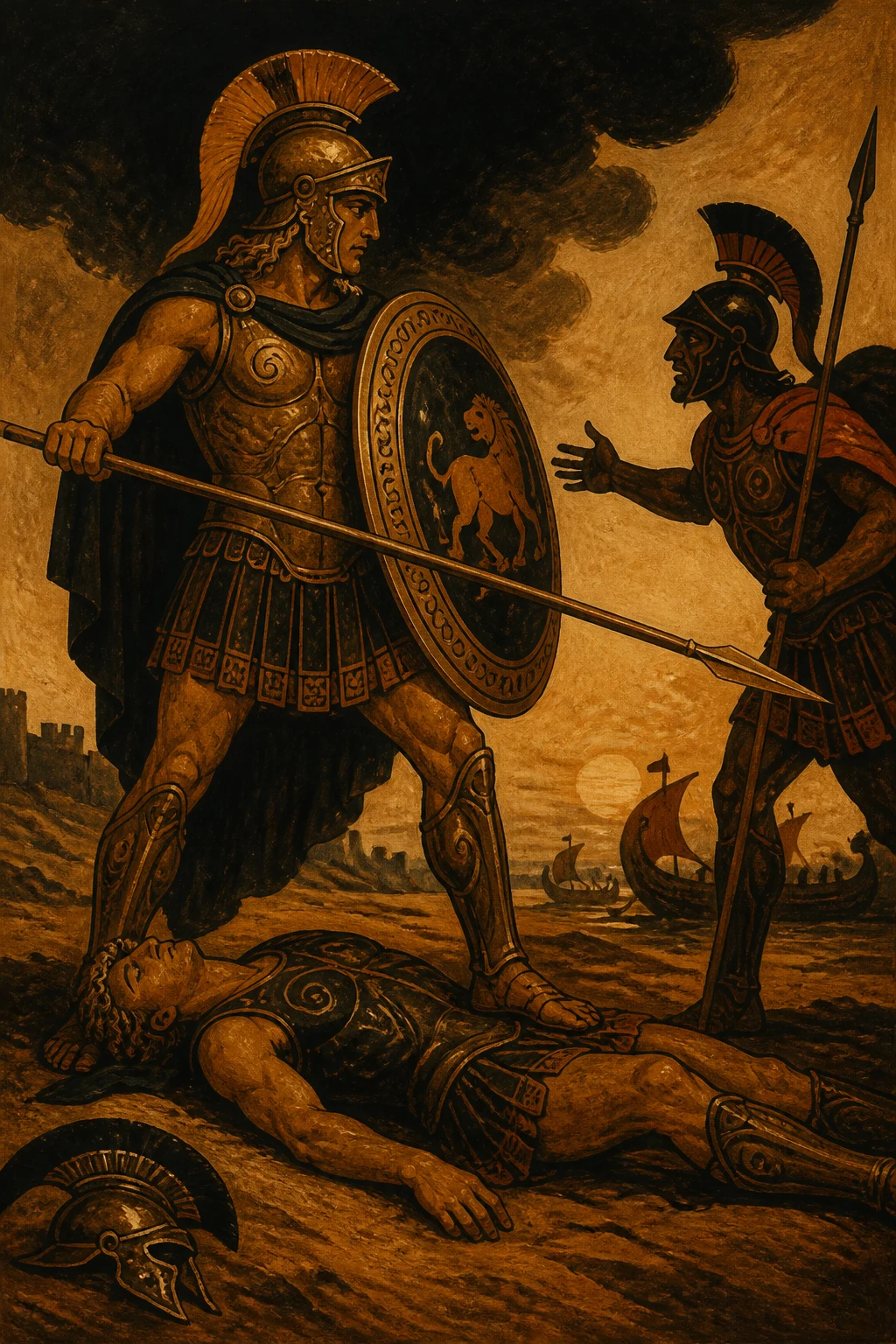
Deeply troubled, swift-footed Achilles answered him: “Xanthus, why do you prophesy my death? There is no need. I know well enough myself that I am fated to die here, far from my dear father and mother. Even so, I shall not stop until I have driven the Trojans to their fill of war.”
With that, shouting, he drove his single-hoofed horses among the foremost.