Prevod
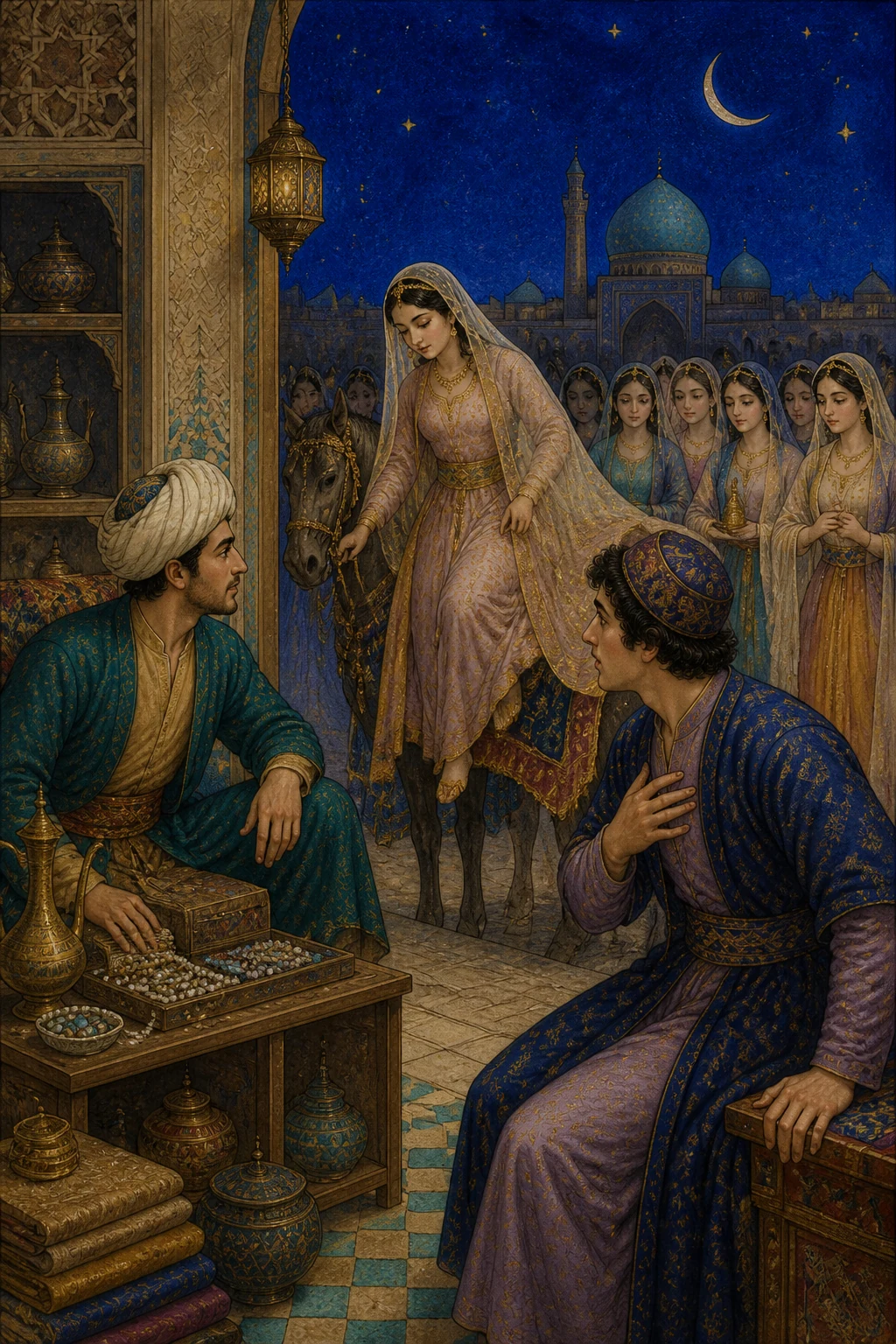
It is related that one day Abu Nuwas, finding himself alone, prepared a sumptuous gathering, laying out every kind of food and delicacy that lips and tongue could desire. Then he went out in search of a beloved worthy of such a feast, saying, “O my God, my Lord and Master, I beseech You to send me someone suited to this gathering, someone fit to be my drinking companion today.” Scarcely had he finished speaking when he saw three handsome, beardless young men, like the youths of Paradise. Though their complexions differed, their charms were alike in their perfection, and the sway of their supple bodies awakened eager hopes, as the poet said:
I passed two beardless beauties and declared, “I love you both.” The pair replied, “Have you wealth?” “And generosity besides,” I said. “Then what you seek is close at hand,” they answered. Such was Abu Nuwas’s way: he made merry with the beautiful and plucked the rose from every blooming cheek, as the poet said:
An old man, yet youthful in desire, who loves fair faces, music, and delight, went forth a man of Mosul in the land of al-Naqa, yet thought of nothing but Aleppo. Abu Nuwas approached the young men and greeted them, and they returned his greeting with every courtesy and honor. Then, when they made to go on their way, he detained them and recited these verses:
Seek no one else, for I possess the very mine of good things. I have wine that gleams when poured, bought from the monastery’s monk; I have the flesh of sheep and birds of every kind. Eat of these, and drink old wine that drives all care away. Fuck one another, and slip my cock between you. Beguiled by his verses, the young men yielded to his wishes and accepted his invitation. And dawn overtook Shahrazad, and she fell silent, ceasing her permitted tale.
Then, when it was the three hundred and eighty-second night,
She said: It has reached me, O fortunate King, that when Abu Nuwas had beguiled the young men with his verses, they yielded to his wishes and answered, “We hear and obey.” They went home with him and found everything he had described in his poem laid out for the gathering. They sat down, ate and drank, took their pleasure and made merry, then asked Abu Nuwas to judge which of them was fairest and most radiant, and whose figure was most graceful and well proportioned. After kissing one of them twice, he pointed to him and recited these two verses:
My soul would I ransom the mole upon his cheek—and whence came such a mole? My wealth would I give to redeem it! Blessed be He who left that cheek bare of hair and lodged all beauty in that single mole. Then he pointed to the second, after kissing him on the lips, and recited these two verses:
My beloved has a mole upon his cheek, like musk upon the purest camphor. My eye marveled when it saw him, and the mole said, “Invoke blessings upon the Prophet!” Then he pointed to the third, after kissing him ten times, and recited these verses:
A young man, his hands stained with wine, melted gold within a silver cup. He passed among the cupbearers with a cup of wine, while his two eyes went round with two cups more. A lovely Turk, a gazelle whose slender waist contends with the twin hills of Hunayn! Though my soul has found repose in al-Zawra, my heart is torn between two powers: one draws it toward Diyar Bakr, the other toward the land of al-Jami‘ayn. Each of the young men had drunk two cups, and when Abu Nuwas’s turn came, he took the cup and recited these two verses:
Drink wine only from the hands of a young gazelle, whose subtle grace it mirrors, as he mirrors its own. The drinker finds no true delight in wine unless the cheek of him who pours it is smooth and clear. Then he drained his cup, and the drinking went round. When his turn came again, joy overcame him, and he recited these verses:
Take for your companion cups of wine in endless succession, and follow every cup with more, from the hand of a dark-lipped marvel of beauty, whose mouth, on waking, is fragrant as musk or apples. Drink wine only from the hands of a young gazelle whose cheek is sweeter to kiss than wine to drink. At last drunkenness so mastered Abu Nuwas that he could scarcely tell his hand from his head. He fell upon the young men with kisses and embraces, entwining leg with leg, heedless of sin or shame, and recited these verses:
No man has tasted pleasure to the full unless he drinks with beardless beauties for companions. One sings to him; another greets him as he revives him with a cup. Whenever he craves a kiss from one of them, that one offers his mouth to sip. Blessings upon them! They have made my day delightful—ah, how sweet it has been! We drink it neat and mixed, and this is our rule: whoever falls asleep, we fuck him. While they were thus engaged, someone knocked at the door. They gave him leave to enter, and when he came in, they found that it was the Commander of the Faithful, Harun al-Rashid. They all rose and kissed the ground before him, and awe of the Caliph sobered Abu Nuwas. “Abu Nuwas!” said the Commander of the Faithful. “At your service, Commander of the Faithful! May God strengthen you!” he answered. “What is the meaning of this?” the Caliph asked. “Commander of the Faithful,” he replied, “surely what you see makes questioning needless.” The Caliph said, “Abu Nuwas, I have sought Almighty God’s guidance and appointed you judge of the pimps.” “Do you truly wish this office upon me, Commander of the Faithful?” asked Abu Nuwas. “Yes,” he answered. “Then, Commander of the Faithful, have you a case you wish to bring before me?” At this the Commander of the Faithful grew angry and turned away, leaving them in a fury. When night fell, he remained bitterly incensed with Abu Nuwas, while Abu Nuwas passed one of the happiest of nights in pleasure and delight. When morning dawned and its light shone bright, Abu Nuwas broke up the gathering and sent the young men away. He dressed in his court attire and left his house to attend the Commander of the Faithful. It was the Caliph’s custom, after dismissing the court, to enter his sitting hall, where the poets, boon companions, and musicians would assemble, each taking his appointed place and no other. That day, as it happened, he had come down from the court into the hall and summoned his companions, who seated themselves in their places. When Abu Nuwas arrived and was about to take his seat, the Commander of the Faithful called for Masrur the executioner and ordered him to strip Abu Nuwas, fasten a donkey’s packsaddle to his back, put a halter on his head and a crupper around his backside, and lead him through the maidens’ chambers. And dawn overtook Shahrazad, and she fell silent, ceasing her permitted tale.
Then, when it was the three hundred and eighty-third night,
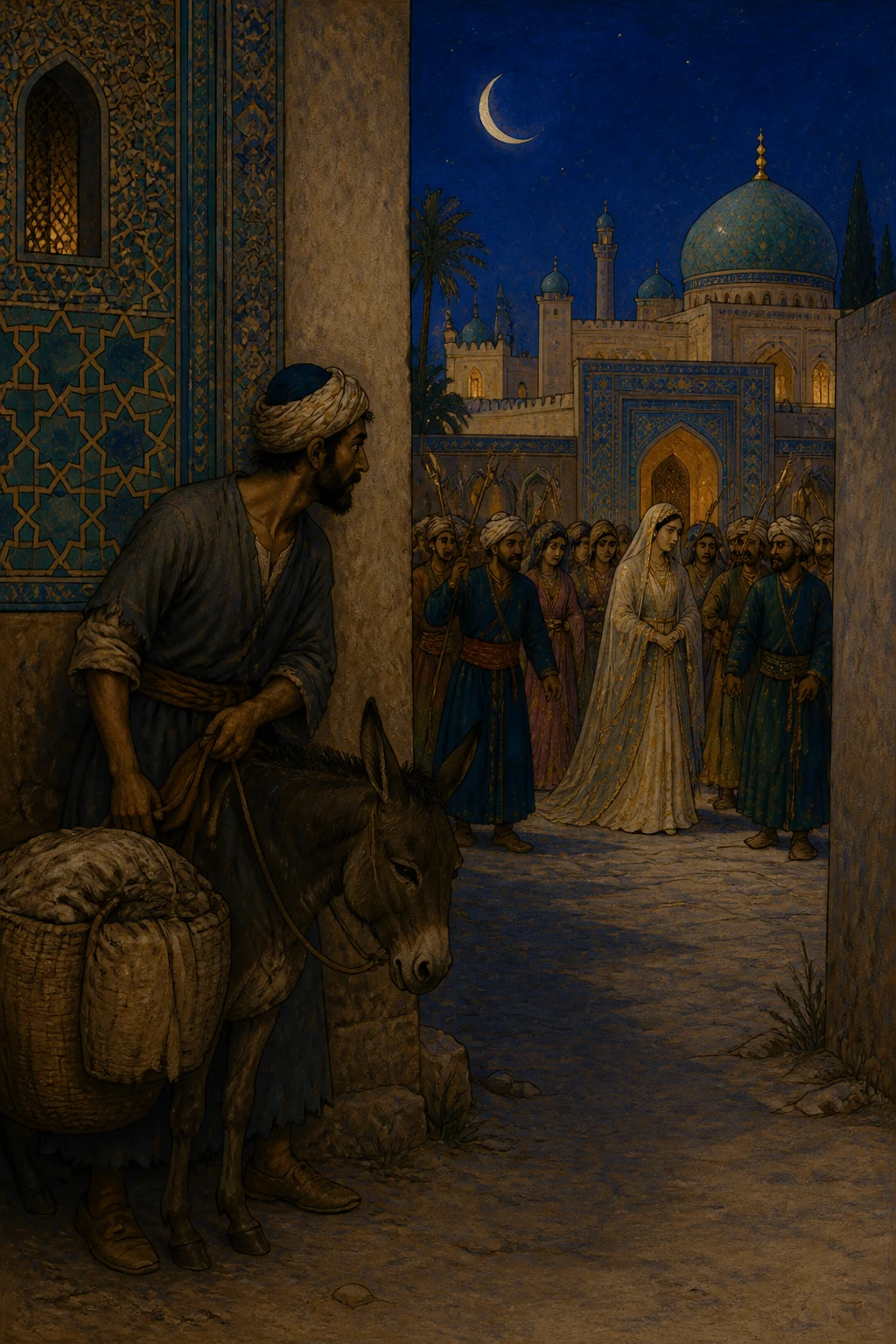
She said: It has reached me, O fortunate King, that the Commander of the Faithful ordered Masrur the executioner to strip Abu Nuwas, fasten a packsaddle to his back, put a halter on his head and a crupper around his backside, and lead him through the maidens’ chambers, the women’s apartments, and all the other quarters, so that everyone might mock him. Afterward, he was to cut off his head and bring it to the Caliph. “I hear and obey,” said Masrur. He proceeded to carry out the Caliph’s orders and led Abu Nuwas through the chambers, of which there were as many as the days of the year. Now Abu Nuwas was a merry fellow, and everyone who saw him gave him money, so that by the time he returned, his bosom was full of coins. While he was in this state, Ja‘far al-Barmaki arrived to attend the Caliph, having been away on an important errand for the Commander of the Faithful. He saw Abu Nuwas in this plight and recognized him. “Abu Nuwas!” he called. “At your service, my lord!” he replied. “What offense have you committed to deserve such punishment?” Ja‘far asked. Abu Nuwas answered, “I have committed no offense, save that I presented our lord the Caliph with the finest of my verses, and he has presented me in return with the finest of his clothes.” When the Commander of the Faithful heard this, laughter burst from his anger-filled heart. He pardoned Abu Nuwas and ordered that he be given a purse of money.