Waltey
022 The Three Little Pigs
022 The Three Little Pigs
Mother's Nursery Tales · Katharine PyleO besedilu
022 The Three Little Pigs
- Vir
- Mother's Nursery Tales
- Avtor
- Katharine Pyle
- Jezik branja
- Slovenščina
- Jezik izvirnika
- English
- Čas branja
- 10 min branja
- Obseg
- 8 strani
- Naslov izvirnika
- 022 The Three Little Pigs
O izvirniku
Mother's Nursery Tales
Štiriintrideset zgodovinskih literarnih priredb starejših pravljic, ki jih je Pyle tudi ilustrirala. Bralni jezik je Slovenščina, izvirnik pa prihaja iz vira Mother's Nursery Tales v jeziku English.
Besedilo
022 The Three Little Pigs
Mama pujsa in njeni trije pujski so vse dolgo poletje živeli skupaj v gozdu in bili zelo srečni. Ko pa se je bližala jesen, je mama pujsa poklicala svoje malčke k sebi in rekla: »Moji dragi pujski, prišel je čas, da se odpravite v svet in si poiščete srečo. Vsak si bo želel postaviti hišico, v kateri bo živel, vendar jih ne gradite iz slame ali listja; slama je krhka, listje pa šibko. Zgradite si hišice iz opeke, pa boste vedno imeli varno zavetje. Lahko boste stopili vanje in zaklenili vrata, pa vam nič ne bo moglo škodovati.« Nato se je poslovila od pujskov in ti so stekli v svet iskat srečo.
Prvi pujsek še ni prišel daleč, ko je srečal moža s tovorom slame. Slama je bila videti tako topla in tako lepo je dišala, da je pujsek povsem pozabil, kaj mu je naročila mama.
»Prosim, gospod,« je rekel pujsek, »dajte mi toliko slame, da si bom lahko zgradil hišico, v kateri mi bo toplo vso dolgo zimo.« Mož mu ni odrekel. Dal mu je toliko slame, kolikor je je želel, nato pa se je odpeljal naprej.
Pujsek si je zgradil hišico iz slame. Bila je tako topla in prijetna, da je bil ves navdušen nad njo. »Koliko boljša je,« je rekel, »od hiše iz mrzle, trde opeke.«
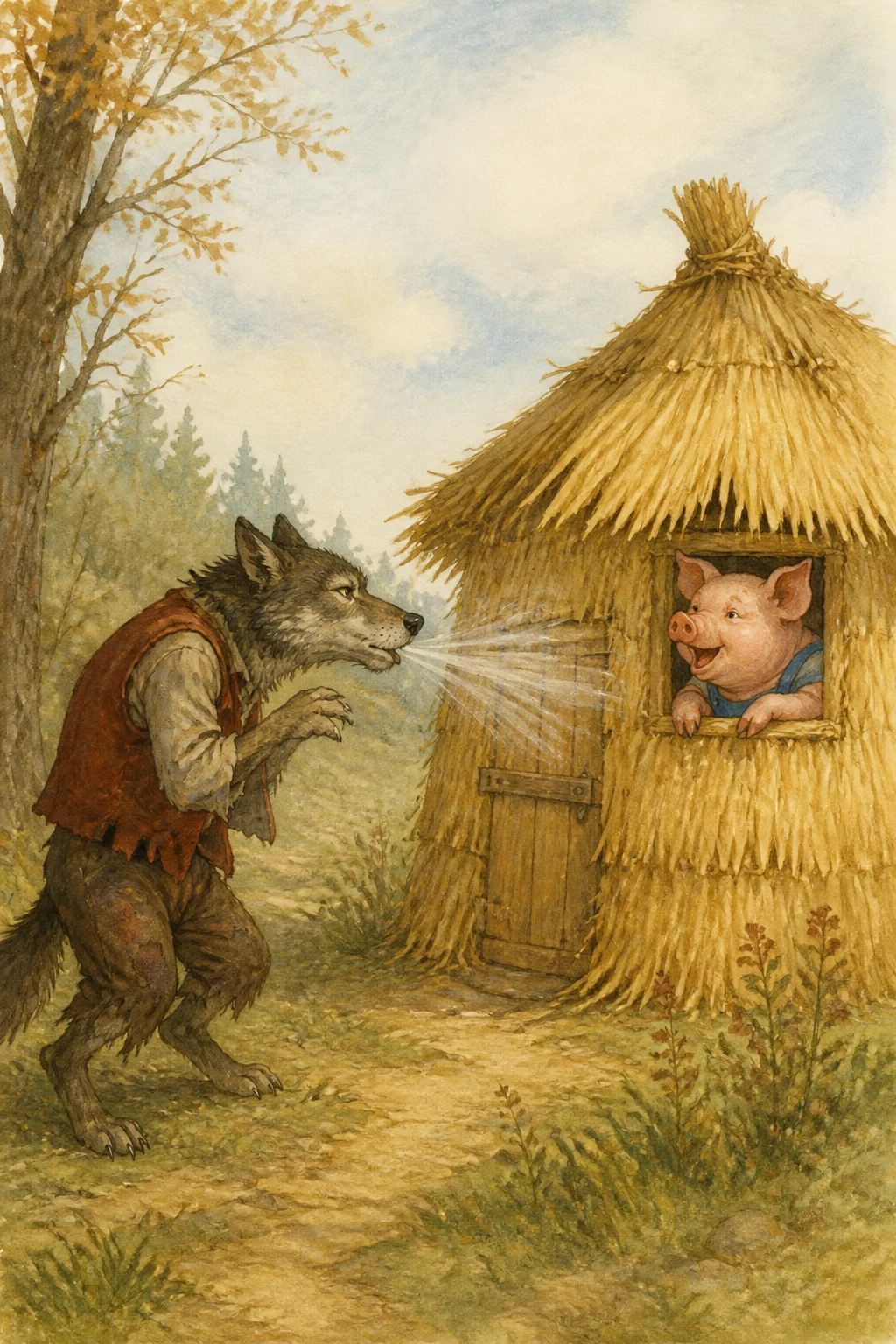
Tako je ležal na toplem in udobnem, ko je čez čas na vrata potrkal stari volk. »Pujsek, pujsek, spusti me noter!« je zavpil. »Ne, prisežem pri ščetinah na svoji bradici,« je odgovoril pujsek.
»Potem bom sopel in puhal in ti hišico odpihnil!« Pujsek se je glasno zasmejal, saj se je v svoji prijetni slamnati hišici počutil zelo varnega. »Pa sopi in puhaj in mi hišico odpihni!« je zavpil.
In stari volk je res sopel in puhal ter odpihnil hišico, saj je bila le iz slame, potem pa je požrl pujska. Drugi pujsek je po odhodu iz gozda tekel in tekel, dokler ni srečal moža z velikim tovorom listja.
»O, dobri gospod, prosim, dajte mi nekaj listja, da si bom zgradil hišico za zimo,« je vzkliknil pujsek. Mož mu je z veseljem ustregel. Dal mu je toliko listja, kolikor ga je želel, potem pa je šel svojo pot.
Pujsek si je zgradil hišico iz listja in bila je še prijetnejša in toplejša od slamnate. »Kako nespametna je bila moja mama,« je rekel pujsek, »da mi je naročila, naj si zgradim hišico iz opeke. Kaj bi sploh lahko bilo toplejše, prijetnejše in varnejše od tega?« Nato se je udobno ugnezdil med listje in bil nadvse srečen.
Čez čas je mimo prišel veliki volk, se ustavil in potrkal na vrata. »Pujsek, pujsek, spusti me noter!« je zavpil. »Ne, prisežem pri ščetinah na svoji bradici!«
»Potem bom sopel in puhal in ti hišico odpihnil!« Pujsek se je ob teh besedah zasmejal, saj so bile stene debele in počutil se je varnega.
»Pa sopi in puhaj in mi hišico odpihni!« In volk je sopel in puhal, odpihnil hišico ter požrl pujska, ki je bil v njej.
Tretji pujsek je bil najmanjši od vseh, a je bil zelo moder in je sklenil narediti natanko tako, kot mu je naročila mama. Ko je zapustil gozd, je srečal moža, ki je peljal voz slame, vendar ga ni prosil zanjo. Srečal je moža s tovorom listja, vendar ga ni prosil zanj. Potem pa je srečal moža s tovorom opeke. Ustavil se je in ga tako lepo prosil za dovolj opek, da bi si zgradil hišico, da mu mož ni mogel odreči.
Pujsek je vzel opeke in si iz njih zgradil rdečo hišico, kar nikakor ni bilo lahko delo. Ko je bila končana, ni bila tako mehka kakor slamnata hišica in ne tako topla kakor hišica iz listja, bila pa je zelo varna.
Čez čas je prišel stari volk in potrkal na vrata — trk, trk, trk! »Pujsek, pujsek, spusti me noter!« je zaklical. »Ne, prisežem pri ščetinah na svoji bradici.«
»Potem bom sopel in puhal in ti hišico odpihnil!« »Pa sopi in puhaj in mi hišico odpihni!« je odgovoril pujsek. In stari volk je sopel in puhal, pa puhal in sopel, in SOPEL IN PUHAL, da bi mu skoraj razneslo boke, a hišice nikakor ni mogel odpihniti. Pujsek pa se je potihem smejal, ko je na varnem in udobnem sedel v njej.
Stari volk je videl, da s pihanjem ne bo nič opravil, zato je sedel in dolgo tuhtal. Nato je rekel: »Pujsek, vem, kje je njiva z lepo repo.«
»Kje?« je vprašal pujsek. »Odpri vrata, pa ti povem.« Ne, pujsek je prav dobro slišal tudi skozi zaprta vrata. »Malo naprej ob cesti, tri njive od tod,« je rekel volk, »in če bi je rad nekaj nabral, pridem jutri zjutraj ob šestih pote, pa jo bova šla skupaj izkopat.«
»Ob šestih!« je rekel pujsek. »Prav.« Nato je stari volk odhlačal domov in si oblizoval gobec. Bil je nadvse zadovoljen, saj je mislil, da bo naslednji dan za zajtrk jedel pujska.
Toda naslednje jutro je bil pujsek pokonci že ob petih. Odhitel je na njivo, nabral polno vrečo repe in bil spet doma, še preden je stari volk pomislil, da bi se odpravil ponj.
Ob šestih je stari volk potrkal na vrata. »Si pripravljen, da greva po repo, pujsek?« je zaklical. »Pripravljen!« je odgovoril pujsek. »Saj sem že pred eno uro vstal in šel na njivo. Imam toliko repe, kolikor je potrebujem, in zdaj jo kuham za zajtrk.«
»Tako si torej naredil!« je rekel volk. Nato je malo pomislil. »Pujsek, imaš rad lepa, zrela jabolka?« je vprašal. Da, pujsek je imel jabolka zelo rad.
»Potem ti lahko povem, kje jih najdeš.« »Kje pa?« »Tam za hribom, v graščakovem sadovnjaku. In če me ne boš spet ukanil, pridem jutri ob petih pote, pa bova šla skupaj in jih nekaj nabrala.«
Prav; pujsek bo pripravljen. Volk je zato odhlačal domov in tokrat je bil povsem prepričan, da bo naslednje jutro za zajtrk pojedel lepega, tolstega pujska.
Naslednji dan je pujsek vstal ob štirih in se odpravil proti sadovnjaku tako hitro, kot so ga nesle njegove štiri nožice. Toda pot je bila dolga in na drevo je bilo težko splezati. Ko je še sedel med vejami in nabiral jabolka, je v sadovnjak prihlačal stari volk. Pujsek se je zelo prestrašil, vendar je ostal povsem pri miru in upal, da ga volk med listjem ne bo opazil.
Volk se je oziral naokrog, pogledoval najprej na eno drevo, potem na drugo in nazadnje zagledal pujska med vejami. »Zakaj me nisi počakal?«
»O, saj sem vedel, da boš kmalu prišel.« »Kdaj boš prišel dol?« »Ko naberem še nekaj jabolk.« Stari volk je sedel pod drevo, pujsek pa je sedel med vejami, hrustal jabolka in se oblizoval.
»So dobra?« je vprašal volk in pogledal navzgor; kar sline so se mu cedile. Da, bila so zelo dobra. »Bi mi lahko vrgel eno dol?« Da, pujsek je to lahko storil.
Utrgal je največje in najbolj rdeče jabolko, kar jih je našel, nato pa ga je vrgel daleč proč, tako da je poskakovalo in se kotalilo po pobočju navzdol. Volk je planil po hribu za njim, in medtem ko ga je lovil, je pujsek splezal z drevesa ter s polno košaro jabolk varno pritekel domov.
Ko je stari volk ugotovil, da ga je pujsek spet ukanil, se je silno razjezil. Še bolj kakor prej je bil odločen, da ga bo ujel. Odhlačal je do rdeče hišice in potrkal na vrata.
»Si nabral toliko jabolk, kolikor si jih hotel?« je vprašal volk. Da, pujsek jih je imel dovolj in volku je bil zelo hvaležen, da mu je povedal za sadovnjak.
»Poslušaj, pujsek, jutri bo v mestu imeniten sejem,« je rekel volk. »Bi rad šel?« Da, pujsek bi šel zelo rad.
»Prav,« je rekel volk. »Potem pridem jutri ob pol štirih pote, pa bova šla skupaj.« »Prav,« je rekel pujsek. Toda naslednji dan se je na sejem odpravil že dolgo pred pol četrto. S seboj je vzel štiri bleščeče srebrnike, saj si je hotel kupiti pinjo za izdelovanje masla. Pinjo je hitro kupil, nato pa se je odpravil domov in jo nosil na hrbtu.
Toda volk se je o pujskovih zvijačah že marsičesa naučil. Tudi sam se je na sejem odpravil dolgo pred pol četrto. Tako pujsek še ni bil niti na pol poti domov in je ravno prišel na vrh visokega hriba, ko je zagledal volka, ki je prihlačal navkreber naravnost proti njemu. Pujsek se je silno prestrašil. Ozrl se je na vse strani, a nikjer ni videl skrivališča. Sklenil je, da bo najbolje, če zleze v pinjo. Zato jo je odložil na tla in smuknil vanjo. Toda hrib je bil zelo strm in komaj je bil pujsek v pinji, se je ta že začela kotaliti po pobočju navzdol, bum, bum, bum, čez skale in kamenje, poskakujoč in odskakujoč kakor živo bitje. Pujsek ni vedel, kaj se dogaja z njim. Začel je cviliti na ves glas.
Stari volk je bil na pol poti na hrib, ko je zaslišal ropot. Pogledal je navzgor in zagledal veliko okroglo reč, ki je poskakovala čez skale naravnost proti njemu in pri tem neprestano cvilila. En sam pogled je bil dovolj, da se mu je od strahu naježila dlaka. Zatulil je, se obrnil in jo ucvrl domov, kolikor so ga nesle noge. Ustavil se je šele, ko je bil na varnem v svoji hiši ter je za seboj zaprl in zaklenil vrata. Tam je čepel, se tresel in ugibal, kaj se bo zgodilo. Toda zgodilo se ni nič in vse je bilo tiho, zato se je volk čez nekaj časa opogumil, odšel ven in stekel k pujskovi hišici.
»Pujsek, pujsek! Si notri?« Da, pujsek je sedel ob ognju in pekel jabolka. »Potem pa poslušaj, da ti povem, kaj se mi je zgodilo na poti na sejem.« Volk je približal smrček špranji pri vratih in pujsku povedal vse o veliki okrogli cvileči reči, ki ga je pognala po hribu navzdol.
Pujsek se je smejal in smejal. »Jaz pa ti lahko povem, kaj natanko je bila tista velika cvileča reč: pinja, ki sem jo kupil na sejmu, jaz pa sem bil v njej.«
Ko je stari volk to slišal, je tako pobesnel, da je sklenil pujska dobiti za vsako ceno, pa četudi bi moral zato splezati na streho in se spustiti po dimniku. Ostre kremplje je zasadil med opeke ter splezal po steni hišice naravnost na streho. Nato je splezal na dimnik in se spustil po njem proti ognjišču.
Toda pujsek je slišal, kaj počne, in ga je pripravljen čakal. Na ognju je imel velik lonec vrele vode. Ko je zaslišal, kako volk drsi in praska po dimniku navzdol, je dvignil pokrov in — čof! — stari volk je padel naravnost v vrelo vodo. Pujsek je nato lonec naglo in tesno pokril, in to je bil volkov konec.
Pujsek pa je odtlej živel v miru in izobilju, in če ga je kdaj prišel nadlegovat še kakšen volk, jaz o tem nisem nikoli slišal.
Izvirnik
022 The Three Little Pigs
Naslednje strani prikazujejo izvirno besedilo za primerjavo.
A mother pig and her three little pigs lived together in a wood very happily all through the long summertime, but towards autumn the mother pig called her little ones to her and said, “My dear little pigs, the time has come for you to go out into the world and seek your own fortunes. You will each want to build a little house to live in, but do not build them of straw or leaves; straws are brittle and leaves are frail. Build your houses of bricks, for then you will always have a safe place to live in; you can go in and lock the door, and nothing can harm you.” She then bade the little pigs farewell, and away they ran out into the world to make their fortunes.
The first little pig had not gone far when he met a man with a load of straw. The straw looked so warm, and smelled so good that the little pig quite forgot what his mother had told him.
“Please, Mr. Man,” said the little pig, “give me enough straw to build a house to keep me warm through the long winter.”
The man did not say no. He gave the little pig all the straw he wanted, and then he drove on.
The little pig built himself a house of straw, and it was so warm and cosy that he was quite delighted with it. “How much better,” said he “than a house of cold hard bricks.”
So he lay there snug and warm, and presently the old wolf knocked at the door.
“Piggy-wig, piggy-wig, let me in!” he cried.
“I won’t, by the hair on my chinny-chin-chin,” answered the pig.
“Then I’ll huff, and I’ll puff, and I’ll blow your house in.”
The little pig laughed aloud, for he felt very safe in his snug straw house.
“Well, then huff, and then puff, and then blow my house in!” he cried.
Well, the old wolf did huff and puff, and he did blow the house in, for it was only made of straw, and then he ate up the pig.
The second little pig when he left the forest ran along and ran along and presently he met a man with a great load of leaves.
“Oh, kind Mr. Man, please give me some leaves to build me a little house for the winter time,” cried the piggy.
The man was willing to do this. He gave the pig all the leaves he wanted, and then he went on his way.
The pig built himself a house of leaves and it was even snugger and warmer than the straw house had been. “How silly my mother was,” said the pig, “to tell me to build a brick house. What could be warmer and cosier and safer than this.” And he snuggled down among the leaves and was very happy.
Presently along came the great wolf, and he stopped and knocked at the door.
“Piggy-wig, piggy-wig, let me in!” he cried.
“I won’t, by the hair of my chinny-chin-chin!”
“Then I’ll huff, and I’ll puff, and I’ll blow your house in.”
The little pig laughed when he heard that, for the walls were thick, and he felt secure.
“Well, then huff, and then puff, and then blow my house in.”
So the wolf huffed, and he puffed, and he did blow the house in, and he ate up the little pig that was inside of it.
Now the third little pig was the smallest pig of all, but he was a very wise little pig, and he meant to do exactly as his mother had told him to do. After he left the forest he met a man driving a wagon-load of straw, but he did not ask for any of it. He met the man with the load of leaves, but he did not ask for any of it. He met a man with a load of bricks, and then he stopped and begged so prettily for enough bricks to build himself a little house that the man could not refuse him.
The pig took the bricks and built himself a little red house with them, and it was not an easy task either. When it was done it was not so soft as the little straw house, and it was not so warm as the little leaf house, but it was a very safe little house.
Presently the old wolf came along and knocked at the door—rat-tat-tat!
“Piggy-wig, piggy-wig, let me in,” he called.
“I won’t, by the hair on my chinny-chin-chin.”
“Then I’ll huff, and I’ll puff, and I’ll blow your house in.”
“Well, then huff, and then puff, and then blow my house in,” answered the pig.
So the old wolf huffed and he puffed, and he puffed and he huffed, and he HUFFED AND HE PUFFED till he almost split his sides, and he just couldn’t blow the house in, and the little pig laughed to himself as he sat safe and comfortable inside there.
The old wolf saw there was nothing to be done by blowing, so he sat down and thought and thought. Then he said, “Piggy-wig, I know where there is a field of fine turnips.”
“Where?” asked the little pig.
“Open the door and I will tell you.”
No, the little pig could hear quite well with the door closed.
“It is just up the road three fields away,” said the wolf, “and if you would like to have some I will come for you at six o’clock to-morrow morning, and we will go and dig them up together.”
“At six o’clock!” said the little pig. “Very well.”
Then the old wolf trotted off home, licking his lips, and he was well content, for he thought he would have pig for breakfast the next day.
But the next morning the little pig was up and astir by five o’clock. Off he trotted to the turnip field and gathered a whole bagful of turnips and was home again before the old wolf thought of coming.
At six o’clock the old wolf knocked at the door.
“Are you ready to go for the turnips, Piggy?” he cried.
“Ready!” answered the pig. “Why I was up and off to the field an hour ago and I have all the turnips I want, and I’m boiling them for breakfast.”
“That’s what you did!” said the wolf. And then he thought a bit. “Piggy, do you like fine ripe apples?” he asked.
Yes, the pig was very fond of apples.
“Then I can tell you where to find some.”
“Where is that?”
“Over beyond the hill in the squire’s orchard, and if you will play me no tricks I will come for you at five o’clock to-morrow, and we will go together, and gather some.”
Very well; the pig would be ready.
So the wolf trotted off home, and this time he was very sure that he would have a nice fat little piggy for breakfast the next morning.
The little pig got up at four o’clock the next day, and off he started for the orchard as fast as his four little feet would carry him. But the way was long, and the tree was hard to climb, and while he was still up among the branches gathering apples the old wolf came trotting into the orchard. The little pig was very much frightened, but he kept very still and hoped, up among the leaves, the wolf would not see him.
The wolf peered about, first up one tree and then up another, and finally he spied the piggy up among the branches.
“Why did you not wait for me?”
“Oh, I knew you would be along presently.”
“How soon are you coming down?”
“When I have picked a few more apples.”
The old wolf sat down at the foot of the tree, and the pig sat up among the branches crunching apples and smacking his lips.
“Are they good?” asked the wolf looking up; and his mouth watered.
Yes, they were very good.
“Could you not throw one down to me?”
Yes, the little pig could do that.
He picked the biggest, reddest apple he could, and then he threw it, but he threw it far off, and in such a way that it went bounding and rolling down the hill slope. The wolf bounded down the hill after it, and while he was catching it, the little pig climbed down the tree and ran safely home with his basketful of apples.
When the old wolf found the pig had tricked him again he was very angry. He was more determined than ever that he would catch the little pig. He trotted off to the little red house and knocked at the door.
“Did you get all the apples you wanted?” asked the wolf.
Yes, the little pig had all he wanted, and he was very much obliged to the wolf for telling him about the orchard.
“Listen, Piggy, there’s to be a fine fair over in the town to-morrow,” said the wolf. “Wouldn’t you like to go?”
Yes, the little pig would like very much to go.
“Very well,” said the wolf. “Then I will come for you at half-past three to-morrow, and we will go together.”
“Very well,” said the little pig. But long before half-past three the next day, piggy was off to the fair, and he took four bright silver pieces with him, for he wanted to buy himself a butter-churn. It did not take him long to buy the churn, and then he started home again, carrying it on his back.
But the wolf had learned a thing or two about the little pig’s tricks. He, too, started off to the fair long before half-past three, and so it was that the little pig was scarcely half-way home, and had just reached the top of a high hill, when he saw the wolf come trotting up the hill directly toward him. The little pig was terrified. He looked all around but he could not see any place to hide. He decided the best thing he could do was to get inside the churn. So he put it down and crept inside it. But the hill was very steep, and no sooner was the piggy inside the churn than it began to roll down the hill slope bumpety-bumpety-bump, over rocks and stones, leaping and bounding like a live thing. The little pig did not know what was happening to him. He began to squeal at the top of his voice.
The old wolf was half-way up the hill when he heard the noise. He looked up, and there was a great round thing coming bounding over the rocks straight at him, and squeaking and squeaking as it came. He gave one look and his hair bristled with fear, and with a howl he turned tail and ran home as fast as he could. He never stopped till he was safe inside his house, and had shut and locked the door behind him. There he crouched, trembling and wondering what would happen. But nothing happened, and all was quiet, so after awhile the wolf ventured out and ran over to the pig’s house.
“Piggy, Piggy! Are you in there?”
Yes, the little pig was sitting by the fire roasting apples.
“Then, listen while I tell you what happened to me on the way to the fair.” Then the wolf put his nose close to the crack of the door, and told the little pig all about the great round squealing thing that had chased him down the hill.
The little pig laughed and laughed. “And I can tell you exactly what the great squealing thing was; it was a churn I had bought at the fair, and I was inside it.”
When the old wolf heard this he was so furious that he determined to have the little pig whether or no, even if he had to climb up on the roof and down the chimney to get him. He stuck his sharp nails in between the bricks of the house and climbed right up the side of it and onto the roof. Then he climbed up on the chimney and slid down it into the fire-place.
But the little pig had heard what he was doing, and was ready for him. He had a great pot of boiling water on the fire, and when he heard the wolf slipping and scrabbling down the chimney he took the lid off the kettle, and plump! the old wolf fell right into the boiling water. Then the little pig clapped the lid tight down over him, and that was the end of the wolf.
But the little pig lived on in peace and plenty forever after, and if any other wolf ever came along to bother him I never heard of it.
Nadaljuj z branjem