O besedilu
Škrjanec in kmet
- Vir
- Ezopove basni
- Avtor
- Ezop / Karl Halm
- Jezik branja
- English
- Jezik izvirnika
- Ancient Greek
- Čas branja
- 2 min branja
- Obseg
- 1 stran
- Naslov izvirnika
- 210. Κορυδαλλὸς καὶ Γεωργός. (F. 379. C. 42Ι. B.88.)
O izvirniku
Ezopove basni
Kratke basni, kjer živali v nekaj potezah razkrijejo človeške slabosti. Bralni jezik je English, izvirnik pa prihaja iz vira Ezopove basni v jeziku Ancient Greek.
Besedilo
Škrjanec in kmet
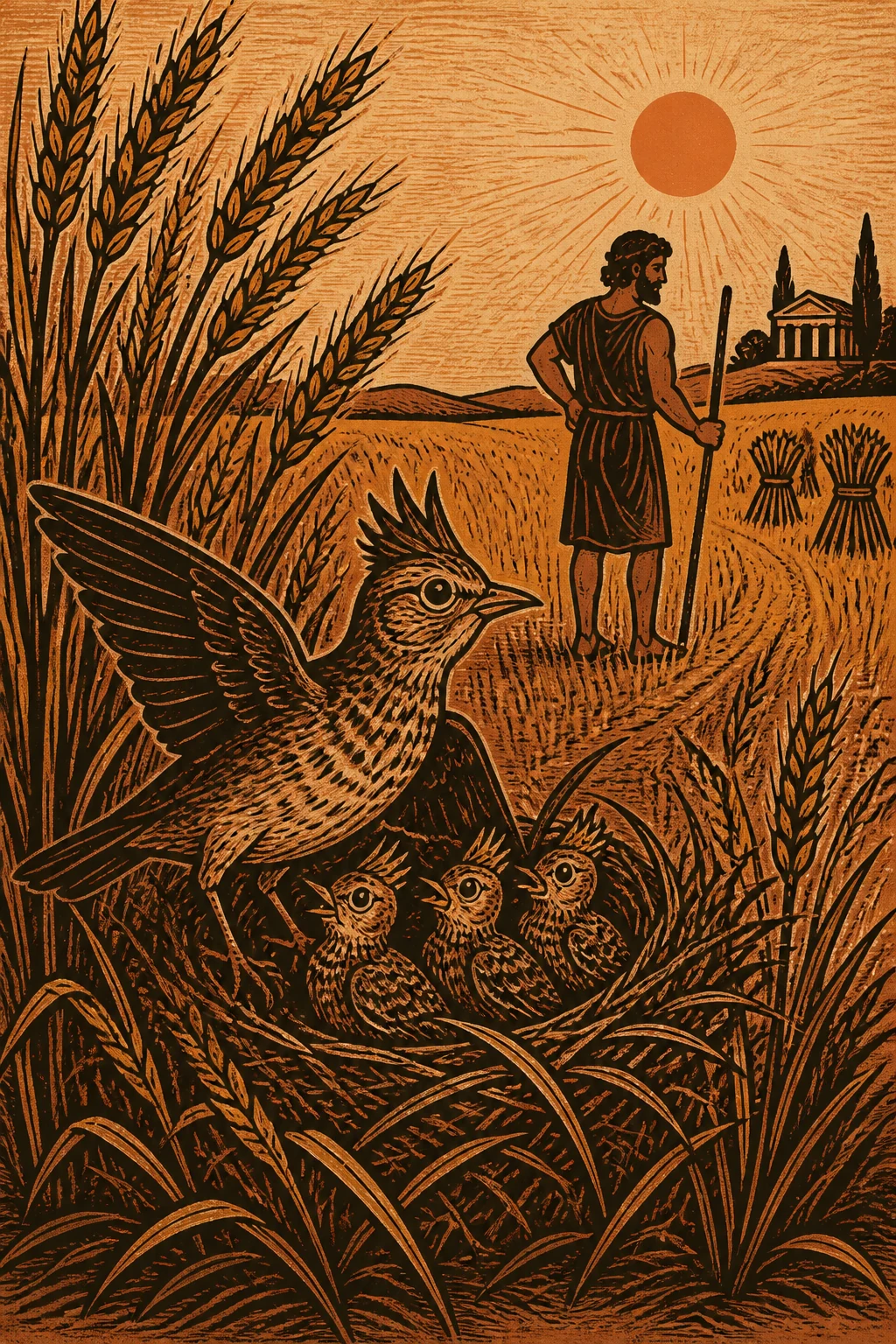
A lark, who sang in answer to the plover at dawn, had made his nest among the green shoots. There, sheltered by the waving grain, he had raised his young until their crests had grown and their wings were strong. The owner of the field came to inspect it, and when he saw that the crop was dry and ripe, he said, “Now it is time to gather all my friends and reap.” One of the lark’s crested chicks heard him and told his father, urging him to consider where he would move them. But the lark replied, “It is not yet time to flee. A man who relies on his friends is in no great hurry.” When the owner returned and saw that the ears were already shedding their grain beneath the sun’s rays, he said that the next day he would send payment to the reapers and pay everyone who carried the sheaves. Then the lark said to his little ones, “Now, children, it is time to fly elsewhere, for he is relying on himself, not on his friends.” The fable teaches us to attend to our own affairs as diligently as we can, and not to neglect them in the confidence that our friends will come to our aid.
Izvirnik
210. Κορυδαλλὸς καὶ Γεωργός. (F. 379. C. 42Ι. B.88.)
Naslednje strani prikazujejo izvirno besedilo za primerjavo.
Κορυδαλὸς ἦν τις ἐν χλόῃ νεοσσεύων, ὁ τῷ χαραδριῷ πρὸς τὸν ὄρθρον ἀντᾴδων, ὃς παῖδας εἶχε ληίου κόμῃ θρέψας λοφῶντας ἤδη καὶ πτεροῖσιν ἀκμαίους. ὁ δὲ τῆς ἀρούρης δεσπότης ἐποπτεύων, ὡς ξηρὸν εἶδε τὸ θέρος, εἶπε· „νῦν ὥρη πάντας λαβεῖν μοι τοὺς φίλους, ἵνʼ ἀμήσω.“ καί τις κορυδαλοῦ τῶν λοφηφόρων παίδων ἤκουσεν αὐτοῦ τῷ τε πατρὶ μηνύει, σκοπεῖν κελεύων ποῦ σφέας μεταστήσει. ὁ δʼ εἶπεν· „οὔπω καιρός ἐστι νῦν φεύγειν ὃς γὰρ φίλοις πέποιθεν οὐκ ἄγαν σπεύδει.“ ὡς δʼ αὖθις ἐλθών ἡλίου δʼ ὑπʼ ἀκτίνων ἤδη ῥέοντα τὸν στάχυν θεωρήσας, μισθὸν μὲν ἀμητῆρσιν αὔριον πέμψειν, μισθὸν δὲ πᾶσι δραγματηφόροις δώσειν εἶπεν, κορυδαλὸς παισὶ νηπίοις οὕτως· „νῦν ἔστιν ὥρη, παῖδες, ἀλλαχοῦ φεύγειν, ὅτʼ αὐτὸς αὑτῷ κοὐ φίλοισι πιστεύει.“
Ὁ μῦθος διδάσκει ἡμᾶς ἐμπιμελεῖσθαι τῶν οἰκείων, ὅση δύναμις, καὶ μὴ καταφρονεῖν, θαῤῥοῦντας ταῖς τῶν φίλων συνδρομαῖς.
Nadaljuj z branjem