Prevod
Once upon a time there was an old king who lay ill and thought, “This must surely be my deathbed.” So he said, “Send for Faithful Johannes!” Faithful Johannes was his dearest servant, and was so called because he had served him faithfully all his life. When he came to the bedside, the king said to him, “My most faithful Johannes, I feel that my end is drawing near, and my only care is for my son. He is still young and does not always know what is best. Unless you promise to teach him everything he needs to know and to be a foster father to him, I cannot close my eyes in peace.” Faithful Johannes answered, “I will never leave him, and I will serve him faithfully, even if it costs me my life.” Then the old king said, “Now I can die comforted and at peace.” He went on, “After my death, you must show him the whole castle, all the chambers, halls, and vaults, and all the treasures they contain. But you must not show him the last chamber in the long passage, where the portrait of the Princess of the Golden Roof is hidden. If he sees that portrait, he will be seized with a passionate love for her and fall down in a faint, and for her sake he will face great dangers. You must protect him from that.” And when Faithful Johannes had once more given the old king his hand upon the promise, the king fell silent, laid his head upon the pillow, and died.
When the old king had been laid in his grave, Faithful Johannes told the young king what he had promised his father on his deathbed, and said, “I shall surely keep my word and be as faithful to you as I was to him, even if it costs me my life.” The time of mourning passed. Then Faithful Johannes said to him, “It is time for you to see your inheritance. I will show you your father’s castle.” He led him everywhere, upstairs and down, and showed him all the riches and splendid chambers. Only the one chamber that held the dangerous portrait did he leave unopened. The portrait was placed so that anyone opening the door would look straight at it, and it was so wonderfully painted that the princess seemed alive, and one could imagine nothing lovelier or more beautiful in all the world. But the young king noticed that Faithful Johannes always passed one door by, and asked, “Why do you never unlock this one for me?” “There is something inside,” he answered, “that would frighten you.” But the king replied, “I have seen the whole castle, and I mean to know what is in there too,” and went to force the door open. Faithful Johannes held him back and said, “Before your father died, I promised him that you should not see what is in that chamber. It might bring great misfortune upon us both.” “Oh, no,” answered the young king, “it will surely be my ruin if I cannot go in. I shall have no peace by day or night until I have seen it with my own eyes. Now I will not stir from this spot until you have unlocked it.”
Then Faithful Johannes saw that nothing could be done, and with a heavy heart and many a sigh he chose the key from the great bunch. When he had opened the door, he stepped in first, intending to cover the portrait so that the king could not see it. But what good did that do? The king rose on tiptoe and looked over his shoulder. And when he saw the maiden’s portrait, so magnificent and gleaming with gold and precious stones, he fell to the floor in a faint. Faithful Johannes lifted him, carried him to his bed, and thought anxiously, “The misfortune has come to pass. Lord God, what will come of it?” Then he revived him with wine until he came to himself again. His first words were, “Ah, who is that beautiful woman in the portrait?” “That is the Princess of the Golden Roof,” answered Faithful Johannes. Then the king went on, “My love for her is so great that if every leaf on every tree were a tongue, they could not tell it. I will stake my life on winning her. You are my most faithful Johannes; you must help me.”
The faithful servant thought for a long time about how to set about it, for it was difficult even to gain an audience with the princess. At last he devised a plan and said to the king, “Everything around her is made of gold: tables, chairs, dishes, cups, bowls, and all her household furnishings. In your treasury lie five barrels of gold. Have the goldsmiths of the kingdom work up one of them into all manner of vessels and utensils, birds, wild creatures, and wondrous beasts. These will please her. We will sail there with them and try our luck.” The king summoned all the goldsmiths, who had to work day and night until at last the most magnificent things were ready. When everything had been loaded aboard a ship, Faithful Johannes dressed as a merchant, and the king had to do the same, so that no one would recognize him. Then they sailed across the sea and sailed on until they reached the city where the Princess of the Golden Roof lived.
Faithful Johannes told the king to remain aboard the ship and wait for him. “Perhaps,” he said, “I shall bring the princess back with me, so see that everything is in order. Have the golden vessels set out and the whole ship adorned.” Then he gathered a selection of the golden things into his apron, went ashore, and walked straight to the royal palace. When he entered the courtyard, a beautiful girl was standing by the well, drawing water with two golden buckets. As she turned to carry away the sparkling water, she saw the stranger and asked who he was. “I am a merchant,” he answered, opening his apron to let her look inside. “Oh, what beautiful golden things!” she exclaimed, setting down the buckets and examining the objects one by one. Then the girl said, “The princess must see these. She takes such delight in golden things that she will buy everything you have.” She took him by the hand and led him upstairs, for she was the princess’s lady’s maid. When the princess saw his wares, she was delighted and said, “They are so beautifully made that I shall buy them all.” But Faithful Johannes said, “I am only the servant of a wealthy merchant. What I have here is nothing beside what my master has aboard his ship: the most exquisite and precious things ever fashioned in gold.” She wanted everything brought up to her, but he said, “That would take many days, so great is the quantity, and so many halls would be needed to display it that your palace could not hold it all.” This so increased her curiosity and desire that at last she said, “Take me to the ship. I will go myself and look at your master’s treasures.”
Faithful Johannes led her to the ship in great delight, and when the king saw her, he found her even more beautiful than her portrait and felt as though his heart would burst. She boarded the ship, and the king led her below, while Faithful Johannes stayed behind with the helmsman and ordered the ship to cast off. “Spread every sail, so that she flies like a bird through the air.” Below, the king showed her the golden objects one by one: the dishes, cups, bowls, birds, wild creatures, and wondrous beasts. Many hours passed while she examined everything, and in her delight she did not notice that the ship was sailing away. When she had looked at the last piece, she thanked the merchant and wished to go home. But when she came to the ship’s side, she saw that they were far from land, out on the open sea, speeding along under full sail. “Oh!” she cried in alarm. “I have been deceived! I have been carried off and fallen into the power of a merchant. I would rather die!” But the king took her hand and said, “I am no merchant. I am a king, and my birth is no less noble than yours. If I have used a trick to carry you away, it was because my love for you was so great. The first time I saw your portrait, I fell to the ground in a faint.” When the Princess of the Golden Roof heard this, she was comforted, and her heart inclined toward him, so that she gladly agreed to become his wife.
Now it happened, as they sailed across the open sea, that Faithful Johannes was sitting in the bow of the ship making music when he saw three ravens flying through the air toward them. He stopped playing and listened to what they were saying to one another, for he understood their speech. One cried, “Well, there he goes, taking the Princess of the Golden Roof home.” “Yes,” answered the second, “but he has not won her yet.” The third said, “Of course he has. She is sitting beside him aboard the ship.” Then the first began again, crying, “What good will that do him? When they reach land, a chestnut horse will come bounding toward him. He will want to mount it, and if he does, it will gallop away with him and up into the air, and he will never see his maiden again.” The second asked, “Is there no way to save him?” “Oh, yes. If someone else mounts quickly, takes the firearm that must be in the saddle holsters, and shoots the horse dead, the young king will be saved. But who knows that? And whoever knows it and tells him will turn to stone from his toes to his knees.” Then the second said, “I know more. Even if the horse is killed, the young king will still not keep his bride. When they enter the castle together, a wedding shirt will be lying there in a dish, ready to wear. It will look as though it were woven of gold and silver, but it is nothing but sulphur and pitch. If he puts it on, it will burn him to the very marrow of his bones.” The third asked, “Is there no way to save him?” “Oh, yes,” answered the second. “If someone wearing gloves seizes the shirt and throws it into the fire to burn, the young king will be saved. But what good is that? Whoever knows it and tells him will turn half to stone, from his knees to his heart.” Then the third said, “I know more. Even if the wedding shirt is burned, the young king will still not have his bride. When the dancing begins after the wedding and the young queen joins in, she will suddenly turn pale and fall as though dead. Unless someone lifts her up, sucks three drops of blood from her right breast, and spits them out again, she will die. But whoever knows this and reveals it will turn to stone from the crown of his head to the tips of his toes.” When the ravens had said these things to one another, they flew on. Faithful Johannes had understood everything, but from that moment he was silent and sad. For if he concealed what he had heard from his master, misfortune would befall him; yet if he revealed it, he must give up his own life. At last, however, he said to himself, “I will save my master, even if I must perish for it.”
When they reached land, everything happened as the raven had foretold, and a magnificent chestnut horse came galloping toward them. “Splendid!” said the king. “That shall carry me to my castle,” and he was about to mount. But Faithful Johannes forestalled him, sprang quickly onto the horse, drew the firearm from the holsters, and shot the animal dead. Then the king’s other servants, who bore Faithful Johannes no goodwill, cried, “How shameful to kill the beautiful creature that was to carry the king to his castle!” But the king said, “Be silent and leave him alone. He is my most faithful Johannes. Who knows what good may come of it?” They went into the castle, and there in the hall stood a dish with the wedding shirt lying in it, looking just as though it were made of gold and silver. The young king approached and was about to take it, but Johannes pushed him aside, seized it with gloved hands, carried it quickly to the fire, and let it burn. The other servants began grumbling again and said, “Look, now he is even burning the king’s wedding shirt!” But the young king said, “Who knows what good may come of it? Leave him alone. He is my most faithful Johannes!” Then the wedding was celebrated. The dancing began, and the bride joined in, while Faithful Johannes watched her closely, keeping his eyes on her face. All at once she turned pale and fell to the floor as though dead. He hurried to her side, lifted her, and carried her into a chamber. There he laid her down, knelt, sucked the three drops of blood from her right breast, and spat them out. Soon she began to breathe again and recovered. But the young king had seen what Faithful Johannes had done, and, not knowing why he had done it, grew angry and cried, “Throw him into prison!” The next morning Faithful Johannes was condemned and led to the gallows. As he stood there, about to be executed, he said, “Everyone who is to die is allowed to speak once more before the end. May I have that right too?” “Yes,” answered the king, “you shall be granted it.” Then Faithful Johannes said, “I have been unjustly condemned, and I have always been faithful to you.” And he told how he had heard the ravens talking at sea, and how he had been obliged to do all these things to save his master. Then the king cried, “Oh, my most faithful Johannes! Mercy! Mercy! Bring him down!” But as Faithful Johannes spoke his last word, he had fallen lifeless and turned to stone.
The king and queen grieved deeply, and the king said, “Alas, how badly I have rewarded such great faithfulness!” He had the stone figure lifted up and placed in his bedchamber beside his bed. Whenever he looked at it, he wept and said, “Oh, if only I could bring you back to life, my most faithful Johannes!” Some time passed, and the queen gave birth to twins, two little sons, who grew and brought them great joy. One day, while the queen was at church and the two children sat playing beside their father, he looked sadly at the stone figure once more, sighed, and cried, “Oh, if only I could bring you back to life, my most faithful Johannes!” Then the stone began to speak and said, “Yes, you can bring me back to life, if you are willing to sacrifice what you love most.” The king cried, “I will give up everything I have in the world for you!” The stone went on, “If you cut off your two children’s heads with your own hand and smear me with their blood, I shall come to life again.” The king was horrified to hear that he must kill his own beloved children. Yet he remembered Johannes’s great faithfulness, and how he had died for him, and drew his sword and cut off the children’s heads with his own hand. When he had smeared the stone with their blood, life returned to it, and Faithful Johannes stood before him once more, alive and well. He said to the king, “Your faithfulness shall not go unrewarded.” Then he took the children’s heads, set them back in place, and smeared the wounds with their blood. In an instant they were whole again, and jumped about and went on playing as though nothing had happened. Now the king was full of joy, and when he saw the queen coming, he hid Faithful Johannes and the two children in a large cupboard. As she entered, he said to her, “Did you pray in church?” “Yes,” she answered, “but all the while I was thinking of Faithful Johannes and the misfortune we have brought upon him.” Then he said, “Dear wife, we can restore him to life, but it will cost us our two little sons. We must sacrifice them.” The queen turned pale, and her heart filled with dread, yet she said, “We owe it to him for his great faithfulness.” Then the king rejoiced that she thought as he had thought. He went and unlocked the cupboard, brought out the children and Faithful Johannes, and said, “God be praised! He is delivered, and we have our little sons back too!” And he told her all that had happened. Then they lived together in happiness to the end of their days.
Izvirnik
Ein Märchen der Brüder Grimm
Es war einmal ein alter König, der war krank und dachte es wird wohl das Totenbett sein, auf dem ich liege. Da sprach er: "Laßt mir den getreuen Johannes kommen!" Der getreue Johannes war sein liebster Diener und hieß so, weil er ihm sein Leben lang so treu gewesen war. Als er nun vor das Bett kam, sprach der König zu ihm: "Getreuester Johannes, ich fühle, daß mein Ende herannaht, und da habe ich keine andere Sorge als um meinen Sohn. Er ist noch in jungen Jahren, wo er sich nicht immer zu raten weiß. Und wenn du mir nicht versprichst, ihn zu unterrichten in allem, was er wissen muß, und sein Pflegevater zu sein, so kann ich meine Augen nicht in Ruhe schließen." Da antwortete der getreue Johannes: "Ich will ihn nicht verlassen und will ihm mit Treue dienen, wenn's auch mein Leben kostet." Da sagte der alte König: "So sterb ich getrost und in Frieden." Und sprach dann weiter: "Nach meinem Tode sollst du ihm das ganze Schloß zeigen, alle Kammern, Säle und Gewölbe und alle Schätze, die darin liegen. Aber die letzte Kammer in dem langen Gange sollst du ihm nicht zeigen, worin das Bild der Königstochter vom goldenen Dache verborgen steht. Wenn er das Bild erblickt, wird er eine heftige Liebe zu ihr empfinden und wird in Ohnmacht niederfallen und wird ihretwegen in große Gefahren geraten; davor sollst du ihn hüten." Und als der treue Johannes nochmals dem alten König die Hand darauf gegeben hatte, ward dieser still, legte sein Haupt auf das Kissen und starb.
Als der alte König zu Grabe getragen war, da erzählte der treue Johannes dem jungen König, was er seinem Vater auf dem Sterbelager versprochen hatte, und sagte: "Das will ich gewißlich halten und will dir treu sein, wie ich ihm gewesen bin, und sollte es mein Leben kosten." Die Trauer ging vorüber. Da sprach der treue Johannes zu ihm: "Es ist nun Zeit, daß du dein Erbe siehst, ich will dir dein väterliches Schloß zeigen." Da führte er ihn überall herum, auf und ab, und ließ ihn alle die Reichtümer und prächtigen Kammern sehen, nur die eine Kammer öffnete er nicht, worin das gefährliche Bild stand. Das Bild war aber so gestellt, daß, wenn die Türe aufging, man gerade darauf sah, und war so herrlich gemacht, daß man meinte, es leibte und lebte und es gäbe nichts Lieblicheres und Schöneres auf der ganzen Welt. Der junge König aber merkte wohl, daß der getreue Johannes immer an einer Tür vorüberging, und sprach: "Warum schließest du mir diese niemals auf?" - "Es ist etwas darin," antwortete er, "vor dem du erschrickst." Aber der König antwortete: "Ich habe das ganze Schloß gesehen, so will ich auch wissen, was darin ist," ging und wollte die Türe mit Gewalt öffnen. Da hielt ihn der getreue Johannes zurück und sagte: "Ich habe es deinem Vater vor seinem Tode versprochen, daß du nicht sehen sollst, was in der Kammer steht; es könnte dir und mir zu großem Unglück ausschlagen." - "Ach nein," antwortete der junge König, "wenn ich nicht hineinkomme, so ist's mein sicheres Verderben. Ich würde Tag und Nacht keine Ruhe haben, bis ich's mit meinen Augen gesehen hätte. Nun gehe ich nicht von der Stelle, bis du aufgeschlossen hast."
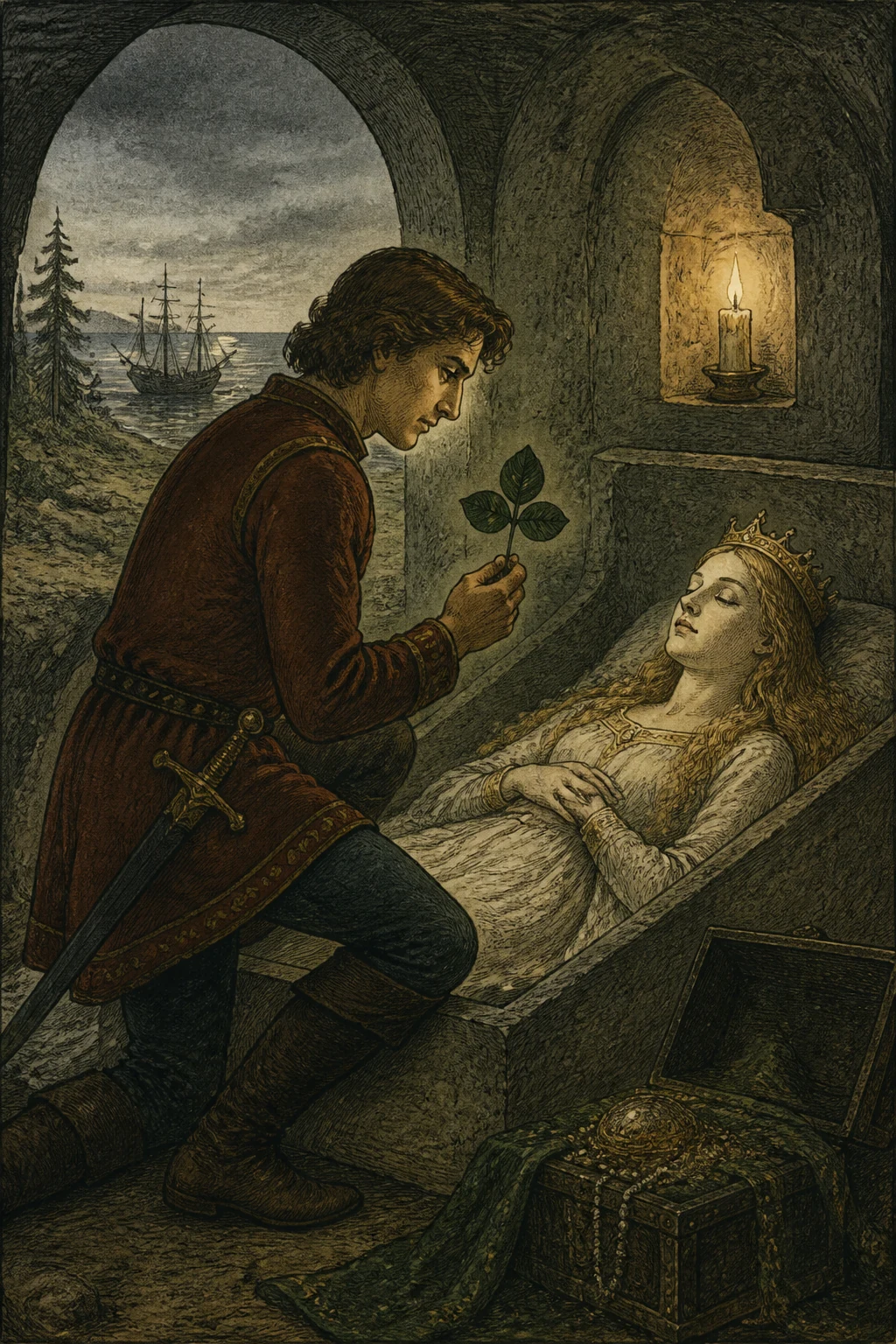
Da sah der getreue Johannes, daß es nicht mehr zu ändern war, und suchte mit schwerem Herzen und vielem Seufzen aus dem großen Bund den Schlüssel heraus. Als er die Tür geöffnet hatte, trat er zuerst hinein und dachte, er wolle das Bildnis bedecken, daß es der König vor ihm nicht sähe. Aber was half das? Der König stellte sich auf die Fußspitzen und sah ihm über die Schulter. Und als er das Bildnis der Jungfrau erblickte, das so herrlich war und von Gold und Edelsteinen glänzte, da fiel er ohnmächtig zur Erde nieder. Der getreue Johannes hob ihn auf, trug ihn in sein Bett und dachte voll Sorgen: Das Unglück ist geschehen, Herr Gott, was will daraus werden? Dann stärkte er ihn mit Wein, bis er wieder zu sich selbst kam. Das erste Wort, das er sprach, war: "Ach, wer ist das schöne Bild?" - "Das ist die Königstochter von goldenen Dache," antwortete der treue Johannes. Da sprach der König weiter: "Meine Liebe zu ihr ist so groß, wenn alle Blätter an den Bäumen Zungen wären, sie könnten's nicht aussagen; mein Leben setze ich daran, daß ich sie erlange. Du bist mein getreuester Johannes, du mußt mir beistehen."
Der treue Diener besann sich lange, wie die Sache anzufangen wäre, denn es hielt schwer, nur vor das Angesicht der Königstochter zu kommen. Endlich hatte er ein Mittel ausgedacht und sprach zu dem König: "Alles, was sie um sich hat, ist von Gold, Tische, Stühle, Schüsseln, Becher, Näpfe und alles Hausgerät. In deinem Schatze liegen fünf Tonnen Goldes, laß eine von den Goldschmieden des Reiches verarbeiten zu allerhand Gefäßen und Gerätschaften, zu allerhand Vögeln, Gewild und wunderbaren Tieren, das wird ihr gefallen, wir wollen damit hinfahren und unser Glück versuchen." Der König hieß alle Goldschmiede herbeiholen, die mußten Tag und Nacht arbeiten, bis endlich die herrlichsten Dinge fertig waren. Als alles auf ein Schiff geladen war, zog der getreue Johannes Kaufmannskleider an, und der König mußte ein Gleiches tun, um sich ganz unkenntlich zu machen. Dann fuhren sie über das Meer und fuhren so lange, bis sie zu der Stadt kamen, worin die Königstochter vom goldenen Dache wohnte.
Der treue Johannes hieß den König auf dem Schiffe zurückbleiben und auf ihn warten. "Vielleicht," sprach er, "bring ich die Königstochter mit, darum sorgt, daß alles in Ordnung ist, laßt die Goldgefäße aufstellen und das ganze Schiff ausschmücken." Darauf suchte er sich in sein Schürzchen allerlei von den Goldsachen zusammen, stieg ans Land und ging gerade nach dem königlichen Schloß. Als er in den Schloßhof kam, stand da beim Brunnen ein schönes Mädchen, das hatte zwei goldene Eimer in der Hand und schöpfte damit. Und als es das blinkende Wasser forttragen wollte und sich umdrehte, sah es den fremden Mann und fragte, wer er wäre. Da antwortete er: "Ich bin ein Kaufmann," und öffnete sein Schürzchen und ließ sie hineinschauen. Da rief sie: "Ei, was für schönes Goldzeug!" setzte die Eimer nieder und betrachtete eins nach dem anderen. Da sprach das Mädchen: "Das muß die Königstochter sehen, die hat so große Freude an den Goldsachen, daß sie Euch alles abkauft." Es nahm ihn bei der Hand und führte ihn hinauf, denn es war die Kammerjungfer. Als die Königstochter die Ware sah, war sie ganz vergnügt und sprach: .,Es ist so schön gearbeitet, daß ich dir alles abkaufen will." Aber der getreue Johannes sprach: "Ich bin nur der Diener von einem reichen Kaufmann. Was ich hier habe, ist nichts gegen das, was mein Herr auf seinem Schiff stehen hat, und das ist das Künstlichste und Köstlichste, was je in Gold gearbeitet worden ist." Sie wollte alles heraufgebracht haben, aber er sprach: "Dazu gehören viele Tage, so groß ist die Menge, und so viele Säle, um es aufzustellen, daß Euer Haus nicht Raum dafür hat." Da ward ihre Neugierde und Lust immer mehr angeregt, so daß sie endlich sagte: "Führe mich hin zu dem Schiff, ich will selbst hingehen und deines Herrn Schätze betrachten."
Da führte sie der treue Johannes zu dem Schiffe hin und war ganz freudig, und der König, als er sie erblickte, sah, daß ihre Schönheit noch größer war, als das Bild sie dargestellt hatte, und meinte nicht anders, als das Herz wollte ihm zerspringen. Nun stieg sie in das Schiff, und der König führte sie hinein; der getreue Johannes aber blieb zurück bei dem Steuermann und hieß das Schiff abstoßen: "Spannt alle Segel auf, daß es fliegt wie ein Vogel in der Luft." Der König aber zeigte ihr drinnen das goldene Geschirr, jedes einzeln, die Schüsseln, Becher, Näpfe, die Vögel, das Gewild und die wunderbaren Tiere. Viele Stunden gingen herum, während sie alles besah, und in ihrer Freude merkte sie nicht, daß das Schiff dahinfuhr Nachdem sie das letzte betrachtet hatte, dankte sie dem Kaufmann und wollte heim, als sie aber an des Schiffes Rand kam sah sie, daß es fern vom Land auf hohem Meere ging und mit vollen Segeln forteilte. "Ach," rief sie erschrocken, "ich bin betrogen, ich bin entführt und in die Gewalt eines Kaufmannes geraten; lieber wollt ich sterben!" Der König aber faßte sie bei der Hand und sprach: "Ein Kaufmann bin ich nicht ich bin ein König und nicht geringer an Geburt als du bist. Aber daß ich dich mit List entführt habe, das ist aus übergroßer Liebe geschehen. Das erstemal, als ich dein Bildnis gesehen habe, bin ich ohnmächtig zur Erde gefallen." Als die Königstochter vom goldenen Dache das hörte, ward sie getröstet, und ihr Herz ward ihm geneigt, so daß sie gerne einwilligte, seine Gemahlin zu werden.
Es trug sich aber zu, während sie auf dem hohen Meere dahinfuhren, daß der treue Johannes, als er vorn auf dem Schiffe saß und Musik machte, in der Luft drei Raben erblickte, die dahergeflogen kamen. Da hörte er auf zu spielen und horchte, was sie miteinander sprachen, denn er verstand das wohl. Der eine rief: "Ei, da führt er die Königstochter vom goldenen Dache heim." - "Ja," antwortete der zweite, "er hat sie noch nicht." Sprach der dritte: "Er hat sie doch, sie sitzt bei ihm im Schiffe." Da fing der erste wieder an und rief: "Was hilft ihm das! Wenn sie ans Land kommen, wird ihm ein fuchsrotes Pferd entgegenspringen, da wird er sich aufschwingen wollen, und tut er das, so sprengt es mit ihm fort und in die Luft hinein daß er nimmer mehr seine Jungfrau wiedersieht." Sprach der zweite: "Ist gar keine Rettung?" - "O ja, wenn ein anderer schnell aufsitzt, das Feuergewehr, das in den Halftern stecken muß, herausnimmt und das Pferd damit totschießt, so ist der junge König gerettet. Aber wer weiß das! Und wer's weiß und sagt's ihm, der wird zu Stein von den Fußzehen bis zum Knie." Da sprach der zweite: "Ich weiß noch mehr, wenn das Pferd auch getötet wird, so behält der junge König doch nicht seine Braut. Wenn sie zusammen ins Schloß kommen, so liegt dort ein gemachtes Brauthemd in einer Schüssel und sieht aus, als wär's von Gold und Silber gewebt, ist aber nichts als Schwefel und Pech. Wenn er's antut, verbrennt es ihn bis auf Mark und Knochen." Sprach der dritte: "Ist da gar keine Rettung?" - "0 ja," antwortete der zweite, "wenn einer mit Handschuhen das Hemd packt und wirft es ins Feuer, daß es verbrennt, so ist der junge König gerettet. Aber was hilft's! Wer's weiß und es ihm sagt, der wird halben Leibes Stein vom Knie bis zum Herzen." Da sprach der dritte: "Ich weiß noch mehr, wird das Brauthemd auch verbrannt, so hat der junge König seine Braut doch noch nicht. Wenn nach der Hochzeit der Tanz anhebt und die junge Königin tanzt, wird sie plötzlich erbleichen und wie tot hinfallen, und hebt sie nicht einer auf und zieht aus ihrer rechten Brust drei Tropfen Blut und speit sie wieder aus, so stirbt sie. Aber verrät das einer, der es weiß, so wird er ganzen Leibes zu Stein vom Wirbel bis zur Fußzehe." Als die Raben das miteinander gesprochen hatten, flogen sie weiter, und der getreue Johannes hatte alles wohl verstanden, aber von der Zeit an war er still und traurig. Denn verschwieg er seinem Herrn, was er gehört hatte, so war dieser unglücklich; entdeckte er es ihm, so mußte er selbst sein Leben hingeben. Endlich aber sprach er bei sich: "Meinen Herrn will ich retten, und sollte ich selbst darüber zugrunde gehen."
Als sie nun ans Land kamen, da geschah es, wie der Rabe vorher gesagt hatte, und es sprengte ein prächtiger fuchsroter Gaul daher. "Wohlan," sprach der König, "der soll mich in mein Schloß tragen," und wollte sich aufsetzen, doch der treue Johannes kam ihm zuvor, schwang sich schnell darauf, zog das Gewehr aus den Halftern und schoß den Gaul nieder. Da riefen die anderen Diener des Königs, die dem treuen Johannes doch nicht gut waren: "Wie schändlich, das schöne Tier zu töten, das den König in sein Schloß tragen sollte! " Aber der König sprach: "Schweigt und laßt ihn gehen, es ist mein getreuester Johannes, wer weiß, wozu das gut ist!" Nun gingen sie ins Schloß, und da stand im Saal eine Schüssel, und das gemachte Brauthemd lag darin und sah nicht anders aus, als wäre es von Gold und Silber. Der junge König ging darauf zu und wollte es ergreifen, aber der Johannes schob ihn weg, packte es mit Handschuhen an, trug es schnell ins Feuer und ließ es verbrennen. Die anderen Diener fingen wieder an zu murren und sagten: "Seht, nun verbrennt er gar des Königs Brauthemd." Aber der junge König sprach: "Wer weiß, wozu es gut ist laßt ihn gehen, es ist mein getreuester Johannes!" Nun ward die Hochzeit gefeiert. Der Tanz hub an, und die Braut trat auch hinein, da harte der treue Johannes acht und schaute ihr ins Antlitz. Auf einmal erbleichte sie und fiel wie tot zur Erde. Da sprang er eilends hinzu, hob sie auf und trug sie in eine Kammer, da legte er sie nieder, kniete und sog die drei Blutstropfen aus ihrer rechten Brust und speite sie aus. Als bald atmete sie wieder und erholte sich, aber der junge König hatte es mit angesehen und wußte nicht, warum es der getreue Johannes getan hatte, ward zornig darüber und rief: "Werft ihn ins Gefängnis!" Am anderen Morgen ward der getreue Johannes verurteilt und zum Galgen geführt und als er oben stand und gerichtet werden sollte, sprach er: "Jeder, der sterben soll darf vor seinem Ende noch einmal reden, soll ich das Recht auch haben?" - "Ja," antwortete der König "es soll! dir vergönnt sein." Da sprach der treue Johannes: "Ich bin mit Unrecht verurteilt und bin dir immer treu gewesen, und erzählte, wie er auf dem Meer das Gespräch der Raben gehört und wie er, um seinen Herrn zu retten, das alles hätte tun müssen. Da rief der König: "Oh, mein treuester Johannes Gnade! Gnade! Führt ihn herunter!' Aber der treue Johannes war bei dem letzten Wort das er geredet hatte, leblos herabfallen und war ein Stein.
Darüber trugen nun der König und die Königin großes Leid, und der König sprach: "Ach, was hab ich große Treue so übel belohnt!" und ließ das steinerne Bild aufheben und in seine Schlafkammer neben sein Bett stellen. Sooft er es ansah, weinte er und sprach: "Ach, könnt' ich dich wieder lebendig machen, mein getreuester Johannes!" Es ging eine Zeit herum, da gebar die Königin Zwillinge, zwei Söhnlein, die wuchsen heran und waren ihre Freude. Einmal, als die Königin in der Kirche war und die zwei Kinder bei dem Vater saßen und spielten, sah dieser wieder das steinerne Bildnis voll Trauer an, seufzte und rief: "Ach, könnt' ich dich wieder lebendig machen, mein getreuester Johannes!" Da fing der Stein an zu reden und sprach: "Ja, du kannst mich wider lebendig machen, wenn du dein Liebstes daran wenden willst' Da rief der König: "Alles, was ich auf der Welt habe, will ich für dich hingeben!" Sprach der Stein weiter: "Wenn du mit deiner eigenen Hand deinen beiden Kindern den Kopf abhaust und mich mit ihrem Blute bestreichst, so erhalte ich das Leben wieder." Der König erschrak, als er hörte, daß er seine liebsten Kinder selbst töten sollte, doch dachte er an die große Treue und daß der getreue Johannes für ihn gestorben war, zog sein Schwert und hieb mit eigner Hand den Kindern den Kopf ab. Und als er mit ihrem Blute den Stein bestrichen hatte, so kehrte das Leben zurück, und der getreue Johannes stand wieder frisch und gesund vor ihm. Er sprach zum König: "Deine Treue soll nicht unbelohnt bleiben," und nahm die Häupter der Kinder, setzte sie auf und bestrich die Wunde mit ihrem Blut, davon wurden sie im Augenblick wieder heil, sprangen herum und spielten fort, als war ihnen nichts geschehen. Nun war der König voll Freude, und als er die Königin kommen sah, versteckte er den getreuen Johannes und die beiden Kinder in einen großen Schrank. Wie sie hereintrat, sprach er zu ihr: "Hast du gebetet in der Kirche?" - "Ja," antwortete sie, "aber ich habe beständig an den getreuen Johannes gedacht, daß er so unglücklich durch uns geworden ist." Da sprach er: "Liebe Frau, wir können ihm das Leben wiedergeben. aber es kostet uns unsere beiden Söhnlein, die müssen wir opfern." Die Königin ward bleich und erschrak im Herzen, doch sprach sie: "Wir sind's ihm schuldig wegen seiner großen Treue." Da freute er sich, daß sie dachte, wie er gedacht hatte, ging hin und schloß den Schrank auf, holte die Kinder und den treuen Johannes heraus und sprach: "Gott sei gelobt, er ist erlöst, und unsere Söhnlein haben wir auch wieder!" und erzählte ihr, wie sich alles zugetragen hatte. Da lebten sie zusammen in Glückseligkeit bis an ihr Ende.