Prevod
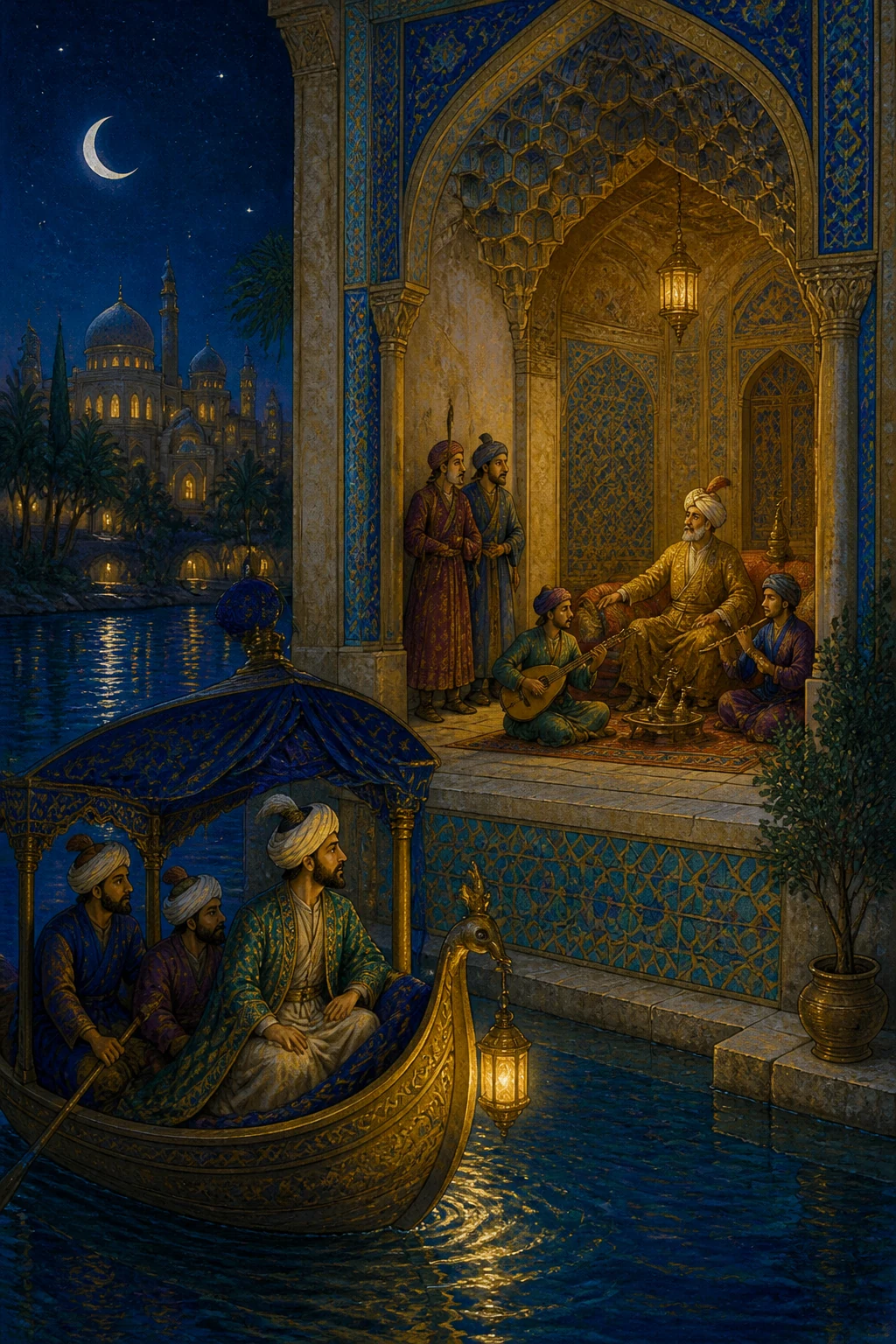
It is told that there once lived in Baghdad a man of consequence, wealthy in money and estates, and one of the foremost merchants. God had granted him worldly abundance, but had not blessed him with the offspring he desired. Many years passed without his being granted either daughters or sons, until he grew old, his bones weakened, his back bent, and his frailty and sorrow increased. He feared that his wealth and lineage would vanish if he had no son to inherit from him and preserve his name. So he pleaded with God Most High, fasting by day and keeping vigil by night. He made vows to God, the Ever-Living, the Self-Sustaining, visited the righteous, and prayed with ever greater fervor. God answered him and accepted his prayer, taking pity on his entreaties and lamentations. Only a few days later, he lay with one of his wives, and she conceived by him that very night, at that very hour. She completed her months and gave birth to a boy as lovely as a piece of the moon. In gratitude to God, mighty and glorious, the merchant fulfilled his vows, distributed alms, and clothed widows and orphans. On the night of the seventh day after the birth, he named the boy Abu al-Hasan. Wet nurses suckled him, nursemaids tended him, and slaves and servants carried him, until he grew into a flourishing youth. He learned the glorious Quran, the obligations of Islam and the precepts of the true faith, calligraphy, poetry, arithmetic, and archery. He became peerless in his day, the handsomest of his age and generation, with a beautiful face and an eloquent tongue. He walked with a graceful sway, bearing himself with charming pride and a coquettish air. His cheeks were rosy, his brow radiant, and the first dark down shaded his face, as one who described him said:
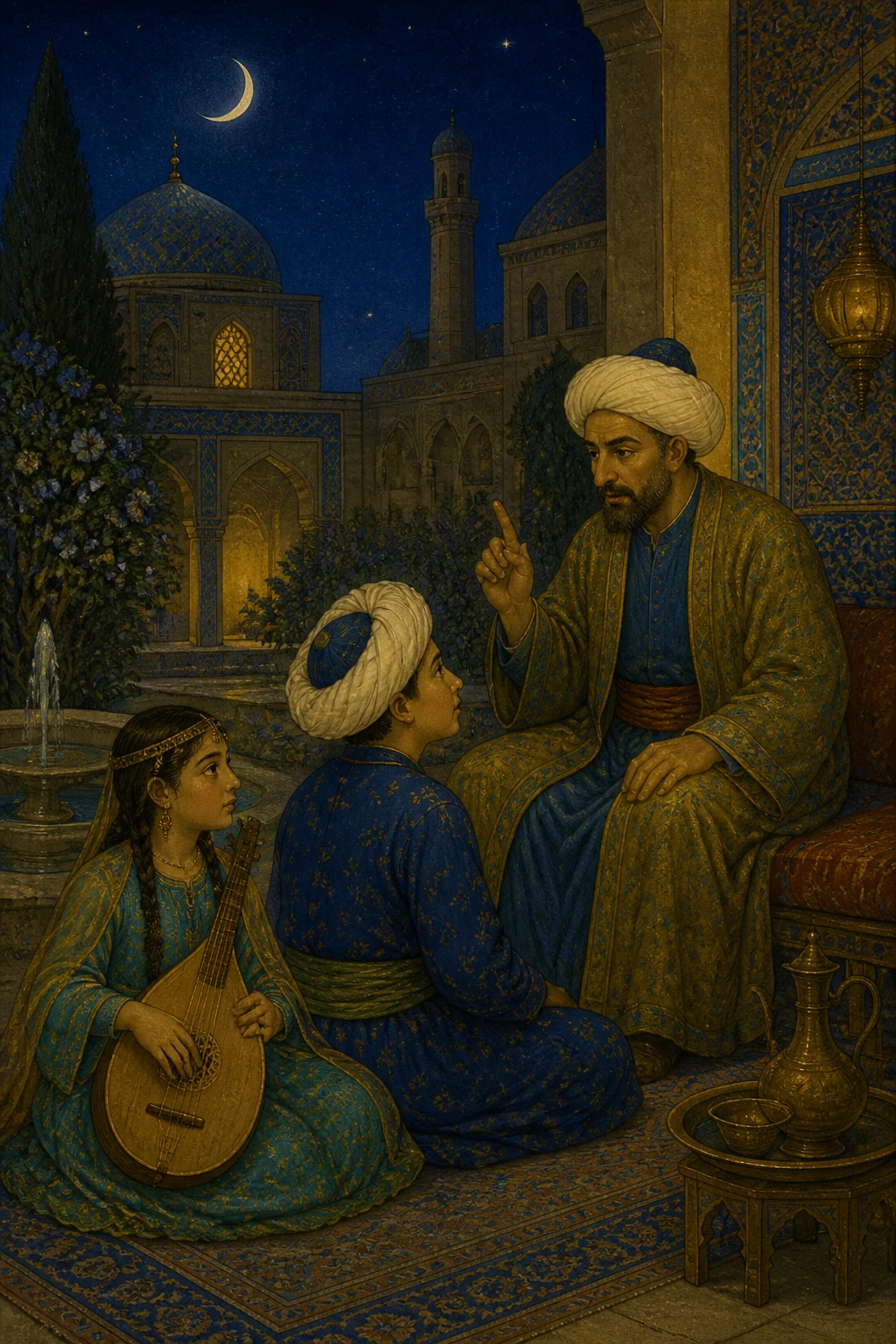
The springtime of his beard has dawned before our eyes; how have the roses lingered after spring? Do you not see the growth upon his cheeks—violets springing from the leaves? He lived with his father for a time in the happiest circumstances, and his father delighted and rejoiced in him, until he reached manhood. Then one day his father seated him before him and said, “My son, my appointed end draws near, and the hour of my death is at hand. Nothing remains for me but to meet God, mighty and glorious. I have left you sound wealth, farms, properties, and orchards, enough to provide for you and your children’s children. So fear God Most High, my son, in your use of what I leave you, and follow none but those who lend you their support.” Before long, the man fell ill and died. His son prepared him for burial with the greatest care, buried him, and returned home, where he sat in mourning for days and nights. Then his companions came to him and said, “A man who leaves a son like you has not died. What is past is past, and mourning is fit only for girls and secluded women.” They persisted until he went to the bathhouse, where they joined him and dispelled his sorrow. But dawn overtook Shahrazad, and she fell silent, leaving her permitted tale untold.
When it was the four hundred and thirty-seventh night
She said: It has reached me, O fortunate king, that when the companions of Abu al-Hasan, the merchant’s son, joined him at the bathhouse and dispelled his sorrow, he forgot his father’s counsel. Dazzled by his great wealth, he imagined that fortune would always remain the same and that his riches could never disappear. He ate and drank, reveled and made merry, bestowed robes and gifts, and lavished gold. He feasted continually on chickens, broke the seals of wine bottles, delighted in the gurgling of flasks, and listened to songs. He went on in this fashion until his wealth dwindled, his circumstances declined, and all he possessed was gone, leaving him helpless with regret. After squandering everything, he had nothing left but a slave girl whom his father had bequeathed him among his other possessions. This girl had no equal in beauty and loveliness, splendor and perfection, or the grace and proportion of her figure. She possessed many accomplishments, refinement, and admirable virtues. She surpassed all the people of her time, and her mastery of the arts was more conspicuous than a landmark. She excelled other beauties in knowledge and skill, and in her swaying, supple grace. She stood five spans tall and was born beneath a fortunate star. Her temples were like the crescent moon of Shaaban, her eyebrows finely arched, her eyes like a gazelle’s, her nose like the edge of a sword, her cheeks like anemones, her mouth like Solomon’s seal, and her teeth like strings of pearls. Her navel could hold an ounce of ben-oil; her waist was slenderer than the body of one whom love had wasted and secrecy made ill, while her hips were heavier than sand dunes. In short, her beauty deserved the words of the poet:
When she approaches, her lovely figure casts a spell; when she departs, her turning away deals death. Sunlike, moonlike, supple as a bough—coldness and estrangement are not in her nature. Gardens of Eden lie beneath her gown’s neckline, and above her necklaces the full moon rides its sphere. She was like the rising full moon and a grazing gazelle, a girl of fourteen who put the moon and sun to shame, as the eloquent and skillful poet said:
She resembles the moon when five nights have passed, then five more, and four thereafter. What sin was mine, that she has made me resemble it when first it rises? Her skin was clear and her breath fragrant, as though she had been created from light and fashioned out of crystal. Her cheeks were rosy, her stature and figure perfectly proportioned, as one who described her said:
She moves in proud array of saffron, gold, silver, rose, and sandalwood hues. She is a flower in a garden, a pearl within its shell, an image in a shrine. So slender is she that when her figure says, “Rise up,” her hips reply, “Stay still, and take your time.” When I seek union, her beauty says, “Be generous,” but her coyness answers, “Do not.” Glory to Him who made loveliness her portion, and the scolders’ words her lover’s share! She stole the hearts of all who saw her with her beauty and her dazzling smile, and shot them with the arrows of her eyes. For all this, she was also eloquent in speech and graceful in composition. When all her master’s wealth was spent and the misery of his condition became plain, and he had nothing left but this girl, he passed three days without tasting food or finding rest in sleep. Then the girl said to him, “My master, take me to the Commander of the Faithful, Harun al-Rashid.” But dawn overtook Shahrazad, and she fell silent, leaving her permitted tale untold.
When it was the four hundred and thirty-eighth night
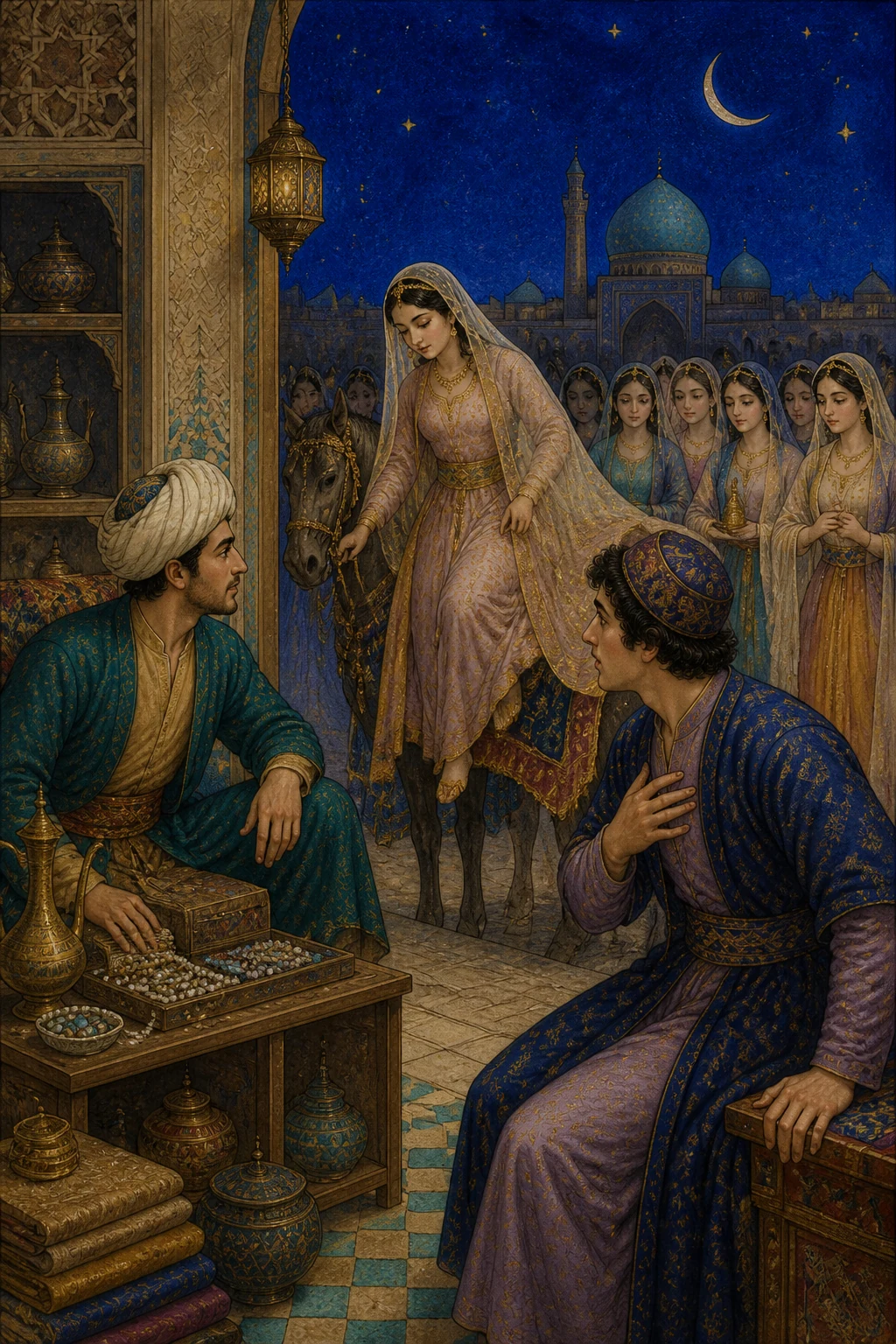
She said: It has reached me, O fortunate king, that the girl said to her master, “My master, take me to Harun al-Rashid, the fifth of the Abbasids, and ask him ten thousand dinars as my price. If he thinks me too dear, say to him, ‘Commander of the Faithful, my slave girl is worth more than that. Examine her, and her value will rise in your eyes, for this girl has no equal and is fit for none but a man like you.’” Then she added, “Beware, my master, of selling me for less than the price I have named, for it is little enough for one such as I.” Her master did not know her worth, nor did he realize that she had no equal in her time. He took her to the Commander of the Faithful, Harun al-Rashid, presented her to him, and repeated what she had said. The caliph asked her, “What is your name?” She replied, “My name is Tawaddud.” He said, “Tawaddud, what branches of learning have you mastered?” She answered, “My lord, I know grammar, poetry, jurisprudence, Quranic commentary, and language. I know the art of music, the laws of inheritance, arithmetic, division, surveying, and the tales of the ancients. I know the glorious Quran and have recited it according to the seven, the ten, and the fourteen readings. I know the number of its chapters and verses, its sections, halves, quarters, eighths, and tenths, its prostrations, and the number of its letters. I know its abrogating and abrogated verses, its Medinan and Meccan revelations, and the occasions of their revelation. I know the noble Traditions, both their interpretation and their transmission, those with complete chains of authority and those with incomplete chains. I have studied mathematics and geometry, philosophy, wisdom, logic, rhetoric, and eloquence. I have committed much learning to memory and devoted myself to poetry. I play the lute and know the places of its notes and the movements and rests of its strings. If I sing and dance, I enchant; if I adorn and perfume myself, I slay. In short, I have attained knowledge known only to those deeply grounded in learning.”
When the caliph Harun al-Rashid heard her words, despite her tender age, he marveled at her eloquence. Turning to her master, he said, “I shall summon men to debate with her in all the subjects she claims to know. If she answers them, I shall pay you her price and more; if she cannot, you have the better right to her.” Her master replied, “Commander of the Faithful, most gladly and with all respect.” The Commander of the Faithful wrote to the governor of Basra, instructing him to send Ibrahim ibn Sayyar al-Nazzam, the foremost man of his time in argument, eloquence, poetry, and logic. He also ordered that Quran reciters, scholars, physicians, astrologers, sages, geometers, and philosophers be assembled. Ibrahim was the most learned of them all. Before long they arrived at the caliphal palace, knowing nothing of the matter. The Commander of the Faithful summoned them to his council and ordered them to sit, which they did. Then he commanded that the slave girl Tawaddud be brought in. She appeared, revealing herself like a brilliant star, and a golden chair was set out for her. She greeted them and said in eloquent speech, “Commander of the Faithful, order the scholars, reciters, physicians, astrologers, sages, geometers, and philosophers here present to debate with me.” The Commander of the Faithful said to them, “I wish you to question this girl concerning her religion and refute her arguments in everything she has claimed.” They replied, “We hear and obey God and you, Commander of the Faithful.” Then the girl lowered her eyes and asked, “Which of you is the jurist, scholar, Quran reciter, and authority on the Traditions?” One of them said, “I am the man you seek.” She told him, “Ask whatever you wish.” He said, “Have you read the mighty Book of God, learned its abrogating and abrogated verses, and pondered its verses and letters?” “Yes,” she replied. He said, “I shall ask you about the binding duties and established observances. Tell me of these, girl. Who is your Lord? Who is your prophet? Who is your guide? What is your direction of prayer? Who are your brethren? What is your path? What is your way?” She replied, “God is my Lord; Muhammad, God bless him and grant him peace, is my prophet; the Quran is my guide; the Kaaba is my direction of prayer; the believers are my brethren; goodness is my path; and the Prophet’s practice is my way.” The caliph marveled at her words and the eloquence of her tongue despite her youth. Then he said to her, “Girl, tell me, by what means did you come to know God Most High?” She replied, “Through reason.” He asked, “What is reason?” She answered, “Reason is of two kinds: innate reason and acquired reason…” But dawn overtook Shahrazad, and she fell silent, leaving her permitted tale untold.
When it was the four hundred and thirty-ninth night
She said: It has reached me, O fortunate king, that the girl said, “Reason is of two kinds, innate and acquired. Innate reason is that which God, mighty and glorious, created, and by which He guides whom He wills among His servants. Acquired reason is that which a person gains through education and sound understanding.” He said to her, “Well answered.” Then he asked, “Where does reason reside?” She replied, “God casts it into the heart, and its radiance rises into the brain, where it settles.” He said, “Well answered. Now tell me, by what means did you come to know the Prophet, God bless him and grant him peace?” She replied, “By reading the Book of God Most High, and through signs and indications, proofs and miracles.” He said, “Well answered. Tell me, then, about the binding duties and established observances.” She replied, “The binding duties are five: bearing witness that there is no god but God alone, who has no partner, and that Muhammad is His servant and messenger; performing the prayer; paying the alms-tax; fasting during Ramadan; and making the pilgrimage to God’s Sacred House, for whoever is able to undertake the journey. As for the established courses, they are four: night, day, sun, and moon. They build up life and hope, yet the son of Adam does not know that they are wearing away his allotted span.” He said, “Well answered. Tell me the observances of faith.” She replied, “The observances of faith are prayer, almsgiving, fasting, pilgrimage, holy war, and avoidance of what is forbidden.” He said, “Well answered. Tell me, with what do you rise to pray?” She replied, “With the intention of servitude, acknowledging God’s lordship.” He said, “Tell me, what has God made obligatory upon you before you undertake the prayer?” She replied, “Purification, covering the private parts, avoiding soiled garments, standing in a clean place, facing the direction of prayer, standing upright, forming the intention, and pronouncing the opening declaration, ‘God is most great.’” He said, “Well answered. Tell me, with what do you leave your house to go to prayer?” She replied, “With the intention of worship.” He asked, “With what intention do you enter the mosque?” She replied, “With the intention of service.” He asked, “With what do you face the direction of prayer?” She replied, “With three obligatory acts and one customary observance.” He said, “Well answered. Tell me, what is the beginning of prayer? What releases one from it, and what binds one to it?” She replied, “The beginning of prayer is purification. The opening declaration, ‘God is most great,’ binds one to it, and the salutation of peace releases one from it.” He asked, “What is the judgment upon one who abandons it?” She replied, “It is reported in an authentic Tradition: ‘Whoever deliberately abandons prayer without an excuse has no share in Islam.’” But dawn overtook Shahrazad, and she fell silent, leaving her permitted tale untold.
When it was the four hundred and fortieth night
She said: It has reached me, O fortunate king, that when the girl quoted the noble Tradition, the jurist said to her, “Well answered. Now tell me, what is prayer?” She replied, “Prayer is a bond between the servant and his Lord. It has ten virtues: it illuminates the heart, brightens the face, pleases the All-Merciful, angers Satan, averts affliction, protects against the evil of enemies, increases mercy, wards off punishment, draws the servant near his Master, and restrains indecency and wrongdoing. It is among the prescribed and binding obligations, and it is the pillar of religion.” He said, “Well answered. Tell me, what is the key to prayer?” She replied, “Ablution.” He asked, “What is the key to ablution?” She replied, “Invoking God’s name.” He asked, “What is the key to invoking His name?” She replied, “Certainty.” He asked, “What is the key to certainty?” She replied, “Trust in God.” He asked, “What is the key to trust?” She replied, “Hope.” He asked, “What is the key to hope?” She replied, “Obedience.” He asked, “What is the key to obedience?” She replied, “Acknowledging God Most High’s oneness and confessing His lordship.” He said, “Well answered. Tell me the obligatory acts of ablution.” She replied, “According to the school of Imam al-Shafii, Muhammad ibn Idris, may God be pleased with him, they are six: forming the intention, washing the face, washing the hands and arms up to and including the elbows, wiping part of the head, washing the feet up to and including the ankles, and performing these acts in their proper order. Its customary observances are ten: invoking God’s name, washing the hands before putting them into the vessel, rinsing the mouth, drawing water into the nostrils, wiping the whole head, wiping the ears inside and out with fresh water, running the fingers through a thick beard, washing between the fingers and toes, beginning with the right side before the left, washing each part three times, and proceeding without interruption. When one has finished the ablution, one says, ‘I bear witness that there is no god but God alone, who has no partner, and I bear witness that Muhammad is His servant and messenger. O God, make me one of those who repent, and make me one of those who purify themselves. Glory and praise be to You, O God. I bear witness that there is no god but You. I seek Your forgiveness and turn to You in repentance.’ For it is related in a noble Tradition that the Prophet, God bless him and grant him peace, said, ‘Whoever says this after every ablution, the eight gates of Paradise shall be opened to him, and he may enter through whichever he wishes.’”
He said, “Well answered. When a person intends to perform ablution, what angels and devils attend him?” She replied, “When a person prepares for ablution, angels come to his right and devils to his left. If he invokes God Most High at the beginning of the ablution, the devils flee, and the angels shelter him beneath a tent of light with four ropes. At each rope stands an angel who glorifies God Most High and asks forgiveness for him as long as he remains silent or remembers God. But if he does not invoke God, mighty and glorious, at the beginning of the ablution and does not remain silent, the devils take possession of him and the angels depart. Satan whispers to him until doubt and imperfection enter his ablution. For the Prophet, blessings and peace be upon him, said, ‘Proper ablution drives away Satan and protects against the ruler’s tyranny.’ He also said, ‘Whoever is struck by affliction while not in a state of ablution has none to blame but himself.’” He said, “Well answered. Tell me what a person should do on waking from sleep.” She replied, “When a person wakes from sleep, he should wash his hands three times before putting them into the vessel.” He said, “Well answered. Tell me the obligatory and customary acts of the full ritual washing.” She replied, “Its obligatory acts are forming the intention and washing the whole body with water—that is, making the water reach every hair and all the skin. Its customary acts are performing ablution beforehand, rubbing the body, running the fingers through the hair, and, according to one opinion… leaving the washing of the feet until the end.” He said, “Well answered.” But dawn overtook Shahrazad, and she fell silent, leaving her permitted tale untold.
When it was the four hundred and forty-first night
She said: It has reached me, O fortunate king, that when the girl had told the jurist about the obligatory and customary acts of the full ritual washing, he said, “Well answered. Tell me the grounds for dry ablution, its obligatory acts, and its customary observances.” She replied, “Its grounds are seven: lack of water, fear, needing the water for another purpose, losing it among one’s baggage, illness, a splint, and wounds. Its obligatory acts are four: forming the intention, using earth, striking it once for the face, and once for the hands and arms. Its customary observances are invoking God’s name and beginning with the right side before the left.” He said, “Well answered. Tell me the conditions of prayer, its essential acts, and its customary observances.” She replied, “Its conditions are five: purity of the body, covering the private parts, certainty or reasonable belief that the proper time has begun, facing the direction of prayer, and standing in a clean place. Its essential acts are forming the intention; pronouncing the opening declaration, ‘God is most great’; standing, if able; reciting the Opening chapter—and according to the school of Imam al-Shafii, ‘In the name of God, the Compassionate, the Merciful’ is one of its verses; bowing and remaining still in that position; standing upright again and remaining still; prostrating and remaining still; sitting between the two prostrations and remaining still; reciting the final testimony of faith and sitting for it; invoking blessings upon the Prophet, God bless him and grant him peace, during it; giving the first salutation of peace; and, according to one opinion, forming the intention to leave the prayer. Its customary observances are the call to prayer and the announcement that it is about to begin; raising the hands at the opening declaration; the opening supplication; seeking refuge in God; saying ‘Amen’; reciting a chapter after the Opening; saying ‘God is most great’ when moving from one posture to another; saying ‘God hears whoever praises Him’ and ‘Our Lord, to You belongs all praise’; reciting aloud where appropriate and silently where appropriate; reciting the first testimony of faith and sitting for it; invoking blessings upon the Prophet, God bless him and grant him peace, during it; invoking blessings upon his family in the final testimony; and giving the second salutation of peace.”
He said, “Well answered. Tell me, on what is the alms-tax due?” She replied, “It is due on gold, silver, camels, cattle, sheep and goats, wheat, barley, millet, sorghum, beans, chickpeas, rice, raisins, and dates.” He said, “Well answered. Tell me, at what amount does the alms-tax become due on gold?” She replied, “No alms-tax is due on less than twenty mithqals. When it reaches twenty, half a mithqal is due, and anything above that is assessed proportionately.” He said, “Tell me, at what amount does it become due on silver?” She replied, “No alms-tax is due on less than two hundred dirhams. When it reaches two hundred, five dirhams are due, and anything above that is assessed proportionately.” He said, “Well answered. Tell me, at what number does it become due on camels?” She replied, “One sheep for every five camels up to twenty-five, when a one-year-old she-camel is due.” He said, “Well answered. Tell me, at what number does it become due on sheep?” She replied, “When they reach forty, one sheep is due.” He said, “Well answered. Tell me about fasting and its obligatory acts.” She replied, “The obligatory acts of fasting are forming the intention and abstaining from food, drink, intercourse, and deliberate vomiting. It is binding upon every legally accountable person who is free of menstruation and the bleeding of childbirth. It becomes obligatory upon sighting the crescent moon, or upon the report of an upright witness whose truthfulness the hearer trusts. Among its obligations is forming the intention during the night. Its customary observances are hastening to break the fast, delaying the predawn meal, and refraining from speech except for good words, remembrance of God, and recitation of the Quran.” He said, “Well answered. Tell me something that does not invalidate the fast.” She replied, “Applying oils or kohl, road dust, swallowing saliva, the emission of semen in a dream, looking at an unrelated woman, bloodletting, and cupping—none of these invalidates the fast.” He said, “Well answered. Tell me about the prayers of the two feasts.” She replied, “They consist of two units of prayer and are customary observances, without either the call to prayer or the announcement of its beginning. Instead, one calls, ‘Gather for prayer.’ In the first unit, one says ‘God is most great’ seven times, apart from the opening declaration, and in the second five times, apart from the declaration made on rising, according to the school of Imam al-Shafii, may God Most High have mercy on him.” But dawn overtook Shahrazad, and she fell silent, leaving her permitted tale untold.
When it was the four hundred and forty-second night
She said: It has reached me, O fortunate king, that when the girl had told the jurist about the prayers of the two feasts, he said, “Well answered. Tell me about the prayer for eclipses of the sun and moon.” She replied, “It consists of two units, without either the call to prayer or the announcement of its beginning. In each unit there are two standings, two bowings, and two prostrations. Then one sits, recites the testimony of faith, and gives the salutation of peace.” He said, “Well answered. Tell me about the prayer for rain.” She replied, “It consists of two units, without either the call to prayer or the announcement of its beginning. One recites the testimony of faith and gives the salutation of peace. Then one delivers a sermon, asking forgiveness of God Most High in place of the declarations of His greatness in the two feast sermons. One turns one’s cloak upside down, then prays and entreats God.” He said, “Well answered. Tell me about the odd-numbered night prayer.” She replied, “Its minimum is one unit and its maximum eleven.” He said, “Well answered. Tell me about the forenoon prayer.” She replied, “Its minimum is two units and its maximum twelve.” He said, “Well answered. Tell me about retreat in the mosque.” She replied, “It is a customary observance.” He asked, “What are its conditions?” She replied, “Forming the intention, leaving the mosque only for a necessity, refraining from relations with women, fasting, and abstaining from speech.” He said, “Well answered. Tell me, what makes the pilgrimage obligatory?” She replied, “Puberty, sanity, Islam, and the means to undertake it. It is obligatory once in a lifetime, before death.” He asked, “What are the obligatory acts of the pilgrimage?” She replied, “Entering the consecrated state, standing at Arafat, circling the Kaaba, passing between Safa and Marwa, and shaving the head or shortening the hair.” He asked, “What are the obligatory acts of the lesser pilgrimage?” She replied, “Entering its consecrated state, circling the Kaaba, and passing between Safa and Marwa.” He asked, “What are the obligations of the consecrated state?” She replied, “Removing sewn garments, avoiding perfume, and refraining from shaving the head, trimming the nails, killing game, and marriage.” He asked, “What are the customary observances of the pilgrimage?” She replied, “Reciting the pilgrim’s invocation, performing the arrival and farewell circuits, spending the night at Muzdalifa and Mina, and casting the pebbles.”
He said, “Well answered. What is holy war, and what are its essential conditions?” She replied, “Its essential conditions are an attack upon us by unbelievers, the presence of an imam and the necessary equipment, and steadfastness when meeting the enemy. Its customary observance is urging men to fight, as God Most High says: ‘O Prophet, urge the believers to battle.’” He said, “Well answered. Tell me the obligatory and customary requirements of a sale.” She replied, “The obligatory requirements are an offer and acceptance; that the thing sold be owned, useful, and capable of being delivered; and that usury be avoided. The customary requirements are allowing cancellation by mutual consent, and retaining the option to withdraw before parting, for the Prophet, God bless him and grant him peace, said, ‘Both parties to a sale have the choice so long as they have not parted.’” He said, “Well answered. Tell me something that may not be exchanged for another of its kind.” She replied, “On that subject I have learned an authentic Tradition transmitted by Nafi from the Messenger of God, God bless him and grant him peace: he forbade the exchange of dried dates for fresh dates, fresh figs for dried figs, dried meat for fresh meat, and butter for clarified butter. Any food of one kind may not be exchanged in one form for another.” When the jurist heard her words and realized that she was intelligent, perceptive, accomplished, and learned in jurisprudence, the Traditions, Quranic commentary, and other subjects, he said to himself, “I must find a way to outwit her and defeat her before the Commander of the Faithful.” So he asked her, “Girl, what does the word ‘ablution’ mean in ordinary language?” She replied, “Cleanliness and freedom from impurity.” He asked, “What does ‘prayer’ mean in ordinary language?” She replied, “Supplication for good.” He asked, “What does ‘ritual washing’ mean in ordinary language?” She replied, “Purification.” He asked, “What does ‘fasting’ mean in ordinary language?” She replied, “Abstention.” He asked, “What does ‘alms-tax’ mean in ordinary language?” She replied, “Increase.” He asked, “What does ‘pilgrimage’ mean in ordinary language?” She replied, “Purposeful journeying.” He asked, “What does ‘holy war’ mean?” She replied, “Defense.” The jurist had no further argument to offer. But dawn overtook Shahrazad, and she fell silent, leaving her permitted tale untold.
When it was the four hundred and forty-third night
She said: It has reached me, O fortunate king, that when the jurist had no further argument to offer, he rose to his feet and said, “Bear witness for me, Commander of the Faithful, that this girl knows more jurisprudence than I do.” The girl said to him, “I shall ask you something. Answer me quickly, if you know.” He said, “Ask.” She said, “What are the portions of religion?” He replied, “They are ten. The first is the testimony of faith, which is the creed; the second is prayer, which is the natural disposition; the third is the alms-tax, which is purification; the fourth is fasting, which is a shield; the fifth is pilgrimage, which is the sacred law; the sixth is holy war, which is sufficiency; the seventh and eighth are enjoining right and forbidding wrong, which are righteous zeal; the ninth is congregation, which is fellowship; and the tenth is the pursuit of knowledge, which is the praiseworthy path.” She said, “Well answered. But one question remains for you: what are the roots of Islam?” He replied, “They are four: sound belief, sincerity of purpose, observance of the bounds, and faithfulness to one’s covenant.” She said, “There is one more question. Answer it, or I shall take your clothes.” He said, “Speak, girl.” She asked, “What are the branches of Islam?” He remained silent for a while and gave no answer. She said, “Take off your clothes, and I shall explain them to you.” The Commander of the Faithful said, “Explain them, and I shall have his clothes taken off for you.” She replied, “There are twenty-two branches: holding fast to the Book of God Most High; following the example of His Messenger, God bless him and grant him peace; refraining from harm; eating what is lawful; avoiding what is forbidden; restoring wrongfully taken possessions to their owners; repentance; understanding religion; loving the Friend of God; following revelation; believing the messengers; fearing a change of faith; preparing for departure; firmness of certainty; pardoning when one has power; strength in weakness; patience in affliction; knowing God Most High; knowing what His Prophet, God bless him and grant him peace, brought; opposing the accursed Iblis; struggling against the self and resisting it; and sincere devotion to God.” When the Commander of the Faithful heard this, he ordered the jurist’s clothes and mantle to be removed. The jurist took them off and departed from the Commander of the Faithful’s presence, defeated by her and covered in shame.
Then another man rose before her and said, “Girl, hear a few questions from me.” She replied, “Speak.” He asked, “What makes a contract for future delivery valid?” She replied, “A known quantity, a known kind, and a known term.” He said, “Well answered. What are the obligatory and customary observances of eating?” She replied, “The obligations of eating are acknowledging that God Most High has provided for one, fed one, and given one drink, and thanking Him for it.” He asked, “What is gratitude?” She replied, “For the servant to use all that God has bestowed upon him for the purpose for which it was created.” He asked, “What are the customary observances of eating?” She replied, “Invoking God’s name, washing the hands, sitting on the left hip, eating with three fingers, and eating from the food nearest to you.” He said, “Well answered. Tell me the manners of eating.” She replied, “Taking small mouthfuls and looking sparingly at one’s table companion.” He said, “Well answered.” But dawn overtook Shahrazad, and she fell silent, leaving her permitted tale untold.
When it was the four hundred and forty-fourth night
She said: It has reached me, O fortunate king, that when the girl was asked about the manners of eating and gave her answer, the jurist questioning her said, “Well answered. Tell me the convictions of the heart and their opposites.” She replied, “There are three, and their opposites are three. The first is adherence to faith, opposed by keeping clear of unbelief; the second is adherence to the Prophet’s practice, opposed by keeping clear of innovation; the third is adherence to obedience, opposed by keeping clear of disobedience.” He said, “Well answered. Tell me the conditions of ablution.” She replied, “Islam, discernment, purifying water, the absence of any physical obstruction, and the absence of any legal impediment.” He said, “Well answered. Tell me about faith.” She replied, “Faith is divided into nine parts: faith in the One worshipped; faith in servitude; faith in divine election; faith in the two handfuls; faith in predestination; faith in what abrogates; faith in what is abrogated; belief in God, His angels, His books, and His messengers; and belief in divine decree and predestination, its good and its evil, its sweetness and its bitterness.” He said, “Well answered. Tell me three things that prevent three things.” She replied, “Yes. It is related that Sufyan al-Thawri said, ‘Three things destroy three things: contempt for the righteous destroys the afterlife; contempt for kings destroys life; and contempt for expenditure destroys wealth.’” He said, “Well answered. Tell me about the keys of heaven, and how many gates it has.” She replied, “God Most High says, ‘And heaven is opened and becomes gates.’ And the Prophet, blessings and peace be upon him, said, ‘None knows the number of heaven’s gates but He who created heaven. Every son of Adam has two gates in heaven: one through which his provision descends and one through which his deeds ascend. The gate of his provision is not closed until his allotted span is ended, and the gate of his deeds is not closed until his spirit ascends.’”
He said, “Well answered. Tell me of something, half a thing, and nothing.” She replied, “Something is the believer, half a thing is the hypocrite, and nothing is the unbeliever.” He said, “Well answered. Tell me about hearts.” She replied, “There is a sound heart, a sick heart, a penitent heart, a warning heart, and an illumined heart. The sound heart is the heart of the Friend of God; the sick heart is the heart of the unbeliever; the penitent heart is the heart of the pious and fearful; the warning heart is the heart of our master Muhammad, God bless him and grant him peace; and the illumined heart is the heart of whoever follows him. The hearts of scholars are of three kinds: a heart attached to this world, a heart attached to the hereafter, and a heart attached to its Master. It is also said that hearts are of three kinds: a suspended heart, which is the heart of the unbeliever; an absent heart, which is the heart of the hypocrite; and a steadfast heart, which is the heart of the believer. And it is said that they are three: a heart opened wide by light and faith, a heart wounded by fear of estrangement, and a heart afraid of abandonment.” He said, “Well answered.” But dawn overtook Shahrazad, and she fell silent, leaving her permitted tale untold.
When it was the four hundred and forty-fifth night
She said: It has reached me, O fortunate king, that when the second jurist had questioned the girl and she had answered him, and he had said, “Well answered,” she said, “Commander of the Faithful, he has questioned me until he is weary. Now I shall ask him two questions. If he can answer them, well and good; otherwise I shall take his clothes, and he may depart in peace.” The jurist said to her, “Ask me whatever you wish.” She asked, “What do you say of faith?” He replied, “It is confession with the tongue, belief in the heart, and action with the limbs. The Prophet, blessings and peace be upon him, said, ‘A person’s faith is not complete until five qualities are perfected in him: trust in God, committing his affairs to God, submission to God’s command, contentment with God’s decree, and doing all things for God. Whoever loves for God’s sake, gives for God’s sake, and withholds for God’s sake has perfected his faith.’” She said, “Tell me, then, of the obligation of obligations; of an obligation at the beginning of every obligation; of an obligation needed by every obligation; of an obligation encompassing every obligation; of a customary observance included within an obligation; and of a customary observance by which an obligation is completed.” He fell silent and gave no answer. The Commander of the Faithful ordered her to explain them and ordered him to take off his clothes and give them to her. Then she said, “Jurist, the obligation of obligations is knowledge of God Most High. The obligation at the beginning of every obligation is bearing witness that there is no god but God and that Muhammad is the Messenger of God. The obligation needed by every obligation is ablution. The obligation encompassing every obligation is the full ritual washing after sexual impurity. The customary observance included within an obligation is washing between the fingers and running them through a thick beard. The customary observance by which an obligation is completed is circumcision.” Then the jurist’s inability became plain. He rose to his feet and said, “I call God to witness, Commander of the Faithful, that this girl knows more than I do of jurisprudence and other subjects.” Then he took off his clothes and departed in defeat.
As for her encounter with the Quran reciter, she turned to the scholars still present and said, “Which of you is the master reciter, learned in the seven readings, grammar, and language?” The reciter rose and sat before her, saying, “Have you read the Book of God Most High and thoroughly mastered its verses, its abrogating and abrogated passages, its clear and ambiguous verses, its Meccan and Medinan revelations? Have you understood its commentary and learned it according to the transmitted readings and their principles?” She replied, “Yes.” He said, “Tell me the number of the Quran’s chapters. How many tenths does it contain? How many verses? How many letters? How many prostrations? How many prophets are mentioned in it? How many Medinan chapters does it have, and how many Meccan chapters? And how many birds?” She replied, “My lord, the Quran has one hundred and fourteen chapters, seventy of them Meccan and forty-four Medinan. It has six hundred and twenty-one tenths, six thousand two hundred and thirty-six verses, seventy-nine thousand four hundred and thirty-nine words, and three hundred and twenty-three thousand six hundred and seventy letters. For each letter, the reciter receives ten good deeds. As for the prostrations, there are fourteen.” But dawn overtook Shahrazad, and she fell silent, leaving her permitted tale untold.
When it was the four hundred and forty-sixth night
She said: It has reached me, O fortunate King, that when the Qur’an reciter questioned the slave girl about the Qur’an, she answered him, saying, “As for the prophets named in the Qur’an, they are twenty-five: Adam, Noah, Abraham, Ishmael, Isaac, Jacob, Joseph, Elisha, Jonah, Lot, Salih, Hud, Shuayb, David, Solomon, Dhu al-Kifl, Idris, Elijah, John, Zachariah, Job, Moses, Aaron, Jesus, and Muhammad. May God’s blessings and peace be upon them all. As for the winged creatures, there are nine.” He asked, “What are their names?” She replied, “The mosquito, the bee, the fly, the ant, the hoopoe, the raven, the locust, the birds in flocks, and the bird of Jesus—peace be upon him—which is the bat.” “Well answered,” he said. “Now tell me, which surah of the Qur’an is the best?” “The surah of the Cow.” “And which verse is the greatest?” “The Throne Verse. It contains fifty words, and with every word come fifty blessings.” “And which verse contains nine signs?” “The words of the Most High: ‘Indeed, in the creation of the heavens and the earth, in the alternation of night and day, and in the ships that sail the sea with what benefits mankind’ (The Cow: 169), to the end of the verse.” “Well answered. Now tell me, which verse is the most just?” “The words of the Most High: ‘God commands justice, kindness, and generosity to kinsfolk, and forbids indecency, wrongdoing, and oppression’ (The Bee: 90).” “And which verse speaks of the greatest longing?” “The words of the Most High: ‘Does every man among them long to be admitted to a garden of bliss?’ (The Ways of Ascent: 38).” “And which verse offers the greatest hope?” “The words of the Most High: ‘Say: O My servants who have transgressed against yourselves, do not despair of God’s mercy. God forgives all sins; He is indeed the All-Forgiving, the Merciful’ (The Troops: 53).”
“Well answered,” he said. “Now tell me, according to whose reading do you recite?” She replied, “The reading of the people of Paradise, which is the reading of Nafi.” “And in which verse did prophets lie?” “In the words of the Most High: ‘And they brought his shirt stained with false blood’ (Joseph: 18). They were Joseph’s brothers.” “Then tell me, in which verse did unbelievers speak the truth?” “In the words of the Most High: ‘The Jews say, “The Christians have no foundation,” and the Christians say, “The Jews have no foundation,” though they read the Scripture’ (The Cow: 113). They all spoke the truth.” “And which verse did God speak concerning Himself?” “The words of the Most High: ‘I created jinn and mankind only that they might worship Me’ (The Winnowing Winds: 56).” “And which verse contains the words of the angels?” “The words of the Most High: ‘We glorify You with praise and proclaim Your holiness’ (The Cow: 30).” “Now tell me about ‘I seek refuge in God from Satan the accursed,’ and what has been said concerning it.” She replied, “Seeking refuge is an obligation commanded by God when reciting. The proof is His saying: ‘When you recite the Qur’an, seek refuge in God from Satan the accursed’ (The Bee: 98).” “Then tell me the wording of this invocation, and what differences of opinion there are concerning it.” She replied, “Some seek refuge by saying, ‘I seek refuge in God, the All-Hearing, the All-Knowing, from Satan the accursed.’ Others say, ‘I seek refuge in God the Mighty.’ But the best form is that spoken in the glorious Qur’an and handed down in the Sunna. When the Prophet, God bless him and grant him peace, began to recite the Qur’an, he would say, ‘I seek refuge in God from Satan the accursed.’ It is related by Nafi, on his father’s authority, that when the Messenger of God, God bless him and grant him peace, rose to pray at night, he would say, ‘God is supremely great; abundant praise belongs to God; and glory be to God morning and evening.’ Then he would say, ‘I seek refuge in God from Satan the accursed, and from the goadings and incitements of devils.’ And it is related of Ibn Abbas—may God be pleased with them both—that he said, ‘When Gabriel first descended to the Prophet, God bless him and grant him peace, he taught him to seek refuge, saying, “Say, O Muhammad: I seek refuge in God, the All-Hearing, the All-Knowing. Then say: In the name of God, the Compassionate, the Merciful. Then: Read in the name of your Lord who created—created man from a clinging clot” (The Clinging Clot: 1–2).’”
When the reciter heard her words, he marvelled at her expression and eloquence, her knowledge and excellence. Then he said to her, “Girl, what do you say of the words of the Most High, ‘In the name of God, the Compassionate, the Merciful’ (The Ants: 1)? Are they a verse of the Qur’an?” She replied, “Yes, they are a verse of the Qur’an in the surah of the Ants, and a verse between every two surahs, though scholars differ greatly on the matter.” “Well answered,” he said. And dawn overtook Shahrazad, and she fell silent, leaving her tale untold.
When it was the four hundred and forty-seventh night,
She said: It has reached me, O fortunate King, that when the slave girl answered the reciter, saying that scholars differed greatly concerning “In the name of God, the Compassionate, the Merciful,” he said, “Well answered. Now tell me why ‘In the name of God, the Compassionate, the Merciful’ is not written at the beginning of the surah of Disavowal.” She replied, “When the surah of Disavowal was revealed, annulling the covenant between the Prophet, God bless him and grant him peace, and the idolaters, he sent Ali ibn Abi Talib—may God honour his countenance—with that surah on a day of the pilgrimage season. Ali recited it to them without reciting ‘In the name of God, the Compassionate, the Merciful.’” He said, “Then tell me of the merit and blessing of ‘In the name of God, the Compassionate, the Merciful.’” She replied, “It is related that the Prophet, God bless him and grant him peace, said, ‘Never have I recited “In the name of God, the Compassionate, the Merciful” over anything without a blessing entering it.’ It is also related of him, God bless him and grant him peace: ‘The Lord of Might has sworn by His might that “In the name of God, the Compassionate, the Merciful” shall not be pronounced over a sick person without his being cured of his sickness.’ It is said that when God created the Throne, it shook violently, so He wrote upon it, ‘In the name of God, the Compassionate, the Merciful,’ and its shaking ceased. When ‘In the name of God, the Compassionate, the Merciful’ was revealed to the Messenger of God, God bless him and grant him peace, he said, ‘I am safe from three things: being swallowed by the earth, being transformed, and being drowned.’ Its merit is great and its blessings many; to explain them would take a long time. It is related that the Messenger of God, God bless him and grant him peace, said, ‘A man will be brought forward on the Day of Resurrection and called to account, and not a single good deed will be found to his credit. He will be ordered to the Fire, but will say, “My God, You have not dealt fairly with me.” God, the Mighty and Majestic, will ask, “Why is that?” He will reply, “My Lord, because You have named Yourself the Compassionate, the Merciful, yet You wish to torment me with fire.” Then God, exalted be His majesty, will say, “I have indeed named Myself the Compassionate, the Merciful. Take My servant to Paradise through My mercy, for I am the most merciful of all who show mercy.”’” “Well answered,” he said. “Now tell me how ‘In the name of God, the Compassionate, the Merciful’ first came to be used.” She replied, “When God Most High began to reveal the Qur’an, they wrote, ‘In Your name, O God.’ When He revealed, ‘Say: Call upon God, or call upon the Compassionate; by whichever name you call upon Him, His are the most beautiful names’ (The Night Journey: 110), they wrote, ‘In the name of God, the Compassionate.’ Then, when ‘Your God is one God; there is no god but He, the Compassionate, the Merciful’ (The Cow: 163) was revealed, they wrote, ‘In the name of God, the Compassionate, the Merciful.’”
When the reciter heard her words, he lowered his head and said to himself, “This is a wonder of wonders! How well this girl has spoken of the origin of ‘In the name of God, the Compassionate, the Merciful’! By God, I must contrive some way to overcome her.” Then he asked her, “Girl, did God reveal the Qur’an all at once, or in separate portions?” She replied, “Gabriel the Trustworthy—peace be upon him—brought it down from the Lord of all worlds to His prophet Muhammad, chief of the messengers and seal of the prophets, with commands and prohibitions, promises and threats, accounts and parables, over twenty years, in separate verses according to the occasions.” “Well answered,” he said. “Now tell me which surah was first revealed to the Messenger of God, God bless him and grant him peace.” She replied, “According to Ibn Abbas, the surah of the Clinging Clot; according to Jabir ibn Abd Allah, the surah of the Cloaked One. The other surahs and verses were revealed thereafter.” “Then tell me the last verse to be revealed.” She replied, “The last verse revealed to him was the verse on usury; though some say it was ‘When God’s help and victory come’ (Divine Help: 1).” And dawn overtook Shahrazad, and she fell silent, leaving her tale untold.
When it was the four hundred and forty-eighth night,
She said: It has reached me, O fortunate King, that when the slave girl answered the reciter concerning the last verse revealed in the Qur’an, he said to her, “Well answered. Now tell me how many of the Companions gathered the Qur’an together in the lifetime of the Messenger of God, God bless him and grant him peace.” She replied, “There were four: Ubayy ibn Kaab, Zayd ibn Thabit, Abu Ubayda Amir ibn al-Jarrah, and Uthman ibn Affan. May God be pleased with them all.” “Well answered. Now tell me the reciters from whom the readings are received.” She replied, “They are four: Abd Allah ibn Masud, Ubayy ibn Kaab, Muadh ibn Jabal, and Salim ibn Abd Allah.” He asked, “What do you say of the words of the Most High, ‘And that which is slaughtered upon the stone altars’ (The Table: 3)?” She replied, “These are the idols set up and worshipped instead of God Most High. May God Most High preserve us!” “And what do you say of His words, ‘You know what is within me, but I do not know what is within You’ (The Table: 116)?” She replied, “‘You know my true nature and what I possess, but I do not know what You possess.’ The proof is His saying, ‘You alone are the Knower of all things unseen’ (The Table: 116). It is also explained as ‘You know my essence, but I do not know Your essence.’” “And what do you say of His words, ‘O you who believe, do not forbid the good things God has made lawful for you’ (The Table: 87)?” She replied, “The sheikh—may God Most High have mercy upon him—related to me on the authority of al-Dahhak that he said, ‘There were some Muslims who said, “Let us cut off our members and clothe ourselves in sackcloth,” whereupon this verse was revealed.’ Qatada said that it was revealed concerning a group of the Companions of the Messenger of God, God bless him and grant him peace, including Ali ibn Abi Talib, Uthman ibn Musab, and others, who said, ‘Let us castrate ourselves, wear haircloth, and become monks.’ Then this verse was revealed.” He asked, “What do you say of the words of the Most High, ‘And God took Abraham as a khalil’?” She replied, “A khalil is one who is poor and in need. According to another interpretation, he is a lover wholly devoted to God Most High, whose devotion admits no flaw.”
When the reciter saw her words flowing like passing clouds, without a moment’s hesitation in her answers, he rose to his feet and said, “I call God to witness, O Commander of the Faithful, that this girl knows more than I do of the readings and of other matters.” Then the girl said, “I shall ask you one question. If you can answer it, well and good; otherwise, you must take off your clothes.” The Commander of the Faithful said, “Ask him.” She said, “What do you say of a verse containing twenty-three kafs, a verse containing sixteen mims, a verse containing a hundred and forty ayns, and a section containing no Divine Name?” The reciter could not answer, so she said, “Take off your clothes.” He took them off, and she said, “O Commander of the Faithful, the verse containing sixteen mims is in the surah of Hud: ‘It was said: O Noah, disembark with peace from Us and blessings upon you’ (Hud: 48), to the end of the verse. The verse containing twenty-three kafs is in the surah of the Cow, and is the verse concerning debt. The verse containing a hundred and forty ayns is in the surah of the Heights: ‘Moses chose seventy men from his people for Our appointed meeting’ (The Heights: 155), for each man had two eyes. And the section containing no Divine Name consists of the surah beginning ‘The Hour has drawn near, and the moon has split’ (The Moon: 1), the surah of the Compassionate, and the surah of the Inevitable Event.” Thereupon the reciter stripped off the clothes he wore and departed in shame. And dawn overtook Shahrazad, and she fell silent, leaving her tale untold.
When it was the four hundred and forty-ninth night,
She said: It has reached me, O fortunate King, that when the slave girl defeated the reciter, and he took off his clothes and departed in shame, the skilful physician stepped forward and said, “We have finished with the science of religions; now prepare yourself for the science of bodies. Tell me about man: how was he created? How many vessels are in his body? How many bones? How many vertebrae? Where do the vessels begin? And why was Adam called Adam?” She replied, “He was called Adam because of his udma, that is, the brownness of his colour. It is also said that he was created from the adim of the earth, that is, its outer surface: his breast from the soil of the Kaaba, his head from the soil of the East, and his feet from the soil of the West. God created seven openings in his head: the eyes, the ears, the nostrils, and the mouth. He gave him two outlets, before and behind. He made the eyes the organs of sight, the ears of hearing, the nostrils of smell, and the mouth of taste, and made the tongue express what lies within a man’s heart. He created Adam from four elements: water, earth, fire, and air. Yellow bile has the nature of fire, being hot and dry; black bile the nature of earth, being cold and dry; phlegm the nature of water, being cold and moist; and blood the nature of air, being hot and moist. He created in man three hundred and sixty vessels, two hundred and forty bones, and three spirits: the vital, the psychic, and the natural, assigning each its function. God created for him a heart, a spleen, lungs, six intestines, a liver, two kidneys, two buttocks, a brain, bones, skin, and five senses: hearing, sight, smell, taste, and touch. He placed the heart on the left side of the breast, the stomach before the heart, and made the lungs a fan to cool the heart. He placed the liver on the right side, opposite the heart, and beneath these He created the diaphragm and intestines. He fitted together the bones of the breast and joined them to the ribs.”
“Well answered,” he said. “Now tell me how many chambers there are in the head of a son of Adam.” She replied, “Three chambers, containing five faculties called the inward senses: the common sense, imagination, the combining faculty, estimation, and memory.” “Well answered,” he said. “Now tell me about the framework of the bones.” And dawn overtook Shahrazad, and she fell silent, leaving her tale untold.
When it was the four hundred and fiftieth night,
She said: It has reached me, O fortunate King, that when the physician said to the slave girl, “Tell me about the framework of the bones,” she replied, “It is made up of two hundred and forty bones and is divided into three parts: the head, the trunk, and the limbs. The head is divided into the skull and the face. The skull consists of eight bones, to which are added the four little bones of hearing. The face is divided into an upper and a lower jaw: the upper contains eleven bones, while the lower is a single bone. To these are added the teeth, thirty-two in number, and also the hyoid bone. The trunk is divided into the spinal column, the chest, and the pelvis. The spinal column consists of twenty-four bones called vertebrae. The chest consists of the breastbone and the ribs, which number twenty-four, twelve on each side. The pelvis consists of the two hip bones, the sacrum, and the coccyx. The limbs are divided into two upper and two lower limbs. Each upper limb consists, first, of a shoulder, made up of the shoulder blade and collarbone; second, an upper arm, which is a single bone; third, a forearm, made up of two bones, the radius and the ulna; and fourth, a hand, divided into the wrist, the palm, and the fingers. The wrist consists of eight bones arranged in two rows, each containing four bones. The palm contains five bones. The digits number five, each consisting of three bones called phalanges, except for the thumb, which has only two. Each lower limb consists, first, of a thigh, which is a single bone; second, a lower leg, made up of three bones, the tibia, the fibula, and the kneecap; and third, a foot, divided, like the hand, into tarsus, metatarsus, and toes. The tarsus consists of seven bones arranged in two rows, the first containing two bones and the second five. The metatarsus consists of five bones, and the toes number five, each consisting of three phalanges, except the great toe, which has only two.”
“Well answered,” he said. “Now tell me the source of the vessels.” She replied, “The source of the vessels is the aorta, from which they branch. They are so numerous that none but their Creator knows their number, though it is said, as already mentioned, that there are three hundred and sixty. God made the tongue an interpreter, the eyes two lamps, the nostrils two clefts, and the hands two wings. Mercy resides in the liver, laughter in the spleen, and cunning in the kidneys. The lungs are a fan, the stomach a storehouse, and the heart the mainstay of the body. If the heart is sound, the whole body is sound; if it is corrupt, the whole body is corrupt.” He said, “Tell me about the outward signs and indications by which disease in the outward and inward organs may be recognized.” She replied, “Yes. An intelligent physician examines the condition of the body. By feeling the hands he judges hardness, heat, dryness, cold, and moisture. Sensible signs may indicate inward diseases: yellowing of the eyes, for example, indicates jaundice, while curvature of the back indicates disease of the lungs.” “Well answered,” he said. And dawn overtook Shahrazad, and she fell silent, leaving her tale untold.
When it was the four hundred and fifty-first night,
She said: It has reached me, O fortunate King, that when the slave girl described the outward signs to the physician, he said, “Well answered. What, then, are the inward signs?” She replied, “Knowledge of diseases through inward signs is derived from six principles: first, from the bodily functions; second, from what is discharged from the body; third, from pain; fourth, from its location; fifth, from swelling; and sixth, from symptoms.” He asked, “Tell me, how does harm come to the head?” She replied, “By taking food upon food before the first has been digested, and eating to repletion when already full. This is what has destroyed nations. Whoever wishes for long life should eat his morning meal early, not delay his evening meal until late, have little intercourse with women, and lessen what brings decline—that is, avoid excessive bloodletting and cupping. He should divide his belly into three parts: a third for food, a third for water, and a third for breath. For a man’s intestines are eighteen spans long: six should be allotted to food, six to drink, and six to breath. If he walks gently, it will be better for him, more becoming to his body, and more fully in keeping with the words of the Most High: ‘Do not walk upon the earth arrogantly’ (The Night Journey: 37).” “Well answered,” he said. “Now tell me the signs of yellow bile, and what dangers are feared from it.” She replied, “It is recognized by a yellow complexion, bitterness in the mouth, dryness, poor appetite, and a rapid pulse. One fears for the sufferer burning fever, inflammation of the brain, carbuncles, jaundice, swelling, intestinal ulcers, and excessive thirst. These are the signs of yellow bile.” “Well answered. Now tell me the signs of black bile, and what dangers threaten the sufferer when it predominates in the body.” She replied, “It produces a false appetite, obsessive thoughts, anxiety, and sorrow. It should then be evacuated; otherwise it gives rise to melancholy, leprosy, cancer, pains of the spleen, and intestinal ulcers.”
“Well answered,” he said. “Now tell me into how many branches medicine is divided.” She replied, “It is divided into two: one is the knowledge of how to manage sick bodies, and the other is how to restore them to health.” He asked, “Tell me at what time taking medicine is more beneficial than at other times.” She replied, “When sap flows in the bough, berries form in the grape cluster, and Sad al-Suud rises, the season has come when taking medicine is beneficial and disease may be driven away.” He asked, “Tell me at what time a man may drink from a new vessel and find his drink more pleasant and wholesome than at other times, with a sweet and fragrant scent rising from it.” She replied, “When he has waited an hour after eating, for the poet has said:
Do not drink in haste when your meal is done, lest you lead your body by the bridle into harm. Wait a little after eating, an hour at least; perhaps, my brother, you will gain what you desire.” He asked, “Tell me of food that gives rise to no sickness.” She replied, “It is food eaten only after hunger, and not in such abundance that it fills the ribs. For Galen the sage said, ‘Whoever wishes to take food should delay, then not go astray.’ Let us conclude with the words of the Prophet, blessings and peace be upon him: ‘The stomach is the house of disease, abstinence the chief remedy, and the root of every disease is overloading’—meaning indigestion.” And dawn overtook Shahrazad, and she fell silent, leaving her tale untold.
When it was the four hundred and fifty-second night,
She said: It has reached me, O fortunate King, that when the slave girl quoted to the physician the saying, “The stomach is the house of disease, and abstinence the chief remedy,” and the rest, he asked her, “What do you say of the bathhouse?” She replied, “One should not enter it on a full stomach. The Prophet, God bless him and grant him peace, said, ‘What an excellent house is the bathhouse! It cleanses the body and reminds one of the Fire.’” He asked, “Which bathhouses have the best water?” She replied, “Those whose water is sweet, whose space is ample, and whose air is pleasant, with four kinds of atmosphere: autumnal, summerlike, wintry, and springlike.” “Then tell me, what food is best?” She replied, “That which women prepare, which brings little waste, and which you eat with pleasure. The best of foods is tharid, bread steeped in broth, for the Prophet, blessings and peace be upon him, said, ‘The excellence of tharid over other foods is like the excellence of Aisha over all other women.’” “And what is the best accompaniment to bread?” “Meat, for the Prophet, blessings and peace be upon him, said, ‘The best accompaniment is meat, for it is the delight of this world and the next.’” “And which meat is best?” “Mutton. Dried meat should be avoided, for there is no benefit in it.” “Then tell me about fruit.” “Eat it when its season begins, and leave it when its season has passed.” “What do you say of drinking water?” She replied, “Do not drink it in great draughts or gulp it down, for it will afflict you with headaches and trouble you with many kinds of harm. Do not drink it immediately after leaving the bathhouse, after intercourse, or after a meal until fifteen degrees of time have passed for a young man and forty for an old man; nor drink it immediately upon waking from sleep.” “Well answered,” he said. “Now tell me about drinking wine.” She replied, “Is what appears in the Book of God Most High not enough to deter you? He says, ‘Wine, gambling, idols, and divining arrows are an abomination of Satan’s handiwork. Avoid them, that you may prosper’ (The Table: 90). And the Most High says, ‘They ask you about wine and gambling. Say: In them is great sin and some benefit for mankind, but their sin is greater than their benefit’ (The Cow: 219). The poet has said:
O drinker of wine, have you no shame, drinking what God has forbidden? Leave it alone and do not approach it, for truly God has condemned it.” Another poet said on the same subject:
“I drank of sin until my reason fled; an evil drink indeed, when reason is gone.” As for its benefits, it breaks up stones in the kidneys, strengthens the intestines, banishes care, stirs generosity, preserves health, aids digestion, makes the body sound, expels diseases from the joints, purges the body of corrupt humours, gives rise to joy and gladness, strengthens the innate heat, firms the bladder, fortifies the liver, opens obstructions, reddens the face, clears waste from the head and brain, and delays the greying of the hair. Had God, the Mighty and Majestic, not forbidden it, nothing on the face of the earth could take its place. As for maysir, it means gambling.” He asked, “What wine is best?” She replied, “That which is eighty days old or more, pressed from white grapes and unmixed with water. Nothing on earth is like it.” He asked, “What do you say of cupping?” She replied, “It is for one whose body is full of blood, not for one whose blood is deficient. Whoever wishes to be cupped should do so when the moon is waning, on a day without cloud, wind, or rain, on the seventeenth day of the month. If it falls on a Tuesday, the benefit is greater still. Nothing is more beneficial than cupping for the brain, the eyes, and clarity of mind.” And dawn overtook Shahrazad, and she fell silent, leaving her tale untold.
When it was the four hundred and fifty-third night,
She said: It has reached me, O fortunate King, that when the slave girl described the benefits of cupping, the physician said to her, “Tell me the best way to undergo cupping.” She replied, “It is best on an empty stomach, for it increases intelligence and memory. It is related of the Prophet, blessings and peace be upon him, that whenever anyone complained to him of pain in his head or feet, he told him, ‘Have yourself cupped.’ After cupping, one should not eat salty food on an empty stomach, for it causes scabies, nor should one eat anything sour immediately afterwards.” He asked, “At what times is cupping to be avoided?” She replied, “On Saturdays and Wednesdays. Whoever is cupped on either day has only himself to blame. One should not be cupped in extreme heat or extreme cold; the best days for it are those of spring.”
He said, “Tell me about intercourse.” When she heard this, she lowered her eyes and bowed her head, abashed out of reverence for the Commander of the Faithful. Then she said, “By God, O Commander of the Faithful, I am not at a loss, only ashamed; the answer is on the tip of my tongue.” He said to her, “Speak, girl.” She said, “Intercourse has many virtues and praiseworthy effects. Among them are that it lightens a body overburdened with black bile, soothes the heat of passion, brings affection, gladdens the heart, and dispels loneliness. Excess in it during summer and autumn is more harmful than during winter and spring.” He asked, “Then tell me its benefits.” She replied, “It removes anxiety and obsessive thoughts, calms passion and anger, and benefits ulcers, provided coldness and dryness predominate in the constitution. Otherwise, excess weakens the sight and gives rise to pain in the legs, head, and back. Beware, beware of intercourse with an old woman, for it is one of the deadly things. Imam Ali—may God honour his countenance—said, ‘Four things kill and age the body: entering the bathhouse on a full stomach, eating salty food, intercourse when full, and intercourse with a sick woman, for she weakens your strength and sickens your body. An old woman is a deadly poison.’ Someone has said, ‘Beware of marrying an old woman, though her treasures exceed Qarun’s.’” He asked, “What makes intercourse most pleasant?” She replied, “When the woman is young, graceful of figure, lovely of cheek, noble of ancestry, and full-breasted. She will increase your strength and bodily health, and will be as one who described such a woman said:
Whenever you glance, she knows what you desire, by inspiration, without a sign or explanation. And when you look upon her wondrous beauty, her charms leave you no need of any garden.” He asked, “Then tell me at what time intercourse is most pleasant.” She replied, “If at night, after the food has been digested; if by day, after the morning meal.” “Then tell me the best fruits.” “The pomegranate and the citron.” “And the best greens?” “Chicory.” “And the best fragrant flowers?” “The rose and the violet.” “Then tell me where a man’s semen settles.” She replied, “There is in man a vessel that supplies all the other vessels. The fluid gathers from three hundred and sixty vessels, then enters the left testicle as red blood. There it is cooked by the heat of the human constitution into a thick white fluid whose scent resembles that of palm blossom.” “Well answered,” he said. “Now tell me of a winged creature that emits semen and menstruates.” She replied, “It is the bat.” “Tell me of something that lives when confined, but dies when it smells the air.” “A fish.” “Tell me of a shuja, a fierce creature, that lays eggs.” “A serpent.” At last the physician, exhausted by his many questions, fell silent. Then the slave girl said, “O Commander of the Faithful, he has questioned me until he is weary. I shall ask him a single question, and if he cannot answer, his clothes shall lawfully be mine.” And dawn overtook Shahrazad, and she fell silent, leaving her tale untold.
When it was the four hundred and fifty-fourth night,
She said: It has reached me, O fortunate King, that when the slave girl said to the Commander of the Faithful, “He has questioned me until he is weary. I shall ask him a single question, and if he cannot answer, his clothes shall lawfully be mine,” the Caliph told her, “Ask him.” She said to the physician, “What do you say of a thing round like the earth, hiding its backbone and its base from sight; of little worth and low esteem, narrow of breast and throat; fettered though no runaway, bound though no thief; pierced, but not in battle, wounded, but not in combat; eating once in a lifetime, drinking water often; sometimes beaten without offence, put to service for no skill; brought together after being scattered, humble but not from flattery; bearing, but no child in its belly, leaning, but supported by no pillar; growing dirty and then cleansing itself, going into the fire and changing; coupling without a male member, wrestling without fear; giving rest and taking rest, bitten yet never crying out; more honoured than a boon companion, yet more distant than an intimate friend; parting from its wife by night and embracing her by day; dwelling at the edges in the houses of the noble?” The physician fell silent and could give no answer. He was bewildered, his colour changed, and he bowed his head for a time without speaking. She said, “Physician, speak, or else take off your clothes.” He rose and said, “O Commander of the Faithful, I bear witness that this girl knows more than I do of medicine and other matters. I am no match for her.” He stripped off his clothes and fled. Then the Commander of the Faithful said to her, “Explain to us what you have said.” She replied, “O Commander of the Faithful, it is the button and the buttonhole.”
As for her encounter with the astrologer, she said, “Let whichever of you is an astrologer rise.” The astrologer rose, approached her, and sat before her. When she saw him, she laughed and said, “Are you the astrologer, calculator, and scribe?” “Yes,” he replied. She said, “Ask whatever you wish; success comes from God.” He said, “Tell me about the sun, its rising and its setting.” She replied, “Know that the sun rises from springs and sets in springs. The springs of its rising are the divisions of the eastern horizon, and the springs of its setting are the divisions of the western horizon, each numbering a hundred and eighty. God Most High says, ‘I swear by the Lord of the Easts and the Wests.’ And He says, ‘It is He who made the sun a radiance and the moon a light, and appointed phases for it, that you might know the number of years and the reckoning’ (Jonah: 5). The moon is sovereign of the night, and the sun sovereign of the day. They race, each following the other. God Most High says, ‘It is not for the sun to overtake the moon, nor does the night outstrip the day; each swims in an orbit’ (Ya Sin: 40).” He asked, “Then tell me, when night comes, what becomes of day, and when day comes, what becomes of night?” She replied, “‘He causes the night to enter into the day, and causes the day to enter into the night.’”
He said, “Tell me about the mansions of the moon.” She replied, “The moon has twenty-eight mansions: al-Sharatan, al-Butayn, al-Thurayya, al-Dabaran, al-Haqa, al-Hana, al-Dhira, al-Nathra, al-Tarf, al-Jabha, al-Zubra, al-Sarfa, al-Awwa, al-Simak, al-Ghafr, al-Zubana, al-Iklil, al-Qalb, al-Shawla, al-Naaim, al-Balda, Sad al-Dhabih, Sad Bula, Sad al-Suud, Sad al-Akhbiya, al-Fargh al-Muqaddam, al-Fargh al-Muakhkhar, and al-Risha. They are arranged according to the letters of the abjad alphabet, from abjad hawwaz to its end, and in them lies a hidden mystery known only to God—glory be to Him, the Most High—and those firmly grounded in knowledge. As for their division among the twelve signs of the zodiac, each sign is allotted two mansions and a third. Thus al-Sharatan, al-Butayn, and a third of al-Thurayya belong to Aries; two-thirds of al-Thurayya, al-Dabaran, and two-thirds of al-Haqa to Taurus; a third of al-Haqa, al-Hana, and al-Dhira to Gemini; al-Nathra, al-Tarf, and a third of al-Jabha to Cancer; two-thirds of al-Jabha, al-Zubra, and two-thirds of al-Sarfa to Leo; a third of al-Sarfa, al-Awwa, and al-Simak to Virgo; al-Ghafr, al-Zubana, and a third of al-Iklil to Libra; two-thirds of al-Iklil, al-Qalb, and two-thirds of al-Shawla to Scorpio; a third of al-Shawla, al-Naaim, and al-Balda to Sagittarius; Sad al-Dhabih, Sad Bula, and a third of Sad al-Suud to Capricorn; two-thirds of Sad al-Suud, Sad al-Akhbiya, and two-thirds of al-Muqaddam to Aquarius; and a third of al-Muqaddam, al-Muakhkhar, and al-Risha to Pisces.” And dawn overtook Shahrazad, and she fell silent, leaving her tale untold.
When it was the four hundred and fifty-fifth night,
She said: It has reached me, O fortunate King, that when the slave girl had enumerated the lunar mansions and assigned them to the signs of the zodiac, the astrologer said to her, “Well answered. Now tell me of the wandering stars, their natures, how long they remain in the signs, which are fortunate and which unfortunate, and where their houses, exaltations, and falls lie.” She said, “Our time here is short, but I shall tell you. There are seven wandering stars: the Sun, the Moon, Mercury, Venus, Mars, Jupiter, and Saturn. The Sun is hot and dry, unfortunate in conjunction but fortunate in aspect, and remains in each sign for thirty days. The Moon is cold, moist, and fortunate, and remains in each sign for two days and a third. Mercury is of a mixed nature, fortunate with the fortunate planets and unfortunate with the unfortunate, and remains in each sign for seventeen and a half days. Venus is temperate and fortunate, and remains in each sign for twenty-five days. Mars is unfortunate and remains in each sign for ten months. Jupiter is fortunate and remains in each sign for a year. Saturn is cold, dry, and unfortunate, and remains in each sign for thirty months. The Sun has its house in Leo, its exaltation in Aries, and its fall in Aquarius. The Moon has its house in Cancer, its exaltation in Taurus, its fall in Scorpio, and its detriment in Capricorn. Saturn has its houses in Capricorn and Aquarius, its exaltation in Libra, its fall in Aries, and its detriment in Cancer and Leo. Jupiter has its houses in Pisces and Sagittarius, its exaltation in Cancer, its fall in Capricorn, and its detriment in Gemini and Leo. Venus has its house in Taurus, its exaltation in Pisces, its fall in Libra, and its detriment in Aries and Scorpio. Mercury has its houses in Gemini and Virgo, its exaltation in Virgo, its fall in Pisces, and its detriment in Taurus. Mars has its houses in Aries and Scorpio, its exaltation in Capricorn, its fall in Cancer, and its detriment in Libra.”
When the astrologer saw her skill, knowledge, eloquence, and understanding, he sought some trick by which to put her to shame before the Commander of the Faithful. “Girl,” he said, “will rain fall this month?” She lowered her eyes for a while and pondered so long that the Commander of the Faithful thought her unable to answer. The astrologer said, “Why do you not speak?” She replied, “I shall not speak unless the Commander of the Faithful grants me leave.” “What do you mean?” asked the Commander of the Faithful. She said, “I wish you to give me a sword, so that I may strike off his head, for he is a heretic.” The Commander of the Faithful laughed, as did all those around him. Then she said, “Astrologer, there are five things known only to God Most High.” And she recited: “With God alone rests knowledge of the Hour; He sends down the rain and knows what is in the wombs. No soul knows what it will earn tomorrow, and no soul knows in what land it will die. Truly God is All-Knowing, All-Aware” (Luqman: 34). He said, “Well answered. By God, I meant only to test you.” She said, “Know that the makers of almanacs have signs and indications relating to the planets at the beginning of the year, and people have experience of these.” “What are they?” he asked. She said, “Each day has a planet that rules it. If the first day of the year is Sunday, it belongs to the Sun. This indicates—and God knows best—oppression by kings, sultans, and governors, much pestilence and little rain, and great turmoil among the people. The grain crops will be good, except for lentils, which will be blighted; the grapes will spoil, flax will grow dear, and wheat will be cheap from the beginning of Tuba to the end of Baramhat. There will be much warfare among kings, and much abundance in that year. God knows best.” He said, “Tell me of Monday.” She replied, “It belongs to the Moon, and indicates uprightness among rulers and officials. The year will have plentiful rain, the grain crops will be good, flaxseed will spoil, and wheat will be cheap in the month of Kiyahk. Plague will be rife, half the sheep and goats will die, grapes will be plentiful, honey scarce, and cotton cheap. God knows best.” And dawn overtook Shahrazad, and she ceased her permitted tale.
When it was the four hundred and fifty-sixth night,
She said: It has reached me, O fortunate King, that when the slave girl had finished explaining Monday, he said to her, “Tell me of Tuesday.” She said, “It belongs to Mars, and indicates the death of great men, widespread destruction, bloodshed, dear grain, and little rain. Fish will be scarce, increasing on some days and diminishing on others. Honey and lentils will be cheap, while flaxseed will be dear that year. Barley alone among the grains will thrive. There will be much warfare among kings, death through bloodshed, and many donkeys will die. God knows best.” He said, “Tell me of Wednesday.” She replied, “It belongs to Mercury, and indicates great turmoil among the people and a multitude of enemies. Rainfall will be moderate, some crops will fail, and many beasts and children will die. There will be much slaughter at sea. Wheat will be dear from Baramuda to Misra, while the other grains will be cheap. Thunder and lightning will be frequent, honey dear, and date-palm blossom plentiful. Flax and cotton will abound, while radishes and onions will be dear. God knows best.” He said, “Tell me of Thursday.” She replied, “It belongs to Jupiter, and indicates justice among viziers and righteousness among judges, the poor, and the devout. There will be great abundance, with plentiful rain, fruit, trees, and grain. Flax, cotton, honey, and grapes will be cheap, and fish abundant. God knows best.” He said, “Tell me of Friday.” She replied, “It belongs to Venus, and indicates tyranny among the great ones of the jinn, and the spreading of lies and slander. Dew will be plentiful, and autumn will be pleasant throughout the lands. Prices will be low in some countries but not in others. Corruption will abound on land and sea, flaxseed will be dear, and wheat will be dear in Hatur but cheap in Amshir. Honey will be dear, and grapes and melons will spoil. God knows best.” He said, “Tell me of Saturday.” She replied, “It belongs to Saturn, and indicates favor shown to slaves, Byzantines, and those in whom there is no good, nor any good in their company. High prices and drought will prevail, clouds will be plentiful, and death will be widespread among mankind. Woe to the people of Egypt and Syria for the tyranny of the ruler! The crops will yield little blessing, and the grain will spoil. God knows best.”
Then the astrologer lowered his eyes and bowed his head. She said, “Astrologer, I shall ask you one question. If you fail to answer, I shall take your clothes.” “Ask,” he said. She said, “Where does Saturn dwell?” He answered, “In the seventh heaven.” “And Jupiter?” “In the sixth heaven.” “And Mars?” “In the fifth heaven.” “And the Sun?” “In the fourth heaven.” “And Venus?” “In the third heaven.” “And Mercury?” “In the second heaven.” “And the Moon?” “In the first heaven.” She said, “Well answered. One question remains.” He said, “Ask it.” She said, “Tell me into how many classes the stars are divided.” He fell silent and could find no answer. “Take off your clothes,” she said. He took them off, and when she had received them, the Commander of the Faithful said to her, “Explain this question to us.” She said, “Commander of the Faithful, they are of three classes. One hangs like lamps in the lowest heaven and lights the earth. Another is hurled at the devils when they steal a hearing, as God Most High has said: ‘We have adorned the lowest heaven with lamps, and made them missiles against the devils’ (Al-Mulk: 5). The third hangs in the air and lights the seas and all within them.” The astrologer said, “I have one question left. If she answers it, I shall acknowledge her superiority.” She said, “Speak.” And dawn overtook Shahrazad, and she ceased her permitted tale.
When it was the four hundred and fifty-seventh night,
She said: It has reached me, O fortunate King, that he said, “Tell me of four contrary things founded upon four contrary things.” She replied, “They are heat, cold, moisture, and dryness. God created fire from heat, and its nature is hot and dry. From dryness He created earth, whose nature is cold and dry. From cold He created water, whose nature is cold and moist. From moisture He created air, whose nature is hot and moist. Then God created the twelve signs of the zodiac: Aries, Taurus, Gemini, Cancer, Leo, Virgo, Libra, Scorpio, Sagittarius, Capricorn, Aquarius, and Pisces. He assigned them four natures: three fiery, three earthy, three airy, and three watery. Aries, Leo, and Sagittarius are fiery; Taurus, Virgo, and Capricorn are earthy; Gemini, Libra, and Aquarius are airy; and Cancer, Scorpio, and Pisces are watery.” The astrologer rose and said, “Bear witness that she is more learned than I.” And he withdrew, defeated.
Then the Commander of the Faithful said, “Where is the philosopher?” A man rose and came forward to her, saying, “Tell me of time, its definition and its days, and what has been said concerning it.” She replied, “Time is a name given to the hours of night and day, which are but measures of the course of the Sun and Moon in their spheres, as God Most High has told us: ‘A sign for them is the night: We strip the day from it, and behold, they are in darkness. And the Sun runs to its appointed resting place. Such is the decree of the Almighty, the All-Knowing’ (Ya Sin: 37–38).” He said, “Tell me how unbelief enters the son of Adam.” She replied, “It is related that the Messenger of God, God bless him and grant him peace, said, ‘Unbelief flows through the sons of Adam as blood flows through their veins when they curse the world, time, the night, and the hour.’ And he said, blessings and peace be upon him, ‘Let none of you curse time, for time is God. Let none of you curse the world, lest it say, “May God give no aid to him who curses me.” Let none of you curse the Hour, for the Hour is surely coming, beyond all doubt. And let none of you curse the earth, for it is a sign,’ as God Most High has said: ‘From it We created you, to it We shall return you, and from it We shall bring you forth once more’ (Ta Ha: 55).” He said, “Tell me of five who ate and drank but came neither from a man’s loins nor from a woman’s womb.” She replied, “They are Adam, Sham‘un, Salih’s she-camel, Ishmael’s ram, and the bird that Abu Bakr al-Siddiq saw in the cave.” He said, “Tell me of five in Paradise who are neither human beings, nor jinn, nor angels.” She replied, “Jacob’s wolf, the dog of the Companions of the Cave, al-Aziz’s donkey, Salih’s she-camel, and Duldul, the Prophet’s mule, God bless him and grant him peace.”
He said, “Tell me of a man who prayed neither on earth nor in heaven.” She replied, “Solomon, when he prayed upon his carpet as it rode the wind.” He said, “Tell me of a man who performed the dawn prayer and looked at a slave girl who was forbidden to him. At noon she became lawful to him, in the afternoon forbidden, at sunset lawful, at nightfall forbidden, and at dawn lawful again.” She replied, “This was a man who looked at another man’s slave girl at dawn, when she was forbidden to him. At noon he bought her, and she became lawful to him. In the afternoon he freed her, and she became forbidden to him. At sunset he married her, and she became lawful to him. At nightfall he divorced her, and she became forbidden to him. At dawn he took her back, and she became lawful to him.” He said, “Tell me of a tomb that traveled with its occupant.” She replied, “The great fish that swallowed Jonah son of Matta.” He said, “Tell me of a single place upon which the sun shone once, and upon which it will never shine again until the Day of Resurrection.” She replied, “The sea, when Moses struck it with his staff and it parted into twelve divisions, according to the number of the tribes. The sun shone upon it then, and will not return to it until the Day of Resurrection.” And dawn overtook Shahrazad, and she ceased her permitted tale.
When it was the four hundred and fifty-eighth night,
She said: It has reached me, O fortunate King, that the philosopher then said to the slave girl, “Tell me whose was the first trailing hem to be dragged over the face of the earth.” She replied, “Hagar’s, out of modesty before Sarah, and it became a custom among the Arabs.” He said, “Tell me of something that breathes but has no soul.” She replied, “As God Most High says: ‘By the dawn when it breathes’ (Al-Takwir: 18).” He said, “Tell me of a flock of pigeons that flew to a tall tree. Some alighted above and some below. Those above said to those below, ‘If one of you comes up, you will be a third of us all; and if one of us comes down, we shall equal you in number.’” The slave girl replied, “There were twelve pigeons: seven alighted in the tree and five below it. If one flew up, those above would be twice as many as those below; and if one flew down, those below would equal those above. God knows best.” The philosopher stripped off his clothes and fled.
As for her encounter with al-Nazzam, the slave girl turned to the scholars present and said, “Which of you can discourse on every art and science?” Al-Nazzam rose to face her and said, “Do not suppose me like the others.” She replied, “I think it more likely that you will be defeated, for you are a pretender. God will aid me against you until I strip you of your clothes. You would do better to send someone to fetch you something to wear.” He said, “By God, I shall defeat you and make you a tale that people will tell from generation to generation.” The girl replied, “You had best make atonement for that oath.” He said, “Tell me of five things God Most High created before He created living beings.” She replied, “Water, earth, sleep, darkness, and fruit.” He said, “Tell me what God created with the hand of His power.” She replied, “The Throne, the tree of Tuba, Adam, and the Garden of Eden. These God created with the hand of His power. To all other creatures He said, ‘Be,’ and they were.” He said, “Tell me who is your father in Islam.” She replied, “Muhammad, God bless him and grant him peace.” He said, “And who is Muhammad’s father?” She replied, “Abraham, the Friend of God.” He said, “What is the religion of Islam?” She replied, “To bear witness that there is no god but God, and that Muhammad is the Messenger of God.” He said, “Tell me what your beginning is, and what your end.” She replied, “My beginning is a foul drop of seed, and my end a filthy corpse. My beginning is dust, and my end is dust. As the poet said:
From dust I was created and became a man, eloquent in question and reply. To dust I returned and lay within it, for from dust I was created.” He said, “Tell me of something that began as wood and ended as a living creature.” She replied, “Moses’ staff, when he cast it into the valley and, by God Most High’s leave, it became a serpent moving swiftly.” He said, “Tell me of the words of the Most High: ‘And I have other uses for it’ (Ta Ha: 18).” She replied, “He would plant it in the earth, and it would blossom and bear fruit. It sheltered him from heat and cold, carried him when he was weary, and guarded his sheep from wild beasts while he slept.” He said, “Tell me of a female from a male, and a male from a female.” She replied, “Eve from Adam, and Jesus from Mary.” He said, “Tell me of four fires: one that eats and drinks, one that eats but does not drink, one that drinks but does not eat, and one that neither eats nor drinks.” She replied, “The fire that eats but does not drink is the fire of this world. The fire that eats and drinks is the fire of Hell. The fire that drinks but does not eat is the fire of the Sun. The fire that neither eats nor drinks is the fire of the Moon.” He said, “Tell me of the open and the closed.” She replied, “Nazzam, the open is what is prescribed by tradition, and the closed is what is obligatory.” He said, “Explain these words of the poet:
A dweller in a tomb, his food beside his head: when he tastes that food, he speaks. He rises and walks, silent yet speaking, then returns to the tomb from which he rose. He is not alive, to merit honor, nor dead, to merit prayers for mercy.” She said, “It is the pen.” He said, “Explain these words of the poet:
Rounded on either side, filled with dark blood, its ears are covered and its mouth stands open. It has an idol like a cock that pecks within its belly; if you value it, it is worth half a dirham.” She replied, “It is the inkwell.” He said, “Explain these words of the poet:
Say to the people of learning, wisdom, and letters, and every scholar eminent in understanding and rank: tell me what you have seen among the birds in the lands of Arabs and foreigners that has no flesh and has no blood, no feathers and no down. It is eaten cooked and eaten cold, and eaten roasted when thrust into the flame. It shows two colors: one like silver, and another lovely hue that gold cannot match. It is not seen alive, yet is not dead. Tell me, for this is a wonder.” She replied, “You have made a very long question of an egg worth a single fals.” He said, “Tell me how many words God spoke to Moses.” She replied, “It is related that the Messenger of God, God bless him and grant him peace, said, ‘God spoke one thousand five hundred and fifteen words to Moses.’” He said, “Tell me of fourteen who spoke to the Lord of the Worlds.” She replied, “The seven heavens and the seven earths, when they said, ‘We come in willing obedience.’” And dawn overtook Shahrazad, and she ceased her permitted tale.
When it was the four hundred and fifty-ninth night,
She said: It has reached me, O fortunate King, that when the slave girl had given him this answer, he said, “Tell me of Adam and his first creation.” She replied, “God created Adam from clay, birds from foam, foam from the sea, the sea from darkness, darkness from light, light from a great fish, the fish from a rock, the rock from a ruby, the ruby from water, and water from His power, as the Most High has said: ‘His command, when He wills a thing, is only to say to it, “Be,” and it is’ (Ya Sin: 82).” He said, “Explain these words of the poet:
An eater with neither mouth nor belly, whose food is trees and beasts: feed it, and it revives and lives; give it water, and it dies.” She replied, “It is fire.” He said, “Explain these words of the poet:
Two lovers denied every pleasure spend the whole night embracing. They guard the household against every harm, and part when the sun rises.” She replied, “They are the two leaves of a door.” He said, “Tell me of the gates of Hell.” She replied, “There are seven, contained in these two verses:
Jahannam, Laza, and al-Hatim; count also al-Sa‘ir and Saqar. After these come Jahim and Hawiya: such is their number, briefly told.” He said, “Explain these words of the poet:
A thing with tresses trailing long behind it as it comes and goes, with an eye that has never tasted sleep nor shed a flowing tear. All its days it has never worn a garment, yet clothes mankind in every kind of dress.” She replied, “It is the needle.” He said, “Tell me what the Bridge is, and what its length and breadth are.” She replied, “Its length is a journey of three thousand years: a thousand descending, a thousand ascending, and a thousand on level ground. It is sharper than a sword and finer than a hair.” And dawn overtook Shahrazad, and she ceased her permitted tale.
When it was the four hundred and sixtieth night,
She said: It has reached me, O fortunate King, that when the slave girl had described the Bridge to him, he said, “Tell me how many intercessions our Prophet Muhammad, God bless him and grant him peace, may make.” She replied, “He has three intercessions.” He said, “Was Abu Bakr the first to embrace Islam?” She replied, “Yes.” He said, “But Ali embraced Islam before Abu Bakr.” She replied, “Ali came to the Prophet, God bless him and grant him peace, when he was seven years old. God granted him guidance despite his tender years, and he never once bowed before an idol.” He said, “Tell me, then, is Ali more excellent, or al-Abbas?” She knew this was a trap: if she said that Ali was more excellent than al-Abbas, she would have no excuse before the Commander of the Faithful. She lowered her eyes for a while, flushing and paling by turns, then said, “You ask me of two excellent men, each possessing his own merit. Let us return to our former subject.” When the Caliph Harun al-Rashid heard her, he rose to his feet and said, “Well answered, by the Lord of the Kaaba, Tawaddud!” Then Ibrahim al-Nazzam said to her, “Explain these words of the poet:
Slender of skirt and sweet to taste, it resembles a spear but has no point. All people draw benefit from it, and after pressing it is eaten in Ramadan.” She replied, “Sugar cane.” He said, “Will you answer a host of questions?” She said, “What are they?” He said, “What is sweeter than honey? What is sharper than a sword? What is swifter than poison? What is an hour’s delight? What is three days’ pleasure? What is the happiest day? What is a week’s joy? What truth does even the follower of falsehood not deny? What is the prison of the grave? What is the heart’s delight? What is the soul’s torment? What is the death of life? What illness cannot be cured? What disgrace can never be effaced? And what creature shuns inhabited places, dwells in ruins, hates the sons of Adam, and has within it the form of seven mighty beasts?” She said, “Hear the answers to your questions, then take off your clothes while I explain them.” The Commander of the Faithful said to her, “Explain while he takes off his clothes.” She said, “Sweeter than honey is the love of children dutiful to their parents. Sharper than a sword is the tongue. Swifter than poison is the glance of one who casts the evil eye. An hour’s delight is lovemaking. Three days’ pleasure is depilatory paste for women. The happiest day is a day of profit in trade. A week’s joy is a bride. The truth that even the follower of falsehood does not deny is the dead. The prison of the grave is a wicked child. The heart’s delight is a wife obedient to her husband; it is also said to be meat when it reaches the heart, for the heart rejoices in it. The soul’s torment is a disobedient slave. The death of life is poverty. The illness that cannot be cured is an ill temper. The disgrace that can never be effaced is a wicked daughter. As for the creature that shuns inhabited places, dwells in ruins, hates the sons of Adam, and has within it the form of seven mighty beasts, it is the locust. Its head is like a horse’s head, its neck like a bull’s neck, its wings like an eagle’s wings, its legs like a camel’s legs, its tail like a serpent’s tail, its belly like a scorpion’s belly, and its horns like a gazelle’s horns.”
The Caliph Harun al-Rashid marveled at her skill and understanding, then said to al-Nazzam, “Take off your clothes.” He rose and said, “I call everyone present in this assembly to witness that she is more learned than I, and than every scholar.” He took off his clothes and said to her, “Take them, and may God grant you no blessing in them!” The Commander of the Faithful ordered that he be given clothes to wear, then said, “Tawaddud, one of the things you promised remains: chess.” He ordered the masters of chess, ganjifa, and backgammon to be brought. They came, and the chess master sat down opposite her. The pieces were arranged between them, and each began to move. Whatever move he made, she soon thwarted it. And dawn overtook Shahrazad, and she ceased her permitted tale.
When it was the four hundred and sixty-first night,
She said: It has reached me, O fortunate King, that when the slave girl played chess with the master in the presence of the Commander of the Faithful Harun al-Rashid, she thwarted every move he made until she defeated him and he found his king checkmated. He said, “I only meant to let you win, so that you would think yourself skilled. Set up the pieces, and I shall show you.” When she had arranged them for the second game, he said to himself, “Keep your eyes open, or she will defeat you.” He moved no piece without calculation, and they continued playing until she said, “Checkmate.” Seeing this, he was astonished at her skill and understanding. She laughed and said, “Master, for this third game I shall wager that I can remove my vizier, my right-hand rook, and my left-hand knight. If you defeat me, take my clothes; if I defeat you, I shall take yours.” He said, “I accept those terms.” They set up the two sides, and she removed the vizier, rook, and knight. “Make your move, master,” she said. He moved, saying, “How can I fail to defeat her with such a handicap?” He laid his plans, while she made only a few moves, until she had promoted a pawn to a vizier. She pressed close, brought her pawns and pieces forward, kept him occupied, and offered him a piece, which he captured. Then she said, “The measure is full and the rice is pure: eat until you are more than sated! Nothing destroys you, son of Adam, but greed. Do you not know that I feed you only to deceive you? Look—your king is checkmated!” Then she said, “Take off your clothes.” He replied, “Leave me my trousers, and may God reward you.” He swore by God that he would challenge no one so long as Tawaddud remained in the kingdom of Baghdad. Then he took off his clothes, handed them to her, and departed.
The backgammon player was brought in, and she said to him, “If I defeat you today, what will you give me?” He replied, “I shall give you ten robes of Constantinopolitan brocade embroidered with gold, ten robes of velvet, and a thousand dinars. If I defeat you, I ask only that you write me a scroll declaring that I defeated you.” She said, “Go ahead, on the terms you have proposed.” They played, and he lost. He rose, jabbering in the Frankish tongue and saying, “By the bounty of the Commander of the Faithful, there is no one like her in all the lands!” Then the Commander of the Faithful summoned the master musicians, and they came. He said to her, “Do you know how to play any musical instrument?” She replied, “Yes.” He ordered a lute to be brought, rubbed smooth and polished, stripped bare, its owner worn down by separation, of which one who described it said:
May God water the earth that brought forth the wood of a tuneful lute, whose boughs flourished and whose planting places were sweet. Birds sang upon it when its wood was green, and graceful maidens sang to it when its wood was dry. A lute was brought in a case of red satin with a tassel of saffron-colored silk. She untied the case and drew out the lute, and found these words inscribed upon it:
A tender bough became a singing girl’s lute, yearning for its companions in the groves. She sings, and it follows her melody, as though teaching her to render the song of nightingales. She laid it in her lap, rested her breast upon it, and bent over it like a mother suckling her child. She played twelve melodies upon it until the whole assembly swayed with delight, then sang:
Shorten your absence and lessen your cruelty, for by all that you are, my heart has not forgotten you. Have mercy on one who weeps, sorrowful and forlorn, a captive of passion, enslaved by love of you. The Commander of the Faithful was enraptured and said, “God bless you, and have mercy on whoever taught you!” She rose and kissed the ground before him. Then the Commander of the Faithful ordered the money to be brought and paid her master one hundred thousand dinars. He said to her, “Tawaddud, ask a boon of me.” She replied, “My wish is that you return me to the master who sold me.” He said, “It shall be so.” He restored her to him, gave her five thousand dinars for herself, and made her master his lifelong boon companion. And dawn overtook Shahrazad, and she ceased her permitted tale.
When it was the four hundred and sixty-second night,
She said: O fortunate King, the Caliph gave the slave girl five thousand dinars, restored her to her master, and made him his lifelong boon companion, granting him a thousand dinars every month. He lived with his slave girl Tawaddud in the greatest comfort. The King marveled at the girl’s eloquence, her abundant knowledge and understanding, and her mastery of every science. Consider the magnanimity of the Commander of the Faithful Harun al-Rashid: he gave her master all that money, then said to her, “Ask a boon of me.” She asked to be returned to her master, so he restored her to him, gave her five thousand dinars for herself, and made her master his boon companion. Where, after the Abbasid caliphs—may God Most High have mercy on them all—could such generosity be found?