Waltey
Zgodba o samostanu
Tisoč in ena noč · arabska pripovedna tradicijaO besedilu
Zgodba o samostanu
- Vir
- Tisoč in ena noč
- Avtor
- arabska pripovedna tradicija
- Jezik branja
- English
- Jezik izvirnika
- Arabic
- Čas branja
- 71 min branja
- Obseg
- 57 strani
- Naslov izvirnika
- حكاية الدير - الليالي ٩٥ إلى ١٠٧
O izvirniku
Tisoč in ena noč
Zgodbe v zgodbah, polne trgovcev, dvorov, preoblek in nočnih zapletov. Bralni jezik je English, izvirnik pa prihaja iz vira Tisoč in ena noč v jeziku Arabic.
Besedilo
Zgodba o samostanu
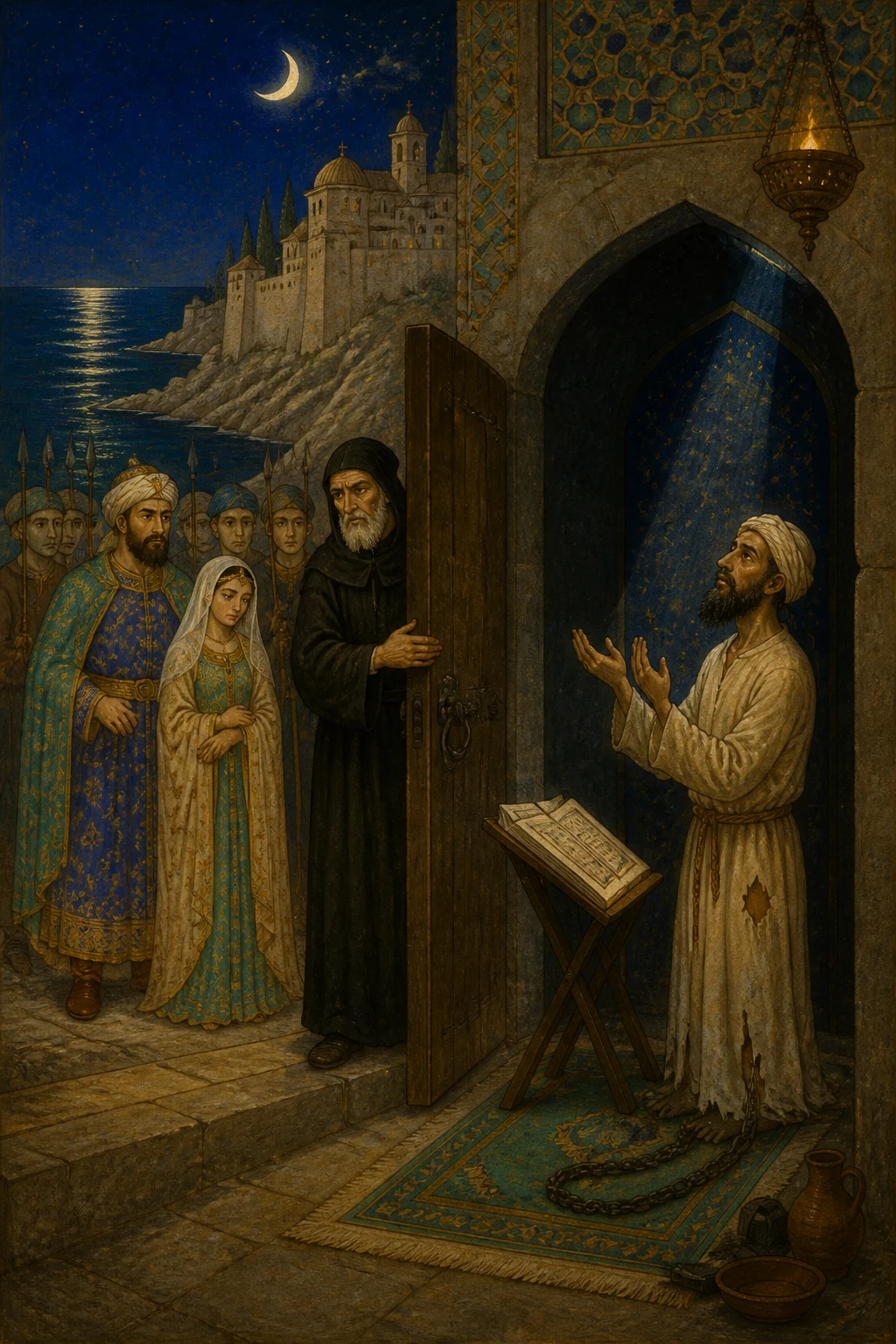
Know that I was in Jerusalem with some of the holy saints and masters of spiritual states, and I never behaved arrogantly toward them, for God, glorified and exalted be He, had blessed me with humility and renunciation. One night I happened to go down to the sea and walk upon the water. Then, without my knowing it, pride stole into my heart, and I said to myself, “Who is there like me, who walks upon the water?” From that moment my heart grew hard, and God afflicted me with a passion for wandering. I traveled to the land of the Greeks and roamed its provinces for a whole year, leaving no place where I had not worshipped God. When I reached this spot, I climbed this mountain, where there is a monastery belonging to a monk named Matruhanni. When he saw me, he came out, kissed my hands and feet, and said, “I have watched you ever since you entered the land of the Greeks, and you have filled me with longing for the lands of Islam.” Then he took my hand and led me into the monastery, and from there into a dark room. Once I was inside, he caught me unawares and locked the door on me, leaving me there for forty days without food or drink, intending to kill me by slow starvation. One day a patrician named Daqyanus came to the monastery with ten young servants and a daughter named Tamathil, who was without equal in beauty. When they entered, the monk Matruhanni told them about me, and the patrician said, “Bring him out, for there can be scarcely enough flesh left on him for the birds to eat.” They opened the door of that dark room and found me standing in the prayer niche, praying, reciting the Qur’an, glorifying God, and supplicating Him. When they saw me in that state, Matruhanni said, “This man is a sorcerer.” At his words they all rose and came in, and Daqyanus and his companions fell upon me and beat me savagely. Then I longed for death, and reproached myself, saying, “This is the reward of one who grows arrogant and takes pride in gifts his Lord has bestowed on him, which lie beyond his own power. O my soul, pride and arrogance have entered you! Did you not know that arrogance angers the Lord, hardens the heart, and brings a man into the Fire?”
After that they put me in fetters and returned me to my prison, a cellar beneath that room. Every three days they threw me a barley cake and a draught of water. Every two months the patrician came to the monastery. His daughter Tamathil had grown to womanhood: she had been nine years old when I first saw her, and I spent fifteen years in captivity, so that she was now twenty-four. Neither in our lands nor in the land of the Greeks was there anyone more beautiful. Her father feared that the king would take her from him, for she had dedicated herself to Christ. Yet she rode with her father dressed as a knight, and though her beauty was peerless, no one who saw her knew that she was a maiden. Her father had stored his wealth in that monastery, for everyone who possessed precious treasures deposited them there. I saw gold, silver, jewels, vessels, and rarities in such abundance that God Most High alone could reckon them. You have a better right to them than these unbelievers, so take what is in the monastery and spend it on the Muslims, especially those who fight in God’s cause. When these merchants reached Constantinople and sold their wares, the image on the wall spoke to them, through a miracle with which God honored me. They came to the monastery and killed the patrician Matruhanni, after subjecting him to the harshest torments and dragging him by his beard until he showed them where I was. They took me away, and had no choice but to flee for fear of destruction. Tomorrow night Tamathil will come to that monastery as usual, and her father will follow with his servants, for he is anxious for her safety. If you wish to see this for yourselves, take me along, and I shall deliver into your hands the wealth and the treasury of the patrician Daqyanus in that mountain. I have seen them bring out vessels of gold and silver to drink from, and I have seen a slave girl there singing to them in Arabic. Alas, that such a lovely voice was not used to recite the Qur’an! If you wish, enter the monastery and lie in wait until Daqyanus arrives with his daughter. Take her, for she is fit for none but the king of the age, Sharkan, and King Daw al-Makan.
They rejoiced when they heard her words, all except the vizier Dandan, who could make no sense of what she said and spoke with her only to please the king. He was bewildered by her tale, and disbelief showed plainly on his face. Then the old woman Dhat al-Dawahi said, “I fear that the patrician may come and see these troops in the meadow, and not dare enter the monastery.” So the sultan ordered the army to set out toward Constantinople. Daw al-Makan said, “My intention is for us to take a hundred horsemen and many mules and go to that mountain, so that they may carry away the wealth in the monastery.” At once he sent for the grand chamberlain and had him brought before him, together with the commanders, the Turks, and the Daylamites. “At daybreak,” he told them, “set out for Constantinople. You, chamberlain, shall take my place in counsel and command, and you, Rustam, shall act for my brother in battle. Let no one know that we are not with you. We shall join you in three days.” Then he chose a hundred valiant horsemen and withdrew with his brother Sharkan, the vizier Dandan, and the hundred men, taking mules and chests to carry the treasure. But morning overtook Shahrazad, and she fell silent, leaving her tale untold.
When it was the ninety-sixth night
She said: It has reached me, O fortunate king, that Sharkan, his brother Daw al-Makan, and the vizier Dandan set out with the hundred horsemen for the monastery described to them by the accursed Dhat al-Dawahi, taking mules and chests to carry the treasure. When morning came, the chamberlain proclaimed the order to march, and the troops set out, believing that Sharkan, Daw al-Makan, and the vizier Dandan were with them, unaware that they had gone to the monastery.
Such was their case. As for Sharkan, his brother Daw al-Makan, and the vizier Dandan, they remained where they were until the end of the day. The unbelievers who were Dhat al-Dawahi’s accomplices had departed secretly after coming before her, kissing her hands and feet, and asking leave to go. She had given them permission and instructed them in the tricks she wished them to perform. When darkness fell, the old woman rose and said to Daw al-Makan and his companions, “Come with me to the mountain, and bring a few of the soldiers with you.” They obeyed, leaving five horsemen at the foot of the mountain, and went on behind Dhat al-Dawahi. Her joy lent her such strength that Daw al-Makan exclaimed, “Glory be to Him who has strengthened this ascetic, whose like we have never seen!” The sorceress had already sent a letter by carrier pigeon to the king of Constantinople, telling him what had happened. At its end she wrote, “I want you to send me ten thousand brave Greek horsemen. Let them move secretly along the foot of the mountain, so that the army of Islam does not see them, and come to the monastery, where they must lie in hiding until I bring them the king of the Muslims and his brother. I have deceived them and brought them here with their vizier and no more than a hundred horsemen. I shall hand over to them the crosses in the monastery. I have resolved to kill the monk Matruhanni, for the stratagem cannot succeed unless he dies. If it succeeds, not one Muslim will reach his homeland—not a soul to dwell in a house or blow upon a fire. Matruhanni will be a sacrifice for the Christian faith and the company of the Cross. Thanks be to Christ, first and last.” When the letter reached Constantinople, the keeper of the pigeons brought it to King Afridun. On reading it, he immediately dispatched the troops, providing each man with a horse, a riding camel, a mule, and provisions, and ordering them to make their way to the monastery.
Such was their case. As for King Daw al-Makan, his brother Sharkan, the vizier Dandan, and their soldiers, when they reached the monastery they entered and saw the monk Matruhanni coming to see who they were. The ascetic said, “Kill this accursed man!” They struck him with their swords and made him drink the cup of death. Then the accursed woman led them to the place where the votive offerings were kept, and they brought out more treasures and rarities than she had described. They gathered them, packed them into the chests, and loaded them onto the mules. But Tamathil did not come, nor did her father, for fear of the Muslims. Daw al-Makan waited for her that day, and a second and a third. Then Sharkan said, “By God, my heart is troubled for the army of Islam, and I do not know how they fare.” His brother replied, “We have taken this great treasure, and I do not think that Tamathil or anyone else will come to this monastery after what has befallen the Greek army. We ought to be content with what God has granted us and set out. Perhaps God will help us conquer Constantinople.”
Then they descended the mountain, and Dhat al-Dawahi could not oppose them for fear they would discover her deceit. They traveled on until they reached the entrance to the ravine, where the old woman had laid an ambush of ten thousand horsemen. At the sight of them, the horsemen surrounded them on every side, leveled their spears, and drew their gleaming swords. The unbelievers shouted the watchword of their unbelief and loosed the arrows of their malice. Daw al-Makan, his brother Sharkan, and the vizier Dandan looked at the host and saw how vast it was. “Who told these troops about us?” they asked. Sharkan said, “Brother, this is no time for words, but for sword strokes and flying arrows. Set your resolve and take courage. This ravine is like a passage with two gates. By the lord of Arabs and non-Arabs, were this place not so narrow, I would destroy them even if they were a hundred thousand horsemen!” Daw al-Makan said, “Had we known this, we would have brought five thousand horsemen.” The vizier Dandan replied, “Even ten thousand horsemen would be of no use to us in this narrow place. But God will help us against them. I know this ravine and its narrow paths, and I know that it has many desolate stretches, for I campaigned here with King Umar al-Numan when we besieged Constantinople. We used to camp here, and there is water colder than snow. Come, let us leave this ravine before the unbelievers’ troops grow more numerous and reach the mountaintop before us. Then they will hurl stones down upon us, and we shall have no power to harm them.” They began hurrying out of the ravine, but the ascetic looked at them and said, “What is this fear, when you have sold your souls to God Most High in His cause? By God, I remained imprisoned underground for fifteen years and never questioned what God did to me. Fight in God’s cause! Whoever among you is slain shall have Paradise for his home, and whoever slays shall advance toward honor.”
When they heard these words from the ascetic, their grief and anxiety left them, and they stood firm as the unbelievers assailed them from every side. Swords played about their necks, and the cup of death passed among them. The Muslims fought fiercely in obedience to God, plying spearheads and blades against His enemies. Daw al-Makan struck down men and laid champions low, sending their heads flying five at a time and ten at a time, until he had slain numbers beyond reckoning, heaps beyond counting. As he fought, he caught sight of the accursed woman gesturing toward them with her sword and urging them on. Everyone who took fright fled to her, and she kept signaling to them to kill Sharkan. They advanced upon him company after company, but whenever a company charged him, he charged in turn and routed it. Another company would attack, and he would drive it back with his sword. He thought his victory over them came through the holy man’s blessing, and said to himself, “God has looked upon this holy man with the eye of His care, and through the purity of his devotion has strengthened my resolve against the unbelievers. I see that they fear me and cannot venture against me. Whenever they charge, they turn their backs and take refuge in flight.”
They fought on for the rest of the day, and when night fell they took shelter in a cave in the ravine, so grievously had they suffered from the fighting and the stones hurled down upon them. Forty-five of their men had been killed that day. When they gathered together, they searched for the ascetic but found no trace of him. They were greatly distressed and said, “Perhaps he has died a martyr.” Sharkan said, “I saw him heartening the horsemen with divine gestures and protecting them with verses of the Merciful.” While they were speaking, the accursed Dhat al-Dawahi appeared, carrying the head of the chief patrician, who commanded the twenty thousand. He had been an obstinate tyrant and a rebellious devil. A Turk had killed him with an arrow, and God had sped his soul to the Fire. When the unbelievers saw what that Muslim had done to their leader, they fell upon him as one, grievously wounded him, and cut him to pieces with their swords; and God sped him to Paradise.
The accursed woman had then cut off the patrician’s head, brought it back, and thrown it before Sharkan, King Daw al-Makan, and the vizier Dandan. At the sight of her, Sharkan sprang to his feet and said, “Praise be to God that we see you again, O devout ascetic and holy warrior!” She replied, “My son, I sought martyrdom today and cast myself among the ranks of the unbelievers, but they stood in awe of me. When you withdrew, my zeal for your safety was kindled, and I charged their chief patrician, a man reckoned equal to a thousand horsemen. I struck him and severed his head from his body. None of the unbelievers dared approach me, and I have brought his head to you.” But morning overtook Shahrazad, and she fell silent, leaving her tale untold.
When it was the ninety-seventh night
She said: It has reached me, O fortunate king, that when the accursed Dhat al-Dawahi took the head of the patrician who commanded the twenty thousand unbelievers, she brought it and cast it before King Daw al-Makan, his brother Sharkan, and the vizier Dandan. She said, “When I saw your plight, my zeal for your safety was kindled. I charged the chief patrician and struck him with my sword, severing his head. None of the unbelievers dared come near me. I have brought you his head to strengthen your spirits for the holy struggle, so that with your swords you may please the Lord of all servants. I wish you to keep up the fight while I go to your army, even if they are at the gates of Constantinople, and bring you twenty thousand horsemen to destroy these unbelievers.” Sharkan said, “How can you reach them, O ascetic, when the valley is blocked on every side by unbelievers?” The accursed woman replied, “God will veil me from their eyes so that they cannot see me, and any who do see me will not dare approach. At that time I shall be lost in God, and He will fight His enemies on my behalf.” Sharkan said, “You speak truly, O ascetic, for I have witnessed it. If you can leave early tonight, that will be better for us.” The ascetic replied, “I shall go this very hour. If you wish to come with me unseen, rise and come. If your brother will come too, we shall take him, but no one else, for a saint’s shadow can shelter only two.” Sharkan said, “As for me, I will not abandon my companions. But if my brother agrees, there is no harm in his going with you and escaping this strait, for he is the stronghold of the Muslims and the sword of the Lord of the Worlds. If he wishes, let him take the vizier Dandan or whomever he chooses, and then send us ten thousand horsemen to help us against these villains.” They agreed upon this, and the old woman said, “Give me time to go ahead of you and see whether the unbelievers are sleeping or awake.” They answered, “We shall go out only with you and commit our affairs to God.” She said, “If I yield to you, do not blame me; blame yourselves. My advice is that you give me time to discover their circumstances.” Sharkan said, “Go to them, but do not be long, for we shall be waiting.” Dhat al-Dawahi went out. After she had left them, Sharkan said to his brother, “Had this ascetic not possessed miraculous powers, he could never have killed that tyrannical patrician. That alone is proof enough of his sanctity. The unbelievers’ strength has been broken by the death of this patrician, for he was an obstinate tyrant and a rebellious devil.”
While they were talking of the ascetic’s miracles, the accursed Dhat al-Dawahi returned and promised them victory over the unbelievers. They thanked the ascetic, not knowing that it was all a trick and a deceit. Then the accursed woman said, “Where is the king of the age, Daw al-Makan?” He answered her summons, and she said, “Take your vizier and follow me, so that we may go to Constantinople.” Dhat al-Dawahi had already told the unbelievers of her scheme, and they had rejoiced exceedingly. “Nothing will console us,” they said, “but killing their king in return for the death of the patrician, for we had no finer horseman than he.” When the ill-omened old woman told them that she would bring them the king of the Muslims, she said, “Once I bring him, we shall take him to King Afridun.” Then Dhat al-Dawahi set out with Daw al-Makan and the vizier Dandan, going ahead of them and saying, “Proceed with the blessing of God Most High.” They obeyed her, and the arrow of fate and destiny pierced them. She continued leading them until she had brought them into the midst of the Greek army and they reached the narrow ravine already mentioned. The unbelievers’ troops watched them pass but did them no harm, for the accursed woman had instructed them accordingly. When Daw al-Makan and the vizier Dandan saw the enemy troops and realized that the unbelievers had seen them but were leaving them alone, Dandan said, “By God, this is one of the ascetic’s miracles! Surely he is among God’s chosen.” Daw al-Makan replied, “By God, I think the unbelievers must be blind, for we see them, but they do not see us.” While they were praising the ascetic and recounting his miracles, his renunciation, and his devotion, the unbelievers suddenly fell upon them, surrounded them, and seized them. “Is there anyone else with you whom we should arrest?” they asked. The vizier Dandan said, “Do you not see this other man ahead of us?” The unbelievers replied, “By Christ, the monks, the Catholicos, and the metropolitan, we have seen no one but you two.” Daw al-Makan said, “By God, what has befallen us is a punishment from God Most High.” But morning overtook Shahrazad, and she fell silent, leaving her tale untold.
When it was the ninety-eighth night
She said: It has reached me, O fortunate king, that when the unbelievers seized King Daw al-Makan and the vizier Dandan, they asked, “Is there anyone else with you whom we should arrest?” The vizier Dandan said, “Do you not see this other man with us?” They replied, “By Christ, the monks, the Catholicos, and the metropolitan, we see no one but you two.” Then the unbelievers put fetters on their feet and appointed guards to watch them through the night. The two men lamented and said to one another, “To question the righteous leads to worse than this. The distress we are suffering is no more than we deserve.”
Such was the case of Daw al-Makan and the vizier Dandan. As for King Sharkan, he passed the night where he was, and at daybreak rose and performed the dawn prayer. Then he and his soldiers got up and prepared to fight the unbelievers. Sharkan strengthened their hearts and promised them every good reward. They advanced until they reached the enemy, and when the unbelievers saw them from afar, they called out, “Muslims, we have captured your sultan and his vizier, who keeps your affairs in order. Unless you cease fighting us, we shall kill you to the last man. But if you surrender, we shall take you to our king, and he will make peace with you on condition that you do not leave our country or return to your own, and that you do us no harm, nor we you. If you agree, good fortune will be yours. If you refuse, nothing awaits you but death. We have made our terms known, and this is our last word to you.” When Sharkan heard this and learned that his brother and the vizier Dandan had indeed been captured, he was overwhelmed. He wept, his strength failed him, and he felt certain of destruction. He said to himself, “I wonder what caused their capture. Did they behave disrespectfully toward the ascetic and question him? Or what has happened to them?” Then they rose to fight the unbelievers and slew a great multitude. That day the brave were distinguished from the cowardly, and swords and spearheads were dyed with blood. The unbelievers swarmed upon them from every side like flies upon a drink. Sharkan and his companions fought like men who had no fear of death and let no chance to strike escape them, until blood flowed through the valley and the ground was covered with the slain. When night fell, the armies parted and each side returned to its place. The Muslims withdrew to the cave, only a few of them left, with none but God and their swords to rely upon. Thirty-five of their horsemen, all emirs and men of distinction, had been killed that day, though thousands of the unbelievers, on foot and horseback, had fallen beneath their swords. Seeing this, Sharkan was sorely troubled and said to his companions, “What are we to do?” They answered, “Nothing will happen but what God Most High wills.”
On the following day Sharkan said to the remaining soldiers, “If you go out to fight, not one of you will survive, for we have only a little water and food left. The course I think wisest is for you to draw your swords and stand at the mouth of this cave, defending yourselves against anyone who tries to enter. Perhaps the ascetic has reached the Muslim army and will bring us ten thousand horsemen to help us fight the unbelievers. Perhaps the unbelievers did not see him or those with him.” His companions replied, “That is sound advice; there can be no doubt of its wisdom.” The soldiers went out and took command of the cave’s entrance, standing on either side. They killed any unbeliever who tried to enter and kept driving the enemy back from the mouth of the cave. They endured the fighting until the day was gone and night came on with gathering darkness. But morning overtook Shahrazad, and she fell silent, leaving her tale untold.
When it was the ninety-ninth night
She said: It has reached me, O fortunate king, that the Muslim soldiers held the mouth of the cave, standing on either side and driving the unbelievers away. Whoever tried to storm it they killed, and they endured the fighting until the day departed and night came on with gathering darkness. King Sharkan now had only twenty-five men left. The unbelievers said to one another, “When will these days be over? We are weary of fighting the Muslims.” Some of them said, “Come, let us storm them. There are only twenty-five men left. If we cannot overcome them, we shall set fire to them. If they yield and surrender, we shall take them prisoner. If they refuse, we shall leave them as fuel for the flames, a warning to all who have eyes to see. May Christ have no mercy on their fathers, nor make the Christians’ resting place their abode!” Then they carried firewood to the cave’s entrance and set it alight, and Sharkan and his companions became certain of their doom. But as matters stood thus, the patrician in command turned to the man who had proposed killing them and said, “They must be put to death only before King Afridun, so that he may satisfy his thirst for revenge. We ought to keep them prisoners and take them to Constantinople tomorrow. There we shall hand them over to King Afridun, who may do with them as he wishes.” They replied, “That is the right course.” Then they ordered the Muslims’ arms bound behind their backs and set guards over them.
When darkness fell, the unbelievers turned to feasting and merrymaking. They called for wine and drank until every one of them fell flat on his back. Sharkan, his brother Daw al-Makan, and the champions with them were all in bonds. Sharkan looked at his brother and said, “Brother, how can we escape?” Daw al-Makan replied, “By God, I do not know. We have become like birds in cages.” Sharkan was filled with rage and heaved a sigh so fierce that his bonds snapped. Once free, he went to the chief guard, took the keys of the fetters from his pocket, and released Daw al-Makan, the vizier Dandan, and the rest of the soldiers. Then he turned to his brother and the vizier and said, “I want to kill three of the guards. We three can take their clothes and put them on, disguising ourselves as Greeks, and pass among them unrecognized. Then we can make our way to our army.” Daw al-Makan replied, “That is not a wise plan. If we kill them, someone may hear their death rattles, and the unbelievers will become aware of us and kill us. The sound course is to make our way out of the ravine.” They agreed.
When they had gone a little way beyond the ravine, they saw horses tethered, their owners asleep nearby. Sharkan said to his brother, “Each of us should take one of these horses.” They were twenty-five men, and they took twenty-five horses, for God had cast sleep upon the unbelievers for a purpose known to Him. Then Sharkan stole swords and spears from the unbelievers until he had enough weapons. They mounted the horses they had taken and rode away. The unbelievers had supposed that no one could release Daw al-Makan, his brother, and their soldiers, and that escape was impossible. When they were all free of captivity and safely away from the enemy, Sharkan turned to them and said, “Have no fear, for God has sheltered us. But I have a plan that may be a good one.” “What is it?” they asked. He said, “I want you to climb the mountain and all cry out together, ‘God is greatest!’ Then shout, ‘The armies of Islam have come upon you!’ We shall all raise a single cry of ‘God is greatest!’ This will scatter their host, and they will not know what to do. They are drunk and will think that the Muslim army has surrounded them on every side and broken into their ranks. Bewildered by wine and sleep, they will fall upon one another with their swords. Thus we shall cut them down with their own blades, and the sword will rage among them until morning.” Daw al-Makan said, “That is not a wise plan. We should make our way to our army without uttering a word. If we raise the cry, they will discover us and pursue us, and not one of us will escape.” Sharkan replied, “By God, even if they discover us, we shall come to no harm. I wish you would agree to this plan, for nothing but good will come of it.” They consented, climbed the mountain, and cried, “God is greatest!” The mountains, trees, and stones echoed their cry in fear of God. The unbelievers heard it and shouted … But morning overtook Shahrazad, and she fell silent, leaving her tale untold.
When it was the hundredth night
She said: It has reached me, O fortunate king, that Sharkan said, “I wish you would agree to this plan, for nothing but good will come of it.” They consented, climbed the mountain, and cried, “God is greatest!” The mountains, trees, and stones echoed their cry in fear of God. When the unbelievers heard it, they shouted to one another, put on their armor, and cried, “By Christ, the enemy has attacked us!” Then they slaughtered one another in numbers known only to God Most High. In the morning they searched for the captives but found no trace of them. Their commanders said, “Those prisoners of ours are the ones who have done this to you. Pursue them until you overtake them and make them drink the cup of punishment. Let neither fear nor bewilderment seize you.” They mounted their horses and rode after them, and in no time caught up with them and surrounded them. When Daw al-Makan saw this, his alarm grew, and he said to his brother, “What I feared has come to pass. We have no course left but to fight.” Sharkan remained silent. Then Daw al-Makan rode down from the mountaintop, crying, “God is greatest!” The men echoed his cry, resolved to fight and to sell their lives in obedience to the Lord of all servants.
As they did so, they suddenly heard voices proclaiming God’s oneness and greatness and invoking blessings and peace upon the Bringer of Glad Tidings and Warning. They turned toward the sound and saw the armies of the Muslims, the hosts of those who profess God’s oneness, advancing toward them. At the sight, their hearts grew strong. Sharkan charged the unbelievers, and he and his companions proclaimed God’s oneness and greatness until the earth shook as though with an earthquake. The unbelievers’ troops scattered across the mountains, and the Muslims pursued them with sword strokes and spear thrusts, severing heads from bodies. Daw al-Makan and the Muslims with him continued striking at the unbelievers’ necks until day departed and night came on with gathering darkness. Then the Muslims gathered together and passed the whole night rejoicing. When morning dawned and its light shone clear, they saw Bahram, commander of the Daylamites, and Rustam, commander of the Turks, approaching with twenty thousand horsemen like grim-faced lions. At the sight of Daw al-Makan, the horsemen dismounted, saluted him, and kissed the ground before him. Daw al-Makan said, “Rejoice in the victory of the Muslims and the destruction of the unbelieving people!” Then they congratulated one another on their deliverance and on the great reward awaiting them at the Resurrection.
The reason they had come to this place was that Emir Bahram, Emir Rustam, and the grand chamberlain had marched with the Muslim armies, their banners unfurled above them, until they reached Constantinople. There they saw the unbelievers upon the walls, holding the towers and citadels and prepared in every impregnable stronghold, having learned of the approach of the armies of Islam and the banners of Muhammad. They had heard the clash of weapons and the tumult of voices; looking out, they had seen the Muslims and heard the hoofbeats of their horses beneath the dust. They were like swarming locusts and clouds pouring rain, and their voices could be heard reciting the Qur’an and glorifying the Merciful. The unbelievers had been forewarned through the falsehood, depravity, slander, and cunning of the old woman Dhat al-Dawahi. As the armies drew near, like a surging sea with their multitude of foot soldiers and horsemen, women and children, the commander of the Turks said to the commander of the Daylamites, “Emir, we are in danger from the enemy upon the walls. Look at those towers and that multitude, like a roaring sea of clashing waves! These unbelievers outnumber us a hundredfold. We cannot be sure that some malicious spy will not tell them of our peril, faced with enemies whose numbers cannot be counted and whose reinforcements never cease, especially while King Daw al-Makan, his brother, and the illustrious vizier Dandan are absent. Their absence will embolden the enemy against us, and they will wipe us out with their swords to the last man, leaving not one survivor. My advice is that you take ten thousand horsemen from Mosul and the Turks and go to the monastery of Matruhanni and the meadow of Malukhna in search of our brothers and companions. If you heed me, you may bring them relief if the unbelievers have hemmed them in. If you do not, no blame can fall on me. When you go, you must return to us swiftly, for caution lies in suspecting the worst.” The emir accepted his counsel, and together they selected twenty thousand horsemen and set out along the roads, seeking that meadow and the well-known monastery.
Such was the reason for their coming. As for the old woman Dhat al-Dawahi, once she had delivered Sultan Daw al-Makan, his brother Sharkan, and the vizier Dandan into the hands of the unbelievers, that harlot took a horse, mounted it, and said to the unbelievers, “I mean to catch up with the Muslim army and contrive its destruction. They are at Constantinople, and I shall tell them that their companions have perished. When they hear this from me, their unity will dissolve, their bond will be severed, and their host will scatter. Then I shall go in to King Afridun, ruler of Constantinople, and my son King Hardub, ruler of the Greeks, and tell them the news. They will march out with their armies against the Muslims and destroy them, leaving not one alive.” She rode that horse across the country all night. At daybreak the army of Bahram and Rustam came into view. She entered a wood, hid her horse there, and came out on foot. After walking a little way, she said to herself, “Perhaps the Muslim troops are returning defeated from the battle of Constantinople.” As she drew near, she looked closely at their banners and saw that they were not lowered. She knew then that they had not come in defeat, nor out of fear for their king and his companions. Seeing this, she ran toward them with all her speed, like a rebellious devil, until she reached them. “Hasten, hasten, O soldiers of the Merciful,” she cried, “to fight the host of Satan!” When Bahram saw her, he approached, dismounted, kissed the ground before her, and said, “O friend of God, what news do you bring?” She answered, “Do not ask of our wretched plight and the terrible horrors we have endured! When our companions had taken the treasure from the monastery of Matruhanni and were about to set out for Constantinople, a vast and mighty army of unbelievers fell upon them.”
Then the accursed woman repeated her tale to them, spreading alarm and dread, and said, “Most of them have perished; only twenty-five men remain.” Bahram asked, “Holy man, when did you leave them?” “This very night,” she replied. Bahram said, “Glory be to Him who folded up the distant earth for you, though you travel on foot, leaning on a palm stick! Surely you are one of those flying saints inspired by divine signs.” Then he mounted his horse, bewildered and astonished by what he had heard from that mistress of lies and slander, and said, “There is no power and no strength save in God! Our toil has come to nothing, our hearts are heavy, and our sultan and his companions have been taken prisoner.” They rode across the country by night and day. In the hour before dawn they reached the head of the ravine, where they saw Daw al-Makan and his brother Sharkan crying, “There is no god but God! God is most great!” and invoking blessings and peace upon the Bearer of Glad Tidings and Warnings. Bahram and his companions charged, surrounding the unbelievers as a flood engulfs the wilderness, and raised a battle cry that made champions tremble and mountains split. When morning came and its light shone forth, the sweet fragrance of Daw al-Makan’s presence reached them, and they recognized one another, as has already been related. They kissed the ground before Daw al-Makan and his brother Sharkan, who told them what had happened in the cave. They marveled at his story, then said to one another, “Let us hurry to Constantinople, for we left our companions there, and our hearts are with them.” So they hastened on, putting their trust in the Gracious, the All-Aware, while Daw al-Makan encouraged the Muslims to stand firm and recited these verses:
Praise be to You, worthy of praise and thanksgiving; my Lord, You have always aided me in my affairs. I grew up a stranger in foreign lands, and You were my guardian, so that never did I fear destruction. You gave me wealth, dominion, and blessing, and girded me with the sword of courage and victory. You granted me long life beneath a king’s sheltering shade, and lavished upon me the overflowing bounty of Your grace. You saved me from every calamity I feared, and I knew for certain that evil brings evil to an end. By Your favor we struck the Greeks a mighty blow, and they withdrew beneath our strokes, clad in robes of red. I made a show of being routed, then turned upon them like a noble lion. I left them fallen on the plain, as though drunk on the cup of death, not on wine. All their ships passed into our hands, and dominion on land and sea became ours. Then came to us the devout ascetic whose miracles were famed among nomads and townsfolk alike. We came to take vengeance upon every unbeliever, and the tale of my deeds has spread among the people. They have slain men of ours, who now have lofty chambers in eternity above a flowing river. When Daw al-Makan had finished his poem, his brother Sharkan congratulated him on his deliverance and thanked him for his deeds. Then they pressed on at a swift pace. And dawn overtook Shahrazad, and she fell silent, leaving her permitted tale untold.
When it was the hundred and first night
She said: It has reached me, O fortunate King, that Sharkan congratulated his brother Daw al-Makan on his deliverance and thanked him for his deeds. Then they pressed on swiftly in search of their army. Such was their case. As for the old woman Dhat al-Dawahi, after meeting the forces of Bahram and Rustam, she returned to the forest, fetched her horse, mounted, and rode swiftly until she came within sight of the Muslim army besieging Constantinople. Then she dismounted and led her horse to the pavilion where the chamberlain was staying. When he saw her, he rose, greeted her with a gesture of respect, and said, “Welcome, devout and holy man!” He asked what had happened, and she told him her terrifying tale and her ruinous lies. “I fear for the Emir Rustam and the Emir Bahram,” she said, “for I met them on the road with their troops and sent them to the king and his companions. They had twenty thousand horsemen, but the unbelievers outnumber them. I wish you to send a body of your troops this very moment to overtake them quickly, lest they be destroyed to the last man.” And she urged them, “Haste! Haste!”
When the chamberlain and the Muslims heard these words, their resolve gave way and they wept. Dhat al-Dawahi said to them, “Seek help in God and bear this calamity patiently. You have an example in those of Muhammad’s people who went before you. Paradise, with its palaces, has been prepared for those who die as martyrs. Death must come to everyone, but death in holy war is the most praiseworthy.” When the chamberlain heard the words of the accursed Dhat al-Dawahi, he summoned the Emir Bahram’s brother, a knight named Tarkash, chose ten thousand grim-faced champions for him, and ordered him to set out. He rode all that day and through the night until he drew near the Muslims. At daybreak Sharkan saw the dust and feared for his men. “An army is advancing upon us,” he said. “If it is a Muslim army, this is a manifest victory; if it is an army of unbelievers, there is no disputing destiny.” Then he went to his brother Daw al-Makan and said, “Never fear, for I would give my life to save you from destruction. If these men belong to the army of Islam, it is a further blessing; if they are our enemies, we must fight them. Yet before I die, I long to meet the holy man and ask him to pray that I may die only as a martyr.”
While they were thus engaged, banners appeared, bearing the words: “There is no god but God; Muhammad is the Messenger of God.” Sharkan called out, “How fare the Muslims?” They answered, “Safe and well. We came only because we feared for you.” Then the commander dismounted, kissed the ground before him, and said, “My lord, how are the sultan, the vizier Dandan, Rustam, and my brother Bahram? Are they all safe?” “They are well,” he replied. Then he asked, “Who brought you news of us?” The commander answered, “The ascetic. He said he had met my brother Bahram and Rustam and sent them to you. He told us that the unbelievers had surrounded them in great numbers. Yet I see that things are otherwise, and that victory is yours.” They asked him, “How did the ascetic reach you?” He replied, “He was traveling on foot, and in a day and a night he covered a distance that would take a hard-riding horseman ten days.” Sharkan said, “There is no doubt that he is a saint of God. Where is he?” They answered, “We left him with our faithful troops, urging them to fight the people of unbelief and tyranny.” Sharkan rejoiced and praised God for their safety and that of the ascetic. They prayed for mercy upon those who had been slain and said, “This was written in the Book.” Then they hastened on. As they rode, a cloud of dust rose until it obscured the horizon and darkened the day. Sharkan looked at it and said, “I fear the unbelievers have broken the army of Islam, for this dust veils the east and west and fills the whole horizon.” Beneath it there appeared a pillar of darkness, blacker than the darkest day. It kept drawing nearer, more dreadful than the terrors of Judgment Day. Horsemen and foot soldiers hurried toward it to discover the cause of this ominous sight, and found the very ascetic of whom they had been speaking. They crowded around to kiss his hands while he cried, “O people of the best of mankind, the lamp that lights the darkness! The unbelievers have treacherously attacked the Muslims! Hasten to the armies of those who profess God’s oneness and save them from the hands of the vile infidels! They fell upon them in their tents and brought a humiliating torment upon them while they rested secure in their camp.”
When Sharkan heard these words, his heart fluttered with violent agitation. He dismounted in dismay and kissed the ascetic’s hands and feet, as did his brother Daw al-Makan and the rest of the army, both foot and horse. Only the vizier Dandan remained mounted. “By God,” he said, “my heart recoils from this ascetic. I have never known these zealots in religion to bring anything but harm. Leave him and hasten to your Muslim companions, for this man is among those driven from the gate of the Lord of All Worlds’ mercy. How often I campaigned with King Umar al-Numan and trod the soil of this land!” Sharkan said to him, “Put aside this wicked suspicion. Have you not seen this holy man urging the faithful into battle, heedless of swords and arrows? Do not speak ill of him, for backbiting is blameworthy, and the flesh of the righteous is poisonous. See how he urges us to fight our enemies! Had God Most High not loved him, He would not have folded up the distant earth for him after first subjecting him to grievous suffering.” Then Sharkan ordered a Nubian mule to be brought for the ascetic and said, “Mount, O holy, devout, and pious man.” But she would not accept it and refused to ride, making a show of self-denial to gain her ends. They did not know that this debauched ascetic was one of those of whom the poet said:
He prayed and fasted for an end he sought; once it was gained, he neither prayed nor fasted. Then the ascetic continued walking among the horsemen and foot soldiers, like a cunning fox plotting murder. As she went, she raised her voice in recitation of the Quran and praise of the Merciful. They journeyed on until they came within sight of the army of Islam. Sharkan found it broken, with the chamberlain on the verge of defeat and flight, while swords plied their work among the righteous and the wicked alike. And dawn overtook Shahrazad, and she fell silent, leaving her permitted tale untold.
When it was the hundred and second night
She said: It has reached me, O fortunate King, that when Sharkan reached the Muslims, he found them broken, with the chamberlain on the verge of defeat and flight, while swords plied their work among the righteous and the wicked alike. The cause of the Muslims’ disaster was this: when the accursed Dhat al-Dawahi, enemy of the faith, saw that Bahram and Rustam had set off with their troops toward Sharkan and his brother Daw al-Makan, she went to the Muslim army and sent off the Emir Tarkash, as has already been related. Her purpose was to divide the Muslim forces and so weaken them. Then she left them and made for Constantinople, where she called at the top of her voice to the Greek patricians, “Lower a rope so that I may tie this letter to it, and deliver it to your king Afridun. Let him and my son, the king of the Greeks, read it and obey its commands and prohibitions.” They lowered a rope, and she tied the letter to it. It read: “From the greatest of calamities and the mightiest of disasters, Dhat al-Dawahi, to King Afridun. To proceed: I have devised a stratagem to destroy the Muslims, so set your minds at ease. I have taken them prisoner, together with their sultan and vizier. Then I went to their army and told them the news, breaking their spirit and weakening their strength. I deceived the army besieging Constantinople until I had sent twelve thousand horsemen away with the Emir Tarkash, besides those already taken prisoner. Only a few remain. What I require of you is to march out against them with your entire army before this day is over and attack them in their tents. Be sure to go out all together, and kill them to the last man. Christ has looked upon you, and the Virgin has shown you favor. I trust that Christ will not forget what I have done.”
When her letter reached King Afridun, he rejoiced exceedingly and at once sent for the king of the Greeks, Dhat al-Dawahi’s son. When he arrived, Afridun read him the letter, and he was delighted. “See my mother’s cunning!” he said. “It serves in place of swords, and her appearance alone can stand for the terrors of a dreadful day.” King Afridun replied, “May Christ never deprive us of your mother’s presence, nor you of your cunning and malice!” Then he ordered the patricians to proclaim a march out of the city. The news spread through Constantinople, and the Christian armies and the hosts of the Cross went forth, drawing their keen swords, proclaiming words of unbelief and impiety, and denying the Lord of His servants. When the chamberlain saw them, he said, “The Greeks have come upon us. They have learned that our sultan is absent and may attack us, when most of our army has gone to King Daw al-Makan.” Filled with anger, he cried, “O army of the Muslims, defenders of the steadfast faith! If you flee, you will perish; if you stand firm, you will prevail. Know that courage is but an hour’s endurance, and no strait is so narrow that God cannot make a way through it. May God bless you and look upon you with mercy!”
Then the Muslims cried, “God is most great!” and those who professed His oneness raised their voices. The mill of war began to turn with thrust and stroke; keen swords and spears went to work, and blood filled the valleys and plains. Priests and monks performed their rites, tightened their girdles, and raised their crosses, while the Muslims proclaimed the greatness of the Sovereign Judge and cried aloud the verses of the Quran. The host of the Merciful clashed with the host of Satan, heads flew from bodies, and the good angels hovered about the people of the chosen Prophet. Swords continued their work until day departed and night came on in gathering darkness. The unbelievers surrounded the Muslims, imagining that they would escape humiliating punishment. The idolaters pressed their advantage over the faithful until dawn rose clear. Then the chamberlain and his army mounted, hoping that God would grant them victory. Nation mingled with nation, battle rose in fury, and heads flew. The brave stood firm and advanced; the coward turned and fled. Death, the judge, delivered his sentence, until champions toppled from their saddles and the meadows filled with corpses. The Muslims were driven back from their positions, and the Greeks seized some of their tents and quarters. The Muslims were about to give way, take flight, and flee.
At that very moment Sharkan arrived with the Muslim troops and the banners of those who professed God’s oneness. As soon as he reached them, he charged the unbelievers, followed by Daw al-Makan. After them charged the vizier Dandan, Bahram, emir of the Daylamites, Rustam, and his brother Tarkash. At the sight before them, they were beside themselves with fury. Dust rose and filled the horizon, and the good Muslims joined their righteous companions. Sharkan met the chamberlain, thanked him for his endurance, and congratulated him on the support and victory granted him. The Muslims rejoiced, their hearts grew strong, and they charged their enemies, fighting with sincere devotion to God. When the unbelievers saw the banners of Muhammad bearing the Muslim declaration of faith, they cried out in woe and despair, called upon the patricians of the monasteries for help, and invoked John, Mary, and the blackened cross. Their hands faltered in battle. King Afridun joined the king of the Greeks; one took the right wing and the other the left, while a renowned knight named Lawiya took his place in the center. They drew up for battle, though they were shaken with fear. The Muslims likewise arrayed their troops. Then Sharkan turned to his brother Daw al-Makan and said, “O king of the age, they plainly desire single combat, which is just what we wish. Yet I would first put forward those of our army whose resolve is firm, for good planning is half of livelihood.” The sultan asked, “What do you propose, O man of sound judgment?” Sharkan replied, “I wish to strike into the heart of the unbelievers’ army. Let the vizier Dandan take the left, and you the right; let the Emir Bahram hold the right wing and the Emir Rustam the left. And you, great King, must remain beneath the standards and banners, for you are our mainstay, and after God it is upon you that we rely. All of us would give our lives to shield you from harm.” Daw al-Makan thanked him. The shouting rose, and blades were drawn.
While they were thus engaged, a rider emerged from the Greek army. As he drew near, they saw that he rode a slow-paced mule that would carry its master away from the fall of swords. Its saddlecloth was of white silk, and over it lay a rug worked in Kashmir. On its back sat an old man with a handsome white beard and an air of dignity, dressed in a gown of white wool. He kept urging the mule forward until he approached the Muslim army and said, “I am a messenger to you all, and a messenger’s duty is only to deliver his message. Grant me safe conduct and freedom to return, so that I may convey it to you.” Sharkan replied, “You have safe conduct. Fear neither the stroke of a sword nor the ring of a spear.” Then the old man dismounted and removed the cross from his neck before the sultan, bowing humbly like one who hoped for favor. The Muslims asked him, “What news do you bring?” He said, “I am a messenger from King Afridun. I advised him to refrain from destroying these human forms, these temples fashioned by the Merciful. I explained that it would be right to spare bloodshed and confine the battle to two knights. He agreed, and says to you: ‘I offer my own life to spare my army. Let the king of the Muslims do likewise and offer his life to spare his army. If he kills me, the army of the unbelievers will no longer stand firm; if I kill him, the army of Islam will no longer stand firm.’”
When Sharkan heard this, he said, “Monk, we accept his proposal. It is fair, and there shall be no departure from it. I myself will go out to meet him and charge him, for I am the champion of the Muslims, and he is the champion of the unbelievers. If he kills me, victory is his, and the Muslim army will have no choice but flight. Return to him, monk, and tell him that the duel shall be tomorrow, for we have come from a journey and are weary today. Once we have rested, there can be neither reproach nor blame.” The monk returned joyfully to King Afridun and the king of the Greeks and told them what had passed. Afridun was overjoyed, and all his anxiety and sorrow vanished. He said to himself, “There is no doubt that this Sharkan is their finest swordsman and their strongest wielder of the spear. If I kill him, their spirit will break and their strength will fail.” Dhat al-Dawahi had written to King Afridun about this, telling him that Sharkan was the foremost of champions and the bravest of knights, and warning him against him. Afridun was himself a mighty warrior, skilled in every form of combat. He could cast stones and arrows, wield an iron mace, and face the fiercest onslaught without fear. When he heard the monk say that Sharkan had accepted the challenge, he could scarcely contain his joy, for he trusted in his own strength and believed that no man could withstand him.
The unbelievers spent that night in joy and merriment, drinking wine. When morning came, the horsemen advanced with dusky spears and gleaming blades. Then a knight appeared in the field, mounted on a splendid charger, strong of limb and trained for war and combat. He wore iron armor made to withstand the fiercest fighting, with a jeweled breastplate upon his chest. In his hand he held a keen-edged sword and a lance of khulanj wood, a rare piece of Frankish workmanship. The knight uncovered his face and said, “He who knows me has no need of more; he who does not will soon learn who I am. I am Afridun, enfolded in the blessing of Shawahi Dhat al-Dawahi!” Scarcely had he finished speaking when Sharkan, champion of the Muslims, rode out to meet him on a chestnut horse worth a thousand pieces of red gold. His equipment was embroidered with pearls and jewels, and at his side hung a jeweled Indian sword that severed necks and made light of difficult deeds. He rode between the ranks while the knights watched, then called to Afridun, “Woe to you, accursed man! Do you think me like those knights you have met before, who could not stand against you in the thick of battle?”
Then each charged the other, and they were like two mountains colliding or two seas crashing together. They drew near and pulled apart, closed and separated, and continued charging and retreating, feinting and striking in earnest, cutting and thrusting, while both armies looked on. Some said, “Sharkan is winning,” and others, “Afridun is winning.” The two knights fought on until all talk fell silent. Dust rose, day declined, and the sun began to pale toward yellow. Then King Afridun called to Sharkan, “By Christ and the true faith, you are indeed a tireless knight and a daring champion! Yet you are treacherous, and yours is not the nature of honorable men. I see that your conduct is unworthy, though you fight like a hero. Your own people call you a slave, and there they are, bringing out another horse for you so that you may return to battle. By my faith, fighting you has exhausted me, and your strokes and thrusts have worn me out. If you mean to fight me tonight, change neither your equipment nor your horse, so that the knights may see your honor and your prowess.”
When Sharkan heard this, he was angered by the thought that his companions were calling him a slave. He turned toward them, intending to signal that they should change neither his horse nor his equipment. At once Afridun raised his lance and thrust it at Sharkan. Sharkan looked behind him and found no one there, and knew that the accursed man had tricked him. He turned back quickly, but the lance was already upon him. He swerved aside until his head was level with his saddlebow, and the lance passed across his chest. Sharkan was broad and high in the breast, and the point stripped the skin from it. He gave a single cry and lost consciousness. The accursed Afridun rejoiced, believing that he had killed him, and shouted triumphantly to the unbelievers. The people of tyranny exulted, while the faithful wept. When Daw al-Makan saw his brother slumped upon his horse, almost falling, he sent horsemen to him. The champions raced to his side and brought him back. The unbelievers charged the Muslims, the two armies met, the ranks mingled, and Yemeni blades went to work. The first to reach Sharkan was the vizier Dandan. And dawn overtook Shahrazad, and she fell silent, leaving her permitted tale untold.
When it was the hundred and third night
She said: It has reached me, O fortunate King, that when King Daw al-Makan saw the accursed man strike Sharkan with his lance, he thought his brother dead and sent horsemen to him. The first to reach him were the vizier Dandan, Bahram, emir of the Turks, and the emir of the Daylamites. They caught him as he slipped from his horse, supported him, and brought him back to his brother Daw al-Makan. Then they entrusted him to the pages and returned to the battle and the thrusting of spears. The fighting grew fierce, spearheads shattered, and all talk ceased. Nothing could be seen but flowing blood and drooping necks. Swords continued to fall upon necks, and the conflict raged until most of the night had passed. At last both sides grew weary of fighting and called for a withdrawal. Each army returned to its tents. All the unbelievers went to their king Afridun and kissed the ground before him, while priests and monks congratulated him on his victory over Sharkan. Then King Afridun entered Constantinople and sat upon his royal throne. The king of the unbelievers came to him and said, “May Christ strengthen your arm and ever be your helper! May He answer the prayers that our righteous mother Dhat al-Dawahi offers for you! Know that the Muslims can no longer hold their ground now that Sharkan is gone.” Afridun replied, “Tomorrow will settle the matter. I shall go out to battle, challenge Daw al-Makan, and kill him. Then their army will turn its back and take to flight.”
Such was the case of the unbelievers. As for the army of Islam, when Daw al-Makan returned to the tents, he could think of nothing but his brother. He went in and found him in the worst of states and the gravest distress. He summoned the vizier Dandan, Rustam, and Bahram to take counsel with them. When they entered, they agreed that physicians should be brought to treat Sharkan. Then they wept and said, “Time has never brought forth his equal.” They kept vigil beside him that night. Toward its end, the ascetic came to them weeping. When Daw al-Makan saw her, he rose to greet her. She passed her hand over his brother, recited a passage from the Quran, and invoked the verses of the Merciful to protect him. She remained awake beside him until morning. Then Sharkan regained consciousness, opened his eyes, moved his tongue in his mouth, and spoke. Sultan Daw al-Makan rejoiced and said, “The ascetic’s blessing has restored him!” Sharkan said, “Praise be to God for my recovery! I am well at this moment. That accursed man played a trick upon me, and had I not swerved more swiftly than lightning, the lance would have pierced my chest. Praise be to God who saved me! How fare the Muslims?” Daw al-Makan answered, “They are weeping for you.” Sharkan said, “I am safe and well. Where is the ascetic?” She was sitting at his head, and his brother replied, “Here at your head.” Sharkan turned and kissed her hands. The ascetic said, “My son, bear your suffering with gracious patience, and God will make your reward great, for the reward is measured by the hardship.” Sharkan said, “Pray for me.” And she prayed for him.
When morning came and dawn broke clear, the Muslims went out to the battlefield, while the unbelievers prepared for thrust and stroke. The Muslim troops advanced, eager for battle and combat, and drew their weapons. King Daw al-Makan and Afridun were about to charge each other. Daw al-Makan rode out into the field, accompanied by the vizier Dandan, the chamberlain, and Bahram, who said to him, “We would give our lives for you.” But he answered, “By the Sacred House, by Zamzam and the Station of Abraham, I will not hold back from going out against these barbarians!” Once in the field, he displayed such skill with sword and spear that the knights were dazed and both armies marveled. He charged the right wing and killed two patricians, then the left and killed two more. Taking his stand in the middle of the field, he cried, “Where is Afridun, that I may make him taste the torment of humiliation?” The accursed man wished to turn away, dismayed, but Daw al-Makan adjured him not to leave the field, saying, “O king, yesterday you fought my brother; today you fight me. Your courage means nothing to me!” Then he advanced with a keen sword in his hand, mounted on a stallion like Antar in the thick of battle. The horse was a deep, glossy black, as the poet said:
He raced the glance upon a racing steed, as though he sought to overtake destiny. Its dark coat showed a blackness deep as night when night grows thick. Its neigh delighted all who heard it, like thunder when the storm arrives. Were it to race the wind, it would outstrip it; nor could lightning overtake it when it flashed. Then each charged the other, guarding against his opponent’s blows and bringing forth all the wondrous skill he possessed. They charged and wheeled away until hearts grew tight and patience with fate wore thin. Then Daw al-Makan gave a cry, rushed upon Afridun, king of Constantinople, and struck him a blow that sent his head flying and ended his breath. When the unbelievers saw this, they charged him all together, directing their full force against him. He met them in the thick of the field, and the cutting and thrusting continued until blood ran in streams. The Muslims raised their voices in cries of “God is most great!” and “There is no god but God!” and invoked blessings upon the Bearer of Glad Tidings and Warnings. They fought fiercely, and God sent victory upon the faithful and disgrace upon the unbelievers. The vizier Dandan cried, “Avenge King Umar al-Numan and his son Sharkan!” He bared his head and shouted to the Turks. More than twenty thousand horsemen were beside him, and they charged with him as one man. The unbelievers could do nothing but turn their backs and flee, while keen-edged swords plied their work among them. The Muslims killed some fifty thousand horsemen and captured even more. Many died in the crush as they tried to enter the gate. Then the gates were shut, and the defenders climbed the walls in fear of punishment. The Muslim divisions returned triumphant and victorious to their tents. King Daw al-Makan went in to his brother and found him in the happiest condition. He prostrated himself in thanks to the Generous, the Most High, then approached him and congratulated him on his recovery. Sharkan said, “We are all sheltered by the blessing of this penitent ascetic. We prevailed only through his answered prayers, for he sat here all day praying for victory for the Muslims.” And dawn overtook Shahrazad, and she fell silent, leaving her permitted tale untold.
When it was the hundred and fourth night
She said: It has reached me, O fortunate King, that when King Daw al-Makan went in to his brother Sharkan, he found him sitting up with the holy man beside him. He rejoiced, approached him, and congratulated him on his recovery. Sharkan said, “We are all sheltered by this ascetic’s blessing, and you prevailed only through his prayers. All day he never ceased praying for the Muslims. I felt strength return to me when I heard your cries of ‘God is most great!’ and knew that you had defeated your enemies. Tell me, brother, what happened to you.” Daw al-Makan related everything that had passed between him and the accursed Afridun, and told him how he had killed him and sent him to God’s curse. Sharkan praised him and thanked him for his efforts. When Dhat al-Dawahi, disguised as the ascetic, heard that her son King Afridun had been killed, her face turned yellow and her eyes brimmed with tears. But she concealed her grief, showing the Muslims a joyful face and pretending that she wept from sheer happiness. She said to herself, “By Christ, there is no purpose left in my life unless I burn his heart for his brother Sharkan, as he has burned mine for King Afridun, pillar of the Christian faith and the hosts of the Cross.” Yet she concealed her feelings. The vizier Dandan, King Sharkan, and the chamberlain remained sitting beside Sharkan while plasters and ointments were applied and medicine was given to him. His health began to return, and they rejoiced exceedingly. They sent word to the troops, and the Muslims shared the glad tidings, saying, “Tomorrow he will ride with us and take part in the siege.” Then Sharkan said to them, “You have fought today and are weary from battle. You should go to your quarters and sleep, rather than keep watch.” They agreed, and each went to his own pavilion. Only a few pages and the old woman Dhat al-Dawahi remained with Sharkan. He talked with her for a little of the night, then lay down to sleep, as did the pages. Sleep overcame them, and they lay like the dead.
Such was the case of Sharkan and his pages. As for the old woman Dhat al-Dawahi, once they were asleep she remained alone and wakeful in the tent. She looked at Sharkan and found him deep in slumber. Then she sprang to her feet like a ravening she-bear or an overwhelming pestilence, and drew from her girdle a poisoned dagger that would have melted a rock had it been laid upon one. She stripped it from its sheath, came to Sharkan’s head, and drew it across his neck, slaughtering him and severing his head from his body. Then she sprang up, went to the sleeping pages, and cut off their heads lest they wake. She left the tent and made for the sultan’s quarters, but found the guards awake. Turning aside to the vizier Dandan’s tent, she found him reading the Quran. His eye fell upon her, and he said, “Welcome, devout and holy man!” When she heard the vizier’s greeting, her heart trembled, and she said, “The reason I have come here at this hour is that I heard the voice of one of God’s saints, and I am going to him.” Then she turned away. The vizier Dandan said to himself, “By God, I shall follow this ascetic tonight.” He rose and went after her. When the accursed woman heard his footsteps, she knew that he was following and feared exposure. “Unless I trick him,” she said to herself, “he will discover me.” She turned toward him from a distance and said, “Vizier, I am following this saint so that I may make his acquaintance. Once I have done so, I shall ask his permission for you to visit him, then return and tell you. I fear that if you come with me without his leave, he may take offense at me when he sees you by my side.”
When the vizier heard her words, he was too ashamed to answer her. He left her and returned to his tent, intending to sleep, but sleep brought him no comfort, and he felt as though the whole world were closing in upon him. He rose and went out, saying to himself, “I will go to Sharkan and talk with him until morning.” He made his way to Sharkan’s tent and entered, only to find blood streaming from him as from a conduit, and the young servants lying slaughtered. He gave a cry that startled everyone from sleep, and the people hurried to him. When they saw the flowing blood, they broke into weeping and lamentation. Sultan Daw al-Makan awoke and asked what had happened. He was told, “Your brother Sharkan and his servants have been murdered.” He sprang up and hurried into the tent, where he found the vizier Dandan crying aloud and his brother’s body lying headless. He lost consciousness, and all the soldiers cried out and wept, gathering about him for a time until he revived. Then he looked at Sharkan and wept bitterly, as did the vizier, Rustam, and Bahram. The chamberlain cried aloud and lamented at length, then urged them to depart, so great was his fear. The king said, “Do you not know who has done this deed to my brother? And why do I not see the ascetic who shuns all worldly goods?” The vizier replied, “Who else has brought these sorrows upon us but that devil of an ascetic? By God, my heart recoiled from him from first to last, for I know that every man who makes an excessive show of piety is a malicious schemer.” Then the people raised their voices in weeping and lamentation, beseeching Him who is near and answers prayer to deliver into their hands that ascetic who denied the signs of God. They prepared Sharkan’s body for burial and laid him to rest on the mountain already mentioned, mourning his renowned virtues. And morning overtook Shahrazad, and she fell silent, leaving her tale untold.
When it was the hundred and fifth night,
She said: It has reached me, O fortunate king, that they prepared Sharkan’s body for burial and laid him to rest on the mountain already mentioned, mourning his renowned virtues. Now, when the accursed woman had finished her monstrous deed and revealed the depths of her own wickedness, she took an inkwell and a sheet of paper and wrote: “From Shawahi Dhat al-Dawahi to the Muslim host. Know that I entered your lands and, in my vileness, deceived your noblest men. Before this, I killed your king, Umar al-Numan, in the very heart of his palace. I also slew many men in the battle of the ravine and the cave. The latest victims of my cunning, craft, and treachery are Sharkan and his servants. Had fortune favored me and the Devil obeyed me, I would have killed the sultan and the vizier Dandan as well. It was I who came among you in the guise of an ascetic, and you were taken in by my tricks and schemes. If you wish to be safe hereafter, depart; if you wish to destroy yourselves, remain where you are. Though you stay for years and years, you will never gain what you seek from us.” Having written the letter, she continued her mourning for King Afridun for three days. On the fourth day she summoned a patrician and ordered him to take the paper, attach it to an arrow, and shoot it toward the Muslims. Then she entered the church and began to lament and weep for the loss of Afridun, saying to the king who had succeeded him, “I shall surely kill Daw al-Makan and all the princes of Islam.”
Such was her case. As for the Muslims, they spent three days in sorrow and distress. On the fourth day they looked toward the wall and saw a patrician holding an arrow with a letter fastened to its tip. They waited until he shot it toward them, and the sultan ordered the vizier Dandan to read it. When he read it and the sultan heard its contents and understood its meaning, tears streamed from his eyes, and he cried out in anguish at her treachery. The vizier said, “By God, my heart always recoiled from her.” The sultan said, “How did this harlot contrive to deceive us twice? By God, I will not stir from here until I fill her privy parts with molten lead and shut her up like a bird in a cage. Then I will hang her by her hair at the gate of Constantinople.” He remembered his brother and wept bitterly. Now, when Dhat al-Dawahi had gone to the unbelievers and told them what had happened, they rejoiced at Sharkan’s death and her safe return. The Muslims returned to the gate of Constantinople, and the sultan promised that, if he took the city, he would divide its wealth equally among them. All this while his tears for his brother never ceased, and his body wasted away until he was thin as a toothpick. The vizier Dandan came to him and said, “Take comfort and let your heart be at peace. Your brother died only when his appointed hour had come, and there is no profit in this grief. How well the poet says:
What cannot be, no artifice can bring to pass; what is to be will surely come to be. Whatever is to be will come in its own time, while the ignorant man is forever the loser. So leave off weeping and lamentation, and strengthen your heart to bear arms.” He replied, “Vizier, my heart is weighed down by the deaths of my father and brother, and by our absence from our own land, for my thoughts are troubled for my subjects.” The vizier and all those present wept. They continued their siege of Constantinople for some time, until news arrived from Baghdad in the company of one of the king’s emirs. It ran as follows: “The wife of King Daw al-Makan has been blessed with a son, whom the king’s sister, Nuzhat al-Zaman, has named Kan ma Kan. This boy is destined for greatness, judging by the marvelous and extraordinary signs that have been witnessed concerning him. Orders have been given to the scholars and preachers to pray for you from the pulpits and after every prayer. We are all well and prospering, and the rains have been plentiful. Your friend the bathhouse stoker enjoys the greatest abundance, with servants and young attendants about him, but to this day he knows nothing of what has befallen you. Peace be upon you.” Daw al-Makan said, “Now my strength is renewed, for I have been blessed with a son named Kan ma Kan.” And morning overtook Shahrazad, and she fell silent, leaving her tale untold.
When it was the hundred and sixth night,
She said: It has reached me, O fortunate king, that when King Daw al-Makan received the news that his wife had borne him a son, he rejoiced exceedingly and said, “Now my strength is renewed, for I have been blessed with a son named Kan ma Kan.” Then he said to the vizier Dandan, “I wish to put aside this grief and have complete recitations of the Quran performed for my brother, and do other charitable works on his behalf.” The vizier replied, “An excellent resolve.” The king ordered tents to be pitched over his brother’s grave, and they pitched them and gathered those soldiers who could recite the Quran. Some recited while others invoked the name of God until morning. Then Sultan Daw al-Makan approached the grave of his brother Sharkan, shed tears, and recited these verses:
They bore him forth, and every mourner following swooned as Moses swooned the day the Mount was shattered. They brought him to a grave that seemed to lie carved in the heart of every believer in the One. Before I saw your bier, I never thought to see Mount Radwa carried on men’s hands; nor, before they laid you in the earth, did I believe the stars could sink into the dust. O dweller in the tomb, held fast within a hollow where your face sheds light and radiance! Praise has pledged to give you back your life: though folded in the shroud, you seem unfurled once more. When Daw al-Makan had finished his verses, he wept, and all the people wept with him. Then the vizier Dandan came to the grave and cast himself upon it in bewildered grief, reciting the poet’s words:
You left what passes and attained what lasts; men such as you have gone before, outstripping all. You left this dwelling free of any stain, and in the world you now inhabit, may what meets you bring delight. You were a shield against the enemy whenever war’s arrows sought their mark. I see this world as vanity and falsehood, while mankind’s highest aim should be to seek the truth. May the Lord of the Throne grant you the triumph of a garden, and the Guide lodge you there in a seat of truth. As for me, I am left consumed by sorrow for you; I see both West and East mourning your loss. When the vizier Dandan had finished his verses, he wept bitterly, his eyes scattering tears like strung pearls. Then a man who had been one of Sharkan’s boon companions came forward and wept until his tears flowed like streams. He recalled Sharkan’s noble deeds and recited these verses:
Where now is bounty, when your generous hand lies in the dust, and since your passing sickness has worn my body thin? O driver of the departing caravan, does what you see delight you? My tears have written lines upon my cheeks. By God, never have I spoken of you within my heart, nor has this calamity crossed my mind, but tears have wounded the corners of my eyes, even when I turn my gaze to someone other than you. When the man had finished his verses, Daw al-Makan and the vizier Dandan wept, and the whole army broke into loud lamentation. Then they returned to their tents. The sultan turned to the vizier Dandan, and the two began to consult together about the conduct of the war. They continued thus for days and nights, while Daw al-Makan chafed beneath his cares and sorrows. At last he said, “I long to hear accounts of people, histories of kings, and tales of passionate lovers. Perhaps God will relieve the heavy grief in my heart and free me from weeping and lamentation.” The vizier replied, “If nothing will ease your sorrow but stories of kings and their remarkable adventures, and tales of lovers and others from ages past, that is easily done. During the lifetime of your late father, my sole occupation was with tales and poetry. Tonight I shall tell you the story of a lover and his beloved, so that your heart may be cheered.” When Daw al-Makan heard the vizier Dandan’s words, his heart fastened upon the promise, and he thought of nothing but waiting for nightfall, when he would hear the vizier’s tales of kings and lovers from bygone days. Hardly had night arrived before he ordered candles and lamps to be lit and everything they needed of food, drink, and incense burners to be brought. All this was set before him. Then he sent for the vizier Dandan, who came, and summoned Bahram, Rustam, Tarkash, and the grand chamberlain, who also attended. When they were all assembled before him, he turned to the vizier Dandan and said, “Know, Vizier, that night has come and let its robes fall over us, spreading them all about. We wish you to tell us the stories you promised.” The vizier replied, “With love and honor.” And morning overtook Shahrazad, and she fell silent, leaving her tale untold.
When it was the hundred and seventh night,
She said: It has reached me, O fortunate king, that when the vizier, the chamberlain, Rustam, and Bahram had assembled before King Daw al-Makan, he turned to the vizier Dandan and said, “Know, Vizier, that night has come and let its robes fall over us, spreading them all about. We wish you to tell us the stories you promised.” The vizier replied, “With love and honor.”
Izvirnik
حكاية الدير - الليالي ٩٥ إلى ١٠٧
Naslednje strani prikazujejo izvirno besedilo za primerjavo.
فلما كانت الليلة ٩٥
اعلموا أنني كنتُ في القدس مع بعض الأبدال وأرباب الأحوال، وكنتُ لا أتكبر عليهم؛ لأن الله سبحانه وتعالى أنعم عليَّ بالتواضع والزهد، فاتفق أنني توجَّهت إلى البحر ليلةً، ومشيت على الماء، فداخَلَني العُجْب من حيث لا أدري، وقلت في نفسي: مَن مثلي يمشي على الماء؟ فقسا قلبي من ذلك الوقت، وابتلاني الله بحب السفر، فسافرتُ إلى بلاد الروم، وجلتُ في أقطارها سنةً كاملة حتى لم أترك موضعًا إلا عبدتُ الله فيه، فلمَّا وصلتُ إلى هذا المكان صعدتُ إلى هذا الجبل، وفيه دير راهب يقال له «مطروحني»، فلما رآني خرج إليَّ وقبَّلَ يدي ورجلي، وقال: إني رأيتك منذ دخلت بلاد الروم، وقد شوَّقتني إلى بلاد الإسلام. ثم أخذ بيدي، وأدخلني في ذلك الدير، ثم دخل بي إلى بيت مظلم، فلما دخلت فيه غافلني وأغلق عليَّ الباب، وتركني فيه أربعين يومًا من غير طعام ولا شراب، وكان قصده بذلك قتلي صبرًا، فاتفق في بعض الأيام أنه دخل ذلك الديرَ بطريقٌ يقال له دقيانوس، ومعه عشرة من الغلمان، ومعه ابنة يقال لها «تماثيل»، ولكنها في الحُسْن ليس لها مثيل، فلما دخلوا الدير أخبرهم الراهب مطروحني بخبري، فقال البطريق: أخرِجوه لأنه لم يبقَ من لحمه ما يأكله الطير. ففتحوا باب ذلك البيت المظلم، فوجدوني منتصبًا في المحراب أصلِّي وأقرأ وأسبِّح وأتضرَّع إلى الله تعالى، فلما رأوني على تلك الحالة قال مطروحني: إن هذا ساحر من السَّحَرَة. فلما سمعوا كلامه قاموا جميعًا ودخلوا عليَّ، وأقبل عليَّ دقيانوس هو وجماعته وضربوني ضربًا عنيفًا، فعند ذلك تمنَّيْتُ الموت، ولمت نفسي وقلت: هذا جزاءُ مَن يتكبَّر ويُعجب بما أنعم عليه ربُّه مما ليس في طاقته، وأنتِ يا نفسي قد داخلك العُجْب والكِبْر، أَمَا علمتِ أن الكِبْر يُغضِب الرب ويقسي القلب، ويُدخِل الإنسان النارَ.
ثم بعد ذلك قيَّدوني وردُّوني إلى مكاني، وكان سردابًا في ذلك البيت تحت الأرض، وكل ثلاثة أيام يرمون إليَّ قرصة من الشعير، وشربة ماء، وكل شهرين يأتي البطريق ويدخل ذلك الدير، وقد كبرت ابنته تماثيل؛ لأنها كانت بنت تسع سنين حين رأيتها، ومضى لي في الأسر خمس عشرة سنة، فجملة عمرها أربعة وعشرون عامًا، وليس في بلادنا ولا في بلاد الروم أحسن منها، وكان أبوها يخاف عليها من الملك أن يأخذها منه؛ لأنها وهبت نفسها للمسيح، غير أنها تركب مع أبيها في زيِّ الرجال الفرسان، وليس لها مثيل في الحُسْن، ولم يعلم مَن رآها أنها جارية، وقد خزن أبوها أموالَه في هذا الدير؛ لأن كلَّ مَن كان عنده شيء من نفائس الذخائر يضعه في ذلك الدير، وقد رأيت فيه من أنواع الذهب والفضة والجواهر، وسائر الأواني والتحف، ما لا يُحصِي عددَه إلا الله تعالى، فأنتم أولى به من هؤلاء الكفرة، فخذوا ما في هذا الدير، وأنفقوه على المسلمين، وخصوصًا المجاهدين. ولما وصل هؤلاء التجار إلى القسطنطينية، وباعوا بضاعتهم، كلَّمتهم تلك الصورة التي في الحائط كرامةً أكرمني الله بها، فجاءوا إلى ذلك الدير، وقتلوا البطريق مطروحني بعد أن عاقبوه أشد العقاب، وجرُّوه من لحيته، فدلَّهم على موضعي فأخذوني، ولم يكن لهم سبيل إلا الهرب خوفًا من العطب. وفي ليلة غدٍ تأتي «تماثيل» إلى ذلك الدير على عادتها، ويلحقها أبوها مع غلمانه؛ لأنه يخاف عليها، فإن شئتم أن تشاهدوا هذا الأمر فخذوني بين أيديكم، وأنا أسلِّم إليكم الأموال وخزانة البطريق دقيانوس التي في ذلك الجبل، وقد رأيتهم يُخرِجون أواني الذهب والفضة يشربون فيها، ورأيت عندهم جارية تغنِّي لهم بالعربي، فوا حسرتاه لو كان الصوت الحَسَن في قراءة القرآن! وإن شئتم فادخلوا ذلك الدير واكمنوا فيه إلى أن يصل دقيانوس ومعه ابنته، فخذوها فإنها لا تصلح إلا لملك الزمان شركان، وللملك ضوء المكان.
ففرحوا بذلك حين سمعوا كلامها إلا الوزير دندان، فإنه ما دخل كلامُها في عقله، وإنما كان يتحدَّث معها لأجل خاطر الملك، وصار باهتًا من كلامها، ويلوح على وجهه علامة الإنكار عليها، فقالت العجوز ذات الدواهي: إني أخاف أن يُقبِل البطريق، وينظر هذه العساكر في المرج، فما يجسر أن يدخل الدير. فأمر السلطان العسكرَ أن يرحلوا صوب القسطنطينية، وقال ضوء المكان: إن قصدي أن نأخذ معنا مائة فارس، وبغالًا كثيرة، ونتوجَّه إلى ذلك الجبل، لأجل أن نحملهم المال الذي في الدير. ثم أرسَلَ من وقته وساعته إلى الحاجب الكبير، فأحضره بين يديه، وأحضر المقدمين والأتراك والديلم، وقال: إذا كان وقت الصباح، فارحلوا إلى القسطنطينية، وأنت أيها الحاجب تكون عوضًا عني في الرأي والتدبير، وأنت يا رستم تكون نائبًا عن أخي في القتال، ولا تُعلِموا أحدًا أننا لسنا معكم، وبعد ثلاثة أيام نلحقكم. ثم انتخب مائة فارس من الأبطال، وانحازَ هو وأخوه شركان والوزير دندان والمائة فارس، وأخذوا معهم البغال والصناديق لأجل حمل المال. وأدرك شهرزاد الصباح، فسكتَتْ عن الكلام المباح.
فلما كانت الليلة ٩٦
قالت: بلغني أيها الملك السعيد أن شركان وأخاه ضوء المكان والوزير دندان، سافروا هم والمائة خيَّال إلى الدير الذي وصفته لهم اللعينةُ ذات الدواهي، وأخذوا معهم البغال والصناديق لأجل حمل المال، فلما أصبح الصباح، نادى الحاجب بين العسكر بالرحيل، فرحلوا وهم يظنون أن شركان وضوء المكان والوزير دندان معهم، ولم يعلموا أنهم ذهبوا إلى الدير.
هذا ما كان من أمرهم، وأما ما كان من أمر شركان وأخيه ضوء المكان والوزير دندان، فإنهم أقاموا إلى آخِر النهار، وكان الكفار أصحاب ذات الدواهي رحلوا خفيةً بعد أن دخلوا عليها، وقبَّلوا يدَيْها ورجلَيْها، واستأذنوها في الرحيل، فأذنت لهم وأمرتهم بما شاءت من المكر، فلما جنَّ الظلام قامت العجوز وقالت لضوء المكان هو وأصحابه: قوموا معي إلى الجبل، وخذوا معكم قليلًا من العسكر، فأطاعوها وتركوا في سفح الجبل خمسة فوارس بين يدَيْ ذات الدواهي، وصارت عندها قوة من شدة فرحها، وصار ضوء المكان يقول: سبحان مَن قوَّى هذا الزاهد الذي ما رأينا مثله! وكانت الكاهنة قد أرسلَتْ كتابًا على أجنحة الطير إلى ملك القسطنطينية تخبره فيه بما جرى، وقالت في آخِر الكتاب: أريد أن تنفذ لي عشرة آلاف فارس من شجعان الروم، يكون سيرهم في سفح الجبل خفيةً لئلا يراهم عسكر الإسلام، ويأتون إلى الدير ويكمنون فيه حتى أحضر إليهم ومعي ملك المسلمين وأخوه، فإني خدعتهما وجئت بهما ومعهما الوزير ومائة فارس لا غير، وسوف أسلِّم إليهم الصلبان التي في الدير، وقد عزمتُ على قتل الراهب مطروحني؛ لأن الحيلة لا تتم إلا بقتله، فإن تمت الحيلة فلا يصل من المسلمين إلى بلادهم لا ديَّار ولا مَن ينفخ النار، ويكون مطروحني فداء لأهل الملة النصرانية والعصابة الصليبية، والشكر للمسيح أولًا وآخِرًا. فلما وصل الكتاب إلى القسطنطينية، جاء براج الحمام إلى الملك أفريدون بالورقة، فلما قرأها أنفذ الجيش من وقته، وجهَّزَ كلَّ واحد بفرس وهجين وبغل وزاد، وأمرهم أن يصلوا إلى ذلك الدير.
هذا ما كان من أمر هؤلاء، وأما ما كان من أمر الملك ضوء المكان وأخيه شركان والوزير دندان والعسكر، فإنهم لما وصلوا إلى الدير دخلوه، فرأوا الراهب مطروحني قد أقبل لينظر حالهم، فقال الزاهد: اقتلوا هذا اللعين. فضربوه بالسيوف، وأسقوه كأس الحتوف، ثم مضت بهم الملعونة إلى موضع النذور، فأخرجوا منه من التحف والذخائر أكثرَ مما وصفته لهم، وبعد أن جمعوا ذلك وضعوه في الصناديق، وحملوه على البغال، وأما «تماثيل» فإنها لم تحضر لا هي ولا أبوها خوفًا من المسلمين، فأقام ضوء المكان في انتظارها ذلك النهار، وثاني يوم وثالث يوم، فقال شركان: والله إن قلبي مشغول بعسكر الإسلام، ولا أدري ما حالهم. فقال أخوه: إنَّا قد أخذنا هذا المال العظيم، وما أظن أن «تماثيل» ولا غيرها يأتي إلى هذا الدير بعد أن جرى لعسكر الروم ما جرى، فينبغي أننا نقنع بما يسَّرَه الله لنا، ونتوجَّه لعل الله يُعِيننا على فتح القسطنطينية.
ثم نزلوا من الجبل، فما أمكن ذات الدواهي أن تتعرَّض لهم خوفًا من التفطُّن لخداعها، ثم إنهم ساروا إلى أن وصلوا إلى باب الشِّعب، وإذا بالعجوز قد أكمنت لهم عشرة آلاف فارس، فلما رأوهم احتاطوا بهم من كل جانب، وأشرعوا الرماح، وجرَّدوا عليهم بيض الصفاح، ونادى الكفار بكلمة كفرهم، وفرَّقوا سهامَ شرِّهم، فنظر ضوء المكان وأخوه شركان والوزير دندان إلى هذا الجيش، فرأوه جيشًا عظيمًا، وقالوا: مَن أعلم هذه العساكر بنا؟ فقال شركان: يا أخي، ما هذا وقت كلام، بل هذا وقت الضرب بالسيف والرمي بالسهام، فشدوا عزمكم وقوُّوا نفوسكم؛ لأن هذه الشِّعب مثل الدرب لها بابان، وحقِّ سيد العرب والعجم، لولا أن هذا المكان ضيِّق لَكنتُ أفنيتُهم، ولو كانوا مائة ألف فارس. فقال ضوء المكان: لو علمنا ذلك لَأخذنا معنا خمسة آلاف فارس. فقال الوزير دندان: لو كان معنا عشرة آلاف فارس في هذا المكان الضيق لا تفيدنا شيئًا، ولكن الله يعيننا عليهم، وأنا أعرف هذه الشِّعب وضيقها، وأعرف أن فيها مفاوز كثيرة؛ لأني قد غزوتُ فيها مع الملك عمر النعمان حين حاصرنا القسطنطينية، وكنَّا نقيم فيها، وفيها ماء أبرد من الثلج، فانهضوا بنا لنخرج من هذه الشعب قبل أن يكثر علينا عساكر الكفار، ويسبقونا إلى رأس الجبل، فيرموا علينا الحجارة، ولا نملك فيهم أربًا. فأخذوا في الإسراع بالخروج من تلك الشعب، فنظر إليهم الزاهد وقال لهم: ما هذا الخوف وأنتم قد بعتم أنفسكم لله تعالى في سبيله؟ والله إني مكثتُ مسجونًا تحت الأرض خمسة عشر عامًا، ولم أعترض على الله فيما فعل بي، فقاتِلوا في سبيل الله، فمَن قُتِل منكم فالجنة مأواه، ومَن قتل فإلى الشرف مسعاه.
فلما سمعوا من الزاهد هذا الكلامَ زال عنهم الهمُّ والغمُّ، وثبتوا حتى هجم عليهم الكفار من كل مكان، ولعبت في أعناقهم السيوف، ودارت بينهم كأس الحتوف، وقاتَلَ المسلمون في طاعة الله أشد القتال، وأَعْمَلوا في أعدائه الأسِنَّةَ والنصال، وصار ضوء المكان يضرب الرجال، ويجندل الأبطال، ويرمي رءوسهم خمسة خمسة، وعشرة عشرة، حتى أفنى منهم عددًا لا يُحصَى، وأحمالًا لا تُستقصَى، فبينما هو كذلك إذ نظر الملعونة وهي تشير بالسيف إليهم وتقويهم، وكل مَن خاف يهرب إليها، وصارت تومئ إليهم بقتل شركان، فيميلون إلى قتله فرقة بعد فرقة، وكل فرقة حملت عليه يحمل عليها ويهزمها، وتأتي بعدها فرقة أخرى حاملة عليه فيردها بالسيف على أعقابها، فظن أن نصره عليهم ببركة العابد، وقال في نفسه: إن هذا العابد قد نظر الله إليه بعين عنايته، وقوَّى عزمي على الكفار بخالص نيته، فأراهم يخافونني، ولا يستطيعون الإقدامَ عليَّ، بل كلما حملوا عليَّ يولون الأدبار، ويركنون إلى الفرار.
ثم قاتلوا بقيةَ يومهم إلى آخِر النهار، ولما أقبل الليل نزلوا في مغارة من تلك الشعب من كثرة ما حصل لهم من الوبال ورمي الحجارة، وقُتِل منهم في ذلك اليوم خمسة وأربعون رجلًا، ولما اجتمعوا مع بعضهم فتَّشوا على ذلك الزاهد، فلم يروا له أثرًا، فعظم عليهم ذلك وقالوا: لعله استشهد. فقال شركان: أنا رأيتُه يقوِّي الفرسان بالإشارات الربانية، ويعيذهم بالآيات الرحمانية. فبينما هم في الكلام، وإذا بالملعونة ذات الدواهي قد أقبَلَتْ، وفي يدها رأس البطريق الكبير الرئيس على العشرين ألفًا، وكان جبَّارًا عنيدًا، وشيطانًا مريدًا، وقد قتله رجل من الأتراك بسهم، فعجَّلَ الله بروحه إلى النار، فلما رأى الكفار ما فعل ذلك المسلم بصاحبهم مالوا بكليتهم عليه، وأوصلوا الأذيَّة إليه، وقطَّعوه بالسيوف، فعجَّلَ الله به إلى الجنة.
ثم إن الملعونة قطعت رأس ذلك البطريق، وأتَتْ بها وألقتها بين يدي شركان والملك ضوء المكان والوزير دندان، فلما رآها شركان وثب قائمًا على قدمَيْه، وقال: الحمد لله على رؤيتكَ أيها العابد المجاهد الزاهد. فقالت: يا ولدي، إني قد طلبتُ الشهادة في هذا اليوم، فصرتُ أرمي روحي بين عسكر الكفَّار، وهم يهابونني، فلما انفصلتم أخذتني الغيرة عليكم، وهجمت على البطريق الكبير رئيسهم، وكان يُعَدُّ بألف فارس، فضربته حتى أطحتُ رأسَه عن بدنه، ولم يقدر أحد من الكفار أن يدنو مني، وأتيت برأسه إليكم. وأدرك شهرزاد الصباح، فسكتَتْ عن الكلام المباح.
فلما كانت الليلة ٩٧
قالت: بلغني أيها الملك السعيد أن اللعينة ذات الدواهي لما أخذت رأس البطريق رئيس العشرين ألف كافر، أتت بها وألقتها بين يدَي الملك ضوء المكان وأخيه شركان والوزير دندان، وقالت لهم: لما رأيتُ حالَكم، أخذتني الغيرةُ عليكم، وهجمتُ على البطريق الكبير وضربته بالسيف، فأطحتُ رأسَه ولم يقدر أحد من الكفار أن يدنو مني، وأتيت برأسه إليكم لتقوى نفوسكم على الجهاد، وترضوا بسيوفكم ربَّ العباد، وأريد أن أشغلكم في الجهاد، وأذهب إلى عسكركم، ولو كانوا على باب القسطنطينية، وآتيكم من عندهم بعشرين ألف فارس يهلكون هؤلاء الكفرة. فقال شركان: وكيف تمضي إليهم أيها الزاهد والوادي مسدود بالكفار من كل جانب؟ فقالت الملعونة: الله يسترني عن أعينهم فلا يرونني، ومَن رآني لا يجسر أن يُقبِل عليَّ، فإني في ذلك الوقت أكون فانيًا في الله، وهو يقاتل عني أعداءَه. فقال شركان: صدقتَ أيها الزاهد؛ لأني شاهدت ذلك، وإذا كنتَ تقدر أن تمضي أول الليل يكون ذلك أجود لنا. فقال: أنا أمضي في هذه الساعة، وإن كنتَ تريد أن تجيء معي ولا يراك أحد فقُمْ، وإن كان أخوك يذهب معنا أخذناه دون غيره، فإنَّ ظلَّ الوليِّ لا يستر غير اثنين. فقال شركان: أمَّا أنا فلا أترك أصحابي، ولكن إذا كان أخي يرضى بذلك فلا بأس حيث ذهب معك وخلص من هذا الضيق، فإنه هو حصن المسلمين وسيف رب العالمين، وإنْ شاء فَلْيأخذ معه الوزير دندان أو مَن يختار، ثم يرسل إلينا عشرة آلاف فارس إعانةً على هؤلاء اللئام. واتفقوا على هذا الحال، ثم إن العجوز قالت: أمهلوني حتى أذهب قبلكم، وأنظر حال الكفرة، هل هم نيام أو يقظانون؟ فقالوا: ما نخرج إلا معك، ونسلم أمرنا لله. فقالت: إذا طاوعتكم لا تلوموني ولوموا أنفسكم، فالرأي عندي أن تمهلوني حتى أكشف خبرهم. فقال شركان: امضِ إليهم ولا تبطئ علينا؛ لأننا ننتظرك. فعند ذلك خرجت ذات الدواهي، وكان شركان حدَّث أخاه بعد خروجهما، وقال: لولا أن هذا الزاهد صاحب كرامات ما قتل هذا البطريق الجبَّار، وفي هذا القدر كفاية في كرامة هذا الزاهد، وقد انكسرت شوكة الكفار بقتل هذا البطريق؛ لأنه كان جبَّارًا عنيدًا، وشيطانًا مريدًا.
فبينما هم يتحدثون في كرامات الزاهد، وإذا باللعينة ذات الدواهي قد دخلت عليهم، ووعدتهم بالنصر على الكفرة، فشكروا الزاهد على ذلك، ولم يعلموا أن هذا حيلة وخداع، ثم قالت اللعينة: أين ملك الزمان ضوء المكان؟ فأجابها بالتلبية، فقالت له: خذ معك وزيرك، وسِرْ خلفي حتى نذهب إلى القسطنطينية. وكانت ذات الدواهي قد أعلمت الكفار بالحيلة التي عملتها، ففرحوا بذلك غاية الفرح، وقالوا: ما يجبر خاطرنا إلا قتل ملكهم في نظير قتل البطريق؛ لأنه لم يكن عندنا أفرس منه. وقالت العجوز النحس ذات الدواهي حين أخبرتهم بأنها تذهب إليهم بملك المسلمين: إذا أتيتُ به نأخذه إلى الملك أفريدون. ثم إن العجوز ذات الدواهي توجَّهت وتوجَّهَ معها ضوء المكان والوزير دندان، وهي سابقة عليهما تقول لهما: سيروا على بركة الله تعالى. فأجاباها إلى قولها، ونفذ فيهما سهم القضاء والقدر، ولم تَزَلْ سائرةً بهما حتى توسَّطت بهما عسكر الروم، ووصلوا إلى الشعب المذكورة الضيقة، وعساكر الكفار ينظرون إليهم ولا يتعرضون لهم بسوء؛ لأن الملعونة أوصتهم بذلك. فلما نظر ضوء المكان والوزير دندان إلى عساكر الكفار، وعرفوا أن الكفار عاينوهم ولم يتعرَّضوا لهم، قال الوزير دندان: والله إن هذه كرامة من الزاهد، ولا شك أنه من الخواص. فقال ضوء المكان: والله ما أظن الكفار إلا عميانًا؛ لأننا نراهم وهم لا يروننا. فبينما هما في الثناء على الزاهد، وتعداد كراماته وزهده وعبادته، وإذا بالكفار قد هجموا عليهما، واحتاطوا بهما وقبضوا عليهما، وقالوا: هل معكما أحد غيركما فنقبض عليه؟ فقال الوزير دندان: أَمَا ترون هذا الرجلَ الآخَر الذي بين أيدينا؟ فقال لهم الكفار: وحق المسيح والرهبان والجاثليق والمطران إننا لم نَرَ أحدًا غيركما. فقال ضوء المكان: والله إن الذي حلَّ بنا عقوبة لنا من الله تعالى. وأدرك شهرزاد الصباح، فسكتَتْ عن الكلام المباح.
فلما كانت الليلة ٩٨
قالت: بلغني أيها الملك السعيد أن الكفار لما قبضوا على الملك ضوء المكان والوزير دندان، قالوا لهما: هل معكما غيركما فنقبض عليه؟ فقال الوزير دندان: أَمَا ترون هذا الرجلَ الآخَر الذي معنا؟ قالوا: وحق المسيح والرهبان والجاثليق والمطران إننا ما نرى أحدًا غيركما، ثم إن الكفار قد وضعوا القيودَ في أرجلهما، ووكَّلوا بهما مَن يحرسهما في المبيت، فصارَا يتأسَّفان ويقولان لبعضهما: إن الاعتراض على الصالحين يؤدِّي إلى أكثر من ذلك، وجزاؤنا ما حلَّ بنا من الضيق الذي نحن فيه.
هذا ما كان من أمر ضوء المكان والوزير دندان، وأما ما كان من أمر الملك شركان، فإنه بات تلك الليلة، فلما أصبح الصباح قام وصلَّى صلاة الصبح، ثم نهض هو ومَن معه من العساكر، وتأهَّبوا لقتال الكفار، وقوَّى قلوبهم شركان، ووعدهم بكل خير، ثم ساروا إلى أن وصلوا إلى الكفار، فلما رآهم الكفار من بعيد قالوا لهم: يا مسلمون، إنَّا أسرنا سلطانكم ووزيره الذي به انتظام أمركم، وإن لم ترجعوا عن قتالنا قتلناكم عن آخِركم، وإذا سلَّمتم لنا أنفسكم، فإننا نروح بكم إلى ملكنا فيصالحكم على ألَّا تخرجوا من بلادنا، ولا تذهبوا إلى بلادكم، ولا تضرونا بشيء ولا نضركم بشيء، فإن طاب خاطركم كان الحظ لكم، وإن أبيتم فما يكون إلا قتلكم، وقد عرفناكم وهذا آخِر كلامنا معكم. فلما سمع شركان كلامهم، وتحقَّقَ أسْرَ أخيه والوزير دندان عظم عليه ذلك، وبكى وضعفت قوته، وأيقن بالهلاك، فقال في نفسه: يا تُرَى ما سبب أسرهما؟ هل حصل منهما إساءة أدب في حق الزاهد واعتراضَا عليه؟ أو ما شأنهما؟ ثم نهضوا إلى قتال الكفار، فقتلوا منهم خلقًا كثيرًا، وتبيَّن في ذلك اليومِ الشجاعُ من الجبان، واختضب السيف والسنان، وتهافَتَ عليهم الكفار تهافُت الذباب على الشراب من كل مكان، وما زال شركان ومَن معه يقاتلون قتال مَن لا يخاف الموت، ولا يعتريه في طلب الفرصة فوت، حتى سال الوادي بالدماء، وامتلأت الأرض بالقتلى، فلما أقبل الليل تفرَّقت الجيوش، وكلٌّ من الفريقين ذهب إلى مكانه، وعاد المسلمون إلى تلك المغارة، ولم يبقَ منهم إلا القليل، لم يكن منهم إلا على الله والسيف تعويل، وقد قُتِل منهم في هذا النهار خمسة وثلاثون فارسًا من الأمراء والأعيان، وإنْ قُتِل بسيفهم من الكفَّار آلاف من الرجال والركبان. فلما عايَنَ شركان ذلك ضاق عليه الأمر، وقال لأصحابه: كيف العمل؟ فقال له أصحابه: لا يكون إلا ما يريده الله تعالى.
فلما كان ثاني يوم قال شركان لبقية العسكر: إن خرجتم للقتال ما بقي منكم أحد؛ لأنه لم يبقَ عندنا إلا قليل من الماء والزاد، والرأي الذي عندي فيه الرشاد أن تجرِّدوا سيوفكم، وتخرجوا وتقفوا على باب تلك المغارة لأجل أن تدفعوا عن أنفسكم كلَّ مَن يدخل عليكم، فلعل الزاهد أن يكون وصل إلى عسكر المسلمين ويأتينا بعشرة آلاف فارس، فيعينونا على قتال الكفرة، ولعل الكفار لم ينظروه هو ومَن معه. فقال له أصحابه: إن هذا الرأي هو الصواب، وما في سداده ارتياب. ثم إن العسكر خرجوا وملكوا باب المغارة، ووقفوا في طرفَيْه، وكلُّ مَن أراد أن يدخل عليهم من الكفار يقتلوه، وصاروا يدفعون الكفار عن الباب، وصبروا على قتال الكفار إلى أن ذهب النهار، وأقبل الليل بالاعتكار. وأدرك شهرزاد الصباح، فسكتَتْ عن الكلام المباح.
فلما كانت الليلة ٩٩
قالت: بلغني أيها الملك السعيد أن عسكر المسلمين ملكوا باب المغارة، ووقفوا في طرفيه، وصاروا يدفعون الكفار عن الباب، وكلُّ مَن أراد أن يهجم عليه قتلوه، وصبروا على قتال الكفار إلى أن ولى النهار وأقبل الليل بالاعتكار، ولم يبقَ عند الملك شركان إلا خمسة وعشرون رجلًا لا غير، فقال الكفار لبعضهم: متى تنقضي هذه الأيام، فإننا قد تعبنا من قتال المسلمين. فقال بعضهم: قوموا نهجم عليهم، فإنه لم يبقَ منهم إلا خمسة وعشرون رجلًا، فإن لم نقدر عليهم نضرم عليهم النار، فإن انقادوا وسلَّموا أنفسهم إلينا أخذناهم أسارى، وإن أَبَوْا تركناهم حطبًا للنار حتى يصيروا عبرةً لأولي الأبصار، فلا رحم المسيح أباهم، ولا جعل مستقر النصارى مثواهم. ثم إنهم حملوا الحطب إلى باب المغارة، وأضرموا فيه النار، فأيقن شركان ومَن معه بالبوار، فبينما هم كذلك إذا بالبطريق الرئيس عليهم التفَتَ إلى المشير بقتلهم، وقال له: لا يكون قتلهم إلا عند الملك أفريدون لأجل أن يشفي غليله، فينبغي أننا نبقيهم عندنا أسارى، وفي غدٍ نسافر بهم إلى القسطنطينية، ونسلمهم إلى الملك أفريدون، فيفعل بهم ما يريد. فقالوا: هذا هو الرأي الصواب. ثم أمروا بتكتيفهم، وجعلوا عليهم حرَّاسًا.
فلما جنَّ الظلام اشتغل الكفار باللهو والطعام، ودعوا بالشراب، فشربوا حتى انقلب كلٌّ منهم على قفاه، وكان شركان وأخوه ضوء المكان مقيَّدين، وكذلك مَن معهم من الأبطال، فعند ذلك نظر شركان إلى أخيه وقال له: يا أخي كيف الخلاص؟ فقال ضوء المكان: والله لا أدري، وقد صرنا كالطير في الأقفاص. فاغتاظ شركان وتنهَّدَ من شدة غيظه؛ فانقطع الكتاف، فلما خلص من الوثاق قام إلى رئيس الحراس، وأخذ مفاتيح القيود من جيبه، وفكَّ ضوء المكان وفكَّ الوزير دندان، وفكَّ بقية العسكر، ثم التفت إلى أخيه ضوء المكان والوزير دندان، وقال: إني أريد أن أقتل من الحراس ثلاثة، ونأخذ ثيابهم ونلبسها نحن الثلاثة حتى نصير في زيِّ الروم، ونسير بينهم حتى لا يعرفوا أحدًا منَّا، ثم نتوجه إلى عسكرنا. فقال ضوء المكان: إن هذا الرأي غير صواب؛ لأننا إذا قتلناهم نخاف أن يسمع أحد شخيرهم، فينتبه إلينا الكفَّار فيقتلوننا، والرأي السديد أن نسير إلى خارج الشعب. فأجابوه إلى ذلك.
فلما صاروا بعيدًا عن الشعب بقليل رأوا خيلًا مربوطة، وأصحابها نائمون، فقال شركان لأخيه: ينبغي أن يأخذ كل واحد منَّا جوادًا من هذه الخيول. وكانوا خمسة وعشرين رجلًا، فأخذوا خمسة وعشرين جوادًا، وقد ألقى الله النومَ على الكفار لحكمة يعلمها، ثم إن شركان جعل يختلس من الكفار السلاحَ من السيوف والرماح حتى اكتفى، ثم ركبوا الخيل التي أخذوها وساروا، وكان في ظن الكفار أنه لا يقدر أحد على فكاك ضوء المكان وأخيه ومَن معهما من العساكر، وأنهم لا يقدرون على الهروب، فلما خلصوا جميعًا من الأسر، وصاروا في أمن من الكفار، التفَتَ إليهم شركان وقال لهم: لا تخافوا حيث سترنا الله، ولكن عندي رأي ولعله صواب. فقالوا: وما هو؟ قال: أريد أن تطلعوا فوق الجبل، وتكبِّروا كلكم تكبيرةً واحدةً، وتقولوا: لقد جاءتكم العساكر الإسلامية. ونصيح كلنا صيحة واحدة بقول: الله أكبر. فيفترق الجمع من ذلك، ولا يجدون لهم في هذا الوقت حيلة، فإنهم سكارى ويظنون أن عسكر المسلمين أحاطوا بهم من كل جانب، واختلطوا بهم، فيقعون ضربًا بالسيوف في بعضهم من دهشة السكر والنوم، فنقطعهم بسيوفهم ويدور السيف فيهم إلى الصباح. فقال ضوء المكان: إن هذا الرأي غير صواب، والصواب إننا نسير إلى عسكرنا ولا ننطق بكلمة؛ لأننا إن كبَّرنا تنبَّهوا لنا، ولحقونا فلم يسلم منَّا أحد. فقال شركان: والله لو تنبَّهوا لنا ما علينا بأس، وأشتهي أن توافقوني على هذا الرأي، وهو لا يكون إلا خيرًا. فأجابوه إلى ذلك، وطلعوا فوق الجبل، وصاحوا بالتكبير، فكبَّرَتْ معهم الجبال والأشجار والأحجار من خشية الله، فسمع الكفَّار ذلك التكبير، فصاح الكفار … وأدرك شهرزاد الصباح، فسكتَتْ عن الكلام المباح.
فلما كانت الليلة ١٠٠
قالت: بلغني أيها الملك السعيد أن شركان قال: أشتهي أن توافقوني على هذا الرأي، وهو لا يكون إلا خيرًا. فأجابوه إلى ذلك، وطلعوا فوق الجبل، وصاحوا بالتكبير، فكبَّرَتْ معهم الجبال والأشجار والأحجار من خشية الله، فسمعه الكفَّار، فصاحوا على بعضهم ولبسوا السلاح، وقالوا: قد هجم علينا الأعداء وحق المسيح، ثم قتلوا من بعضهم ما لا يعلم عدده إلا الله تعالى. فلما كان الصباح فتَّشوا على الأسارى، فلم يجدوا لهم أثرًا، فقال رؤساؤهم: إن الذي فعل بكم هذه الفعال هم الأسارى الذين كانوا عندنا، فدونكم والسعي خلفهم حتى تلحقوهم فتسقوهم كأس الوبال، ولا يحصل لكم خوف ولا انذهال. ثم إنهم ركبوا خيولهم، وسعوا خلفهم، فما كان إلا لحظة حتى لحقوهم وأحاطوا بهم، فلما رأى ضوء المكان ذلك ازداد به الفزع، وقال لأخيه: إن الذي خفتُ من حصوله قد حصل، وما بقي لنا حيلة إلا الجهاد. فلزم شركان السكوت عن المقال، ثم انحدر ضوء المكان من أعلى الجبل، وكبَّر وكبَّرت معه الرجال، وعوَّلوا على الجهاد، وبيع أنفسهم في طاعة رب العباد.
فبينما هم كذلك وإذا بأصوات يصيحون بالتهليل والتكبير، والصلاة والسلام على البشير النذير، فالتفتوا إلى جهة الصوت فرأوا جيوش المسلمين، وعساكر الموحدين مُقبِلين، فلما رأوهم قويت قلوبهم، وحمل شركان على الكافرين، وهلَّلَ وكبَّرَ هو ومَن معه من الموحدين، فارتجَّتِ الأرض كالزلازل، وتفرَّقت عساكر الكفار في عرض الجبال، فتبعهم المسلمون بالضرب والطعان، وأطاحوا منهم الرءوس عن الأبدان، ولم يزل ضوء المكان هو ومَن معه من المسلمين يضربون في أعناق الكافرين إلى أن ولَّى النهار، وأقبل الليل بالاعتكار، ثم انحاز المسلمون إلى بعضهم، وباتوا مستبشرين طول ليلهم. فلما أصبح الصباح، وأشرق بنوره ولاح، رأوا بهرام مقدم الديلم، ورستم مقدم الأتراك، ومعهما عشرون ألف فارس مُقبِلين عليهم كالليوث العوابس، فلما رأوا ضوء المكان ترجَّلَ الفرسان، وسلَّموا عليه، وقبَّلوا الأرض بين يدَيْه، فقال لهم ضوء المكان: أبشروا بنصر المسلمين، وهلاك القوم الكافرين. ثم هنَّئوا بعضهم بالسلامة، وعظيم الأجر في القيامة.
وكان السبب في مجيئهم إلى هذا المكان، أن الأمير بهرام والأمير رستم والحاجب الكبير لما ساروا بجيوش المسلمين والرايات على رءوسهم منشورة حتى وصلوا إلى القسطنطينية، رأوا الكفار قد طلعوا على الأسوار، وملكوا الأبراج والقلاع، واستعدوا في كل حصن مناع، حين علموا بقدوم العساكر الإسلامية، والأعلام المحمدية، وقد سمعوا قعقعة السلاح، وضجة الصياح، ونظروا فرأوا المسلمين، وسمعوا حوافر خيولهم من تحت الغبار، فإذا هم كالجراد المنتشر، والسحاب المنهمر، وسمعوا أصوات المسلمين بتلاوة القرآن، وتسبيح الرحمن، وكان السبب في إعلام الكفَّار بذلك ما دبَّرته العجوز ذات الدواهي من زورها وعهرها، وبهتانها ومكرها، حتى قربت العساكر كالبحر الزاخر من كثرة الرجال والفرسان، والنساء والصبيان، فقال أمير الترك لأمير الديلم: يا أمير، إننا بقينا على خطر من الأعداء الذين فوق الأسوار، فانظر إلى تلك الأبراج، وإلى هذا العالَم الذي كالبحر العجاج المتلاطم بالأمواج، إن هؤلاء الكفار قدرنا مائة مرة، ولا نأمن من جاسوس شره فيخبرهم أننا على خطر من الأعداء الذين لا يُحصَى عددهم، ولا ينقطع مددهم، خصوصًا مع غيبة الملك ضوء المكان وأخيه والوزير الأجَلِّ دندان، فعند ذلك يطمعون فينا لغيبتهم عنَّا؛ فيمحقوننا بالسيف عن آخِرنا، ولا ينجو منَّا ناجٍ، ومن الرأي أن تأخذ أنت عشرة آلاف فارس من المواصلة والأتراك، وتذهب بهم إلى دير مطروحني ومرج ملوخنا في طلب إخواننا وأصحابنا، فإن أطعتموني كنتم سببًا في الفرج عنهم إن كان الكفار قد ضيَّقوا عليهم، وإن لم تطيعوني فلا لوم عليَّ، وإذا توجَّهتم ينبغي أن ترجعوا إلينا مسرعين، فإن من الحزم سوء الظن. فعندها قَبِلَ الأميرُ المذكور كلامَه، وانتخبَا عشرين ألف فارس، وساروا يقطعون الطرقات طالبين المرج المذكور، والدير المشهور.
هذا ما كان من أمر سبب مجيئهم، وأما ما كان من أمر العجوز ذات الدواهي، فإنها لما أوقعت السلطان ضوء المكان وأخاه شركان والوزير دندان في أيدي الكفار، أخذت تلك العاهرة جوادًا وركبته وقالت للكفار: إني أريد أن ألحق عسكرَ المسلمين، وأتحيَّل على هلاكهم؛ لأنهم في القسطنطينية، فأُعلِمهم أن أصحابهم هلكوا، فإذا سمعوا ذلك مني تشتَّت شملُهم، وانصرم حبلهم، وتفرَّق جمعهم، ثم أدخل أنا على الملك أفريدون ملك القسطنطينية، وولدي الملك حردوب ملك الروم، وأخبرهما بهذا الخبر، فيخرجان بعساكرهما إلى المسلمين ويهلكونهم، ولا يتركون أحدًا منهم. ثم إنها سارت تقطع الأرض على ذلك الجواد طول الليل، فلما أصبح الصباح لاحَ لها عسكر بهرام ورستم، فدخلت بعض الغابات، وأخفت جوادها هناك، ثم خرجَتْ وتمشَّتْ قليلًا وهي تقول في نفسها: لعل عساكر المسلمين قد رجعوا منهزمين من حرب القسطنطينية. فلما قربت منهم نظرت إليهم، وتحقَّقت أعلامهم، فرأتها غير منكسة، فعلمت أنهم أتوا غير منهزمين، ولا خائفين على ملكهم وأصحابهم، فلما عايَنَتْ ذلك أسرعت نحوهم بالجري الشديد مثل الشيطان المريد إلى أن وصلت إليهم، وقالت لهم: العَجَل العَجَل يا جند الرحمن إلى جهاد حزب الشيطان. فلما رآها بهرام أقبَلَ عليها، وترجَّلَ وقبَّلَ الأرض بين يديها، وقال لها: يا ولي الله، ما وراءك؟ فقالت: لا تسأل عن سوء الحال، وشديد الأهوال، فإن أصحابنا لما أخذوا المال من دير مطروحني أرادوا أن يتوجَّهوا إلى القسطنطينية، فعند ذلك خرج عليهم عسكر جرَّار ذو بأس من الكفار.
ثم إن الملعونة أعادت عليهم الحديث إرجافًا ووجلًا، وقالت: إن أكثرهم هلك، ولم يبقَ منهم إلا خمسة وعشرون رجلًا. فقال بهرام: أيها الزاهد، متى فارقَتْهم؟ فقال: في ليلتي هذه. فقال بهرام: سبحان الذي طوى لك الأرض البعيدة، وأنت ماشٍ على قدمَيْك متكئًا على جريدة، لكنك من الأولياء الطيَّارة، الملهمين وحي الإشارة. ثم ركب على ظهر جواده وهو مدهوش وحيران بما سمعه من ذات الإفك والبهتان، وقال: لا حول ولا قوة إلا بالله، لقد ضاع تعبنا، وضاقت صدورنا، وأُسِر سلطاننا ومَن معه، ثم جعلوا يقطعون الأرض طولًا وعرضًا ليلًا ونهارًا. فلما كان وقت السَّحَر أقبلوا على رأس الشعب، فرأوا ضوء المكان وأخاه شركان يناديان بالتهليل والتكبير، والصلاة والسلام على البشير النذير، فحمل هو وأصحابه وأحاطوا بالكفار إحاطة السيل بالقفار، وصاحوا عليهم صياحًا ضجَّتْ منه الأبطال، وتصدَّعَتْ منه الجبال، فلما أصبح الصباح، وأشرق بنوره ولاح، فاحَ لهم من ضوء المكان طِيبَه ونشره، وتعارفوا ببعضهم كما تقدَّم ذكره، فقبَّلوا الأرض بين يدي ضوء المكان وأخيه شركان، وأخبرهم شركان بما جرى لهم في المغارة، فتعجَّبوا من ذلك، ثم قالوا لبعضهم: أسرعوا بنا إلى القسطنطينية؛ لأننا تركنا أصحابنا هناك، وقلوبنا عندهم. فعند ذلك أسرعوا في المسير، وتوكَّلوا على اللطيف الخبير، وكان ضوء المكان يقوِّي المسلمين على الثبات، وينشد هذه الأبيات:
لَكَ الْحَمْدُ يَا مُسْتَوْجِبَ الْحَمْدِ وَالشُّكْرِ فَمَا زِلْتَ لِي بِالْعَوْنِ يَا رَبُّ فِي أَمْرِي
رَبِيتُ غَرِيبًا فِي الْبِلَادِ وَكُنْتَ لِي كَفِيلًا فَلَمْ أَخْشَ الرَّدَى أَبَدَ الدَّهْرِ
وَأَعْطَيْتَنِي مَالًا وَمُلْكًا وَنِعْمَةً وَقَلَّدْتَنِي سَيْفَ الشَّجَاعَةِ وَالنَّصْرِ
وَخَوَّلْتَنِي ظِلَّ الْمَلِيكِ مُعَمِّرًا وَقَدْ جُدْتَ لِي مِنْ فَيْضِ جُودِكَ بِالْغَمْرِ
وَسَلَّمْتَنِي مِنْ كُلِّ خَطْبٍ حَذِرْتُهُ فَأَيْقَنْتُ أَنَّ الشَّرَّ يَقْضِي عَلَى الشَّرِّ
بِفَضْلِكَ قَدْ صُلْنَا عَلَى الرُّومِ صَوْلَةً وَقَدْ رَجَعُوا بِالضَّرْبِ فِي حُلَلٍ حُمْرِ
وَأَظْهَرْتُ أَنِّي قَدْ هُزِمْتُ هَزِيمَةً وَعُدْتُ عَلَيْهِمْ عَوْدَةَ الضَّيْغَمِ الْحُرِّ
تَرَكْتُهُمُ فِي الْقَاعِ صَرْعَى كَأَنَّهُمْ نَشَاوَى بِكَأْسِ الْمَوْتِ لَا قَهْوَةِ الْخَمْرِ
وَصَارَتْ بِأَيْدِينَا الْمَرَاكِبُ كُلُّهَا وَصَارَ لَنَا السُّلْطَانُ فِي الْبَرِّ وَالْبَحْرِ
وَجَاءَ إِلَيْنَا الزَّاهِدُ الْعَابِدُ الَّذِي كَرَامَتُهُ شَاعَتْ لَدَى الْبَدْوِ وَالْحَضَرِ
أَتَيْنَا لِأَخْذِ الثَّأْرِ مِنْ كُلِّ كَافِرٍ وَقَدْ شَاعَ عِنْدَ النَّاسِ مَا كَانَ مِنْ أَمْرِي
وَقَدْ قَتَلُوا مِنَّا رِجَالًا فَأَصْبَحُوا لَهُمْ غُرَفٌ فِي الْخُلْدِ تَعْلُو عَلَى نَهْرِ
فلما فرغ ضوء المكان من شعره، هنَّأه أخوه شركان بالسلامة، وشكره على أفعاله، ثم إنهم توجَّهوا مُجِدِّين المسيرَ. وأدرك شهرزاد الصباح، فسكتَتْ عن الكلام المباح.
فلما كانت الليلة ١٠١
قالت: بلغني أيها الملك السعيد أن شركان هنَّأ أخاه ضوء المكان بالسلامة، وشكره على أفعاله، ثم إنهم توجَّهوا مُجِدِّين المسيرَ طالبين عساكرهم. هذا ما كان من أمرهم، وأما ما كان من أمر العجوز ذات الدواهي، فإنها لما لاقَتْ عسكر بهرام ورستم عادت إلى الغابة، وأخذت جوادها وركبته، وأسرعت في سيرها حتى أشرفت على عسكر المسلمين المحاصِرين للقسطنطينية، ثم إنها نزلت وأخذت جوادها، وأتَتْ به إلى السرادق الذي فيه الحاجب، فلما رآها نهض لها قائمًا، وأشار إليها بالإيماء، وقال: مرحبًا بالعابد الزاهد. ثم سألها عمَّا جرى، فأخبرته بخبرها المرجف وبهتانها المتلف، وقالت: إني أخاف على الأمير رستم والأمير بهرام؛ لأني قد لاقيتهما مع عسكرهما في الطريق، وأرسلتهما إلى الملك ومَن معه، وكانَا في عشرين ألف فارس، والكفار أكثر منهم، وإني أردتُ في هذه الساعة أن ترسل جملةً من عسكرك حتى يلحقوهم بسرعة لئلا يهلكوا عن آخِرهم. وقالت لهم: العَجَل العَجَل.
فلما سمع الحاجب والمسلمون منها ذلك الكلام، انحلَّتْ عزائمهم وبكوا، فقالت لهم ذات الدواهي: استعينوا بالله واصبروا على هذه الرزية، فلكم أسوة بمَن سلف من الأمة المحمدية، فالجنة ذات القصور أعدَّها لمَن يموت شهيدًا، ولا بد من الموت لكل أحد، ولكنه في الجهاد أحمد. فلما سمع الحاجب كلام اللعينة ذات الدواهي دعا بأخي الأمير بهرام، وكان فارسًا يقال له تركاش، وانتخب له عشرة آلاف فارس أبطالًا عوابس، وأمره بالسير، فسار في ذلك اليوم وطول الليل حتى قرب من المسلمين، فلما أصبح الصباح رأى شركان ذلك الغبار فخاف على المسلمين، وقال: إن هذه عساكر مُقبِلة علينا، فإما أن يكونوا من عسكر المسلمين، فهذا هو النصر المبين، وإما أن يكونوا من عسكر الكفار فلا اعتراضَ على الأقدار. ثم إنه أتى إلى أخيه ضوء المكان، وقال له: لا تَخَفْ أبدًا، فإني أفديك بروحي من الردى، فإن كان هؤلاء من عسكر الإسلام فهذا مزيد الإنعام، وإن كان هؤلاء أعداءنا فلا بد من قتالهم، لكن أشتهي أن أقابل العابد قبل موتي؛ لأسأله أن يدعو لي ألَّا أموت إلا شهيدًا.
فبينما هم كذلك وإذا بالرايات قد لاحَتْ مكتوبًا عليها: لا إله إلا الله محمد رسول الله. فصاح شركان: كيف حال المسلمين؟ قالوا: بعافية وسلامة، وما أتينا إلا خوفًا عليكم. ثم ترجَّلَ رئيس العسكر عن جواده، وقبَّلَ الأرض بين يدَيْه، وقال: يا مولانا، كيف السلطان والوزير دندان، ورستم وأخي بهرام، أَمَا هم الجميع سالمون؟ فقال: بخير. ثم قال له: ومَن الذي أخبركم بخبرنا؟ قال: الزاهد، وقد ذكر أنه لقي أخي بهرام ورستم، وأرسلهما إليكم، وقال لنا إن الكفار قد أحاطوا بهم وهم كثيرون، وما أرى الأمر إلا بخلاف ذلك، وأنتم منصورون. فقالوا له: وكيف وصول الزاهد إليكم؟ فقالوا له: كان سائرًا على قدمَيْه، وقطع في يوم وليلة مسيرة عشرة أيام للفارس المُجِدِّ. فقال شركان: لا شك أنه ولي الله، وأين هو؟ قالوا له: تركناه عند عسكرنا أهل الإيمان يحرِّضهم على قتال أهل الكفر والطغيان. ففرح شركان بذلك، وحمد الله على سلامتهم وسلامة الزاهد، وترحَّموا على مَن قُتِل منهم، وقالوا: كان ذلك في الكتاب مسطورًا. ثم ساروا مُجِدِّين في سيرهم، فبينما هم كذلك وإذا بغبار قد طار حتى سدَّ الأقطار، وأظلم منه النهار، فنظر إليه شركان وقال: إني أخاف أن يكون الكفار قد كسروا عسكر الإسلام؛ لأن هذا الغبار سدَّ المشرقين، وملأ الخافقين. ثم لاح من تحت ذلك الغبار عمودٌ من الظلام أشد سوادًا من حالك الأيام، وما زالت تقرب منهم تلك الدعامة، وهي أشد من هول يوم القيامة، فتسارعت إليها الخيل والرجال لينظروا ما سبب سوء هذا الحال، فرأوا الزاهد المشار إليه، فازدحموا على تقبيل يدَيْه وهو ينادي: يا أمة خير الأنام، ومصباح الظلام، إن الكفار غدروا بالمسلمين، فأدرِكوا عساكرَ الموحدين، وأنقذوهم من أيدي الكفرة اللئام، فإنهم هجموا عليهم في الخيام، ونزل بهم العذاب المهين، وكانوا في مكانهم آمنين.
فلما سمع شركان ذلك الكلام طار قلبه من شدة الخفقان، وترجَّلَ عن جواده وهو حيران، ثم قبَّلَ يد الزاهد ورجلَيْه، وكذلك أخوه ضوء المكان، وبقية العسكر من الرجال والركبان، إلا الوزير دندان، فإنه لم يترجَّل عن جواده وقال: والله إن قلبي نافر من هذا الزاهد؛ لأني ما عرفت للمتنطِّعين في الدين غير المفاسد، فاتركوه وأدركوا أصحابكم المسلمين، فإن هذا من المطرودين عن باب رحمة رب العالمين، فكم غزوت مع الملك عمر النعمان، ودستُ أراضي هذا المكان. فقال له شركان: دَعْ هذا الظنَّ الفاسد، أَمَا نظرت إلى هذا العابد وهو يحرِّض المؤمنين على القتال، ولا يبالي بالسيوف والنبال؟ فلا تغتبه؛ لأن الغيبة مذمومة، ولحوم الصالحين مسمومة، وانظر إلى تحريضه لنا على قتال أعدائنا، ولولا أن الله تعالى يحبه ما طوى له البعيدَ بعدَ أن أوقَعَه سابقًا في العذاب الشديد. ثم إن شركان أمر أن يقدموا بغلةً نوبية إلى الزاهد ليركبها، وقال له: اركب أيها الزاهد الناسك العابد. فلم يقبل ذلك، وامتنع عن الركوب، وأظهَرَ الزُّهْدَ لينالَ المطلوب، وما دروا أن هذا الزاهد العاهر هو الذي قال في مثله الشاعر:
صَلَّى وَصَامَ لَأَمْرٍ كَانَ يَطْلُبُهُ لَمَّا قَضَى الْأَمْرَ لَا صَلَّى وَلَا صَامَا
ثم إن ذلك الزاهد ما زال ماشيًا بين الخيل والرجال، كأنه الثعلب المحتال للاغتيال، وسار رافعًا صوته بتلاوة القرآن، وتسبيح الرحمن، وما زالوا سائرين حتى أشرفوا على عسكر الإسلام، فوجدهم شركان في حالة الانكسار، والحاجب قد أشرف على الهزيمة والفرار، والسيف يعمل بين الأبرار والفجَّار. وأدرك شهرزاد الصباح، فسكتَتْ عن الكلام المباح.
فلما كانت الليلة ١٠٢
قالت: بلغني أيها الملك السعيد أن شركان لما أدرك المسلمين وهم في حالة الانكسار، والحاجب قد أشرف على الهزيمة والفرار، والسيف يعمل بين الأبرار والفجَّار، وكان السبب في خذل المسلمين أن اللعينة ذات الدواهي عدوة الدين لما رأت بهرام ورستم قد سارَا بعسكرهما نحو شركان وأخيه ضوء المكان، سارت هي نحو عسكر المسلمين، وأنفذت الأميرَ تركاش كما تقدَّمَ ذكره، وقصْدُها بذلك أن تفرِّق بين عسكر المسلمين لأجل أن يضعفوا، ثم تركتهم وقصدت القسطنطينية، ونادت بطارقة الروم بأعلى صوتها وقالت: أدلوا حبلًا لأربط فيه هذا الكتاب، وأوصلوه إلى ملككم أفريدون ليقرأه هو وولدي ملك الروم، ويعملان بما فيه من أمره ونواهيه. فأَدْلَوْا لها حبلًا، فربطت فيه الكتاب، وكان مضمونه: «من عند الداهية العظمى والطامة الكبرى ذات الدواهي إلى الملك أفريدون. أما بعدُ؛ فإني دبَّرت لكم حيلةً على هلاك المسلمين، فكونوا مطمئنين، وقد أسرتهم وأسرت سلطانهم ووزيرهم، ثم توجَّهتُ إلى عسكرهم، وأخبرتُهم بذلك فانكسرَتْ شوكتهم، وضعفت قوتهم، وقد خدعت العسكرَ المحاصرين للقسطنطينية حتى أرسلتُ منهم اثني عشر ألف فارس مع الأمير تركاش خلاف المأسورين، وما بقي منهم إلا القليل؛ فالمراد منكم أنكم تخرجون إليهم بجميع عسكركم في بقية هذا النهار، وتهجمون عليهم في خيامهم، ولكنكم لا تخرجون إلا سواء، واقتلوهم عن آخِرهم، فإن المسيح قد نظر إليكم، والعذراء تعطفت عليكم، وأرجو من المسيح ألَّا ينسى فعلي الذي قد فعلته.»
فلما وصل كتابها إلى الملك أفريدون فرح فرحًا شديدًا، وأرسل في الحال إلى ملك الروم ابن ذات الدواهي وأحضره، وقرأ الكتاب عليه ففرح، وقال: انظر مكر أمي، فإنه يُغنِي عن السيوف، وطلعتها تنوب عن هول اليوم المخوف. فقال الملك أفريدون: لا عدِمَ المسيحُ طلعةَ أمك، ولا أخلاك من مكرك ولؤمك. ثم إنه أمر البطارقة أن ينادوا بالرحيل إلى خارج المدينة، وشاع الخبر في القسطنطينية، وخرجت عساكر النصرانية والعصابة الصليبية، وجرَّدوا السيوف الحِدَاد، وأعلنوا بكلمة الكفر والإلحاد، وكفروا برب العباد، فلما نظر الحاجب إلى ذلك، قال: إن الروم قد وصلوا إلينا، وقد علموا أن سلطاننا غائب، فربما هجموا علينا وأكثر عسكرنا قد توجَّهَ إلى الملك ضوء المكان. واغتاظ الحاجب ونادى: يا عسكر المسلمين، وحماة الدين المتين، إن هربتم هلكتم، وأن صبرتم نُصِرتم، فاعلموا أن الشجاعة صبر ساعة، وما ضاق أمر إلا أوجد الله اتساعه، بارَكَ الله فيكم، ونظر إليكم بعين الرحمة.
فعند ذلك كبَّرَ المسلمون، وصاحَ الموحِّدون، ودارَتْ رحى الحرب بالطعن والضرب، وعملت الصوارم والرماح، وملأ الدم الأودية والبطاح، وقسس القسوس والرهبان، وشدوا الزنانير ورفعوا الصلبان، وأعلن المسلمون بتكبير الملك الديَّان، وصاحوا بتلاوة القرآن، واصطدم حزب الرحمن بحزب الشيطان، وطارت الرءوس عن الأبدان، وطافت الملائكة الأخيار على أمة النبي المختار، ولم يزل السيف يعمل إلى أن ولَّى النهار وأقبل الليل بالاعتكار، وقد أحاط الكفار بالمسلمين، وحسبوا أن ينجوا من العذاب المهين، وطمع المشركون في أهل الإيمان إلى أن طلع الفجر وبان، فركب الحاجب هو وعسكره، ورجا أن الله ينصره، واختلطت الأمم بالأمم، وقامت الحرب على قدم وطارت القمم، وثبت الشجاع وتقدَّم، وولَّى الجبان وانهزم، وقضى قاضي الموت وحكم، حتى تطاوحت الأبطال عن السروج، وامتلأت بالأموات المروجُ، وتأخَّر المسلمون عن أماكنهم، وملك الروم بعض خيامهم ومساكنهم، وعزم المسلمون على الانكسار، والهزيمة والفرار.
فبينما هم كذلك، وإذا بقدوم شركان بعساكر المسلمين، ورايات الموحدين، فلما أقبل عليهم شركان حمل على الكفار وتبعه ضوء المكان، وحمل بعدهما الوزير دندان، وكذلك أمير الديلم بهرام، ورستم وأخوه تركاش، فإنهم لما رأوا ذلك طارت عقولهم، وغاب معقولهم، وثار الغبار حتى ملأ الأقطار، واجتمع المسلمون الأخيار بأصحابهم الأبرار، واجتمع شركان بالحاجب، فشكره على صبره، وهنَّأه بتأييده ونصره، وفرح المسلمون، وقويت قلوبهم، وحملوا على أعدائهم، وأخلصوا الله في جهادهم، فلما نظر الكفار إلى الرايات المحمدية، وعليها كلمة الإخلاص الإسلامية، صاحوا بالويل والثبور، واستغاثوا ببطارقة الديور، ونادوا حنا ومريم، والصليب المسخم، وانقبضت أيديهم عن القتال، وقد أقبل الملك أفريدون على ملك الروم، وصار أحدهما في الميمنة، والآخَر في الميسرة، وعندهم فارس مشهور يُسمَّى لاويا فوقف وسطًا، واصطفوا للنزال، وإن كانوا في فزع وزلزال، ثم صفَّ المسلمون عساكرهم، فعند ذلك أقبل شركان على أخيه ضوء المكان، وقال له: يا ملك الزمان، لا شكَّ أنهم يريدون البِراز، وهذا غاية مرادنا، ولكن أحِبُّ أن أقدِّم من العسكر مَن له عزم ثابت، فإن التدبير نصف المعيشة. فقال السلطان: ماذا تريد يا صاحب الرأي السديد؟ فقال شركان: أريد أن أكون في قلب عسكر الكفار، وأن يكون الوزير دندان في الميسرة، وأنت في الميمنة، والأمير بهرام في الجناح الأيمن، والأمير رستم في الجناح الأيسر، وأنت أيها الملك العظيم تكون تحت الأعلام والرايات؛ لأنك عمادنا، وعليك بعد الله اعتمادنا، ونحن كلنا نفديك من كل أمر يؤذيك. فشكره ضوء المكان على ذلك، وارتفع الصياح، وجُرِّدت الصفاح.
فبينما هم كذلك، وإذا بفارس قد ظهر من عسكر الروم، فلما قرب رأوه راكبًا على بغلة قطوف تفرُّ بصاحبها من وقع السيوف، وبرذعتها من أبيض الحرير، وعليها سجادة من شغل كشمير، وعلى ظهرها شيخ مليح الشيبة ظاهر الهيبة، عليه مدرعة من الصوف الأبيض، ولم يزل يُسرِع بها وينهض حتى قرب من عسكر المسلمين، وقال: إني رسول إليكم أجمعين، وما على الرسول إلا البلاغ، فأعطوني الأمانَ والإقالة حتى أبلغكم الرسالة. فقال له شركان: لك الأمان، فلا تخشَ حرب سيف، ولا طن سنان. فعند ذلك ترجَّلَ الشيخ، وقلع الصليب من عنقه بين يدَي السلطان، وخضع له خضوع راجي الإحسان، فقال له المسلمون: ما معك من الأخبار؟ فقال: إني رسول من عند الملك أفريدون، فإني نصحته ليمتنع عن تلف هذه الصور الإنسانية، والهياكل الرحمانية، وبيَّنْتُ له أن الصواب حقْنُ الدماء، والاقتصار على فارسين في الهيجاء، فأجابني إلى ذلك، وهو يقول لكم: إني فديتُ عسكري بروحي، فَلْيفعل ملك المسلمين مثلي ويفدي عسكره بروحه، فإن قتلني فلا يبقى لعسكر الكفار ثبات، وإن قتلته فلا يبقى لعسكر الإسلام ثبات.
فلما سمع شركان هذا الكلام قال: يا راهب، إنَّا أجبناه إلى ذلك، فإن هذا هو الإنصاف، فلا يكون منه خلاف، وها أنا أبرز إليه، وأحمل عليه، فإني فارس المسلمين، وهو فارس الكافرين، فإنْ قتلني فازَ بالظفر، ولا يبقى لعسكر المسلمين غير المفر، فارجع إليه أيها الراهب، وقل له إن البِراز يكون في غدٍ؛ لأننا أتينا من سفرنا على تعب في هذا اليوم، وبعد الراحة لا عتب ولا لوم. فرجع الراهب وهو مسرور، حتى وصل إلى الملك أفريدون وملك الروم، وأخبرهما بذلك؛ ففرح الملك أفريدون غاية الفرح، وزال عنه الهمُّ والترح، وقال في نفسه: لا شك أن شركان هذا هو أضربهم بالسيف، وأطعنهم بالسنان، فإذا قتلتُه انكسرت همتهم، وضعفت قوتهم. وقد كانت ذات الدواهي كاتبَتِ الملكَ أفريدون بذلك، وقالت له إن شركان هو فارس الشجعان، وشجاع الفرسان، وحذَّرت أفريدون من شركان، وكان أفريدون فارسًا عظيمًا؛ لأنه كان يقاتل كلَّ أنواع القتال، ويرمي بالحجارة والنبال، ويضرب بالعمود الحديد، ولا يخشى من البأس الشديد، فلما سمع قول الراهب من أن شركان أجاب إلى البِراز، كاد أن يطير من شدة الفرح؛ لأنه واثق بنفسه، ويعلم أنه لا طاقةَ لأحد به.
ثم بات الكفار تلك الليلة في فرح وسرور، وشرب خمور، فلما كان الصباح، أقبلت الفوارس بسمر الرماح، وبيض الصفاح، وإذا هم بفارس قد برز في الميدان وهو راكب على جواد من الخيل الجياد، مُعَدٍّ للحرب والجلاد، وله قوائم شداد، وعلى ذلك الفارس درعٌ من الحديد، مُعَدٌّ للبأس الشديد، وفي صدره مرآة من الجوهر، وفي يده صارم أبتر، وقنطارية خولنج من غريب عمل الإفرنج. ثم إن الفارس كشف عن وجهه وقال: مَن عرفني فقد اكتفاني، ومَن لم يعرفني فسوف يراني، أنا أفريدون المغمور ببركة شواهي ذات الدواهي. فما تمَّ كلامه حتى خرج في وجهه فارس المسلمين شركان وهو راكب على جواد أشقر، يساوي ألفًا من الذهب الأحمر، وعليه عدة مزركشة بالدر والجواهر، وهو متقلِّد بسيف هندي مجوهر، يقد الرقاب، ويهون الأمور الصعاب، ثم ساق جواده بين الصفين، والفرسان تنظره بالعين، ثم نادى أفريدون وقال له: ويلك يا ملعون، أتظنني كمَن لاقيتَ من الفرسان، ولا يثبت معك في حومة الميدان؟
ثم حمل كلٌّ منهما على صاحبه، فصار الاثنان كأنهما جبلان يصطدمان، أو بحران يلتطمان، ثم تقارَبَا وتباعَدَا، والتصَقَا وافترَقَا، ولم يزالَا في كرٍّ وفرٍّ، وهزلٍ وجدٍّ، وضرب وطعن، والجيشان ينظران إليهما، وبعضهم يقول: إن شركان غالب. والبعض يقول: إن أفريدون غالب. ولم يزل الفارسان على هذا الحال حتى بطل القيل والقال، وعلا الغبار وولَّى النهار، ومالت الشمس إلى الاصفرار، وصاح الملك أفريدون على شركان وقال له: وحق المسيح والاعتقاد الصحيح، ما أنت إلا فارس كرار، وبطل مغوار، غير أنك غدار، وطبعك ما هو طبع الأخيار؛ لأني أرى فعلك غير حميد، وقتالك قتال الصنديد، وقومك ينسبونك إلى العبيد، وها هم أخرجوا لك غير جوادك، وتعود إلى القتال، وإني وحق ديني قد أعياني قتالك، وأتعبني ضربك وطعانك، فإن كنتَ تريد قتالي في هذه الليلة فلا تغيِّر شيئًا من عدتك ولا جوادك؛ حتى يظهر للفرسان كرمك وقتالك.
فلما سمع شركان هذا الكلام اغتاظ من قول أصحابه في حقه، حيث ينسبونه إلى العبيد، فالتفَتَ إليهم شركان، وأراد أن يشير إليهم، ويأمرهم ألَّا يغيِّروا له جوادًا ولا عدة، وإذا بأفريدون هزَّ حربته، وأرسلها إلى شركان، فالتفت وراءه، فلم يجد أحدًا، فعلم أنها حيلة من الملعون، فردَّ وجهه بسرعة، وإذا بالحربة قد أدركته، فمال عنها حتى ساوى برأسه قربوص سرجه، فجرت الحربة على صدره، وكان شركان عالي الصدر، فكشطت الحربة جلدةَ صدره، فصاح صيحة واحدة، وغاب عن الدنيا؛ ففرح الملعون أفريدون بذلك، وعرف أنه قد قتله، فصاح على الكفار، ونادى بالفرح، فهاج أهل الطغيان وبكى أهل الإيمان، فلما رأى ضوء المكان أخاه مائلًا على الجواد حتى كاد أن يقع، أرسل نحوه الفرسان، فتسابقت إليه الأبطال وأتوا به إليه، وحمل الكفَّار على المسلمين، والتقى الجيشان، واختلط الصفان، وعمل اليماني، وكان أسبق الناس إلى شركان الوزير دندان. وأدرك شهرزاد الصباح، فسكتَتْ عن الكلام المباح.
فلما كانت الليلة ١٠٣
قالت: بلغني أيها الملك السعيد أن الملك ضوء المكان لما رأى اللعين قد ضرب شركان بالحربة ظنَّ أنه مات، فأرسل إليه الفرسان، وكان أسبق الناس إليه الوزير دندان، وأمير الترك بهرام وأمير الديلم، فلحقوه وقد مال عن جواده فأسندوه، ورجعوا به إلى أخيه ضوء المكان، ثم أوصوا به الغلمان، وعادوا إلى الحرب والطعان، واشتدَّ النزال، وتقصفت النصال، وبطل القيل والقال، فلا يُرَى إلا دم سائل، وعنق مائل، ولم يزل السيف يعمل في الأعناق، واشتدَّ الشقاق إلى أن ذهب أكثر الليل، وكلَّتِ الطائفتان عن القتال، فنادوا بالانفصال، ورجعت كل طائفة إلى خيامها، وتوجَّهَ جميع الكفار إلى ملكهم أفريدون، وقبَّلوا الأرض بين يدَيْه، وهنَّأه القسوس والرهبان بظفره بشركان، ثم إن الملك أفريدون دخل القسطنطينية وجلس على كرسي مملكته، وأقبل عليه ملك الكفار وقال له: قوَّى المسيح ساعِدَك، ولا زال مساعِدَك، واستجاب من الأم الصالحة ذات الدواهي ما تدعو به لك، واعلم أن المسلمين ما بقي لهم إقامة بعد شركان. فقال أفريدون: في غدٍ يكون الانفصال إذا خرجت إلى النزال، وطلبت ضوء المكان وقتلته، فإن عسكرهم يولون الأدبار، ويركنون إلى الفرار.
هذا ما كان من أمر الكفار، وأما ما كان من عسكر الإسلام، فإن ضوء المكان لما رجع إلى الخيام لم يكن له شغل إلا بأخيه، فلما دخل عليه وجده في أسوأ الأحوال، وأشد الأهوال، فدعا بالوزير دندان، ورستم وبهرام للمشورة، فلما دخلوا عليه اقتضى رأيهم إحضار الحكماء لعلاج شركان، ثم بكوا وقالوا: لم يسمح بمثله الزمان. وسهروا عنده تلك الليلة، وفي آخِر الليل أقبل عليهم الزاهد وهو يبكي، فلما رآه ضوء المكان قام إليه فلمس بيده على أخيه، وتلا شيئًا من القرآن، وعوَّذه بآيات الرحمن، وما زال سهرانًا عنده إلى الصباح، فعند ذلك استفاق شركان، وفتح عينيه، وأدار لسانه في فمه وتكلم، ففرح السلطان ضوء المكان، وقال: قد حصلت له بركة الزاهد. فقال شركان: الحمد لله على العافية، فإنني بخير في هذه الساعة، وقد عمل عليَّ هذا الملعون حيلة، ولولا أني زغت أسرع من البرق لَكانت الحربة نفذت من صدري، فالحمد لله الذي نجَّاني، وكيف حال المسلمين؟ فقال له ضوء المكان: هم في بكاء من أجلك. فقال: إني بخير وعافية، وأين الزاهد؟ وهو عند رأسه قاعد، فقال له: عند رأسك. فالتفَتَ إليه وقبَّلَ يدَيْه، فقال الزاهد: يا ولدي، عليك بجميل الصبر يعظم الله لك الأجر، فإن الأجر على قدر المشقة. فقال شركان: ادعُ لي. فدعا له.
فلما أصبح الصباح، وبان الفجر ولاح، برز المسلمون إلى ميدان الحرب، وتهيَّأ الكفَّار للطعن والضرب، وتقدَّمت عساكر المسلمين فطلبوا الحربَ والكفاح، وجرَّدوا السلاح، وأراد الملك ضوء المكان وأفريدون أن يحملَا على بعضهما، وإذا بضوء المكان خرج إلى الميدان، وخرج معه الوزير دندان، والحاجب وبهرام، وقالوا لضوء المكان: نحن فداك. فقال لهم: وحقِّ البيت الحرام، وزمزم والمقام، لا أقعد عن الخروج، إلى هؤلاء العلوج. فلما صار في الميدان، لعب بالسيف والسنان، حتى أذهل الفرسان، وتعجَّبَ الفريقان، وحمل في الميمنة فقتل منها بطريقين، وفي الميسرة فقتل منها بطريقين، ووقف في وسط الميدان وقال: أين أفريدون حتى أذيقه عذابَ الهوان؟ فأراد الملعون أن يولي وهو مغبون، فأقسم عليه ضوء المكان ألَّا يبرح من الميدان، وقال له: يا ملك، بالأمس كان قتال أخي، واليوم قتالي، وأنا بشجاعتك لا أبالي. ثم خرج وبيده صارم، وتحته حصان كأنه عنتر في حومة الميدان، وذلك الحصان أدهم مغاير كما قال فيه الشاعر:
قَدْ سَابَقَ الطَّرْفَ بِطِرْفٍ سَابِقٍ كَأَنَّهُ يُرِيدُ إِدْرَاكَ الْقَدَرْ
دُهْمَتُهُ تُبْدِي سَوَادًا حَالِكًا كَأنَّهَا لَيْلٌ إِذَا اللَّيْلُ اعْتَكَرْ
صَهِيلُهُ يُطْرِبُ مَنْ يَسْمَعُهُ كَأَنَّهُ الرَّعْدُ إِذَا الرَّعْدُ حَضَرْ
لَوْ سَابَقَ الرِّيحَ جَرَى مِنْ قَبْلِهَا وَالْبَرْقُ لَا يَسْبِقُهُ إِذَا ظَهَرْ
ثم حمل كلٌّ منهما على صاحبه، واحترز من مضاربه، وأظهر ما في بطنه من عجائبه، وأخذَا في الكرِّ والفرِّ حتى ضاقت الصدور، وقلَّ الصبر للمقدور، وصاح ضوء المكان، وهجم على ملك القسطنطينية أفريدون، وضربه ضربةً أطاح به رأسَه، وقطع أنفاسَه، فلما نظرت الكفار إلى ذلك حملوا جميعًا عليه، وتوجَّهوا بكليتهم إليه، فقابَلَهم في حومة الميدان، واستمر الضرب والطعان، حتى سال الدم بالجريان، وضجَّ المسلمون بالتكبير والتهليل، والصلاة على البشير النذير، وقاتلوا قتالًا شديدًا، وأنزل الله النصر على المؤمنين، والخزي على الكافرين، وصاح الوزير دندان: خذوا بثأر الملك عمر النعمان، وثأر ولده شركان، وكشف برأسه وصاح للأتراك، وكان بجانبه أكثر من عشرين ألف فارس، فحملوا معه جملةً واحدة، فلم يجد الكفار لأنفسهم غير الفرار، وتولِّي الأدبار، وعمل فيهم الصارم البتَّار، فقتلوا منهم نحوَ خمسين ألف فارس، وأسروا ما يزيد على ذلك، وقُتِل عند دخول الباب خلقٌ كثير من شدة الزحام، ثم غلَّقوا الباب، وطلعوا فوق الأسوار خوفَ العذاب، وعادت طوائف المسلمين مؤيَّدين منصورين، وأتوا خيامهم، ودخل الملك ضوء المكان على أخيه فوجده في أسرِّ الأحوال؛ فسجد شكرًا للكريم المتعال، ثم أقبَلَ عليه وهنَّأه بالسلامة، فقال له شركان: إننا كلنا في بركة هذا الزاهد الأوَّاب، وما انتصرنا إلا بدعائه المستجاب، فإنه لم يزل اليومَ قاعدًا يدعو للمسلمين بالنصر. وأدرك شهرزاد الصباح، فسكتَتْ عن الكلام المباح.
فلما كانت الليلة ١٠٤
قالت: بلغني أيها الملك السعيد أن الملك ضوء المكان لما دخل على أخيه شركان وجده جالسًا والعابد عنده، ففرح وأقبل عليه وهنَّأه بالسلامة، فقال شركان: إننا كلنا في بركة هذا الزاهد، وما انتصرتم إلا بدعائه، فإنه ما برح اليوم وهو يدعو للمسلمين، وكنت وجدت في نفسي قوة حين سمعت تكبيرَكم، فعلمت أنكم منصورون على أعدائكم، فاحكِ لي يا أخي ما وقع لك. فحكى له جميع ما وقع له مع الملعون أفريدون، وأخبره أنه قتله وراح إلى لعنة الله، فأثنى عليه وشكر مسعاه. فلما سمعت ذات الدواهي، وهي في صفة الزاهد، بقتل ولدها الملك أفريدون، انقلب لونها بالاصفرار، وتغرغرت عيناها بالدموع الغزار، ولكنها أخفَتْ ذلك، وأظهرت للمسلمين أنها فرحت، وأنها تبكي من شدة الفرح، ثم إنها قالت في نفسها: وحقِّ المسيح ما بقي في حياتي فائدة إنْ لم أحرق قلبه على أخيه شركان، كما أحرق قلبي على عماد الملة النصرانية، والعصابة الصليبية، الملك أفريدون. ولكنها كتمت ما بها، ثم إن الوزير دندان والملك شركان والحاجب استمروا جالسين عند شركان حتى عملوا له اللزق والأدهان، وأعطوه الدواء، فتوجَّهَتْ إليه العافية، وفرحوا بذلك فرحًا شديدًا، وأعلموا به العساكر فتباشَرَ المسلمون، وقالوا: في غدٍ يركب معنا، ويباشر الحصار. ثم إن شركان قال لهم: إنكم قاتلتم اليومَ وتعبتم من القتال، فينبغي أن تتوجَّهوا إلى أماكنكم وتناموا ولا تسهروا. فأجابوه إلى ذلك، وتوجَّهَ كلٌّ منهم إلى سرادقه، وما بقي عند شركان سوى قليل من الغلمان والعجوز ذات الدواهي، فتحدَّثَ معها قليلًا من الليل، ثم اضطجع لينام، وكذلك الغلمان، ثم غلب عليهم النومُ فصاروا مثل الأموات.
هذا ما كان من أمر شركان وغلمانه، وأما ما كان من أمر العجوز ذات الدواهي، فإنها بعد نومهم صارت يقظانة وحدها في الخيمة، ونظرت إلى شركان، فوجدته مستغرقًا في النوم، فوثبت على قدميها كأنها دبة معطاء، أو آفة غطاء، وأخرجت من وسطها خنجرًا مسمومًا لو وُضِع على صخرة لأذابها، ثم جرَّدته من غمده، وأتت عند رأس شركان وجرَّته على رقبته فذبحته، وأزالت رأسه عن جسده، ثم وثبت على قدمَيْها وأتَتْ إلى الغلمان النيام وقطعت رءوسهم لئلا يتنبهوا، ثم خرجت من الخيمة وأتت إلى خيام السلطان، فوجدت الحراس غير نائمين، فمالت إلى خيمة الوزير دندان، فوجدته يقرأ القرآن، فوقعت عينه عليها، فقال: مرحبًا بالزاهد العابد. فلما سمعت ذلك من الوزير ارتجف قلبها وقالت له: إن سبب مجيئي إلى هنا في هذا الوقت أني سمعت صوت ولي من أولياء الله، وأنا ذاهب إليه. ثم ولَّت، فقال الوزير دندان في نفسه: والله لأتبع هذا الزاهد في هذه الليلة. فقام ومشى خلفها، فلما أحَسَّتِ الملعونة بمشيه عرفت أنه وراءها؛ فخشيت أن تفتضح، وقالت في نفسها: إنْ لم أخدعه بحيلةٍ فإني أفتضِح معه. فأقبلت إليه من بعيد وقالت: أيها الوزير، إني سائر خلف هذا الولي لأعرفه، وبعد أن أعرفه أستأذنه في مجيئك إليه، وأقبل عليك وأخبرك، لأني أخاف أن تذهب معي بغير استئذان الولي، فيحصل له نفرة مني إذا رآك معي.
فلما سمع الوزير كلامها استحى أن يردَّ عليها جوابًا، فتركها ورجع إلى خيمته، وأراد أن ينام فما طاب له منام، وكادت الدنيا أن تنطبق عليه، فقام وخرج من خيمته، وقال في نفسه: أنا أمضي إلى شركان وأتحدَّث معه إلى الصباح. فسار إلى أن دخل خيمة شركان، فوجد الدم سائلًا منه كالقناة، ونظر الغلمان مذبوحين، فصاح صيحةً أزعجَتْ مَن كان نائمًا، فتسارع الخلق إليه، فرأوا الدم سائلًا فضجوا بالبكاء والنحيب، فعند ذلك استيقظ السلطان ضوء المكان، وسأل عن الخبر فقيل له: إن شركان أخاك والغلمان مقتولون. فقام مسرعًا إلى أن دخل الخيمة، فوجد الوزير دندان يصيح ووجد جثة أخيه بلا رأس، فغاب عن الدنيا، وصاح كل العساكر وبكوا وداروا حول ضوء المكان ساعةً حتى استفاق، ثم نظر إلى شركان وبكى بكاءً شديدًا، وفعل مثله الوزير ورستم وبهرام، وأما الحاجب فإنه صاح وأكثر من النواح، ثم طلب الارتحال لما به من الأوجال، فقال الملك: أَمَا علمتم بالذي فعل بأخي هذه الفعال؟ وما لي لا أرى الزاهد الذي عن متاع الدنيا متباعد؟ فقال الوزير: ومَن جلب هذه الأحزان إلا هذا الزاهد الشيطان؟ فوالله إن قلبي نفر منه في الأول والآخِر؛ لأنني أعرف أن كلَّ متنطع في الدين خبيث ماكر. ثم إن الناس ضجوا بالبكاء والنحيب، وتضرَّعوا إلى القريب المجيب، أن يوقع بين أيديهم ذلك الزاهد، الذي هو لآيات الله جاحد، ثم جهَّزوا شركان ودفنوه في الجبل المذكور، وحزنوا على فضله المشهور. وأدرك شهرزاد الصباح، فسكتَتْ عن الكلام المباح.
فلما كانت الليلة ١٠٥
قالت: بلغني أيها الملك السعيد، أنهم جهَّزوا شركان ودفنوه في الجبل المذكور، وحزنوا على فضله المشهور، ثم إن الملعونة لما فرغت من الداهية التي عملتها، والمخازي التي لنفسها أبدتها، أخذت دواة وقرطاسًا، وكتبت فيه: «من عند شواهي ذات الدواهي، إلى حضرة المسلمين، اعلموا أني دخلت بلادكم، وغششت بلؤمي كرامكم، وقتلت سابقًا ملككم عمر النعمان في وسط قصره، وقتلتُ أيضًا في وقعة الشعب والمغارة رجالًا كثيرين، وآخِر مَن قتلته بمكري ودهائي وغدري شركان وغلمانه، ولو ساعدني الزمان وطاوعني الشيطان كنتُ قتلتُ السلطان والوزير دندان، وأنا الذي أتيتُ إليكم في زيِّ الزاهد، وانطلَتْ عليكم مني الحيل والمكائد، فإنْ شئتم سلامتكم بعد ذلك فارحلوا، وإنْ شئتم هلاكَ أنفسكم فعن الإقامة لا تعدلوا، فلو أقمتم سنين وأعوامًا فما تبلغون منَّا مرامًا.» وبعد أن كتبَتِ الكتابَ، أقامت حزنها على الملك أفريدون ثلاثة أيام، وفي اليوم الرابع دعَتْ بطريقًا وأمرَتْه أن يأخذ الورقة، ويضعها في سهم ويرميها إلى المسلمين، ثم دخلت الكنيسة وصارت تندب وتبكي على فقْدِ أفريدون، وقالت لمَن تسلطن بعده: لا بدَّ أن أقتل ضوء المكان، وجميع أمراء الإسلام.
هذا ما كان من أمرها، وأما ما كان من أمر المسلمين، فإنهم أقاموا ثلاثة أيام في همٍّ واغتمام، وفي اليوم الرابع نظروا إلى ناحية السور، وإذا ببطريق معه سهم نشاب، وفي طرفه كتاب، فصبروا عليه حتى رماه إليهم، فأمر السلطان الوزير دندان أن يقرأه، فلما قرأه وسمع ما فيه وعرف معناه، هملت بالدموع عيناه، وصاح وتضجَّرَ من مكرها، وقال الوزير: والله لقد كان قلبي نافرًا منها. فقال السلطان: وهذه العاهر، كيف عملت علينا الحيلة مرتين؟ ولكن والله لا أحول من هنا حتى أملأ فرجها بمسيح الرصاص، وأسكنها سجن الطير في الأقفاص، وبعد ذلك أصلبها من شعرها على باب القسطنطينية. ثم تذكَّرَ أخاه فبكى بكاءً شديدًا. ثم إن الكفار لما توجَّهت لهم ذات الدواهي وأخبرتهم بما حصل، فرحوا بقتل شركان وسلامة ذات الدواهي، ثم إن المسلمين رجعوا إلى باب القسطنطينية، ووعدهم السلطان أنه إنْ فتح المدينة فرَّق أموالها عليهم بالسوية، هذا والسلطان لم تنشف دموعه حزنًا على أخيه، وعرَا جسمَه الهزالُ حتى صار كالخلال، فدخل عليه الوزير دندان، وقال له: طِبْ نفسًا وقِرَّ عينًا، فإن أخاك ما مات إلا بأجَلِه، وليس في هذا الحزن فائدة، وما أحسن قول الشاعر:
مَا لَا يَكُونُ فَلَا يَكُونُ بِحِيلَةٍ أَبَدًا وَمَا هُوَ كَائِنٌ سَيَكُونُ
سَيَكُونُ مَا هُوَ كَائِنٌ فِي وَقْتِهِ وَأَخُو الْجَهَالَةِ دَائِمًا مَغْبُونُ
فَدَعِ البكاء والنواح، وقوِّ قلبك لحمل السلاح. فقال: يا وزير، إن قلبي مهموم من أجل موت أبي وأخي، ومن أجل غيابنا عن بلادنا، فإن خاطري مشغول برعيتي. فبكى الوزير هو والحاضرون، وما زالوا مقيمين على حصار القسطنطينية مدةً من الزمان، فبينما هم كذلك، وإذا بالأخبار وردت عليهم من بغداد صحبةَ أميرٍ من أمرائه، مضمونها: «إن زوجة الملك ضوء المكان رُزِقت ولدًا وسمَّتْه «نزهةُ الزمان» أختُ الملك: «كان ما كان»، ولكن هذا الغلام سيكون له شأن بسبب ما رأوه له من العجائب والغرائب، وقد أمر العلماء والخطباء أن يدعوا لكم على المنابر، ودُبرَ كلِّ صلاة، وإننا طيبون بخير، والأمطار كثيرة، وإن صاحبك الوقَّاد في غاية النعمة الجزيلة، وعنده الخدم والغلمان، ولكنه إلى الآن لم يعلم بما جرى لك والسلام.» فقال ضوء المكان: الآن اشتدَّ ظهري؛ حيث رُزِقت ولدًا اسمه «كان ما كان». وأدرك شهرزاد الصباح، فسكتَتْ عن الكلام المباح.
فلما كانت الليلة ١٠٦
قالت: بلغني أيها الملك السعيد أن الملك ضوء المكان لما أتاه الخبر بأن زوجته ولدت ولدًا ذ كرًا، فرح فرحًا شديدًا وقال: الآن اشتدَّ ظهري؛ حيث رُزِقت ولدًا اسمه «كان ما كان»، ثم قال للوزير دندان: إني أريد أن أترك هذا الحزن، وأعمل لأخي ختمات وأمورًا من الخيرات. فقال الوزير: نِعْمَ ما أردتَ. ثم أمر بنصب الخيام على قبر أخيه فنصبوها، وجمعوا من العسكر مَن يقرأ القرآن، فصار بعضهم يقرأ وبعضهم يذكر الله إلى الصباح، ثم تقدَّم السلطان ضوء المكان إلى قبر أخيه شركان، وسكب العَبَرات وأنشد هذه الأبيات:
خَرَجُوا بِهِ وَلِكُلِّ بَاكٍ خَلْفَهُ صَعِقَاتُ مُوسَى يَوْمَ دُكَّ الطُّورُ
حَتَّى أَتَوْا حَدَثًا كَأَنَّ ضَرِيحَهُ فِي قَلْبِ كُلِّ مُوَحِّدٍ مَحْفُورُ
مَا كُنْتُ آمَلُ قَبْلَ نَعْشِكَ أَنْ أَرَى رَضْوَى عَلَى أَيْدِي الرِّجَالِ تَسِيرُ
كَلَّا وَلَا مِنْ قَبْلِ دَفْنِكَ فِي الثَّرَى أَنَّ الْكَوَاكِبَ فِي التُّرَابِ تَغُورُ
أَمُجَاوِرَ الدِّيمَاسِ رَهْنُ قَرَارَةٍ فِيهَا الضِّيَاءُ بِوَجْهِهِ وَالنُّورُ
كَفَلَ الثَّنَاءُ لَهُ بِرَدِّ حَيَاتِهِ لَمَّا انْطَوَى فَكَأَنَّهُ مَنْشُورُ
فلما فرغ ضوء المكان من شعره بكى وبكى معه جميع الناس، ثم أتى إلى القبرِ الوزيرُ دندان ورمى نفسه عليه وهو حائر وأنشد قول الشاعر:
تَرَكْتَ الَّذِي يَفْنَى وَنُلْتَ الَّذِي يَبْقَى وَمِثْلُكَ أَقْوَامٌ فَقَدْ سَبَقُوا سَبْقَا
وَفَارَقْتَ هَذِي الدَّارَ مِنْ غَيْرِ رِيبَةٍ فَفِي هَذِهِ الدُّنْيَا تُسَرُّ بِمَا تَلْقَى
وَكُنْتَ مِنَ الْأَعْدَاءِ تُبْدِي وِقَايَةً إِذَا مَا سِهَامُ الْحَرْبِ حَاوَلَتِ الرَّشْقَا
أَرَى هَذِهِ الدُّنْيَا غُرُورًا وَبَاطِلًا وَجُلُّ مُرَادِ الْخَلْقِ أَنْ يَطْلُبُوا الْحَقَّا
حَبَاكَ إِلَهُ الْعَرْشِ فَوْزًا بِجَنَّةٍ وَأَسْكَنَكَ الْهَادِي بِهَا مَقْعَدًا صِدْقَا
وَإِنِّي قَدْ أَمْسَيْتُ فِيكَ بِحَسْرَةٍ أَرَى الْغَرْبَ مَحْزُونًا بِفَقْدِكَ وَالشَّرْقَا
فلما فرغ الوزير دندان من شعره بكى بكاءً شديدًا، ونثرت عيونُه الدموعَ درًّا نضيدًا، ثم تقدَّم رجل كان من ندماء شركان، وبكى حتى حكت دموعه الخلجان، وذكر ما لشركان من المكرمات، وأنشد هذه الأبيات:
أَيْنَ الْعَطَاءُ وَكَفُّ جُودِكَ فِي الثَّرَى وَالْجِسْمُ بَعْدَكَ بِالسِّقَامِ قَدِ انْبَرَى
يَا حَادِيَ الْأَظْعَانِ سَرَّكَ مَا تَرَى كَتَبَتْ دُمُوعِي فَوْقَ خَدِّي أَسْطُرَا
وَاللهِ مَا حَدَّثْتُ عَنْكَ ضَمَائِرِي كَلَّا وَلَا خَطَرَ الْمصَابُ بِخَاطِرِي
إِلَّا وَقَدْ جَرَحَ الدُّمُوعُ مَحَاجِرِي وَإِذَا صَرَفْتُ إِلَى سِوَاكَ نَوَاظِرِي
فلما فرغ الرجل من شعره بكى ضوء المكان هو والوزير دندان، وضجَّ جميع العسكر بالبكاء، ثم إنهم انصرفوا إلى الخيام، وأقبل السلطان على الوزير دندان، وأخذَا يتشاوران في أمر القتال، واستمرَّا على ذلك أيامًا وليالي، وضوء المكان يتضجر من الهم والأحزان، ثم قال: إني أشتهي سماع أخبار الناس، وأحاديث الملوك، وحكايات المتيَّمِين؛ لعلَّ الله يفرج ما بقلبي من الهم الشديد، ويذهب عني البكاء والعديد. فقال الوزير: إنْ كان ما يفرج همَّك إلا سماع قصص الملوك من نوادر الأخبار، وحكايات المتقدمين من المتيَّمِين وغيرهم، فإن هذا أمر سهل؛ لأنني لم يكن لي شغل في حياة المرحوم والدك إلا بالحكايات والأشعار، وفي هذه الليلة أحدِّثك بخبر العاشق والمعشوق لأجل أن ينشرح صدرك. فلما سمع ضوء المكان كلامَ الوزير دندان، تعلَّقَ قلبه بما وعده به، ولم يبقَ له اشتغال إلا انتظار مجيء الليل لأجل أن يسمع ما يحكيه الوزير دندان من أخبار المتقدمين من الملوك والمتيَّمين، فما صدق أن الليل أقبل حتى أمر بإيقاد الشموع والقناديل، وإحضار ما يحتاجون إليه من الأكل والشرب وآلات البخور، فأحضروا له جميع ذلك، ثم أرسل إلى الوزير دندان فحضر، وأرسل إلى بهرام ورستم وتركاش والحاجب الكبير فحضروا، فلما حضروا جميعهم بين يديه التفت إلى الوزير دندان، وقال له: اعلم أيها الوزير أن الليل قد أقبل، وسدل جلابيبه علينا وأسبل، ونريد أن تحكي لنا ما وعدتَنا من الحكايات. فقال الوزير: حبًّا وكرامة. وأدرك شهرزاد الصباح، فسكتَتْ عن الكلام المباح.
فلما كانت الليلة ١٠٧
قالت: بلغني أيها الملك السعيد أن الملك ضوء المكان لما حضر الوزير والحاجب ورستم وبهرام، التفت إلى الوزير دندان، وقال: اعلم أيها الوزير أن الليل قد أقبل، وسدل جلابيبه علينا وأسبل، ونريد أن تحكي لنا ما وعدتنا به من الحكايات. فقال الوزير: حبًّا وكرامة.
Nadaljuj z branjem