Prevod
As for my fifth brother, Commander of the Faithful, he was the one whose ears had been cut off. He was a poor man who begged by night and spent by day whatever his begging brought him. Our father, a very old man, had left us seven hundred dirhams, of which each of us received one hundred. When this fifth brother received his share, he was bewildered and did not know what to do with it. While he was pondering, it occurred to him to buy glassware of every kind, trade in it, and make a profit. So he spent his hundred dirhams on glassware, arranged it on a large tray, and sat down in a place where he could sell it. There was a wall beside him, and he leaned his back against it and began to reflect. “My capital in this glassware,” he said to himself, “is a hundred dirhams. I shall sell it for two hundred, then buy two hundred dirhams’ worth of glassware and sell it for four hundred. I shall go on buying and selling until I have amassed a great fortune. Then I shall buy all manner of merchandise and perfumes and make enormous profits. After that I shall purchase a fine house, slaves, horses, and gilded saddles. I shall eat and drink my fill, and there shall not be a singing girl in the city whom I do not bring to my house to hear her sing.”
All this he was reckoning to himself, with the basket of glassware before him. Then he said, “I shall send all the matchmakers to seek the daughters of kings and viziers for me. I shall ask for the vizier’s daughter, for I have heard that she is perfect in loveliness and wondrously beautiful, and I shall settle a thousand dinars upon her as her marriage gift. If her father consents, my wish will be fulfilled; if he refuses, I shall take her by force in spite of him. Once she is in my house, I shall buy ten young servants, then purchase robes such as kings and sultans wear, and have a saddle fashioned for myself out of gold, studded with jewels. Then I shall ride out, with my slaves walking all around me, before me and behind me. When the vizier sees me, he will rise in reverence and seat me in his own place, while he sits below me, for he will be my father-in-law. I shall have two servants with me, carrying two purses, each containing a thousand dinars. I shall give him a thousand as his daughter’s marriage gift and bestow the second thousand upon him as a present, to show him my nobility and generosity, and how little I care for worldly wealth. Then I shall return to my house. Whenever anyone comes from my wife’s family, I shall give him money and bestow a robe of honor upon him. If the vizier sends me a present, I shall return it, however precious it may be, and refuse to accept it, so that they may know I am a man of pride who will accept nothing less than the highest station. Then I shall instruct them to make the arrangements befitting me and show me due honor. When they have done so, I shall order them to bring the bride to my house. I shall have my house splendidly prepared, and when the time comes for the bridal display, I shall put on my finest clothes and sit upon a brocade cushion, looking neither right nor left, so great will be my dignity and the gravity of my understanding. My wife will come before me, like the full moon in her jewels and robes, but in my pride and haughtiness I shall not look at her, until everyone present says, ‘My lord, your wife and handmaid stands before you. Favor her with a glance, for she is weary of standing.’ Then they will kiss the ground before me again and again. Only then shall I raise my head, give her a single glance, and lower my eyes to the ground. They will lead her away, and I shall rise, change my clothes, and put on something finer still. When they bring the bride before me a second time, I shall not look at her until they have begged me repeatedly. Then I shall look at her and lower my eyes again, and so I shall continue until her bridal display is complete.” And dawn overtook Shahrazad, and she fell silent, leaving her tale untold.
When it was the thirty-second night
She said: It has reached me, O fortunate King, that the barber’s fifth brother said, “Then I shall lower my eyes to the ground, and so I shall continue until her bridal display is complete. Next I shall order one of the servants to toss a purse of five hundred dinars to the women who have adorned her. When they have taken it, I shall tell them to conduct me to her. Once they have brought me in, I shall neither look at her nor speak to her, treating her with disdain so that people will say how proud I am. At last her mother will come and kiss my head and my hand, saying, ‘My lord, look upon your handmaid. She longs for your company. Comfort her with a word.’ But I shall make no answer. She will go on pleading until she rises and kisses my hands and feet again and again, saying, ‘My lord, my daughter is a lovely young girl who has never known a man. If she sees you so cold toward her, her heart will break. Turn to her and speak to her.’ Then she will rise and bring me a cup of wine, and her daughter will take it to offer it to me. When she comes, I shall leave her standing before me while I recline upon a cushion embroidered with gold, not looking at her, so great will be my pride and dignity, until she imagines me a mighty sultan. She will say, ‘My lord, for God’s sake, do not refuse the cup from your handmaid’s hand, for I am your handmaid.’ I shall not speak to her, and she will press me, saying, ‘You must drink it.’ Then she will hold it to my lips, and I shall fling my hand in her face and kick her—like this!” With that, my brother kicked out, and his foot struck the basket of glassware, which stood on a raised place. It fell to the ground, and everything in it was shattered. Then the tailor’s brother said, “All this comes of my pride!” Had the matter rested with me, Commander of the Faithful, I would have given him a thousand lashes and paraded him through the city in disgrace.
After this my brother began slapping his face and tearing his clothes, weeping and beating himself while people watched him on their way to Friday prayers. Some glanced at him, while others paid him no heed in his distress. His capital and his profit were both gone. As he sat there weeping, a woman approached on her way to Friday prayers. She was wondrously beautiful, and the fragrance of musk wafted from her. She rode a mule with a brocade saddlecloth embroidered with gold, and a number of servants accompanied her. When she saw the broken glass and my brother’s plight and tears, pity seized her and her heart softened toward him. She asked what had happened, and was told, “He had a tray of glassware by which he earned his living, but it was broken, and that has brought him to the state you see.” She called one of her servants and said, “Give this poor man what you are carrying.” The servant handed him a purse. My brother took it and opened it, and when he found five hundred dinars inside, he nearly died of joy. He began calling down blessings upon her, then returned home a rich man and sat pondering his good fortune. Presently there was a knock at the door. He rose and opened it, and found an old woman whom he did not know. “My son,” she said, “the time for prayer is almost past, and I have not performed my ablutions. I ask you to let me into your house so that I may wash.” “Gladly,” he replied. He went inside and admitted her, still beside himself with joy over the dinars. When she had finished washing, she came to the place where he sat and prayed two rak‘ahs. Then she offered a fine prayer for my brother, and he thanked her and gave her two dinars. At this she said, “Glory be to God! I marvel at the woman who has taken a liking to you, when you have the manners of a beggar! Take your money away. If you have no need of it, return it to the woman who gave it to you when your glassware was broken.” My brother said to her, “Mother, how can I reach her?” “My son,” she answered, “she is drawn to you, but she is the wife of a wealthy man. Take all your money with you, and when you meet her, spare no tenderness or sweet words in your dealings with her. Then you shall have all you desire of her beauty and her wealth.”
My brother took all his gold and set out with the old woman, scarcely able to believe his good fortune. She walked on, with him following, until they reached a great door. She knocked, and a Greek slave girl came out and opened it. The old woman entered and bade my brother come in. He found himself in a spacious house, with a large reception room furnished with carpets and cushions, its curtains drawn. He sat down, placed the gold before him, and laid his turban on his knees. Suddenly a young woman appeared, more beautiful than any eye had ever seen, dressed in the richest fabrics. My brother rose to his feet. When she saw him, she smiled in his face and welcomed him joyfully, then went to the door and shut it. Returning to my brother, she took him by the hand, and together they went to a secluded chamber furnished with brocades of every kind. My brother sat down, and she seated herself beside him and dallied with him for a while. Then she rose and said, “Do not move until I return.” She was gone some time. As he waited, a huge black slave entered with a drawn sword whose gleam dazzled the eyes. “Woe to you!” he said to my brother. “Who brought you here, you vilest of men, you son of a whore, bred in wickedness?” My brother could make no reply; his tongue was tied with terror. The slave seized him, stripped him naked, and struck him repeatedly with the flat of his sword, dealing him more than eighty blows until he fell full length upon the ground. The slave stepped away, believing him dead, and gave such a mighty shout that the earth seemed to shake and the whole place rang with it. “Where is the pretty one?” he called. A slave girl came to him carrying a fine tray of white salt. She took handfuls of it and packed the wounds in my brother’s skin until they gaped open. My brother did not stir, fearing that if they discovered he was alive, they would kill him. The girl went away, and the slave shouted again as before. The old woman came, dragged my brother by one leg to a long, dark cellar, and threw him among a number of murdered bodies. There he lay for two whole days. But God, glory be to Him, had made the salt the means of preserving his life, for it had stopped the bleeding.
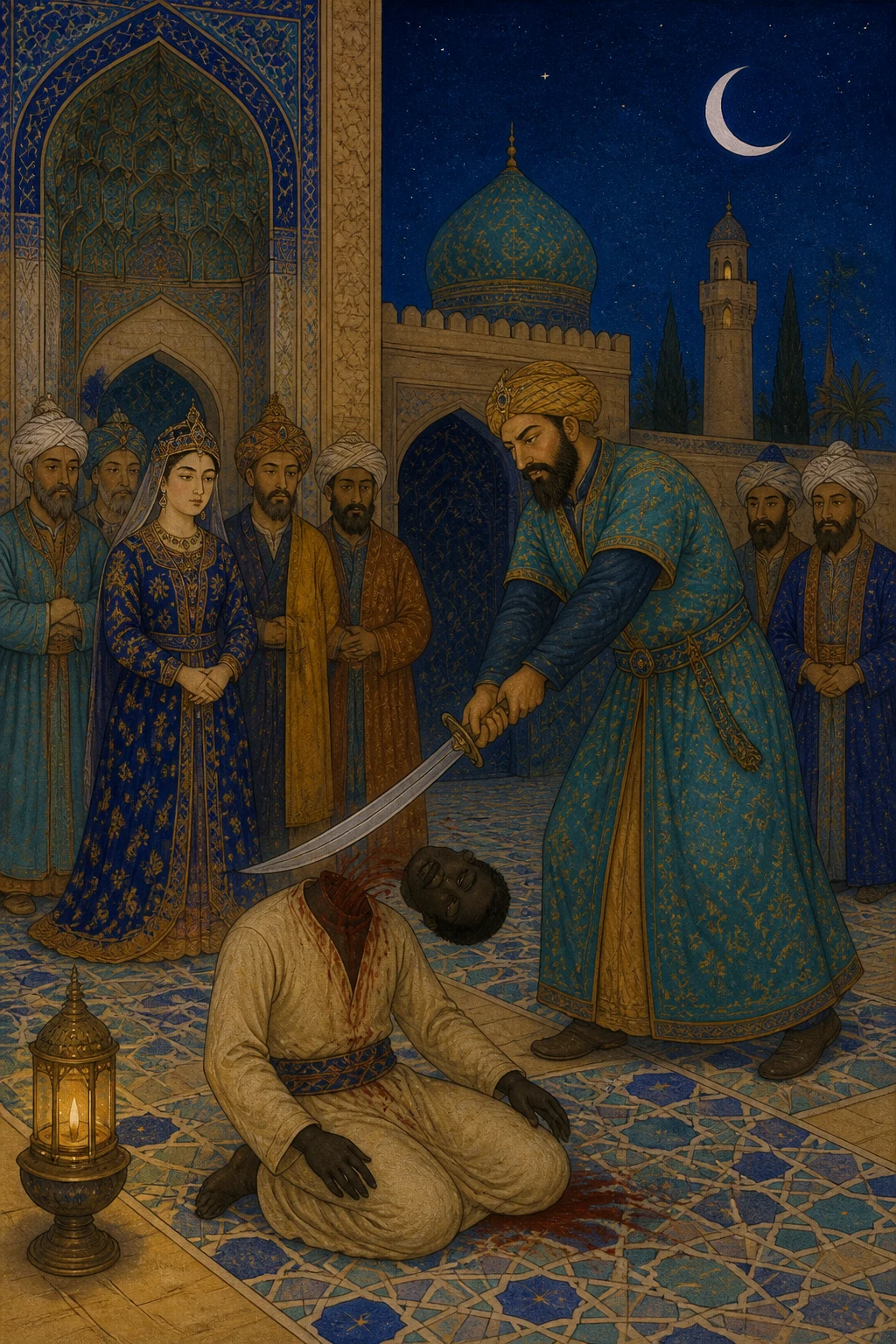
When my brother felt strong enough to move, he rose in the cellar, opened a small aperture in the wall, and escaped from the place where the dead lay. God Almighty concealed him from sight, and he crept through the darkness and hid in the passage until morning. At daybreak the old woman went out in search of another victim, and my brother followed without her knowing, until he reached his own home. He tended his wounds until he recovered, and kept watch upon the old woman, observing how she brought people, one after another, to that house. Yet he said nothing. When his health had returned and his strength was fully restored, he took a piece of cloth, made it into a purse, filled it with glass, and tied it about his waist. He disguised himself so that no one would recognize him, put on Persian clothes, and concealed a sword beneath them. When he saw the old woman, he addressed her in Persian. “Old woman, have you a balance that will weigh nine hundred dinars?” “I have a young son who is a money changer,” she replied, “and he has every sort of balance. Come with me before he leaves his shop, and he will weigh your gold for you.” “Lead the way,” said my brother. She went on, and he followed until they reached the door. She knocked, and the slave girl came out and smiled in his face. “I have brought you a fat piece of meat,” said the old woman. The girl took my brother by the hand and brought him into the same room he had entered before. She sat with him a while, then rose and said, “Do not move until I return.” She went away, and scarcely had my brother settled himself when the slave appeared with his drawn sword. “Get up, you wretch!” he said. My brother rose, and the slave walked ahead of him. Following behind, my brother reached for the sword beneath his clothes and struck off the slave’s head. He dragged him by the foot to the cellar, then called, “Where is the pretty one?” The slave girl came carrying the tray of salt. When she saw my brother with the sword in his hand, she turned and fled, but he pursued her and struck off her head. Then he called, “Where is the old woman?” She came, and he said to her, “Do you recognize me, you accursed old woman?” “No, my lord,” she replied. “I am the owner of the dinars,” he said, “the man whose house you entered to perform your ablutions and pray. Then you tricked me and brought me here.” “Fear God in your treatment of me,” she said. But he turned upon her and struck her with the sword, cutting her in two.
Then he went in search of the young woman. When she saw him, she nearly lost her wits with fright and begged him to spare her. He promised her safety, then asked, “How did you fall into the hands of this black man?” She replied, “I was a slave girl belonging to a merchant, and this old woman used to visit me. One day she said, ‘There is a celebration at our house such as no one has ever seen, and I should like you to come and see it.’ ‘Gladly,’ I replied. I rose, put on my finest clothes, took a purse containing a hundred dinars, and went with her until she brought me into this house. No sooner had I entered than this black man seized me. I have remained here in this plight for three years, through the trickery of that old witch.” My brother asked her, “Has he anything of value in the house?” “A great deal,” she replied. “If you can carry it away, do so.” My brother rose and went with her, and she opened chests full of purses. He stood astonished. “Go now,” she said, “and leave me here. Bring men to carry the money away.” He went out, hired ten men, and returned. But when he reached the door, he found it open, and neither the young woman nor the purses were to be seen. He found only a little money and some rich fabrics, and knew that she had deceived him. He took what money remained, opened the storerooms, and carried off all the fabrics they contained, leaving nothing in the house. He passed that night in great contentment. In the morning, however, he found twenty soldiers at his door. When he went out to them, they seized him, saying, “The governor wants you.” They took him to the governor, who asked as soon as he saw him, “Where did you get these fabrics?” My brother said, “Grant me safe conduct.” The governor gave him the handkerchief of safe conduct, and my brother told him everything that had happened with the old woman, from beginning to end, and how the young woman had fled. Then he said, “Take whatever you wish of what I brought away, but leave me enough to live on.” The governor demanded all the money and fabrics, but, fearing that the sultan might learn of the affair, he took a portion and gave my brother the rest. “Leave this city,” he told him, “or I shall hang you.” “I hear and obey,” my brother replied. He set out for another country, but robbers fell upon him, stripped him, beat him, and cut off his ears. When I heard what had happened, I went to him, taking clothes for him, and brought him back to the city, happy to have found him. Then I made provision for his food and drink.