Prevod
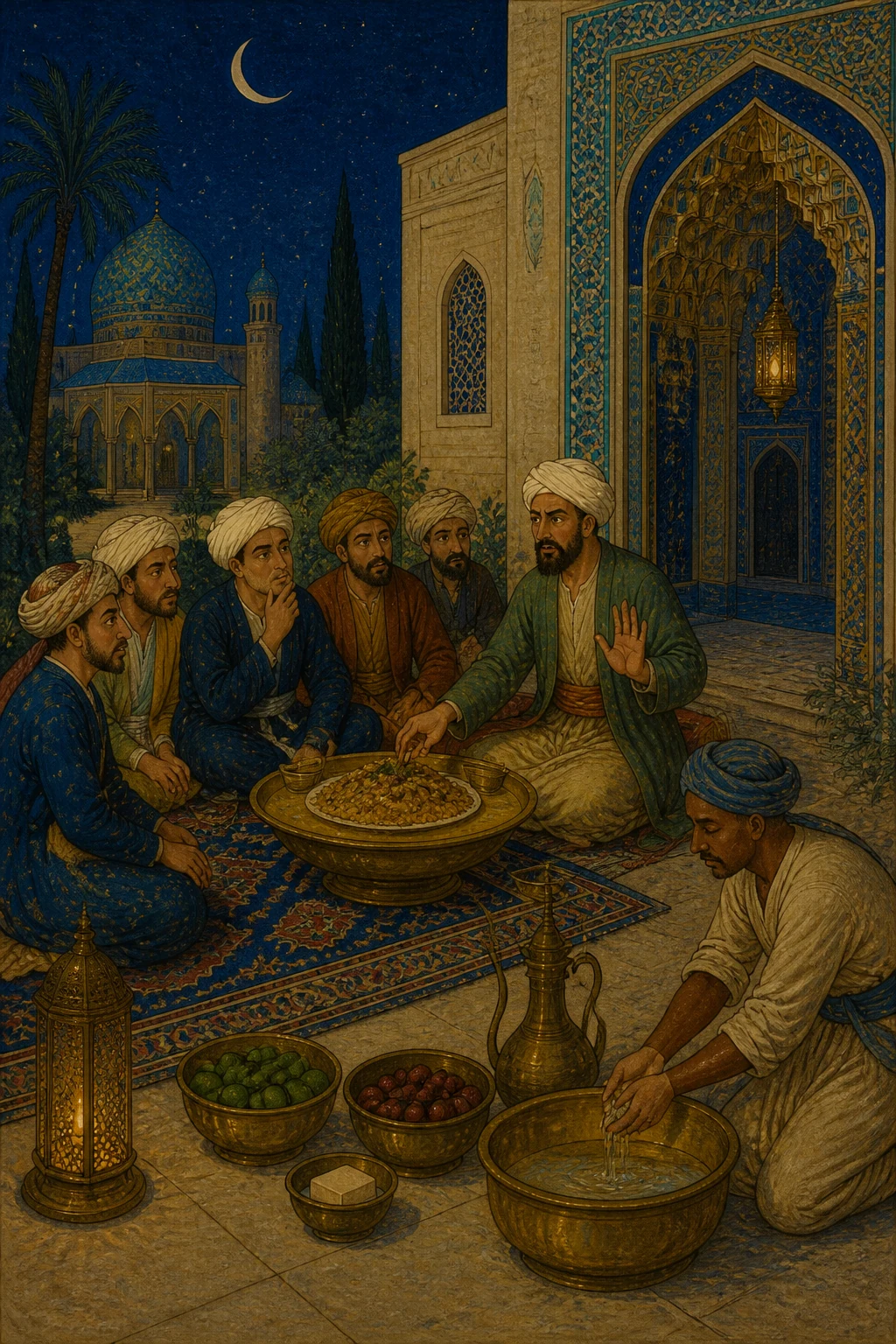
As for my sixth brother, Commander of the Faithful, whose lips were cut off, he was so poor that he possessed nothing of this fleeting world’s goods. One day he went out in search of something to keep body and soul together. As he walked along a street, he saw a fine house with a lofty, spacious entrance passage. Servants stood at the door, and orders were being given and obeyed. He asked one of the bystanders who lived there, and the man replied, “A descendant of kings.” My brother approached the doorkeepers and asked them for alms. “Go inside,” they told him. “You will find what you desire from the master of the house.” He entered the passage and walked along it for some time until he came to a house of the utmost elegance and beauty. In its midst was a garden more lovely than any eye had ever seen; the floors were paved with marble, and curtains hung all around. My brother did not know which way to turn, but at last he went toward the upper end of the hall, where he saw a handsome man with a fine beard. On seeing my brother, the man rose, welcomed him, and asked how he fared. My brother told him that he was in need. At this, the man showed the deepest distress, seized his own clothes, and tore them, crying, “Can I be living in a city where you are starving? I cannot bear it!” He promised him every kindness, then said, “You must share my bread and salt.” “My lord,” my brother replied, “I cannot wait, for I am terribly hungry.” The man called out, “Boy, bring the basin and ewer!” Then he said, “Come forward, my guest, and wash your hands.” He made as though he himself were washing his hands, then called to his servants to lay the table. They began bustling back and forth as though preparing a meal. He took my brother and seated him beside him at this imaginary table, then began making gestures and moving his lips as though eating. “Eat, and do not be shy,” he told my brother. “You are hungry, and I know how keenly you suffer.” My brother, too, began pretending to eat, while his host said, “Eat! Look how white this bread is!” My brother gave no sign of what he was thinking.
Then my brother said to himself, “This is a man who enjoys making fools of people.” Aloud he said, “My lord, never in my life have I seen bread so white or tasted any so delicious.” “It was baked by a slave girl of mine,” the man replied, “whom I bought for five hundred dinars.” Then the master of the house called out, “Boy, bring us the sikbaj, a stew finer than any served at a king’s table!” Turning to my brother, he said, “Eat, my guest, for you are hungry—very hungry—and need food.” My brother began working his jaws and chewing as though he were eating. The man went on ordering dish after dish, and whenever a supposed dish was brought, he urged my brother to eat. Then he cried, “Boy, bring us the young chickens stuffed with pistachios! Eat something the like of which you have never tasted.” “My lord,” said my brother, “this food has no equal for deliciousness.” The man began reaching toward my brother’s mouth as though feeding him with his own hand. He kept listing these dishes and describing them to my hungry brother, whose hunger grew so fierce that he longed for even a loaf of barley bread. Then the master of the house asked, “Have you ever tasted finer seasonings than those in these dishes?” “No, my lord,” my brother replied. “Eat your fill, and do not be shy.” “I have had enough,” said my brother. The man called to his servants to bring the sweets. They moved their hands through the air as though setting them down, and the master of the house said to my brother, “Try this kind; it is excellent. And by my life, eat some of these qatayif! Take this one before the syrup runs out of it.” “May I never be deprived of you, my lord,” my brother replied. He began asking about the abundance of musk in the qatayif, and the man said, “That is the custom in my house. They always put a mithqal of musk and half a mithqal of ambergris into every pastry.” All this while, my brother kept moving his head and working his mouth from side to side as though relishing the sweets. Then the master called to his servants to bring the nuts and dried fruit, and they moved their hands through the air as though bringing them. “Eat some of these almonds,” he told my brother, “and these walnuts and raisins.” He went on naming all the different kinds and urging him, “Eat, and do not be shy.” “My lord,” my brother replied, “I have had enough. I cannot eat another thing.” “My guest,” said the man, “if you wish to dine and enjoy the marvels of fine food, then for heaven’s sake, do not come hungry!”
My brother reflected on his plight and on the way the man was mocking him. “By God,” he said to himself, “I will play him a trick that will make him repent before God of such behavior.” Then the man told his servants, “Bring us the wine.” They moved their hands through the air as though bringing it, and the master of the house made as though handing my brother a cup. “Take this cup,” he said. “You will find it to your liking.” “My lord, you are most generous,” my brother replied, and raised his hand as though drinking. “Did you like it?” the man asked. “My lord, I have never tasted a more delicious wine.” “Then drink in pleasure and good health!”
The master of the house made as though drinking, then handed my brother a second cup. My brother pretended to drink it and began acting drunk. Then, catching his host unawares, he raised his arm so high that the white of his armpit showed and struck him on the back of the neck with a slap that rang through the hall. He followed it with a second slap. “What is this, you lowest of creatures?” the man cried. “My lord,” my brother replied, “I am your servant, whom you have favored, welcomed into your house, fed, and given old wine to drink. He became drunk and behaved boisterously toward you, but your station is too exalted for you to punish his ignorance.” When the master of the house heard this, he burst out laughing. Then he said, “For a long time I have been making sport of people and mocking every jester and merry fellow, but never have I found anyone who could endure this prank of mine, or anyone clever enough to enter into all my fancies, except you. Now I forgive you. Be my companion in earnest, and never leave me.”
Then he ordered several of the dishes he had named earlier to be brought, and he and my brother ate their fill. Afterward they moved to the drinking chamber, where slave girls as lovely as moons sang every kind of melody and played all manner of instruments. The two men drank until drunkenness overcame them. The man grew as fond of my brother as though he were his own brother, loved him dearly, and bestowed a splendid robe of honor on him. When morning came, they resumed their eating and drinking, and continued in this way for twenty years. Then the man died, and the sultan seized all his wealth and took possession of it. My brother fled the city, but halfway through his journey a band of Bedouins fell upon him and took him captive. His captor began torturing him, saying, “For God’s sake, ransom your life with money, or I will kill you!” My brother wept and said, “By God, sheikh of the Arabs, I own nothing and know of no way to obtain any money. I am your captive, in your power, so do with me as you please.” The cruel Bedouin drew from his belt a broad knife that could have severed a camel’s neck from vein to vein. Taking it in his right hand, he approached my poor brother, cut off his lips, and pressed his demands still more fiercely. Now the Bedouin had a beautiful wife, and whenever he went out she would make advances to my brother and try to seduce him, but he resisted out of reverence for Almighty God. One day, however, when she sought to tempt him, he rose, dallied with her, and seated her on his lap. While they were thus occupied, her husband suddenly came in. Seeing my brother, he cried, “Woe to you, you scoundrel! Do you now mean to corrupt my wife as well?” He drew a knife and cut off my brother’s member, then loaded him on a camel, cast him onto a mountainside, and went his way, leaving him there. Some travelers passed by and recognized him. They gave him food and drink and brought me word of his plight, so I went to him, carried him back to the city, and made provision for his needs. And now, Commander of the Faithful, I have come before you. I feared it would be wrong to return home without telling you my story, for I have six brothers dependent on me, and I support them all.
When the Commander of the Faithful heard my story and all I had told him about my brothers, he laughed and said, “You have spoken truly, Silent One. You are indeed a man of few words, with no taste for meddling. But now leave this city and settle elsewhere.” Then he banished me from Baghdad. I traveled from land to land, roaming through the provinces, until I heard of his death and the accession of another caliph. I returned to the city and found that he was indeed dead. Then I fell in with this young man and did him the greatest service. Had it not been for me, he would have been killed. Yet he has accused me of faults I do not possess. All he has said about my meddlesomeness, my chatter, my dullness, and my lack of tact is false, good people.
Then the tailor said to the King of China: When we had heard the barber’s story and were convinced of his meddlesomeness and his endless chatter, and saw how unjustly he had treated the young man, we seized the barber and locked him up. Then we sat down, safe from him, and ate and drank, and the feast ended most pleasantly. We remained seated until the call to afternoon prayer, when I left and went home to my wife. She said, “You have spent the whole day enjoying yourself while I have sat here miserable. Unless you take me out to enjoy what is left of the day, it will be the cause of our separation.” So I took her out, and we amused ourselves until nightfall. On our way home we met this hunchback, very drunk, singing these two verses:
The glass was fine, the wine so clear, that each resembled each, and all grew one: as though there were wine but no cup, or a cup and no wine. I invited him home, and he accepted. Then I went out to buy fried fish, bought some, and returned. We sat down to eat, and my wife took a mouthful of food and a piece of fish, thrust them into his mouth, and held it shut, whereupon he died. I carried him away and contrived to leave him in this physician’s house. The physician contrived to leave him in the steward’s house, and the steward contrived to leave him in the broker’s path. That is the story of what befell me last night. Is it not more marvelous than the hunchback’s story? When the King of China heard this tale, he ordered some of his chamberlains to go with the tailor and bring the barber. “He must be brought here,” he told them, “so that I may hear what he has to say. This shall be the means of saving you all. Then we will bury this hunchback and lay him in the earth, for he has been dead since yesterday, and we will build him a tomb, since it was through him that we came to hear these wondrous tales.” Within an hour the chamberlains and the tailor returned. They had gone to the prison, brought out the barber, and led him before the king. The king studied him and saw an old man past ninety, dark-faced, with a white beard and eyebrows, drooping ears, a long nose, and a conceited air. The king laughed at the sight of him and said, “Silent One, I want you to tell me one of your tales.” The barber replied, “King of the Age, what is the matter with this Christian, this Jew, this Muslim, and this hunchback lying dead among you? Why is everyone gathered here?” “Why do you ask?” said the King of China. “I ask about them so that the king may know that I am no meddler, that I concern myself only with what is my business, and that I am innocent of their charge of excessive talk. I have some claim to my name, for they call me the Silent One. As the poet says:
Seldom will your eyes behold a man with a surname without finding, if you look, its meaning in him. Then the king said, “Tell the barber what happened to this hunchback at supper, and relate to him the stories told by the Christian, the Jew, the steward, and the tailor.” They told him all their tales, which there is no need to repeat. The barber shook his head and said, “By God, this is a wondrous thing! Uncover this hunchback for me.” They uncovered him, and the barber sat beside his head, took it into his lap, and looked into his face. Then he laughed so loudly that he fell over backward with laughter, and said, “Every death has its cause, but this hunchback’s death is a marvel of marvels. It ought to be recorded in the chronicles, so that those who come after may take heed of what happened before.” The king was astonished at his words and said, “Silent One, tell us why you speak so.” “O King,” he replied, “by your bounty, there is still life in this hunchback!” Then the barber took from his belt a small vial containing oil, rubbed the hunchback’s neck with it, and covered it until it sweated. Next he took out a pair of iron pincers and lowered them into his throat, where they caught the piece of fish with its bone. He drew it out, and everyone saw it with their own eyes. Then the hunchback sprang to his feet, sneezed, and came to his senses. He passed his hands over his face and said, “There is no god but God, and Muhammad is the Messenger of God, may God bless him and grant him peace!” All those present were astonished at what they had witnessed. The King of China laughed until he fainted, and those around him did the same. “By God,” the sultan declared, “this is an extraordinary story! I have never seen anything stranger.” Then he said, “Muslims, soldiers, have you ever in your lives seen anyone die and then return to life? Had God not sent him this barber, he would today be among the people of the next world, for it was the barber who brought him back to life.” “By God,” they replied, “this is a marvel of marvels!”
Then the King of China ordered that this story be written down, and when it was recorded, they placed it in the royal treasury. He bestowed splendid robes of honor on the Jew, the Christian, and the steward. He appointed the tailor as his own tailor, granted him a regular allowance, and reconciled him with the hunchback. He gave the hunchback a fine, splendid robe of honor, assigned him an allowance, and made him his companion. He also lavished favors on the barber, bestowed a splendid robe of honor on him, granted him allowances and a salary, and appointed him barber to the kingdom and his own companion. They continued to live in the sweetest ease and happiness until there came to them the Destroyer of Delights and the Divider of Companies. Yet this is no more marvelous than the story of the two viziers, in which Anis al-Jalis is mentioned. “And what is the story of the two viziers?” asked the king.