Prevod
She said: It has reached me, O fortunate King, that the king said to the vizier, “What is the story of the spider and the wind?” The vizier replied, “Know, O King, that a spider once clung to the top of a doorway in a secluded place, spun herself a web, and dwelt there in safety. She gave thanks to God Most High, who had provided her with this refuge and relieved her fear of creeping creatures. For a time she remained thus, thanking God for her ease and her unfailing sustenance. Then her Creator put her to the test, driving her out to see how grateful and patient she would be. He sent a fierce east wind against her, which carried her away, web and all, and cast her into the sea. The waves washed her ashore, and she thanked God Most High for her deliverance. Then she began to reproach the wind, saying, ‘O Wind, why have you done this to me? What good has it brought you to carry me from my home to this place? I was safe and at peace in my web at the top of that doorway.’ The wind replied, ‘Cease your reproaches. I shall take you back and restore you to your former place.’ So the spider waited patiently, hoping to return to her home, until the north wind departed without carrying her back. Then the south wind arose, passed by her, snatched her up, and flew with her towards that house. As she passed it, she recognized it and clung to it. And we beseech God, who rewarded the king for his loneliness and patience, granting him this boy in his old age after he had lost hope, and who did not take him from this world before blessing him with a son to gladden his eyes; who bestowed upon him kingship and dominion, so that he showed mercy to his subjects and showered his bounty upon them.” The king said, “Praise be to God above all praise, and thanks be to Him above all thanks! There is no god but He, the Creator of all things, who has made Himself known to us through the light of His works and the majesty of His greatness. He grants kingship and dominion to whom He wills among His servants in His lands, choosing whom He pleases to be His deputy and steward over His creatures. He commands him to treat them with justice and equity, to uphold the laws and established ordinances, to act truthfully, and to conduct their affairs uprightly, in a manner pleasing to Him and to them. Whoever among them acts according to God’s commands secures his own good fortune and obeys his Lord; God will spare him the terrors of this world and reward him well in the next, for He does not let the reward of the righteous go to waste. But whoever acts contrary to God’s commands commits a grievous error, disobeys his Lord, and prefers this world to the next. He shall have neither honourable deeds to his name in this world nor any share in the hereafter, for God does not long indulge the unjust and corrupt, nor does He overlook any of His servants. These viziers of ours have said that, because of our just rule and good dealings with them, He has favoured us and them by guiding us to give Him thanks, thereby earning still greater blessings. Each has spoken as God inspired him, and all have been unstinting in their gratitude and praise to God Most High for His bounty and grace. I too thank God, for I am but a servant under His command. My heart is in His hand, and my tongue obeys it. I am content with whatever God decrees for me and for them, whatever the outcome may be. Each has spoken the thoughts that came to him concerning this boy, and recalled the new blessing bestowed upon us when I had reached an age at which despair prevails and confidence grows weak. Praise be to God, who has saved us from being left without an heir and from rulers succeeding one another as night succeeds day. This has been a mighty blessing to them and to us. We praise God Most High, who has granted us this attentive and obedient boy and made him heir to an exalted station in the sovereignty. We ask Him, in His generosity and forbearance, to bless the boy’s every undertaking and guide him to good deeds, so that he may become a king and sovereign who rules his subjects with justice and equity, protecting them from the ruin wrought by oppression, through God’s favour, generosity, and bounty.”
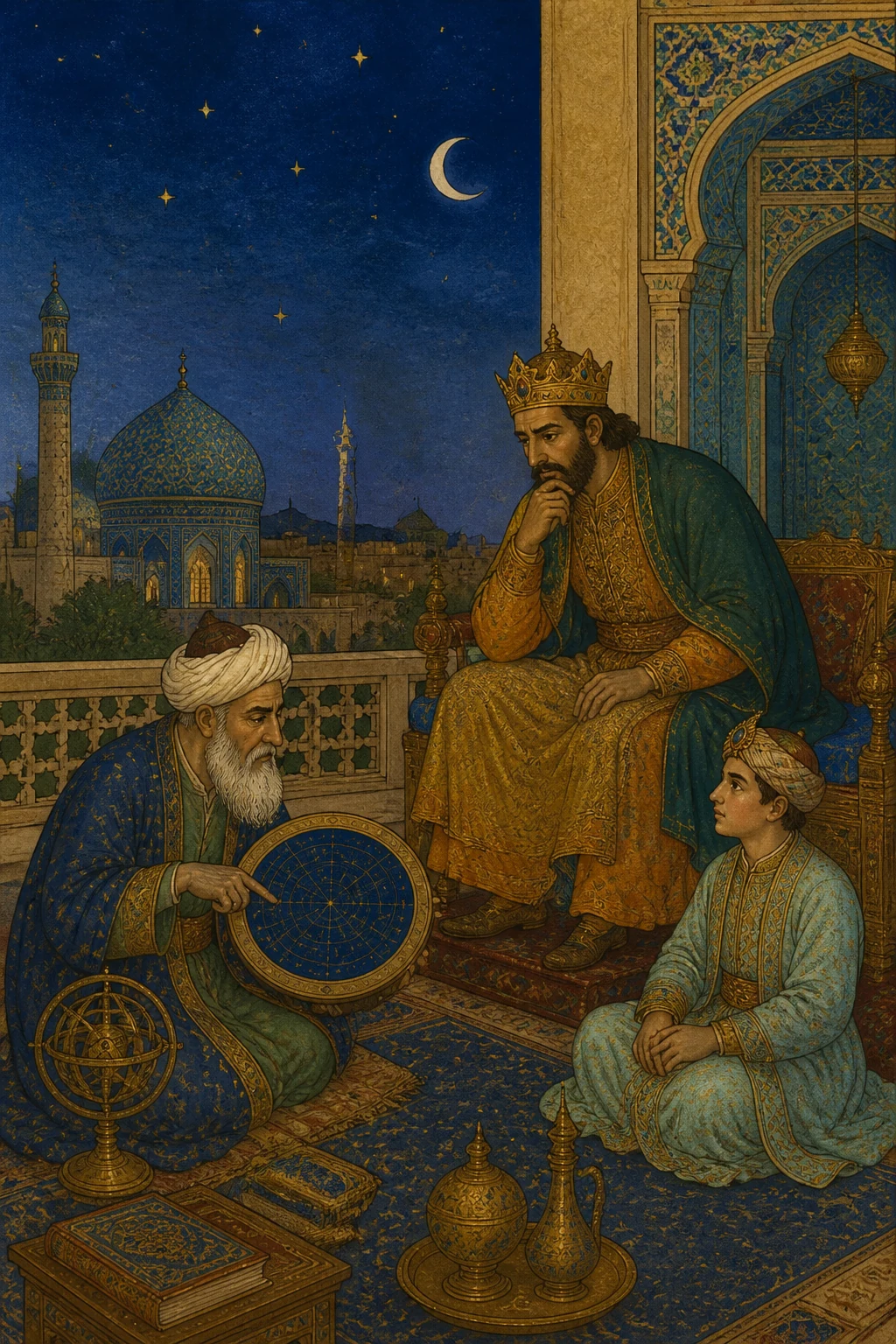
When the king had finished speaking, the sages and scholars rose and prostrated themselves before God. They thanked the king and kissed his hands, then each returned to his own house. The king then entered his private apartments, looked upon the boy, prayed for him, and named him Wardkhan. When the boy was twelve years old, the king wished to have him instructed in the sciences. He built him a palace in the middle of the city, containing three hundred and sixty chambers, and lodged him there. He appointed three sages and scholars to attend him, commanding them never to neglect his instruction, by night or by day, and to sit with him in a different chamber each day. They were to take care that there was no branch of knowledge they did not teach him, until he became versed in every science. On the door of each chamber they were to write the subjects they taught him there, and every seven days they were to submit to the king an account of what he had learned.
The scholars devoted themselves to the boy, never wearying of teaching him, night or day, and withholding nothing of the knowledge they possessed. He displayed such keenness of mind, excellence of understanding, and readiness to learn as no one before him had shown. Each week they reported to the king how much his son had learned and mastered, and from these reports the king discerned sound learning and fine cultivation. The scholars said, “Never have we seen anyone endowed with understanding like this boy’s. May God bless him for you and grant you joy in his life!” When the boy had completed twelve years of study, he had mastered the finest part of every science and surpassed all the scholars and sages of his age. His teachers brought him before his father the king and said, “May God gladden your eyes, O King, with this fortunate son! We have brought him to you after teaching him every science, until no scholar or sage of our time has attained what he has attained.” The king rejoiced exceedingly, redoubled his thanks to God Most High, and fell prostrate before Him, mighty and glorious, saying, “Praise be to God for His blessings beyond number!” Then he summoned the vizier Shimas and said to him, “Know, Shimas, that the scholars have come to me and told me that this son of mine has learned every science. There is no branch of knowledge they have not taught him, until he has surpassed all who came before him. What do you say, Shimas?” At this, Shimas prostrated himself before God, mighty and glorious, kissed the king’s hands, and said, “A ruby, though hidden in the heart of solid rock, cannot but shine like a lamp. This son of yours is a jewel, and his youth does not prevent him from being wise. Praise be to God for what He has bestowed upon him! Tomorrow, if God Most High wills, I shall question him and draw out his knowledge before an assembly of distinguished scholars and emirs whom I shall gather for him.” But morning overtook Shahrazad, and she fell silent, leaving her tale untold.
When it was the nine hundred and ninth night
She said: It has reached me, O fortunate King, that when King Jali‘ad heard Shimas’s words, he commanded the foremost scholars, the most discerning men of learning, and the most accomplished sages to attend the royal palace the following day. They all came, and when they had assembled at the palace gates, the king gave them leave to enter. Then the vizier Shimas appeared and kissed the hands of the king’s son. The prince rose and prostrated himself before Shimas, who said to him, “A lion’s cub should not bow before any of the beasts, nor should light be joined with darkness.” The boy replied, “When the lion’s cub saw the king’s vizier, he bowed before him.” Then Shimas said, “Tell me, who is the Absolute and Everlasting, what are His two realms of existence, and what endures in those two realms?” The boy replied, “The Absolute and Everlasting is God, mighty and glorious, for He is the First without beginning and the Last without end. His two realms of existence are this world and the hereafter, and what endures in them is the bliss of the hereafter.” Shimas said, “You have spoken truly, and I accept your answer. But I would have you tell me how you know that one of these realms is this world and the other is the hereafter.” The boy replied, “Because this world was created when nothing existed, and thus became the first realm of existence. Yet it is a fleeting state, soon to pass away, in which deeds require recompense. This calls for the restoration of what has perished, and so the hereafter is the second realm of existence.” Shimas said, “You have spoken truly, and I accept your answer. But I would have you tell me how you know that the bliss of the hereafter is what endures in these two realms.” The boy replied, “I know this because it is the abode of recompense for deeds, prepared by Him who abides and never passes away.” Shimas said, “Tell me, whose deeds are most praiseworthy among the people of this world?” The boy replied, “Those of the man who prefers the hereafter to this world.” Shimas asked, “And who is it that prefers the hereafter to this world?” The boy replied, “He who knows that he dwells in an abode that must come to an end, that he was created only to perish, and that after death he will be called to account. Even if there were a man destined to live for ever in this world, he should not prefer it to the hereafter.” Shimas said, “Tell me, can there be a hereafter without this world?” The boy replied, “He who has no life in this world has no hereafter. Yet I see this world, its people, and the final abode to which they are bound as resembling the people of certain estates, for whom an emir built a cramped house and into which he brought them. He ordered them to perform a task, appointed a term for each, and set a keeper over him. Whoever did as he was commanded was led out of that narrow place by his keeper, but whoever failed to do as he was commanded before his appointed term was up was punished. While they were there, honey began to seep through the cracks in the house. When they ate it and tasted its sweetness, they grew slack in the work they had been ordered to do and cast it behind their backs. They endured the confinement and distress in which they lived, despite knowing the punishment to which they were bound, content with that little sweetness. Yet their keeper never failed to take each of them out of the house when his appointed time arrived. Thus we know that this world is an abode where men’s eyes are bewildered and the allotted span of their lives slips away. Whoever finds the little sweetness this world affords and occupies himself with it will be among the lost, because he has preferred the affairs of this world to those of the hereafter. But whoever prefers the hereafter to this world and pays no heed to that little sweetness will be among those who attain salvation.”
Shimas said, “I have heard what you have said concerning this world and the hereafter, and I accept it. Yet I see that both hold sway over man, so that he must satisfy them both, though their demands are at odds. If a man devotes himself to earning his livelihood, he harms his soul in the life to come; but if he devotes himself to the hereafter, he harms his body. There is no way for him to satisfy two opposing demands at once.”