Prevod
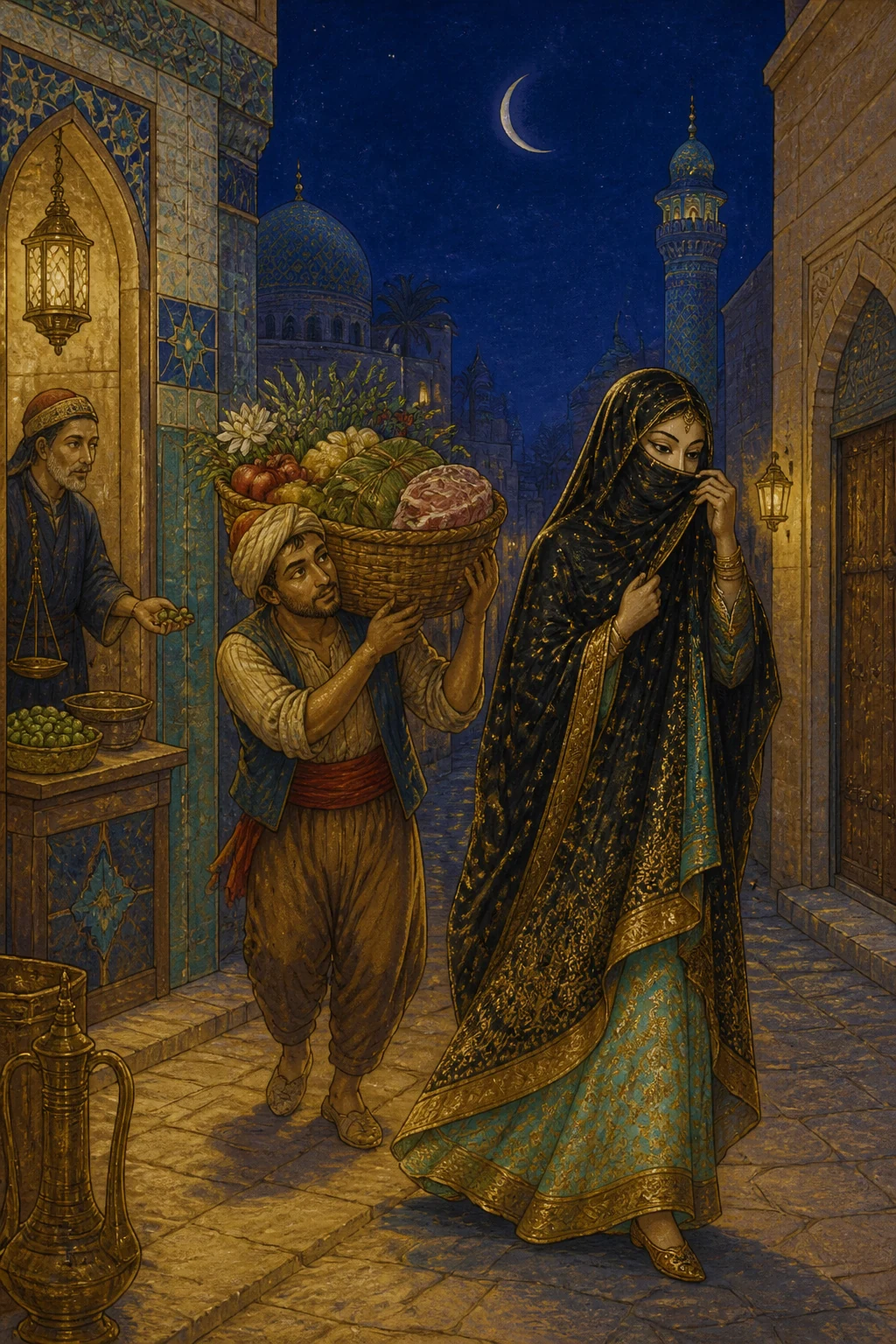
It is told that one night the Caliph Harun al-Rashid grew deeply restless. He summoned his vizier, Ja‘far al-Barmaki, and said, “My heart is heavy, and tonight I wish to stroll through the streets of Baghdad and see how my subjects fare, on condition that we dress as merchants so that no one recognizes us.” The vizier replied, “I hear and obey.” They rose at once, took off their splendid robes, and put on merchants’ clothes. There were three of them: the caliph, Ja‘far, and Masrur the swordsman. They wandered from place to place until they reached the Tigris, where they saw an old man sitting in a boat. They approached and greeted him, saying, “Good old man, we would be grateful if you would take us for a pleasure trip in your boat. Here is a dinar for your hire.” But morning overtook Shahrazad, and she fell silent, leaving her permitted tale untold.
When it was the Two Hundred and Eighty-sixth Night
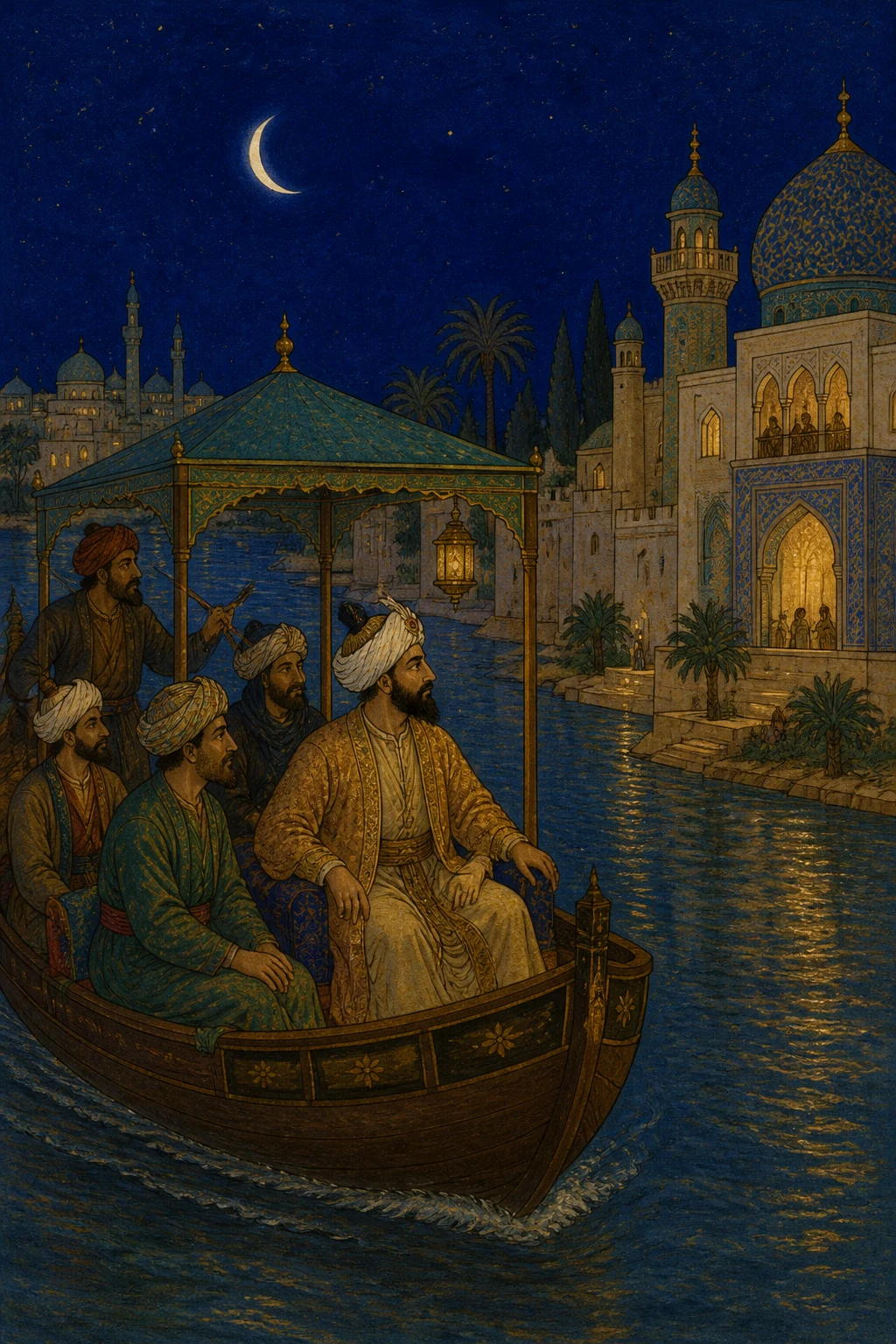
She said: It has reached me, O fortunate king, that when they said to the old man, “We would like you to take us out in your boat; here is a dinar,” he replied, “Who can venture out for pleasure when the Caliph Harun al-Rashid goes down the Tigris every night in a little boat, with a crier who proclaims, ‘People of every rank, great and small, noble and common, boys and youths! Whoever takes a boat out upon the Tigris shall have his head struck off or be hanged from his own mast!’ Why, his boat may be coming this very moment.” The caliph and Ja‘far said, “Good old man, take these two dinars and shelter us in one of those covered recesses until the caliph’s boat has passed.” “Give me the gold,” said the old man, “and let us put our trust in Almighty God.” He took the money and rowed them a little way. Suddenly the boat appeared in midstream, ablaze with candles and torches. “Did I not tell you,” said the old man, “that the caliph comes down the river every night?” Then he began to pray, “O Concealer, do not strip away our cover!” He brought them into a covered recess and threw a black cloth over them. Peering out from beneath it, they saw a man in the bow holding a torch of red gold, which he fed with Qaqili aloeswood. He wore a red satin coat, a yellow embroidered sash over one shoulder, and a turban of Mosul muslin. From his other shoulder hung a green silk bag full of Qaqili aloeswood, with which he fed the torch instead of ordinary firewood. In the stern stood another man dressed in the same fashion and holding a similar torch. Two hundred mamluks stood to right and left, and a throne of red gold had been set up, on which sat a handsome youth, lovely as the moon, wearing a black robe embroidered with yellow gold. Before him was a man who looked like the vizier Ja‘far, and beside his head stood an attendant who resembled Masrur, holding a drawn sword. They also saw twenty boon companions. At this sight the caliph said, “Ja‘far!” “At your service, Commander of the Faithful.” “Perhaps this is one of my sons—either al-Ma’mun or al-Amin.” He studied the young man seated on the throne and saw that he was perfect in beauty, stature, and proportion. Then he turned to the vizier and said, “Vizier!” “At your service.” “By God, this fellow has left out none of the trappings of the caliphate! The man before him looks like you, Ja‘far, and the attendant standing beside his head looks like Masrur. Those companions might be my own. I am utterly bewildered.”
Her sister Dunyazad said to her, “How lovely your tale is, how delightful, how sweet and pleasing!” She replied, “What is this compared with what I shall tell you tomorrow night, if I live and the king spares me?” The king said to himself, “By God, I shall not kill her until I have heard the rest of her tale.” But morning overtook Shahrazad, and she fell silent, leaving her permitted tale untold.
When it was the Two Hundred and Eighty-seventh Night
She said: It has reached me, O fortunate king, that the caliph was bewildered by what he saw and said, “By God, Ja‘far, this is astonishing!” “By God, Commander of the Faithful,” Ja‘far replied, “I am astonished too.” The boat sailed on until it was out of sight. Then the old man brought his own boat out and said, “Praise be to God for our safety! No one came upon us.” The caliph asked, “Good old man, does the caliph come down the Tigris every night?” “Yes, my lord. He has been doing so for a whole year.” “Then we would be grateful if you would wait for us here tomorrow night. We will give you five gold dinars. We are strangers here, lodging in al-Khandaq, and we wish to enjoy ourselves.” “With pleasure and all honor,” replied the old man. The caliph, Ja‘far, and Masrur left him and returned to the palace. They took off their merchants’ clothes, put on their robes of state, and each assumed his proper station. The emirs, viziers, chamberlains, and deputies entered, and the court assembled. When the day was over and the various people had dispersed, each going his own way, Harun al-Rashid said, “Ja‘far, come, let us go and look at the second caliph.” Ja‘far and Masrur laughed. They put on their merchants’ clothes and went out by the secret gate, strolling along in high spirits. When they reached the Tigris, they found the old boatman waiting for them and climbed into his boat. They had scarcely settled themselves beside him when the second caliph’s boat came towards them. They turned and looked closely, finding in it two hundred mamluks different from those of the night before, while the torchbearers cried out as usual. The caliph said, “Vizier, had I only heard of this, I would never have believed it. But I have seen it with my own eyes.” Then he said to their boatman, “Take these ten dinars, good old man, and row alongside them. They are in the light and we are in the dark, so we can watch them without being seen.” The old man took the ten dinars and rowed beside them, keeping in the darkness cast by their boat. But morning overtook Shahrazad, and she fell silent, leaving her permitted tale untold.
When it was the Two Hundred and Eighty-eighth Night
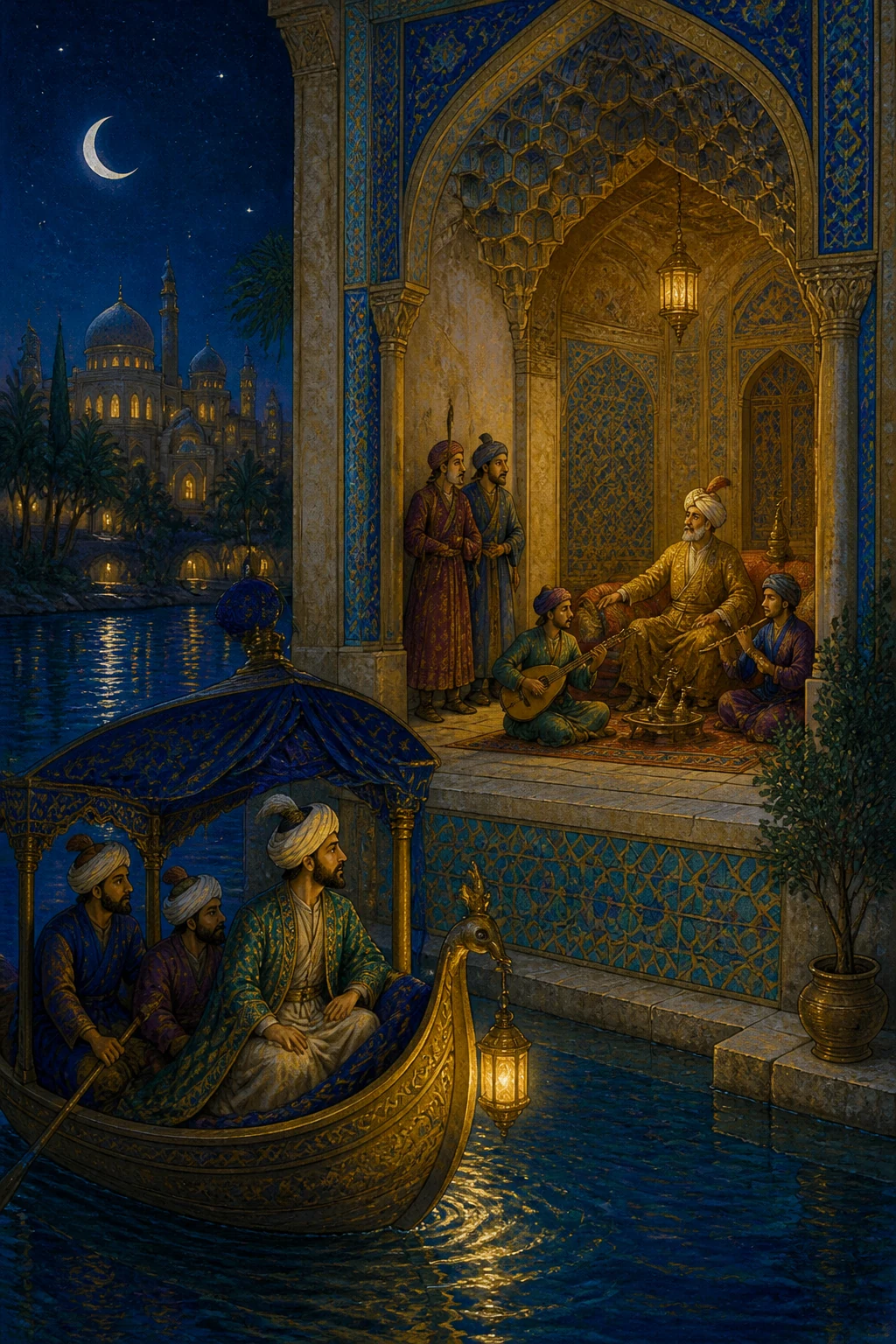
She said: It has reached me, O fortunate king, that the Caliph Harun al-Rashid said to the old man, “Take these ten dinars and row alongside them.” “I hear and obey,” he replied. He took the money and rowed them on, keeping in the shadow of the other boat until they reached the gardens. There they saw a landing place, at which the boat moored, and servants waiting with a saddled and bridled mule. The second caliph stepped ashore, mounted the mule, and rode off among his companions. The torchbearers shouted, and the whole retinue busied itself about him. Harun al-Rashid, Ja‘far, and Masrur landed too, made their way among the mamluks, and walked ahead of them. Some torchbearers happened to turn and saw three strangers dressed as merchants. Suspicious, they signaled to one another, seized them, and brought them before the second caliph. He looked at them and asked, “How did you reach this place? What brings you here at such an hour?” They replied, “Our lord, we are merchants from another country and arrived only today. We went out for a walk tonight, and when you appeared, these men came and seized us and brought us before you. That is our story.” The second caliph said, “You have nothing to fear, since you are strangers. Had you been men of Baghdad, I would have had your heads struck off.” Then he turned to his vizier and said, “Take these men with you; they are our guests tonight.” “I hear and obey, my lord,” he replied. He went on with them until they reached a lofty and magnificent palace, solidly built, such as no sultan had ever possessed. It rose from the earth to cling to the shoulders of the clouds. Its door was of teak inlaid with gleaming gold, and through it one entered a great hall with a fountain basin and a cascade, carpets and cushions of brocade, bolsters and long divans. There hung a curtain, and there were furnishings that dazzled the mind and defied description. On the door were written these two verses:
“Upon this palace be greetings and peace; the days have clothed it in their beauty. Within it wonders and marvels abound in such variety that pens are bewildered by their art.” Then the second caliph entered with the company and seated himself on a jeweled throne of gold, spread with a yellow silk carpet. His companions sat down, and the swordsman of vengeance stood before him. They laid the table and ate; then the dishes were removed, their hands were washed, and the wine service was brought in. Bottles and cups were ranged in order, and the cup passed round until it reached the Caliph Harun al-Rashid, who declined to drink. The second caliph asked Ja‘far, “Why does your friend not drink?” “My lord,” he replied, “he has not drunk wine for some time.” “I have another drink that will suit your friend—an apple drink.” He ordered it brought, and it appeared at once. The second caliph stepped forward to Harun al-Rashid and said, “Whenever your turn comes, drink this.” They continued in merriment, passing the winecups, until the drink went to their heads and mastered their wits. But morning overtook Shahrazad, and she fell silent, leaving her permitted tale untold.
When it was the Two Hundred and Eighty-ninth Night
She said: It has reached me, O fortunate king, that the second caliph and his companions went on drinking until the wine went to their heads and mastered their wits. Harun al-Rashid said to his vizier, “Ja‘far, by God, we have no vessels like these! I wonder who this young man can be.” While they were whispering together, the youth happened to turn and saw the vizier speaking secretly with the caliph. “Whispering makes for quarrels,” he said. “There is no quarrel,” replied the vizier. “My companion was merely saying, ‘I have traveled through most countries, caroused with mighty kings, and kept company with soldiers, but I have never seen arrangements so fine or a night so delightful. Yet the people of Baghdad say that wine without music may bring on a headache.’” At these words the second caliph smiled and brightened. With a wand he held in his hand, he tapped a round cushion. A door opened, and out came a servant carrying an ivory chair plated with gleaming gold. Behind him came a slave girl of surpassing beauty and grace, radiance and perfection. The servant set down the chair, and she sat upon it, like the shining sun in a cloudless sky. In her hand was a lute fashioned by Indian craftsmen. She laid it in her lap and bent over it as a mother bends over her child. After a rapturous prelude, she sang to its accompaniment, passing through twenty-four modes until she bewildered their senses. Then she returned to her first mode, enchanted them with her melodies, and sang these verses:
“Love’s tongue speaks for you within my heart, declaring that I am your lover. My witnesses are the heat of a tormented heart, wounded eyes, and tears that race one another. Before I loved you, I knew nothing of love; but God’s decree precedes all things.” When the second caliph heard these verses from the girl, he gave a mighty cry and tore the robe he wore down to the hem. A curtain was lowered over him, and they brought him another robe, finer than the first. He put it on and sat as before. When the cup came to him, he tapped the cushion with his wand, and a door opened. A servant emerged carrying a golden chair, followed by a girl more beautiful than the first. She sat upon the chair, holding a lute that would have filled an envious heart with grief, and sang these two verses to its accompaniment:
“How can I endure, with longing’s fire in my breast and tears pouring forever in floods from my eyes? By God, life holds no pleasure to delight me: how can a heart brimful of grief rejoice?” When the youth heard these verses, he gave a mighty cry and tore his clothes down to the hem. The curtain fell over him, and they brought him another robe. He put it on, sat upright as before, and resumed his cheerful conversation. When the cup reached him, he tapped the cushion, and a servant appeared with a chair, followed by a girl more beautiful than the one before. She sat upon the chair with a lute in her hands and sang these verses:
“Shorten your absence and lessen your cruelty; by all you hold dear, my heart has not forgotten you. Have pity on a sick and sorrowful lover, enslaved and distraught with love for you. Sickness born of yearning has worn him away, and he prays to God for your favor. O full moons whose dwelling is my heart, how could I choose anyone in the world but you?” When the youth heard these verses, he gave a mighty cry and tore the clothes he wore. They lowered the curtain over him and brought him fresh clothes. Then he returned to his companions as before, and the cups went round. When his cup reached him, he tapped the cushion. The door opened, and a servant came out carrying a chair, with a girl behind him. He set the chair down for her, and she sat upon it, took the lute, tuned it, and sang these verses:
“How long must estrangement and aversion last, before the happiness I once knew returns? Only yesterday our home gathered us together in delight, while our enviers remained unaware. Time betrayed us and scattered our company, leaving our dwellings desolate. Do you ask me, my reproacher, to forget, when my heart refuses to heed reproach? Spare me your blame and leave me to my longing: my heart has never been emptied of the sweetness of those I love. O masters who broke your vows and changed, do not imagine that my captive heart has forgotten.” When the second caliph heard the girl’s song, he gave a mighty cry and tore his clothes. But morning overtook Shahrazad, and she fell silent, leaving her permitted tale untold.
When it was the Two Hundred and Ninetieth Night
She said: It has reached me, O fortunate king, that when the second caliph heard the girl’s verses, he gave a mighty cry, tore the clothes he wore, and fell unconscious. They tried to lower the curtain over him as usual, but its cords caught. Harun al-Rashid happened to glance towards him and saw the marks of scourging on his body. After looking carefully and making certain, al-Rashid said, “Ja‘far, by God, he is a handsome youth, but a vile thief.” “How do you know that, Commander of the Faithful?” Ja‘far asked. “Did you not see the marks of the lash on his sides?” Then they lowered the curtain over him and brought him a fresh robe. He dressed and sat upright among his companions as before. Turning, he caught sight of the caliph and Ja‘far whispering together. “What is the matter, young men?” he asked. “Nothing but good, our lord,” Ja‘far replied. “As you know, my friend is a merchant who has traveled through every country and region and kept company with kings and worthy men. He was saying to me, ‘What our lord the caliph has done tonight is a great extravagance. In all my travels I have never seen anyone do the like. He has torn so many robes, each worth a thousand dinars! This is excessive waste.’” The second caliph replied, “My good fellow, the money is mine and the clothes are mine. This is merely one of the ways I reward my servants and attendants. Every robe I have torn belongs to one of the companions here, and with each robe I have ordered him five hundred dinars.” The vizier Ja‘far said, “You have done nobly, our lord,” and recited these two verses:
“Generosity has built its dwelling in your palm, and you have made your wealth free to all mankind. Whenever noble bounty shuts its doors, your hands become the key to its lock.” When the youth heard these verses from the vizier Ja‘far, he ordered him a thousand dinars and a robe. The cups passed among them, and they delighted in the wine. Then al-Rashid said, “Ja‘far, ask him about the marks on his sides, so that we may hear his answer.” “Do not be hasty, my lord,” he replied. “Be easy; patience is best.” “By my head and by the tomb of al-‘Abbas, if you do not ask him, I shall put an end to your breathing!” At that moment the youth turned to the vizier and said, “Why are you and your companion whispering? Tell me what is between you.” “Nothing but good.” “I beg you by God,” said the youth, “tell me your story and conceal nothing from me.” Ja‘far replied, “My lord, he saw the marks of blows, lashes, and scourges on your sides and was greatly astonished. ‘How can a caliph be beaten?’ he said. He wishes to know the reason.” At this the youth smiled and said, “Know that my tale is strange and my story marvelous. Were it written with needles upon the inner corners of the eyes, it would be a lesson to all who take heed.” Then he heaved deep sighs and recited these verses:
“My tale is wondrous beyond all wonders; by love, every path has narrowed before me. If you wish me to tell it, listen, and let all this company fall silent. Attend to my words, for they carry a meaning; what I say is true and no lie. I am slain by passion and longing, and she who slew me surpasses every full-breasted maid. Her dark-rimmed eyes are like Indian blades, and she shoots arrows from the bows of her brows. My heart has sensed that among you is our imam, the caliph of this age, descended from the noblest. Your second, whom you call Ja‘far, is his vizier, a companion and the son of a companion. Your third is Masrur, the swordsman of vengeance. If these words are true, then all that I have hoped for is attained, and joy comes to my heart from every side.” When they heard this, Ja‘far swore that they were not the men he named, wording his oath so that it bore another meaning. The youth laughed and said, “Know, my lords, that I am not the Commander of the Faithful. I have merely given myself that title to get my way with the people of the city. My name is Muhammad Ali ibn Ali al-Jawhari. My father was a man of standing, and when he died he left me great wealth: gold and silver, pearls and coral, rubies, chrysolites, jewels, estates, bathhouses, fields, gardens, shops, bakeries, male and female slaves, and serving boys. One day I was sitting in my shop, surrounded by my servants and attendants, when a young woman approached on a mule, attended by three slave girls as lovely as moons. When she drew near, she dismounted at my shop, sat beside me, and said, ‘Are you Muhammad the jeweler?’ ‘Yes,’ I replied, ‘I am your servant and slave.’ ‘Have you a necklace of gems suitable for me?’ she asked. I said, ‘My lady, I shall show you what I have and lay it before you. If anything pleases you, your servant will be fortunate; if nothing does, it will be my ill luck.’ I had a hundred necklaces of gems and showed her all of them, but none pleased her. ‘I want something finer than these,’ she said. Now I had a small necklace that my father had bought for a hundred thousand dinars, the like of which was not to be found in the possession of any mighty sultan. I said, ‘My lady, I have one necklace left, of precious stones and gems, whose equal no man, great or small, possesses.’ ‘Show it to me,’ she said. When she saw it, she said, ‘This is what I seek, what I have wished for all my life.’ Then she asked, ‘What is its price?’ ‘It cost my father a hundred thousand dinars,’ I replied. ‘And you shall have five thousand dinars profit.’ ‘My lady,’ I said, ‘the necklace and its owner are at your disposal. I shall not dispute with you.’ ‘You must have your profit,’ she replied, ‘and my gratitude besides.’ She rose at once, quickly mounted her mule, and said, ‘Sir, in God’s name, be so kind as to come with us and receive your money. May this day with us be white as milk for you.’ I rose, locked my shop, and walked with her in peace until we reached her house. It was a house upon which the signs of prosperity shone plainly. Its door was adorned with gold, silver, and lapis lazuli, and upon it were written these two verses:
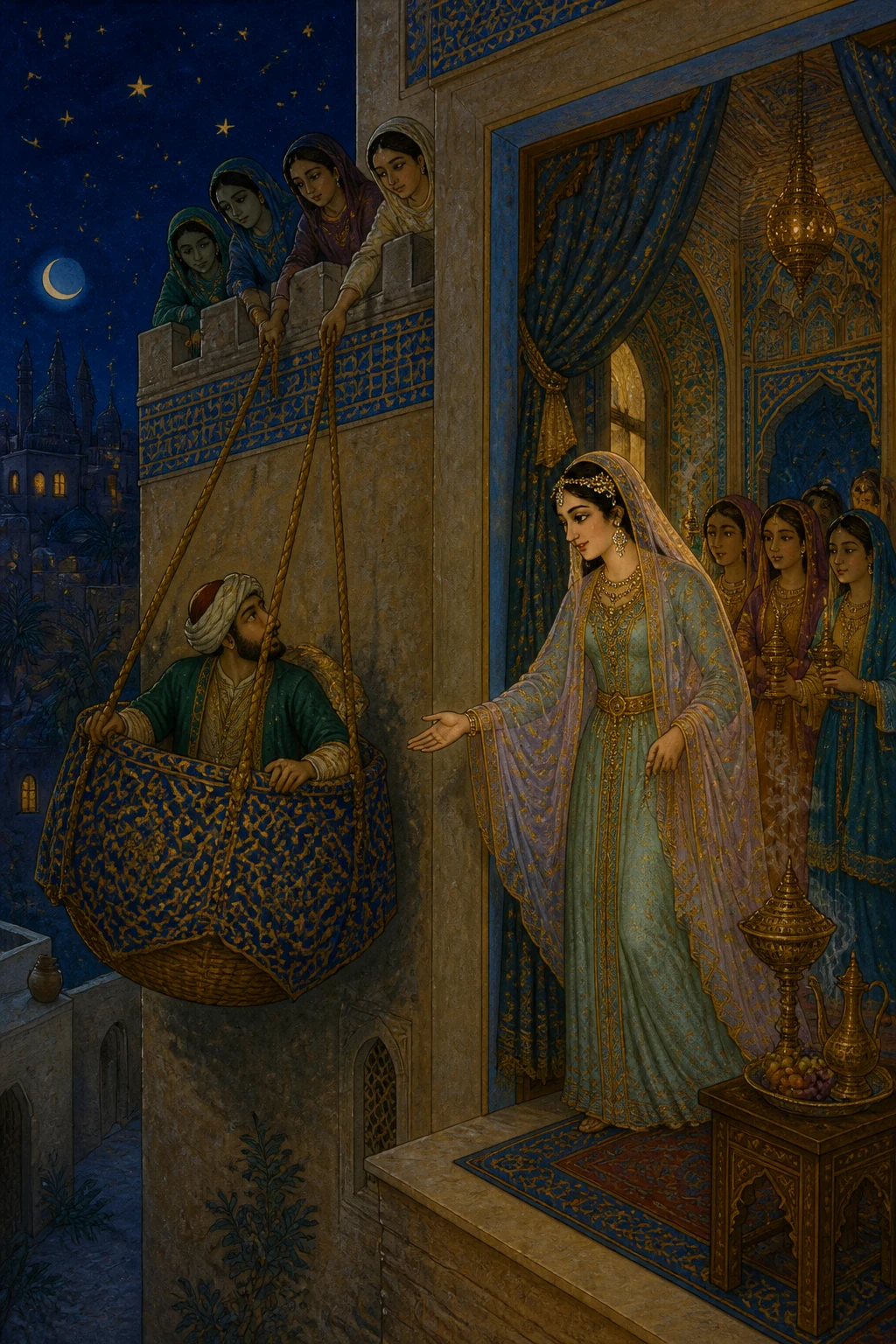
“O house, may sorrow never enter you, nor time betray your master! A fine home you are for every guest who finds no room elsewhere.” The young woman dismounted, entered the house, and told me to sit on the bench by the door until the money changer arrived. I sat there for a while, and then a slave girl came out and said, ‘Sir, come into the entrance passage; it is unseemly for you to sit at the door.’ I rose, went into the passage, and sat on a bench. While I was sitting there, another girl came out and said, ‘Sir, my mistress asks you to come in and sit at the entrance to the great hall until you receive your money.’ I rose, went inside, and sat for a moment. There stood a golden chair behind a silk curtain. The curtain was lifted, revealing the young woman who had bought the necklace, now wearing it about her neck. Her face was unveiled, round and radiant as the moon. At the sight of her surpassing beauty, my wits scattered and my mind was dazed. When she saw me, she rose from her chair and hurried towards me, saying, ‘Light of my eyes, can anyone as handsome as you have no pity for the woman who loves him?’ I replied, ‘My lady, all beauty is in you, and even that is but one of your gifts.’ ‘Jeweler,’ she said, ‘know that I love you, and could scarcely believe I had managed to bring you here.’ Then she leaned towards me; I kissed her and she kissed me, drew me close, and pulled me against her breast.” But morning overtook Shahrazad, and she fell silent, leaving her permitted tale untold.
When it was the Two Hundred and Ninety-first Night
She said: It has reached me, O fortunate king, that the jeweler said, “Then she leaned towards me and kissed me, drew me close, and pulled me against her breast. Seeing that I desired to possess her, she said, ‘Sir, do you wish to lie with me unlawfully? By God, far be it from me to commit such a sin and consent to such disgrace! I am a virgin whom no man has approached, and I am not unknown in this city. Do you know who I am?’ ‘No, by God, my lady,’ I replied. She said, ‘I am Lady Dunya, daughter of Yahya ibn Khalid al-Barmaki, and my brother Ja‘far is the caliph’s vizier.’ At these words I shrank inwardly from her and said, ‘My lady, I am not to blame for making advances. It was you who brought me here and encouraged me to hope for your favors.’ ‘You have nothing to fear,’ she said. ‘You shall certainly attain your desire in a manner pleasing to God. I am free to dispose of myself, and the qadi shall act as my guardian in the marriage contract. My purpose is to be your wife and have you for my husband.’ She sent for the qadi and witnesses and spared no effort. When they arrived, she said, ‘Muhammad Ali ibn Ali al-Jawhari has asked for my hand and given me this necklace as my marriage portion. I have accepted and consented.’ They drew up our marriage contract, and I took her as my wife. The wine service was brought, and the cups passed round in the finest order and with perfect care. When the wine began to sparkle in our heads, she ordered a girl who played the lute to sing. The girl took up her instrument, delighted us with her melodies, and sang these verses:
“He appeared, revealing to me the gazelle, the swaying bough, and the full moon. Shame upon a heart that does not spend the night enamored of him! A beauty whose charms God sought to quench with the down upon his cheeks—only to kindle a fresh enchantment. When my reproachers speak of him, I mislead them, pretending I do not care to hear his name. When they speak of others, I listen with my ears, yet my thoughts dissolve in him. A prophet of beauty, all his charms are miracles, but his face is the greatest sign. The crescent of his beauty mark rests upon his cheek, watching for dawn in the radiance of his brow. In their ignorance, my reproachers would have me forget him; but after faith, I would never consent to unbelief.” The girl delighted us with the music of her strings and the tenderness of her verses. The girls continued singing and reciting poetry, one after another, until ten had sung. Then Lady Dunya took the lute herself, played enchanting melodies, and sang these verses:
“By the suppleness of your swaying form, I suffer in the fire of separation from you. Have mercy on a heart ablaze with love for you, O full moon shining in the deepest darkness! Grant me your embrace, for I forever behold your beauty in the brightness of the cup, among roses of many colors whose loveliness blooms amid the myrtle.” When she had finished her verses, I took the lute from her, played a rare and wonderful melody, and sang these lines:
“Glory to the Lord who gave you every beauty, until I became one of your captives! O you whose glance enslaves mankind, grant us safe conduct from the arrows of your gaze. Two opposites, water and blazing fire, your cheeks have strangely brought together. You are both the hellfire of my heart and its paradise: how bitter you are within it, and how sweet!” When she heard these words from me, she was overjoyed. Then she dismissed the slave girls, and we went to a beautiful chamber where bedding of every color had been laid out for us. She took off her clothes, and we were alone together as lovers. I found her an unpierced pearl, an unridden filly. I rejoiced in her, and never in all my life had I known a sweeter night.” But morning overtook Shahrazad, and she fell silent, leaving her permitted tale untold.
When it was the Two Hundred and Ninety-second Night
She said: It has reached me, O fortunate king, that Muhammad ibn Ali al-Jawhari said, “When I consummated my marriage with Lady Dunya, daughter of Yahya ibn Khalid al-Barmaki, I found her an unpierced pearl, an unridden filly, and recited these two verses:
“I circled my love with my arm like the ring about a dove’s neck, and freely offered my palm for kisses. This is the great triumph! We remained entwined, desiring never to part.” Then I stayed with her for a whole month, abandoning my shop, my family, and my home. One day she said to me, ‘Light of my eyes, my dear Muhammad, today I intend to go to the bathhouse. Stay here on this couch and do not stir from your place until I return.’ She made me swear to it, and I replied, ‘I hear and obey.’ Again she bound me by oath not to leave my place, then took her slave girls and went to the bathhouse. By God, my brothers, she had scarcely reached the end of the lane when the door opened and an old woman entered. ‘My dear Muhammad,’ she said, ‘Lady Zubayda summons you. She has heard of your accomplishments, your wit, and your beautiful singing.’ ‘By God,’ I replied, ‘I shall not rise from this spot until Lady Dunya returns.’ ‘Sir,’ said the old woman, ‘do not anger Lady Zubayda and make her your enemy. Get up, speak with her, and return to your place.’ So I rose at once and went with her, the old woman leading the way until she brought me to Lady Zubayda. When I came before her, she said, ‘Light of my eyes, are you Lady Dunya’s beloved?’ ‘I am your servant and slave,’ I replied. ‘Whoever praised your beauty and grace, your accomplishments and perfection, spoke truly,’ she said. ‘Indeed, you surpass all description. But sing for me, so that I may hear you.’ ‘I hear and obey,’ I replied. She had a lute brought to me, and I sang these verses to its accompaniment:
“The lover’s heart is wearied by those he loves, and sickness plunders his body. Now that their mounts are saddled for departure, none remains among the encampments but a lover whose beloved is in the caravan. I commend to God a moon beneath your tent ropes, whom my heart adores but my eyes cannot see. Now pleased, now angry—how sweet is that beloved’s coquetry! All that the beloved does is beloved.” When I finished singing, she said, ‘May God keep your body sound and sweeten your breath! You are perfect in beauty, refinement, and song. Now rise and return to your place before Lady Dunya comes back, fails to find you, and grows angry.’ I kissed the ground before her and left, following the old woman until we reached the door through which I had come. I entered and went to the couch, where I found that Lady Dunya had returned from the bathhouse and was lying asleep. I sat at her feet and began to massage them. She opened her eyes, saw me, drew back her feet, and kicked me off the couch. ‘Traitor!’ she cried. ‘You betrayed your oath and broke it! You promised not to stir from your place, but you broke your word and went to Lady Zubayda. By God, were I not afraid of scandal, I would bring her palace down upon her head!’ Then she said to her slave, ‘Sawab, get up and strike off this liar’s head! We have no need of him.’ The slave came forward, tore a strip from the hem of his robe, bound it over my eyes, and prepared to cut off my head.” But morning overtook Shahrazad, and she fell silent, leaving her permitted tale untold.
When it was the Two Hundred and Ninety-third Night
She said: It has reached me, O fortunate king, that Muhammad the jeweler said, “The slave came forward, tore a strip from the hem of his robe, bound it over my eyes, and prepared to cut off my head. But the slave girls, young and old, went to her and pleaded, ‘Our lady, he is not the first to make a mistake. He does not know your temper, and he has committed no offense deserving death.’ ‘By God,’ she replied, ‘I must leave my mark upon him!’ Then she ordered me beaten, and they beat me across the ribs. What you saw are the marks of those blows. Afterwards she ordered me thrown out. They carried me away from the palace and cast me aside. I struggled to my feet and walked little by little until I reached my house. I sent for a surgeon and showed him my wounds; he treated me gently and took pains to heal me. When I had recovered, visited the bathhouse, and was free of pain and sickness, I went to my shop, took everything in it, and sold it. With the proceeds I bought four hundred mamluks, such as no king had ever assembled. Two hundred of them ride with me each day. I had this boat built at a cost of five thousand gold dinars and called myself the caliph. I assigned each of my servants the office of one of the caliph’s attendants and dressed him accordingly. Then I proclaimed, ‘Whoever goes out upon the Tigris for pleasure shall have his head struck off without delay!’ I have lived this way for a whole year, yet I have heard no news of her and found no trace.” Then he wept, shedding abundant tears, and recited these verses:
“By God, through all this time I have never forgotten her, nor drawn near to anyone who does not draw near to her. In her form she is like the full moon: glory to her Creator, glory to her Maker! She has left me sorrowful, sleepless, and sick, my heart bewildered by her charms.” When Harun al-Rashid heard his words and understood his longing, anguish, and passion, he was overcome with sympathy and astonishment. “Glory to God,” he said, “who appoints a cause for everything!” Then they asked the youth’s leave to depart, and he granted it. Al-Rashid resolved in his heart to do him justice and bestow the greatest favors upon him. They left him and made their way back to the seat of the caliphate. Once they were settled, they changed their clothes and put on their ceremonial robes, while Masrur, the swordsman of vengeance, stood before them. Then the caliph said to Ja‘far, “Vizier, bring me the young man.” But morning overtook Shahrazad, and she fell silent, leaving her permitted tale untold.
When it was the Two Hundred and Ninety-fourth Night
She said: It has reached me, O fortunate king, that the caliph said to the vizier, “Bring me the young man with whom we spent last night.” “I hear and obey,” he replied. He went to the youth, greeted him, and said, “Answer the summons of the Commander of the Faithful, the Caliph Harun al-Rashid.” The young man accompanied him to the palace, greatly distressed at being placed under guard. When he entered the caliph’s presence, he kissed the ground before him and prayed that his glory and good fortune might endure, his hopes be fulfilled, his blessings continue, and misery and adversity be banished from him. He spoke most eloquently, saying, “Peace be upon you, Commander of the Faithful and defender of the faith’s domain.” Then he recited these two verses:
May your gate ever be a Kaaba to which pilgrims turn, its dust leaving traces upon their brows, until the cry goes up throughout the land: “This is the Station, and you are Abraham!” The caliph smiled at him, returned his greeting, and regarded him with honor. He drew him close, seated him before him, and said, “Muhammad Ali, I want you to tell me what happened tonight, for it is a marvel among the strangest wonders.” The young man replied, “Your pardon, Commander of the Faithful. Give me the handkerchief of safe conduct, so that my terror may subside and my heart be at peace.” The caliph said, “You have my assurance of safety from fear and sorrow.” Then the young man began to tell him all that had happened, from beginning to end. The caliph understood that the youth was a lover parted from his beloved, and said to him, “Would you like me to restore her to you?” He replied, “That would be a gift of the Commander of the Faithful’s bounty.” Then he recited these two verses:
Kiss his fingertips, for they are not mere fingers, but the keys to every livelihood; give thanks for his favors, for they are not mere favors, but necklaces to adorn the neck. At this the caliph turned to the vizier and said, “Ja‘far, bring me your sister, Lady Dunya, daughter of the vizier Yahya ibn Khalid.” “I hear and obey, Commander of the Faithful,” he replied, and brought her at once. When she stood before him, the caliph asked her, “Do you know who this is?” She answered, “Commander of the Faithful, how should women have any acquaintance with men?” The caliph smiled and said, “Dunya, this is your beloved, Muhammad Ali ibn al-Jawhari. We have learned what happened and heard the tale from beginning to end. We understand both its outward appearance and its hidden meaning: a thing does not remain unknown merely because it is concealed.” She replied, “Commander of the Faithful, it was all inscribed in the Book of Destiny. I beg Almighty God to forgive what I have done, and ask you, in your bounty, to pardon me.” The caliph Harun al-Rashid laughed, summoned the judge and the witnesses, and renewed her marriage contract with her husband, Muhammad Ali ibn al-Jawhari. The two enjoyed the greatest good fortune, to the mortification of the envious, and the caliph made him one of his boon companions. They lived on in joy, delight, and happiness, until there came to them the Destroyer of Pleasures and the Sunderer of Companions.