Waltey
Zgodba o dveh mladičih nosatega medveda in dveh človeških mladičih
Cuentos de la selva
Cuentos de la selva · Horacio QuirogaO besedilu
Zgodba o dveh mladičih nosatega medveda in dveh človeških mladičih
- Vir
- Cuentos de la selva
- Avtor
- Horacio Quiroga
- Jezik branja
- English
- Jezik izvirnika
- Español
- Čas branja
- 13 min branja
- Obseg
- 10 strani
- Naslov izvirnika
- 006 Historia de dos cachorros de coatí y de dos cachorros de hombre
O izvirniku
Cuentos de la selva
Osem avtorskih živalskih zgodb iz leta 1918, tesno povezanih z gozdnim svetom Misiones. Bralni jezik je English, izvirnik pa prihaja iz vira Cuentos de la selva v jeziku Español.
Besedilo
Zgodba o dveh mladičih nosatega medveda in dveh človeških mladičih
Once upon a time there was a mother coati who had three sons. They lived in the forest, eating fruit, roots, and little birds’ eggs. Whenever they were up in the trees and heard a loud noise, they would dive headfirst to the ground and run off with their tails held high.
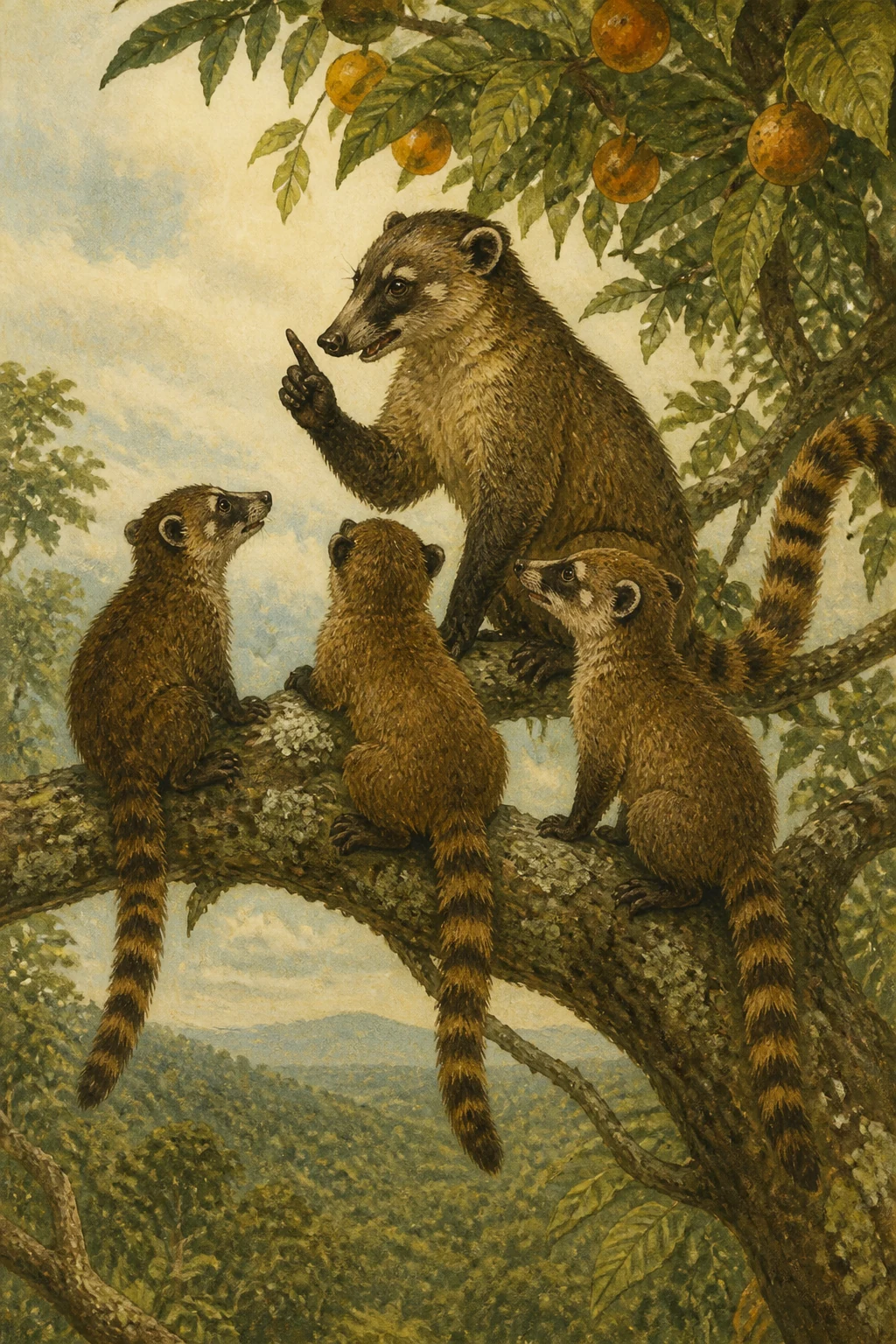
When the little coatis were somewhat bigger, their mother gathered them one day at the top of an orange tree and spoke to them like this: “Little coatis, you are big enough now to find your own food. You must learn how, because when you are old you will always go about alone, as all coatis do.
“The eldest of you, who loves hunting beetles, can find them among the rotten branches, because there are plenty of beetles and cockroaches there. The second, who is a great fruit-eater, can find fruit in this orange grove; there will be oranges until December. The third, who wants to eat nothing but birds’ eggs, can go anywhere, because there are birds’ nests everywhere. But he must never go looking for nests in the open fields, because it is dangerous.
“Little coatis, there is just one thing you must be very afraid of: dogs. I fought them once, and I know what I am telling you; that is why I have a broken tooth. Behind the dogs always come men with a great noise that kills. When you hear that noise nearby, dive headfirst to the ground, however tall the tree may be. If you do not, they are sure to shoot you dead.”
So spoke their mother. Then they all climbed down and went their separate ways, walking from right to left and from left to right, as though they had lost something, because that is how coatis walk.
The eldest, who wanted to eat beetles, searched among the rotten branches and the leaves of the weeds, and found so many that he ate until he fell asleep. The second, who preferred fruit to anything else, ate all the oranges he wanted, because the orange grove was in the forest, as they often are in Paraguay and Misiones, and not a soul came to bother him. The third, who was mad about birds’ eggs, had to wander all day to find just two nests: a toucan’s, with three eggs, and a dove’s, with only two. Five little eggs altogether, which was very little food; so by nightfall the little coati was as hungry as he had been that morning, and he sat down sadly at the edge of the forest. From there he could see the open fields, and he thought of his mother’s warning.
“Why doesn’t Mother want me to look for nests in the fields?” he asked himself. He was thinking about this when, far away, he heard a bird calling. “What a loud call!” he said in wonder. “What big eggs that bird must have!”
The call came again, and the coati began running through the forest, taking a shortcut, because the sound had come from far off to his right. The sun was already setting, but the coati flew along with his tail held high. At last he reached the edge of the forest and looked out across the fields. In the distance he saw a house where people lived, and a man in boots leading a horse by a rope. He also saw a very large bird calling, and then the little coati slapped his forehead and said:
“What a fool I am! Now I know what that bird is. It’s a rooster: Mother showed me one once, from up in a tree. Roosters have a lovely call, and they have lots of hens that lay eggs. If only I could eat hens’ eggs!…”
As everyone knows, there is nothing the little creatures of the forest like better than hens’ eggs. For a while the little coati remembered his mother’s warning. But his longing got the better of him, and he sat down at the edge of the forest, waiting until it was quite dark before going to the henhouse.
At last night fell, and then, on tiptoe, step by step, he made his way toward the house. When he reached it, he listened carefully: not the slightest sound could be heard. The little coati, wild with joy because he was going to eat a hundred, a thousand, two thousand hens’ eggs, went into the henhouse, and the very first thing he saw, right by the entrance, was a hen’s egg, a splendid egg lying all by itself on the ground. For a moment he thought of leaving it until last, for dessert, because it was such a large egg; but his mouth watered, and he sank his teeth into it.
The instant he bit it, SNAP! A terrible blow struck his face, and an immense pain shot through his snout. “Mother! Mother!” he cried, frantic with pain, leaping in every direction. But he was caught fast, and just then he heard a dog’s hoarse bark.
While the coati had been waiting at the edge of the forest for it to grow quite dark so he could go to the henhouse, the man who lived in the house had been playing on the grass with his children, two fair-haired little ones of five and six, who ran about laughing, fell down, got up laughing again, and fell down once more. Their father fell down too, to the children’s great delight. At last they stopped playing because it was dark, and the man said:
“I’m going to set the trap to catch the opossum that comes to kill the chicks and steal the eggs.” And he went and set the trap. Then they ate and went to bed. But the children were not sleepy, and they jumped from one bed to the other, getting tangled in their nightshirts. Their father, who was reading in the dining room, let them carry on. But suddenly the children stopped jumping and shouted:
“Papa! The opossum’s been caught in the trap! Tuké is barking! We want to come too, Papa!” Their father agreed, but only after the children had put on their sandals, for he never let them go barefoot at night for fear of snakes.
Off they went. What did they see there? They saw their father bending down, holding the dog back with one hand while, with the other, he lifted a coati by the tail—a little coati, still very young, who was letting out rapid, piercing shrieks like a cricket.
“Papa, don’t kill him!” the children said. “He’s so little! Give him to us!” “All right, I’ll give him to you,” their father answered. “But take good care of him, and above all, don’t forget that coatis drink water, just as you do.”
He said this because the children had once had a little wildcat, and they were forever bringing it meat from the food safe; but they never gave it any water, and it died.
So they put the coati in the wildcat’s old cage, which stood near the henhouse, and everyone went back to bed. And when it was past midnight and all was very quiet, the little coati, who was suffering terribly from the teeth of the trap, saw three shadows approaching very stealthily in the moonlight. The poor little coati’s heart leaped when he recognized his mother and his two brothers, who had been looking for him.
“Mother, Mother!” the prisoner murmured very softly, so as not to make a noise. “I’m here! Get me out of here! I don’t want to stay, Mo…ther!…” And he wept inconsolably.
But in spite of everything they were happy to have found one another, and they nuzzled one another over and over. They immediately set about freeing the prisoner. First they tried to cut through the wire mesh, and all four went to work with their teeth; but they got nowhere. Then an idea suddenly came to the mother, and she said:
“Let’s go and find the man’s tools! Men have tools for cutting iron. They’re called files. They have three sides, like rattlesnakes. You push them forward and pull them back. Let’s go and find one!”
They went to the man’s workshop and returned with the file. Thinking that one alone would not be strong enough, all three took hold of the file and began to work. They grew so eager that before long the whole cage was shaking with their efforts and making a terrible noise. Such a noise, indeed, that the dog woke up with a hoarse bark. But the coatis did not wait for the dog to demand an explanation for all that racket: they dashed off into the forest, leaving the file lying on the ground.
Early the next morning the children went to see their new guest, who was very sad. “What shall we call him?” the little girl asked her brother.
“I know!” the little boy answered. “We’ll call him Seventeen!” Why Seventeen? No forest creature ever had a stranger name. But the little boy was learning to count, and perhaps that number had caught his fancy.
At any rate, “Seventeen” was his name. They gave him bread, grapes, chocolate, meat, grasshoppers, eggs—delicious hens’ eggs. In a single day they persuaded him to let them scratch his head; and so true is the affection of children that, by nightfall, the coati was almost reconciled to his captivity. He kept thinking about all the lovely things there were to eat there, and about those fair-haired little human cubs, who were so merry and kind.
For two nights in a row the dog slept so close to the cage that the prisoner’s family did not dare come near, much to their sorrow. And when, on the third night, they came to fetch the file again and set the little coati free, he said to them:
“Mother, I don’t want to leave here anymore. They give me lots of eggs, and they’re very good to me. Today they told me that if I behaved well they would let me out very soon. They’re just like us. They’re cubs too, and we play together.”
The wild coatis were very sad, but they accepted his decision, promising the little coati that they would come to visit him every night. And indeed, every night, rain or shine, his mother and brothers came to spend a little time with him. The little coati passed bread to them through the wire mesh, and the wild coatis sat down in front of the cage to eat.
After a fortnight the little coati was roaming free, and at night he went back to his cage of his own accord. Apart from having his ears pulled now and then for going too near the henhouse, everything was going very well. He and the children loved one another dearly, and even the wild coatis, seeing how kind those little human cubs were, had grown fond of the two children.
Until one very dark night, when it was hot and thundering, the wild coatis called to the little coati and received no answer. They came closer, very uneasy, and then, just as they were about to step on it, they saw an enormous snake coiled at the entrance to the cage. The coatis understood at once that the little coati had been bitten as he went in, and had not answered their call because he might already be dead. But they would make the snake pay dearly. In a moment, the three of them had bewildered the rattlesnake by leaping this way and that, and in another moment they fell upon it and bit its head to pieces.
Then they rushed inside, and there indeed lay the little coati, swollen, his legs trembling, dying. In vain the wild coatis shook him; in vain they licked him all over for a quarter of an hour. At last the little coati opened his mouth and stopped breathing, for he was dead.
Coatis are almost immune, as they say, to snake venom. The poison scarcely affects them, and there are other animals, such as the mongoose, that withstand snake venom very well. The little coati must certainly have been bitten in an artery or a vein, because then the blood is poisoned at once, and the animal dies. That was what had happened to the little coati.
When they saw him like this, his mother and brothers wept for a long time. Then, since there was nothing more for them to do there, they left the cage, turned to look one last time at the house where the little coati had been so happy, and went back into the forest.
Yet the three coatis were deeply troubled as they went, and this was what troubled them: what would the children say when, the next day, they found their beloved little coati dead? The children loved him very much, and they, the coatis, loved the fair-haired cubs too. So all three coatis had the same thought: to spare the children that great sorrow.
They talked for a long time, and at last they decided on this: the second coati, who was very much like the youngest in both appearance and temperament, would stay in the cage in place of the dead one. Since they knew many of the household’s secrets from the little coati’s stories, the children would never know; they might find a few things a little strange, but nothing more.
And that was just what happened. They returned to the house, and a new little coati took the first one’s place, while the mother and the other brother carried away the youngest’s body, holding it in their teeth. Slowly they carried him into the forest, his head hanging and swaying, his tail trailing along the ground.
The next day the children did indeed find some of the little coati’s habits strange. But since he was just as kind and affectionate as the other, they never suspected a thing. They became the same family of little cubs as before, and, as before, the wild coatis came night after night to visit the tame little coati, sitting beside him to eat the bits of hard-boiled egg he saved for them, while they told him about life in the forest.
Izvirnik
006 Historia de dos cachorros de coatí y de dos cachorros de hombre
Naslednje strani prikazujejo izvirno besedilo za primerjavo.
H abía una vez una coatí que tenía tres hijos. Vivían en el monte comiendo frutas, raíces y huevos de pajaritos. Cuando estaban arriba de los árboles y sentían un gran ruido, se tiraban al suelo de cabeza y salían corriendo con la cola levantada.
Una vez que los coaticitos fueron un poco grandes, su madre los reunió un día arriba de un naranjo y les habló así:
—Coaticitos: ustedes son bastante grandes para buscarse la comida solos. Deben aprenderlo, porque cuando sean viejos an darán siempre solos, como todos los coatís.
El mayor de ustedes, que es muy amigo de cazar cascarudos, puede encontrarlos entre los palos podridos, porque allí hay muchos cascarudos y cucarachas. El segundo, que es gran comedor de frutas, puede encontrarlas en este naranjal; hasta diciembre habrá naranjas. El tercero, que no quiere comer sino huevos de pájaros, puede ir a todas partes, porque en todas partes hay nidos de pájaros. Pero que no vaya nunca a buscar nidos al campo, porque es peligroso.
Coaticitos: hay una sola cosa a la cual deben tener un gran miedo. Son los perros. Yo peleé una vez con ellos, y sé lo que les digo; por eso tengo un diente roto. Detrás de los perros vienen siempre los hombres con un gran ruido, que mata. Cuando oigan cerca este ruido, tírense de cabeza al suelo, por alto que sea el árbol. Si no lo hacen así, los matarán con seguridad de un tiro.
Así habló la madre. Todos se bajaron entonces y se separaron, caminando de derecha a izquierda y de izquierda a derecha, como si hubieran perdido algo, porque así caminan los coatís.
El mayor, que quería comer cascarudos, buscó entre los palos podridos y las hojas de los yuyos, y encontró tantos, que comió hasta quedarse dormido. El segundo, que prefería las frutas a cualquier cosa, comió cuantas naranjas quiso, porque aquel naranjal estaba dentro del monte, como pasa en el Paraguay y en Misiones, y ningún hombre vivo a incomodarlo. El tercero, que era loco por los huevos de pájaros, tuvo que andar todo el día para encontrar únicamente dos nidos: uno de tucán, que tenía tres huevos y uno de tórtola, que tenía sólo dos. Total, cinco huevos chiquitos, que era muy poca comida; de modo que al caer la tarde el coaticito tenía tanta hambre como de mañana, y se sentó muy triste a la orilla del monte. Desde allí veía el campo, y pensó en la recomendación de su madre.
—¿Por qué no querrá mamá— se dijo —que vaya a buscar nidos en el campo?
Estaba pensando así, cuando oyó, muy lejos, el canto de un pájaro.
—¡Qué canto tan fuerte!— dijo admirado. —¡Qué huevos tan grandes debe de tener ese pájaro!
El canto se repitió, y entonces el coatí se puso a correr por entre el monte, cortando camino, porque el canto había sonado muy a su derecha. El sol caía ya, pero el coatí volaba con la cola levantada. Llegó a la orilla del monte, por fin, y miró al campo. Lejos vió una casa de hombres, y vió a un hombre con botas que llevaba un caballo de la soga. Vió también un pájaro muy grande que cantaba, y entonces el coaticito se golpeó la frente y dijo:
—¡Qué zonzo soy! Ahora ya sé qué pájaro es ése. Es un gallo: mamá me lo mostró un día, de arriba de un árbol. Los gallos tienen un canto lindísimo y tienen muchas gallinas que ponen huevos. ¡Si yo pudiera comer huevos de gallina!...
Es sabido que nada gusta tanto a los bichos chicos del monte como los huevos de gallina. Durante un rato el coaticito se acordó de la recomendación de su madre. Pero el deseo pudo más, y se sentó a la ori lla del monte, esperando que cerrara bien la noche para ir al gallinero.
La noche cerró por fin, y entonces, en puntas de pie y paso a paso, se encaminó a la casa. Llegó allá y escuchó atentamente: no se sentía el menor ruido. El coaticito, loco de alegría porque iba a comer cien, mil, dos mil huevos de gallina, entró en el gallinero, y lo primero que vió bien en la entrada, fué un huevo de gallina, un espléndido huevo que estaba solo en el suelo. Pensó un instante en dejarlo para el final, como postre, porque era un huevo muy grande; pero la boca se le hizo agua, y clavó los dientes en el huevo.
Apenas lo mordió, ¡TRAC!, un terrible golpe en la cara y un inmenso dolor en el hocico.
—¡Mamá, mamá! - gritó, loco de dolor, saltando a todos lados. Pero estaba sujeto, y en ese nomento oyó el ronco ladrido de un perro.
Mientras el coatí esperaba a la orilla del monte que cerrara bien la noche para ir al galinero, el hombre de la casa jugaba sobre la gramilla con sus hijos, dos criaturas rubias de cinco y seis años, que corrían riendo, se caían, se levantaban riendo otra vez, y volvían a caerse. El padre se caía también, con gran alegría de los chicos. Dejaron por fin de jugar porque ya era de noche, y el hombre dijo entonces:
—Voy a poner la trampa para cazar a la comadreja que viene a matar a los pollos y robar los huevos.
Y fué y armó la trampa. Después comieron y se acostaron. Pero las criaturas no tenían sueño, y saltaban de la cama del uno a la del otro y se enredaban en el camisón. El padre, que leía en el comedor, los dejaba hacer. Pero los chicos de repente se detuvieron en sus saltos y gritaron:
—¡Papá! ¡Ha caído la comadreja en la trampa! ¡Tuké está ladrando! ¡Nosotros también queremos ir, papá!
El padre consintió, pero no sin que las criaturas se pusieran las sandalias, pues nunca los dejaba andar descalzos de noche, por temor a las víboras.
Fueron. ¿Qué vieron allí? Vieron a su padre que se agachaba, teniendo al perro con una mano, mientras con la otra levantaba de la cola a un coatí, un coaticito chico aún, que gritaba con un chillido rapidísimo y estridente, como un grillo.
—¡Papá, no lo mates!— dijeron las criaturas. —¡Es muy chiquito! ¡Dánoslo para nosotros!
—¡Bueno, se lo voy a dar— respondió el padre. —Pero cuídenlo bien, y sobre todo no se olviden de que los coatís toman agua como ustedes.
Esto lo decía porque los chicos habían tenido un vez un gatito montés al cual a cada rato le llevaban carne, que sacaban de la fiambrera; pero nunca le dieron agua, y se murió.
En consecuencia, pusieron al coatí en la misma jaula del gato montés, que estaba cerca del gallinero, y se acostaron todos otra vez.
Y cuando era más de media noche y había un gran silencio, el coaticito, que sufría mucho por los dientes de la trampa, vió, a la luz de la luna, tres sombras que se acercaban con gran sigilo. El corazón le dió un vuelco al pobre coaticito al reconocer a su madre y sus dos hermanos que lo estaban buscando.
—¡Mamá, mamá!— murmuró el prisionero en voz muy baja para no hacer ruido.
—¡Estoy aquí! ¡Sáquenme de aquí! ¡No quiero quedarme, má... má!...— Y lloraba desconsolado.
Pero a pesar de todo estaban contentos porque se habían encontrado, y se hacían mil caricias con el hocico.
Se trató en seguida de hacer salir al prisionero. Probaron primero cortar el alambre tejido, y los cuatro se pusieron a trabajar con los dientes; más no conseguían nada. Entonces a la madre se le ocurrió de repente una idea, y dijo:
—¡Vamos a buscar las herramientas del hombre! Los hombres tienen herramientas para cortar fierro. Se llaman limas. Tienen tres lados, como las víboras de cascabel. Se empuja y se retira. ¡Vamos a buscarla!
Fueron al taller del hombre y volvieron con la lima. Creyendo que uno solo no tendría fuerzas bastantes, sujetaron la lima entre los tres y empezaron el trabajo. Y se entusiasmaron tanto, que al rato la jaula entera temblaba con las sacudidas y hacía un terrible ruido. Tal ruido hacía, que el perro se despertó, lanzando un ronco ladrido. Mas los coatís no esperaron a que el perro les pidiera cuenta de ese escándalo, y dispararon al monte, dejando la lima tirada.
Al día siguiente los chicos fueron temprano a ver a su nuevo huésped, que estaba muy triste.
—¿Qué nombre le pondremos?— preguntó la nena a su hermano.
—¡Ya sé!— respondió el varoncito. —¡Le vamos a poner Diecisiete!
¿Por qué Diecisiete? Nunca hubo bicho del monte con nombre más raro. Pero el varoncito está aprendiendo a contar, y tal vez le había llamado la atención aquel número.
El caso es que se llamó "Diez y siete".
Le dieron pan, uvas, chocolate, carne, langostas, huevos, riquísimos huevos de gallina. Lograron que en un sólo día se dejara rascar la cabeza; y tan grande es la sinceridad del cariño de las criaturas, que al llegar la noche, el coatí estaba casi resignado con su cautiverio. Pensaba a cada momento en las cosas ricas que había para comer allí, y pensaba en aquellos rubios cachorritos de hombre, que tan alegres y buenos eran.
Durante dos noches seguidas el perro durmió tan cerca de la jaula, que la familia del prisionero no se atrevió a acercarse, con gran sentimiento. Y cuando a la tercera noche llegaron a buscar de nuevo la lima para dar libertad al coaticito, éste les dijo:
—Mamá: yo no quiero irme más de aquí. Me dan muchos huevos y son muy buenos conmigo. Hoy me dijeron que si me portaba bien me iban a dejar suelto muy pronto. Son como nosotros. Son cachorritos también, y jugamos juntos.
Los coatís salvajes quedaron muy tristes, pero se resignaron, prometiendo al coaticito venir todas las noches a visitarlo.
Efectivamente, todas las noches, lloviera o no, su madre y sus hermanos iban a pasar un rato con él. El coaticito les daba pan por entre el tejido de alambre, y los coatís salvajes se sentaban a comer frente a la jaula.
Al cabo de quince días el coaticito andaba suelto, y él mismo se iba de noche a su jaula. Salvo algunos tirones de orejas que se llevaba por andar muy cerca del gallinero, todo marchaba muy bien. El y las criaturas se querían mucho, y los mismos coatís salvajes, al ver lo buenos que eran aquellos cachorritos de hombre, habían concluído por tomar cariño a las dos criaturas.
Hasta que una noche muy oscura, en que hacía mucho calor y tronaba, los coatís salvajes llamaron al coaticito y nadie les respondió. Se acercaron muy inquietos y vieron entonces, en el momento en que casi la pisaban, una enorme víbora que estaba enroscada a la entrada de la jaula. Los coatís comprendieron en seguida que el coaticito había sido mordido al entrar, y no había respondido a su llamado porque acaso estaba ya muerto. Pero lo iban a vengar bien. En un segundo, entre los tres, enloquecieron a la serpiente de cascabel, saltando de aquí para allá, y en otro segundo cayeron sobre ella, deshaciéndole la cabeza a mordiscones.
Corrieron entonces adentro, y allí estaba en efecto el coaticito, tendido, hinchado, con las patas temblando y muriéndose. En balde los coatís salvajes lo movieron; lo lamieron en balde por todo el cuerpo durante un cuarto de hora. El coaticito abrió por fin la boca y dejo de respirar, porque estaba muerto.
Los coatís son casi refractarios, como se dice, al veneno de las víboras. No les hace casi nada el veneno, y hay otros animales, como la mangusta, que resisten muy bien el veneno de las víboras. Con toda seguridad el coaticito había sido mordido en una arteria o una vena, porque entonces la sangre se envenena en seguida, y el animal muere. Esto le había pasado al coaticito.
Al verlo así, su madre y sus hermanos lloraron un largo rato. Después, como nada más tenían que hacer allí, salieron de la jaula, se dieron vuelta para mirar por última vez la casa donde tan feliz había sido el coaticito, y se fueron otra vez al monte.
Pero los tres coatís, sin embargo, iban muy preocupados, y su preocupación era ésta: ¿qué iban a decir los chicos cuando, al día siguiente, vieran muerto a su querido coaticito? Los chicos lo querían muchísimo, y ellos, los coatís, querían también a los cachorritos rubios. Así es que los tres coatís tenían el mismo pensamiento, y era evitarles ese gran dolor a los chicos.
Hablaron un largo rato, y al fin decidieron lo siguiente: el segundo de los coatís, que se parecía muchísimo al menor, en cuerpo y modo de ser, iba a quedarse en la jaula, en vez del difunto. Como estaban enterados de muchos secretos de la casa, por los cuentos del coaticito, los chicos no conocérían nada; extrañarían un poco algunas cosas, pero nada más.
Y así pasó, en efecto. Volvieron a la casa, y un nuevo coaticito reemplazó al primero, mientras la madre y el otro hermano se llevaban sujetos de los dientes el cadáver del menor. Lo llevaron despacio al monte, y la cabeza colgaba, balanceándose, y la cola iba arrastrando por el suelo.
Al día siguiente los chicos extrañaron, efectivamente algunas costumbres raras del coaticito. Pero como éste era tan bueno y cariñoso como el otro, las criaturas no tuvieron la menor sospecha. Formaron la misma familia de cachorritos de antes, y, como antes, los coatís salvajes venían noche a noche a visitar al coaticito civilizado, y se sentaban a su lado a comer pedacitos de huevos duros que él les guardaba, mientras ellos le contaban la vida de la selva.
Nadaljuj z branjem