Prevod
It is also told that in days of old there lived a man of Baghdad, born to a wealthy family, who inherited a great fortune from his father. He fell in love with a slave girl and bought her, and she loved him as dearly as he loved her. He went on spending money on her until his entire fortune was gone and nothing remained. Then he sought some means of earning a living, but could find none. In his prosperous days, the young man had frequented the gatherings of masters of the art of singing, and had attained the highest skill in it. He consulted one of his friends, who said to him, “I know no better trade for you than to sing, you and your slave girl. You could earn a great deal of money by it, and have food and drink.” But both he and the girl disliked the thought. Then she said to him, “I have thought of a plan for you.” “What is it?” he asked. She replied, “Sell me, and we shall both escape this hardship. I shall live in comfort, for none but a wealthy man would buy someone like me, and in this way I may find the means of returning to you.” So he took her to the market, and the first person to see her was a Hashimite from Basra, a cultivated, gracious man of generous spirit, who bought her for fifteen hundred dinars. The young man who owned the girl said: “When I received the price, I regretted what I had done, and both the girl and I wept. I asked him to undo the sale, but he would not agree. So I put the dinars in a purse, not knowing where to go, for my house would be desolate without her. Never had I wept and wailed and beaten myself as I did then. I went into a mosque and sat there weeping, so bewildered that I lost all awareness of myself. At last I fell asleep, with the purse beneath my head for a pillow. I knew nothing more until someone snatched it from under my head and ran off. I awoke in terror and alarm, and found the purse gone. I sprang up to run after him, only to find that my foot had been tied with a rope. I fell on my face and began weeping and beating myself, saying in my heart, ‘Your very soul has left you, and your money is lost.’” But morning overtook Shahrazad, and she fell silent, leaving off her permitted tale.
Then, when it was the eight hundred and ninety-seventh night,
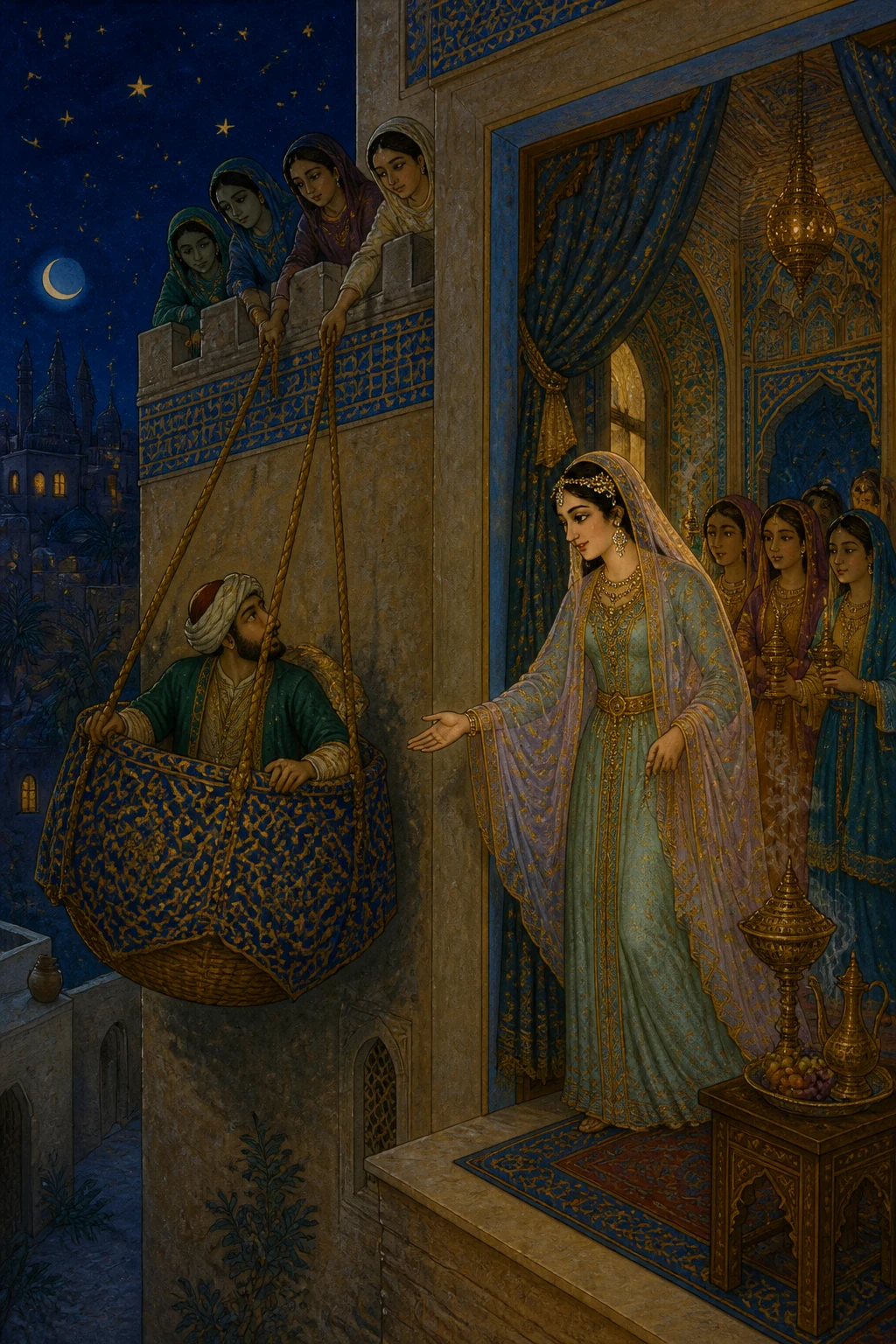
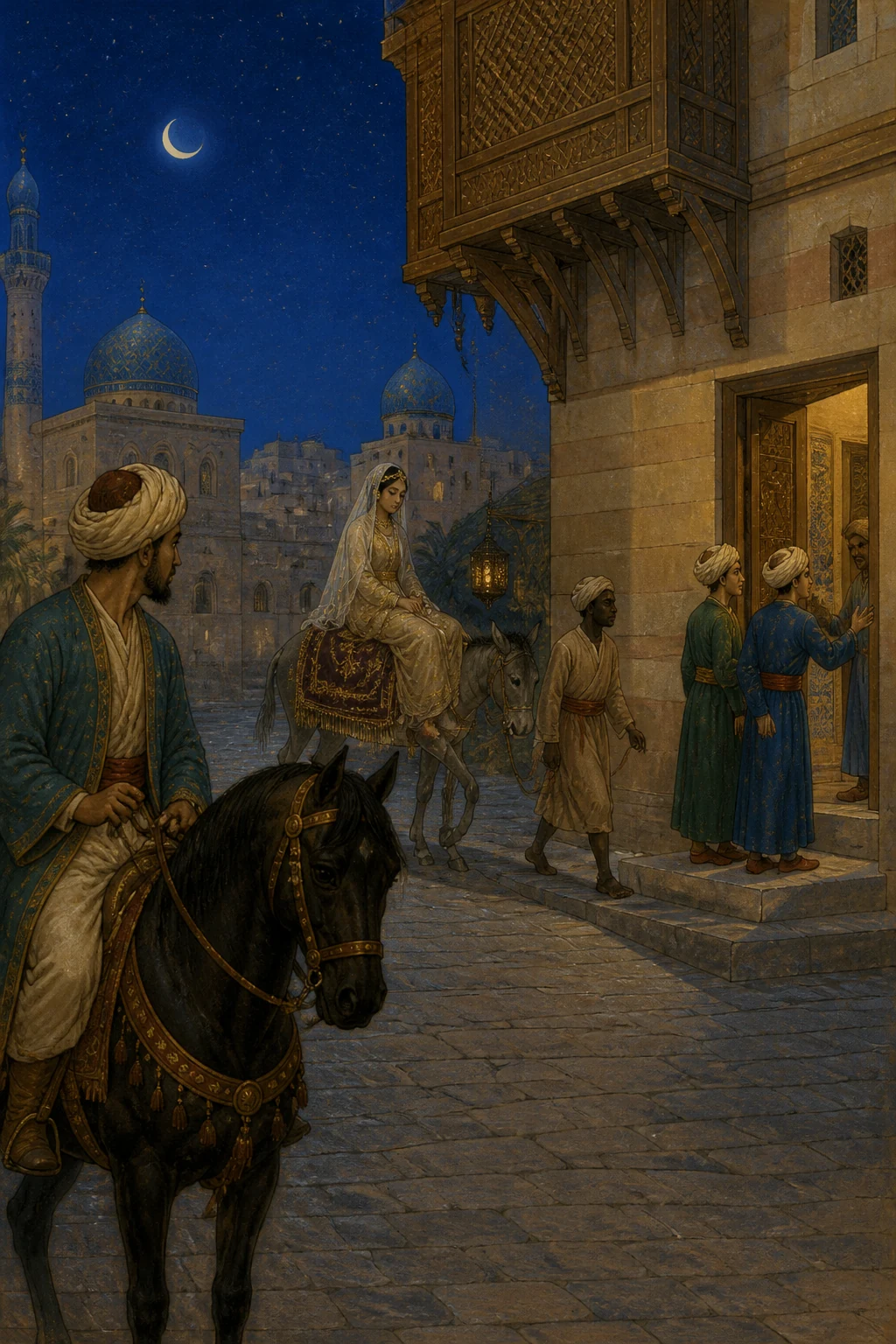
She said: “It has reached me, O fortunate King, that when the young man lost his purse, he said: ‘I said to myself, “Your very soul has left you, and your money is lost.” My distress grew worse, and I went to the Tigris, drew my robe over my face, and threw myself into the water. Those who were there saw me and said, “Some terrible sorrow must have befallen him.” They flung themselves in after me, brought me out, and asked what had happened. I told them my story, and they were grieved for me. Then an old man among them came to me and said, “Your money is gone; why should you bring about the loss of your soul as well, and become one of the people of Hell? Come with me and show me your home.” I did so, and when we reached my house he sat with me for a while, until my distress had subsided. I thanked him, and he departed. Once he had gone, I nearly killed myself, but I remembered the Hereafter and the Fire, and fled my house to seek out a friend. I told him what had happened to me, and he wept in pity, gave me fifty dinars, and said, “Take my advice and leave Baghdad this very hour. Use this money for your expenses until your heart is diverted from its love for her and you find some consolation. You come from a family of secretaries and scribes; your handwriting is fine, and your learning excellent. Go to whichever official you please and place yourself in his service. Perhaps God will reunite you with your slave girl.” I listened to him, and my resolve grew stronger and some of my sorrow left me. I decided to go to the region of Wasit, for I had relatives there. So I went down to the riverbank and saw a ship lying at anchor, with sailors carrying goods and costly cloth aboard. I asked them to take me with them, but they said, “This ship belongs to a Hashimite, and we cannot take you aboard as you are.” I offered them a tempting fare, and they said, “If you insist, take off those fine clothes you are wearing, put on sailors’ clothes, and sit among us as though you were one of us.” So I went back, bought some sailors’ clothes, put them on, and returned to the ship, which was bound for Basra. I went aboard with them, and scarcely an hour had passed before I saw my very own slave girl, with two slave girls attending her. The anguish within me subsided, and I said to myself, “At least I shall see her and hear her singing all the way to Basra.” Before long the Hashimite rode up with a party of men. They boarded the ship, and she carried them downstream. He had food brought out and ate with the girl, while the others ate amidships. Then the Hashimite said to her, “How long will you refuse to sing and persist in grief and tears? You are not the first to be parted from someone you love!” Then I knew how deeply she still loved me. He had a curtain hung around her in one part of the ship, and summoned the men who were near me to sit with him outside it. I asked who they were, and learned that they were his brothers. Then he had wine and refreshments brought for them, and they kept urging the girl to sing until at last she called for the lute, tuned it, and began to sing these two verses:
“The company bore my beloved away, setting out in the night; they did not scruple to carry my heart’s desire through the darkness. And when their camels had risen and gone, the forsaken lover was left with desert embers blazing in his heart.” Then tears overcame her, and she cast down the lute and broke off her song. The company’s pleasure was spoiled, and I fell senseless. They thought I had suffered a fit, and some of them began reciting sacred verses into my ear. They went on soothing her and asking her to sing until she tuned the lute again and sang these two verses:
“I stood lamenting those who had loaded their beasts and departed; though far away, though gone, they dwell within my heart. I stood among the ruins, asking after them, but the dwelling was deserted, and the houses lay waste.” Then she fell senseless, and the people raised their voices in weeping. I cried out and fainted too, and the sailors began to complain of me. One of the Hashimite’s servants said, “Why did you take this madman aboard?” Then some of them said to the others, “When you come to a village, put him ashore and rid us of him.” This filled me with great distress and bitter anguish, but I mastered myself as best I could, saying in my heart, “There is no way to escape their hands unless I let her know where I am on the ship, so that she will prevent them from putting me ashore.” We sailed on until we came near a village, and the owner of the ship said, “Take us ashore.” The company went up onto the bank, for it was now evening. I rose, went behind the curtain, took up the lute, and changed its tuning from one mode to another, until I played in the mode I had taught her. Then I returned to my place on the ship.’” But morning overtook Shahrazad, and she fell silent, leaving off her permitted tale.
Then, when it was the eight hundred and ninety-eighth night,
She said: “It has reached me, O fortunate King, that the young man said: ‘Then I returned to my place on the ship. Afterward the company came down from the bank and resumed their places aboard. The moonlight had spread over land and water, and the Hashimite said to the girl, “For God’s sake, do not spoil our pleasure.” She took up the lute and tried the strings with her hand, then gave such a gasp that they thought her soul had left her. Then she said, “By God, my teacher is with us on this ship!” The Hashimite replied, “By God, if he were with us, I would not deprive our company of him, for perhaps he could ease your sorrow and let us enjoy your singing. But it is most unlikely that he is aboard.” She said, “I cannot play the lute and turn from melody to melody while my master is with us.” “Shall we ask the sailors?” said the Hashimite. “Do,” she replied. So he asked them, “Have you taken anyone aboard with you?” “No,” they answered. Fearing that the inquiry would end there, I laughed and said, “Yes, I am her teacher. I taught her when I was her master.” She cried, “By God, that is my master’s voice!” The servants came and brought me to the Hashimite. When he saw me, he recognized me and said, “Alas, what has happened to you? What has befallen you, to bring you to this state?” I told him all that had happened and wept, while the girl’s sobbing rose from behind the curtain. The Hashimite and his brothers wept bitterly out of pity for me. Then he said, “By God, I have neither approached this girl nor lain with her, nor have I heard her sing until today. I am a man upon whom God has bestowed abundance. I came to Baghdad only to hear music and claim my stipend from the Commander of the Faithful, and I achieved both aims. When I wished to return to my own country, I said to myself, ‘Let me hear something of Baghdad’s singing,’ and so I bought this girl, not knowing how matters stood between you. Now I call God to witness that, when she reaches Basra, I shall set her free and marry her to you. I shall grant you both an allowance sufficient for your needs and more, on one condition: whenever I wish to hear music, a curtain shall be hung for her, and she shall sing behind it, while you shall be counted among my brothers and boon companions.” I rejoiced at this. Then the Hashimite put his head behind the curtain and said to her, “Does this please you?” She began praying for him and thanking him. He summoned one of his servants and said, “Take this young man by the hand, remove his clothes and dress him in fine garments, perfume him with incense, and bring him back to us.” The servant took me away and did as his master had commanded, then brought me before him. He set wine before me just as he had before the others, and the girl burst into song in the loveliest of melodies, singing these verses:
“They reproached me for shedding tears when my beloved came to bid farewell. They have never tasted parting, nor felt the anguish of grief burn through their ribs as it has through mine. Only the sorrowful know love’s passion, those whose hearts lie stricken among those dwellings.” He said: The company was deeply moved by her song, and the young man’s joy grew greater still. Then he took the lute from the girl, played the sweetest melodies upon it, and sang these verses:
“If you seek a favour, seek it from a generous man who has always known wealth and ease. To ask of the noble brings honour; to ask of the base brings shame. And if humiliation cannot be avoided, then bear it only when asking of the great. To honour the noble is no abasement; abasement lies in honouring the low.” “The company delighted in me, and their joy grew greater. We continued in merriment and pleasure, with the girl and me taking turns to sing, until we came to a stretch of shore where the ship cast anchor. Everyone aboard went ashore, and I went too. I was drunk, and sat down to relieve myself, but sleep overcame me and I slept. The passengers returned to the ship, and she carried them downstream. They did not notice my absence, for they too were drunk. I had given my travelling money to the girl, and nothing remained with me. They reached Basra, while I did not wake until the sun’s heat roused me. I rose and looked about, but saw no one. I had forgotten to ask the Hashimite his name, where his house was in Basra, or how he was known. I stood bewildered, and all the joy I had known in finding the girl seemed like a dream. I remained at a loss until a large vessel passed me. I went aboard and reached Basra, but I knew no one there, nor did I know the Hashimite’s house. So I went to a grocer and obtained an inkwell and a sheet of paper.” But morning overtook Shahrazad, and she fell silent, leaving off her permitted tale.
Then, when it was the eight hundred and ninety-ninth night,
She said: “It has reached me, O fortunate King, that when the man from Baghdad, the slave girl’s master, entered Basra, he was bewildered, knowing neither anyone there nor the Hashimite’s house. He said: ‘I went to a grocer, obtained an inkwell and a sheet of paper, and sat down to write. He admired my handwriting, but noticed that my clothes were dirty, and asked about my circumstances. I told him that I was a poor stranger. He said, “Will you stay with me and keep the accounts of my shop, for half a dirham a day, with your food and clothing?” “Yes,” I replied. So I stayed with him, put his affairs in order, and managed his income and expenditure. After a month he saw that his income had increased and his expenses had fallen, and he thanked me and raised my pay to a dirham a day. When a year had passed, he invited me to marry his daughter and become his partner in the shop. I agreed, consummated my marriage, and devoted myself to the shop, though my heart and spirit remained broken and my sorrow was plain to see. The grocer used to drink wine and invite me to join him, but I refused out of grief. I continued in this state for two years. One day, while I was in the shop, a party of people passed with food and wine. I asked the grocer what was happening, and he said, “This is the day of the pleasure-seekers, when lovers of music and amusement and wealthy young men go down to the water to eat and drink among the trees along the River Aylah.” I felt a desire to go and see the festivities, and said to myself, “Perhaps, if I go among these people, I may meet the one I love.” So I told the grocer, “I should like to go.” “You are free to go with them,” he said. Then he prepared food and wine for me, and I set out until I reached the River Aylah. The people were already leaving, and I was about to return with them when I saw the very captain of the ship that had carried the Hashimite and the girl, making his way along the River Aylah. I called out to them, and he and those with him recognized me and took me aboard. “Are you still alive?” they cried. They embraced me and asked for my story, and I told them. “We thought you had been overcome by drink and drowned in the water,” they said. I asked them about the girl, and they replied, “When she learned that you were missing, she tore her clothes, burned the lute, and gave herself up to beating her face and wailing. When we returned with the Hashimite to Basra, we said to her, ‘Leave off this weeping and sorrow.’ But she said, ‘I shall wear black and have a grave made for me beside this house. I shall keep vigil at that grave and renounce singing.’ We allowed her to do so, and she remains in that state to this day.
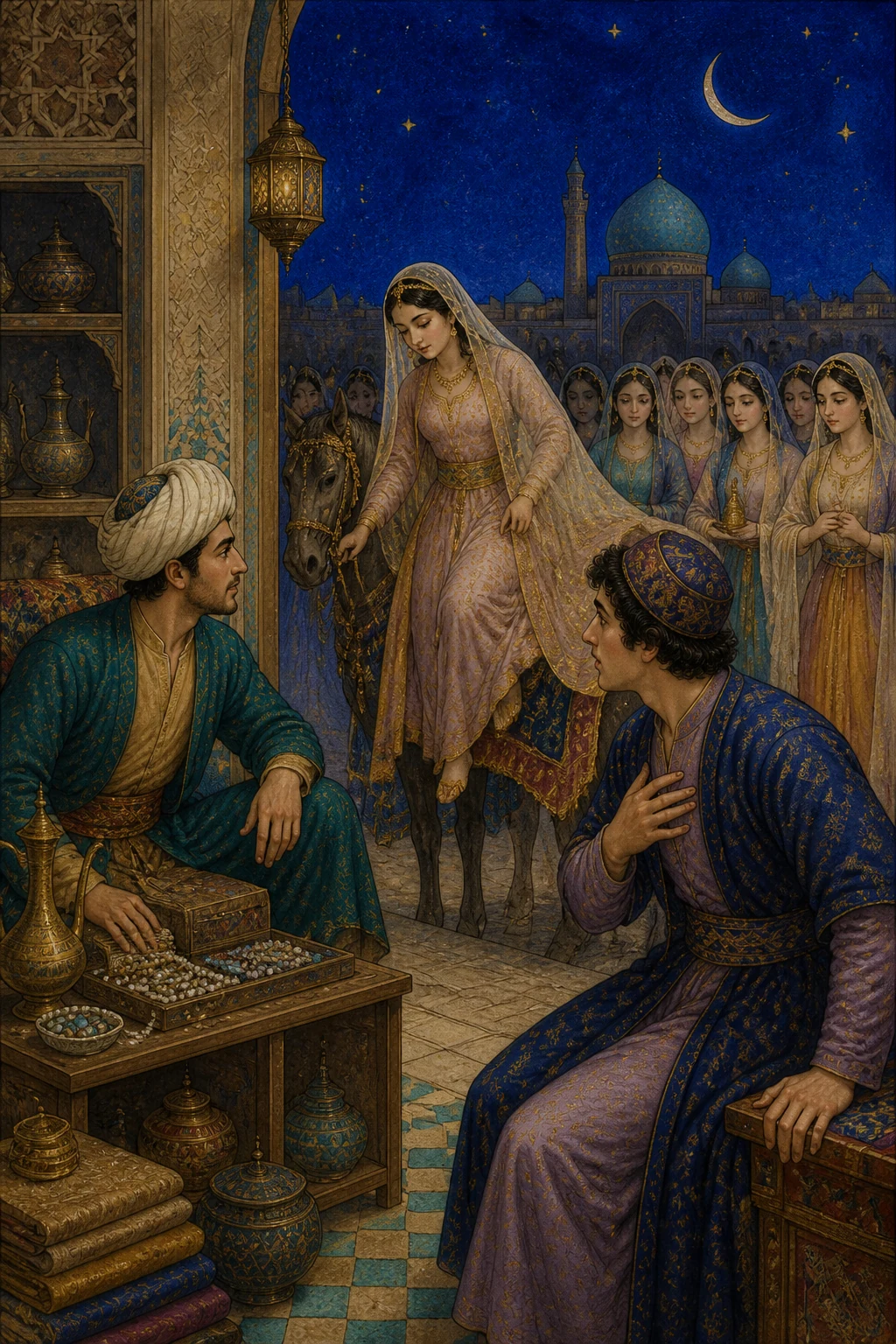
“Then they took me with them, and when I reached the house I found her as they had described. When she saw me, she gave such a great gasp that I thought she had died. I held her in a long embrace, and then the Hashimite said to me, ‘Take her.’ ‘Gladly,’ I replied, ‘but set her free as you promised, and marry her to me.’ He did so, and gave us precious belongings, many garments, bedding, and five hundred dinars, saying, ‘This is the sum I intend to allow you every month, on condition that you keep me company over wine and let me hear the girl sing.’ Then he set aside a house for us and ordered everything we needed to be taken there. When I went to it, I found it filled with furnishings and fine fabrics, and the girl was brought there. Then I went to the grocer, told him everything that had happened, and asked him to release me from any blame for divorcing his daughter through no fault of hers. I paid her her marriage due and all that I owed her. I remained with the Hashimite on these terms for two years and became a man of great wealth. The girl and I regained the prosperity we had once enjoyed in Baghdad. God the Generous relieved our distress, showered His abundant blessings upon us, and made the outcome of our patience the fulfilment of our desire. To Him be praise at the beginning and the end. And God knows best.”